

UPSC Mains · Optional Subject
Geography Optional for UPSC: Complete Notes (Paper I & II)
Free, chapter-wise notes for every unit of Geography Optional, arranged exactly as the UPSC syllabus runs: Paper I (Principles of Geography) and Paper II (Geography of India), with topic-wise PYQs for each unit and PDFs for offline revision.
- 20 units
- 490+ free notes
- PYQs 2013–2026
- PDFs for revision
Go beyond the free notes
- Mains Master KitMost popular
Complete Notes PDF (worth ₹1,180), revision notes, tests and 12 months of premium₹1,770 - 300+ Score Pack
820 solved PYQ model answers, 2013–2026₹1,770 - Complete Notes (PDF)
Both papers as 20 printable books₹1,180
Compare all three · One-time payment, instant access
LotusArise IAS courses
Geography Optional courses for UPSC Mains 2027
The free notes take you through the syllabus. These three take you to the score: printable books for revision, a complete self-study system, and 820 solved PYQs to master answer writing.
Printable books
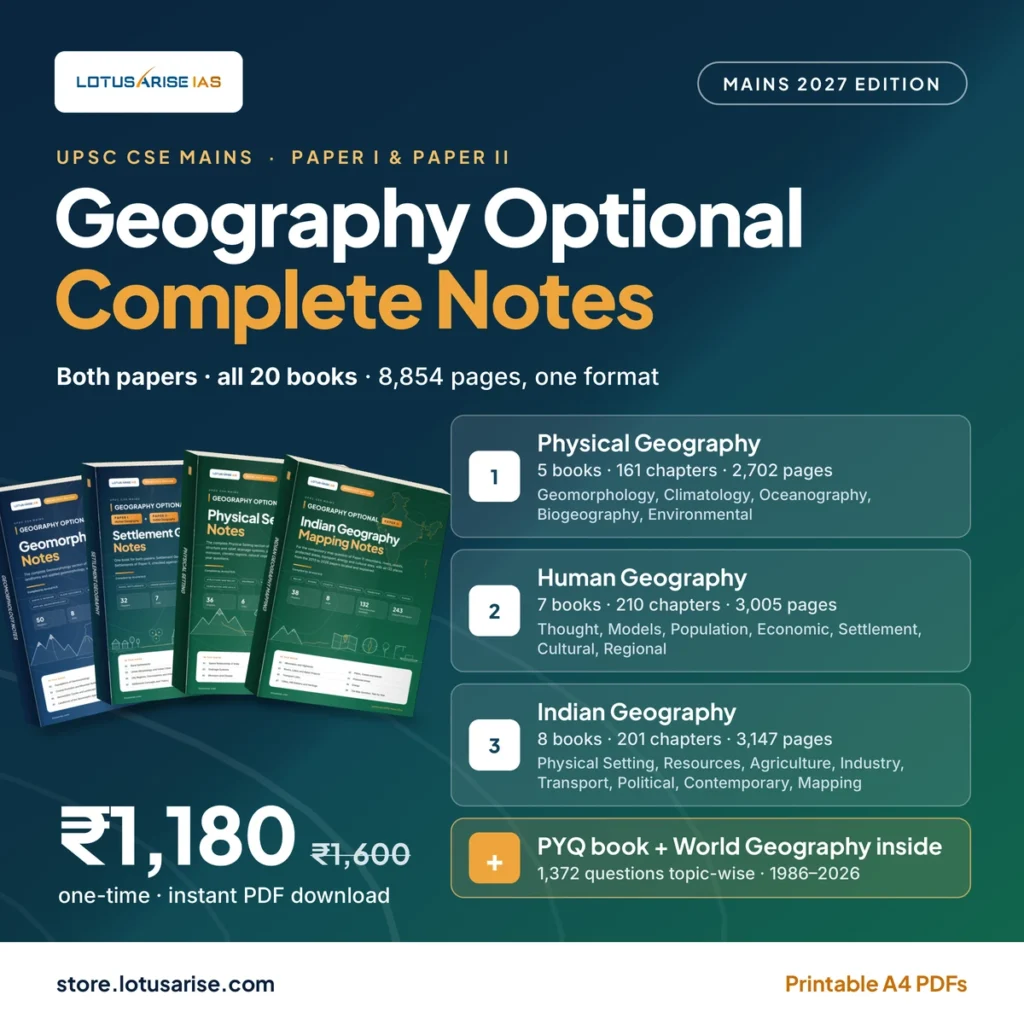
Geography Optional Complete Notes (PDF)
Both papers as 20 books, Mains 2027 edition.
- 572 chapters across 20 books, covering all 20 units
- 1,372 topic-wise PYQs, updated to Mains 2026
- All 132 map-question places from 2013 to 2026, explained
- 2,749 diagrams; read offline, print, no expiry
₹1,180 ₹1,600 Save ₹420
2,600+ Geography Optional PDFs sold
Or buy by part: Physical ₹413 · Human ₹471 · Indian ₹590
Most popular

Geography Optional Mains Master Kit
The complete self-study system for Paper I and Paper II.
- Complete Notes PDF worth ₹1,180 for Paper I and Paper II
- Revision notes for quick, exam-ready revision
- Topic-wise test series questions in the UPSC pattern
- 12 months of premium article access
- Mobile, laptop and tablet, with offline downloads
₹1,770 ₹5,000 Save ₹3,230
Includes the ₹1,180 Complete Notes, so the revision notes, tests and 12 months of premium cost just ₹590 more.
Chosen by 950+ aspirants · 12 months’ validity
For answer writing

Geography Optional 300+ Score Pack
Learn to write what UPSC rewards, question by question.
- 820 solved PYQ model answers, 2013 to 2026
- All 20 units of Paper I and Paper II, topic-wise
- 20 PYQ pattern and strategy reports, one per unit
- Diagrams and maps drawn inside the answers
₹1,770 ₹2,500 Save ₹730
150+ aspirants enrolled · 500 days of access
One-time payment · Instant access after purchase · Phone, laptop and tablet · 3,00,000+ aspirants read LotusArise IAS every month
Which one is right for you?
| What you get | Complete Notes (PDF) | Mains Master Kit | 300+ Score Pack |
|---|---|---|---|
| Best for | Revising from printable books | Studying the full syllabus in one system | Writing answers that score |
| Notes for Paper I and II | 20 books, 572 chapters | Complete Notes PDF (worth ₹1,180) | — |
| Practice | 1,372 topic-wise PYQs | Topic-wise test series questions | 820 solved PYQ model answers |
| Revision notes | — | Included | — |
| Also includes | Mapping book: 132 map places | 12 months of premium articles | 20 PYQ pattern and strategy reports |
| Access | Unlimited downloads, no expiry | 12 months | 500 days |
| Price | ₹1,180 | ₹1,770 | ₹1,770 |
Best pair: the Mains Master Kit tells you what to study, and the 300+ Score Pack shows you how to write it. Together they cover both halves of the paper.
What is Geography Optional in UPSC?
Geography is one of the optional subjects you can choose for the UPSC Civil Services Main Examination, and it has long been one of the most popular. You write two papers of 250 marks each, so the optional decides 500 of the 1,750 marks in the written Mains.
It also pays off beyond the optional. Large parts of the syllabus overlap with GS Paper I (physical, world and Indian geography), GS Paper III (environment, disasters, agriculture and infrastructure), the Essay paper and Prelims, so one round of preparation serves several papers. Every unit below follows the official Geography Optional syllabus line by line, so you can tick off topics as you finish them.
Geography Optional at a glance
| Paper I | Principles of Geography: Section A, Physical Geography; Section B, Human Geography |
| Paper II | Geography of India |
| Marks | 250 per paper, 500 in all |
| Time | 3 hours per paper |
| Questions | 8 per paper; answer 5. Q1 and Q5 are compulsory, and at least one more must come from each section |
| Map question | Paper II, Q1: mark places on an outline map of India and write their significance in about 30 words each (20 marks) |
| Units | 10 in Paper I (5 physical, 5 human) and 10 in Paper II |
Start here
How to study Geography Optional: the order that works
Twenty units look heavy until you take them in the right order. This sequence builds each unit on the one before it and keeps answer writing running from the first week.
- Read the syllabus against recent papers. Before opening a note, go through the last five years of Geography Optional question papers to see how UPSC frames each unit.
- Begin Paper I with Geomorphology and Climatology. They form the base of Section A: the forces, circulation patterns and cycles you learn here return in Oceanography, Biogeography and Environmental Geography.
- Move to Human Geography theory. Take Perspectives in Human Geography, then Models, Theories and Laws, then Economic Geography. Learn every model with its diagram and its criticism; Section B rewards both.
- Study the overlapping units once, for both papers. Population and Settlement Geography (Paper I) runs with Cultural Setting and Settlements (Paper II), and Regional Planning (Paper I) runs with Regional Development and Planning (Paper II).
- Cover Paper II with an atlas open. Physical Setting, Resources, Agriculture and Industry supply the map question and most India examples, so mark every place as you read and revise them with an Indian Geography mapping list.
- Keep Political Aspects and Contemporary Issues current. Both units draw on recent events, so add examples through the year instead of studying them once.
- Write answers from week one. After each unit, attempt its topic-wise PYQs under time: about 7 minutes for a 10-mark answer and 11 for a 15-mark answer. Check your structure against toppers’ answer copies, the answer-writing tips and the 820 solved answers in the 300+ Score Pack.
Jump to a unit · Paper I
- Geomorphology
- Climatology
- Oceanography
- Biogeography
- Environmental Geography
- Perspectives in Human Geography
- Economic Geography
- Population and Settlement Geography
- Regional Planning
- Models, Theories and Laws
Jump to a unit · Paper II
Paper I: Principles of Geography (Notes)
Section A covers Physical Geography and Section B covers Human Geography. Within each unit, notes are listed in the order to study them.
Section A · Physical Geography
Geomorphology
- Nature, Scope and Fundamental Concepts of Geomorphology New
- Universe and Solar System Planets
- Theories of Origin of the Earth
- Latitude and Longitude, Standard Time Zones
- Geological Time Scale
- Interior of the Earth: Core, Mantle and Crust
- Discontinuities Inside the Earth
- Seismic Waves and Earth’s Interior
- Geomagnetism and Geomagnetic Reversal
- Factors Controlling Landform Development New
- Endogenic Forces: Epeirogenic and Orogenic Movements
- Exogenic Forces: Denudation and Weathering
- Weathering and Mass Movement New
- Earth Movements, Folds, Faults, Nappes and Structural Landforms New
- Landforms: Types of Mountains, Plateaus and Plains New
- Geosyncline Theory
- Continental Drift Theory
- Isostasy and Theories of Isostasy
- Seafloor Spreading Theory
- Plate Tectonics Theory
- Theories of Mountain Building
- Recent Views on Mountain Building
- Volcanism and Volcanic Landforms
- Earthquakes: Causes and Effects
- Tsunami: Causes and Warning Systems
- Theories of Landform Development: Gilbert, Hack, Morisawa and Schumm New
- Geomorphic Cycles and Davis’s Cycle of Erosion
- Penck’s Model of the Cycle of Erosion
- Rejuvenation and Polycyclic Landforms New
- Denudation Chronology
- Erosion Surfaces: Peneplains, Pediplains and Panplains
- Slope Elements and Slope Development
- L.C. King’s Model of Slope Development
- Alan Wood’s and Strahler’s Views on Slope Development
- Drainage Basin: Concept, Patterns, Morphometry and Evolution New
- River Valleys, Graded River and Profile of Equilibrium New
- Channel Morphology
- Fluvial Landforms
- Marine (Coastal) Landforms
- Karst Landforms
- Cave and Spring Deposits in Karst Topography New
- Glacial Landforms
- Periglacial Landforms
- Desert (Arid) Landforms
- Lakes and Types of Lakes New
- Climatic Geomorphology and Morphogenetic Regions New
- Quaternary Geomorphology and Pleistocene Glaciation New
- Applied Geomorphology
- Anthropogenic and Environmental Geomorphology New
Practise it for marks: solved Geomorphology PYQs from 2013 to 2026, with diagrams, are in the 300+ Score Pack.
Climatology
- Climatology: Comprehensive Overview
- Origin of the Atmosphere
- Composition and Structure of the Atmosphere
- Heat Budget of the Earth
- Temperature Belts of the Earth
- Temperature Inversion: Types and Effects on Weather
- Pressure Belts of the Earth
- Forces Controlling Wind: Pressure Gradient, Coriolis Force and Friction New
- Winds and Types of Wind
- Local Winds of the World New
- General Circulation of the Atmosphere: Tricellular Model, Rossby Waves and Walker Circulation New
- Jet Streams
- Origin of Monsoon: Classical to Modern Theories New
- Atmospheric Stability and Instability New
- Humidity, Evaporation and Condensation New
- Clouds and Types of Clouds
- Precipitation: Types of Precipitation and Rainfall
- Hydrological Cycle New
- Air Masses and Source Regions
- Fronts and Types of Fronts
- Tropical Cyclones
- Thunderstorms, Tornadoes and Waterspouts New
- Temperate (Extratropical) Cyclones
- Köppen Climate Classification
- Thornthwaite Climatic Classification
- Trewartha Climatic Classification
- Climatic Regions of the World
- Climatic Change: Evidence, Past Climates and Causes New
- Global Warming and Man’s Role in Climatic Change New
- Applied Climatology and Urban Climate New
- Aurora Borealis and Aurora Australis
Practise it for marks: solved Climatology PYQs from 2013 to 2026, with diagrams, are in the 300+ Score Pack.
Oceanography
- Oceanography: Syllabus, Topic Map and PYQ Trends
- Nature of Oceanography
- Origin of Ocean Basins
- Ocean Morphology and Bottom Relief
- Ocean Relief Features
- Bottom Topography of the Atlantic Ocean
- Bottom Topography of the Pacific Ocean
- Bottom Topography of the Indian Ocean
- Temperature Distribution of the Oceans
- Salinity of Ocean Water
- Density of Ocean Water, Water Masses and the T-S Diagram New
- Heat and Salt Budgets of the Oceans New
- Ocean Deposits: Terrigenous and Pelagic Sediments New
- Ocean Waves
- Tides
- Ocean Currents
- Ocean Currents of the Atlantic, Pacific and Indian Oceans New
- Thermohaline Circulation and the AMOC New
- El Niño, La Niña and ENSO
- Ocean (Marine) Resources
- Coral Reefs and Coral Bleaching
- Theories of Origin of Coral Reefs
- Sea-Level Changes
- Ocean Issues and Threats
- Marine (Ocean) Pollution
- UNCLOS: United Nations Convention on the Law of the Sea
Practise it for marks: solved Oceanography PYQs from 2013 to 2026, with diagrams, are in the 300+ Score Pack.
Biogeography
- Biogeography: Definition, Scope and Development
- Soil Genesis: Soil-Forming Processes and Factors
- Soil Properties: Physical, Chemical and Biological
- Soil Profile (Soil Horizons)
- Soil Classification and World Distribution of Soils
- Soil Erosion, Degradation and Conservation
- Plant Communities, Ecological Classification of Plants and Plant Succession New
- World Distribution of Plants and Animals
- Factors Influencing the Distribution of Plants and Animals
- Biogeographic Realms and Regions
- Dispersal, Migration and Barriers New
- Island Biogeography and Patterns of Species Richness New
- Biodiversity and Endemism
- Problems of Deforestation and Conservation Measures
- Social Forestry and Agroforestry
- Wildlife: Problems and Conservation
- Major Gene Pool Centres
- Human Impacts, Habitat Fragmentation and Landscape Connectivity
- Biogeography of Climate Change
- Climate Change Impacts on Species Distributions
- Climate Change, Range Shifts and Biogeographic Responses
- Climate Change and Biogeography: Implications and Strategies
Practise it for marks: solved Biogeography PYQs from 2013 to 2026, with diagrams, are in the 300+ Score Pack.
Environmental Geography
Read this unit alongside the GS Environment and Ecology notes and keep adding recent examples; answers here gain a lot from current data.
- Environmental Geography: Nature, Scope and Human–Environment Paradigms
- Man–Environment Relationship
- Determinism, Possibilism and Neo-Determinism
- Marxian View on the Environment
- Social Production of Nature
- Deep Ecology vs Shallow Ecology New
- Fundamental Concepts and Principles of Ecology
- Ecosystem: Structure, Functions, Energy Flow and Biogeochemical Cycles New
- Biomes of the World
- Mountain Ecosystems and High-Altitude Hazards New
- Human Ecological Adaptations
- Ecological Adaptive Processes: Kinds of Adaptations
- Cultural Adaptation of Humans
- Influence of Man on Ecology and Environment
- Global and Regional Ecological Changes and Imbalances
- Ecosystem Management and Conservation
- Environmental Degradation
- Environmental Impacts of Large Dams and Mining New
- Environmental Management
- PAVE Theory of Environmental Management New
- Environmental Conservation
- Biodiversity and Sustainable Development
- Conservation Measures of Biodiversity
- Gender and Biodiversity in India
- Human–Wildlife Conflict New
- Environmental Policy in India
- Carbon Neutrality and Net Zero New
- Environment and Human Health New
- Environmental Hazards and Remedial Measures
- Environmental Impact Assessment: Methods and Techniques
- Social Impact Assessment: Methods and Techniques
- Environmental Education in India
- Environmental Legislations in India
- Environmental Legislation in India: Quick Revision
Practise it for marks: solved Environmental Geography PYQs from 2013 to 2026, with diagrams, are in the 300+ Score Pack.
Geography Optional Complete Notes (PDF)
Finished Physical Geography? Keep all of it as printable books.
All 20 units of Paper I and Paper II in 20 books: 572 chapters, 1,372 topic-wise PYQs, 2,749 diagrams and every map-question place from 2013 to 2026.
One-time payment · Unlimited downloads · Printable
Section B · Human Geography
Perspectives in Human Geography
- Meaning, Definition, Aims and Purpose of Geography
- Evolution of Geographical Thought
- Paradigms and Paradigm Shifts in Geography New
- Contribution of Greek Scholars
- Contribution of Roman and Ancient Chinese Geographers New
- Contributions of Arab Geographers
- Impact of Voyages, Discoveries and the Renaissance
- Geographical Thinking of Varenius and Kant
- Contributions of Humboldt and Carl Ritter
- Impact of Darwinism on Geographical Thought New
- German School of Geographical Thought
- French School of Geographical Thought
- British School of Geographical Thought
- American School of Geographical Thought
- Russian School of Geographical Thought
- Evolution of Geographical Thought in India
- Approaches to Geography: Systematic and Regional
- Regional Geography vs Systematic Geography
- Dichotomy and Dualism
- Areal Differentiation
- Regional Synthesis
- Hartshorne vs Schaefer Debate
- New Regional Geography New
- Spatial Organisation
- Space, Place and the Socio-Spatial Dialectic New
- Environmentalism
- Neo-Determinism and Probabilism
- Quantitative Revolution
- Criticism of Quantification in Geography
- Locational Analysis
- Time Geography: Hägerstrand’s Space-Time Paths New
- Critical Revolution
- Behavioural Approach
- Humanistic Approach
- Radical Approach
- Welfare Approach
- Welfare Geography vs Humanistic Geography
- Postmodern and Feminist Geography New
- Cultural Regions of the World
- Culture, Cultural Change and Globalisation New
- Languages, Religions and Secularisation
- Human Development Index
- Social Well-Being and Human Development
Practise it for marks: solved Perspectives in Human Geography PYQs from 2013 to 2026, with diagrams, are in the 300+ Score Pack.
Economic Geography
- Economic Geography: Evolution and Approaches
- Themes in Economic Geography
- Spatial Concepts: Space, Place and Scale
- Major Theoretical Perspectives in Economic Geography
- Geographical Bases of Economic Activities
- Sectors of the Economy: Primary, Secondary and Tertiary
- World Economic Development: Measurement and Problems
- Problems in World Economic Development
- World Resources and Their Distribution
- Distribution of Key Natural Resources across the World
- Global Water Scarcity New
- Energy Crisis
- Energy Transition and Energy Security New
- Limits to Growth Model
- World Agriculture: Typology of Agricultural Regions
- Plantation Agriculture New
- Dryland Farming and Protected Cultivation New
- World Fisheries New
- Agricultural Inputs and Productivity
- Food and Nutrition Problems
- Food Security
- Famine: Causes and Effects
- World Industries: Locational Patterns and Problems
- World Industrial Regions
- Global Shift in Manufacturing New
- The New International Division of Labour (NIDL)
- Patterns of World Trade
- The New Economic Geography (NEG)
- Colonialism, Neo-Colonialism and Lebensraum
Practise it for marks: solved Economic Geography PYQs from 2013 to 2026, with diagrams, are in the 300+ Score Pack.
Population and Settlement Geography
Study this unit together with Cultural Setting and Settlements in Paper II: one set of notes serves both papers.
Population Geography
- Definition and Core Areas of Population Geography
- Development of Population Geography
- Development of Population Geography in India
- Pre-Malthusian Perspectives on Population
- Growth and Distribution of World Population
- Population Distribution in the World
- Population Density and Density Zones
- Factors Influencing Population Distribution and Density
- Population Growth in India
- Population Distribution and Density in India
- Demographic Attributes
- Fertility: Measures and Determinants
- Mortality: Measurements, Trends and Patterns
- Age Composition of the Population
- Population Ageing: Dependency Ratio and Longevity New
- Sex Composition and the Age-Sex Pyramid
- Economic Composition and Work Participation Rate
- Religion: Concept, Determinants and Spatial Patterns
- Caste and Tribe Composition: Concept and Spatial Patterns
- World Migration: Causes and Consequences
- Measurements, Trends and Patterns of Migration
- Theories of Migration
- Migration in India
- Over, Under and Optimum Population
- Optimum Population Theory
- Neo-Malthusian Theory
- Epidemiological and Health Transition Theory
- Health Indicators and Population Problems New
- Ackerman’s Population-Resource Regions
- Social Well-Being and Quality of Life
- Population as Social Capital
Settlement Geography (Paper I and Paper II)
These notes also cover Settlements in Paper II, so read them once and write for both papers.
- The Settlement: Meaning, Nature and Concept
- Origin and Growth of Settlements
- Settlement Geography: Concept, Evolution and Approaches
- Theories of the Evolution of Human Settlements
- Classification of Settlements
- Rural Settlement and Urban Settlement
- Rural-Urban Distribution of Population
- Morphology of Rural Settlement
- Types of Rural Settlement
- Patterns of Rural Settlement
- Social Morphology of Rural Settlements in India
- Environmental Issues in Rural Settlement
- Urban Morphology and Its Theories
- Urban Morphology of Indian Cities
- Hierarchy of Urban Settlements
- Classification of Urban Settlements
- Primate City and Rank-Size Rule
- Rural-Urban Fringe
- Sphere of Urban Influence
- Functional Classification of Towns and Cities
- Central Place Theory of Christaller and Lösch
- Conurbations and Metropolitan Regions
- Satellite Towns
- Urban Sprawl: Causes and Impacts
- Contemporary Urban Geography Terminology
- Slums: Development and Associated Problems
- Urbanisation: Trends and Patterns
- Problems and Remedies of Urbanisation
- Sustainable Development of Cities
- Town Planning in India: Master Plans, New Towns and Smart Cities
Practise it for marks: solved Population and Settlement Geography PYQs from 2013 to 2026, with diagrams, are in the 300+ Score Pack.
Regional Planning
These notes cover both Regional Planning (Paper I) and Regional Development and Planning (Paper II).
- Concept of Region
- Types of Regions
- Methods of Regionalisation
- Growth Centres and Growth Poles
- Regional Imbalances
- Theories of Regional Imbalance
- Regional Development Strategies
- Environmental Issues in Regional Planning
- Planning for Sustainable Development
- Planning as a Tool to Reduce Regional Imbalance
- Experience of Regional Planning: Five Year Plans
- Backward Area Planning
- Hill Area Development
- Drought Prone Area Development
- Tribal Area Development
- Regional Planning and Development of Island Territories
- Integrated Rural Development Programme
- Command Area Development
- Watershed Management
- Multi-Level and Decentralised Planning
- Inclusive Regional Development: Gender and Displacement
- Backwash Effects
- Planning Regions of India
- Aspirational Districts and Blocks Programmes
- Desert Development Programme
- Economic Planning in India and NITI Aayog
- Five Year Plans in India
Practise it for marks: solved Regional Planning PYQs from 2013 to 2026, with diagrams, are in the 300+ Score Pack.
Models, Theories and Laws
- Systems Analysis in Geography
- Malthusian Theory of Population
- Marxian Theory of Population
- Demographic Transition Theory
- Central Place Theories of Christaller and Lösch
- Von Thünen’s Model of Agricultural Location
- Weber’s Model of Industrial Location
- Heartland and Rimland Theories
- Growth Pole Theory: Perroux and Boudeville
- Rostow’s Stages of Growth
- Laws of International Boundaries and Frontiers
- Organic State Theory (Ratzel)
- Influence of Sea Power (Mahan)
- Classical and Contemporary Location Theories
- Models in Geography
- Gravity Model in Geography
Practise it for marks: solved Models, Theories and Laws PYQs from 2013 to 2026, with diagrams, are in the 300+ Score Pack.
Geography Optional 300+ Score Pack
Reading notes covers half the paper. Writing answers covers the rest.
820 solved PYQ model answers from 2013 to 2026 across all 20 units, each with an introduction, argument flow, diagrams and a conclusion, plus 20 PYQ pattern and strategy reports, one per unit.
₹2.16 per model answer · 500 days of access · 150+ aspirants enrolled
Paper II: Geography of India (Notes)
Ten units on India’s physical setting, economy, society and regional issues. Question 1 is always the map question, so read these with a map of India beside you.
Physical Setting
- India’s Geographical Extent and Frontiers
- Rock Systems of India: Archaean, Purana, Dravidian and Aryan
- Formation and Structure of the Himalayas
- Himalayan Ranges: Greater, Middle and Shiwaliks
- Longitudinal Divisions of the Himalayas
- Mountain Passes of India
- Important Hill Ranges of India
- List of Mountain Ranges in India
- Indo-Gangetic-Brahmaputra Plains
- Peninsular Plateau (Deccan Plateau)
- Western and Eastern Ghats
- Western and Eastern Coastal Plains
- Coastline of India
- Islands of India: Andaman and Nicobar, Lakshadweep
- Drainage Systems of India
- Ganga River System
- Yamuna River System
- Brahmaputra River System
- Indus River System
- Mahanadi River System
- Godavari River System
- Krishna River System
- Cauvery (Kaveri) River System
- East-Flowing Rivers
- West-Flowing Rivers: Narmada, Tapi and Others
- Mechanism of the Indian Monsoon
- Tropical Cyclones
- Western Disturbances
- Floods
- Droughts
- Climatic Regions of India
- Köppen’s Classification of India’s Climatic Regions
- Natural Vegetation of India
- Soil Types and Their Distribution
- Important Glaciers in India
- Types of Glaciers
- Important Tribes of India
Practise it for marks: solved Physical Setting PYQs from 2013 to 2026, with diagrams, are in the 300+ Score Pack.
Resources
- Iron Ore Distribution in India
- Manganese Ore Distribution in India
- Copper, Nickel and Chromite Distribution in India
- Bauxite Distribution in India
- Lead, Zinc, Tungsten and Pyrites Distribution in India
- Uranium and Thorium Distribution in India
- Gold and Silver Distribution in India
- Diamond and Graphite Distribution in India
- Non-Metallic Minerals: Mica, Limestone, Dolomite and Others
- Coal Reserves in India
- Natural Gas Reserves in India
- Petroleum Reserves in India
- Hydroelectric Power
- Wind Energy
- Solar Energy
- Geothermal Energy
- Ocean Energy
- Biomass Energy
- Energy Crisis
- Land Resources of India
- Water Resources in India
- Important Canals in India
- Forest Resources in India
- Wildlife Resources in India
- Biotic and Marine Resources
Practise it for marks: solved Resources PYQs from 2013 to 2026, with diagrams, are in the 300+ Score Pack.
Agriculture
- Salient Features of Indian Agriculture
- Determinants of Agriculture
- Irrigation
- Seeds
- Fertilisers
- Farm Power (Energy)
- Landholdings, Land Tenure and Land Reforms
- Cropping Systems
- Cropping Pattern
- Cropping Intensity
- Crop Classification
- Crop Combination
- Agricultural Productivity and Efficiency
- Land Capability
- Social Forestry and Agroforestry
- Green Revolution
- White Revolution
- Blue Revolution
- Sericulture
- Apiculture
- Horticulture
- Poultry Farming
- Dryland and Rainfed Agriculture
- Agricultural Regionalisation
- Agro-Climatic Zones of India
- Agro-Ecological Regions of India
- Agro-Biodiversity Hotspots in India
Practise it for marks: solved Agriculture PYQs from 2013 to 2026, with diagrams, are in the 300+ Score Pack.
Industry
- Evolution of Industries in India
- Locational Factors of Industries
- Classification of Industries
- Major Industries in India
- Cotton Textile Industry
- Jute Industry
- Iron and Steel Industry
- Aluminium Industry
- Automobile Industry
- Fertiliser Industry
- Paper Industry
- Sugar Industry
- Chemical and Allied Industries
- Drugs and Pharmaceuticals Industry
- Small-Scale and Cottage Industries
- Industrial Houses
- Industrial Complexes
- Industrial Regions of India
- Economic Planning, Planning Commission and NITI Aayog
- Five Year Plans
- Liberalisation, Privatisation and Globalisation
- Public Sector Reforms
- Disinvestment
- Multinational Companies in India
- Special Economic Zones
- Tourism, Including Eco-Tourism
Practise it for marks: solved Industry PYQs from 2013 to 2026, with diagrams, are in the 300+ Score Pack.
Transport, Communication and Trade
- Road Transport
- Railways
- Ports and Waterways
- Major Sea Ports in India
- National Waterways in India
- Ports and the Sagarmala Project
- Airways
- Pipelines
- Export Processing Zones
- Balance of Trade
- Foreign Trade Policy of India
- Developments in Communication and IT
- Indian Space Programme
Practise it for marks: solved Transport, Communication and Trade PYQs from 2013 to 2026, with diagrams, are in the 300+ Score Pack.
Cultural Setting
- Historical Perspective of Indian Society
- Racial, Linguistic and Ethnic Diversity in India
- Racial Groups of India
- Linguistic Diversity in India
- Religious Minorities in India
- Important Tribes of India
- Tribal Areas and Their Problems
- Culture: Meaning, Types, Aspects and Hierarchy
- Major Cultural Regions of the World
- Cultural Regions of India
- Ravenstein’s Laws of Migration (with Reference to India)
- Population Policy: Rationale and Elements
- Population Policy of India
- Literacy and Educational Attainment
- Caste and Tribe Composition
- Religious Composition
Practise it for marks: solved Cultural Setting PYQs from 2013 to 2026, with diagrams, are in the 300+ Score Pack.
Settlements
Settlements in Paper II is studied together with Settlement Geography in Paper I; the same 30 notes cover both papers.
Regional Development and Planning
Regional Development and Planning in Paper II is studied together with Regional Planning in Paper I; the same 27 notes cover both papers.
Political Aspects
Questions in this unit lean heavily on current events, so keep adding recent examples to these notes through the year.
- Overview of Political Geography
- Geographical Basis of Indian Federalism
- State Reorganisation in India
- Demand for New States in India
- Regional Consciousness and National Integration
- Inter-State Water Disputes in India
- India’s International Boundaries and Related Issues
- International Water Disputes and Agreements
- Cross-Border Terrorism
- India’s Role in World Affairs
- Geopolitics of South Asia and the Indian Ocean Realm
- Heartland and Rimland Theories
- Organic State Theory (Ratzel)
- Influence of Sea Power (Mahan)
Practise it for marks: solved Political Aspects PYQs from 2013 to 2026, with diagrams, are in the 300+ Score Pack.
Contemporary Issues
- Landslides: Types, Causes, Impact and Remedial Steps
- Earthquakes: Causes and Effects
- Tsunami: Causes and Warning Systems
- Floods: Causes, Impact and Measures
- Drought: Types, Causes and Consequences
- Changes in Land Use Patterns in India
- Environmental Impact Assessment (EIA)
- Deforestation: Problems and Conservation Measures
- Soil Erosion, Degradation and Conservation
- Agrarian and Industrial Unrest
- Regional Disparities in Economic Development
- Sustainable Growth and Development
- Environmental Awareness
- Interlinking of Rivers: Issues and Challenges
- Globalisation and the Indian Economy
- Epidemics in India
- Environmental Pollution
- Environmental Degradation in India
- Population Explosion and Food Security
- Food Security
Practise it for marks: solved Contemporary Issues PYQs from 2013 to 2026, with diagrams, are in the 300+ Score Pack.
Finished the notes?
Turn these notes into marks
Every unit above is free to read. When you are ready to revise faster, practise in the UPSC pattern and write answers that score, these three are built for it.
Printable books
Geography Optional Complete Notes (PDF)
Both papers as 20 books, Mains 2027 edition.
- 572 chapters across 20 books, covering all 20 units
- 1,372 topic-wise PYQs, updated to Mains 2026
- All 132 map-question places from 2013 to 2026, explained
- 2,749 diagrams; read offline, print, no expiry
₹1,180 ₹1,600 Save ₹420
2,600+ Geography Optional PDFs sold
Or buy by part: Physical ₹413 · Human ₹471 · Indian ₹590
Most popular
Geography Optional Mains Master Kit
The complete self-study system for Paper I and Paper II.
- Complete Notes PDF worth ₹1,180 for Paper I and Paper II
- Revision notes for quick, exam-ready revision
- Topic-wise test series questions in the UPSC pattern
- 12 months of premium article access
- Mobile, laptop and tablet, with offline downloads
₹1,770 ₹5,000 Save ₹3,230
Includes the ₹1,180 Complete Notes, so the revision notes, tests and 12 months of premium cost just ₹590 more.
Chosen by 950+ aspirants · 12 months’ validity
For answer writing
Geography Optional 300+ Score Pack
Learn to write what UPSC rewards, question by question.
- 820 solved PYQ model answers, 2013 to 2026
- All 20 units of Paper I and Paper II, topic-wise
- 20 PYQ pattern and strategy reports, one per unit
- Diagrams and maps drawn inside the answers
₹1,770 ₹2,500 Save ₹730
150+ aspirants enrolled · 500 days of access
One-time payment · Instant access after purchase · Phone, laptop and tablet · 3,00,000+ aspirants read LotusArise IAS every month
Geography Optional: frequently asked questions
Start today
Prepare for Mains 2027 with LotusArise IAS
Free notes for every unit, plus the three tools that turn them into marks.
One-time payment · Instant access · Phone, laptop and tablet · 3,00,000+ aspirants read LotusArise IAS every month