- India’s population policy has been essentially a positive and interventionist policy aimed at reducing birth rates and stabilising population growth, particularly in a socio-economic context where illiteracy, traditional beliefs, fatalism, and resistance to family planning practices have historically limited voluntary demographic transition, thereby necessitating active government intervention.
- The high growth rate of population has been one of the most persistent developmental challenges in India, as the country, with merely about 2.4% of the world’s land area, supports a disproportionately large share of global population (over 16%), leading to immense pressure on resources, infrastructure, and public services.
- Post-independence development resulted in a significant decline in death rates due to improvements in healthcare and sanitation, but birth rates remained relatively high, creating a wide gap and leading to rapid population growth (‘population explosion phase’).
- This accelerated population growth has aggravated poverty, unemployment, regional disparities, and inequality, while simultaneously exerting pressure on natural resources, leading to environmental degradation, urban congestion, and strain on basic services like education, health, and social security.
National Population Policy, 1976 (Emergency Phase)

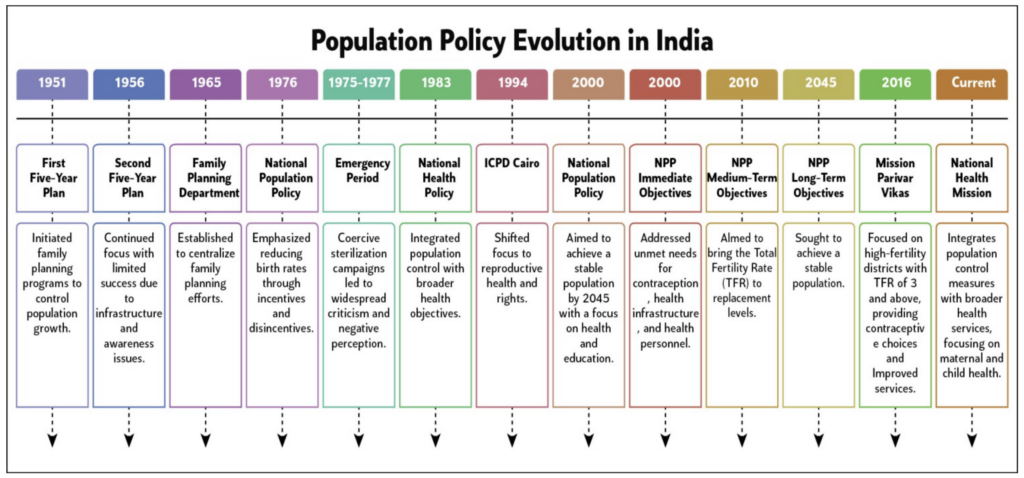
- For the first time, a comprehensive National Population Policy (1976) was announced to directly address rapid population growth, introducing aggressive and target-oriented measures, many of which were implemented in a coercive administrative environment during the Emergency period.
- The salient features of the policy included:
- Raising the legal age of marriage to 18 years (girls) and 21 years (boys) to reduce early marriages and thereby lower fertility rates.
- Adopting special measures to promote female education, recognizing that female literacy is directly linked with lower fertility and improved family planning adoption.
- Providing monetary incentives for sterilisation, structured according to the number of children, thereby encouraging small family norms.
- Offering additional incentives to government employees adopting sterilisation after having up to two children, institutionalising small family norms in formal sectors.
- However, the policy became controversial due to the introduction of compulsory sterilisation targets, which led to a sharp rise in sterilisation numbers (from 9.4 lakh in 1973–74 to 82.6 lakh in 1976–77), largely driven by coercive state measures.
- This coercive approach resulted in widespread public resentment, social unrest, and loss of trust, ultimately making the family planning programme highly unpopular and politically sensitive.
Janata Government Policy, 1977 (Post-Emergency Correction)
- In the post-emergency phase, the Janata Government (1977) introduced a revised population policy, marking a paradigm shift from coercive population control to voluntary family welfare, thereby restoring public confidence in demographic programmes.
- The key features of this policy included:
- Renaming the ‘Family Planning Programme’ as ‘Family Welfare Programme’, thereby broadening its scope from population control to reproductive health and well-being.
- Reaffirming the legal age of marriage (18 for females and 21 for males) through legislative measures such as the Child Marriage Restraint (Amendment) Act, 1978.
- Making sterilisation strictly voluntary, rejecting coercive practices and emphasizing informed choice and consent.
- Introducing population education as part of the formal education system, aiming at long-term awareness and behavioural change.
- Providing monetary incentives for voluntary sterilisation and tubectomy, while encouraging private sector participation through tax incentives.
- Utilising mass media and communication strategies to spread family planning awareness, especially in rural areas.
- As a result of the shift to voluntarism, sterilisation numbers declined sharply, reflecting the end of coercion and the need for rebuilding trust in state-led programmes.
Population Policy in Five-Year Plans (Evolution of Targets and Approach)
- The Sixth Five-Year Plan introduced long-term demographic goals such as achieving Net Reproduction Rate (NRR = 1) by 2000, along with targets for crude birth rate (CBR), crude death rate (CDR), infant mortality rate (IMR), and couple protection rate (CPR), thereby institutionalising demographic planning.
- The Seventh Plan revised targets and timelines, emphasizing the two-child norm and strengthening maternal and child health programmes, reflecting a shift from quantitative targets to health-based approaches.
- The Eighth Plan extended the timeline for achieving replacement-level fertility and focused on improving service quality, particularly in contraception and maternal healthcare.
- A major shift occurred in 1997 with the Reproductive and Child Health (RCH) approach, which replaced the earlier target-based population control strategy with a decentralised, need-based, and area-specific planning approach, focusing on quality of life and reproductive rights.
- This approach led to programmes such as safe motherhood, Universal Immunisation Programme (UIP), and treatment of Reproductive Tract Infections (RTIs), thereby integrating population policy with public health.
- The Ninth Plan marked another conceptual shift by replacing NRR with Total Fertility Rate (TFR), setting a target of replacement level fertility (TFR = 2.1), while also focusing on IMR, CBR, and contraceptive prevalence.
Shift Towards Women Empowerment and Human Development
- The adoption of the National Policy for Empowerment of Women (2001) marked a significant transition in India’s population policy, recognizing that demographic outcomes are closely linked with women’s status, autonomy, education, and economic participation.
- A National Plan of Action for Empowerment of Women was formulated to operationalize this policy, emphasizing gender equality, reproductive rights, and access to healthcare and education, thereby integrating population stabilisation with socio-economic development.
- Thus, India’s population policy evolved from a narrow population control approach to a comprehensive framework encompassing family welfare, reproductive health, gender empowerment, and human development.
National Population Policy, 2000 (NPP 2000)
- India’s population reached 100 crores on May 11, 2000, and it was estimated that if current growth trends continue, India would become the most populous country by 2045, overtaking China; during the 20th century, India’s population increased nearly four times (23 crore → 100 crore), while world population grew about three times (200 crore → 600 crore).
- With an annual increase of about 1.55 crore people, it became increasingly difficult to maintain a balance between population growth, resource endowment, and environmental sustainability, highlighting the urgent need for population stabilisation and equitable development.
- To address reproductive and child health needs and to achieve TFR targets, the National Population Policy (announced on 15 February 2000) provided a comprehensive policy framework, aiming to improve maternal health, child survival, contraception access, and to ensure affordable and accessible reproductive healthcare for all.
Objectives of NPP 2000
- There are three categories of objectives under the policy:
- Immediate Objective
- To address the unmet needs for contraception, strengthen healthcare infrastructure and health personnel, and provide integrated service delivery for reproductive and child health care.
- Medium-Term Objective
- To achieve replacement level fertility (TFR = 2.1) by around 2010 through vigorous implementation of inter-sectoral strategies, involving health, education, and social development.
- Long-Term Objective
- To achieve a stable population by 2045, consistent with the requirements of sustainable economic growth, social development, and environmental protection.
- Immediate Objective
Targets of National Population Policy, 2000
- The policy laid down specific socio-demographic targets, including:
- Achieving population stabilisation / zero population growth by 2045.
- Reducing infant mortality rate (IMR) to below 30 per 1000 live births.
- Reducing maternal mortality ratio (MMR) to below 100 per 100,000 live births.
- Reducing crude birth rate (CBR) to 21 per 1000 population.
- Achieving Total Fertility Rate (TFR) of 2.1 (replacement level fertility).
Key Policy Features:
- Voluntary and informed choice: The policy emphasised the importance of voluntary family planning and ensuring informed consent for services like sterilisation.
- Focus on women’s empowerment: Education and improved access to healthcare for women were seen as crucial factors in reducing fertility rates.
- Improved service delivery: Upgrading infrastructure, increasing healthcare personnel, and expanding access to family planning services across rural and urban areas were prioritized.
- Integration with other sectors: The policy advocated collaboration with departments like education and social welfare to address underlying factors like poverty and gender inequality that contribute to population growth.
Conclusion
- The NPP shifted the focus from solely reducing birth rates to a more holistic approach that emphasised women’s empowerment, improved healthcare, and responsible parenthood.
- NPP 2000 reflects a shift from population control → population stabilisation → human development approach, integrating health, gender empowerment, and sustainable development.
- The policy underscores that demographic transition in India is not merely a numerical issue, but is deeply linked with education, healthcare access, women empowerment, and socio-economic transformation.
Revamping India’s Population Policy: Need for a New Population Policy
- India’s existing population policy (NPP 2000) requires a comprehensive update, as it was primarily designed to address family planning and maternal mortality, whereas the current demographic realities have significantly evolved, demanding a more dynamic and multi-dimensional policy response.
Emerging Demographic Challenges
- A Looming Demographic Shift: India is currently experiencing a demographic window of opportunity (demographic dividend), with a large youthful population expected to peak around 2041, but this opportunity is time-bound and requires urgent policy action; at the same time, continued population growth exerts pressure on resources, infrastructure, and employment generation, while declining fertility rates are simultaneously leading to rapid population ageing (projected ~12% elderly by 2025), creating a dual challenge of managing both youth bulge and ageing population.
Policy Imperatives for a Revised Population Strategy
- Investing in Youth Capital: There is a critical need to invest in education, skill development, and employment generation, ensuring that the youthful population is transformed into a productive human resource, thereby effectively harnessing the demographic dividend rather than allowing it to turn into a demographic burden.
- Strengthening Elderly Support Systems: With the growing proportion of elderly population, especially women due to higher life expectancy, policy must focus on social security, healthcare infrastructure, pension systems, and community-based care mechanisms, ensuring dignified ageing and reducing dependency pressures.
- Targeted Focus on High Fertility Regions (BIMARU States): States such as Bihar, Madhya Pradesh, Rajasthan, and Uttar Pradesh, which continue to exhibit higher fertility rates and lower socio-economic indicators, require region-specific interventions, including improved education (especially female literacy), healthcare access, skill development, and employment opportunities, to accelerate demographic transition.
Shift in Policy Approach: From Control to Development
- From Population Control to Sustainable Development: The emphasis should move beyond coercive or target-based approaches to creating enabling socio-economic conditions, where smaller family norms emerge naturally through economic growth, urbanisation, education, and improved living standards.
- Education and Skill-Oriented Demographic Strategy: With the advent of automation, AI, and changing labour markets, the policy must prioritise future-ready skills, vocational training, and human capital formation, ensuring that India’s workforce remains competitive and adaptable in a global economy.
Conclusion
- India’s population policy must now evolve into a holistic population-development framework, integrating demography with economic planning, social justice, gender empowerment, and environmental sustainability, thereby ensuring that population dynamics become a driver of inclusive and sustainable development rather than a constraint.