Sociology Optional PYQ Solutions: Topic-wise Solved PYQs (1985–2026) by LotusArise IAS
Original price was: ₹2,500.00.₹1,499.00Current price is: ₹1,499.00.
₹1,499 (complete-pack price — ₹1,001 below MRP now that all 25 units are live). MRP: ₹2,500
Most Sociology Optional aspirants study PYQs the wrong way — read the question, recall what a thinker said, write a description, move on. No framework applied. No Indian example. No idea whether UPSC wanted Weber or Srinivas in that answer.
Sociology Optional PYQ Solutions fixes this — and it is now 100% complete.
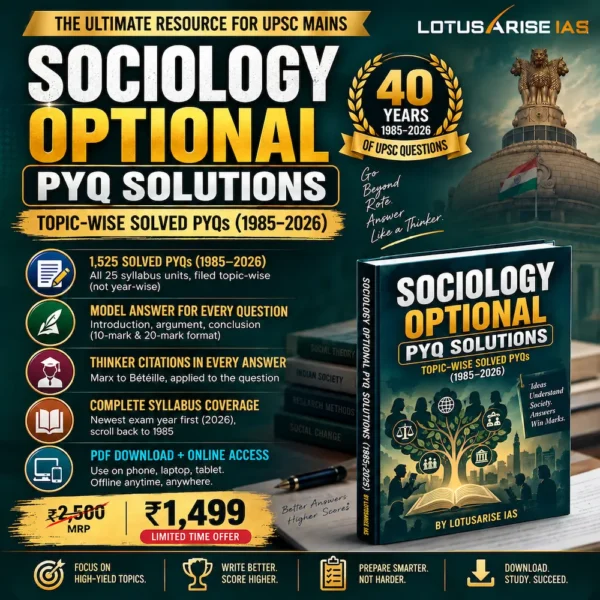
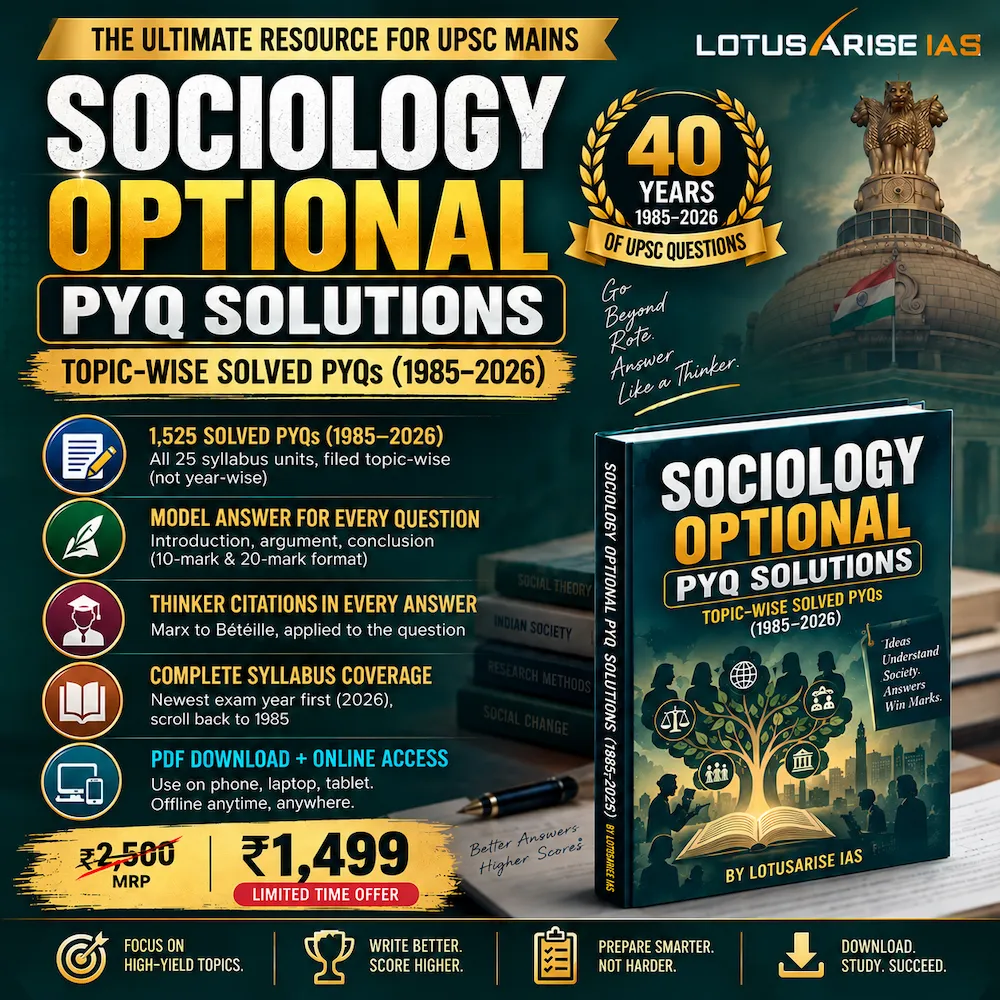
📜 1,525 solved PYQs (1985–2026) — every unit of Paper I and Paper II, filed topic-wise, not year-wise
✍️ A full model answer for every question — introduction, argument, conclusion, in 10-mark and 20-mark shape
🎓 Thinker citations built into each answer — Marx to Béteille, applied to the question, never name-dropped
🗂️ All 25 syllabus units, newest exam year first — open a unit, see 2026 at the top, scroll back to 1985
📱 PDF download + online access on lotusarise.com — phone, laptop, tablet; offline anytime
12 months’ access from the day you enrol — not from a batch date.
One-time payment. No subscription. Instant access after purchase.
⭐⭐⭐⭐⭐ Trusted by 300,000+ UPSC aspirants monthly on LotusArise IAS
The Sociology Optional PYQ problem nobody admits
Ask any Sociology Optional aspirant three months before Mains how their PYQ practice is going. They will not say the syllabus is too long. They will say one of three things:
“I know Marx, Weber and Durkheim cold — but when the question says ‘critically examine’, I write what they said, not what the question asked.”
“Paper II feels bottomless. Caste, tribe, kinship, agrarian change, movements — I cannot tell which questions repeat and which were one-offs.”
“I solved the 2024 and 2025 papers. Then I stopped, because there was no answer to check mine against.”
These are not knowledge gaps. The content is already in your notes. What is missing is the bridge between reading a question and writing the answer UPSC actually rewards — a framework, a thinker applied to it, an Indian example, a conclusion that takes a position. Sociology Optional PYQ Solutions is that bridge, written out for every question UPSC has asked since 1985.
Why solved PYQs are the highest-return hours in Sociology
Sociology Optional is 500 marks across two papers, and it is the optional with the most predictable question bank in the exam. UPSC returns to the same themes — stratification, thinkers, religion, kinship, caste, social movements, population — year after year, rephrasing rather than replacing. An aspirant who has seen every framing of “Weber on stratification” since 1985 is not surprised in the hall.
The return does not stop at the optional. Paper II is Indian Society, which is a full section of GS Paper I, a recurring Essay theme and a standard Interview probe. Every solved answer on caste, tribe, gender or urbanisation is a GS answer as well.
The bottleneck was never the subject. It was that nobody had solved the full question bank in one place, in one voice, in exam shape. Now it exists.
What’s inside
📜 1,525 solved PYQs — 1985 to 2026, both papers
Every question UPSC has set in Sociology Optional across 42 years, solved and filed under the syllabus unit it belongs to. The 2026 paper is already inside — 56 questions solved in the weeks after the exam.
Paper I — Fundamentals of Sociology (10 units)
- Sociology: The Discipline · Sociology as a Science · Research Methods and Analysis
- Sociological Thinkers — Marx, Durkheim, Weber, Parsons, Merton, Mead
- Stratification and Mobility · Works and Economic Life · Politics and Society
- Religion and Society · Systems of Kinship · Social Change in Modern Society — including the sub-topics on social movements, education and science/technology
Paper II — Indian Society: Structure and Change (15 units)
- Perspectives on the Study of Indian Society · Impact of Colonial Rule
- Rural and Agrarian Social Structure · Caste System · Tribal Communities · Social Classes · Systems of Kinship in India · Religion and Society in India
- Visions of Social Change · Rural and Agrarian Transformation · Industrialization and Urbanisation · Politics and Society in India · Social Movements in Modern India · Population Dynamics · Challenges of Social Transformation
Scan that list for your weakest unit. It is there, with every question UPSC has asked on it and the answer to each.
✍️ A complete model answer for every question
Not hints. Not a bullet skeleton. Each question gets a full answer of roughly 400–450 words, written the way a 20-mark Sociology answer is meant to read:
- Structure — a one-paragraph introduction that defines the terms and takes a position, two or three headed sections that build the argument, a conclusion that answers the question as set
- Thinker application — the framework that fits this question (Weber’s status groups, Dumont’s purity–pollution, Srinivas’s Sanskritisation, Béteille’s class–caste–power), deployed inside the argument, never as a name dropped at the end
- Indian evidence — a contemporary example, a study, a policy or a data point that turns theory into an answer about India
- Comparison where UPSC asks for it — tables and contrasts when the question puts two thinkers or two concepts side by side
What makes this different from downloaded coaching PDFs is the discipline of answering the question as set. A 1990s “define social stratification” and a 2020s “evaluate Weberian stratification in contemporary India” get different answers here, because they are different questions — and seeing both side by side is how you learn to read what the examiner wants.
🗂️ Topic-wise organisation, newest exam year first
Every unit has its own page. Open Caste System and the 2026 questions are at the top, tagged by year, with 2025, 2024 and every earlier year below them. You see at a glance which themes UPSC has returned to five times and which appeared once — and you revise the unit, not the year.
📱 PDF download + online access, 12 months
- Read on lotusarise.com on any device, with the unit pages linked from the free Sociology notes
- Download the PDFs for offline reading and printed answer practice
- 12 months’ access from the day you enrol — no batch date, no schedule to keep
The aspirant who buys this
First-attempt Sociology aspirants — you want to know from week one what UPSC actually asks. Read the solved PYQs for a unit before you make notes on it, and your notes will be built around answers rather than chapters.
Repeaters who scored 250–290 and want 300+ — the content is in your head. The marks you dropped were in framing: the thinker that fitted the question, the Indian example you did not have, the conclusion you did not commit to. This pack is 1,525 worked examples of exactly those three things.
Aspirants using the Sociology Optional Mains Master Kit — the Kit gives you the notes; the Solutions pack shows you what those notes look like when they are turned into an answer. Together they are the full self-study system.
GS aspirants with a different optional — Paper II’s solved answers on caste, tribe, kinship, movements and urbanisation are ready-made material for GS Paper I’s Indian Society section and for the Essay.
Self-study aspirants outside Delhi, Prayagraj and Jaipur — you do not need a ₹15,000–₹54,000 classroom batch to see how a good answer is written. You need the answers, and you need them for every question, not the twenty a batch has time for.
Why not just use free PYQ compilations from Telegram?
Free compilations exist, and the questions in them are the same questions. Most aspirants have three of them. What none of them has is the answer — 1,525 times over, in one consistent structure, with the thinker chosen for you and an Indian example attached. A question list tells you what was asked; a solved list shows you what to write.
If you have the time and the discipline to write your own model answer for every question since 1985 and check it against a mentor, you may not need this. If you would rather open the unit you are revising tonight and read the answers already written, this is what the pack is for.
The price
Sociology Optional PYQ solution sets elsewhere are sold for ₹2,500–₹3,500, and usually for a shortlist of questions rather than the full bank.
MRP: ₹2,500 → Complete pack: ₹1,499 — for 1,525 solved answers, that is under ₹1 per answer.
One-time payment. No subscription. No recurring charge.
Access is activated instantly after payment; the PDF link is emailed to you (check your spam folder if it has not arrived within a few minutes).
For support: support@lotusarise.com
You may also like…
-

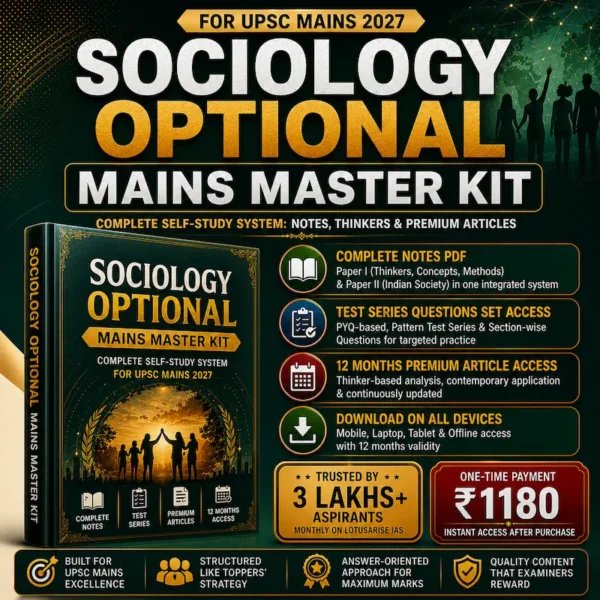
Sociology Optional Mains Master Kit 2027 — Complete Self-Study System: Notes, Thinkers & Premium Articles by LotusArise IAS
Original price was: ₹5,000.00.₹1,180.00Current price is: ₹1,180.00.