

UPSC Mains · Optional Subject
Sociology Optional for UPSC: Complete Notes (Paper I & II)
Free, unit-wise notes for every topic of Sociology Optional, arranged exactly as the UPSC syllabus runs: Paper I (Fundamentals of Sociology, with the six thinkers) and Paper II (Indian Society: Structure and Change), with topic-wise PYQs for each unit and PDFs for offline revision.
- 25 units
- 95+ free notes
- Topic-wise PYQs for every unit
- PDFs for revision
Go beyond the free notes
- Mains Master KitMost popular
Complete Notes PDF, test-series questions and 12 months of premium₹1,180 - PYQ Solutions
1,525 solved PYQs with model answers, 1985–2026₹1,499 - Complete Notes (PDF)
Paper 1 and Paper 2 notes with topic-wise PYQs₹500
Compare all three · One-time payment, instant access
LotusArise IAS courses
Sociology Optional courses for UPSC Mains 2027
The free notes take you through the syllabus. These three take you to the score: printable notes for revision, a complete self-study system, and 1,525 solved PYQs to master answer writing.
Printable PDFs

Sociology Optional Complete Notes (PDF)
Both papers, plus every PYQ sorted by unit.
- Paper 1 notes: all 10 units, with the six core thinkers
- Paper 2 notes: all 15 units of Indian society
- Topic-wise question book: 1,643 PYQs, 1980 to 2026
- Read offline, print, unlimited downloads, no expiry
₹500 ₹765 Save ₹265
350+ Sociology Optional notes PDFs sold
Or buy by part: Paper 1 notes · Paper 2 notes ₹354 each · Topic-wise question book ₹59
Most popular
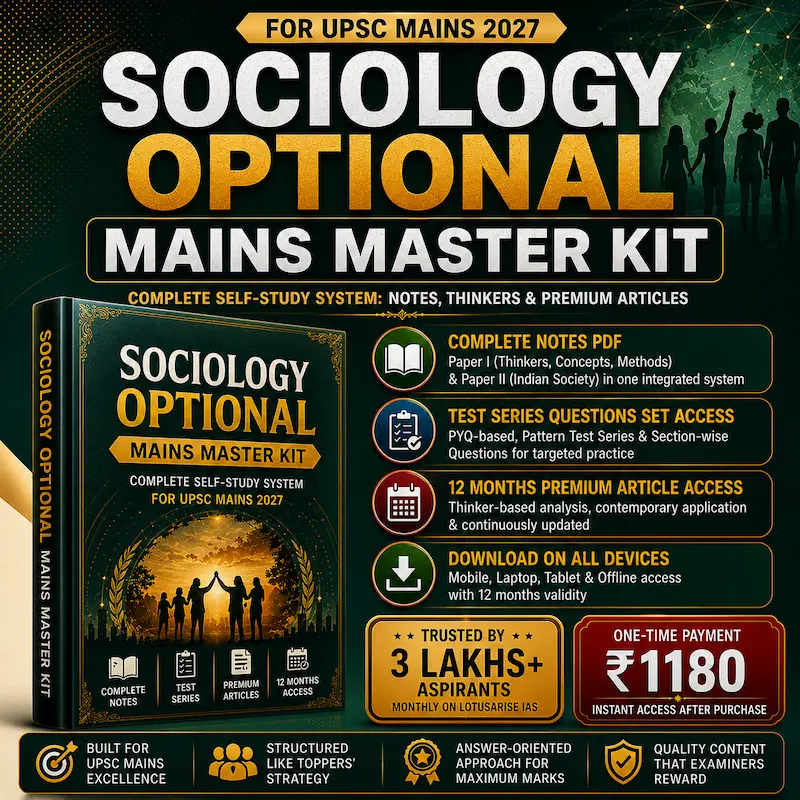
Sociology Optional Mains Master Kit
The complete self-study system for Paper I and Paper II.
- Complete Notes PDF for Paper I and Paper II, from the thinkers to Indian society
- Test-series question sets: PYQ-based, UPSC-pattern answer practice
- 12 months of premium articles: thinker analysis and current examples
- Mobile, laptop and tablet, with offline downloads
₹1,180 ₹5,000 Save ₹3,820
Chosen by 70+ aspirants · 12 months’ validity
For answer writing
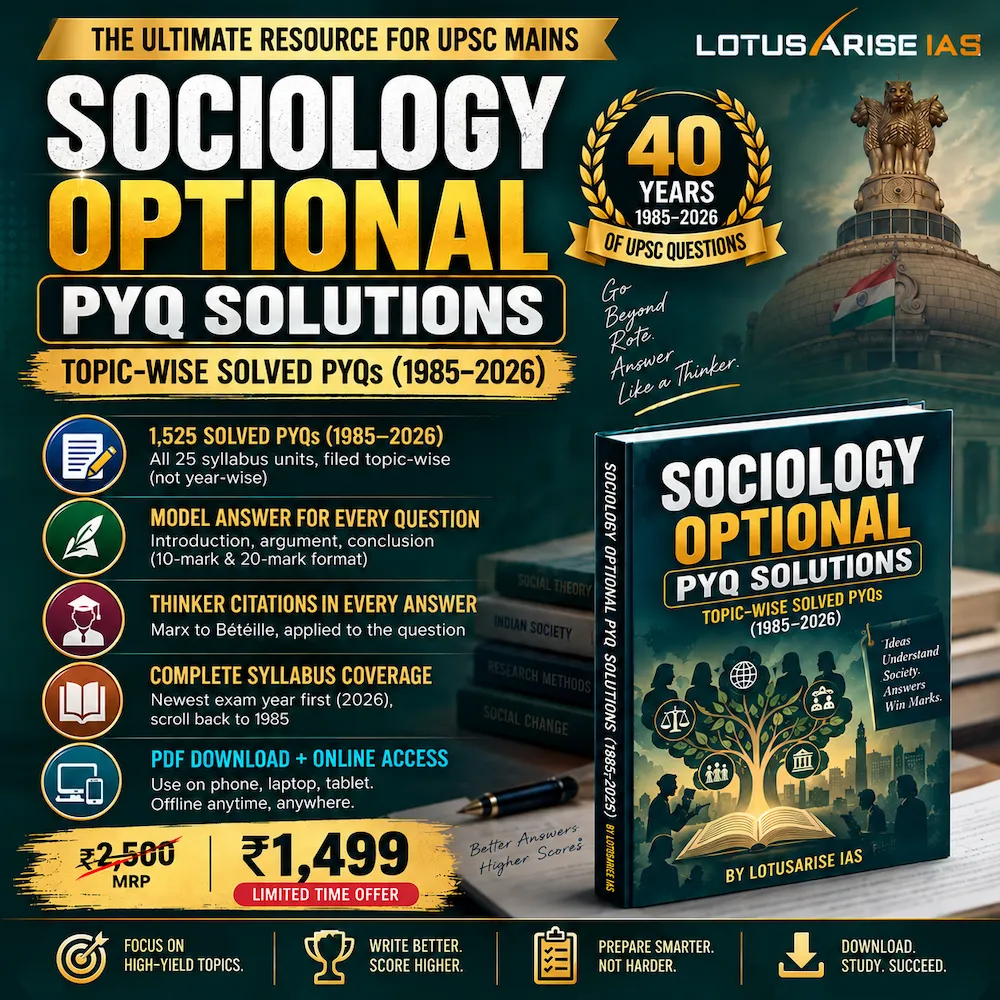
Sociology Optional PYQ Solutions
Every PYQ since 1985, answered the way UPSC rewards.
- 1,525 solved PYQs, 1985 to 2026, filed topic-wise
- All 25 units of Paper I and Paper II, newest year first
- A full model answer for every question, in 10- and 20-mark shape
- Thinker citations and Indian examples in each answer
₹1,499 ₹2,500 Save ₹1,001
PDF download + 12 months of online access
One-time payment · Instant access after purchase · Phone, laptop and tablet · 3,00,000+ aspirants read LotusArise IAS every month
Which one is right for you?
| What you get | Complete Notes (PDF) | Mains Master Kit | PYQ Solutions |
|---|---|---|---|
| Best for | Revising from printable notes | Studying the full syllabus in one system | Writing answers that score |
| Notes for Paper I and II | Paper 1 and Paper 2 PDFs | Complete Notes PDF | — |
| Practice | Topic-wise question book (1,643 PYQs) | PYQ-based test-series question sets | 1,525 solved PYQs with model answers |
| Thinkers | Covered in the notes | Covered in the notes, plus premium analysis | Cited and applied in every answer |
| Also includes | — | 12 months of premium articles | Indian examples in every answer |
| Access | Unlimited downloads, no expiry | 12 months | PDF download + 12 months online |
| Price | ₹500 | ₹1,180 | ₹1,499 |
Best pair: the Mains Master Kit tells you what to study, and PYQ Solutions shows you how to write it. Together they cover both halves of the paper.
What is Sociology Optional in UPSC?
Sociology is one of the optional subjects you can choose for the UPSC Civil Services Main Examination, and one of the most widely chosen. You write two papers of 250 marks each, so the optional decides 500 of the 1,750 marks in the written Mains.
It also pays off beyond the optional. Paper II is, in effect, the Indian Society part of GS Paper I studied in depth, and the thinkers and concepts of Paper I feed straight into the Essay and Ethics papers. Every unit below follows the official Sociology Optional syllabus line by line, so you can tick off topics as you finish them.
Sociology Optional at a glance
| Paper I | Fundamentals of Sociology: the discipline, research methods, the thinkers and core concepts (10 units) |
| Paper II | Indian Society: Structure and Change, in three parts: introducing Indian society, social structure and social change (15 units) |
| Marks | 250 per paper, 500 in all |
| Time | 3 hours per paper |
| Questions | 8 per paper in two sections; answer 5. Q1 and Q5 are compulsory, and at least one more must come from each section |
| Short answers | Q1 and Q5 each have five parts of 10 marks, about 150 words each |
| Thinkers | Marx, Durkheim, Weber, Parsons, Merton and Mead in Paper I; Ghurye, Srinivas and Desai in Paper II |
Start here
- Syllabus (Paper I and II)
- Best books (booklist)
- Preparation strategy
- Self-study plan
- Question papers (2010–2026)
- Topic-wise PYQs
- Most repeated topics
- PYQ solutions (1985–2026)
- Answer writing (10 and 20 marks)
- What high-scoring answers do
- Is Sociology scoring?
- Unit-wise notes, PYQs and answers
- Test-series questions
- PSIR vs Sociology
- Join the Mains Master Kit
- Get PYQ Solutions
How to study Sociology Optional: the order that works
Twenty-five units are manageable when each one builds on the last, and when answer writing starts in the first week rather than the last month. This is the sequence that does both.
- Read the syllabus against recent papers. Before opening a note, go through the topic-wise PYQs and the most repeated topics to see which units UPSC returns to and how it frames them.
- Start with Paper I, and with the thinkers. Marx, Durkheim, Weber, Parsons, Merton and Mead run through almost every other unit, so learn each thinker’s core ideas and the main critiques of them first, from the Sociological Thinkers notes.
- Read the discipline, science and methods units as one block. Sociology: The Discipline, Sociology as a Science and Research Methods share one debate, positivism against interpretation, so they are faster and clearer read together.
- Read each concept unit through the thinkers. Stratification, work, power, religion, kinship and social change each have a Marxian, Durkheimian and Weberian reading. Note them as you go so you can compare perspectives in a 20-mark answer.
- Open Paper II with the perspectives. Ghurye, Srinivas and Desai give you the lenses for every later unit on caste, village, class and change, so study them first and reuse them throughout.
- Pair every Indian topic with a theory and a fact. For caste, tribe, kinship, movements and population, combine a sociologist’s view with a current example or data point. That pairing is what lifts a Paper II answer above a GS answer.
- Write answers from week one. After each unit, attempt its topic-wise PYQs under time: about 7 minutes for a 10-mark answer, 11 for a 15-mark and 14 for a 20-mark answer. Check your answers against the answer-writing guide and the 1,525 solved PYQs in PYQ Solutions.
Jump to a unit · Paper I · Fundamentals of Sociology
- Sociology: The Discipline
- Sociology as a Science
- Research Methods and Analysis
- Sociological Thinkers
- Stratification and Mobility
- Works and Economic Life
- Politics and Society
- Religion and Society
- Systems of Kinship
- Social Change in Modern Society
Paper II · Introducing Indian Society
Paper II · Social Structure
- Rural and Agrarian Social Structure
- Caste System
- Tribal Communities in India
- Social Classes in India
- Systems of Kinship in India
- Religion and Society in India
Paper II · Social Changes in India
Paper I: Fundamentals of Sociology (Notes)
Ten units, from the discipline and its methods to the six thinkers and the core concepts. Within each unit, notes are listed in the order to study them.
Sociology: The Discipline
- Modernity and social changes in Europe and emergence of Sociology
- Scope of the subject and comparison with other social sciences
- Sociology and common sense
Practise it for marks: solved Sociology: The Discipline PYQs from 1985 to 2026, with thinkers and Indian examples, are in Sociology Optional PYQ Solutions.
Sociology as a Science
- Science, Scientific method and Critique
- Major theoretical strands of research methodology
- Positivism and its critique
- Fact value and objectivity
- Non-positivist methodologies
Practise it for marks: solved Sociology as a Science PYQs from 1985 to 2026, with thinkers and Indian examples, are in Sociology Optional PYQ Solutions.
Research Methods and Analysis
- Qualitative and quantitative methods
- Techniques of data collection
- Variables, sampling, hypothesis, reliability and validity
Practise it for marks: solved Research Methods and Analysis PYQs from 1985 to 2026, with thinkers and Indian examples, are in Sociology Optional PYQ Solutions.
Sociological Thinkers
- Karl Marx – Historical materialism, mode of production, alienation, class struggle
- Emile Durkheim – Division of labour, social fact, suicide, religion and society
- Max Weber – Social action, ideal types, authority, bureaucracy, protestant ethic and the spirit of capitalism
- Talcott Parsons – Social system, pattern variables
- Robert K. Merton – Latent and manifest functions, conformity and deviance, reference groups
- G H Mead – Self and identity
Practise it for marks: solved Sociological Thinkers PYQs from 1985 to 2026, with thinkers and Indian examples, are in Sociology Optional PYQ Solutions.
Sociology Optional Complete Notes (PDF)
Finished the thinkers? Keep all of it as printable notes.
Paper 1 and Paper 2 notes as printable PDFs, from the six thinkers to Indian society, plus a topic-wise question book with 1,643 PYQs from 1980 to 2026.
One-time payment · Unlimited downloads · Printable
Stratification and Mobility
- Concepts – equality, inequality, hierarchy, exclusion, poverty and deprivation
- Theories of social stratification – Structural functionalist theory, Marxist theory, Weberian theory
- Dimensions – Social stratification of class, status groups, gender, ethnicity and race
- Social mobility – open and closed systems, types of mobility, sources and causes of mobility
Practise it for marks: solved Stratification and Mobility PYQs from 1985 to 2026, with thinkers and Indian examples, are in Sociology Optional PYQ Solutions.
Works and Economic Life
- Social organization of work in different types of society – slave society, feudal society, industrial capitalist society
- Formal and informal organization of work
- Labour and society
Practise it for marks: solved Works and Economic Life PYQs from 1985 to 2026, with thinkers and Indian examples, are in Sociology Optional PYQ Solutions.
Politics and Society
- Sociological theories of power
- Power elite, bureaucracy, pressure groups and political parties
- Nation, state, citizenship, democracy, civil society, ideology
- Protest, agitation, social movements, collective action, revolution
Practise it for marks: solved Politics and Society PYQs from 1985 to 2026, with thinkers and Indian examples, are in Sociology Optional PYQ Solutions.
Religion and Society
- Sociological theories of religion
- Types of religious practices: animism, monism, pluralism, sects, cults
- Religion in modern society: religion and science, secularization, religious revivalism, fundamentalism
Practise it for marks: solved Religion and Society PYQs from 1985 to 2026, with thinkers and Indian examples, are in Sociology Optional PYQ Solutions.
Systems of Kinship
- Family, household, marriage
- Types and forms of family
- Lineage and descent
- Patriarchy and sexual division of labour
- Contemporary trends
Practise it for marks: solved Systems of Kinship PYQs from 1985 to 2026, with thinkers and Indian examples, are in Sociology Optional PYQ Solutions.
Social Change in Modern Society
- Sociological theories of social change
- Development and dependency
- Agents of social change
- Education and social change
- Science, technology and social change
Practise it for marks: solved Social Change in Modern Society PYQs from 1985 to 2026, with thinkers and Indian examples, are in Sociology Optional PYQ Solutions.
Sociology Optional PYQ Solutions
Reading notes covers half the paper. Writing answers covers the rest.
1,525 solved PYQs from 1985 to 2026 across all 25 units, each with a full model answer that applies the right thinker and an Indian example, filed topic-wise with the newest year first.
Under ₹1 per solved question · PDF download and online access
Paper II: Indian Society, Structure and Change (Notes)
Part A introduces Indian society, Part B covers its social structure and Part C covers social change in India. Within each unit, notes are listed in the order to study them.
Part A · Introducing Indian Society
Perspectives on the Study of Indian Society
Practise it for marks: solved Perspectives on Indian Society PYQs from 1985 to 2026, with thinkers and Indian examples, are in Sociology Optional PYQ Solutions.
Impact of Colonial Rule on Indian Society
- The social background of Indian nationalism
- Modernization of Indian tradition
- Protests and movements during the colonial period; social reforms
Practise it for marks: solved Impact of Colonial Rule PYQs from 1985 to 2026, with thinkers and Indian examples, are in Sociology Optional PYQ Solutions.
Part B · Social Structure
Rural and Agrarian Social Structure
- The idea of Indian village and village studies
- Agrarian social structure – evolution of land tenure system, land reforms
Practise it for marks: solved Rural and Agrarian Social Structure PYQs from 1985 to 2026, with thinkers and Indian examples, are in Sociology Optional PYQ Solutions.
Caste System
- Perspectives on the study of caste systems: G. S. Ghurye, M. N. Srinivas, Louis Dumont, André Béteille
- Features of the caste system
- Untouchability – forms and perspectives
Practise it for marks: solved Caste System PYQs from 1985 to 2026, with thinkers and Indian examples, are in Sociology Optional PYQ Solutions.
Tribal Communities in India
- Definitional problems
- Geographical spread
- Colonial policies and tribes
- Issues of integration and autonomy
Practise it for marks: solved Tribal Communities in India PYQs from 1985 to 2026, with thinkers and Indian examples, are in Sociology Optional PYQ Solutions.
Social Classes in India
Practise it for marks: solved Social Classes in India PYQs from 1985 to 2026, with thinkers and Indian examples, are in Sociology Optional PYQ Solutions.
Systems of Kinship in India
- Lineage and descent in India
- Types of kinship systems
- Family and marriage in India
- Household dimensions of the family
Practise it for marks: solved Systems of Kinship in India PYQs from 1985 to 2026, with thinkers and Indian examples, are in Sociology Optional PYQ Solutions.
Religion and Society in India
- Religious communities in India
- Problems of religious minorities
- Patriarchy, entitlements and sexual division of labour
Practise it for marks: solved Religion and Society in India PYQs from 1985 to 2026, with thinkers and Indian examples, are in Sociology Optional PYQ Solutions.
Part C · Social Changes in India
Visions of Social Change in India
- The idea of development planning and mixed economy
- Constitution, law and social change
- Education and social change
Practise it for marks: solved Visions of Social Change in India PYQs from 1985 to 2026, with thinkers and Indian examples, are in Sociology Optional PYQ Solutions.
Rural and Agrarian Transformation in India
- Programmes of rural development, Community Development Programme, cooperatives, poverty alleviation schemes
- Green revolution and social change
- Changing modes of production in Indian agriculture
- Problems of rural labour, bondage, migration
Practise it for marks: solved Rural and Agrarian Transformation PYQs from 1985 to 2026, with thinkers and Indian examples, are in Sociology Optional PYQ Solutions.
Industrialization and Urbanisation in India
- Evolution of modern industry in India
- Growth of urban settlements in India
- Working-class: structure, growth, class mobilization
- The informal sector, child labour
- Slums and deprivation in urban areas
Practise it for marks: solved Industrialization and Urbanisation PYQs from 1985 to 2026, with thinkers and Indian examples, are in Sociology Optional PYQ Solutions.
Politics and Society in India
- Nation, democracy and citizenship
- Political parties, pressure groups, social and political elite
- Regionalism and decentralization of power
- Secularization
Practise it for marks: solved Politics and Society in India PYQs from 1985 to 2026, with thinkers and Indian examples, are in Sociology Optional PYQ Solutions.
Social Movements in Modern India
- Peasants and farmers movements
- Women’s movement
- Backward classes and Dalit movement
- Environmental movements
- Ethnicity and Identity movements
Practise it for marks: solved Social Movements in Modern India PYQs from 1985 to 2026, with thinkers and Indian examples, are in Sociology Optional PYQ Solutions.
Population Dynamics
- Population size, growth, composition and distribution
- Components of population growth: birth, death, migration
- Population policy and family planning
- Emerging issues: ageing, sex ratios, child and infant mortality, reproductive health
Practise it for marks: solved Population Dynamics PYQs from 1985 to 2026, with thinkers and Indian examples, are in Sociology Optional PYQ Solutions.
Challenges of Social Transformation
- Crisis of development: displacement, environmental problems, and sustainability
- Poverty, deprivation and inequalities
- Violence against Women
- Caste conflicts
- Ethnic conflicts, communalism, religious revivalism
- Illiteracy and disparities in education
Practise it for marks: solved Challenges of Social Transformation PYQs from 1985 to 2026, with thinkers and Indian examples, are in Sociology Optional PYQ Solutions.
Finished the notes?
Turn these notes into marks
Every unit above is free to read. When you are ready to revise faster, practise answers in UPSC pattern and write answers that score, these three are built for it.
Printable PDFs
Sociology Optional Complete Notes (PDF)
Both papers, plus every PYQ sorted by unit.
- Paper 1 notes: all 10 units, with the six core thinkers
- Paper 2 notes: all 15 units of Indian society
- Topic-wise question book: 1,643 PYQs, 1980 to 2026
- Read offline, print, unlimited downloads, no expiry
₹500 ₹765 Save ₹265
350+ Sociology Optional notes PDFs sold
Or buy by part: Paper 1 notes · Paper 2 notes ₹354 each · Topic-wise question book ₹59
Most popular
Sociology Optional Mains Master Kit
The complete self-study system for Paper I and Paper II.
- Complete Notes PDF for Paper I and Paper II, from the thinkers to Indian society
- Test-series question sets: PYQ-based, UPSC-pattern answer practice
- 12 months of premium articles: thinker analysis and current examples
- Mobile, laptop and tablet, with offline downloads
₹1,180 ₹5,000 Save ₹3,820
Chosen by 70+ aspirants · 12 months’ validity
For answer writing
Sociology Optional PYQ Solutions
Every PYQ since 1985, answered the way UPSC rewards.
- 1,525 solved PYQs, 1985 to 2026, filed topic-wise
- All 25 units of Paper I and Paper II, newest year first
- A full model answer for every question, in 10- and 20-mark shape
- Thinker citations and Indian examples in each answer
₹1,499 ₹2,500 Save ₹1,001
PDF download + 12 months of online access
One-time payment · Instant access after purchase · Phone, laptop and tablet · 3,00,000+ aspirants read LotusArise IAS every month
Sociology Optional: frequently asked questions
Start today
Prepare for Mains 2027 with LotusArise IAS
Free notes for every unit, plus the three tools that turn them into marks.
One-time payment · Instant access · Phone, laptop and tablet · 3,00,000+ aspirants read LotusArise IAS every month