Sociology Optional · Paper II · Social Structure
Tribal Communities in India Notes · PYQs · Solved Answers
Free notes, every previous year question and the solved answers for Tribal Communities in India (Paper II, Social Structure), arranged so you can read a topic and immediately see how UPSC has asked it. Syllabus: Definitional problems, geographical spread, colonial policies and tribes, issues of integration and autonomy.
43
Solved answers
1984–2026
Years covered
43
Questions listed
4
Free notes
On this page
Free notes Previous year questions Solved answers All Sociology Optional units
Paper II · Unit 03
Tribal Communities in India notes
Topic-wise notes for this unit in syllabus order. Read a topic, then open its previous year questions below.
Free notes
Free practice
Previous year questions: Tribal Communities in India
Every question UPSC has asked from this unit, year-wise, with a link to its solved answer.
Topic-wise question list
Year-wise question papers
-
UPSC Sociology Optional Question Paper 2026
-
UPSC Sociology Optional Question Paper 2025
-
UPSC Sociology Optional Question Paper 2024
-
UPSC Sociology Optional Question Paper 2023
-
Sociology Optional Question Paper 2010
-
Sociology Optional Question Paper 2011
-
Sociology Optional Question Paper 2012
-
Sociology Optional Question Paper 2013
-
Sociology Optional Question Paper 2014
-
Sociology Optional Question Paper 2015
-
Sociology Optional Question Paper 2016
-
Sociology Optional Question Paper 2017
-
Sociology Optional Question Paper 2018
-
Sociology Optional Question Paper 2019
Sociology PYQ Master Pack
Solved PYQ answers: Tribal Communities in India
Topic-wise model answers, newest exam year first. Members open the full answer; everyone else sees the question and can join the pack.
PYQ Solutions
-
Why was the category of ‘criminal tribe’ created by law during the colonial period in India? Discuss its implications.
-
Where would you locate the tribal community in the Varna system of India? Discuss.
-
How did Colonial Policies for the tribes affected their socio-economic conditions in India? Discuss.
-
In what respects have the constitutional provisions changed the socio-economic and political conditions of Scheduled Castes and Scheduled Tribes in India? Critically examine.
-
What are the definitional problems involved in identifying tribes in India? Discuss the main obstacles to tribal development in India.
-
Analyse the perspectives of Isolation, Assimilation and Integration in understanding the trajectories of Indian Tribal Development.
-
Define ethnicity. Discuss the factors responsible for the growth of ethnic movements in India.
-
Discuss the main features of the debate between G.S. Ghurye and V. Elwin on tribal development.
-
Explain the definitional problems concerning the tribal communities in India.
-
Examine the colonial policy of segregation of tribes under the Government of India Act, 1935.
-
Comment on the growing assertion of tribal community for autonomy in India.
-
What is ethnonationalism? Examine the critical factors responsible for tribal discontent in India.
-
What is the nature of religious change among tribal communities? Illustrate with two examples from colonial and post-independence times.
-
Why have we started using another category of tribes called the Particularly Vulnerable Tribal Groups (PVTGs)? Why are they so called?
-
Write short notes with a sociological perspective: ‘Isolationism’ as a dominant feature of colonial tribal policy.
-
How is the tribal question related with the issues of integration and autonomy in modern India?
-
Write short note with a sociological perspective: Verrier Elwin’s views on freedom for the tribals.
-
Write short note with a sociological Perspective: Main objective of Tribal sub plan (TSP).
-
Analyse the different views on integration and autonomy of tribes in India.
-
What are the features that distinguish tribes from the rest of the population?
-
Write a note on ethnicity and integration in the context of tribes.
-
How does the new Forest Act affect tribals?
-
Distinguish between : Tribe and Caste.
-
Has geographic and economic mobility impacted the tribal culture and social structure? Give examples.
-
Write short note with a sociological perspective on the following in not more than 150 words: Unity and diversity among the tribes in India.
-
Discuss the various problems of tribal communities in India and assess the impact of tribal development efforts after Independence.
-
Describe the distinctive features of tribal communities in India. Discuss the factors affecting tribal identity.
-
Write short note : Migration and tribal communities.
-
Write short note : Isolation approach in tribal policy.
-
Write short note : Emergence of classes among tribes.
-
Write short note : Integration of tribes in Hindu culture.
-
Critically examine various tribal policies. Which tribal policy would you advocate for tribal development in India any way?
-
Analyse critically the Government of India’s tribal policy.
-
Write short note : Issues of tribal identity.
-
What changes have taken place in the tribal social stratification pattern in recent times? Describe the factors responsible for these changes.
-
Describe the socio-cultural consequences of tribals’ contacts with the non-tribals. What measures would you suggest to bring the tribals in the national mainstream?
-
Write short note : Tribal integration.
-
Write short note : Sources of tribal unrest in India.
-
Trace the impact of cultural contact on the Indian tribes.
-
‘Erosion of ecology and economy, and not politicisation, is the main source of tribal unrest in India today.’ Examine the validity of this statement.
-
‘Uneven development is the major source of tribal unrest in India’. Examine the statement in relation to the movements in tribal India.
-
Analyse the different dimensions of the integration of tribes in the national polity. How can the process by accelerated?
-
Write short note : The future of tribal culture.
Premium content · how to get access
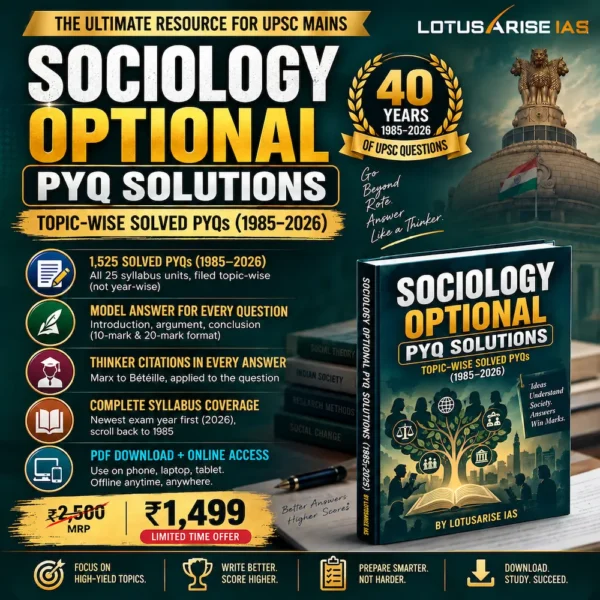
These solutions are part of the Sociology Optional PYQ Solutions pack.
Every solved answer below opens with one enrolment. One-time payment, no subscription.
- Topic-wise solved PYQs with thinker citations and examiner insights
- Model structures you can reuse in the exam
- Access on phone, laptop or tablet
Full pack
₹1,499 ₹2,500 40% off
One-time payment · instant access · UPI, cards, RuPay