

PSIR Notes for UPSC: Free Political Science Optional Notes (Paper 1 & 2)
Free, topic-wise PSIR notes for the UPSC Civil Services Mains — the complete Political Science and International Relations optional syllabus in 230+ topics, covering Paper I (Political Theory and Indian Government and Politics) and Paper II (Comparative Politics, International Relations and India and the World). Every topic is updated for UPSC 2027 and ends with its previous year questions. Read any topic free below, or download all four sections as PSIR notes PDF.
PSIR Notes at a Glance
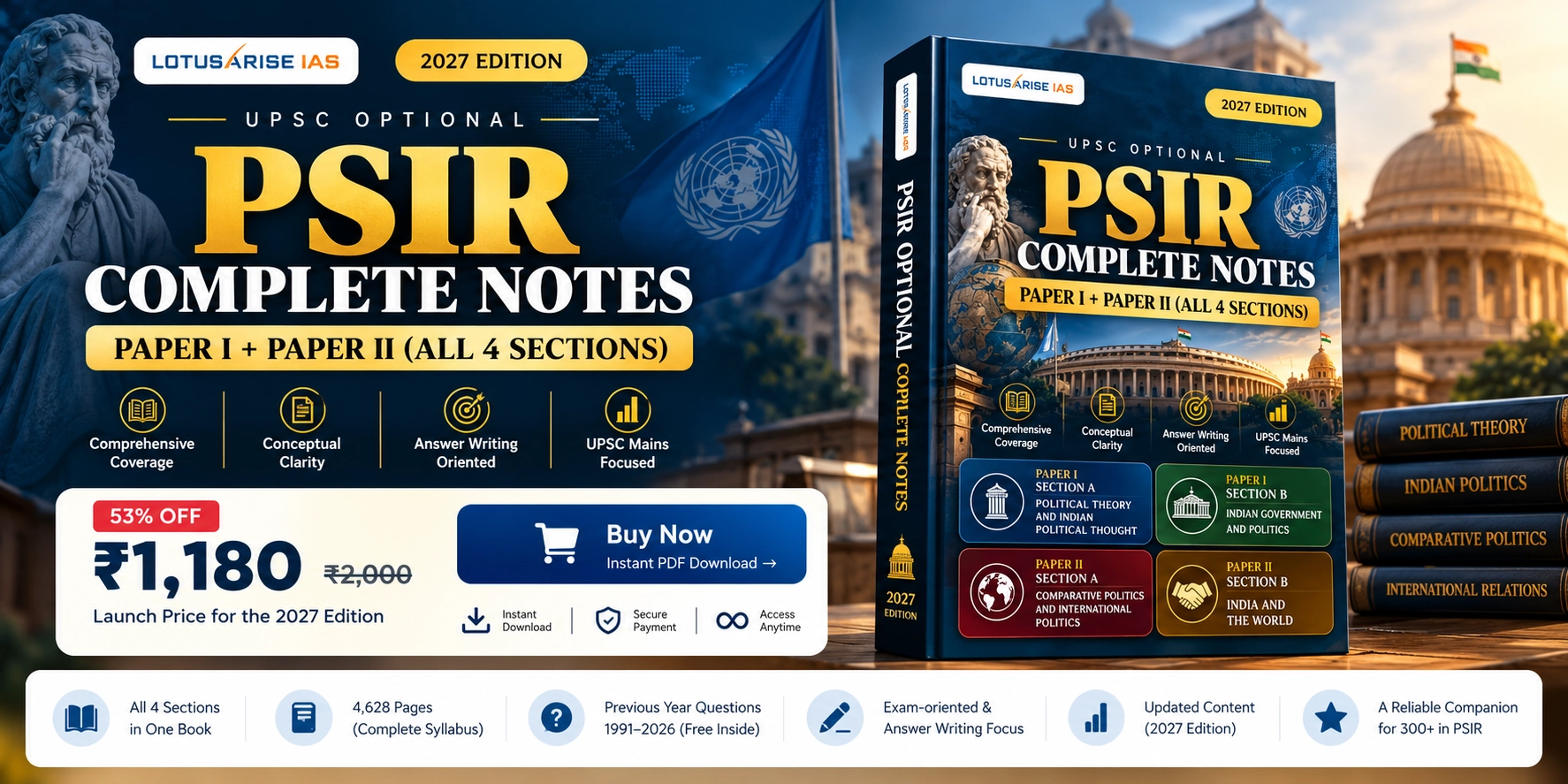
- Complete syllabus: all four sections of the UPSC PSIR optional — Paper I (Sections A and B) and Paper II (Sections A and B) — in 230+ topic-wise notes, each on its own page.
- Updated for UPSC 2027: Indian polity and international relations topics carry developments up to 2026.
- Previous year questions after every topic, so you see exactly how UPSC asks it.
- Free to read online, no sign-up. All four sections are also available as PSIR notes PDF.
Categories
PSIR: Political Science Optional Notes (Paper-1)
Section A: Political Theory and Indian Politics
1. Political Theory
2. Theories of the State
Pluralist Theory of State
7. Concept of Power
9. Indian Political Thought
10. Western Political Thought
Section B: Indian Government and Politics
1. Indian Nationalism
3. Salient Features of the Indian Constitution
4. Principal Organs of the Union Government
6. Statutory Institutions/Commissions
7. Federalism
9. Caste, religion and ethnicity in Indian Politics
10. Party System
PSIR: Political Science Optional Notes (Paper-2)
Section A: Comparative Political Analysis and International Politics
1. Comparative Politics
3. Politics of Representation and Participation
5. Approaches to the Study of International Relations
6. Key concepts in International Relations
7. Changing International Political Order
8. Evolution of the International Economic System
9. United Nations
10. Regionalisation of World Politics
11. Contemporary Global Concerns
Section B: India and the World
1. Indian Foreign Policy
3. India and South Asia
4. India and the Global South
5. India and the Global Centres of Power
7. India and the Nuclear Question
8. Recent developments in Indian Foreign policy
PSIR Optional study material from LotusArise IAS
Two ways to prepare with us — the full self-study system, or just the notes you need right now.
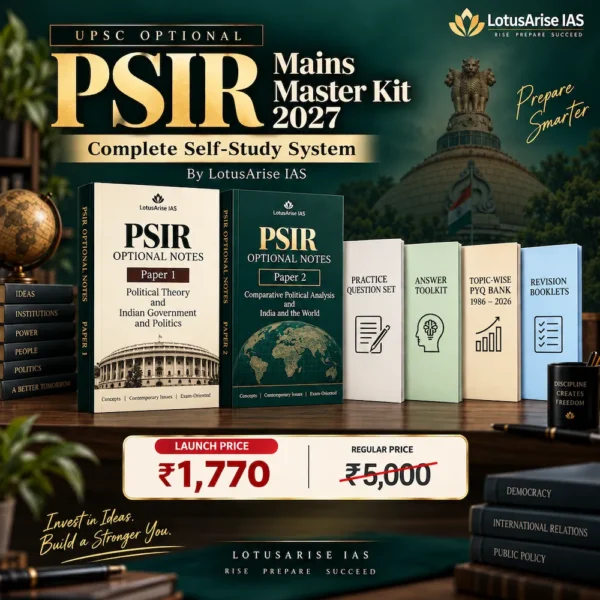
| What you get | PSIR Mains Master Kit 2027 | PSIR Complete Notes (Store) |
|---|---|---|
| Paper 1 notes — Political Theory + Indian Government and Politics | Included | Included — Section A and Section B |
| Paper 2 notes — Comparative Politics and India and the World | Included | Included — Section A and Section B |
| Topic-wise PYQ bank | 1986–2026, with trend analysis and probables by Dec 2026 | 1991–2025 question papers, free with every notes pack |
| Practice question set for timed answer writing | ✅ Available now | ❌ |
| Answer toolkit — intros, conclusions, frameworks, thinker and example banks | By Dec 2026 | ❌ |
| Revision booklets for the last 60 days | ✅ Available now | ❌ |
| Format | Online articles + PDF | PDF download |
| Access | Valid until UPSC CSE Mains 2027 | Instant download after payment |
| Price | ₹1,770 (regular ₹5,000) | ₹1,180 for all four sections · ₹599 a paper · ₹354 a section |
| Best for | Aspirants who want the whole system in one place | Aspirants who want the notes now, in the parts they need |
About These PSIR Notes
These PSIR notes are LotusArise IAS’s complete, topic-wise study material for the Political Science and International Relations optional in the UPSC Civil Services Mains. Every unit of the official syllabus has its own notes, and every topic within a unit has its own page — so you can study the optional in the order UPSC sets it, and find any thinker, institution or relationship in seconds.
The notes are written for answer writing, not just reading: each topic gives you the core concepts, the thinkers and their critics, the debates the examiner expects you to take a position on, and Indian examples to anchor the argument.
What Each Section of the PSIR Notes Covers
| Paper and section | What the notes cover | Units | Section notes |
|---|---|---|---|
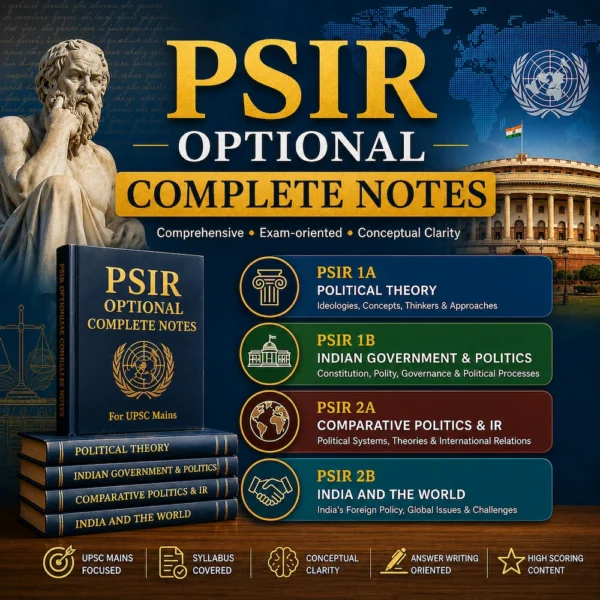
| Paper I, Section A | Political theory, theories of the state, justice, equality, rights, democracy, power, ideologies, Indian and Western political thought | 10 | Political Theory and Indian Politics |
| Paper I, Section B | National movement, making and features of the Constitution, organs of government, grassroots democracy, statutory bodies, federalism, planning, caste, religion and ethnicity, party system, social movements | 11 | Indian Government and Politics |
| Paper II, Section A | Comparative politics, the state, representation, globalisation, IR theories and concepts, world order, the international economic system, the UN, regionalism, global concerns | 11 | Comparative Political Analysis and International Politics |
| Paper II, Section B | Indian foreign policy, NAM, South Asia, the Global South, the major powers, the UN system, the nuclear question, recent developments | 8 | India and the World |
What Makes These PSIR Notes Different
Mapped to the Syllabus, Clause by Clause
Most PSIR notes in circulation follow a coaching institute’s class order. These follow the official PSIR syllabus unit by unit, so nothing is skipped and nothing is buried inside an unrelated chapter.
Updated for UPSC 2027
Half the PSIR syllabus changes every year. Notes written for 2021 or 2022 miss what examiners now expect you to cite. These notes are updated with developments up to 2026, for example:
- Paper I, Section B: the 16th Finance Commission report (February 2026), the Supreme Court’s opinion on Governors’ assent to Bills (November 2025), the defeat of the Constitution (131st Amendment) Bill on delimitation (April 2026), and caste enumeration in Census 2027.
- Paper II: BRICS at eleven members with India in the 2026 chair, the 2025 US tariff war and the US Supreme Court’s ruling against IEEPA tariffs (February 2026), the WTO’s MC14 at Yaoundé, and the India–EU free trade agreement concluded in January 2026.
Previous Year Questions After Every Topic
Each topic ends with the verbatim questions UPSC has asked on it, so you read with the exam in mind. For worked answers, see the topic-wise PSIR PYQ solutions, and for full papers, the PSIR optional question papers.
Thinkers, Debates and Indian Examples
Paper I rewards answers that compare thinkers and take a position; Paper II rewards answers grounded in current events. The notes are built for both: thinker-by-thinker treatment with critiques for political theory, and up-to-date Indian examples for every institution and every bilateral relationship.
PSIR Notes PDF: How to Download
You can read every topic free on this page. If you prefer to study offline or print, these are the PDF options:
| Option | What you get | Price |
|---|---|---|
| PSIR Optional Complete Notes | All four sections as printable A4 PDFs, with PSIR question papers 1991–2025 free inside | ₹1,180 (₹599 a paper, ₹354 a section) |
| PSIR Mains Master Kit 2027 | Complete notes plus four revision booklets, practice question set, topic-wise PYQ bank 1986–2026 and answer toolkit | ₹1,770 |
| Updated Utkarsh Dwivedi PSIR notes | AIR 5 (CSE 2021) topper’s PSIR notes, corrected and updated by Team LotusArise IAS | Free |
How to Use These PSIR Notes
- Start with the syllabus. Keep the PSIR syllabus open and tick off each unit as you finish it.
- Begin with Paper I, Section A. Political theory and thought give you the concepts and thinkers you will reuse across all four sections.
- Read the previous year questions at the end of each topic, and write one answer before moving on — the answer writing tips show the structure that scores.
- Make your own short notes once a unit is done — here is how to condense PSIR material for revision.
- Revise in cycles and add current examples to Paper I-B and Paper II topics as you read the news.
More PSIR Resources
- PSIR Optional Strategy
- PSIR Study Plan for Beginners
- PSIR Optional Booklist
- Books vs Notes for PSIR Optional
- PSIR Optional Test Series 2027