

Almost every argument about the Non-Aligned Movement’s record is an argument about the yardstick. Judged as an alliance it did nothing, because it was never an alliance; judged as moral protest it succeeded entirely, because protest needs only a voice. The real question lies between them — measured against what the movement set out to do, and against what a coalition of poor and militarily negligible states could plausibly deliver, what did it change?
- The answer is uneven in a consistent way: the movement delivered where the currency was legitimacy and almost nothing where the currency was material power.
- Its origins, its declared aims, Bandung and Belgrade, the Panchsheel code and its structure are treated separately and assumed here. This is the audit.
Setting the Standard: How to Assess a Movement With No Secretariat, No Charter and No Enforcement

Before any achievement can be counted the instrument has to be described accurately, and most criticism of the movement fails at exactly this point — holding it to a standard designed for a different kind of body.
What the movement had, and what it deliberately did not have
- The founders chose the word “movement” rather than “organisation” precisely to escape the machinery of an organisation, and that choice determined everything that followed.
- No charter. There is no founding treaty, no list of binding obligations, and no article any member can be said to have violated.
- No permanent secretariat. Administrative continuity rests on the chair-in-office, which rotates with the summit host every three years, supported by a Coordinating Bureau of member representatives in New York.
- No enforcement, no sanctions, no expulsion. A member that acts against the movement’s declared principles faces nothing but words, and often not even those.
- Consensus decision-making. Every declaration must satisfy every member present, which sets the ceiling of any collective position at the level of its least willing signatory.
- What it did have was numbers inside institutions that count votes, and a normative vocabulary — sovereign equality, self-determination, non-intervention, racial equality, disarmament, development — that the colonial powers had themselves written into the UN Charter and could not easily disown.
- T. V. Paul (“The power of non-alignment”, The Hindu, 11 October 2018) calls this repertoire soft balancing by weak states, adopted because they had little material capacity to constrain superpower conflict or the arms race.
- Its currency is normative power — peace, disarmament, development, autonomy of choice and a reformed world order — and its instrument is “naming and shaming” great powers where they cannot simply be ignored.
Three yardsticks, three different verdicts
| Yardstick | What it asks | Verdict on the movement | Why the verdict comes out this way |
|---|---|---|---|
| The alliance standard | Did it protect members, deter aggression, intervene in wars? | Total failure | No armed forces, no mutual-defence clause, no intention of acquiring either; this tests a promise it never made |
| The bargaining-coalition standard | Did it extract concessions from the strong? | Mixed, tilting to failure | It won where the concession was a vote or a norm, lost where it was money, technology or weapons |
| The normative standard | Did it change what counts as legitimate? | Substantial success | Colonial and racial rule became indefensible in public argument within a generation |
- All three yardsticks are legitimate and they do not agree, so a single-word verdict is a choice of yardstick disguised as a finding.
- The productive question is which kind of outcome the movement could convert its assets into — and the record shows a consistent line between normative goods, which it won, and distributive goods, which it did not.
The movement was strongest where world politics runs on legitimacy and weakest where it runs on capability. Its record is the map of that difference.
What such a coalition can and cannot be expected to deliver
- It can shift the burden of justification, making a practice presumptively illegitimate so that its defenders must argue rather than simply act.
- It can build institutions of scrutiny — committees, standing agenda items, annual votes — that convert a diffuse grievance into a permanent administrative fact.
- It can confer recognition, which is a real resource: observer status turns a rebellion into a party to a dispute.
- It cannot compel a state willing to be condemned. Against a power indifferent to reputational cost — the USSR in Hungary or Afghanistan, the United States in Vietnam — shaming has no purchase.
- It cannot supply what its members lack — capital, technology, markets, force. A coalition of the poor cannot redistribute wealth it does not hold.
- It cannot discipline its own members, because the absence of obligation that made membership attractive also made collective action unenforceable. That is not a defect it failed to fix; it is the price of the design that made it large.
Decolonisation: The Clearest Success, and Why It Has to Be Argued
The standard claim — that the movement accelerated decolonisation — is usually asserted rather than demonstrated, which invites the obvious retort that colonies would have become independent anyway, given European exhaustion and nationalist mobilisation on the ground. The retort is partly right and entirely insufficient. The movement’s contribution was not to cause independence; it was to change the terms on which independence was claimed and the speed at which it was conceded.
The arithmetic that made everything else possible
- Membership of the United Nations rose from 51 founding states in 1945 to well over a hundred within two decades, and the additions were overwhelmingly Asian and African, overwhelmingly newly independent, and overwhelmingly non-aligned in sympathy if not always in formal membership.
- 1960 alone brought seventeen new members, sixteen of them African — a single year that permanently altered the composition of the General Assembly.
- Because the Assembly runs on one state, one vote, and because its resolutions on decolonisation required only a majority, the new states acquired agenda-setting power they possessed nowhere else in the international system.
- This is the mechanism the whole achievement rests on: the movement did not have armies, but it had a standing majority in the one universal forum where numbers translate directly into outcomes, and it used that majority with unusual discipline on precisely one cluster of issues.
Resolution 1514 and the reversal of the burden of proof
- The Declaration on the Granting of Independence to Colonial Countries and Peoples, adopted as General Assembly Resolution 1514 (XV) on 14 December 1960, is the single most consequential document the non-aligned constituency produced.
- It was tabled by forty-three Asian and African states as a deliberate alternative to a more polemical Soviet draft — an important detail, because it shows the constituency acting as an independent bloc rather than as a Soviet auxiliary.
- It passed 89 votes to none, with nine abstentions: Australia, Belgium, the Dominican Republic, France, Portugal, South Africa, Spain, the United Kingdom and the United States. Every colonial power abstained; not one could bring itself to vote against.
“The subjection of peoples to alien subjugation, domination and exploitation constitutes a denial of fundamental human rights, is contrary to the Charter of the United Nations and is an impediment to the promotion of world peace and co-operation.” — Resolution 1514 (XV)
- The Declaration did three things no earlier instrument had done.
- It stated that “all peoples have the right to self-determination” as a right, not as an aspiration to be granted when a metropolitan power judged a territory ready.
- It removed the standard delaying argument by declaring that “inadequacy of political, economic, social or educational preparedness should never serve as a pretext for delaying independence” — which struck directly at the trusteeship logic of the Charter’s own Chapter XI.
- It classified colonial rule as a violation of human rights and a threat to peace, moving the question out of the domestic jurisdiction of the metropolitan power and into the legitimate business of the international community.
- The consequence was a reversal of the burden of proof.
- Before 1514 a colonial power was presumed entitled to rule until it chose otherwise; after 1514 it was presumed obliged to leave and had to justify staying. That is a change in the structure of the argument, and the kind of change a normative coalition can produce.
The machinery that followed, and why machinery matters
- Declarations decay unless something institutional is built to enforce them, and the constituency immediately built one.
- Resolution 1654 (XVI) of 27 November 1961 created a Special Committee of seventeen members to examine the application of the Declaration and recommend how to implement it.
- Resolution 1810 (XVII) of 17 December 1962 enlarged it to twenty-four, giving it the name by which it is still known — the Committee of Twenty-Four, or C-24.
- The Committee acquired powers that mattered in practice: it reviews the list of Non-Self-Governing Territories, hears petitioners from those territories directly, dispatches visiting missions, and reports annually to the Assembly.
- The effect was to make decolonisation a permanent standing item rather than a series of crises. A colonial administration now faced annual scrutiny, testimony from its own subjects, and a documented record — a low-grade but unremitting cost that no single episode of repression could discharge.
- The common Article 1 of the two 1966 human rights Covenants and the 1970 Declaration on Friendly Relations then entrenched self-determination in general international law, and the International Court of Justice has treated the right as flowing from this sequence. A political demand had been written into the vocabulary of law.
Support for liberation movements and the politics of recognition
- Where a territory’s rulers refused to concede, the movement’s instrument was recognition of the movements fighting them, which raised their status without requiring anyone to fight alongside them.
- Non-aligned summits from Lusaka 1970 and Algiers 1973 onward received liberation movements as guests, endorsed them by name, and channelled diplomatic and material support through African and Arab members.
- The Palestine Liberation Organization was invited to address the General Assembly and granted observer status by Resolution 3237 (XXIX) of 22 November 1974, an outcome driven by the Afro-Asian and non-aligned majority.
- The South West Africa People’s Organisation was recognised as the authentic representative of the Namibian people and given observer status in 1976, which underwrote the long diplomatic route to Namibian independence in 1990.
- Recognition is easy to dismiss as symbolism, and was not: observer status conferred standing to speak and to be counted as a party, converting an insurgency into a diplomatic actor and denying the incumbent the claim that it faced mere criminality.
The counter-argument, and how far it holds
- The objection. Decolonisation was driven by nationalist mobilisation in the colonies and by the fiscal and political exhaustion of the metropoles; the General Assembly ratified an outcome it did not cause, and the movement is claiming credit for the weather.
- What it gets right. No resolution liberated Algeria or Vietnam; those were won by war, and the timing of British and French withdrawal owed more to Suez, Dien Bien Phu and domestic politics than to any vote in New York.
- What it misses. Three things were not available from nationalist mobilisation alone.
- Simultaneity. Isolated nationalist movements can be defeated one at a time; a general norm made each concession a precedent against every remaining colonial holding, and made piecemeal resistance untenable.
- The hardest cases. Where the metropole was not exhausted and did not intend to leave — Portugal’s African territories, Rhodesia, Namibia, South Africa — external delegitimisation and its accompanying sanctions were a substantial part of what eventually broke the position.
- The vocabulary itself. That colonial rule became something to be defended rather than assumed is not a natural fact. Someone had to make the argument, repeatedly, in the one place where the colonial powers were outnumbered.
- The defensible claim is therefore precise: the movement did not cause decolonisation, but it compressed its timetable, generalised its principle, and made self-determination a right rather than a concession. That is the strongest single item on the balance sheet.
The Campaign Against Apartheid: Delegitimisation as a Weapon
If decolonisation shows the movement working with the grain of history, South Africa shows it working against a determined, well-armed and well-connected state — and winning slowly. The campaign is the best available test of what sustained normative pressure can do when it is combined with material measures that member states could actually impose.
India’s opening move, which predates the movement by fifteen years
- India raised the treatment of Indians in South Africa at the General Assembly’s first session in 1946, before its own independence was complete, carrying a resolution over British and South African objections that the matter was the Assembly’s business.
- This settled the jurisdictional point early: Pretoria’s claim that racial policy was a domestic matter shielded by Article 2(7) of the Charter was contested from the start and never accepted.
- India severed trade relations with South Africa in 1946, the first state anywhere to impose sanctions over racial policy.
- The movement did not invent the campaign; it inherited an Indian initiative and gave it a permanent multilateral constituency — which is what such an initiative needs to survive its originator’s changing priorities.
Building the machinery
- General Assembly Resolution 1761 of 6 November 1962 condemned apartheid, called for economic and diplomatic sanctions, and created the Special Committee against Apartheid, a standing body to monitor, publicise and mobilise.
- It did for apartheid what the Committee of Twenty-Four did for colonialism: converted episodic outrage into annual, documented, institutional pressure.
- Security Council Resolution 181 of 7 August 1963 established a voluntary arms embargo, which the major suppliers largely evaded. Resolution 418 of 4 November 1977 made it mandatory under Chapter VII — the first binding sanctions ever imposed on a member state. The fourteen-year gap measures both the difficulty and the persistence.
- An oil embargo was the non-aligned constituency’s most effective material contribution, because South Africa had no domestic crude. Arab and other producers embargoed supply from 1973, and the Assembly adopted a formal voluntary petroleum embargo in 1987. Enforcement leaked and Pretoria paid heavy premiums through intermediaries, but the cost was real and rising.
- Sporting and cultural isolation attacked the regime’s self-image rather than its finances: South Africa was excluded from the Olympic Games from 1964 and expelled from the International Olympic Committee in 1970, the Assembly recommended severing sporting and cultural ties from 1968, and the Gleneagles Agreement of 1977 committed Commonwealth governments to discourage sporting contact.
- The Assembly kept a register of entertainers and sportspersons who broke the boycott — naming and shaming of exactly the type Paul describes, effective because the target was a settler society acutely conscious of its Western standing.
- Support for the African National Congress ran through the movement’s African members: recognition of the ANC and the Pan Africanist Congress as authentic representatives, observer status at the UN, funding, training facilities and diplomatic representation in non-aligned capitals.
Mandela’s own verdict, and what it is worth
- Nelson Mandela, addressing the movement’s summit at Durban in 1998 as President and incoming chair, acknowledged its part in the anti-apartheid struggle directly, treating non-aligned solidarity as a debt his country owed and a reason for South Africa’s own commitment.
- Asked whether sanctions had helped end apartheid, his answer was unequivocal that there was no doubt of it; F. W. de Klerk made the same judgement, citing the economic unsustainability of the burden of international sanctions.
- Testimony from the victor and from the man who conceded is unusually strong evidence where causal claims are normally untestable. It does not show the movement’s contribution was decisive; it does show the pressure was felt by the people who had to decide.
The limits of the achievement, stated honestly
- The decisive pressure was internal — township revolt from 1976 and 1984, the unions, and the collapse of government by consent.
- The movement’s own members leaked: trade continued through intermediaries, and several African states kept covert commercial and security relationships while voting for embargoes.
- The largest economic levers were Western, and Western governments moved late; the movement could set the agenda but could not itself deliver the capital markets, disinvestment or technology denial that ultimately bit.
- It took forty-eight years from India’s first move to the 1994 election — a long time to hold a coalition together on one issue, and the reason the campaign counts as achievement rather than gesture.
Disarmament and the Nuclear Question: Sustained Advocacy, Almost No Leverage
Here the pattern that runs through the whole record is at its starkest. The movement produced a coherent, persistent and intellectually serious disarmament position over six decades, and converted almost none of it into constraint on the states that own the weapons.
What the movement asked for
- A comprehensive ban on nuclear testing, which was the movement’s earliest and longest-running demand.
- Jawaharlal Nehru was the first head of government anywhere to call for a halt to testing, proposing a “standstill agreement” on 2 April 1954, weeks after the Castle Bravo test at Bikini — a demand made two years before the movement existed and carried into it as founding property.
- The line ran unbroken from there to the Partial Test Ban Treaty of 1963, which the non-aligned welcomed as an instalment and criticised as insufficient because it permitted underground testing, and on to the Comprehensive Nuclear-Test-Ban Treaty of 1996.
- Nuclear-weapon-free zones, which are almost entirely a construction of non-aligned regions and the movement’s most tangible disarmament achievement.
- Tlatelolco (1967) for Latin America and the Caribbean, Rarotonga (1985) for the South Pacific, Bangkok (1995) for Southeast Asia, Pelindaba (1996) for Africa and Semipalatinsk (2006) for Central Asia together place most of the Southern hemisphere and a large part of the tropics under treaty prohibition.
- The demand for a zone free of weapons of mass destruction in the Middle East, pressed continuously by non-aligned members, remains unrealised and is one of the recurring reasons the Non-Proliferation Treaty’s review conferences collapse.
- The complete elimination of nuclear weapons within a time-bound framework, as against the great powers’ preference for managed, bilateral and open-ended reduction. The movement rejected the premise that a permanent division between nuclear haves and have-nots was acceptable, and it has never departed from that position in a summit declaration.
- Non-discrimination in the non-proliferation regime. Non-aligned members supplied the standing critique that the Non-Proliferation Treaty binds the many and exempts the few.
- They argued equally that export-control regimes formed outside the United Nations have no basis in international law and restrict dual-use technology so extensively as to freeze the industrial development of the South. The architecture is treated separately; the critique was the movement’s, and has outlived its capacity to act on it.
- General and complete disarmament and reduced military expenditure, framed as a development argument — resources consumed by the arms race were resources denied to the poor. Linking a security demand to a distributive one is the movement’s distinctive contribution to disarmament discourse.
The record: what the advocacy actually moved
- Real credit is owed for normalising the nuclear-weapon-free zone, for keeping disarmament permanently on the General Assembly agenda, and for articulating the humanitarian and equity case that eventually surfaced in the Treaty on the Prohibition of Nuclear Weapons, in force since 2021 and joined by no nuclear-armed state.
- Members also worked outside the movement’s machinery. The Six-Nation Five-Continent Peace Initiative, launched on 22 May 1984 by the leaders of Argentina, Greece, India, Mexico, Sweden and Tanzania, demanded an immediate halt to the testing, production and deployment of nuclear weapons.
- Three of the six — India, Argentina and Tanzania — were members, the other three being observers: evidence of the constituency’s seriousness, and of its judgement that a small committed caucus could achieve what a hundred-member consensus could not.
Why numbers never became leverage
- Assembly resolutions are recommendations, and binding decisions are made in the Security Council, where the nuclear powers hold vetoes. The movement’s numerical strength was concentrated exactly where it counted least.
- It possessed nothing the nuclear powers wanted. Leverage requires the ability to withhold something valuable — markets, capital, security cooperation, technology — and a coalition of capital- and technology-importing states had no such instrument.
- The demonstration case is its own founding summit. The Soviet Union resumed atmospheric testing on 1 September 1961, the opening day of the Belgrade conference.
- The assembled leaders could do nothing beyond appeals to Kennedy and Khrushchev that produced courteous replies and no change of policy. The pattern held for six decades: the demand could be formulated, and ignored at no cost.
- Members’ own security interests fractured the position, so the movement’s disarmament language was always more united than its members’ behaviour.
The uncomfortable counterpoint: the movement’s own proliferators
- The most damaging fact for the disarmament claim is that a disproportionate share of new nuclear-weapon states came from within the membership.
- India tested in 1974 and declared itself a weapon state in 1998; Pakistan followed within weeks. Both were founding-generation or early members, and both abandoned the movement’s stated position on acquiring the weapons while retaining its stated position on everyone else’s.
- North Korea, a member, withdrew from the Non-Proliferation Treaty and tested from 2006.
- Iraq, Libya and Iran all pursued programmes of varying seriousness while members; South Africa built six devices under apartheid, dismantled them, and joined the movement in 1994.
- By January 2026 two members — India with about 190 warheads and Pakistan with about 170 — sit inside a movement whose every summit declaration demands the elimination of nuclear weapons.
- The movement never produced a response beyond silence, having no mechanism capable of one. A body that cannot discipline members cannot enforce a norm on them, and a disarmament coalition containing nuclear-armed members has a credibility problem it cannot argue away.
- The defence available is real but limited: the movement’s position was always that disarmament must be universal, and its members’ acquisitions were justified by them as responses to a discriminatory order the movement itself had condemned. That is internally consistent and it is also exactly the argument every proliferator makes.
The Economic Campaign: The Most Ambitious Demand and the Completest Failure
From the mid-1960s the movement’s centre of gravity shifted from political to economic non-alignment, on the reasoning that formal sovereignty without economic autonomy was hollow. The campaign produced institutions that still exist, a programme that was adopted by the General Assembly, and no change whatever in the distribution of world income.
The institutional build-up
- UNCTAD, established in 1964 as a permanent organ of the General Assembly, gave developing states a forum on trade and development that they controlled numerically, outside the weighted voting of the Bretton Woods institutions.
- The Group of 77, formed by a Joint Declaration of seventy-seven developing countries at the first UNCTAD in June 1964, became the negotiating arm of the same constituency.
- The division of labour is the crucial point: the movement supplied political leadership and summits, the G-77 supplied negotiating machinery, and the overlap in membership was almost complete.
- The Algiers summit of 1973 launched the demand for a New International Economic Order, in the confidence created by that autumn’s oil shock.
- The General Assembly adopted the Declaration on the Establishment of a New International Economic Order, Resolutions 3201 and 3202 (S-VI) of 1 May 1974, at a special session called at Algeria’s initiative, and followed it in December with the Charter of Economic Rights and Duties of States, Resolution 3281 (XXIX).
What was actually demanded
- Responsibilities imposed on multinational corporations, including regulation of their conduct, a code of conduct on technology transfer, and an unqualified right of host states to nationalise foreign assets with compensation determined by domestic law rather than by international arbitration.
- Better valuation of primary commodities, through indexation of raw-material prices to the price of manufactured imports, an Integrated Programme for Commodities and a Common Fund to stabilise earnings — in effect, a demand that the terms of trade be administered rather than left to the market.
- Pressure on Western states to transfer funds and technology — concessional finance at target proportions of donor income, debt relief, preferential and non-reciprocal market access, and the transfer of industrial technology on non-commercial terms.
- Permanent sovereignty over natural resources and the right of producers to form commodity associations — the OPEC precedent generalised.
- The underlying analysis of surplus drained from periphery to core, unequal exchange and structural dependency is the subject of the archive’s notes on the international economic system and is not re-run here. What matters for the audit is that the diagnosis was serious and the remedy was not deliverable.
Why it produced nothing
| Reason it failed | The mechanism |
|---|---|
| No solidarity once interests diverged | The 1973 oil shock enriched a handful of members and devastated the oil-importing majority, whose balance-of-payments crises were caused by fellow non-aligned states; commodity interests split producers from consumers within the same coalition |
| No bargaining power comparable to OPEC’s | OPEC could withhold a good with no substitute in the short run; the movement’s members exported commodities that were substitutable, stockpiled or produced elsewhere, and could not bring the OPEC members on board with a general Southern programme |
| Proposals that were utopian in construction | Indexation demanded equivalent value for raw materials and manufactures, which no market mechanism can deliver; the programme amounted to an attempt to apply socialism to international trade without any authority capable of administering it |
| Western success in dividing the South | Developed states cultivated differentiated relationships — preferential access for some, aid for others, geopolitical alignment for a third group — and the newly industrialising exporters of East Asia had no interest in a commodity-price regime |
| No sanction for non-compliance | The NIEO resolutions were General Assembly recommendations; the developed states voted against or abstained, and simply declined to implement what they had not agreed to |
| The venue shifted | Hard economic questions — debt, finance, trade, development lending — migrated out of the General Assembly, where the South had votes, into the IMF, the World Bank and the GATT, where voting is weighted and conditionality operates |
- The debt crisis from 1982 completed the reversal: indebted states negotiating individually with the Fund and their creditors had every incentive to differentiate themselves from other debtors rather than hold a front.
- The Washington Consensus — the liberalising package that became the standard condition of external finance from the later 1980s — superseded the NIEO agenda entirely, and without a debate. By the 1990s the same states that had demanded administered commodity prices were competing for the foreign investment the NIEO proposed to regulate.
- The movement’s two most consistent goals — development of the third world and the eradication of poverty — are therefore where its record is weakest — not because the goals were wrong but because achieving them needed instruments it never possessed.
The economic campaign asked the strong to redistribute voluntarily and offered them nothing in return. It was not defeated; it was declined.
Institutional and Normative Achievements: The Part That Is Hardest to Measure
Beneath the headline campaigns sits a quieter set of achievements — structural, cumulative, and easy to underrate because several of them consist of things that did not happen.
The United Nations and peacekeeping
- Consistent support for strengthening the United Nations is the least contested item in the record, and it followed from self-interest: a universal organisation with sovereign equality and a one-state-one-vote assembly is the most favourable environment a weak state can inhabit.
- On the basis of numerical strength, non-aligned members exercised continuous influence over General Assembly decisions, shaping agendas, sponsoring resolutions and controlling any vote on which they held together.
- They supported UN peacekeeping in all its major operations and became the principal contributors of troops — unglamorous institutional investment that gave the organisation the capacity to act at all.
- The movement supplied the standing demand for democratisation of international relations: Security Council reform, restraint on the veto, and resistance to moving economic questions out of the universal body into restricted ones.
- Prevention of full bipolarisation. Wide acceptance among newly independent states gave them a third option at the moment of choosing, and much of the world declined enrolment in either bloc.
- The achievement is negative and therefore invisible, but a system in which every new state had been allocated to a camp would have been considerably more dangerous.
Sovereign equality and non-intervention as operative norms
- Persistent restatement of sovereign equality, territorial integrity, non-interference, non-aggression and peaceful settlement converted Charter language into operative expectations that states had to argue against rather than ignore.
- The significance appears in what became difficult to do openly: annexation, colonial reacquisition, and the public claim that great powers may dispose of small ones. The norms did not prevent intervention; they raised its price and forced it into pretext.
The Non-Aligned News Agencies Pool and the information order
- Western control of the international news agencies meant that information about the developing world was produced in the North for Northern audiences, and non-aligned governments argued that the resulting picture of their societies was distorted, crisis-driven and politically consequential.
- The Non-Aligned News Agencies Pool was built to break that monopoly. Founded in late 1974 at Yugoslav initiative, operating from January 1975 under the Yugoslav agency Tanjug, it was formally adopted at the New Delhi ministerial conference of 1976.
- It worked as an exchange network: members contributed their own material and drew on the pool without charge, so that a story about Africa could reach Asia without passing through London or New York. Around twenty-six agencies joined in the first year, most state-owned. It later became the internet-based NAM News Network.
- The Pool was the operational arm of the campaign for a New World Information and Communication Order, pursued through UNESCO and stated intellectually in the MacBride Report of 1980, which diagnosed a one-way news flow and called for balance.
- The Western reaction was fierce, on press-freedom grounds: the United States withdrew from UNESCO in 1984 and the United Kingdom in 1985, and the programme was abandoned. The Pool declined with it, weakened further by Tito’s death and by the Iran–Iraq war, which set two members against each other.
- The episode is the record in miniature: a real diagnosis, a working institution built quickly, and collapse the moment the strong imposed a cost. The critics were also partly right — a network of state-owned agencies is a poor instrument for correcting distortion.
Diplomatic space for small states
- The achievement hardest to measure, and most consistently underrated, is that the movement gave states with no individual leverage a place to be heard, a caucus to join and a reason to be consulted.
- A summit of a hundred heads of government is a standing bilateral opportunity; the meetings on its margins are often worth more to a small state than the declaration.
- Membership offered an identity other than client, a domestic political asset as much as an international one.
- The benefit is invisible in outcomes, which is why it appears in no list of achievements and in every honest account of why the membership has never stopped growing. States do not persist for sixty-five years in an institution that gives them nothing.
The “Third Force” Question: What It Meant and Whether It Was Ever Realisable
The most persistent charge is that the movement set out to be a third force in world politics and failed because it grew too large and unwieldy to act. The charge is half right, and the wrong half matters more — size is the most visible explanation rather than the strongest.
Four things “third force” could mean
- The phrase was never defined by the movement, and its four available meanings carry entirely different tests of success.
| Sense | What it would require | Did the movement achieve it? |
|---|---|---|
| A third bloc | Common defence, coordinated policy, an institutional core, capacity to act as one | No, and it never tried. A bloc is what “movement, not organisation” was designed to avoid |
| A bargaining coalition | Cohesion enough to extract concessions by withholding what the strong wanted | Rarely. Won on decolonisation and apartheid; lost on economics and disarmament |
| A moral voice | Consistency, and principles applied to friends as well as adversaries | Partly, and wrecked by selectivity — condemning Suez while abstaining on Hungary destroyed the consistency the role needs |
| A balancer | Capability to shift outcomes between the poles, or raise the cost of confrontation | No, in the hard sense. What it managed was soft balancing, which constrains only at the margin |
- Confusion between the four makes the debate irresolvable: the movement is convicted of failing at the first and fourth senses, which it never attempted, and given no credit for partial success at the second and third.
- The defensible reading is that the founders intended the second and third senses combined — enough weight to be consulted, enough standing to be believed — and achieved it for roughly two decades.
The size problem, stated fairly
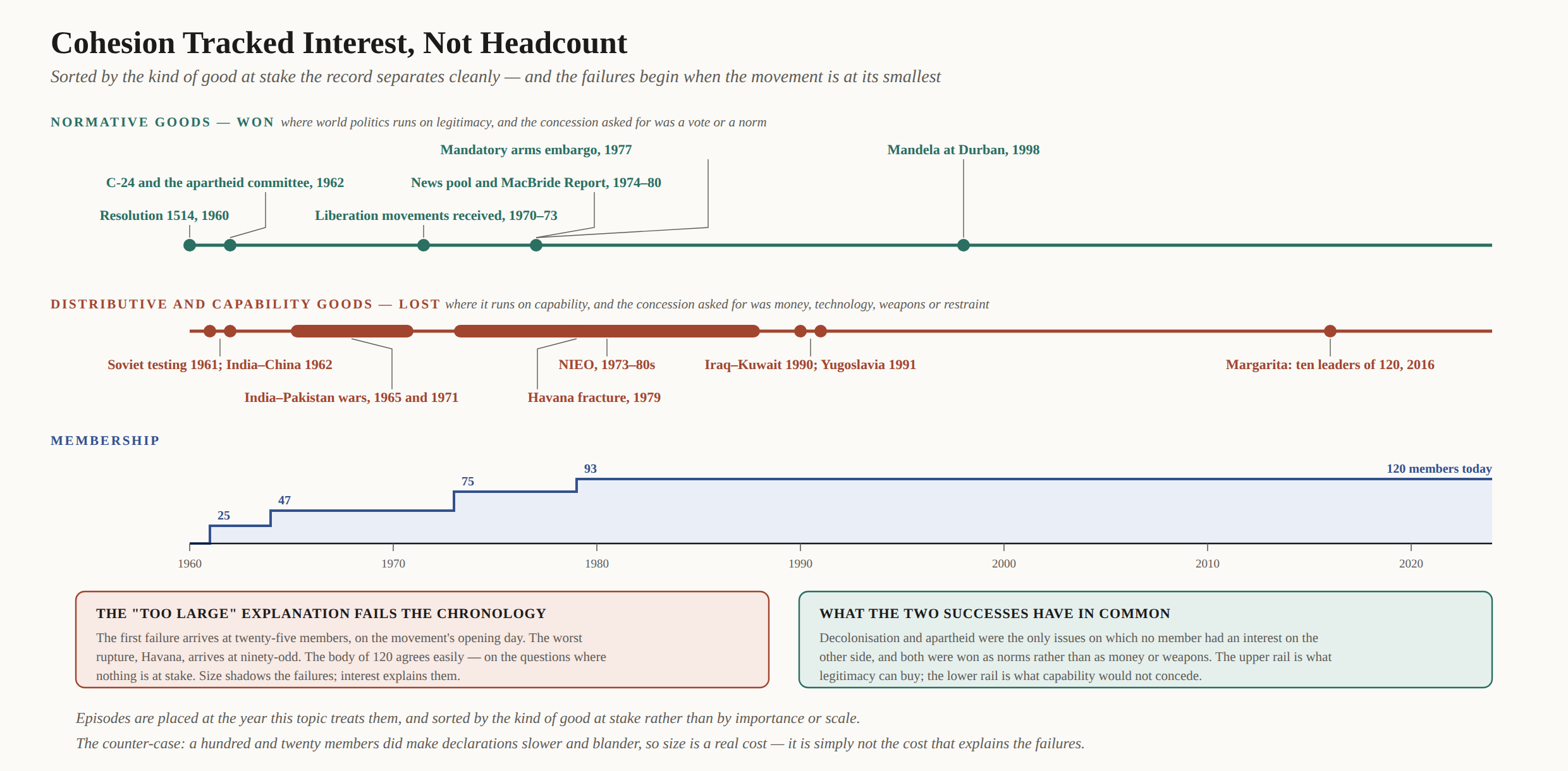
- The growth is real and dramatic: twenty-five states at Belgrade in 1961, forty-seven at Cairo in 1964, seventy-five at Algiers in 1973, ninety-three at Havana in 1979, and 120 members, 18 observer states and 10 observer organisations today — the largest grouping of states after the United Nations itself.
- Two consequences follow directly from the arithmetic, and a third from how membership was granted.
- Consensus becomes lowest-common-denominator. A document that must satisfy 120 governments, from genuinely equidistant states to effective clients of one bloc, cannot contain a proposition any of them objects to. What survives is a list of pieties.
- Declarations lengthen as they weaken. The 2016 summit produced a very long outcome document — everything included, nothing decided; one observer likened such texts to a Christmas tree on which every member’s issue is hung.
- Membership criteria compounded it: the Belgrade qualifying tests were liberal in drafting and loose in application, and states plainly aligned by treaty, base or dependency were admitted anyway, because refusing them meant a quarrel the movement could not survive.
But did size cause the failure? Three rival explanations
The claim that the movement failed because it was too large and unwieldy is testable, and it does not survive the test intact. Three rival explanations account for more of the record, and the honest answer distinguishes them.
- Rival one: heterogeneity of interest, not number of members. Size and diversity are separable, and it is diversity that bites.
- A hundred states with a common interest can act; twenty-five with opposed interests cannot. The failures cluster wherever members’ interests genuinely conflicted — oil producers against oil importers, India against Pakistan, Iran against Iraq — and the successes wherever they did not.
- Decolonisation and apartheid were the two issues on which no member had an interest on the other side, which is why they are the two successes. Cohesion tracked interest, not headcount.
- The chronology confirms it: the most damaging rupture, at Havana in 1979, came at ninety-odd members over an ideological question, while the same body at 120 members holds together easily on questions where nothing is at stake.
- Rival two: no material capability to enforce a common position. Even a perfectly cohesive movement could not have delivered what was asked of it.
- Enforcement was excluded by design, so a common position had no instrument behind it, and agreement without capability produces a statement rather than an outcome.
- This explains the failures cohesion cannot: the movement was fully united in demanding an end to nuclear testing and got nothing, because unity was never the binding constraint.
- Rival three: dependence on bipolarity for leverage. Non-alignment was valuable because two superpowers were competing for the same states, which gave the uncommitted a price. Courtship was the source of the leverage; the movement did not generate it.
- This is the structural argument, and it is not rhetorical: when one pole disappeared the auction ended and the instrument went with it, while the membership went on rising.
- How the three rank. Heterogeneity explains the failures of cohesion; the absence of capability explains the failures where cohesion existed; dependence on bipolarity explains why cohesion stopped producing results after 1991.
- Size is a real aggravating factor and a poor primary cause, because it operates only through heterogeneity — and the movement grew large precisely because it was undemanding, so the cause of its incoherence was also the cause of its reach.
The movement did not fail because it was too large. It grew large because it asked nothing of its members, and asking nothing is why it could not act.
So was the ambition ever realisable?
- In the bloc sense, no, and not through contingent failure: a bloc required obligations that contradicted the founding purpose of preserving decisional freedom. The movement could be large or binding, not both.
- In the bargaining sense, partly, and only where the demand was for a norm rather than a resource and no member had a countervailing interest.
- In the moral-voice sense, yes — and it was squandered, not by size but by selectivity. A movement that condemned Suez and abstained on Hungary spent the asset it was accumulating.
- The ambition was realisable in a weaker form than its rhetoric claimed and a stronger form than its critics allow. What was never available was the version in which the world’s poorest states balance two nuclear superpowers.
The Failures, Stated Without Flinching
Wars between members, which the movement could neither prevent nor resolve
- India and China, 1962. A founder was attacked by the state with which it had signed Panchsheel, and the movement neither condemned the attack nor rallied to India.
- Ghana and Indonesia adopted explicitly pro-Chinese positions, and much of the Afro-Asian constituency chose neutrality between an aggressor and a founder.
- Six non-aligned states meeting at Colombo in December 1962 — Ceylon, Burma, Cambodia, Ghana, Indonesia and the United Arab Republic, convened by Sirimavo Bandaranaike — produced the Colombo Proposals.
- India accepted them in full; China accepted only “in principle” and refused the clarifications India sought. Indian opinion read the asymmetric withdrawal terms as favouring China, and mediation collapsed.
- India and Pakistan, 1965 and 1971. Both belligerents were members, and the movement had no position.
- Indonesia and Egypt supported Pakistan in 1965, and several West Asian members did the same in both wars.
- In 1971 Sri Lanka let Pakistani aircraft refuel at Katunayake after India closed its airspace, materially assisting one member against another.
- Iran and Iraq, 1980–88. Two members fought the longest conventional war of the later twentieth century; the movement’s mediation achieved nothing and the war split the membership on sectarian and Arab–Persian lines.
- Iraq’s invasion of Kuwait, 1990. Both parties were members, one had annexed the other, and the movement took no position — the clearest demonstration that non-aggression and territorial integrity carried no obligation. It played no role in the Gulf crises that followed.
- The civil war in Yugoslavia. The country of a founding father and host of the first summit disintegrated in war, and the movement played no part in preventing, mediating or even authoritatively commenting on it.
- The two 1990–91 failures together produced the crisis of purpose from which the movement has never fully emerged: Egypt, a founding member, proposed that the movement be dissolved, and the standard description of it since has been a movement in search of an agenda.
- The pattern is uniform: the movement never once acted on a conflict between its own members, having no mechanism to monitor events and no instrument to apply.
Selectivity in applying its own principles
- Hungary and Suez, 1956. In the same fortnight the constituency that became the movement condemned the Anglo-French–Israeli attack on Egypt at once and in full, and met the Soviet suppression of the Hungarian rising with hesitation.
- India abstained on the General Assembly resolution of 4 November 1956 calling for an end to Soviet intervention, joined a resolution on UN observers only weeks later, and Nehru criticised the Soviet action publicly on 19 November.
- Afghanistan, 1979. After the intervention of December 1979 the emergency special session of the General Assembly demanded withdrawal by 104 votes to 18, with 18 abstentions, carried in large part by non-aligned members.
- But the movement as such never condemned it. Its Cuban chair-in-office voted against the resolution, and India abstained, its representative telling the Assembly there was no reason to disbelieve Soviet assurances of withdrawal.
- The distinction matters and is usually blurred: a majority of members condemned the intervention while the movement did not, which shows exactly how little the collective structure could deliver even when its members agreed.
- The cost was reputational and permanent. A movement whose only asset is moral standing cannot apply its principles asymmetrically; the perception that condemnation of Western action was reliable while condemnation of Soviet action was negotiable is what let critics dismiss it as aligned in all but name.
Havana 1979: the fracture point
- At the sixth summit in Havana, 3–9 September 1979, with ninety-odd states attending, Fidel Castro argued as chair that the socialist bloc was the movement’s “natural ally” — that since imperialism was the enemy of the developing world, the Soviet Union was on the movement’s side by definition and equidistance was a fiction.
- The argument was resisted by Yugoslavia, India, Sri Lanka, Indonesia, Zambia and Singapore, and Tito’s rejection was the summit’s defining statement.
“The non-aligned movement is not and cannot be either the conveyor belt or the reserve of any bloc.” — Josip Broz Tito, Havana, 1979
- It also fractured over the seating of the Kampuchean delegation and over Egypt’s standing after Camp David, with the chair managing the floor to Egypt’s disadvantage; Burma withdrew from the movement altogether.
- Havana is the fracture point because it exposed the ambiguity the movement had never resolved — whether non-alignment meant equidistance between the blocs or opposition to imperialism, which in practice meant tilting toward one of them.
- The moderates won the argument and the movement lost the credibility, because the question had been asked in public and the answer had needed defending.
- The Soviet intervention in Afghanistan three months later, under a Cuban chairmanship that defended it, turned the ambiguity into a demonstrated liability.
Institutional weakness, restated as a diagnosis
- No charter and no obligations, so no member can be said to have breached anything, and no rule requires members to defend each other’s positions.
- No secretariat, so no institutional memory, no continuous work between summits, no follow-up on what a summit decides.
- Membership criteria too liberal and often violated, so the movement contains states whose alignment is a matter of treaty record.
- Consensus as the only decision rule, converting every contested question into silence or a formula.
- No mechanism for monitoring global events, so it cannot react at the speed crises move and typically has nothing to say until its next scheduled meeting.
- No self-discipline among members, who have consistently treated summit declarations as costless statements rather than commitments.
The Critics and Their Defenders: A Genuine Scholarly Disagreement
The verdict on the movement is contested by serious people arguing from different premises, and the disagreement is best presented as one rather than resolved by assertion.
- The structural case holds that the movement was a creature of bipolarity and its raison d’être went with one of the poles.
- With a single dominant power there is no space between blocs to occupy; the rival alliances it defined itself against — SEATO, CENTO, the Warsaw Pact — have dissolved; and its central task of decolonisation is complete.
- Its sharpest point is about members rather than structure: most are now heavily dependent on the United States in security, finance or market access, which does not leave them non-aligned in any meaningful sense. A movement of clients cannot be a movement of the uncommitted.
- Nor is it a forum for solidarity: with no charter and no rule requiring members to support one another, and competing against bodies like ASEAN and the Commonwealth that deliver concrete trade outcomes, it has no distinctive product — and no progress even where its members agree, on terrorism, the drug trade and non-proliferation.
- Hans Köchler, often cited for this view, argues the reverse: the unipolar moment dimmed the movement’s purpose only temporarily, and in a multipolar world it “may keep its relevance as a balancing force” — the real risk being marginalisation by its own members’ overlapping commitments to BRICS, the SCO or the Quad (“Non-Alignment in a Multipolar World”, 2024).
- Jagat S. Mehta, a former Indian Foreign Secretary, makes the mission-accomplished case (“Non-Alignment: Mission Accomplished”, Indian Express, 1991): the movement existed to advocate the independent rights of nations, those rights have been won, and the mission should be declared accomplished and the movement discontinued.
- This is the most generous critical position, treating dissolution as the proper end of a successful campaign rather than the burial of a failure.
- C. Raja Mohan makes the harshest case (“A movement in coma”, Indian Express, 20 September 2016), and it has two distinct parts that are often collapsed into one.
- First, the movement was irrelevant even before the Cold War ended — it had no concrete achievement to point to, because it was always idealistic to expect a hundred states with divergent interests to harmonise them into collective action.
- Second, the dysfunction did not end with the Cold War: the movement is now a movement in coma, reduced to a “triennial political ritual” in which attendance substitutes for purpose.
- T. V. Paul answers all three, and his defence is methodological before it is empirical.
- There is a structural intellectual bias against the movement, which he compares to the bias of upper classes and upper castes against subaltern movements in hierarchical societies: a coalition of weak states is assumed ineffective before its record is examined, and its successes attributed elsewhere.
- Judged by the standard appropriate to what it was, it functioned as a limited soft-balancing mechanism, using naming and shaming and normative delegitimisation where material balancing was impossible — an instrument with real if bounded effects that the realist literature is not equipped to see.
- The disagreement is about the yardstick, and the four positions arrange accordingly.
| Critic | Premise | What follows | The weakness of the position |
|---|---|---|---|
| The structural case | Relevance follows system structure | Bipolarity gone, purpose gone | Treats non-alignment purely as positioning; ignores normative work of independent value |
| Mehta | A body should end when its purpose is served | Honourable dissolution | Assumes the purpose was only decolonisation; the economic agenda was never completed |
| Raja Mohan | Achievement means concrete outcomes | Always irrelevant; now comatose | Sets a standard no weak-state coalition could meet; understates decolonisation and apartheid |
| T. V. Paul | Weak states act through legitimacy | Soft balancing is real, if limited | Hard to falsify, and thin on evidence of stopping anything a great power was determined to do |
Two Summits as Evidence: Tehran 2012 and Margarita Island 2016
The sixteenth summit, Tehran, August 2012
- Iran took the chairmanship at the sixteenth summit, Tehran, 26–31 August 2012, at the moment of maximum Western pressure: nuclear negotiations were deadlocked and sanctions were tightening. Egypt’s Mohamed Morsi handed the chair to Mahmoud Ahmadinejad for three years.
- Attendance was substantial — around twenty-four presidents, three monarchs, eight prime ministers and some fifty foreign ministers — and Manmohan Singh attended for India.
- UN Secretary-General Ban Ki-moon attended over American and Israeli objections, and used the platform to reject, from the podium, threats by any member state to destroy another and attempts to deny the Holocaust.
- The final document endorsed the right of all states to peaceful nuclear technology, naming Iran, and condemned unilateral sanctions imposed outside the Security Council. It could reach no agreed language on the Syrian civil war.
- What it showed, on both sides of the argument.
- It demonstrated real independence: 120 states declined to isolate a state the West was isolating, and the Secretary-General attended a summit he had been urged to boycott. Consensus in the largest caucus in the General Assembly is not nothing, and it plainly irritated the powers it was meant to.
- It equally demonstrated a willingness to be used. A chairmanship confers a platform, and Iran extracted a multilateral endorsement of its position at the moment it needed one — of a general principle already in Article IV of the Non-Proliferation Treaty, applied to a state whose compliance was the actual question.
- The claim that this was a “victory” reopening the relevance debate should be handled carefully. It changed nothing material: sanctions tightened, the programme continued, and the eventual settlement was negotiated bilaterally, not through the movement.
- What it reopened was the argument about relevance rather than relevance itself, by showing that the movement retains convening power without bargaining power — which is what its critics allege.
The seventeenth summit, Margarita Island, September 2016
- The seventeenth summit was held on Isla de Margarita, Venezuela, its leaders’ segment on 17–18 September 2016, under the theme “Peace, Sovereignty and Solidarity for Development”. Iran handed the chairmanship to Venezuela for 2016–19.
- The host was in severe economic collapse — triple-digit inflation, food and medicine shortages, mounting political crisis — and the government’s preparations, from repainting roads to stocking shelves on the island, became part of the summit’s story.
- Attendance was the lowest in the movement’s history relative to its size. Roughly ten of the 120 members were represented at head-of-state or head-of-government level, against more than thirty at Tehran four years earlier; those who came included Robert Mugabe, Hassan Rouhani and Mahmoud Abbas, alongside Venezuela’s regional allies.
- India was represented by Vice-President Hamid Ansari, the Prime Minister being absent — only the second occasion since 1961 on which an Indian Prime Minister had missed a summit, and a decision read at the time as a statement about the movement’s diminished standing.
- The outputs were extensive and inconsequential: a Margarita Declaration of twenty-one points on Palestine, the Cuban embargo, South–South cooperation, UN reform and climate change, and a very long final outcome document.
- What it revealed. A movement whose chairmanship can be held by a state in economic collapse, whose summit most members do not attend at leader level, and whose declaration is a compendium rather than a programme, is being maintained rather than used.
- It is the strongest evidence for the “triennial rituals” charge — and, awkwardly for that charge, evidence that 120 states still find enough value in membership to keep it alive.
The Balance Sheet
| Achievement | The corresponding limitation |
|---|---|
| Decolonisation accelerated by sustained General Assembly pressure; Resolution 1514 and the Committee of Twenty-Four made self-determination a right rather than a concession | Heterogeneity: members ranged from genuinely equidistant to effectively aligned, so positions settled at the lowest common denominator |
| Sustained opposition to apartheid, from India’s move of 1946 through the arms, oil, sporting and cultural embargoes to support for the ANC | No enforcement and no obligation: no charter, no sanction, no rule that members defend one another |
| Recognition and observer status for liberation movements, converting insurgencies into diplomatic parties | Conflicts among members never prevented — India and China, India and Pakistan, Iran and Iraq, Iraq and Kuwait |
| Advocacy of a comprehensive test ban, nuclear-weapon-free zones across the South, and the elimination of nuclear weapons | Members proliferated and the movement had no answer; leverage over the nuclear powers was never obtained |
| The UNCTAD and G-77 machinery and the NIEO demand, which put distribution on the agenda for a decade | No bargaining power; the campaign failed on solidarity, on OPEC, on utopian design, and was superseded by the Washington Consensus |
| Consistent strengthening of the United Nations, support for peacekeeping, and prevention of full bipolarisation | Selectivity in applying its own principles, over Hungary 1956 and Afghanistan 1979, which spent its moral capital |
| The Non-Aligned News Agencies Pool and the NWICO campaign, which broke the Western news monopoly for a decade | Institutional weakness by design: no secretariat, consensus rule, liberal membership criteria, no monitoring |
| Sovereign equality and non-intervention made operative, and diplomatic space preserved for small states | Dependence on bipolarity for leverage, so the instrument vanished when the structure did |
- The distribution across time is the finding that matters. The achievements cluster in the first three decades, when decolonisation and apartheid were live and superpower competition gave the uncommitted a price. The limitations are structural and present throughout — visible at Belgrade and unchanged at Margarita Island.
The Indian Dimension
- India is central to almost every achievement on the list, which is why the movement is unintelligible without it: the anti-apartheid campaign began as an Indian initiative in 1946, the test-ban demand as a Nehru proposal in 1954, and the decolonisation caucus rested on Indian leadership.
- India’s own practice departed from doctrine repeatedly, and the departures have to be stated because the movement’s selectivity problem is substantially India’s.
- Hungary, 1956 — abstention on the withdrawal resolution, alongside immediate and unqualified condemnation of the Anglo-French action at Suez.
- The Indo-Soviet Treaty of Peace, Friendship and Cooperation of August 1971, whose consultation clause made it an alignment in all but name, defended at the time as a necessary response to the Sino-American-Pakistani convergence.
- Afghanistan, 1979 — the refusal to condemn the Soviet intervention, and the abstention at the General Assembly.
- The defence offered was that non-alignment permits judging each issue on its merits, including India’s own interests. That is internally consistent, and it also shows how much the doctrine permits — which is the same latitude every other member used.
- The movement’s failure to support India was reciprocal and consequential: Ghana and Indonesia backed China in 1962; Indonesia, Egypt and several West Asian members backed Pakistan in 1965 and 1971; Sri Lanka assisted Pakistani aircraft in 1971.
- A founder discovered in three successive crises that the movement it had built would not take its side, and Indian enthusiasm never fully recovered.
- India’s own tilt toward the Soviet Union in the 1970s produced the mirror-image effect: it created confusion among smaller members, weakened the movement’s claim to equidistance, and pushed some of them toward one superpower or the other.
- India chaired the movement from the seventh summit, New Delhi, 7–12 March 1983, and used the chairmanship for a specific purpose: to pull the movement back from the Havana tilt and re-centre it on economic questions.
- Indira Gandhi made the moderate case as chair, and the summit restored the movement’s formal equidistance after four years of Cuban leadership, reasserting the North–South agenda and global negotiations over the East–West one.
- The chairmanship marks the high point of Indian investment in the movement, and also its last: what India did with the movement after 1991 belongs to a separate account.
Conclusion
- Judged as what it was — a normative coalition of weak states with numbers but no capability — the record divides cleanly rather than ambiguously.
- Where the good demanded was legitimacy, it delivered: decolonisation, the delegitimisation of racial rule, self-determination entrenched as a right, liberation movements recognised, and sovereign equality kept operative.
- Where the good demanded was material, it delivered nothing — not through bad argument but because redistribution, disarmament and technology transfer need leverage a coalition of the poor cannot manufacture by resolution.
- The “third force” ambition was realisable only in its weakest sense. A bloc was excluded by the founding design; a balancer was excluded by the absence of capability; what remained was a bargaining coalition on a narrow class of issues and a moral voice that selectivity compromised.
- Size is the wrong culprit. Heterogeneity of interest explains the failures of cohesion, the absence of enforcement explains the failures where cohesion existed, and dependence on bipolarity explains why cohesion stopped mattering after 1991. The movement grew large because it asked nothing of its members, and asking nothing is the deeper cause.
- The strongest verdict is chronological rather than evaluative. The movement succeeded at the tasks of its first two decades and has defined no comparable task since — which is why Mehta’s honourable dissolution and Raja Mohan’s coma describe the same fact from opposite temperaments.
- Against them, Paul’s methodological point survives: an instrument that shifts what can be defended in public does something realists are poorly equipped to measure, and the burden of proof on a coalition of weak states should not be set so high that none could satisfy it.
- The movement did more than its critics concede and far less than its founders promised, and the gap between those two statements is the history of what weak states can do together.
Previous Year Questions
- “During the Cold War, the Non-Aligned Movement tried to become a ‘Third force’ in World Politics, but failed because it was too large and unwieldy.” Discuss. (2023)
- Write a brief note on the 17th NAM Summit in Venezuela. (2019)
- Do you endorse the view that the end of Bipolarity and the rise of multiple regional organisations has made Non-Aligned Movement (NAM) more or less irrelevant? (2017)
- Do you think that Iran’s ‘victory’ in the NAM on the nuclear issue has brought in a new debate on the relevance of the Non-Aligned Movement? (250 words) (2012)
Syllabus unit: Changing International Political Order
PSIR Optional study material from LotusArise IAS
Two ways to prepare with us — the full self-study system, or just the notes you need right now.
| What you get | PSIR Mains Master Kit 2027 | PSIR Complete Notes (Store) |
|---|---|---|
| Paper 1 notes — Political Theory + Indian Government and Politics | Included | Included — Section A and Section B |
| Paper 2 notes — Comparative Politics and India and the World | Included | Included — Section A and Section B |
| Topic-wise PYQ bank | 1986–2026, with trend analysis and probables by Dec 2026 | 1991–2025 question papers, free with every notes pack |
| Practice question set for timed answer writing | ✅ Available now | ❌ |
| Answer toolkit — intros, conclusions, frameworks, thinker and example banks | By Dec 2026 | ❌ |
| Revision booklets for the last 60 days | ✅ Available now | ❌ |
| Format | Online articles + PDF | PDF download |
| Access | Valid until UPSC CSE Mains 2027 | Instant download after payment |
| Price | ₹1,770 (regular ₹5,000) | ₹1,180 for all four sections · ₹599 a paper · ₹354 a section |
| Best for | Aspirants who want the whole system in one place | Aspirants who want the notes now, in the parts they need |
