

UPSC Age Limit 2026: Category-Wise Age Limit, Relaxation & Number of Attempts
Last updated: August 2026
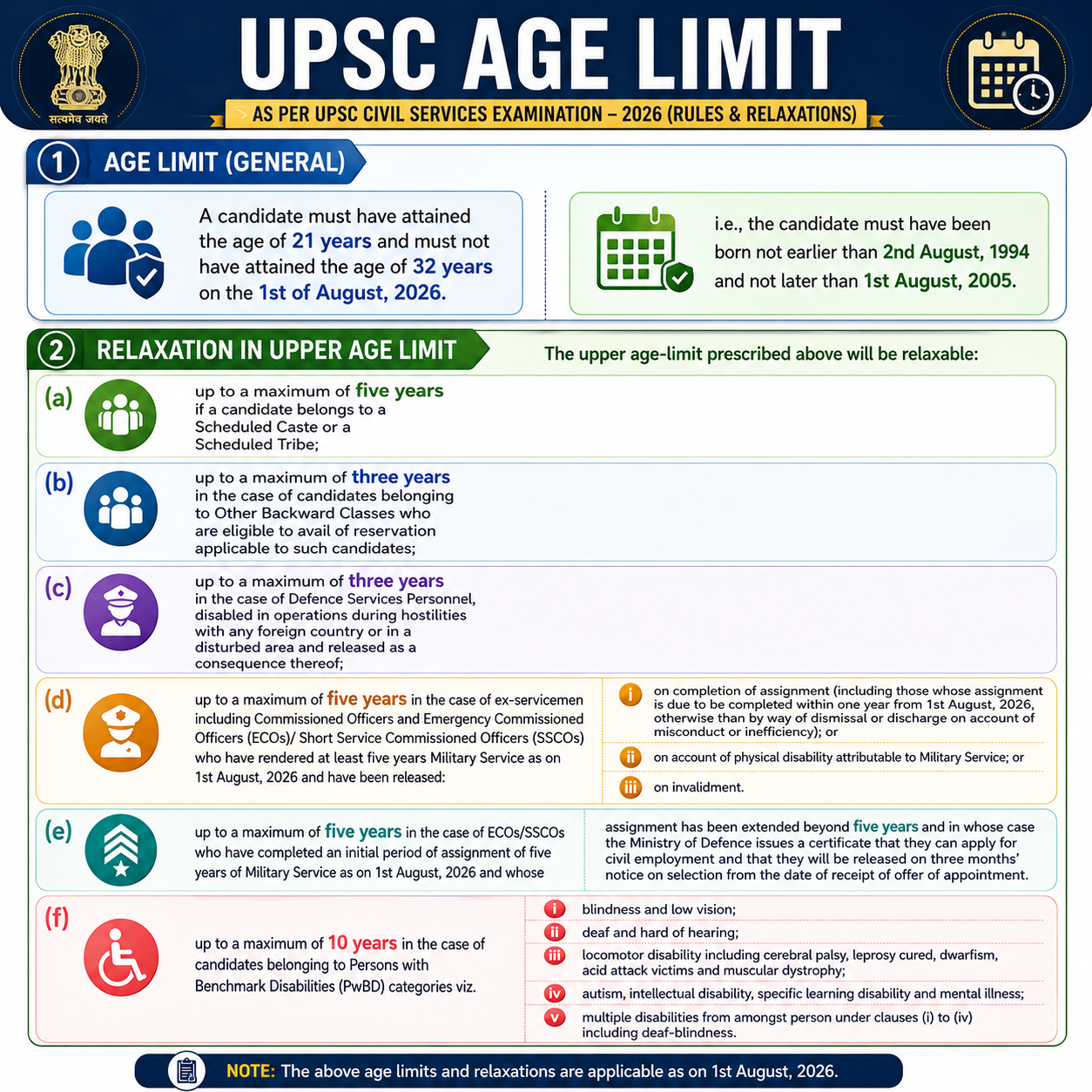
UPSC Age Limit 2026: A General or EWS category candidate must have attained 21 years and must not have attained 32 years of age as on 1 August 2026 to apply for the UPSC Civil Services Examination — that is, born between 2 August 1994 and 1 August 2005. OBC (Non-Creamy Layer) candidates can apply up to 35 years, SC/ST candidates up to 37 years, and eligible PwBD candidates up to 42–47 years depending on category. Age is always calculated as on 1 August of the exam year, never the date of the Prelims, application, or interview.
Latest updates
- UPSC CSE 2026 Mains is being held on 21, 22, 23, 29 and 30 August 2026; Prelims 2026 was conducted on 25 May 2026.
- The CSE 2026 application window (age limit as above) closed in February 2026 — this information is now relevant for verification, cut-off disputes, and planning your 2027 attempt.
- UPSC CSE 2027 notification is expected around mid-January 2027, with Prelims expected in late May 2027. See the Expected UPSC Age Limit 2027 section below.
UPSC Age Limit 2026 — Quick Overview
| Category | Minimum Age | Maximum Age | Age Relaxation | Number of Attempts |
|---|---|---|---|---|
| General | 21 | 32 | None | 6 |
| EWS | 21 | 32 | None (reservation only — no age benefit) | 6 |
| OBC (Non-Creamy Layer) | 21 | 35 | 3 years | 9 |
| SC | 21 | 37 | 5 years | Unlimited, within age limit |
| ST | 21 | 37 | 5 years | Unlimited, within age limit |
| PwBD — General/EWS | 21 | 42 | 10 years | 9 |
| PwBD — OBC | 21 | 45 | 13 years (3 + 10) | 9 |
| PwBD — SC/ST | 21 | 47 | 15 years (5 + 10) | Unlimited, within age limit |
| Ex-Servicemen / released Defence personnel (≥5 yrs service) | 21 | Category limit + 5 years | 5 years, additional | Same as base category |
| Defence personnel disabled in action | 21 | Category limit + 3 years | 3 years, additional | Same as base category |
| J&K Domicile (1 Jan 1980 – 31 Dec 1989) | 21 | Category limit + 5 years | 5 years, additional | Same as base category |
Age is calculated as on 1 August 2026. Always cross-check against the official notification before applying.
UPSC Minimum Age Limit
Every candidate, regardless of category, must have attained 21 years of age as on 1 August of the examination year. There is no relaxation on the minimum age for any category — reserved-category relaxations only extend the upper limit. A candidate who turns 21 exactly on 1 August of the exam year meets this condition and is eligible; a candidate who turns 21 even one day later must wait for the next year’s cycle.
UPSC Maximum Age Limit & Category-Wise Relaxation
General & EWS Category
The upper age limit for General category candidates is 32 years. EWS (Economically Weaker Section) candidates — introduced under the 103rd Constitutional Amendment, 2019, for General-category families with annual income below ₹8 lakh — get reserved seats but no additional age relaxation. Their age limit is identical to General: 21–32 years, 6 attempts.
OBC (Non-Creamy Layer)
OBC candidates get a 3-year relaxation, taking the upper limit to 35 years, with 9 attempts. This benefit only applies to candidates in the Non-Creamy Layer (NCL) — an OBC caste certificate alone is not enough. You need a separate NCL certificate confirming your family’s non-agricultural, non-salary income is below ₹8 lakh per year (current threshold), valid for the financial year in which you apply, and your caste must appear on the Central OBC list (a state-only OBC listing doesn’t qualify you for UPSC’s central reservation).
SC/ST
SC and ST candidates get a 5-year relaxation, taking the upper limit to 37 years, with unlimited attempts within that age window — the only ceiling that applies to them is age, not attempt count.
PwBD (Persons with Benchmark Disabilities)
PwBD candidates with at least 40% benchmark disability (certified by a competent medical authority under the RPwD Act) get a 10-year relaxation added on top of their social category’s limit — not a flat number:
- General/EWS PwBD: 32 + 10 = 42 years, 9 attempts
- OBC PwBD: 32 + 3 + 10 = 45 years, 9 attempts
- SC/ST PwBD: 32 + 5 + 10 = 47 years, unlimited attempts
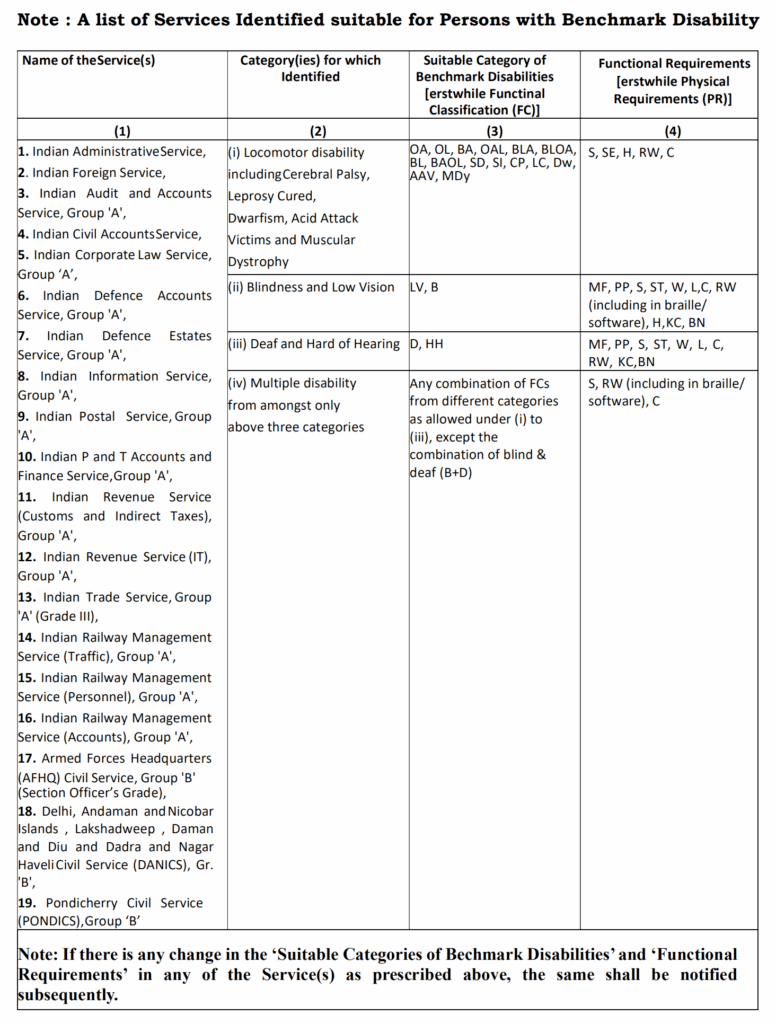
Eligible disability categories include blindness and low vision; deafness and hard of hearing; locomotor disability (including cerebral palsy, leprosy cured, dwarfism, acid-attack victims, muscular dystrophy); and autism, intellectual disability, specific learning disability, and mental illness, among others recognised under the RPwD Act.
Ex-Servicemen and Defence Personnel
Two distinct benefits apply here, and they’re commonly confused:
- Ex-servicemen / Commissioned Officers, ECOs, SSCOs with at least 5 years of military service as on 1 August, released on completion of assignment, disability attributable to service, or invalidment, get a 5-year age relaxation added to their own category’s limit (General → 37, OBC → 40, SC/ST → 42). Their attempt count still follows their base social category — a General-category ex-serviceman gets 6 attempts, not unlimited or 9.
- Defence personnel disabled in operations during hostilities with a foreign country, or in a disturbed area, and subsequently released, get a 3-year relaxation on the same basis.
Jammu & Kashmir Domicile (1980–1989)
Candidates who were ordinarily domiciled in the erstwhile state of Jammu & Kashmir between 1 January 1980 and 31 December 1989 get a flat 5-year relaxation, added to their own category’s limit — General → 37, OBC → 40, SC/ST → 42. This provision, reinstated in the 2018 CSE notification, is still active in the CSE 2026 notification.
How Cumulative Age Relaxation Works
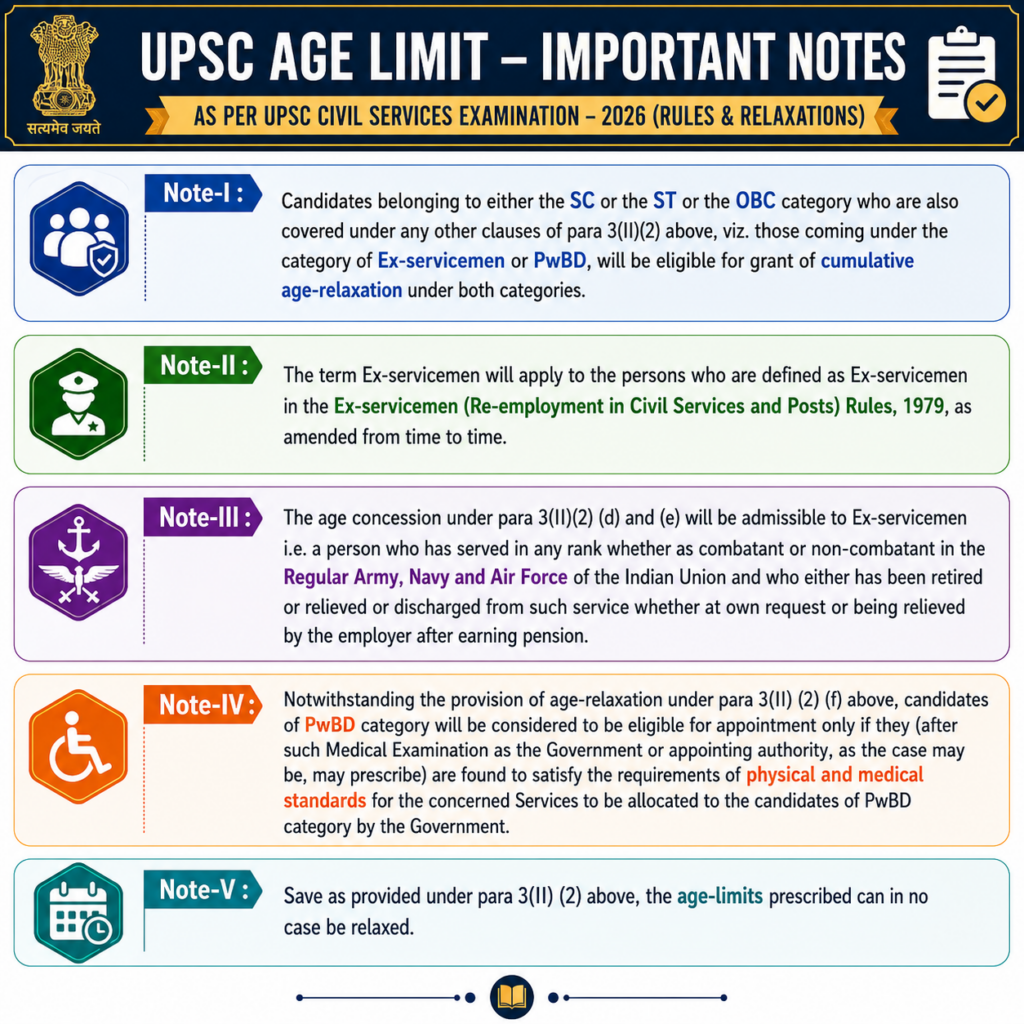
Relaxations stack when a candidate qualifies under more than one head — most commonly social category + PwBD, or social category + ex-serviceman status. The PwBD table above already shows the most common combinations. A few more worked examples:
| Combination | Calculation | Resulting Upper Age |
|---|---|---|
| General + Ex-Servicemen | 32 + 5 | 37 years |
| OBC + Ex-Servicemen | 32 + 3 + 5 | 40 years |
| SC/ST + Ex-Servicemen | 32 + 5 + 5 | 42 years |
| OBC + J&K Domicile | 32 + 3 + 5 | 40 years |
Always verify your specific combination against the current UPSC notification — relaxations are cumulative for the categories listed above, but not every possible combination is automatically additive, and the certificates required stack too (you’ll need each supporting certificate current and valid).
Age Calculation Date & Birth-Date Eligibility
UPSC calculates age strictly as on 1 August of the examination year — never the date of the Preliminary Exam, the application, or the interview. For CSE 2026 (cut-off: 1 August 2026):
| Category | Earliest Eligible Date of Birth | Latest Eligible Date of Birth |
|---|---|---|
| General / EWS | 2 August 1994 | 1 August 2005 |
| OBC | 2 August 1991 | 1 August 2005 |
| SC/ST | 2 August 1989 | 1 August 2005 |
Common misconception — the “exactly 32 on 1 August” myth: Several guides claim a General-category candidate who turns exactly 32 on 1 August is still eligible. This isn’t correct, and the birth-date range UPSC itself publishes each year confirms it: the earliest eligible date of birth is 2 August 1994, not 1 August 1994. A candidate born on 1 August 1994 turns 32 on the cut-off date — they have “attained” 32 that day, which the rule explicitly excludes. The oldest eligible General-category candidate is one born 2 August 1994, who is still 31 years, 364 days old on the cut-off date and turns 32 the following day. On the minimum-age side, the logic runs the other way: a candidate born 1 August 2005 turns exactly 21 on the cut-off date and is eligible, because the rule requires that you have attained 21 by that date — and turning 21 that day satisfies it. When in doubt, don’t try to reason through the “attained the age of” wording — just check your date of birth directly against the range above.
Proof of Date of Birth
UPSC accepts the date of birth recorded in your Matriculation / Class 10 (or equivalent) certificate as final. If your Aadhaar, PAN, or other documents show a different date, the certificate accepted by UPSC takes precedence — get a gazette correction well in advance if there’s a mismatch, since this can’t be resolved during document verification.
Number of Attempts Allowed in UPSC
| Category | Maximum Attempts |
|---|---|
| General / EWS | 6 |
| OBC (NCL) | 9 |
| SC/ST | Unlimited, within age limit |
| PwBD — General/EWS/OBC | 9 |
| PwBD — SC/ST | Unlimited, within age limit |
What counts as one attempt: Appearing in even one paper of the Civil Services Preliminary Examination counts as a full attempt — even if you’re later disqualified, or don’t clear Prelims. Simply submitting the online application and not appearing in either Prelims paper does not count. There’s no way to “undo” an attempt once you’ve sat for a paper.
Two ceilings apply simultaneously — the age limit and the attempt limit — and whichever you hit first ends your eligibility. A General-category candidate who starts at 21 and attempts every single year will exhaust all 6 attempts by age 26, years before the age ceiling of 32 arrives, so attempts, not age, is usually the binding constraint for General/EWS candidates.
Is the Age Limit Different for IAS, IPS, IFS?
No. The age limit, relaxation rules, and attempt limits above apply uniformly to all services filled through the Civil Services Examination — IAS, IPS, IFS, and the other Group A and B Central Services. There’s no separate “IAS age limit” or “IPS age limit”; what differs across services is the physical and medical standards (IPS, for instance, has specific height, chest, and eyesight requirements), not the age or attempt eligibility.
Restrictions on Re-Applying
- A candidate already appointed to IAS or IFS through a previous CSE, and currently serving in either service, cannot appear in the exam again for that same year.
- A candidate already appointed to IPS through a previous CSE and currently serving cannot select IPS as a service preference again in that year’s exam.
Expected UPSC Age Limit 2027
UPSC hasn’t released the CSE 2027 notification yet — it’s expected around mid-January 2027, with Prelims expected in late May 2027. Until then, the 2027 age limit is expected, not official, and should be treated as a planning estimate based on the unchanged pattern of recent years:
| Category | Expected Maximum Age (as on 1 Aug 2027) | Expected Birth-Date Range |
|---|---|---|
| General/EWS | 32 years | 2 August 1995 – 1 August 2006 |
| OBC (NCL) | 35 years | 2 August 1992 – 1 August 2006 |
| SC/ST | 37 years | 2 August 1990 – 1 August 2006 |
| PwBD (General/OBC/SC-ST) | 42 / 45 / 47 years | — |
If you’re planning your first attempt for 2027, use this table for preparation timelines only, and confirm every figure the moment the official notification is out — we’ll update this section immediately when it drops.
Will UPSC Reduce the Age Limit?
This question resurfaces every year, usually around notification time, and it’s worth answering directly rather than ignoring it. As of now, there is no official notification changing the UPSC age limit — the 21–32 (General/EWS) structure has been unchanged since 2015. What keeps the rumor alive is a series of reform proposals from committees and individuals over the years, none of which UPSC or the Government of India has adopted:
- The Administrative Reforms Commission (1996) once recommended lowering the upper age limit to 25.
- NITI Aayog has previously floated a phased reduction (to roughly 27 for General category) as part of broader civil-service reform discussions.
- The Baswan Committee reportedly examined lowering the age ceiling as part of recruitment reform.
- More recently, former RBI Governor Duvvuri Subbarao proposed civil-service reforms that include a lower entry age alongside a mid-career lateral-entry track for professionals in their 40s — a proposal, not a policy.
None of these have translated into an actual notification change. The Government has publicly clarified in the past that it has no plan to reduce the age limit, and any future change would require a full policy process, not a mid-cycle notification tweak. Treat “age limit reduced” headlines as speculation until they’re confirmed on the official UPSC or DoPT website, and plan your attempts based on the current, unchanged rules.
Common Mistakes to Avoid
- Using the wrong reference date. Age is calculated as on 1 August of the exam year — not the Prelims date, not the application date, not your birthday.
- Assuming EWS gets age relaxation. It doesn’t — EWS shares the General category’s age ceiling exactly; the benefit is reserved seats, not extra years.
- Treating an OBC caste certificate as sufficient. You need a valid, current Non-Creamy Layer certificate too — an outdated or missing NCL certificate can cost you the relaxation entirely.
- Assuming attempts reset if you change category (e.g., General to OBC via a later-obtained certificate) — they don’t; all prior attempts count against your new category’s limit.
- Believing a blank or incomplete Prelims paper doesn’t count. It does — appearing in even one paper is a full attempt.
- Confusing the age ceiling with the attempt ceiling for General/EWS candidates — most General candidates run out of attempts years before they run out of eligible age.
Frequently Asked Questions
Always cross-check the figures on this page against the official UPSC Civil Services Examination notification before applying — UPSC’s own notification is the final authority on eligibility.