History Optional Mains Master Kit 2027 Complete Self-Study System — Notes, Mapping & Premium Articles by LotusArise IAS
Original price was: ₹5,000.00.₹1,770.00Current price is: ₹1,770.00.
“Similar History Optional courses cost ₹6,999–₹54,000 elsewhere.”
History Optional covers 500 marks across Paper I and Paper II — Ancient, Medieval, Modern, Post-Independence India, World History, and Mapping.
Most aspirants struggle not because History is hard, but because their material is scattered across 6–8 sources with no integrated system.
History Optional Mains Master Kit 2027 solves this:
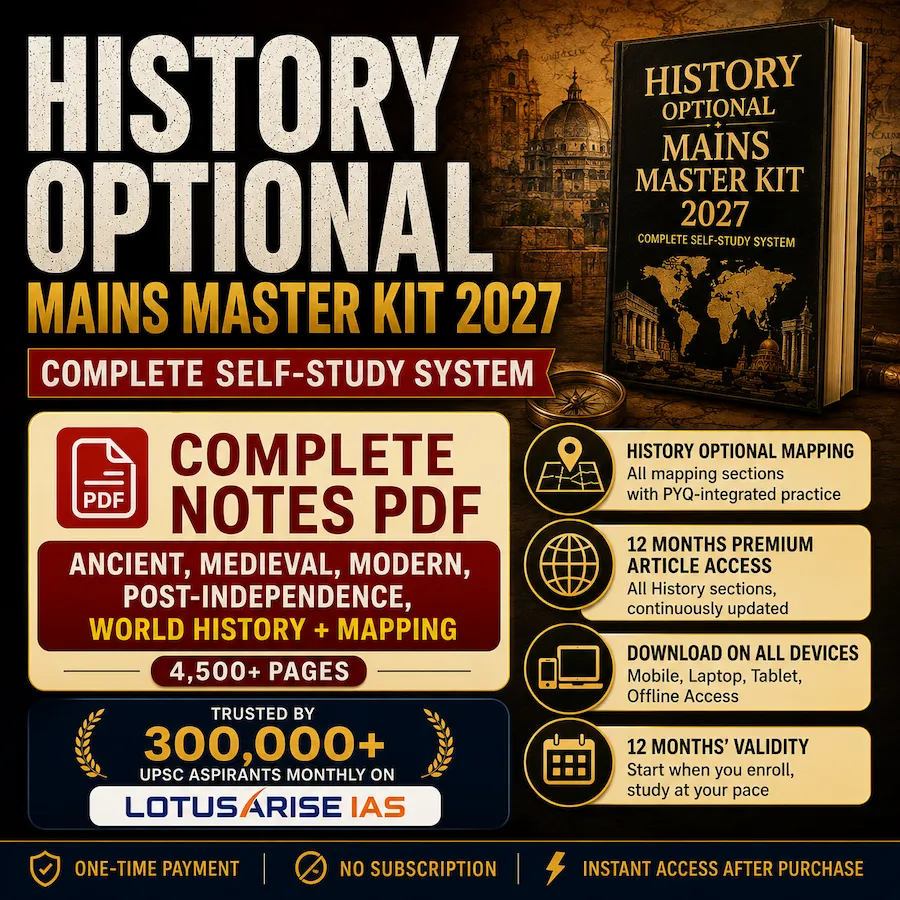
📚 Complete Notes PDF — Ancient, Medieval, Modern, Post-Independence, World History + Mapping (4,500+ pages)
🗺️ History Optional Mapping — all mapping sections with PYQ-integrated practice
🌐 12 Months Premium Article Access — all History sections, continuously updated
📱 Download on all devices — mobile, laptop, tablet, offline access
🗓️ 12 months’ validity — start when you enroll, study at your pace
One-time payment. No subscription. Instant access after purchase.
⭐⭐⭐⭐⭐ Trusted by 300,000+ UPSC aspirants monthly on LotusArise IAS
The History Optional Problem Most Aspirants Don’t Talk About
Ask any History Optional aspirant six months into preparation what their biggest problem is. They won’t say the subject is boring. They won’t say the facts are hard to memorize. They will say one of three things:
“I have notes from Bipan Chandra, Satish Chandra, Romila Thapar, and three coaching sets — and I don’t know which one to trust for which topic.”
“I can recall facts perfectly but when I sit to write a 20-mark answer, I don’t know how to structure it or which historians to cite.”
“The Mapping section of Paper I is 50 marks — I’ve been ignoring it for months and I know it’s going to cost me.”
These are not individual problems. History Optional has great scoring potential — but only with the right approach focusing on conceptual clarity, historiography, and answer writing. Most aspirants have the content. What they lack is the system.
History Optional Mains Master Kit 2027 is that system.
Why History Optional Is One of the Most Strategic Choices for UPSC 2027
Before diving into what’s inside the kit, it’s worth understanding what the research confirms about this subject:
Around 20 questions in GS Prelims and 10 questions in Mains come from History — making it one of the most cross-paper useful optional subjects you can choose.
The History syllabus overlaps extensively with the General Studies syllabus, especially in areas like Indian Freedom Struggle, World History, Cultural Developments, and Social Movements — enriching a candidate’s responses across papers.
This means your History Optional preparation is not isolated work. Every hour you spend on Paper I and Paper II also strengthens your GS Paper I score, your Essay Paper, and your Interview responses. No other major optional offers this level of cross-paper return on preparation time.
The challenge is not the subject. It is having the right, integrated study system.
What’s Inside the History Optional Mains Master Kit
📚 Complete History Optional Notes — 4,500+ Pages
The full LotusArise IAS History Optional notes in downloadable PDF format — structured for UPSC answer writing across every section of Paper I and Paper II.
Paper I — Indian History (Ancient + Medieval):
- Archaeological sources, pre-historic India, Harappan Civilisation
- Vedic age, Mahajanapadas, Mauryan Empire and its administration
- Post-Mauryan India — Kushans, Guptas, Vardhana dynasty
- Early medieval India — regional kingdoms, Arab and Turk invasions
- Delhi Sultanate — administration, economy, culture
- Vijayanagara and Bahmani kingdoms
- Mughal Empire — Akbar to Aurangzeb, administration and decline
- Medieval society, religion, and culture — Bhakti and Sufi movements
- Key historiographical perspectives for every major period
Paper II — Modern India + Post-Independence + World History:
- European expansion and establishment of British rule
- Economic impact of British colonialism — drain theory, deindustrialisation
- Social and religious reform movements — Raja Ram Mohan Roy to Ambedkar
- The freedom struggle — from 1857 to independence
- Constitutional developments and the making of modern India
- Post-Independence India — integration, economic planning, social change
- World History — Renaissance, Enlightenment, French Revolution, industrialisation, imperialism, World Wars, Cold War, decolonisation
What makes these notes different from downloaded Telegram PDFs:
Every section is written for UPSC answer writing — not for academic reading. Historiographical perspectives are integrated throughout. “When writing about the Harappan Civilisation, citing perspectives from scholars like Romila Thapar or B.B. Lal adds authority to answers and shows the analytical thinking UPSC examiners reward.” These notes include the relevant historian citations for every major topic so you never have to hunt for them separately.
🗺️ History Optional Mapping — Complete Mapping Notes + PYQ Integration
“The map section in Paper I carries 50 marks. Many aspirants neglect it and lose easy marks. Excelling at History map pointing can significantly boost your final score.”
The Mapping Notes include:
- All Harappan sites — Mohenjo-daro, Harappa, Lothal, Dholavira, Kalibangan
- Buddhist and Jain pilgrimage centres — Sarnath, Bodh Gaya, Vaishali
- Mughal and Sultanate-era cities, battle sites, and trade routes
- Freedom struggle locations — 1857 revolt centres, major agitations, partition boundaries
- Organised by period and theme for faster, more systematic revision
- PYQ-integrated
50 marks of Paper I come from mapping. This section alone makes the kit worth its price.
🌐 12 Months Premium Article Access — All History Sections
Static notes are necessary but not sufficient. History Optional Paper II, particularly Modern India and World History, rewards answers that connect historical events to contemporary relevance and current scholarly debates.
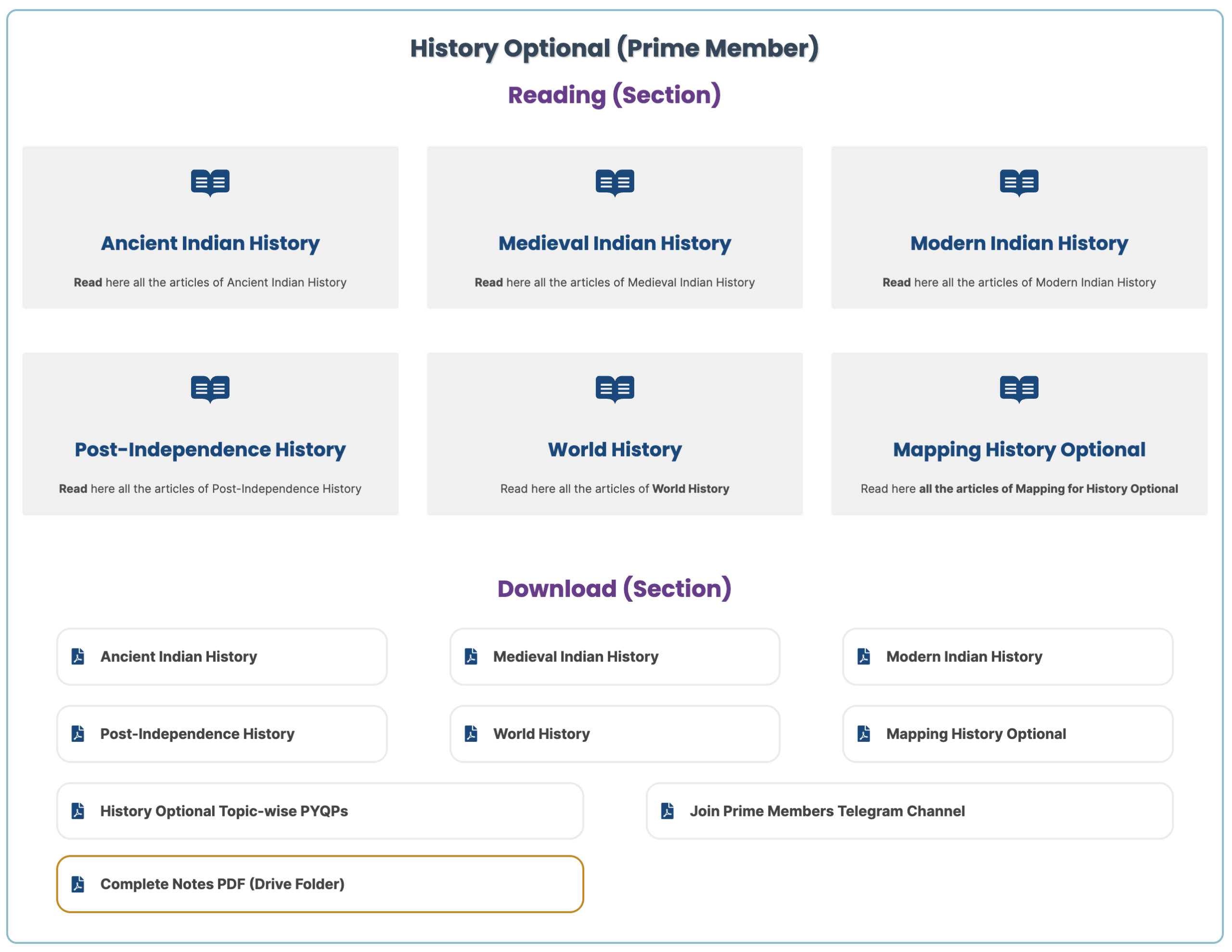
12 months of full access to all LotusArise History Optional premium articles:
- Ancient Indian History — concept explainers, historiographical debates, archaeological sources
- Medieval Indian History — regional dynamics, administrative systems, cultural synthesis
- Modern Indian History — colonial economy, reform movements, freedom struggle analysis
- Post-Independence History — constitutional debates, economic planning, social transformation
- World History — global trends, comparative perspectives, contemporary connections
- Mapping for History Optional — spatial learning, location-based questions
- Topic-wise PYQs — all previous year questions with analysis
Connecting historical events to contemporary themes demonstrates holistic understanding and impresses the examiner. The premium articles do exactly this — every major topic is contextualised with current relevance.
Access from any device. 12 months begins from your enrollment date.
📱 Multi-Device Download + Offline Study
Your preparation is not tied to a desk, a classroom, or an internet connection:
- ✅ Laptop — structured study sessions with full PDF
- ✅ Mobile — every commute and break becomes productive study time
- ✅ Tablet — annotate, highlight, and mark as you revise
Print specific sections for handwritten answer practice. Revise offline during exam hall preparation when distraction-free focus matters most.
🗓️ 12 Months Full Validity — Your Pace, Not a Batch Schedule
Your 12 months starts from the day you enroll — not a fixed batch date.
This means the kit works for you whether you are:
- Starting History Optional now — use the notes as your primary structured resource
- Mid-preparation — use the notes to fill content gaps, mapping notes to plug the 50-mark gap
- In final revision — use premium articles for current relevance and value addition
The most common mistake aspirants make with optional preparation is treating it like an academic subject to be read and understood. UPSC optional papers are examination papers — they test whether you can write structured, analytically rich answers on specific themes from the syllabus within strict time limits. Simply reading standard books, even thoroughly, does not prepare you to do this well.
The Mains Master Kit is built for examination preparation — structured, syllabus-mapped, and integrated with what UPSC actually tests.
The History Optional Aspirant Who Buys This
First-time History Optional aspirants — You want one trusted, integrated resource from Day 1. Not six books, not three coaching sets, not fifteen Telegram files. Open the notes, follow the structure, use the mapping notes daily.
Repeaters who scored 220–260 — The content knowledge is there. The gap is in answer structure, historiography integration, and mapping. This kit directly addresses all three.
GS1 aspirants who are not taking History Optional — Even if History is not your optional, the notes for Ancient, Medieval, and Modern Indian History are directly useful for GS Paper I. Many aspirants buy this kit purely for the GS1 overlap value.
Self-study aspirants outside Delhi — You do not need to be in Delhi, Prayagraj, or Jaipur. You do not need to pay ₹15,000–₹54,000 for classroom coaching. The Mains Master Kit delivers the same structured content through self-study.
Working professionals — 12 months validity, no batch schedule, offline access. Study in the hours available to you, with a system that builds progressively rather than requiring daily attendance.
Why Not Just Use Free Notes from Telegram or Reddit?
An honest answer to the question every aspirant thinks but rarely asks aloud.
Free notes exist. They are widely shared. Most aspirants have gigabytes of downloaded PDFs they have never systematically read.
The difference between downloaded notes and the Mains Master Kit is not the content — it is the system. Random downloaded notes have no historiographical integration, no mapping alignment, no current affairs linkage, no connection between the notes and what UPSC has actually asked across 20 years of PYQs.
The Mains Master Kit is built around one question: what does a History Optional aspirant need to walk into the exam and write answers that score 280–310?
If you have the discipline to build your own integrated system from scattered sources, you may not need this. If you want a system that is already built — open it and start — this is what the Mains Master Kit is for.
Total if bought separately: ₹2,791 ==> Mains Master Kit 2027: ₹1,770
One-time payment. No subscription. No recurring charge. Instant PDF access after payment. Article access activated within 24 hours. For support: support@lotusarise.com | WhatsApp: 9005064862