

The order built at Bretton Woods in July 1944 was not primarily a set of institutions. It was a bargain: states would accept an open economy abroad and in exchange keep the tools to run full employment and welfare states at home. Every later phase of the international monetary and financial order — the end of fixed rates, the debt crises, structural adjustment, the rise of the challengers — is an argument about who broke that bargain and who pays for its absence.
The problem the founders were answering

The delegates who assembled in New Hampshire were not designing in the abstract. They were legislating against a remembered catastrophe, and almost every feature of the system they built is intelligible as an answer to a specific failure of the interwar years.
The classical gold standard and its discipline
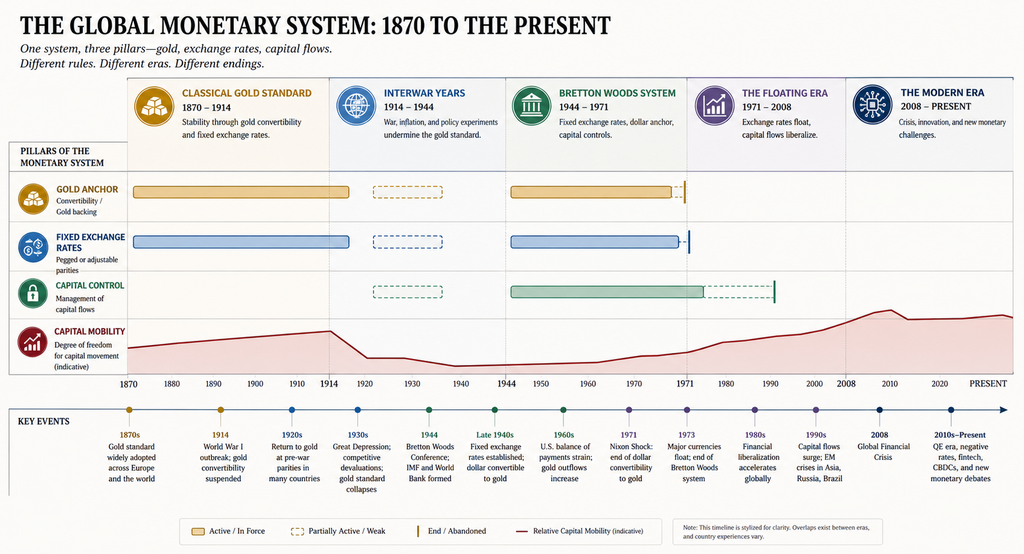
- The classical gold standard, roughly 1870–1914, fixed each currency to a weight of gold, which fixed currencies to one another and made exchange rates arithmetic rather than policy.
- Adjustment ran through Hume’s price-specie-flow mechanism: a deficit country lost gold, its money supply contracted, prices and wages fell, its exports became competitive, and the deficit closed.
- It worked only because domestic politics did not object. Before mass suffrage and organised labour, a central bank could impose deflation and unemployment without being voted out.
- Sterling and the City of London supplied the system’s liquidity and its lender of last resort, which is why the era is better described as British hegemony with a gold veneer than as a rules-based order.
The interwar collapse
- The First World War ended convertibility, and the attempt to restore it in the 1920s restored the form without the conditions.
- Britain’s return to gold at the pre-war parity in 1925 overvalued sterling, and Keynes attacked it in The Economic Consequences of Mr Churchill as a deliberate choice of unemployment.
- German reparations and the hyperinflation of 1923 turned monetary policy into a question of national humiliation rather than technical management.
- The Great Depression then broke the system entirely, and it broke it in a way that taught the founders their central lesson.
- The US Tariff Act of 1930, the Smoot–Hawley tariff, raised average duties on dutiable imports to around fifty per cent and triggered a cascade of retaliation; world trade fell by roughly two-thirds in value between 1929 and 1934.
- Competitive devaluation — Britain leaving gold in 1931, the United States devaluing in 1933–34, the gold bloc collapsing in 1936 — became the characteristic instrument of the decade.
- These are the beggar-thy-neighbour policies: each state exported its unemployment to its neighbours, and because everyone did it, nobody gained and everyone lost.
- The result was the transmission of depression through the channels meant to transmit prosperity, and the formation of exclusive currency and trading blocs — sterling, gold, the Reichsmark clearing system — whose economic logic ran into the politics of the 1930s.
The founders’ conviction was that economic disorder had helped produce the war, and that a monetary system with no rules would produce it again.
- The diagnosis was codified by Ragnar Nurkse, whose League of Nations study International Currency Experience argued that free-floating rates invited destabilising speculation and that unregulated capital movements had been a principal transmitter of the crisis — the intellectual bridge between the interwar experience and the Bretton Woods design.
The conference of July 1944
- Delegates from 44 nations met at the Mount Washington Hotel in Bretton Woods, New Hampshire, from 1 to 22 July 1944, while the war in Europe was still being fought.
- India was among them, in a British Indian delegation that included C. D. Deshmukh, later the first Indian Governor of the Reserve Bank — so India is a founding member of both institutions, not a later joiner.
- Attendance was wide but the negotiation was effectively bilateral: the outcome was settled between the United States and Britain, and the other delegations largely ratified it.
- Two rival blueprints were on the table, and the difference between them is the subject’s most instructive contrast.
The Keynes plan: the Clearing Union and the bancor
- John Maynard Keynes, writing for a debtor Britain facing an enormous post-war deficit, proposed an International Clearing Union — in effect a world central bank for central banks.
- Members would hold accounts at the Union denominated in an artificial reserve asset, the bancor, whose value would be fixed in gold but which could not be converted back into gold.
- Trade imbalances would appear as overdrafts and credits on the Union’s books, and the Union could create bancor as world trade grew, so global liquidity would not depend on gold discoveries or on any one country’s deficits.
- Deficit countries would face charges and eventual devaluation; crucially, surplus countries would face charges too, rising with the size and persistence of the surplus.
- The point of that symmetry is the analytical heart of the plan.
- When only the deficit country must adjust, it adjusts by contracting — cutting spending, raising interest rates, deflating wages. The correction is recessionary.
- When the surplus country shares the burden, it adjusts by expanding — spending more, revaluing upward, importing more. The correction is reflationary.
- Placing adjustment wholly on deficit countries therefore builds in a deflationary bias: the weak are forced to contract while the strong are permitted to hoard, and the world ends up with less demand than it needs.
- Keynes also wanted capital controls made permanent and cooperative rather than a temporary concession, because he believed free capital movement was incompatible with national management of employment.
“Let goods be homespun whenever it is reasonably and conveniently possible; and, above all, let finance be primarily national.” — John Maynard Keynes
The White plan and why it prevailed
- Harry Dexter White, of the US Treasury, proposed a Stabilisation Fund built on subscribed quotas rather than overdrafts, lending a limited pool of real currencies rather than creating a new asset.
- Access would be capped by a country’s own contribution, and drawings would be conditional on policy undertakings — the germ of conditionality.
- The dollar, itself convertible into gold, would anchor the system, making the American currency the world’s reserve asset by design.
- White’s plan prevailed for reasons that had little to do with its economics.
- The United States held roughly two-thirds of the world’s monetary gold, was the only large economy left intact, and expected persistent surpluses. Symmetric adjustment obligations would have fallen on it and nobody else.
- Britain needed American finance immediately and was in no position to insist; Keynes secured drafting concessions, not structural ones.
- Congressional ratification was the binding constraint throughout: anything resembling an unlimited American liability to finance foreign deficits was unpassable.
| Keynes plan (International Clearing Union) | White plan (Stabilisation Fund) | |
|---|---|---|
| Nature of the institution | A clearing bank creating credit | A fund lending pooled subscriptions |
| Reserve asset | A new international unit, the bancor | Gold and the US dollar |
| Size of resources | Elastic, expanding with world trade (~$26 billion) | Fixed by quotas (~$5 billion proposed; $8.8 billion as agreed) |
| Who adjusts | Both surplus and deficit countries | Deficit countries alone |
| Penalty on surpluses | Charges on persistent credit balances | None |
| Access to finance | Automatic overdraft rights | Drawings conditional on policy |
| Systemic bias | Expansionary | Deflationary |
| Whose interest it served | The debtor economies | The creditor, the United States |
The consequence of White’s victory became the system’s defining weakness. With no discipline on surplus countries, global imbalances could accumulate indefinitely until corrected by crisis rather than by rule. The persistent surpluses of Germany, Japan and later China, and the mirror-image American deficit, are the modern form of the problem Keynes tried to legislate against.
Three pillars, and the one that was never built
- The post-war design had three intended institutions — one for money, one for capital, one for trade.
- The International Monetary Fund would police exchange-rate commitments and provide short-term balance-of-payments finance.
- The International Bank for Reconstruction and Development would lend for reconstruction and, later, development.
- The International Trade Organisation would discipline tariffs, quotas, cartels, commodity agreements and employment policy, under the Havana Charter signed in March 1948.
- The third pillar was never built. Truman withdrew the Havana Charter from Congressional consideration in 1950 once it was clear ratification would fail — opposed by protectionists who thought it went too far and by free-traders who thought its exceptions gutted it.
- What survived was the General Agreement on Tariffs and Trade of 1947, negotiated as an interim tariff schedule and given effect by a Protocol of Provisional Application — a stopgap that governed world trade for forty-seven years.
- The consequence is that money and capital got treaty organisations with binding rules while trade got a contract with a secretariat. The trade story from GATT through the WTO is developed separately.
The par-value system in operation
- The regime that operated from the late 1940s to 1971 is best described as a gold-exchange standard with an escape hatch.
- Each member declared a par value for its currency in gold or in US dollars, and undertook to keep the market rate within one per cent either side of it through central bank intervention.
- Only the United States stood ready to convert dollars into gold, at $35 an ounce, and only for foreign monetary authorities — not for private holders, and not for its own citizens.
- Par values could be changed, but only to correct a “fundamental disequilibrium” — a term the Articles deliberately left undefined — and changes beyond ten per cent required the Fund’s concurrence.
- The system was therefore fixed but adjustable, which was the whole point: it rejected both the rigidity of gold and the free float of the 1930s.
- Capital controls were permitted, and this is the feature that separates Bretton Woods from everything that followed.
- Article VI, Section 3 expressly allowed members to regulate international capital movements, and Article VI(1) barred the use of Fund resources to finance a large or sustained capital outflow.
- Article VIII obliged members to make their currencies convertible for current transactions — trade in goods and services — while Article XIV allowed transitional restrictions for as long as a member needed them. Most of Western Europe only accepted Article VIII obligations at the end of 1958.
- The distinction between current-account convertibility (required) and capital-account convertibility (optional, and generally discouraged) is the technical expression of the entire political bargain.
- In practice the Fund did comparatively little of the actual reconstruction financing.
- The Marshall Plan, from 1948, transferred about $13 billion in grants and loans and dwarfed anything the Fund or the Bank could then do.
- The European Payments Union, 1950–58, ran a regional multilateral clearing system of exactly the kind Keynes had wanted globally, and it is what restored intra-European convertibility.
- Bretton Woods, in other words, worked as designed only after American bilateral aid and a regional clearing union had done the hard part.
Embedded liberalism: the name of the bargain
- John Ruggie gave the arrangement its name. Embedded liberalism describes an order that was liberal internationally and interventionist domestically, and that treated the two as complements rather than opposites.
“Unlike the economic nationalism of the thirties, it would be multilateral in character; unlike the liberalism of the gold standard and free trade, its multilateralism would be predicated upon domestic interventionism.” — John Ruggie
- The phrase’s intellectual ancestor is Karl Polanyi‘s account in The Great Transformation of the double movement.
- Polanyi argued that the attempt to create a self-regulating market by turning land, labour and money into commodities generates a countermovement of social protection, because societies will not tolerate having their substance treated as a commodity.
- The nineteenth-century gold standard was for Polanyi the pivot of that self-regulating system; its collapse and the convulsions of the 1930s were the countermovement arriving as fascism, the New Deal and Soviet planning.
- Bretton Woods, read through Polanyi, builds the countermovement into the design — keeping the market economy while re-embedding it in social and political obligation.
The hinge of the bargain is capital control. If money cannot move freely, a government can hold a fixed exchange rate, run its own interest rate and finance a welfare state at once, because it need not price its policies for foreign bondholders. Remove the controls and one of the three has to go — the proposition Rodrik generalised as the trilemma of hyperglobalisation, sovereignty and democratic politics.
- The embedded-liberal decades are the strongest empirical case for the design: from 1950 to 1973 the industrial world saw its fastest sustained growth, the fastest growth of world trade, and falling inequality within most rich countries — the golden age of the world economy, the trente glorieuses.
The breakdown, in stages
The system did not collapse in 1971. It unravelled over a decade, and each stage removed a different pillar. Getting the sequence right matters because the standard shorthand hides the fact that the arrangement’s most important feature — capital control — was dismantled long after the exchange rate peg was.
The Triffin dilemma
- Robert Triffin identified the structural contradiction in 1960, and it is a mechanism rather than a slogan.
- The world needed a growing stock of reserves to finance growing trade, and those reserves were dollars, because gold production was flat and no other currency was usable.
- The only way the rest of the world could acquire dollars was for the United States to supply them — that is, to run balance-of-payments deficits.
- But every dollar supplied was a claim on American gold. As dollar liabilities grew relative to the gold at Fort Knox, the credibility of the $35 promise fell.
- The system therefore faced a choice with no good branch: if America stopped running deficits the world faced a liquidity shortage and deflation; if it continued, confidence in convertibility would break. The reserve-currency country cannot simultaneously supply the world’s liquidity and preserve its own solvency.
- The Fund’s answer to the liquidity half of the problem was Special Drawing Rights in 1969 — an attempt, three decades late, to build something like the bancor into the system. It came too late and too small to matter.
The pressures of the 1960s
- American deficits widened for reasons of domestic politics: the Vietnam War and the Great Society programmes were financed without a matching tax increase, and US inflation was exported to every country pegged to the dollar.
- European and Japanese recovery changed the arithmetic. These were now surplus economies accumulating dollar claims they wished to convert, and France under de Gaulle converted them systematically while denouncing the dollar’s “exorbitant privilege” — a phrase of his finance minister Valéry Giscard d’Estaing, elaborated by the economist Jacques Rueff.
- The London Gold Pool, through which eight central banks had held the market price at $35, collapsed in March 1968, leaving a two-tier market: an official price for governments, a free price for everyone else. That was the effective end of the gold anchor, three years before it was formally abandoned.
- Sterling’s devaluation in November 1967 and repeated attacks on the franc and the mark showed that, with capital increasingly mobile through the Eurodollar market, a parity that markets doubted could not be defended.
15 August 1971 — the Nixon shock
- On 15 August 1971, in a televised address, President Nixon announced three measures together, and the package matters as much as its most famous element.
- Suspension of the dollar’s convertibility into gold — presented as temporary, never reversed.
- A ten per cent surcharge on dutiable imports, an explicit trade weapon intended to force trading partners to revalue.
- A ninety-day freeze on wages and prices, the first peacetime wage-price controls in American history.
- The measures were taken unilaterally and without consultation, which is why the episode is remembered as a shock. Their combination reveals the logic: rather than adjust American policy to the system, the United States adjusted the system to American policy.
Smithsonian, floating, and Jamaica
- The Smithsonian Agreement of December 1971 was the attempt to rebuild fixed rates on new terms.
- The dollar was devalued to $38 an ounce, other currencies revalued, and the permitted band widened from one per cent to 2.25 per cent.
- Convertibility was not restored, so the new parities rested on nothing but agreement. Nixon called it “the most significant monetary agreement in the history of the world”; it lasted fifteen months.
- Sterling floated in June 1972, the dollar was devalued again in February 1973, and by March 1973 the major currencies were floating. The Fund found itself supervising a system that no longer existed.
- The Jamaica Accords of January 1976, given effect by the Second Amendment to the Articles in 1978, ratified the new reality.
- Members became free to choose any exchange arrangement, including a free float — floating was legalised retrospectively.
- Gold was demonetised: the official price was abolished, gold ceased to be the common denominator of par values, and the Fund sold a sixth of its holdings, part of the proceeds funding a trust for low-income members.
- The Fund’s supervisory role was recast as “firm surveillance” under a rewritten Article IV — an obligation to consult rather than a rule to enforce.
| Phase | Anchor | Adjustment mechanism | Capital mobility |
|---|---|---|---|
| Classical gold standard (1870–1914) | Gold, with sterling as vehicle | Automatic price-specie-flow; domestic deflation | High, and politically unchallenged |
| Interwar (1918–39) | Restored gold, then nothing | Competitive devaluation and tariffs | Volatile, then blocked into blocs |
| Bretton Woods (1944–71) | Dollar convertible to gold at $35 | Pegged rates, adjustable for “fundamental disequilibrium” | Low, by design — controls permitted |
| Post-1973 float | None — fiat currencies | Market exchange rates; conditional lending | Rising, then near-complete |
| Present | De facto dollar, no rule | Floating, managed floats, pegs; reserve self-insurance | High, plus sanctions risk on reserves |
- Three consequences followed, and they define everything after.
- Exchange rates became a market variable, raising volatility and with it the demand for reserves as self-insurance.
- Capital controls were progressively dismantled from the late 1970s — Britain in 1979, Japan through the 1980s, the European single market by 1990 — removing the bargain’s load-bearing wall.
- The Fund, deprived of a par-value system to manage, reinvented itself as a crisis lender to developing countries, and it is that turn, not the events of 1971, that made it the object of Southern criticism.
The Fund that the Global South encountered after 1980 was not the institution the founders designed; it was an institution that had lost its original job and found another.
The IMF’s institutional design
Quotas: the Fund’s constitutional currency
- A member’s quota, expressed in SDRs, is the single number from which almost everything else follows.
- It fixes the member’s subscription — up to 25 per cent payable in SDRs or usable currencies, the remainder in its own currency.
- It fixes access limits on borrowing, expressed as multiples of quota.
- It fixes voting power, and it fixes each member’s share in any general allocation of SDRs.
- Voting is weighted but not purely proportional.
- Each member has basic votes — a flat allocation identical for all — plus one vote per SDR 100,000 of quota.
- Basic votes were fixed in number from 1944 and eroded to under 2.1 per cent of the total before the 2008 reform restored them to 5.502 per cent and indexed them so the share cannot erode again.
- This is why a country’s quota share and its voting share differ, and the difference is larger the larger the quota.
- The current quota formula, agreed in 2008, is a weighted average of four variables, compressed to reduce dispersion.
| Variable | Weight | What it measures |
|---|---|---|
| GDP (60% market rates, 40% PPP) | 50% | Economic size — the most contested component |
| Openness | 30% | Gross current-account transactions; favours small trading economies |
| Variability | 15% | Volatility of current receipts and net capital flows — a proxy for need |
| Reserves | 5% | Official reserve holdings |
| Compression factor | 0.95 exponent | Narrows the gap between the largest and smallest members |
The formula is itself a political artefact. Openness at 30 per cent rewards small, highly open European economies and understates continental economies with large internal markets, while a blended GDP that is 60 per cent market-rate understates emerging economies. China’s calculated quota share is roughly double its actual share, and that gap is the core of the reform dispute.
Special Drawing Rights
- SDRs, created by the First Amendment in 1969, are an international reserve asset — not a currency, but a claim on the freely usable currencies of other members.
- Value is set by a basket of five currencies — dollar, euro, renminbi, yen and sterling, reweighted every five years. The renminbi’s admission in 2016 was the first addition since the euro replaced its predecessors.
- Holders earn interest on holdings above their allocation and pay it on holdings below — the mechanism by which an unused SDR gets transferred to a country that needs one.
- General allocations are made in proportion to quota, and that proportionality is the design flaw that made the largest allocation controversial.
- The August 2021 allocation of about $650 billion (SDR 456 billion) was the largest in history, made to support the pandemic recovery.
- Because it followed quota, advanced economies received the bulk of it while Africa as a whole received roughly $33 billion, about five per cent. The countries with the least need for reserves received the most; those with the most need received the least.
- The response was voluntary rechannelling — a G20 pledge of $100 billion of unused SDRs, routed through the Poverty Reduction and Growth Trust and the new Resilience and Sustainability Trust. Rechannelling has been slow, and it leaves the allocation rule untouched.
- A special one-time allocation of SDR 21.5 billion in 2009 had earlier equalised the position of members who joined after previous allocations.
Surveillance under Article IV
- Article IV consultations are the Fund’s routine, non-lending function: an annual mission to each member, a staff report, and an Executive Board discussion of that member’s exchange rate, fiscal, monetary and financial policies.
- Surveillance has widened — to multilateral surveillance through the World Economic Outlook and Global Financial Stability Report, to spillover reports on the external effects of large economies’ policies, and to the Financial Sector Assessment Programme, made mandatory for systemically important financial sectors after 2008.
- Its weakness is structural: surveillance has no teeth over countries that do not borrow. The Fund can criticise a large advanced economy but cannot alter its policy — the asymmetry underlying the charge that it disciplines the weak and advises the strong.
The lending toolkit
| Facility | For whom | Character |
|---|---|---|
| Stand-By Arrangement (SBA) | General resources; short-term balance-of-payments need | The classic instrument, 12–24 months, phased and conditional |
| Extended Fund Facility (EFF) | Protracted problems needing structural reform | Up to four years, longer repayment, deeper conditionality |
| Rapid Financing Instrument (RFI) | Urgent need — disaster, conflict, commodity shock | Outright purchase, no programme, no reviews |
| Flexible Credit Line (FCL) | Members with very strong fundamentals | Purely ex ante — qualification is the condition |
| Short-term Liquidity Line (SLL) | Strong performers facing short capital-account pressure | Revolving 12-month backstop |
| Precautionary and Liquidity Line (PLL) | Sound but not FCL-qualifying members | Hybrid — ex ante qualification plus limited ex post review |
| PRGT facilities (ECF, SCF, RCF) | Low-income countries, concessional | Zero or near-zero interest, long grace periods, separately funded |
| Resilience and Sustainability Facility (RSF) | Climate and pandemic preparedness | Longer-term (20 years); requires a parallel Fund-quality programme |
- Two design generations sit inside that table, and the distinction is the useful thing to hold on to.
- Traditional facilities are ex post: money is released in tranches as the country meets conditions over time, so the Fund acts as a monitor of behaviour.
- Crisis-prevention lines are ex ante: the country pre-qualifies on its existing policies and can then draw without further conditions, so the Fund acts as an insurer.
- The ex ante instruments were built after the Asian crisis because the ex post model created stigma — a country that approached the Fund signalled distress and triggered the capital flight it was trying to avoid. Take-up has still been narrow, concentrated in a few Latin American users.
Conditionality and tranches
- Conditionality is the set of policy commitments a borrower accepts in exchange for phased access. It comes in four forms.
- Prior actions: measures taken before the Board approves anything — a devaluation, a subsidy cut, a budget passed.
- Quantitative performance criteria: hard targets — fiscal deficit ceilings, reserve floors, credit ceilings — whose breach interrupts disbursement.
- Indicative targets: quantitative markers that guide but do not automatically interrupt.
- Structural benchmarks: institutional reforms — a tax law, a bank privatisation, a pension change — assessed at review.
- Tranching gives conditionality its force: the loan is released in instalments after periodic reviews, so the Fund retains leverage throughout the programme rather than only at the start.
- The volume of conditions has been the persistent complaint, and the Fund’s own record bears part of it out.
- Structural conditionality expanded sharply in the 1990s, reaching into governance, privatisation and public-sector restructuring far beyond the Fund’s core competence.
- The 2002 Conditionality Guidelines and the 2009 abolition of structural performance criteria were explicit streamlining exercises.
- The Fund’s Independent Evaluation Office found the average fell from about 9.3 structural conditions per completed review in 2003–07 to 6.2 in 2010–17 — but most of the fall came from reclassification, since structural benchmarks per review were unchanged at 5.4, and conditions rose again to a peak in 2016.
- The IEO’s substantive criticism was sharper than the arithmetic: documents still failed to explain the link between a given condition and the programme’s objectives, and the sheer number of conditions overwhelmed the administrative capacity of fragile states.
The World Bank Group
- What began as a reconstruction bank is now five distinct institutions with different clients, instruments and rules, sharing a president.
| Arm | Founded | Clients | What it does |
|---|---|---|---|
| IBRD | 1944 | Middle-income and creditworthy low-income states | Borrows on capital markets against callable capital and lends at near-market rates; the financial engine |
| IDA | 1960 | The poorest countries (78 currently eligible) | Concessional credits and grants, funded by donor replenishments every three years |
| IFC | 1956 | Private firms, without sovereign guarantee | Equity, loans and advice; the private-sector arm |
| MIGA | 1988 | Foreign investors in developing countries | Political-risk insurance — expropriation, war, currency inconvertibility, breach of contract |
| ICSID | 1966 | States and foreign investors | Arbitration and conciliation of investment disputes; the main investor–state forum |
- The Group’s mandate has migrated through five phases, each a response to criticism of the last.
- Reconstruction (1946–50s): the first loan was $250 million to France in 1947; Europe was quickly taken over by the Marshall Plan and the Bank turned to the newly independent world.
- Development as infrastructure (1950s–60s): dams, roads, power, ports — capital-intensive projects on the assumption that growth would follow investment.
- Poverty as the target: Robert McNamara, president from 1968 to 1981, redirected lending toward rural development, education, population and basic needs and expanded the Bank’s volume roughly thirteenfold — while also greatly enlarging its leverage over borrowers.
- Adjustment: from 1980 the Bank added structural adjustment loans, non-project lending tied to policy reform, which pulled it into the Fund’s territory and into the controversy that followed.
- Institutions and global public goods: James Wolfensohn‘s Comprehensive Development Framework of 1999 insisted on country ownership, a long horizon and attention to law, governance and social protection, and produced Poverty Reduction Strategy Papers as the joint Bank–Fund vehicle. The current phase adds climate, pandemics, debt and digital connectivity.
- IDA is where the Bank’s development legitimacy chiefly rests, and its replenishments are a scheduled test of donor commitment.
- IDA21, agreed on 5 December 2024, is a record $100 billion package built on $23.7 billion of direct contributions from 59 countries, leveraged roughly four to one through IDA’s own market borrowing — agreed against a background of falling aid budgets elsewhere.
- India is now both a former borrower and a donor to IDA, having graduated from eligibility in 2014.
- Ajay Banga‘s agenda since 2023 is summarised in his own formula: a “better bank and a bigger bank”.
- Better: a revised mission — ending poverty “on a livable planet” — shorter project preparation times, a single Group-wide scorecard, and a jobs-centred framing of development.
- Bigger: balance-sheet measures endorsed by shareholders — a lower equity-to-loan ratio, hybrid capital, portfolio guarantee platforms and callable-capital reform — intended to add roughly $150 billion of lending capacity over a decade without new paid-in capital.
- The critique is that balance-sheet optimisation is not capital: it stretches an existing base rather than expanding it, and leaves the Bank far short of what the climate and development transitions require.
| International Monetary Fund | World Bank Group | |
|---|---|---|
| Mandate | Monetary and external stability; balance of payments | Development finance and poverty reduction |
| Time horizon | Short to medium term — stabilisation | Long term — projects and institutions |
| Resources | Member quotas, plus NAB and bilateral borrowing | Callable capital and market borrowing; IDA replenishments |
| Instrument | Conditional lending to governments in crisis | Project and policy loans, grants, guarantees, equity |
| Conditionality | Macroeconomic — fiscal, monetary, exchange rate | Sectoral and institutional — governance, procurement, safeguards |
| Clients | Any member with a payments need, rich or poor | Developing members only; private firms via IFC |
| Membership | 191 members | 189 (IBRD) |
| Leadership convention | Managing Director is European | President is American |
Conditionality and its critics
The 1982 debt crisis
- The crisis that turned the Fund into the South’s antagonist began with a specific announcement: on 12 August 1982 Mexico informed the US Treasury that it could not meet its debt payments, and within months some forty countries were in arrears.
- The mechanism had been assembling for a decade.
- The oil shocks of 1973 and 1979 deposited enormous surpluses in Western banks, which recycled petrodollars as syndicated loans to developing countries at floating rates — judged safe on the reasoning that “countries do not go bankrupt”.
- The Volcker shock — the US Federal Reserve raising policy rates above twenty per cent from 1979 to break inflation — repriced every floating-rate loan at once, while the resulting global recession collapsed the commodity prices meant to service them.
- Debtors were hit from both sides simultaneously: debt service exploded and export earnings fell.
- The management of the crisis, not merely its occurrence, is the object of the criticism.
- It was treated as a liquidity problem for a decade — new lending to service old, coordinated by the Fund with the creditor banks — which protected bank balance sheets and postponed recognition of losses.
- The Baker Plan (1985) offered new money for reform and failed. Only the Brady Plan (1989) conceded that the debt had to be written down, converting bank claims into tradable, partly collateralised bonds.
- For Latin America the decade produced negative net resource transfers to creditors and per capita incomes lower in 1990 than in 1980 — the lost decade.
What structural adjustment required, and the theory behind it
- Structural adjustment programmes combined a stabilisation package, mostly the Fund’s, with a structural reform package, mostly the Bank’s. The standard content was consistent enough across countries to be listed.
- Fiscal contraction: spending cuts, removal of food and fuel subsidies, public-sector retrenchment, and cost recovery through user fees in health and education.
- Monetary tightening: high interest rates to defend the currency and squeeze inflation.
- Devaluation: to switch expenditure toward tradables and restore competitiveness.
- Trade liberalisation: tariff reduction and removal of quotas and import licensing.
- Privatisation and deregulation: sale of state enterprises, dismantling of marketing boards, labour-market flexibility.
- Financial and capital-account liberalisation: freed interest rates, opening to foreign investment.
- The causal theory was that the crisis originated in domestic policy distortion — overvalued currencies, protected industry, bloated states — and that removing the distortions would restore relative prices, shift resources into exportables, attract capital and generate the surplus to service debt.
- The objections were as much about mechanism as about ideology.
- Contractionary bias: fiscal and monetary tightening applied simultaneously in a downturn deepens the downturn, and where many countries devalue and export the same primary commodities, they compete each other’s prices down — a fallacy of composition.
- Distributional incidence: subsidy removal and user fees fall hardest on the poor. UNICEF’s Adjustment with a Human Face (1987) documented the effect on child nutrition and school enrolment and forced the Bank to add social safety nets.
- Sovereignty and accountability: policy was set in negotiation with an external creditor rather than in a legislature, and elected governments could not be held responsible for choices they had not made.
- Sequencing: opening the capital account before supervising the banks, or liberalising trade before building capacity to compete, reliably produced crises.
- Debt relief arrived only after two decades of campaigning.
- The Heavily Indebted Poor Countries Initiative (1996), enhanced in 1999, created a decision point at which relief is committed against a reform record and a completion point at which it is delivered irrevocably.
- The Multilateral Debt Relief Initiative (2005) went further, cancelling outright the IMF, IDA and African Development Fund claims on countries reaching completion point.
- 37 countries, 31 of them African, have completed the process, with relief exceeding $100 billion; Somalia was the most recent, in December 2023. Relief was nonetheless slow, conditional on the very adjustment record that had been contested, and did not prevent re-accumulation.
The Asian crisis and Stiglitz’s charge
- The East Asian financial crisis of 1997–98 began with the collapse of the Thai baht in July 1997 and spread to Indonesia, Malaysia and South Korea, economies that had been the Fund’s exhibits.
- The countries in trouble had balanced budgets, low inflation and high savings. The trouble was short-term foreign-currency borrowing by private banks and firms — a double mismatch of currency and maturity — and a sudden reversal of capital flows.
- Joseph Stiglitz, the World Bank’s chief economist during the crisis, made the central critique in Globalization and Its Discontents.
- The Fund applied its standard fiscal and monetary contraction to a crisis not caused by fiscal excess, raising interest rates to defend currencies and demanding budget surpluses in a collapsing economy.
- The effect was to convert a liquidity crisis into a solvency crisis: high rates bankrupted firms that were fundamentally sound, bank closures without deposit protection triggered runs, and output fell far more than any forecast.
- The prescription was one-size-fits-all, reflecting the ideology and creditor interests of the Fund’s principal shareholders rather than the circumstances of the patient. Stiglitz was blunt that capital-account liberalisation, pressed on these countries in the preceding years, was the proximate cause of their exposure.
- He also argued for transparency in institutions whose decisions bind countries with no voice in them.
- Malaysia’s capital controls of September 1998, imposed against the Fund’s advice, and its subsequent recovery, became the most-cited natural experiment against the orthodoxy.
- The crisis also produced the stigma effect and the reserve accumulation that followed: Asian states concluded that the only reliable insurance was self-insurance, and built reserves on a scale that has shaped global imbalances ever since.
The case for the defence
- The counter-case deserves stating honestly, because it is not weak.
- Selection bias: countries arrive at the Fund only when every other option is exhausted. Comparing their outcomes to non-borrowers compares the terminally ill to the healthy, and blaming the treatment ignores the disease.
- The counterfactual is not “no adjustment” but disorderly default — a sharper contraction, imposed by markets, with no financing at all.
- Some adjustments were unavoidable: a fiscal deficit financed by money creation ends in hyperinflation whether or not the Fund arrives.
- The Fund has evaluated itself and published the results. The Independent Evaluation Office, created in 2001, reports to the Executive Board rather than to management, and its assessments of capital-account liberalisation, of Argentina and of the euro-area programmes have been notably critical.
The honest summary is that the diagnosis was often right and the dosage and sequencing often wrong — and that the political objection, decisions taken by creditors about debtors’ societies, is not answered by any improvement in the economics.
The Washington Consensus
- John Williamson coined the phrase in 1989 in a background paper for a conference on Latin American reform, listing the policies on which he judged official Washington — the Fund, the Bank, the US Treasury and the think tanks — to have converged.
| # | Williamson’s point | What it meant in practice |
|---|---|---|
| 1 | Fiscal discipline | Deficits small enough to be financed without inflation |
| 2 | Redirection of public expenditure | From subsidies and administration toward primary health, primary education and infrastructure |
| 3 | Tax reform | Broader base, moderate marginal rates |
| 4 | Interest-rate liberalisation | Market-determined and positive in real terms |
| 5 | Competitive exchange rates | A rate that supports export growth |
| 6 | Trade liberalisation | Quotas replaced by tariffs, tariffs progressively lowered |
| 7 | Liberalisation of inward FDI | Removal of barriers to foreign direct investment |
| 8 | Privatisation | Sale of state-owned enterprises |
| 9 | Deregulation | Removal of barriers to entry and competition |
| 10 | Property rights | Secure, enforceable title, including for the informal sector |
- Williamson spent the rest of his life protesting the use made of his list, and the protest is substantive rather than pedantic.
- He had written description, not prescription — an account of what Latin American reformers and Washington agencies had converged on, not a universal template.
- He deliberately excluded capital-account liberalisation, precisely the policy most associated with the term and the one most implicated in the crises of the following decade.
- He excluded monetarism, supply-side tax cutting and minimal government as discarded fads. Point 2 directs public spending toward health and education, which is not a doctrine of a shrunken state.
“I specifically did not include comprehensive capital account liberalization, because that did not command a consensus in Washington.” — John Williamson
- The term nonetheless became, as he complained, a synonym for market fundamentalism and for the policies imposed on borrowers — a label used by people who had not read the paper, and one he later said he regretted coining.
The critiques
Ha-Joon Chang‘s Kicking Away the Ladder makes the historical argument. Britain and the United States industrialised behind high tariffs, subsidies and state promotion, and now prescribe free trade to countries at the stage where they themselves used protection — kicking away the ladder by which they climbed. The infant-industry case, from Hamilton and List, was the developed world’s own doctrine.
- Sequencing and speed were the practical failure. Liberalising the capital account before financial supervision existed, or privatising before regulators existed, converted public monopolies into private ones and invited crisis; post-Soviet shock therapy is the extreme case.
- Institutions were the missing variable. Markets require courts, contract enforcement, property registries, bank supervision and a working tax administration. Getting prices right without getting institutions right does not produce growth, and East Asia’s success — activist industrial policy inside a competent state — fitted no point on the list.
- The empirical record is unhelpful. Latin America grew more slowly under the reforms than under the import-substituting decades before them, while the two fastest-growing economies, China and India, followed the list selectively and slowly, retaining capital controls, state banks and a large public sector.
- The 2008 global financial crisis damaged the deregulation case at its source. Points 4 and 9 had been applied most fully in the financial systems that generated the crisis, and it became difficult to prescribe abroad what had just failed at home.
The post-Washington Consensus and the Fund’s partial recantation
- The post-Washington Consensus, a phrase Stiglitz used in a 1998 lecture, kept macroeconomic stability but added institutions, governance, regulation, social protection and country ownership. The Millennium Development Goals, the PRSP process and the Bank’s turn to governance are its institutional expression.
- The Fund’s own retreat is documented in its publications, and it is more than presentational.
- Capital controls: the Institutional View of 2012 accepted that capital flow management measures can be legitimate in specified circumstances; the 2022 review went further, permitting pre-emptive measures against inflow surges rather than only crisis-time responses. That reverses the position pressed on Asian borrowers in the 1990s.
- Austerity: Blanchard and Leigh found in 2013 that the Fund had systematically underestimated fiscal multipliers during the euro-area crisis, so consolidation had cost far more output than the models predicted.
- Inequality: staff research established that inequality is bad for the durability of growth, and the 2016 article Neoliberalism: Oversold? conceded that capital-account liberalisation and rapid fiscal consolidation had increased inequality without delivering the promised growth.
- Industrial policy has returned to respectable discussion, not least because the countries that spent thirty years discouraging it now practise it openly.
An institution that publicly revises its doctrine is behaving well; the question is whether the revision has reached the countries that received the old advice.
Governance and legitimacy
- Both institutions are governed on weighted voting, which distinguishes them sharply from the one-state-one-vote General Assembly and is the structural source of the legitimacy problem.
- The United States holds about 16.5 per cent of IMF votes, against an 85 per cent supermajority required for the most important decisions — amendments to the Articles, quota changes, SDR allocations, gold sales. That gives it a unilateral veto possessed by no other member.
- Its quota share is about 17.4 per cent, higher than its voting share because basic votes dilute large quotas. The two are different figures and should not be run together.
- The European Union’s members collectively hold well over the threshold too, but only by acting together, which they are not obliged to do.
- The gentleman’s agreement of 1946 — that the Fund’s Managing Director is a European and the Bank’s President an American — has survived every reform round and every ostensibly open competition.
- Kristalina Georgieva, a Bulgarian, was reappointed IMF Managing Director in April 2024 to 2029; Ajay Banga, an American, has led the World Bank since June 2023.
- A parallel and less noticed convention gives the Fund’s First Deputy Managing Director post to an American nominee.
- Gita Gopinath, the first woman to be the Fund’s chief economist and then First Deputy Managing Director from 2022, left in August 2025; her replacement by a US Treasury official reopened the argument just as the membership had agreed to broaden geographical representation in senior management.
- Under-representation of the Global South is measurable rather than rhetorical. Emerging and developing economies produce over half of world output in PPP terms and hold appreciably less than half of the quota; Sub-Saharan Africa’s two Executive Directors represent more than forty countries between them.
- The 16th General Review of Quotas is the current disappointment.
- The Board of Governors approved an equiproportional 50 per cent quota increase on 18 December 2023 — every member’s quota rose by the same percentage, so no relative share changed at all. It increases the Fund’s permanent resources and settles nothing about voice.
- Governors asked for approaches to realignment, including a possible new formula, by June 2025. The deadline passed undelivered.
- The increase has still not taken effect: on 8 May 2026 the IMF extended the consent period to 15 November 2026.
Reform also has an arithmetic obstacle that is rarely stated. Realignment toward China would, on the current formula, reduce Africa’s and Latin America’s shares as well as Europe’s. A coalition of the under-represented is therefore harder to build than the rhetoric suggests, and that is one reason quota reform has been stalled for fifteen years.
The challengers
- Since 2014 a set of institutions has grown up outside the Bretton Woods architecture, and the question is whether they constitute an alternative order or a hedge inside the existing one.
- The New Development Bank was agreed at the Fortaleza summit on 15 July 2014, entered into force in July 2015 and is headquartered in Shanghai.
- $50 billion subscribed capital, $100 billion authorised; the five founders hold equal shares, equal votes and no veto — a design choice aimed squarely at the Fund.
- Members added since: Bangladesh and the UAE (2021), Egypt (2023), Algeria (2025) and Uzbekistan (2026), taking membership to ten; Colombia, Uruguay, Ethiopia, Angola and Zimbabwe have been admitted by the Board of Governors but have not yet deposited instruments of accession.
- Dilma Rousseff has been President since 2023 and was re-elected in March 2025. Approvals passed $39 billion by end-2024, and the Bank has committed to raising local-currency lending toward 30 per cent of the portfolio — its most genuinely distinctive feature, since it shifts exchange-rate risk off the borrower.
- Its constraints are real: a balance sheet smaller than a year of World Bank commitments, a credit rating below the established MDBs, and the difficulty created by sanctions on its Russian shareholder.
- The Asian Infrastructure Investment Bank, proposed by China in 2013 and operational from January 2016, has grown to about 110 approved members, including most US allies in Europe and Asia — the United States and Japan the conspicuous absentees.
- Its behaviour is the argument against the alarm that greeted it: conventional safeguards, heavy co-financing with the World Bank and ADB, dollar lending and a triple-A rating it has no interest in risking. It has behaved like a conventional development bank that China happens to lead.
- The Contingent Reserve Arrangement, agreed alongside the NDB, is a $100 billion currency-swap facility among the BRICS central banks — but only 30 per cent is available without an IMF programme in place, conceding the Fund’s central role at the point of maximum stress.
- The Chiang Mai Initiative Multilateralisation is the older and more instructive regional response.
- It grew out of Japan’s Asian Monetary Fund proposal of 1997, which the United States and the Fund blocked; the bilateral Chiang Mai Initiative followed in 2000 and was multilateralised in 2010 at $120 billion, doubled to $240 billion in 2014.
- The IMF de-linked portion — the share drawable without a Fund programme — rose from 10 per cent to 40 per cent, the clearest measure of regional autonomy achieved.
- It has never been drawn on, even in 2008 or 2020, which tells its own story about whether untested regional facilities substitute for the Fund.
- China’s bilateral lending is the largest challenge in volume and the least institutionalised.
- The Belt and Road Initiative since 2013, with swap lines and rescue lending through the People’s Bank, has made China the world’s largest official bilateral creditor.
- Its contracts are often collateralised and confidential, sit outside the Paris Club framework, and complicate every restructuring attempted under the G20 Common Framework.
- Reserve accumulation remains the most widely practised alternative of all — an expensive self-insurance adopted after 1997 in place of a collective safety net the borrowers did not trust.
| Bretton Woods institutions | BRICS institutions | |
|---|---|---|
| Voting | Quota-weighted; a US veto at 85% thresholds | Equal shares among founders, no veto |
| Leadership | European / American by convention | Rotating; Rousseff at the NDB |
| Conditionality | Macroeconomic and structural conditions | “No political conditionality”; project appraisal only |
| Currency of lending | Predominantly dollar | Growing local-currency share, target ~30% |
| Scale | IMF quotas ~SDR 477bn; World Bank far larger | NDB $39bn approved; CRA $100bn notional |
| Universality | Near-universal membership | Restricted membership, regional focus |
| Crisis lending | Full spectrum, lender of last resort | CRA only, 70% conditional on an IMF programme |
The honest verdict is that these are hedges rather than a rival order. They add capital, a second option and negotiating leverage; they supply no reserve currency, no lender of last resort and no rule system. Their real function is competitive pressure — the Bank’s balance-sheet reform and the Fund’s belated movement on quotas read as responses to the existence of alternatives. Exit is not available; the credible threat of exit is.
Geo-economics and financial statecraft
- The end of the Cold War did not end the use of economic instruments for strategic ends; it made them the primary instruments, because interdependence turned every economic connection into a potential point of leverage.
- Robert Gilpin states the underlying structure most sharply: a hegemon is required to sustain a liberal economic order, and American hegemony rested on the dollar, the multinational corporation and the nuclear guarantee — a foundation he judged fragile because each element could erode independently.
- The dollar’s exorbitant privilege is the material basis of American financial power.
- The United States borrows in its own currency, and global demand for dollar assets lowers its borrowing cost — an implicit subsidy no other state enjoys.
- Dollar clearing runs through American banks, so any transaction touching the dollar touches US jurisdiction. That is the mechanism by which sanctions reach parties with no American presence.
- The BIS Triennial Survey of April 2025 put daily foreign-exchange turnover at $9.6 trillion, with the dollar on one side of the overwhelming majority of trades.
- The 2022 Russia sanctions were the demonstration case, and their significance is what they taught observers rather than what they did to their target.
- Selected Russian banks were cut off from SWIFT, the Belgium-based messaging cooperative through which most cross-border payment instructions travel — not a payment system, but the system that tells payment systems what to do.
- More consequentially, roughly $280–300 billion of Russian central bank reserves were immobilised, about $200 billion of it at Euroclear in Belgium. Reserves held in the currencies and jurisdictions of the sanctioning states turned out not to be assets under the holder’s control.
- The G7 Extraordinary Revenue Acceleration loans of $50 billion, serviced from the windfall profits on those immobilised assets, extended the precedent further.
- The lesson taken by other reserve holders was not that the dollar is finished but that reserves carry a political risk premium, and the response has been diversification rather than exit.
- Central bank gold buying has run at record levels since 2022 — an asset that can be held domestically and cannot be frozen by a foreign depository.
- China’s Cross-Border Interbank Payment System (CIPS), launched 2015, had about 176 direct and 1,500 indirect participants across 121 countries by mid-2025 — but still relies on SWIFT messaging for most of its traffic, which limits its value as a sanctions-proof alternative.
- The COFER data discipline de-dollarisation claims: in the first quarter of 2026 the dollar was 57.1 per cent of allocated reserves and the euro 20.0 per cent, the renminbi around two per cent.
- The dollar’s share has drifted down over two decades, and the beneficiaries have been the smaller reserve currencies, not the renminbi.
The pattern generalises. Economic interdependence has become a map of vulnerabilities, and chokepoints in payments, semiconductors, critical minerals and energy are read as instruments — what Farrell and Newman named weaponised interdependence. Export controls, investment screening, open industrial policy and the 2025–26 tariff war fought through emergency statutes rather than trade agreements are the same shift.
- The point is not that geopolitics has been replaced but that the two have fused: economic instruments now serve strategic ends, and strategic rivalry is conducted through economic institutions.
India and the Bretton Woods institutions
- India’s relationship with the two institutions is unusually complete: founding member, repeated borrower, reform critic and now creditor, which is why its argument for reform-from-within carries weight that a pure outsider’s would not.
- A founding member. India was one of the 44 states at Bretton Woods and one of very few non-Western participants, and it has never been outside the system it criticises.
- Three balance-of-payments episodes define the borrowing record.
- 1957: the first drawing, after the Second Plan’s import surge exhausted the sterling balances.
- 1966: a rupee devaluation of about 36 per cent under pressure from the Bank, the Fund and the United States, amid drought and suspended aid. It was politically disastrous, produced little export response in a domestic recession, and left a durable conviction that externally-driven adjustment is a political liability.
- 1981: an Extended Fund Facility of SDR 5 billion, then the Fund’s largest arrangement — from which India drew about SDR 3.9 billion and voluntarily gave up the final tranche in 1984.
- 1991 is the decisive episode.
- The trigger was cumulative: the Gulf War oil shock, the loss of remittances from Kuwait, the collapse of Soviet trade, political instability and a downgraded credit rating that closed commercial borrowing.
- Reserves fell to roughly two weeks of imports, and the Reserve Bank airlifted 47 tonnes of gold to the Bank of England and pledged a further consignment in Switzerland to raise foreign exchange.
- India drew emergency financing in January 1991 and entered a stand-by arrangement in October 1991 of about SDR 1.66 billion.
- The conditionality is worth stating precisely, because the popular account overstates it. It required fiscal deficit reduction, a two-step devaluation of the rupee in July 1991 of about 18–19 per cent, trade liberalisation with tariff reduction and the dismantling of import licensing, and financial-sector reform.
- What it did not require was most of what actually happened. The abolition of industrial licensing, the opening to foreign direct investment, and the reform of the public sector and the tax system were domestic decisions taken under cover of the crisis by a government that had wanted them for years.
- Treating 1991 as a programme imposed from outside therefore misdescribes both the politics and the ownership of the reforms — and ownership is why they were sustained, which is the strongest single piece of evidence for the Fund’s own later insistence on it.
- From borrower to creditor. India repaid its outstanding Fund obligations by 2000 and now participates in the Financial Transactions Plan, meaning its currency is used to finance other members’ drawings. It contributed to the New Arrangements to Borrow and pledged bilateral resources during the 2008–09 crisis.
- India’s standing today. Its quota is about 2.75 per cent of the total and its voting share about 2.63 per cent, making it the eighth-largest member — a position that understates an economy that is now among the largest in the world by output.
- India’s reform position is consistent and has three parts.
- Quota realignment must reflect current economic weight, which means raising the PPP component and lowering the openness weight that flatters small European economies.
- The equiproportional increase of the 16th Review is not reform, because it changes no relative shares; India has pressed for a genuine realignment approach and criticised the missed 2025 deadline.
- Reform from within, not exit. India has built and used alternatives — the NDB, the CRA, and the AIIB, where it is the second-largest shareholder and largest borrower — while insisting these are complements rather than substitutes. That is a deliberate multi-alignment, and the same argument India makes about the Security Council and the WTO.
Conclusion: can institutions be reformed by those they under-represent?
The bargain was that openness abroad would be paid for by policy autonomy at home, and that capital controls were the price of both. That price stopped being paid in the 1970s, and institutions built to manage a par-value system became crisis lenders to countries with no vote over the terms of the loan. The Southern grievance is therefore not that the founders designed badly; it is that the design was altered without them and the governance was not.
- The reformist case is that the alternatives are hedges, not substitutes. There is no rival reserve currency, no rival lender of last resort, and no rival rule system; the challengers add capital and leverage but do not replace the architecture, and the sanctions episode showed how much residual power sits in the incumbent system.
- The sceptical case is that the veto is structural. A supermajority requirement that one member alone can block cannot be reformed by any coalition of the under-represented, and fifteen years of stalled quota reviews are the evidence.
- The realistic reading lies between them. Institutions change under competitive pressure rather than by argument: the Bank’s balance-sheet reform, the record IDA replenishment, the Fund’s reversal on capital controls and the creation of the Resilience and Sustainability Trust all followed the appearance of alternatives, not the arrival of better reasoning.
- What that implies for a country in India’s position is neither loyalty nor exit but the maintenance of a credible outside option — enough independent capacity to make the incumbent institutions negotiate, without dismantling the system that still supplies the public goods no coalition of challengers can yet provide.
The question is not whether the Bretton Woods institutions will be replaced. It is whether they can be reformed fast enough to keep the countries that need them from ceasing to believe in them.
Previous Year Questions
- How are the rising powers challenging the USA and Western dominance in the IMF and the World Bank? (2019)
- “The IMF, World Bank, G-7, GATT and other structures are designed to serve the interests of TNCs, Banks and investment firms in a ‘New Imperial age’.” Substantiate with examples of governance of new world order. (2016)
- Sketch the journey of global political economy from Washington consensus to the present. (150 words) (2013)
- Explain the role of non-state actors, like IMF, World Bank, European Union and MNCs, in modulating and transforming the broad dynamics of international relations. (2009)
- How has geo-economics replaced geo-politics in the present International scenario? (2008)
Syllabus unit: Evolution of the International Economic System
PSIR Optional study material from LotusArise IAS
Two ways to prepare with us — the full self-study system, or just the notes you need right now.
| What you get | PSIR Mains Master Kit 2027 | PSIR Complete Notes (Store) |
|---|---|---|
| Paper 1 notes — Political Theory + Indian Government and Politics | Included | Included — Section A and Section B |
| Paper 2 notes — Comparative Politics and India and the World | Included | Included — Section A and Section B |
| Topic-wise PYQ bank | 1986–2026, with trend analysis and probables by Dec 2026 | 1991–2025 question papers, free with every notes pack |
| Practice question set for timed answer writing | ✅ Available now | ❌ |
| Answer toolkit — intros, conclusions, frameworks, thinker and example banks | By Dec 2026 | ❌ |
| Revision booklets for the last 60 days | ✅ Available now | ❌ |
| Format | Online articles + PDF | PDF download |
| Access | Valid until UPSC CSE Mains 2027 | Instant download after payment |
| Price | ₹1,770 (regular ₹5,000) | ₹1,180 for all four sections · ₹599 a paper · ₹354 a section |
| Best for | Aspirants who want the whole system in one place | Aspirants who want the notes now, in the parts they need |
