

Two states that fear each other will each buy weapons to feel safer, and each purchase will make the other feel less safe. That sentence contains almost the whole problem of the arms race: a competition nobody wins, that both sides know they are losing, and that neither can unilaterally leave. Layered on it since 1945 is a second problem of a different order — weapons whose use would end the societies that ordered them.
What Counts as an Arms Race

- An arms race is a competitive, reciprocal and rapid accumulation of military capability between two states or blocs, each expanding in conscious response to the other and each seeking security or advantage by outpacing the rival.
- Three elements must all be present: competition (arming against a specific named adversary), reciprocity (each buildup answering the other’s) and abnormal pace (growth well above the state’s own peacetime trend).
- Where one is missing, what is happening is something else — and the distinction matters because the remedies differ.
- Ordinary military modernisation is not an arms race, and conflating the two makes almost every defence budget look like a spiral.
- Every state replaces obsolete equipment with something more capable; that is generational renewal, not competition.
- The test is whether the acquisition is indexed to an adversary’s holdings. A navy buying frigates because the old ones are rusting is modernising; a navy buying frigates because the neighbour did is racing.
- Quantitative and qualitative races run on different logics and respond to different kinds of arms control.
- A quantitative race competes on numbers — more ships, more warheads, more divisions. It is easy to count and therefore easy to write treaties about.
- A qualitative race competes on capability — accuracy, speed, survivability, stealth. It is very hard to verify and therefore very hard to limit, which is why arms control always lags technology.
- The Cold War moved from the first to the second, and today’s competition is almost wholly qualitative — a reason the treaty tools inherited from the 1970s no longer fit.
- Symmetric and asymmetric races differ in whether the parties compete in the same currency.
- A symmetric race matches like with like: dreadnought against dreadnought, ICBM against ICBM.
- An asymmetric race answers strength with a different capability — offsetting conventional inferiority with tactical nuclear weapons, or offsetting a carrier fleet with anti-ship missiles and mines.
- Asymmetric competition is harder to stabilise: there is no common unit in which parity can be defined, and no point at which either side can declare itself satisfied.
| Dimension | One pole | The other pole | Why it matters |
|---|---|---|---|
| Object of competition | Quantitative — counts of platforms and warheads | Qualitative — accuracy, speed, survivability | Only the first is easily verifiable, so treaties cluster there |
| Form of response | Symmetric — like answers like | Asymmetric — a different capability offsets the threat | Asymmetry destroys any shared definition of parity |
| Number of parties | Bilateral — two rivals | Multilateral — three or more interlocking dyads | Each added party makes a stable equilibrium exponentially harder |
| Domain | Single-domain — land, sea or air | Cross-domain — nuclear, space, cyber, AI together | Cross-domain racing has no precedent and no regime |
| Driver | External — adversary behaviour | Internal — bureaucracy, industry, laboratories | Determines whether reassurance can slow it at all |
- Arms races are not a modern invention, and reading them only through the Cold War distorts what they are and how they end. Competitive fortification and naval building recur across the whole state system; what changed after 1945 is destructive capacity, not the underlying dynamic.
- The pre-1945 record also supplies the only clear instance of a great-power arms race stopped by negotiation before a war rather than by one.
Racing Before the Bomb: Dreadnoughts and the Interwar Treaties
- The Anglo-German naval race of 1898–1912 is the canonical pre-nuclear case, and almost every proposition in arms-race theory can be illustrated from it.
- Germany’s Naval Laws from 1898, driven by Admiral Tirpitz and his “risk theory”, aimed at a fleet strong enough that Britain would not dare fight it — a bid for leverage, not for victory.
- Britain read a continental land power building a battle fleet in the North Sea as aimed at nothing but itself, and answered with the two-power standard and then a technological leap.
- HMS Dreadnought, launched in 1906, is the classic instance of a qualitative jump resetting a quantitative race.
- An all-big-gun, turbine-driven battleship made every existing battleship obsolete at a stroke, including Britain’s own far larger fleet.
- Britain thereby destroyed its own accumulated lead and restarted the competition from near-zero — the sharpest available illustration of why technological innovation is not automatically a source of security.
- The public agitation of 1909 — the “we want eight and we won’t wait” campaign for eight dreadnoughts — shows domestic politics amplifying an external competition.
- The race did not by itself cause the First World War. Britain had effectively won the naval competition by 1912, and naval tension was easing in the last two years before 1914.
- What the race did was harden the alignment of Britain with France and Russia and poison the political relationship — an indirect causal path, not a direct one.
- The interwar naval treaties are the one serious attempt at negotiated limitation before the nuclear age, and their record is genuinely mixed.
- The Washington Naval Treaty of 1922 capped capital-ship tonnage in a 5:5:3:1.75:1.75 ratio for Britain, the United States, Japan, France and Italy, imposed a ten-year building holiday and scrapped ships already laid down.
- The London Naval Treaty of 1930 extended limitation to cruisers, destroyers and submarines; Japan denounced the system in 1934, finding the inferior ratio politically intolerable, and let it lapse at the end of 1936.
- The lesson of the interwar experiment is double-edged and still relevant.
- Limitation worked while it was believed to be fair: quantitative caps on a countable object did restrain building for a decade.
- Limitation displaced competition rather than ending it — capped in capital ships, the powers raced in cruisers, submarines, naval aviation and qualitative design, which is the earliest clear evidence that qualitative races escape quantitative treaties.
Why Arms Races Happen: Four Competing Explanations
The interesting question is not whether states arm — they always have — but why arming sometimes locks two states into a spiral neither wants and neither can stop. Four families of explanation compete. They are not mutually exclusive, but they identify different causes and make different predictions about what would slow a race down, which makes choosing between them a practical question.
The security dilemma as the core mechanism
- The security dilemma is the foundational mechanism: in a condition of anarchy, measures a state takes to make itself more secure necessarily make others less secure, and their responses leave the first state no safer than before.
- John Herz, who named it, located it in structural anarchy — the absence of any authority above states, which forces each to provide for its own protection and leaves none able to be certain of another’s intentions.
- Herbert Butterfield described the same predicament as “Hobbesian fear”, and stressed its tragedy: it operates even between states with no aggressive intent whatever, because neither can see into the other’s mind.
- The dilemma is therefore not a story about villains. It explains how two status-quo powers, each genuinely defensive, arrive at mutual hostility.
- Robert Jervis gave the mechanism its most developed form and, importantly, specified when it bites hardest.
- Its severity depends on the offence–defence balance: when offensive weapons hold the advantage, small increments of capability threaten the adversary’s survival and the spiral runs fast.
- It also depends on offence–defence differentiation: where defensive weapons can be told from offensive ones, a state can arm without alarming, and the dilemma softens.
- Jervis distinguished the spiral model — where firmness feeds the adversary’s fear and escalates — from the deterrence model, where weakness invites aggression, and observed that a policymaker facing a real adversary cannot know in advance which situation is in front of them.
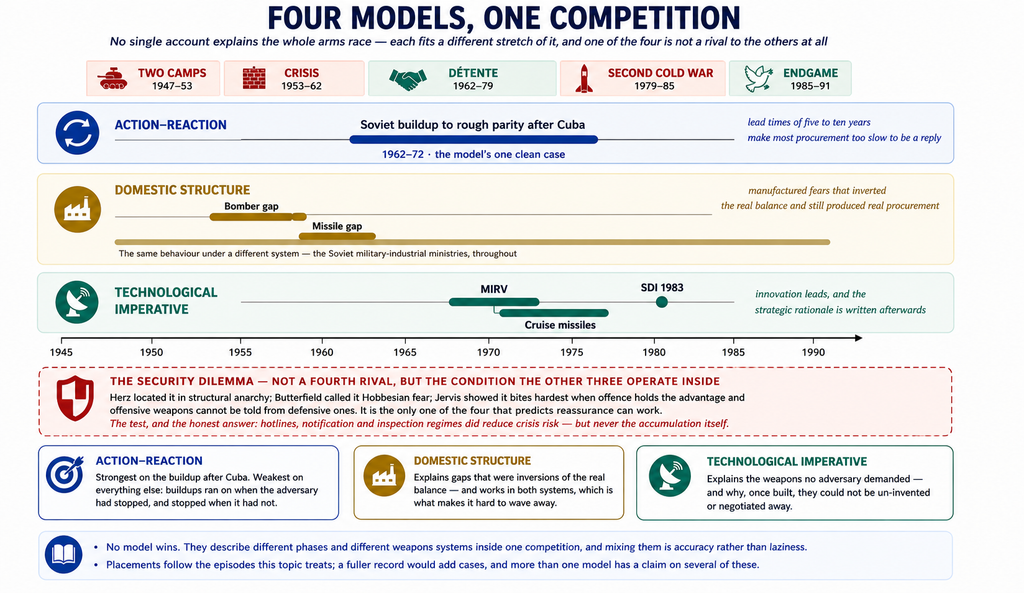
- The security dilemma predicts that reassurance can work, which is exactly what the other three models deny.
- If fear drives the race, then transparency, confidence-building measures, verification and unilateral restraint should slow it.
- The record is patchy: hotlines, notification agreements and inspection regimes did reduce Cold War crisis risk, but they never stopped the accumulation itself.
The action–reaction model and Richardson’s formalisation
- The action–reaction model treats an arms race as a mechanical stimulus-and-response process: A’s buildup is the input that produces B’s, and B’s produces A’s next increment.
- It is the security dilemma stripped of psychology and rendered as behaviour that can be measured.
- Lewis Fry Richardson turned this into the first formal model of an arms race, using coupled differential equations in which each state’s rate of arming is a function of three terms.
- A rivalry or fear coefficient, scaling one’s buildup to the adversary’s stock.
- A fatigue coefficient, capturing the economic drag of one’s own armaments.
- A grievance term, capturing hostility independent of weapons.
- The model’s real payoff is that it identifies when a race is stable and when it explodes.
- Where fatigue terms dominate fear terms, the system converges on a stable equilibrium — a competition that settles rather than runs away.
- Where fear dominates fatigue, the system is explosive, with no ceiling short of exhaustion or war.
- This states rigorously an intuition — a race is dangerous when neither side feels the cost — and implies the same two states can race safely at one moment and catastrophically at another.
- The model’s weakness is that it fits the Cold War badly.
- Superpower procurement decisions ran on five-to-ten-year lead times for design and production, far too slow to be a response to what the adversary did last year.
- Buildups repeatedly continued through periods when the adversary was not building, and stopped when it was.
The domestic-structure model
- The domestic-structure model reverses the causal arrow: the race is generated inside the state, and the adversary supplies not the cause but the justification.
- Eisenhower’s farewell address of January 1961 gave the argument its name and its authority, warning of a permanent armaments industry of vast proportions new to the American experience.
- The warning carried weight precisely because it came from a general and a president who had presided over the buildup he was describing.
“In the councils of government, we must guard against the acquisition of unwarranted influence, whether sought or unsought, by the military-industrial complex.” — Eisenhower
- Three distinct internal drivers are usually separated, and they are not the same claim.
- Industrial interest: firms whose survival depends on procurement lobby for programmes, and the geographic spread of subcontracting turns a weapons system into a coalition of constituencies.
- Bureaucratic and service interest: each service competes for budget share and mission — one plausible reading of why the United States built a triad rather than choosing the most cost-effective leg.
- Electoral incentive: appearing weak on defence is a reliable liability, so incentives run asymmetrically towards buying.
- The Soviet case shows the model is not peculiar to democracies or to capitalism. The military-industrial ministries were the most privileged sector of that economy, with first claim on materials and talent and no consumer constituency against them.
- If the same behaviour appears under radically different systems, adversary behaviour cannot be the whole explanation.
- The model predicts that reassurance will fail, because the demand for weapons is generated domestically and will find a threat to attach itself to.
- Its distinctive testable claim is that procurement should track budget cycles, service rivalries and electoral calendars better than it tracks the adversary.
The technological imperative
- The technological-imperative model holds that the race is driven by what laboratories can build rather than by what the adversary is doing — capability creates its own demand.
- Weapons are developed because a technical possibility has opened, and a strategic rationale is constructed afterwards to justify deployment.
- The mechanism is anticipatory: each side arms against what the other might have in a decade, so the race is run against an imagined future adversary rather than a real present one.
- MIRV is the standard illustration. It was not demanded by any Soviet capability; it emerged from work on penetration aids and guidance accuracy, and its strategic justification shifted repeatedly after the technology existed.
- Once deployed by one side it was irreversible, because a technology cannot be un-invented and each side must assume the other has it.
- The model’s most uncomfortable implication: a race can run with no adversary at all, which is what makes it hard to negotiate away. It predicts that innovation should lead deployment, and that programmes should survive changes in the threat that justified them.
| Model | Where the race originates | Its distinctive prediction | What would slow it |
|---|---|---|---|
| Security dilemma | Anarchy and uncertainty about intentions | Races intensify when offence has the advantage and weapons are indistinguishable | Transparency, reassurance, defensive postures |
| Action–reaction | The adversary’s observable buildup | Procurement correlates with adversary holdings, with a short lag | Reciprocal, verifiable ceilings |
| Domestic structure | Industry, services and electoral politics | Procurement tracks budget and political cycles, not the threat | Domestic reform — almost nothing external |
| Technological imperative | Laboratories and R&D pipelines | Innovation precedes and creates strategic rationale | Limits on testing and development, not on numbers |
- The evidence is genuinely mixed, and no single model wins.
- The missile gap and the bomber gap support the internal models, since both were manufactured fears that turned out to be inversions of the real balance yet still produced real procurement.
- The Soviet strategic buildup after 1962, from clear inferiority to rough parity within a decade, is a straightforward action–reaction response to humiliation in the Cuban Missile Crisis.
- MIRV, cruise missiles and missile defence fit the technological model best.
- The reasonable conclusion is that the models describe different phases and different weapons systems within one competition, and that mixing them is not intellectual laziness but accuracy.
Do Arms Races Cause War?
- This is the central empirical question in the field, and it is not settled. Both sides of it are defensible, and the argument turns on a problem of causal inference rather than on a shortage of cases.
- The spiral argument holds that racing makes war more likely, through four distinct mechanisms that are worth separating.
- Fear feeds on itself. Each increment confirms the adversary’s hostile intent and licenses the next increment, so the relationship deteriorates independently of any political dispute.
- Worst-case planning becomes rational. Uncertain about the other’s holdings, each side arms against the most pessimistic estimate, which is systematically an over-estimate.
- Diplomatic space closes. Rapid arming hardens domestic constituencies, discredits negotiators as naive, and makes concession look like surrender.
- A temporary lead invites preventive war. Where one side believes its advantage is real but will not last, the logic of striking now rather than later becomes compelling — the preventive-war temptation is the sharpest of the four.
- The deterrence argument holds the opposite: an arms race producing mutual capacity for devastation prevents war rather than causing it. Its strongest evidence is the absence of any direct superpower war across four decades of the most intense arms race in history — on this reading the accumulation was the vaccine, not the disease.
- The endogeneity objection cuts underneath both positions, and it is the most important methodological point in the debate.
- Arms races and wars are both effects of a prior underlying rivalry. Two states that are already in deep political conflict will both arm heavily and fight; the arming did not cause the fighting, the conflict caused both.
- The observed correlation between racing and war is therefore compatible with the race doing no independent causal work at all, and separating the two statistically has proved extremely difficult.
- Its policy implication is deflating: capping weapons without addressing the political dispute treats the symptom.
- The nuclear/conventional distinction is where the argument becomes tractable, and it is the most useful single move in the whole debate.
- Conventional arms races lack an absolute ceiling on advantage. A side that believes it has gained a temporary edge can plausibly imagine winning a war at bearable cost, so a conventional lead is an invitation to use it.
- Nuclear arms races destroy that calculation. Once both sides can inflict unacceptable destruction regardless of who strikes first, no lead in numbers converts into a usable advantage, and the incentive to strike disappears.
- This is why the Cold War race and the pre-1914 naval race, superficially similar, had opposite outcomes — and why the pattern must not be generalised from one to the other.
“…safety will be the sturdy child of terror, and survival the twin brother of annihilation.” — Churchill
- The qualified conclusion is that arms races do not cause war on their own, but they shorten the fuse — raising the probability that an existing dispute is resolved by force, and raising the destructiveness of that force when it comes.
What Arms Races Cost, and What Is Claimed for Them
- The opportunity cost is the primary objection, and it is a claim about foregone alternatives rather than about waste as such.
- The guns-versus-butter trade-off is real at the margin: output committed to armaments is unavailable for health, education or investment, and the weapons are, if the strategy works, never used — capital that is neither consumed nor productive.
- The trade-off bites hardest where the surplus is smallest, which is why the burden falls disproportionately on developing states.
- Importing states accumulate debt without a productive return, which is a distinct problem from the domestic opportunity cost.
- Arms purchases are typically in hard currency, generate no export earnings and create no domestic industrial base, so the debt is serviced out of general revenue indefinitely.
- This is the mechanism by which an arms race in the developing world can leave a state permanently poorer whether or not it ever fights.
- The Soviet defence burden is the standard illustration, and it needs to be stated carefully.
- Soviet military spending consumed a very high share of national output — estimates vary widely and the Soviet statistics were themselves unreliable, but a burden several times the American share of GDP is not disputed.
- The economic difficulties of the 1980s were certainly exacerbated by that burden, and the effort to match American qualitative advances, above all after the Strategic Defense Initiative, absorbed exactly the scientific and industrial capacity a stagnating economy most needed elsewhere.
- The burden was an aggravating factor and not a sufficient cause. Structural stagnation, the failure of the command economy to manage complexity, falling oil revenues, the sequencing of reform and the nationalities question all belong in the explanation; the collapse is treated in its own right elsewhere in this archive.
- The “win by bankrupting the rival” argument is real but incomplete, and its costs arrive later.
- A wealthier state can in principle set a pace of competition the poorer one cannot sustain, and force it to choose between armaments and solvency.
- But the victor inherits the wreckage: a collapsing rival means loose fissile material, unpaid weapons scientists, unsecured stockpiles and a successor state with grievances and no stake in the settlement.
- Pakistan’s trajectory is the clearest contemporary case of that inheritance, and it illustrates the argument better than the Soviet one.
- Competing with a neighbour several times its economic size has meant sustaining a defence burden far above what the economy generates, with repeated recourse to the International Monetary Fund as the recurring symptom.
- The result is not victory or defeat but chronic fiscal fragility, with the arms competition crowding out the development spending that might have narrowed the gap.
- The danger the competition creates is therefore not only inter-state: weapons in a state under severe internal stress raise questions of command security and of material reaching non-state actors that no adversary benefits from.
- The arguments in favour of arms spending are not frivolous, but they do not survive scale.
- Employment: defence industries do create skilled jobs, but arms production is capital-intensive and generates fewer jobs per unit of expenditure than health, education or construction — so the employment case is an argument for spending, not for spending on this.
- Technological spin-off: jet engines, semiconductors, satellite navigation and the internet’s precursors all have military origins, and the case is historically genuine.
- But spin-off weakens as the technology specialises. Civilian innovation now leads military application in computing, communications and increasingly in artificial intelligence, so the flow has substantially reversed — spin-on rather than spin-off.
- Beyond a point the competition is zero-sum: if each side’s increment merely offsets the other’s, both have spent heavily to arrive at the security position they started from.
Arms racing is the rare policy where both parties can spend everything they have and end exactly where they began, only poorer.
The Cold War Nuclear Race: How the Arsenals Grew
Nothing in the pre-nuclear record prepares one for the scale of what happened between 1945 and 1986. Two states built, at enormous cost, the capacity to destroy each other several times over while both understood that using it was self-defeating. What follows is a sequence of technical steps, each rational for the side that took it and destabilising for the system.
From monopoly to parity, 1945–62
- The American monopoly lasted four years and shaped everything that followed. The bombing of Hiroshima on 6 August 1945 and Nagasaki on 9 August demonstrated both the weapon and a willingness to use it.
- The one attempt at international control failed at the outset. The Baruch Plan of 1946 proposed an International Atomic Development Authority with full regulatory power over all dangerous nuclear activity, backed by the parallel Acheson–Lilienthal Report.
- Moscow rejected it because inspection would have frozen the American lead while Washington kept its bombs; Washington would not disarm first. The failure produced the US Atomic Energy Act of 1946, which classified all nuclear information — pushing Britain, and later France, towards independent programmes.
- The Soviet test of August 1949 arrived years earlier than American estimates, ending any prospect of managing the technology from monopoly.
- The thermonuclear step of 1952–53 changed the order of magnitude, not merely the count. The American Ivy Mike test of November 1952 and the Soviet device of August 1953 moved yields from kilotons to megatons.
- The atomic bomb destroyed a city; the hydrogen bomb destroyed a metropolitan region. Damage ceased to be proportionate to any conceivable political objective.
- The “bomber gap” and the “missile gap” are the two classic manufactured fears, and both are essential evidence in the argument about what drives arms races.
- The bomber gap of the mid-1950s projected a vast Soviet long-range bomber fleet, on the basis of a fly-past in which the same aircraft circled and were counted repeatedly.
- The missile gap of 1957–61 projected Soviet ICBM superiority. Satellite reconnaissance established that the true ratio ran heavily the other way.
- Both were wrong in the same direction, and both produced real procurement. The refutation did not cancel the programmes the fear had launched — the strongest single piece of evidence for the domestic and technological models.
- Sputnik, launched in October 1957, converted an abstraction into a visible fact: a satellite in orbit meant a rocket that could reach the United States, and it moved American defence and science budgets more than any Soviet weapon.
- The Cuban Missile Crisis of 1962 produced the buildup rather than ended it. Having backed down from clear inferiority, the Soviet leadership resolved never to be outmatched again and reached rough parity within a decade.
The technical steps that made the arsenals unstable
- The triad — land-based missiles, submarine-launched missiles and bombers — was the structural answer to vulnerability.
- Its logic is survivability: no plausible first strike destroys all three legs, so a retaliatory capacity always survives, and submarines are the decisive leg because a boat at sea cannot be targeted.
- Mutual assured destruction is simply the condition that results when both sides hold such a survivable second strike: a first strike guarantees the attacker’s own destruction, so neither strikes. Deterrence theory proper — its requirements, its variants and the full bilateral treaty sequence — is developed in this archive’s separate treatment of deterrence.
- MIRV was the single most destabilising technical step of the entire Cold War, and it is worth being precise about why.
- A multiple independently targetable re-entry vehicle allows one missile to carry several warheads and direct each to a different target, first flight-tested by the United States at the end of the 1960s and deployed on Minuteman III and Poseidon from 1970.
- It inverted the offence–defence arithmetic: one attacking missile could now destroy several of the adversary’s silos, so striking first became cheaper than absorbing a strike.
- It made counting meaningless as a measure of stability — arms control that limited launchers no longer limited warheads, which is why the SALT ceilings were compatible with a warhead explosion.
- It generated use-them-or-lose-them pressure on fixed silos, the crisis instability that everything afterwards tried to undo.
- The Anti-Ballistic Missile Treaty of 1972 embodied a counter-intuitive logic that is easy to state and easy to misunderstand.
- By limiting each side to token defences it deliberately kept both populations hostage, so neither could imagine surviving a war and neither needed more offensive missiles to overwhelm the other’s shield.
- Defences were restricted precisely so that offence would remain credible — the clearest example in strategic history of an agreement to remain vulnerable on purpose.
- It also removed an engine of the offensive race: without a defence to saturate, the case for endless additional warheads weakened.
- The neutron bomb of the late 1970s — an enhanced-radiation warhead meant to kill armoured crews while leaving structures standing — provoked European revolt precisely because it looked usable, and was cancelled by Carter in 1978.
- The Euromissile crisis was the sharpest confrontation of the late Cold War. Soviet deployment of the mobile, MIRVed SS-20 from 1976 was answered by the NATO dual-track decision of December 1979 — deploy Pershing II and ground-launched cruise missiles while negotiating their removal.
- Deployment from 1983 triggered the largest peace demonstrations in European history, and the crisis was resolved only by the INF Treaty of 1987, the first agreement to eliminate an entire class of missiles.
- The Strategic Defense Initiative, announced on 23 March 1983, reopened everything the ABM Treaty had closed — a research programme for space-based defences intended, in Reagan’s words, to render nuclear weapons impotent and obsolete.
- Technically it was far beyond the reach of the period; politically it was decisive, because Moscow could not be certain it would fail.
- Its effect on Soviet calculations was threefold: a shield plus American offensive forces might permit a first strike; matching it demanded exactly the microelectronics the USSR lacked; and the attempt would consume resources a stagnating economy could not spare.
- Soviet insistence on confining SDI to the laboratory is what wrecked the Reykjavik summit of 1986, where the two leaders had come remarkably close to agreeing on the elimination of ballistic missiles.
Every technical advance of the Cold War was bought for security and delivered, on arrival, a new reason to be afraid.
Doctrine evolving alongside the hardware
| Doctrine | Period and author | Core claim | Why it was abandoned or modified |
|---|---|---|---|
| Massive retaliation | 1954, Dulles under Eisenhower | Any aggression answered instantly, at a place and with means of America’s choosing | Offered only capitulation or holocaust; lost credibility once the USSR could retaliate |
| Flexible response | 1960s, Kennedy and McNamara | A graduated ladder of conventional, tactical and strategic options | Made limited war thinkable, which allies feared meant a war fought in Europe |
| Assured destruction | Mid-1960s, McNamara | Capacity to destroy an unacceptable share of the adversary’s population and industry after absorbing a first strike | Became mutual once the USSR matched it; criticised as targeting civilians |
| Countervailing strategy | 1980, Presidential Directive 59, Carter and Brown | Threaten what Soviet leaders value — command posts, military forces, the leadership itself | Counterforce targeting requires accuracy and looks like preparation for a first strike |
- The doctrinal sequence tracks the technology, not the other way round. Massive retaliation was possible only during monopoly; flexible response required a diversified arsenal; assured destruction required survivable second-strike forces; countervailing strategy required the accuracy that MIRV-era guidance provided.
- Each refinement aimed at credibility and purchased it at the price of stability. The more usable a nuclear option is made to look, the more credible the threat — and the lower the threshold at which use becomes conceivable.
The peak and the fall
- The global stockpile peaked at roughly 70,300 warheads in 1986, of which the overwhelming majority belonged to the two superpowers.
- The fall since has been very large and is now over. The global inventory stands at about 12,187 warheads in January 2026, with military stockpiles of 9,745 and roughly 4,012 deployed — a reduction of more than four-fifths from the peak.
- The reduction was achieved mainly by retiring obsolete tactical weapons and the dissolution of the Soviet arsenal, not by disarmament in the treaty sense.
- Russia and the United States still hold about 83% of all stockpiled warheads. The remaining arsenal is smaller, more accurate, more diversified and, on several arguments, more usable than what it replaced.
Why States Build the Bomb: Sagan’s Three Models
- Scott Sagan supplied the organising frame for this question by asking what would count as an explanation at all, and answering that three quite different theories are in circulation, each with different policy implications.
- The security model is the realist default: states build nuclear weapons to deter an existential threat they cannot otherwise meet. It predicts a proliferation chain — each acquisition creating the insecurity that drives the next — and has the best surface fit to the historical sequence.
- Its implication is that non-proliferation must address the underlying insecurity, since denial alone attacks the means, not the motive.
- The domestic-politics model treats the bomb as a solution that internal actors find for their own problems.
- Nuclear complexes acquire institutional interests: weapons laboratories, atomic energy establishments and the military services that would operate the weapons all gain budget, prestige and autonomy from a programme.
- Leaders may find a programme useful for coalition-building or legitimacy, independently of any strategic assessment.
- Its implication is that the decision may be reversible if the coalition changes, which the rollback cases support.
- The norms and symbolic model treats nuclear weapons as markers of modernity and standing rather than as instruments.
- Acquisition is a statement about what kind of state one is — an assertion of independence, technological maturity and membership of the top table.
- De Gaulle’s case for the force de frappe was explicitly of this kind: he argued that nuclear weapons were necessary for France to count in world affairs, and the French programme is intelligible only in that light.
- Its implication is that stigmatising the weapon — devaluing it as a symbol — can be as effective as denying the technology.
- The three models are not rivals to be adjudicated once; almost every real case involves more than one, and the useful exercise is asking which model carries the most weight where.
| State | Primary driver | The specific logic |
|---|---|---|
| USSR | Security, with prestige | Negate the American monopoly and the coercive leverage it conferred |
| Britain | Prestige and alliance autonomy | Great-power standing after the 1946 American cut-off; an independent deterrent if Washington ever hesitated |
| France | Prestige and doubt about the guarantee | Distrust of the American umbrella, Suez, and de Gaulle’s insistence on counting |
| China | Security under double pressure | American nuclear threats over Korea and Taiwan, then the Sino-Soviet split; first test 1964 |
| Israel | Survival | Numerically superior neighbours and no depth; an undeclared arsenal held under deliberate ambiguity |
| India | Security plus status | The 1962 war and China’s 1964 test; also resistance to a nuclear order it regarded as discriminatory |
| Pakistan | Direct response to India | Conventional inferiority against a larger neighbour; explicitly reactive at every stage |
| North Korea | Regime insurance | A hostile environment and the conclusion that only a deterrent prevents externally imposed regime change |
| South Africa | Security, then reversal | A siege mentality under apartheid, abandoned when the threat perception and the regime both changed |
- The alliance-credibility argument is the live proliferation risk of the present, and it follows directly from the security model.
- States that have foregone the bomb because an ally’s guarantee substitutes for it will reconsider if the guarantee looks conditional.
- South Korea faces a nuclear-armed neighbour and has an open domestic debate on indigenous weapons; Japan holds large civil plutonium stocks and the technical capacity to move quickly; Turkey has questioned why others may hold weapons it may not.
- The mechanism is important: extended deterrence is the largest single non-proliferation instrument in existence, and it is not a treaty. Weaken it and the demand side of proliferation reopens.
The strongest brake on proliferation is not a treaty text but somebody else’s credible promise; that is a brake with no legal guarantee behind it.
Why States Stop, and Why Some Are Stopped
- The default assumption that capable states will build the bomb is empirically false. Far more states have had the capacity and declined than have proceeded, and explaining the restraint matters as much as explaining the acquisitions.
- Alliance guarantees remove the need. Japan, South Korea, Australia, Germany and most of NATO shelter under the American nuclear umbrella, and their non-nuclear status is a direct function of it.
- The non-proliferation norm and the sanctions that enforce it raise the price.
- The Nuclear Non-Proliferation Treaty made abstention the default expectation rather than a concession, and made a programme a deviation requiring justification.
- States pursuing weapons have faced technology denial, financial isolation and diplomatic cost — a real deterrent for any state that wants normal international economic life. The architecture of treaties and export-control regimes that does this work is set out separately in this archive.
- Nina Tannenwald’s nuclear taboo operates at a deeper level than either interest or law.
- She argues that a normative inhibition developed against nuclear use — leaders came to see these weapons as abhorrent rather than merely inexpedient, and the taboo extends beyond use to brandishing them as ordinary instruments of policy.
- The taboo does work that deterrence cannot explain: it accounts for non-use against non-nuclear opponents, where no retaliation was possible, including acceptance of defeat in Vietnam and Afghanistan.
- Where the taboo holds, a nuclear programme is not only expensive but disreputable, and that stigma is itself a barrier to acquisition.
- Cost and technical difficulty eliminate many candidates before politics is reached.
- The binding constraint is fissile material: roughly 15–25 kg of highly enriched uranium or 5–8 kg of plutonium for one first-generation device, requiring either an enrichment cascade or a reactor and reprocessing plant.
- Beyond material lie weaponisation and delivery — miniaturisation, reliable initiation, missiles or aircraft — each a substantial programme; for a small economy the diversion of scientific capacity over a decade is a development cost, not a budget line.
- Leadership decisions can reverse a programme outright, and the rollback cases are the strongest evidence against technological determinism.
| Case | What happened | The lesson usually drawn |
|---|---|---|
| South Africa | Built six devices, then dismantled them before the transition and acceded to the NPT in 1991 | The only complete rollback by a state that had actually built weapons; a changed regime and a changed threat both mattered |
| Ukraine, Belarus, Kazakhstan | Inherited Soviet weapons in 1991 and transferred all of them to Russia | Physical possession without operational control is not a deterrent; the security assurances received are now bitterly contested |
| Brazil and Argentina | Rival programmes abandoned by mutual agreement, with a joint bilateral inspection body created in 1991 | A regional security dilemma can be dissolved by reciprocal transparency rather than managed |
| Libya | Gaddafi surrendered the programme in December 2003 to normalise relations with the West | The regime was destroyed eight years later — the case North Korea cites for never disarming |
- The Libyan lesson deserves to be stated plainly, because it is the single most consequential piece of learning in contemporary proliferation politics.
- The bargain was disarmament in exchange for reintegration; the reintegration was delivered and the regime fell anyway.
- North Korea drew the inference explicitly, and every subsequent negotiation with Pyongyang has run into it. The credibility problem is now the West’s, not Pyongyang’s.
- Coercive prevention is the fifth route, and its record is mixed at best.
- Osirak, June 1981: Israel destroyed Iraq’s reactor before fuel loading. The conventional verdict is success; the revisionist reading is that it converted a reactor programme into a covert enrichment programme, and Iraq was closer to a weapon in 1991 than in 1981.
- Syria, September 2007: Israel destroyed a suspected reactor at Al Kibar, and the programme did not restart.
- Stuxnet: a cyber weapon that destroyed Iranian centrifuges around 2009–10 — the first case of code doing the work of a bomb, and the precedent that opened cyber sabotage as a counter-proliferation tool.
- Iran, June 2025: Israeli strikes from 13 June and American strikes on Fordow, Natanz and Isfahan on 22 June in Operation Midnight Hammer, using bunker-penetrating munitions against hardened and buried facilities.
- The strategic problem with coercive prevention: it treats capability while worsening motive. Every strike raises the target’s assessment of how badly it needs the deterrent, and drives the programme deeper underground and further from inspection — as the sharp curtailment of IAEA access in Iran since June 2025 illustrates.
Does the Bomb Make the World Safer? An Unsettled Debate
- The question is whether the spread of nuclear weapons raises or lowers the probability of major war. Both answers are held by serious scholars, both rest on the same historical record, and the disagreement is about which mechanism dominates rather than about the facts.
- Kenneth Waltz argued that more may be better — that nuclear spread is stabilising and that the fear of it is largely unfounded.
- His argument is structural: nuclear weapons make the costs of war unambiguously and immediately catastrophic, which removes the miscalculation that causes most wars. Uncertainty about outcomes is what tempts leaders to fight; nuclear weapons abolish that uncertainty.
- New nuclear states, he held, behave cautiously rather than recklessly, because the weapon concentrates the mind of any leader who possesses it, whatever the character of the regime.
- Deterrence is also cheap and easy: it requires only a small survivable force, not parity, so a poor state can obtain security without racing.
- On this account the Cold War’s forty-five years without great-power war are the decisive datum, and the India–Pakistan relationship since 1998 — dangerous crises, no full war — is confirming evidence.
- John Mearsheimer accepted the logic but attached a selective-proliferation caveat.
- Stability requires survivable second-strike forces, proper command and control, and leaderships insulated from domestic upheaval — conditions mature states can meet and unstable ones cannot.
- He therefore favoured managed spread to particular states rather than either universal proliferation or universal denial, a position that satisfies neither camp and is often misread as simple optimism.
- Scott Sagan’s rebuttal is organisational, and it is the most powerful counter-argument in the literature because it does not deny the deterrence logic at all.
- His premise: deterrence assumes unitary rational states, but nuclear weapons are operated by large military organisations with their own routines, biases and failure modes.
- Drawing on normal accidents theory, he argues that systems that are highly complex and tightly coupled will produce serious failures eventually, however good the safety engineering, because the failures arise from the interaction of components rather than from any one of them.
- Military organisations have systematic biases: they favour offensive doctrines, resist civilian control of alerting, prefer preventive war during windows of advantage, and plan for operational convenience rather than crisis stability.
- The record of near-misses is his evidence — false warnings, unauthorised movements, weapons handled outside protocol, and the Cuban crisis above all, where control came close to slipping for reasons no leader intended.
- His conclusion is probabilistic, not deterministic: given enough time and enough nuclear actors, deterrence will fail somewhere, and the appropriate response is vigorous non-proliferation and tight control of what exists.
- Nina Tannenwald reframes the argument in constructivist terms, and her position reduces to neither side.
- The tradition of non-use is now over eighty years old, and she argues deterrence cannot fully explain it, since it held where the opponent could not retaliate.
- The taboo was built by civil-society pressure, the testimony of the survivors of 1945, United Nations resolutions and the moral positions of leaders; it constrains by changing what is thinkable rather than what is costly.
- She warns explicitly that the taboo may be eroding, and locates the erosion in the nuclear signalling that has accompanied the war in Ukraine since 2022, the normalisation of nuclear threats in political rhetoric, and the return of usable low-yield options to arsenals.
- Her prescription is delegitimisation, and she reads the Treaty on the Prohibition of Nuclear Weapons as a humanitarian reframing that strengthens the taboo even though no nuclear-armed state has joined it.
- A fourth position comes from practitioners.Kissinger, Perry, Shultz and Nunn, all veterans of Cold War nuclear policy, reversed their earlier positions to argue that nuclear weapons had become a source of extreme risk rather than of safety.
- Their reasoning was about the changed setting: more nuclear states, weaker safeguards, shorter decision times and terrorist ambition — conditions under which the Cold War’s carefully learned stability does not transfer.
| Position | Core mechanism | What it predicts | What would falsify it |
|---|---|---|---|
| Waltz — optimist | Certainty of catastrophic cost removes miscalculation | New nuclear states become cautious; no major war among them | A nuclear exchange or major war between nuclear-armed states |
| Mearsheimer — conditional | Stability requires survivability and stable command | Spread stabilises where conditions hold, destabilises where they do not | Reckless behaviour by a mature nuclear state, or restraint by an unstable one |
| Sagan — pessimist | Organisational failure under complexity and tight coupling | Accidents, false alarms and near-misses accumulate with each new arsenal | A long record of new nuclear states with no serious safety incidents |
| Tannenwald — constructivist | A normative taboo independent of deterrence | Non-use persists even where retaliation is impossible; erosion raises risk | Use, or routine brandishing, without political cost to the user |
- The debate is genuinely unsettled, and it is possible to say what evidence would move it.
- Against the optimists: any nuclear use, any exchange during a crisis between new nuclear states, or a documented case where organisational failure rather than leadership choice brought a state to the point of launch.
- Against the pessimists: further decades in which additional nuclear states manage their arsenals without serious incident, and crises between them that de-escalate as the optimists predict.
- The methodological trap is that the optimists’ claim is confirmed by the passage of uneventful time while the pessimists’ claim requires a catastrophe to be vindicated — an asymmetry that makes the argument very hard to settle, and that is itself a reason for caution.
The Arms Races Now Running
The end of the Cold War produced a genuine peace dividend: military budgets fell through the 1990s, the global stockpile shrank by more than three-quarters from its peak, and arms racing looked like a historical category. That period is over. What has replaced it is not one race but several overlapping ones, run by more players, in more domains, with far less of the machinery that managed the first.
The bilateral relationship without a treaty
- New START expired on 5 February 2026 with no successor in force, and for the first time since 1972 no legally binding limit constrains American and Russian strategic arsenals.
- It had capped each side at 1,550 deployed strategic warheads and 700 delivery vehicles, and carried the inspection and data-exchange provisions that made each side’s holdings knowable to the other.
- Verification is the loss that matters most. Numbers can be rebuilt; the transparency that prevented worst-case estimation cannot be recreated quickly.
- Both sides have signalled willingness to talk, and Washington has been open to a political commitment to observe the old ceilings — but that is not a treaty and carries no inspection.
- The erosion was cumulative rather than sudden. The United States left the ABM Treaty in 2002; both parties abandoned the INF Treaty in 2019 over a Russian intermediate-range cruise missile; the Open Skies Treaty unravelled after 2020; Russia de-ratified the CTBT in November 2023.
- Both triads are being comprehensively modernised, and the sums involved are the clearest indicator of intent.
- American nuclear forces are projected to cost about $946 billion over 2025–34 — new ICBMs, a new bomber, new ballistic-missile submarines and warhead refurbishment.
- Russia has fielded new ICBMs and in October 2025 tested the nuclear-powered Burevestnik cruise missile and Poseidon underwater vehicle, systems designed to circumvent missile defences.
- Nuclear testing has returned to political discourse for the first time in three decades, after an American directive of 30 October 2025 on resuming testing; no explosive test has followed, and no state but North Korea has conducted one since 1998.
- The competition has shifted from quantity to quality and diversification, which is what makes it harder to control than the Cold War race.
- Hypersonic glide vehicles — manoeuvring, unpredictable in trajectory and flying below the arc that early-warning systems were built to see — compress decision time and defeat existing defences.
- Missile defence has reopened the offence–defence spiral the ABM Treaty closed: an American continental defence programme announced in 2025 has drawn warnings from Moscow and Beijing that it will be answered with more offensive missiles — the logic of 1972 in reverse.
- Dual-capable systems create a discrimination problem that has no technical solution: a missile that may carry either a conventional or a nuclear warhead cannot be identified in flight, so the target state must assume the worst and may retaliate nuclear against a conventional attack.
- Low-yield warheads are defended as filling a credibility gap and attacked as lowering the threshold — the neutron bomb’s argument, now with the weapons deployed.
Three parties instead of two
- The emerging competition is trilateral, and trilateral arms control is a far harder problem than bilateral.
- China’s arsenal has roughly doubled since 2020 to about 620 warheads, the fastest expansion of any state, and it could hold as many intercontinental missiles as either Russia or the United States by the turn of the decade — moving from a small, unalerted force towards a larger, partly alerted triad.
- Why the trilateral problem is qualitatively different from the bilateral one:
- Parity is undefinable. With two parties, equal numbers are an obvious focal point; with three, equality with one leaves a state inferior to the sum of the other two, and every possible ratio disadvantages somebody.
- Every dyad interacts. American forces sized against Russia are automatically excessive against China; Chinese forces sized against the United States alarm India; Indian forces alarm Pakistan. The chain has no natural terminus.
- Asymmetry of interest. The far smaller party has no incentive to accept limits that freeze its inferiority, and Beijing has consistently declined trilateral talks on that ground — which is why pressing for a trilateral deal is widely read as a way of preventing a bilateral one.
- Regional races run on their own logic and are not derivatives of the great-power one.
- South Asia is the clearest action–reaction cycle in the world: India’s larger conventional forces drove Pakistani tactical nuclear weapons and a declared posture of full-spectrum deterrence, meant to deny India space for limited conventional retaliation below the nuclear threshold.
- India’s own buildup is driven as much by China as by Pakistan, so the dyad is really a chain — and Indian capability calibrated against Beijing lands in Islamabad as threat.
- The Korean peninsula combines an expanding North Korean arsenal, now with fissile material beyond its assembled weapons, with a live South Korean debate about indigenous capability.
- West Asia has an undeclared Israeli arsenal, an Iranian programme now beyond meaningful inspection after the strikes of June 2025 and the reimposition of United Nations sanctions in September 2025, and states that have said they would match an Iranian weapon.
Domains with no regime at all
- Space is contested and effectively unregulated for weapons. The United States, Russia, China and India have all conducted anti-satellite tests, and the debris threatens the orbits every space-faring state depends on.
- Satellites carry early warning and nuclear command and control, so an attack on them is indistinguishable from preparation for a first strike.
- The Outer Space Treaty bans weapons of mass destruction in orbit but not conventional anti-satellite weapons, and efforts at a binding norm have produced only a voluntary testing moratorium that the major players have not all joined.
- Cyber capability is a race that resists being counted. Offensive tools are invisible until used, cannot be verified, and are held by non-state actors too; attribution is slow and contested, which undermines any deterrent threat.
- The acute danger is its interaction with nuclear systems: an intrusion into early-warning or command networks, whether for espionage or attack, is indistinguishable to the target.
- Artificial intelligence and autonomous weapons are the newest and least governed competition.
- The military attraction is decision speed — and speed is precisely what removes the human deliberation on which crisis stability depends.
- Lethal autonomous weapons systems — able to select and engage targets without human intervention — raise unresolved questions of accountability, of compliance with distinction and proportionality, and of the moral threshold of allowing a machine to decide on a human death.
- Discussions have run for over a decade in the Group of Governmental Experts under the Convention on Certain Conventional Weapons, which works by consensus and has therefore produced guiding principles rather than binding law.
- The General Assembly’s First Committee adopted a resolution on autonomous weapons on 6 November 2025 by 156 votes to 5, pressing towards a negotiable instrument; the Secretary-General and the International Committee of the Red Cross have jointly urged a binding instrument, with the CCW review conference of November 2026 as the vehicle.
- The common feature of all three domains: the weapons arrived before the vocabulary. There is no agreed definition of a cyber weapon, no counting unit for autonomy, and no verification method for either — so the tools that limited missiles cannot simply be transferred.
What the spending shows
- World military expenditure reached $2,887 billion in 2025, a real increase of 2.9% and 2.5% of global GDP — the highest share since 2009 and above Cold War levels in constant prices.
- The largest spenders were the United States at $954bn, China at $336bn, Russia at $190bn, Germany at $114bn and India at $92.1bn, followed by the United Kingdom, Ukraine, Saudi Arabia, France and Japan; the top three alone account for 51% of the world total.
- The growth is regionally concentrated and politically driven. European spending rose 14% to $864 billion; Asia and Oceania rose 8.1% to $681 billion; NATO members committed at The Hague in June 2025 to 5% of GDP by 2035, split between core defence and defence-related investment.
- The pattern is a broad-based conventional buildup underneath the nuclear competition, which matters because the historical evidence that conventional races raise war risk is stronger than the evidence for nuclear ones.
India’s Position: Restraint Inside a Race
- India occupies an unusual place in this subject — a nuclear-armed state that arrived late and reluctantly, has argued for disarmament for longer than it has held weapons, and whose declared posture is designed to keep it out of a race it is nonetheless inside.
- Strategic restraint is the tradition, visible in the long gap between capability and weaponisation: India demonstrated a device in 1974 and did not weaponise for a generation, testing and declaring only in 1998 — a delay no other nuclear state has matched.
- The posture that followed rejected both disarmament and open-ended accumulation, and the term for the middle course is credible minimum deterrence.
- The doctrine’s three declared elements are internally coherent, and each is a decision not to race.
- No first use: nuclear weapons are for retaliation only, which means India does not need forces sized to strike first and does not need them on alert.
- Minimum credible deterrence: enough survivable capacity to inflict unacceptable damage in retaliation, not parity with anyone — a doctrine that explicitly refuses to index Indian numbers to Chinese or Pakistani ones.
- Massive retaliation to any nuclear first strike, with the option retained against a major chemical or biological attack on India or Indian forces anywhere, and civilian political control of release through the Nuclear Command Authority.
- The doctrine’s stress point is Pakistani tactical weapons: if a battlefield weapon is used against Indian forces, the declared response is disproportionate to the provocation, and critics argue that this is not credible. India’s nuclear trajectory and doctrinal debate are treated in their own right elsewhere in this archive.
- The capability has nonetheless grown steadily, which is what makes the restraint claim a question rather than a statement.
- The Agni series runs from short-range systems to Agni-V, with a range beyond 5,000 km and a tested multiple-warhead capability; the canisterised Agni-Prime improves readiness and mobility.
- INS Arihant, commissioned in 2016, gave India the sea leg and therefore an assuredly survivable retaliatory force; INS Arighaat followed in 2024 and INS Aridhaman in 2026, approaching a continuous at-sea deterrent.
- India’s stockpile is estimated at about 190 warheads in January 2026, now larger than Pakistan’s 170 — a reversal of the position the older literature describes.
- India sits in two dyads at once, which is why its behaviour cannot be read from either alone.
- Against Pakistan the relationship is a classic action–reaction cycle in which Indian conventional superiority and Pakistani nuclear compensation interact; the four-day crisis of May 2025 showed both a willingness to use conventional force between nuclear-armed states and how fast such an exchange approaches the threshold.
- Against China the asymmetry runs the other way — a larger economy, a defence budget roughly three and a half times India’s, and a far larger and faster-growing arsenal.
- The result is a security-dilemma chain: what India builds to be credible against Beijing is read in Islamabad as directed at it, and Pakistan’s response returns to India as a threat. Neither dyad can be stabilised in isolation.
- India has also been a competitor in the newer domains. The anti-satellite test of March 2019, destroying a satellite in low earth orbit, made India the fourth state to demonstrate the capability, framed as a deterrent demonstration rather than the start of a programme.
- The disarmament advocacy is long, consistent and predates the weapons.
- Nehru proposed a standstill agreement on nuclear testing in 1954, the earliest such proposal by any state and the direct ancestor of the test-ban treaties.
- India pressed for non-discriminatory, universal and verifiable disarmament for decades, and refused the NPT and the CTBT on the ground that both froze an unequal order rather than dismantling it.
- The position is defensible and awkward at once: India insists its objection was never to disarmament but to discrimination, while its own arsenal grows. Critics read that as rationalisation; the defence is that a rule applied only to the weak is not a rule.
Conclusion
- Arms races are not a natural condition but a policy outcome. They are mitigable. The dreadnought race was ended by one side winning; the Cold War race was slowed by negotiation; the Brazilian–Argentine competition was dissolved by reciprocal transparency. None of these was inevitable and none was automatic.
- What made the Cold War manageable was a narrow set of conditions that no longer hold: two parties, one domain, a countable object, an interest in mutual survival strong enough to override the rivalry, and verification that made cheating detectable.
- Each has now failed at once. The parties are at least three; the domains include space, cyber and autonomy; the competition is qualitative and so uncountable; and with the last bilateral treaty expired, verification is gone.
- The practical problem is therefore not persuading anyone that arms racing is wasteful — that is not seriously contested. It is constructing agreement across a fragmented power structure, among parties who cannot define what parity would mean, over technologies for which no counting unit yet exists.
- The modest starting points are the ones that do not require agreement on numbers: restoring transparency and crisis communication, agreeing that human judgement remains in the decision to use force, and keeping the taboo on nuclear use intact. None of that is disarmament. All of it is cheaper than the alternative.
Previous Year Questions
- The changing global order and ongoing regional conflicts, with the global powers taking sides, have jeopardised the progress made towards disarmament in the past. Comment. (2024)
- What does the pace of nuclear proliferation in post-Cold War suggest? (150 words) (2013)
Syllabus unit: Changing International Political Order
PSIR Optional study material from LotusArise IAS
Two ways to prepare with us — the full self-study system, or just the notes you need right now.
| What you get | PSIR Mains Master Kit 2027 | PSIR Complete Notes (Store) |
|---|---|---|
| Paper 1 notes — Political Theory + Indian Government and Politics | Included | Included — Section A and Section B |
| Paper 2 notes — Comparative Politics and India and the World | Included | Included — Section A and Section B |
| Topic-wise PYQ bank | 1986–2026, with trend analysis and probables by Dec 2026 | 1991–2025 question papers, free with every notes pack |
| Practice question set for timed answer writing | ✅ Available now | ❌ |
| Answer toolkit — intros, conclusions, frameworks, thinker and example banks | By Dec 2026 | ❌ |
| Revision booklets for the last 60 days | ✅ Available now | ❌ |
| Format | Online articles + PDF | PDF download |
| Access | Valid until UPSC CSE Mains 2027 | Instant download after payment |
| Price | ₹1,770 (regular ₹5,000) | ₹1,180 for all four sections · ₹599 a paper · ₹354 a section |
| Best for | Aspirants who want the whole system in one place | Aspirants who want the notes now, in the parts they need |
