

For forty-five years two states that never fired a shot at each other organised the whole of international politics around the possibility that they might. The Cold War is usually introduced through its architecture — containment, alliances, deterrence — but the architecture only explains why the confrontation was stable. What has to be explained separately is why its temperature rose and fell so sharply, why the fighting that did happen happened where it did, and what the world inherited when it stopped.
What the Confrontation Was, and How Its Intensity Is Measured

- The Cold War was a protracted geopolitical and ideological rivalry between the United States with its allies and the Soviet Union with its satellites, running from the closing months of the Second World War to the dissolution of the USSR in December 1991.
- The term was popularised by Bernard Baruch in 1947 and carried into use by the columnist Walter Lippmann, who insisted the condition was real and durable rather than a passing quarrel.
- “Cold” describes the relationship between the two principals only. Neither fought the other directly with its own uniformed forces; almost everything else was hot.
- The rivalry was simultaneously strategic and ideological, and neither dimension collapses into the other.
- Strategically, a bipolar distribution of capability: two states so far ahead that alignment, not balance, was the choice available to everyone else.
- Ideologically, a contest between two universalist models of social order — liberal capitalism and state socialism — each claiming to be the destination of history and so treating the other’s existence as provisional.
- The suspicion long predated 1945, which is why the alliance dissolved so quickly once the common enemy was gone.
- The Molotov–Ribbentrop Pact of 1939 and the German invasion of the USSR under Operation Barbarossa in 1941 had made the partnership an accident of necessity.
- Moscow read the delay in opening a second front until 1944 as a willingness to let the USSR bleed, and the Manhattan Project, concealed from an ally, as bad faith.
- The wartime conferences at Tehran, Yalta and Potsdam divided responsibility for post-war Europe without agreeing what the division meant; the use of atomic weapons on Japan was read in Moscow as a message addressed to it.
- Winston Churchill supplied the period’s founding image at Fulton, Missouri, in March 1946, and it framed how the West read every subsequent Soviet move.
“From Stettin in the Baltic to Trieste in the Adriatic, an iron curtain has descended across the Continent.” — Churchill
- Who caused it remains a live historiographical dispute — orthodox, revisionist, post-revisionist, realist and constructivist readings — and that argument is a separate subject from the narrative traced here.
- The narrative question is more tractable: what made the confrontation intensify and relax. Four variables recur.
- The nuclear balance — monopoly, then asymmetry, then rough parity, each with its own appetite for risk.
- Domestic economic capacity. Both sides bargained hardest when they could afford to and negotiated when they could not.
- Third parties, above all the Chinese revolution, the Sino-Soviet split and the arrival of scores of new states.
- Leadership and perception, which is why near-misses cluster around moments of poor information.
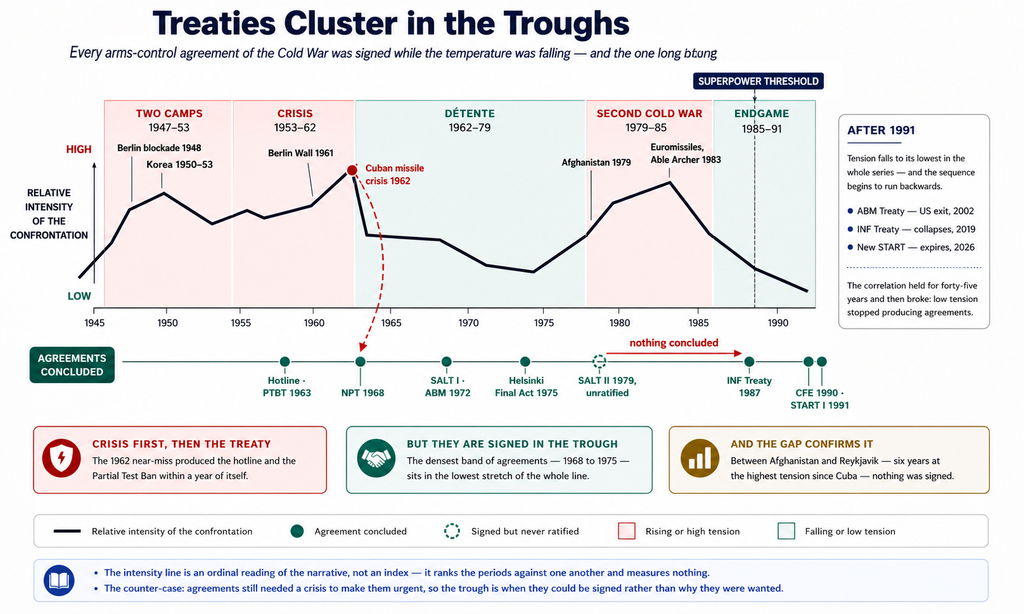
- Five phases organise the whole, each with a distinct logic rather than merely a distinct set of dates, and each is taken in turn below.
Phase One, 1947–53: Building the Two Camps
The first phase converted a wartime alliance of convenience into two organised blocs. Its analytical claim is that the Cold War’s institutions were built in a rush of improvised responses, not from a master plan — each move was read by the other side as offensive and answered in kind, and by 1953 the improvisations had hardened into a permanent architecture that neither side could dismantle unilaterally.
Europe divided: Berlin, the airlift and the two Germanies
- Germany was the first and sharpest test, because it was the one place where the two occupation systems physically touched.
- The Western zones’ currency reform of June 1948, introducing the Deutschmark to bring Germany into the Marshall Plan’s orbit, was the trigger; Moscow cut all land and water access to West Berlin on 24 June 1948.
- The Berlin blockade was the first crisis in which the two sides directly confronted each other over territory.
- The Berlin airlift was the decisive Western answer, and it set the pattern: a response calibrated to be firm without being violent.
- Anglo-American aircraft flew over two million tons of food and coal into the city on roughly a quarter of a million sorties, at the peak landing an aircraft every forty-five seconds.
- Moscow lifted the blockade on 12 May 1949, having shown it would not shoot down transport aircraft and having handed the West a propaganda victory. The crisis produced the two Germanies in 1949.
- The institutional consequences followed immediately.
- The North Atlantic Treaty was signed in April 1949, converting an American commitment into a standing alliance with an armed-attack clause.
- The Council for Mutual Economic Assistance (COMECON) had already given the Eastern bloc its answer to the Marshall Plan; the Warsaw Treaty Organization completed the symmetry in 1955.
1949: the year the balance changed
- Two events in 1949 destroyed the assumptions of American planning, and together they explain why the next four years were the most militarised of the early Cold War.
- The Soviet atomic test of August 1949 ended the American nuclear monopoly years earlier than predicted; the Baruch Plan of 1946 for international control of atomic energy had already failed, Moscow insisting Washington disarm first.
- The Chinese communist revolution of October 1949 transferred the world’s most populous state to the socialist camp, and was read in Washington as a catastrophic loss rather than the outcome of a civil war.
- The Sino-Soviet Treaty of February 1950 appeared to confirm the worst reading — a single communist bloc from the Elbe to the Pacific — which is precisely the misreading the Sino-Soviet split would later expose.
- NSC-68, the American strategy review completed in April 1950, drew the conclusion: containment could no longer be primarily economic and political but required a permanent, large and globally deployable military establishment.
- It treated every point on the perimeter as equally vital, because a loss anywhere would read as a loss of credibility everywhere. Written before Korea, it was Korea that made it politically affordable.
Korea 1950–53: containment goes global
- The Korean War universalised a doctrine designed for Europe. North Korea’s invasion of the South on 25 June 1950 was interpreted in Washington not as a peninsular civil war but as a probe of Western resolve directed from Moscow.
- The United Nations authorised the response only because Moscow was not in the room. Moscow was boycotting the Security Council over the exclusion of the People’s Republic from China’s seat, so its veto was unavailable, and the Council was able to recommend military assistance to South Korea under an American-led unified command.
- This is the single clearest illustration of how Security Council paralysis worked: collective security functioned in 1950 only through an accident of absence, and Moscow never repeated the mistake.
- The “Uniting for Peace” resolution of November 1950, allowing the General Assembly to act where the Council was deadlocked, was the institutional workaround the episode produced.
- The war’s course established the rules of superpower conflict.
- The American advance to the Yalu brought Chinese intervention in October–November 1950, and the front stabilised near the original line.
- Neither superpower used nuclear weapons, and neither attacked the other’s territory or acknowledged fighting the other’s forces — Soviet pilots flew combat missions over Korea, and both sides tacitly agreed not to say so.
- The armistice of July 1953 at Panmunjom ended the fighting without a peace treaty; the peninsula remains divided on those terms.
- The costs were borne almost entirely by Koreans, with deaths on all sides usually estimated in the range of two to three million, most of them civilian — the first demonstration of the pattern that would define the whole period.
| Institution | Date | Bloc | Function |
|---|---|---|---|
| Cominform | 1947 | Soviet | Coordination and ideological discipline among communist parties |
| Marshall Plan | 1947–48 | Western | Economic reconstruction, tying Europe to the dollar |
| Molotov Plan / COMECON | 1947, 1949 | Soviet | Bilateral aid to satellites, then a closed trading area for the bloc |
| NATO | 1949 | Western | Standing alliance with an armed-attack clause |
| SEATO | 1954 | Western | Extension of the alliance system to Southeast Asia |
| Baghdad Pact / CENTO | 1955 | Western | The northern tier of West Asian containment |
| Warsaw Pact | 1955 | Soviet | Formal counterpart to NATO; the legal basis for intra-bloc intervention |
Phase Two, 1953–62: Confrontation, Crisis and the Edge of the Cliff
The decade after Stalin’s death is often read as a thaw punctuated by crises. It is better read the other way round. Each side discovered exactly where the other’s tolerance ended, and the discovery was made by crossing the line rather than by negotiation — which is why the phase closes with the closest approach to nuclear war in history.
The limits of the thaw: 1953 to 1956
- Stalin’s death in March 1953 produced a real relaxation and an equally real demonstration of its boundaries.
- The Korean armistice followed within months; the Austrian State Treaty of 1955 withdrew Soviet troops from a European country in exchange for neutrality; the Geneva summit of that year was the first leaders’ meeting since Potsdam.
- The Warsaw Pact of May 1955 was formed in direct response to West German rearmament and NATO accession, and its real function was internal: it supplied the legal machinery for intervention inside the bloc.
- Khrushchev’s “secret speech” of February 1956, denouncing Stalin’s crimes to the Twentieth Party Congress, was intended to legitimise reform and instead destabilised Eastern Europe by suggesting the terms of Soviet control were negotiable.
1956: Hungary and Suez, the twin crises
- Hungary tested the Soviet sphere and settled what “socialist internationalism” meant.
- The uprising began in October 1956; Imre Nagy formed a reform government and on 1 November announced withdrawal from the Warsaw Pact and neutrality.
- Soviet forces intervened on 4 November 1956; some 2,500 Hungarians were killed, 200,000 fled, and Nagy was executed in 1958.
- The West did not intervene, which exposed rollback as rhetoric: American propaganda had encouraged East Europeans to expect liberation, and none came. The message received in every East European capital was that the sphere was closed — a lesson that held until Gorbachev reversed it.
- Suez tested the Western sphere and produced the opposite lesson: that the alliance’s senior partner could and would discipline its own.
- Nasser nationalised the Suez Canal Company in July 1956; Britain, France and Israel invaded at the end of October under a colluded plan.
- The United States forced its own allies to stop, using financial pressure on sterling and joining the Soviet Union in demanding withdrawal — the only occasion in the Cold War when the two superpowers found themselves on the same side of a major crisis.
- The United Nations Emergency Force, the first armed peacekeeping operation, was deployed to cover the withdrawal.
- The two crises ran simultaneously, and the coincidence mattered. Anglo-French action at Suez gave Moscow cover for Hungary and drained the moral force of Western protest.
- Suez confirmed that Britain and France were no longer independent great powers, completing the transition to a genuinely bipolar system and accelerating decolonisation.
Sputnik, the missile gap and the U-2
- Sputnik, launched in October 1957, transformed the psychology of the confrontation by demonstrating that a rocket capable of orbiting a satellite was a rocket capable of delivering a warhead to North America.
- It generated the “missile gap” — an American political panic about Soviet superiority in intercontinental missiles which turned out to be the reverse of the truth.
- The U-2 incident of May 1960 destroyed the diplomacy the thaw had produced. A reconnaissance aircraft was downed over Soviet territory and its pilot taken alive after Washington had denied the flight; Khrushchev broke up the Paris summit.
- The Berlin problem returned because the missile gap ran in Washington’s favour. East Germany was haemorrhaging its educated young through the open border in Berlin — some three million people since 1949 — and on 13 August 1961 the border was sealed and the Berlin Wall built.
- The Wall was an admission of failure dressed as a victory, and it stabilised the German question by removing the one leak in the system. Berlin never again produced a superpower crisis.
A wall that stopped people leaving was the most eloquent statement either side made about which system had to be defended against its own population.
The Cuban Missile Crisis: Thirteen Days and What They Settled
The October 1962 crisis is the hinge of the whole narrative. It is the moment at which both sides looked directly at the consequences of the system they had built, and it produced the first serious arms-control machinery within a year.
Background: the Bay of Pigs and Operation Mongoose
- Cuba became a Cold War theatre through a revolution that was not originally Soviet-aligned. Fidel Castro took power in January 1959; nationalisation of American assets, the rupture of relations and a trade embargo pushed Havana towards Moscow.
- The Bay of Pigs invasion of April 1961 — a landing by CIA-trained exiles without the air cover that might have saved it — failed in three days, with three consequences.
- It confirmed to Castro that an American invasion was coming, making him receptive to Soviet protection.
- It convinced Khrushchev that Kennedy could be pressed, a judgement reinforced by their bruising Vienna meeting of June 1961.
- It committed Washington to further covert action: Operation Mongoose, a programme of sabotage, economic disruption and assassination plots authorised in November 1961.
Why the missiles went to Cuba
- Redressing the strategic imbalance. Once the missile-gap scare collapsed, the real ratio was starkly against Moscow, which trailed badly in intercontinental missiles and bombers.
- Medium and intermediate-range missiles in Cuba were a cheap way of buying a credible threat against American territory without building an intercontinental force Moscow could not yet afford.
- Protecting Cuba. A socialist state in the Western hemisphere was an asset Moscow did not want to lose, and the Bay of Pigs had made the threat concrete.
- Turkey and the Jupiters. American Jupiter intermediate-range missiles sat in Turkey and Italy, on the Soviet perimeter; Khrushchev’s stated logic was symmetry — to let the Americans learn what it felt like to have enemy missiles pointed at them.
- Bloc leadership. With the Sino-Soviet split widening, a Caribbean success would answer Chinese charges that peaceful coexistence was capitulation.
The thirteen days and the choice of a quarantine
- The crisis ran from 16 to 28 October 1962, beginning when U-2 photographs confirmed missile sites under construction in western Cuba.
- The Executive Committee of the National Security Council (ExComm) was convened to consider the options, and the argument inside it is the reason the crisis is studied as a case in decision-making rather than only as an event.
- Air strike, favoured initially by much of the military leadership, could not be guaranteed to destroy every missile and would kill Soviet personnel.
- Invasion carried the same risk on a larger scale. Soviet forces on the island are now known to have held tactical nuclear weapons with local latitude to use them, so an invasion would very probably have crossed the nuclear threshold.
- Diplomacy alone risked the sites becoming operational while talks continued.
- A naval quarantine was chosen as the option that left both sides time: it stopped further deliveries without firing a shot, placed the burden of the next move on Moscow and kept escalation in reserve.
- The word “quarantine” rather than “blockade” was deliberate, a blockade being in law an act of war; the Organization of American States supplied regional cover.
- Kennedy announced it publicly on 22 October 1962, warning that any nuclear missile launched from Cuba against any nation in the hemisphere would be treated as an attack by the Soviet Union on the United States requiring a full retaliatory response.
The two letters and the two bargains
- The resolution came through direct correspondence between the two leaders, outside the formal machinery.
- Khrushchev’s first message on 26 October offered withdrawal in exchange for an American pledge not to invade Cuba; a harder message next day added removal of the Jupiters from Turkey.
- The American decision to answer the first letter and ignore the second — accepting the softer terms as though the harder had not been sent — is the crisis’s most celebrated improvisation.
- 27 October was the most dangerous day. A U-2 was shot down over Cuba, another strayed into Soviet airspace, and an American destroyer group depth-charged a Soviet submarine carrying a nuclear torpedo whose officers debated using it.
- The public bargain and the secret one were separated deliberately.
- Publicly: the Soviet Union withdrew the missiles under verification, and the United States pledged not to invade Cuba.
- Secretly: Robert Kennedy assured Ambassador Anatoly Dobrynin that the Jupiters in Turkey would be removed within months, on condition that the understanding never be acknowledged. The missiles came out in 1963.
- The concealment mattered: it let Washington claim an unreciprocated victory, distorting the lesson drawn — that firmness alone works — and cost Khrushchev at home, contributing to his removal in 1964.
What the crisis produced
- A permanent channel. The Moscow–Washington hotline of June 1963 created a direct teleprinter link, the crisis having been managed through embassy cables and a television journalist.
- The first arms-control treaty. The Partial Test Ban Treaty of August 1963 prohibited nuclear testing in the atmosphere, in outer space and under water — a limited step, since underground testing continued, but the first time the two sides had accepted a binding constraint.
- A shared doctrine of crisis management: no ultimatum that leaves the other side no exit, and a preference for measures that buy time.
- A Soviet build-up. Moscow concluded it had retreated because it was weaker, and pursued the programme that produced rough strategic parity by the early 1970s — the precondition for détente and SALT.
- A conclusion in Havana and Beijing that superpowers trade away allies’ interests, deepening the Sino-Soviet split.
The crisis in the deterrence argument
- The crisis is the central exhibit on both sides of the deterrence argument.
- Optimists read it as proof that deterrence works: two leaderships facing annihilation found a way to stop, and no shot was fired between them for the next twenty-nine years.
- Pessimists read the same thirteen days as a catalogue of near-misses that no rational-actor model predicted — a submarine commander minutes from launching, a stray U-2 over Siberia, undisclosed tactical warheads on the island, and neither leader in full control of his own forces.
- The outcome depended on information neither side had. Washington did not know of the tactical weapons; Moscow did not know how close the strike option came to prevailing. Survival turned on caution and luck as much as on the logic of the system.
The crisis is usually filed as deterrence working. It is at least as good evidence of how narrow the margin was between working and not.
Phase Three, 1962–79: Détente and Why It Was Only a Pause
Détente — a French term for the easing of tension — describes a managed rivalry rather than a friendship. Its analytical claim is that the two sides did not stop competing; they agreed to stabilise the most dangerous parts of the competition because both had become too expensive to sustain at full intensity, and to continue it everywhere else.
What drove it
- The shock of Cuba. Both leaderships emerged convinced that the crisis-management improvisation of October 1962 could not be relied on twice, and that the risk of inadvertent war was higher than either had assumed.
- Vietnam. The American war was consuming lives, money and legitimacy on a scale that made a second front unthinkable.
- Its fiscal effect was direct: financing war and domestic expansion together drained American gold reserves and forced the Nixon shock of August 1971, when the dollar’s convertibility into gold was suspended and the Bretton Woods par-value system collapsed.
- Politically, the war eroded American moral authority among precisely the newly independent states both blocs were courting.
- Rough strategic parity. By the early 1970s the two arsenals were roughly comparable in delivery vehicles, which made negotiation possible: neither side was being asked to codify its own inferiority.
- The Sino-Soviet split and triangular diplomacy. The rupture between Moscow and Beijing, culminating in armed border clashes on the Ussuri in 1969, gave Washington leverage over both and gave Moscow a strong reason to settle its Western front.
- Soviet economic need. Growth was slowing, agriculture was failing, and Moscow wanted Western credit, grain and technology — an interest that would give the West leverage it did not use well.
- European initiative. Détente was not only a superpower project. Willy Brandt’s Ostpolitik from 1969 normalised West German relations with Moscow, Warsaw and East Berlin, accepting the post-war borders in exchange for access and human contact, and made the European settlement negotiable.
The instruments
- Arms control moved from symbolism to substance, and the treaty sequence of this decade is the period’s most durable product.
- The Nuclear Non-Proliferation Treaty, opened for signature in 1968, froze the number of recognised nuclear-weapon states and traded non-proliferation for peaceful-use assistance and a disarmament promise.
- SALT I in 1972 capped the number of strategic missile launchers on each side for five years — a freeze on quantity, not a reduction.
- The Anti-Ballistic Missile Treaty of the same year was the more consequential of the pair: by limiting defences it deliberately preserved each side’s vulnerability, entrenching mutual assured destruction as a stabilising condition rather than a problem to be solved.
- SALT II, signed at Vienna in June 1979, was never ratified — withdrawn from Senate consideration after Afghanistan — though both sides observed its limits for years.
- The Helsinki Final Act of August 1975 was the political centrepiece, signed by thirty-five states including the United States, Canada and the USSR.
- The bargain looked like a Soviet win: the West accepted the inviolability of post-war European frontiers, which Moscow had sought for thirty years.
- In exchange the Soviet bloc signed a third “basket” on humanitarian cooperation and human rights, treated in Moscow as decorative language.
- It was not decorative. The human-rights basket gave dissidents a text their own governments had signed, and monitoring groups formed around it — Helsinki Watch in Moscow and Warsaw, Charter 77 in Czechoslovakia.
- Those groups became the organisational nucleus of 1989. Helsinki’s consequences ran opposite to the intentions of the side that had wanted it most.
The pivotal event: the Sino-American opening
- The strategic realignment of 1971–72 mattered more than any treaty, because it changed the shape of the system rather than the terms of the competition.
- Kissinger’s secret visit to Beijing in July 1971 was followed by Nixon’s visit of February 1972 and the Shanghai Communiqué; the People’s Republic had taken China’s United Nations seat in October 1971.
- The effect was to convert bipolarity into a strategic triangle in which the United States enjoyed better relations with each communist power than they had with each other.
- Moscow’s incentive to settle with Washington rose sharply, and the 1972 summit and SALT I followed.
- The sight of the two great socialist powers as antagonists destroyed the idea of a monolithic communist camp that had underwritten American policy since 1949.
- For India, the same realignment was threatening rather than reassuring, since it joined Washington, Beijing and Islamabad in a common front — the direct provocation for the Indo-Soviet treaty of August 1971.
Why it was a pause rather than a peace
- Neither side stopped arming. The freeze on launcher numbers was answered by a race in quality: MIRV technology, placing several independently targetable warheads on one missile, multiplied deliverable warheads while leaving treaty-counted launchers unchanged.
- Neither side stopped competing in the Third World. The Yom Kippur War of 1973 produced an American nuclear alert, and Angola and the Horn followed.
- The two sides understood the bargain differently. Washington believed détente implied Soviet restraint everywhere, a form of linkage; Moscow believed it applied to the central strategic relationship and that support for anti-colonial movements was a separate and legitimate activity.
- Domestic constituencies were never converted. Congressional linkage of trade concessions to Soviet emigration policy stripped away the economic incentives, and American critics attacked détente throughout as a device for consecrating Soviet gains.
What killed it
- The Angolan and Ethiopian interventions of 1975–78 destroyed the American assumption of reciprocal restraint.
- The Euromissile problem emerged from 1976, when Soviet deployment of the accurate, mobile SS-20 intermediate-range missile threatened Western Europe without touching the American homeland and raised the question of whether Washington would risk itself for its allies.
- The Iranian revolution of 1979 removed the pillar of American power in the Gulf and, with the hostage crisis, made restraint politically impossible.
- The Soviet intervention in Afghanistan in December 1979 was the immediate cause of death. It produced the grain embargo, the Olympic boycott, the shelving of SALT II and the Carter Doctrine declaring the Gulf a vital American interest.
| Détente delivered | Détente did not touch | |
|---|---|---|
| Strategic arms | SALT I and the ABM Treaty capped launchers and defences | MIRV multiplied warheads inside the caps |
| Europe | Helsinki settled borders; Ostpolitik normalised German relations | The Euromissile balance from 1976 |
| Proliferation | The NPT froze the recognised nuclear club | India’s 1974 test showed the gaps |
| Third World | Nothing | Vietnam, the Middle East, Angola, the Horn, Nicaragua, Afghanistan |
Phase Four, 1979–85: The Second Cold War
The phase that followed was as hostile in rhetoric as the early 1950s but structurally different: the Second Cold War produced no superpower crisis over territory, because the spheres were settled. The danger came instead from accident, misperception and weapons whose short flight times cut decision-making to minutes.
The Euromissile crisis
- NATO’s “double-track” decision of December 1979 answered the SS-20 by planning to deploy American Pershing II ballistic and ground-launched cruise missiles in Western Europe while offering to negotiate both classes away.
- Deployment began in November 1983 after negotiations failed, and Soviet negotiators walked out of the Geneva talks.
- The Pershing II was the specific problem. Its accuracy and very short flight time to Soviet command centres raised in Moscow the prospect of a decapitating first strike — a fear that shaped Soviet behaviour through 1983.
- The deployment produced the largest peace movements in European history, and European governments proceeded anyway — a demonstration of alliance cohesion Moscow had bet against.
Reagan, rhetoric and the Strategic Defense Initiative
- The Reagan administration abandoned the vocabulary of coexistence, calling the Soviet Union an “evil empire” in March 1983 and matching the language with the largest peacetime military build-up in American history.
- The Reagan Doctrine went beyond containment to arming anti-communist insurgencies in Afghanistan, Angola, Nicaragua and Cambodia — rollback by proxy.
- The Strategic Defense Initiative, announced in March 1983, proposed a space-based system to intercept ballistic missiles.
- It was far beyond the state of the art, and critics named it “Star Wars” to say so; strategically it was destabilising by design, since a working defence would negate the other side’s second strike — precisely what the ABM Treaty had been written to prevent.
- Its real effect was psychological and economic. Moscow could not be certain it would fail, and matching it would have required a technological effort the Soviet economy could not fund. SDI became the sticking point that wrecked the Reykjavik summit of 1986.
1983: the most dangerous year since 1962
- KAL 007. A Korean Air Lines Boeing 747 strayed into Soviet airspace and was shot down on 1 September 1983, killing all 269 aboard — confirming each side’s worst reading of the other.
- Operation RYaN, a Soviet intelligence programme launched in 1981 to detect preparations for a Western first strike, meant Moscow was actively looking for indicators of attack and primed to find them.
- Able Archer 83, a NATO command-post exercise of November 1983 rehearsing nuclear release procedures, used new and realistic communication formats; elements of the Soviet leadership appear to have treated it as possible cover for a real attack and raised alert levels.
- The lesson differs from Cuba’s. In 1962 both sides knew they were in a crisis; in 1983 one side did not know the other believed a war might be starting. The characteristic danger was misperception in the absence of a confrontation.
The closest approach to nuclear war after 1962 happened during an exercise that Washington did not know Moscow was taking seriously.
Phase Five, 1985–91: The Endgame
The final phase has a single analytical claim: the Cold War ended because one side decided to stop competing, and did so faster than its own system could absorb. Nothing in the structure of bipolarity required this; it required a Soviet leadership that concluded the competition was unaffordable and unnecessary.
- Mikhail Gorbachev, General Secretary from March 1985, treated the easing of external tension as a precondition for internal reform rather than as a reward for it.
- Glasnost (openness) and perestroika (restructuring) were domestic programmes; “new thinking” was their foreign-policy counterpart, replacing class struggle with interdependence and “common human values” as the organising idea.
- The practical corollary was that the arms race and the empire were costs, not assets.
- The arms-control turn was rapid and asymmetric. The Reykjavik summit of 1986 came close to abolishing all ballistic missiles before foundering on SDI, and the INF Treaty of December 1987 followed.
- It eliminated an entire class of weapons — all ground-launched missiles of 500 to 5,500 kilometres range — rather than capping them, and destroyed roughly 2,700 missiles.
- Its on-site inspection provisions were unprecedentedly intrusive, and mattered as much as the numbers because verification had blocked every earlier attempt.
- Moscow dismantled the larger share — the clearest single indicator of who wanted the competition over.
- The withdrawal from Afghanistan, completed in February 1989, removed the wound that had killed détente and signalled that the Brezhnev Doctrine no longer applied outside the bloc.
- The Sinatra Doctrine settled that it no longer applied inside the bloc either. In October 1989 the Soviet foreign ministry spokesman Gennadi Gerasimov abandoned the doctrine of limited sovereignty in a phrase.
“We now have the Frank Sinatra doctrine. He has a song, ‘I Did It My Way’. So every country decides on its own which road to take.” — Gerasimov
- The revolutions of 1989 followed within weeks, and their speed is explained by the removal of the Soviet guarantee. Every East European regime had rested on the certainty that Moscow would intervene; once that was withdrawn, none had domestic support to fall back on.
- Poland’s round-table elections in June, Hungary’s opening of its Austrian border, the fall of the Berlin Wall on 9 November, Czechoslovakia’s Velvet Revolution and Romania’s violent December.
- Gorbachev did not send tanks, and said so in advance: the decisive act of the year was an omission.
- The Malta Summit of 2–3 December 1989 is the formal end point. Meeting aboard ship off Marsaxlokk, Gorbachev and George H. W. Bush declared the confrontation over.
- No agreement was signed. Malta’s significance is declaratory: the two governments jointly stated that they no longer regarded each other as enemies, which is what ends a Cold War.
- Gorbachev also gave Bush a personal assurance that he would never begin a hot war against the United States.
“The world is leaving one epoch and entering another. The threat of force, mistrust, psychological and ideological struggle should all be things of the past.” — Gorbachev, Malta
- The settlement of the German question in 1990 was the substantive act that Malta only announced. The Two Plus Four Treaty of September 1990 restored full sovereignty to a united Germany, which unified on 3 October and remained in NATO — a Soviet concession that would have been unimaginable eighteen months earlier.
- The Charter of Paris and the Conventional Armed Forces in Europe Treaty, both November 1990, dismantled the military confrontation in Europe; COMECON and the Warsaw Pact were dissolved in mid-1991, and START I, the first treaty to cut rather than cap arsenals, was signed in July 1991.
- The Soviet state survived all of this by another five months. The Cold War ended before the Soviet Union did, and the two events have distinct causes.
| Phase | Years | Organising logic | Landmark |
|---|---|---|---|
| Formation | 1947–53 | Improvised responses harden into blocs | Berlin airlift; NATO; Korea |
| Confrontation and crisis | 1953–62 | Each side finds the other’s limits by crossing them | Hungary and Suez; Berlin Wall; Cuba |
| Détente | 1962–79 | Cost and shock produce a managed rivalry | NPT; SALT I and ABM; Helsinki |
| Second Cold War | 1979–85 | Hostility without crises; danger from misperception | Afghanistan; Euromissiles; SDI |
| Endgame | 1985–91 | One side withdraws from the competition | INF; the Sinatra Doctrine; Malta |
Was the Cold War Entirely Cold?
- No — and the question is worth asking because the answer locates the violence rather than denying it. The absence of direct superpower combat was purchased by displacing the conflict onto other people’s territory.
- The record of the period is among the bloodiest in modern history, with credible estimates of deaths in Cold War-related conflicts running well into the tens of millions.
- Korea, Vietnam, Afghanistan, Angola, Ethiopia, Nicaragua, Guatemala, Cambodia and Congo each cost between hundreds of thousands and millions of lives.
- Almost all the dead were not American or Soviet.
- The superpowers did fight, but never acknowledged it. Soviet pilots flew in Korea; advisers on both sides directed operations against each other’s clients from Vietnam to the Ogaden; Cuban expeditionary forces fought as Soviet proxies in Africa.
- The taboo was narrow: no acknowledged combat between American and Soviet forces, and no nuclear use. Everything short of that was permitted, and the permission structured four decades of violence in the global South.
- Kenneth Waltz’s argument that nuclear weapons “made the Cold War cold” is therefore only half a description. Nuclear weapons made the centre cold. They did not make the periphery cold; arguably they made it hotter, by channelling a competition that could not be fought directly into places where it could.
The Third World as Chessboard
Decolonisation delivered dozens of new states with contested politics, weak institutions and urgent development needs into a system with two rival patrons. The structural result was that local conflicts acquired superpower stakes and superpower resources, which made them longer, better armed and harder to settle.
Asia: Korea, Vietnam and the Domino Theory
- Korea set the template: a civil conflict internationalised, fought to stalemate, frozen rather than settled.
- The Domino Theory, articulated by Eisenhower in 1954, held that one state’s fall to communism would topple its neighbours in sequence, converting every local outcome into a test of global credibility.
- Vietnam is the theory’s fullest application and its refutation.
- After the French defeat at Dien Bien Phu in 1954 and partition at Geneva, the United States backed South Vietnam, escalating to direct combat from 1965 and a peak of over half a million troops.
- The war killed some 58,000 Americans and, by most estimates, two to three million Vietnamese, Cambodians and Laotians; the Paris Peace Accords of January 1973 covered the American withdrawal, and Saigon fell in April 1975.
- No dominoes fell beyond Indochina. Within four years communist Vietnam and communist China were at war with each other, which is the sharpest available refutation of the monolith the theory assumed.
West Asia: pacts, wars and oil
- The Baghdad Pact of 1955, renamed CENTO after Iraq’s exit in 1959, extended containment along the Soviet Union’s southern rim through Iraq, Turkey, Iran, Pakistan and Britain, with the United States as an associate rather than a full member.
- It made Pakistan an American ally — the origin of India’s estrangement from Washington — and was largely ineffective against the Soviet Union while highly effective at aligning regional rivalries with bloc politics.
- The Arab–Israeli wars became superpower proxies after Suez. Moscow armed Egypt and Syria; Washington backed Israel. The 1967 Six-Day War and the 1973 Yom Kippur War were fought with Soviet and American equipment and, in 1973, with both sides resupplying by airlift.
- 1973 brought them closer to confrontation than any event since Cuba, when a Soviet threat to intervene unilaterally produced a worldwide American nuclear alert — inside the détente decade, which is the clearest evidence of how partial détente was.
Africa: Congo, Angola and the Horn
- Congo, 1960–65, was the first African theatre. Patrice Lumumba turned to Moscow after Western support was refused, was removed with American and Belgian involvement and killed in January 1961; Mobutu ruled as an American client for three decades.
- Angola from 1975 was the largest African proxy war: Portuguese withdrawal left the Soviet and Cuban-backed MPLA, the American-backed FNLA and UNITA fighting for the state.
- Cuban expeditionary forces rising to tens of thousands and South African intervention on the other side internationalised it completely; the war ran until 2002.
- The Tripartite Agreement of 1988 linked Cuban to South African withdrawal and produced Namibian independence in 1990 — a rare case where superpower disengagement resolved rather than froze a conflict.
- The Horn of Africa in 1977–78 is the period’s most instructive case, because the patrons swapped clients. When revolutionary Ethiopia turned Marxist, Moscow abandoned its Somali ally for Addis Ababa, deploying advisers and some 15,000 Cuban troops in the Ogaden War; Somalia moved to the American column.
- Nothing ideological changed on the ground. The episode demonstrated that alignment in the Third World was frequently opportunistic on all four sides, and it did serious damage to American faith in détente.
Latin America: the hemisphere as sphere of influence
- The Organization of American States (1948) and the Rio Treaty gave Washington a regional framework, and the Monroe tradition a claim predating the Cold War; Cuba was the exception that proved the rule.
- Guatemala, 1954. A covert operation removed the elected government of Jacobo Árbenz after land reform touched American commercial interests, inaugurating decades of civil war.
- Chile, 1973. The elected Marxist government of Salvador Allende fell to a coup on 11 September 1973 after sustained American economic pressure and covert action; Pinochet’s dictatorship followed.
- Nicaragua and Central America. The Sandinista revolution of 1979 was answered by American funding of the Contras, alongside counter-insurgency support in El Salvador and Guatemala.
- The International Court of Justice held in 1986 that American support for the Contras and the mining of Nicaraguan harbours breached international law; Washington rejected its jurisdiction and blocked enforcement.
- Congressional prohibition on funding the Contras produced the Iran-Contra affair of November 1986, in which arms sales to Iran covertly financed them.
Afghanistan 1979–89: The Longest Proxy War
- The Saur Revolution of April 1978 brought the communist People’s Democratic Party of Afghanistan to power by coup; its forced land reform, literacy campaigns and repression provoked rural and religious rebellion within a year.
- Split between the Khalq and Parcham factions, the party consumed itself: Hafizullah Amin killed his rival Nur Muhammad Taraki in September 1979, alarming a Moscow that regarded him as uncontrollable.
- The Soviet intervention began on 24–27 December 1979. Special forces stormed the presidential palace, killed Amin and installed Babrak Karmal; the deployment grew past 100,000 troops.
- The declared justification was a request for assistance under the 1978 friendship treaty.
- The operative justification was the Brezhnev Doctrine — the claim, formulated after the crushing of the Prague Spring in 1968, that the socialist community had a right and duty to intervene where socialism was threatened in any member state. Afghanistan was its first application outside the Warsaw Pact, and its last anywhere.
- The American response converted an intervention into a war of attrition.Operation Cyclone, the CIA programme to arm the Afghan resistance, had begun in July 1979 with a few hundred thousand dollars in non-lethal aid, months before the Soviet move.
- Funding rose from tens of millions a year in 1980 to roughly $630 million in 1987, with Saudi Arabia matching American contributions dollar for dollar and Chinese and Egyptian weapons added. It became the largest covert operation in American history.
- Pakistan was the indispensable channel and the principal beneficiary. Under Zia-ul-Haq it hosted some three million refugees and served as sanctuary and supply route.
- All assistance was routed through Pakistan’s Inter-Services Intelligence, which decided which of the seven recognised mujahideen parties received weapons and money, and consistently favoured the most Islamist.
- The lasting consequences: the ISI entrenched as an autonomous actor, a jihadist infrastructure built, the region flooded with weapons and heroin, and American acquiescence in Pakistan’s nuclear programme for the duration.
- Stinger shoulder-fired anti-aircraft missiles from 1986 removed Soviet helicopter dominance and are widely credited with turning the military balance.
- The cost was catastrophic and unevenly distributed. Around a million Afghans died and a third of the population became refugees; Soviet dead numbered close to 15,000.
- The Geneva Accords of 14 April 1988 provided the exit. Signed by Afghanistan and Pakistan with the two superpowers as guarantors, they covered non-interference and refugee return and set a withdrawal running from 15 May 1988 to 15 February 1989.
- The mujahideen were not party to them and rejected them, so the accords ended the Soviet war without ending the Afghan one; neither guarantor stopped arming its client.
- What followed is the war’s most consequential legacy. The Najibullah government survived until Soviet aid ceased with the USSR itself, falling in April 1992; the victorious factions then fought each other and devastated Kabul.
- The Taliban emerged from that civil war in 1994, drawing on students from the refugee madrasas of Pakistan and on Pakistani support, and took Kabul in 1996.
- The infrastructure built to fight the Soviet Union — the sanctuaries, the transnational volunteers, the financing networks — outlived its purpose and was available for other uses.
Both superpowers left Afghanistan believing they had won something. The state itself was the only participant that could not withdraw.
Oil, the Gulf and the End of the Bipolar Era
1973: the Yom Kippur War and the embargo
- The October 1973 war turned oil into an instrument of policy. Arab members of OPEC cut production and embargoed states supporting Israel, and the posted price of crude rose roughly fourfold, from about $3 to near $12 a barrel.
- The effects were systemic. Stagflation in the industrial West, the recycling of petrodollars through Western banks into developing-country debt, and a transfer of bargaining power to commodity producers that gave the demand for a New International Economic Order its brief plausibility.
- It split the developing world, dividing oil exporters from oil-importing developing states, which bore the cost without the compensation — permanently weakening Southern solidarity.
1979: the Iranian revolution and the second shock
- The fall of the Shah in 1979 removed the pillar of American security policy in the Gulf and disrupted Iranian output; prices roughly tripled again, to $35–40 a barrel.
- The Carter Doctrine of January 1980 declared the Gulf a vital American interest to be defended by force; the Rapid Deployment Force created to give it effect became Central Command.
- The Iran–Iraq War, September 1980 to August 1988, was the longest conventional war of the century’s second half.
- Both superpowers and most Arab states tilted towards Iraq; the “tanker war” drew in American naval forces reflagging Kuwaiti tankers, and chemical weapons were used against Iranian forces and Kurdish civilians.
- Resolution 598 of July 1987 was accepted by Iran a year later; over a million died and neither side gained territory.
The Gulf War of 1990–91
- Iraq invaded Kuwait on 2 August 1990, driven by war debt, a dispute over oil quotas and a claim to Kuwait as a lost province.
- The Security Council response was immediate and unobstructed.Resolution 660 condemned the invasion the same day, Resolution 661 imposed comprehensive sanctions, and Resolution 678 of November 1990 authorised member states to use “all necessary means” if Iraq did not withdraw by 15 January 1991.
- The Soviet Union voted with the United States and China abstained. This is the crisis’s structural significance: with the Cold War over, the Council could function as the Charter intended.
- A coalition of some three dozen states ran an air campaign from 17 January and a ground offensive from 24 February; Kuwait was liberated in a hundred hours and a ceasefire declared on 28 February 1991.
- It is collective security’s clearest success, and its limits are equally clear. The aggression was unambiguous, the victim a UN member, the coalition broad and the mandate observed — but the operation was American-commanded rather than UN-commanded, and its execution depended on interests aligning, not on the machinery working.
Iraq after the war
- Resolution 687 of April 1991 set the ceasefire terms: elimination of Iraqi weapons of mass destruction and long-range missiles under a special commission, boundary demarcation and reparations, with sanctions to remain until disarmament was verified.
- The uprisings of March 1991 by Shia in the south and Kurds in the north were encouraged by American rhetoric and then not supported; their suppression produced a refugee catastrophe.
- No-fly zones followed: a northern zone above the 36th parallel from 1991, and a southern zone from August 1992, later extended to the 33rd parallel.
- Patrolled by the United States, Britain and France, they were justified by reference to Resolution 688, which does not authorise them; the Secretary-General called them illegal, and France withdrew in 1998.
- Comprehensive sanctions became the decade’s central argument about the ethics of economic coercion. Infrastructure collapse and the destruction of Iraq’s middle class are well documented; the scale of excess child deaths is contested, some widely cited figures resting on data produced by the Iraqi government.
- The oil-for-food arrangement, created by Resolution 986 in 1995 and operating from 1996, allowed Iraq to sell limited quantities of oil under UN supervision to buy food and medicine.
- It mitigated the humanitarian effect without resolving it and became notorious for corruption; two successive UN humanitarian coordinators, Denis Halliday and Hans von Sponeck, resigned in protest at the regime.
- The unresolved Iraqi file was the direct route to 2003. Containment by sanctions, inspection and air power over twelve years was the first sustained experiment in managing a defeated state without occupying it.
The Oil Shocks and India’s Development Strategy
- India entered the 1973 shock with no cushion, mid-way through the Fifth Five Year Plan and just after the 1971 war and two bad monsoons.
- The crude import bill multiplied while export earnings did not, and the balance of payments moved from manageable to critical; wholesale inflation ran near 25–30% in 1973–74.
- The response was compression rather than adjustment — import curbs, a squeeze on wages and dividends, drawings on the IMF — and the political consequences fed into the crisis of 1975.
- The 1979 shock struck harder, coinciding with a drought year and a change of government, and it distorted the Sixth Plan from the start.
- India negotiated an Extended Fund Facility of about SDR 5 billion in 1981, then among the largest in IMF history, and left the final tranche undrawn — but the terms began the argument about conditionality that returned a decade later.
- The 1991 crisis was the delayed consequence of the Gulf War — the sharpest illustration of how energy dependence transmitted distant conflicts into Indian macroeconomics.
- The invasion of Kuwait spiked crude prices just as India’s fiscal and current-account deficits turned structural.
- Remittances from the Gulf collapsed and India evacuated around 170,000 nationals from Kuwait and Iraq, losing both their transfers and the export market.
- Reserves fell to roughly two to three weeks of imports by June 1991, the sovereign rating was cut to junk, 67 tonnes of gold were pledged to the Bank of England and a Swiss bank, and an IMF programme followed — the immediate trigger for liberalisation.
- The cumulative effect was a permanent reorientation of energy strategy rather than a series of one-off adjustments.
- Domestic production and exploration were pushed hard, Bombay High (discovered in February 1974) coming on stream in the mid-1970s, with production from May 1976, and the Oil Industry Development Board and later a strategic reserve programme institutionalised the concern.
- Supplier diversification, and the beginnings of the energy diplomacy that now shapes relations with West Asia, Russia and Central Asia.
- Energy security became a stated objective of planning rather than an assumption, and the argument for indigenous nuclear power drew directly on it.
- The lesson was about vulnerability rather than price. A state whose foreign policy rested on autonomy found that autonomy constrained by an import bill it could not control.
| Shock | Trigger | Effect on India | Policy response |
|---|---|---|---|
| 1973–74 | Yom Kippur War, OPEC embargo | Import bill multiplied; inflation near 25–30%; Fifth Plan disrupted | Import compression, IMF drawings, anti-inflation package |
| 1979–80 | Iranian revolution, then Iran–Iraq war | Sixth Plan distorted; renewed payments strain | IMF Extended Fund Facility, 1981; push for domestic crude |
| 1990–91 | Gulf War price spike; loss of Gulf remittances | Reserves near exhaustion; rating downgrade | Gold pledge, IMF programme, liberalisation |
The World Beyond the Standoff
- Decolonisation was the period’s largest structural change, as dozens of new states entered the system — becoming players or pawns in the bipolar contest, and many seeking a third path through non-alignment.
- Western European integration advanced under American protection, the security guarantee removing the rivalries that had wrecked earlier attempts; the European Economic Community of 1957 is the Cold War’s most durable European by-product.
- The space race gave the competition a peaceful theatre, from Sputnik in 1957 to Apollo in 1969, with large spillovers into computing, materials and telecommunications.
- The cultural contest was pursued deliberately — broadcasting, exhibitions, sponsored art, sport and the Olympic boycotts of 1980 and 1984 — on the recognition that legitimacy was a contested resource.
The Consequences of Forty-Five Years
- A nuclear arms race that produced its own restraints. The superpowers accumulated tens of thousands of warheads and a balance of terror, and the same fear generated the PTBT, NPT, SALT, ABM, INF and START sequence, an architecture built by adversaries rather than friends.
- Militarised blocs and an unsustainable Soviet defence burden. The world divided into NATO and the Warsaw Pact, formally neutral states usually tilting; Soviet defence spending is commonly put at 15–20% of output, which no advanced economy could sustain.
- Devastation and lasting instability in the global South. Korea, Vietnam, Angola, the Horn, Central America and Afghanistan left destroyed states, militarised societies, armed non-state actors and unresolved conflicts — the period’s largest and least acknowledged cost.
- Paralysis of the Security Council. Mutual vetoes made collective security available only when superpower interests coincided — which is why 1950 required a Soviet absence and 1990 required the Cold War to be over.
- A world economy split in two. The West grew under the IMF, World Bank and GATT while the Eastern bloc ran a closed, centrally planned system; technological competition produced satellites, computing and civil spin-offs alongside enormous spending on unproductive capacity.
- The “Long Peace”.John Lewis Gaddis named the paradox: no war between great powers recurred after 1945, the longest such interval in the modern state system.
- The claim’s defenders credit bipolar simplicity, nuclear deterrence and the absence of territorial ambiguity in Europe.
- Its critics answer that the peace was regional rather than global, that it was purchased by the violence described above, and that stability resting on the threat of annihilation is a strange thing to call peace.
India Between the Blocs in Practice
Non-alignment was a doctrine; what follows is the record of how it behaved under pressure. India’s Cold War conduct is best read not as inconsistency but as a policy of judging each case on its merits — principled in intention and asymmetric in effect.
- 1956 is the founding test, because the two crises ran together.
- On Suez, India condemned the Anglo-French-Israeli action unequivocally, and Krishna Menon was active in the diplomacy that produced withdrawal.
- On Hungary, India abstained on the General Assembly resolution of 4 November calling for Soviet withdrawal, and Nehru described the situation as confused where he had found Egypt clear.
- He criticised the Soviet action publicly some weeks later, but the gap between the two responses was noticed everywhere and became the standing charge against Indian non-alignment.
- 1962 exposed how little non-alignment supplied in a crisis. The Chinese attack brought emergency American and British arms and an American air-defence commitment, sought by Nehru and delivered rapidly.
- Most non-aligned states did not support India, and some took explicitly pro-Chinese positions; the movement’s inability to protect a founder was its first serious credibility failure.
- 1965 showed the pattern of superpower detachment. Washington suspended military aid to both India and Pakistan — a heavier blow to India’s Western supply line than to Pakistan’s — and it was Moscow that mediated at Tashkent in January 1966, the Soviet Union’s first appearance as a South Asian arbiter.
- 1971 is the moment India came closest to alignment, and did so because the alternative was worse.
- The Sino-American opening of 1971 aligned Washington, Beijing and Islamabad simultaneously, leaving India without a great-power counterweight.
- The Indo-Soviet Treaty of Peace, Friendship and Cooperation of August 1971 supplied one, with a clause on mutual consultation in the event of an attack that functioned as deterrence.
- In December, the United States deployed Task Force 74, led by the carrier USS Enterprise, into the Bay of Bengal; a Soviet naval group trailed it. The treaty was defended as a necessary response and was an alignment in all but name.
- 1979 repeated the asymmetry of 1956. India abstained on the General Assembly resolution deploring the Soviet intervention in Afghanistan and did not condemn it, while urging withdrawal privately.
- The reasoning was structural — dependence on Soviet arms and vetoes, and the fear of a re-armed Pakistan — but the position cost India standing among non-aligned states and in the Islamic world.
- The economic dimension completes the picture. The oil shocks showed that a country could hold itself apart from the blocs politically and remain wholly exposed to a global economy the blocs shaped.
How It Ended, and the Argument About Why
- The endpoint is agreed: the Malta Summit of December 1989, confirmed by German unification in 1990 and the dissolution of the Warsaw Pact in 1991. Why it ended is not agreed, and four explanations compete.
| Explanation | Core claim | Strongest evidence | Principal weakness |
|---|---|---|---|
| American pressure | The build-up and SDI raised the cost of competing beyond Soviet capacity | Timing; SDI wrecking Reykjavik; Soviet inability to match | Soviet decline predates 1981; pressure strengthened Soviet hardliners |
| Gorbachev’s agency | A different leader would have chosen repression, as 1956 and 1968 show | The choice not to intervene in 1989 was personal | Understates what constrained him |
| Structural economic failure | The command economy could not innovate or bear the burden | Stagnation from the 1970s; falling oil revenues; 15–20% of output on defence | Stagnation is not collapse; explains weakness, not timing |
| Revolution from below | Civil society, Solidarity and the Helsinki networks made the regimes ungovernable | Poland from 1980; Charter 77; the crowds of 1989 | Such movements had been suppressed before; they won only once Moscow withdrew its guarantee |
- The defensible synthesis combines them in sequence. Structural failure created the necessity; Gorbachev’s choices set the form; Western pressure raised the cost of alternatives; mobilisation from below supplied the timing once the guarantee was gone.
- What ended at Malta was the confrontation, not the Soviet state. The causes of that collapse — reform sequencing, nationalities, the August 1991 coup, Belovezha — are a separate question. The USSR still existed when the Cold War was declared over.
Conclusion
The Cold War’s narrative shape is a curve, not a line: crisis, negotiated relaxation, renewed hostility, and an ending nobody forecast. Its intensity tracked the nuclear balance, the two economies and the behaviour of third parties, and its violence was displaced onto the states least able to bear it. That is the paradox the period leaves — a Long Peace at the centre, purchased with four decades of war at the edges.
Previous Year Questions
- Examine in brief the rise and fall of the Cold War. (2016)
- “The Afghan Civil War gave the US a long-awaited upper hand in South Asia”. Elaborate. (2007)
- Comment: Oil crisis: Its impact on India’s development strategy. (2006)
- Analyse critically the Cuban Missile Crisis of 1962 as an instance of super – power relations during the Cold War period. (2004)
- Critically examine the roots of Afghan Civil War. What role the Soviet Union and the United States played in it? (2002)
- Comment: Cuban Missile as a factor in U.S. relationship with the U.S.S.R. (2001)
- Comment: The Gulf Crisis 1991-92. (1999)
- Comment: Iraq after the Gulf War. (1992)
Syllabus unit: Changing International Political Order
PSIR Optional study material from LotusArise IAS
Two ways to prepare with us — the full self-study system, or just the notes you need right now.
| What you get | PSIR Mains Master Kit 2027 | PSIR Complete Notes (Store) |
|---|---|---|
| Paper 1 notes — Political Theory + Indian Government and Politics | Included | Included — Section A and Section B |
| Paper 2 notes — Comparative Politics and India and the World | Included | Included — Section A and Section B |
| Topic-wise PYQ bank | 1986–2026, with trend analysis and probables by Dec 2026 | 1991–2025 question papers, free with every notes pack |
| Practice question set for timed answer writing | ✅ Available now | ❌ |
| Answer toolkit — intros, conclusions, frameworks, thinker and example banks | By Dec 2026 | ❌ |
| Revision booklets for the last 60 days | ✅ Available now | ❌ |
| Format | Online articles + PDF | PDF download |
| Access | Valid until UPSC CSE Mains 2027 | Instant download after payment |
| Price | ₹1,770 (regular ₹5,000) | ₹1,180 for all four sections · ₹599 a paper · ₹354 a section |
| Best for | Aspirants who want the whole system in one place | Aspirants who want the notes now, in the parts they need |
