

The international system that emerged from the Second World War was not simply a system with two very strong states in it. Its entire structure — who allied with whom, which quarrels became global, what counted as a legitimate model of development — was organised around two states and the rival blueprints for society they carried. Understanding that order means separating two claims the phrase “the Cold War” usually runs together: one about the distribution of material capability, one about the distribution of ideas.
What Makes a Power “Super”: The Concept and Its Coinage

The word is not a loose superlative. It was invented at a precise moment to describe a category of state that had not previously existed — and invented before the category was fully occupied.
- The Dutch-American geostrategist Nicholas Spykman sketched the idea in wartime lectures, but the term belongs to the American scholar William T. R. Fox, who coined “super-power” in his 1944 study of the states that would have to keep the post-war peace.
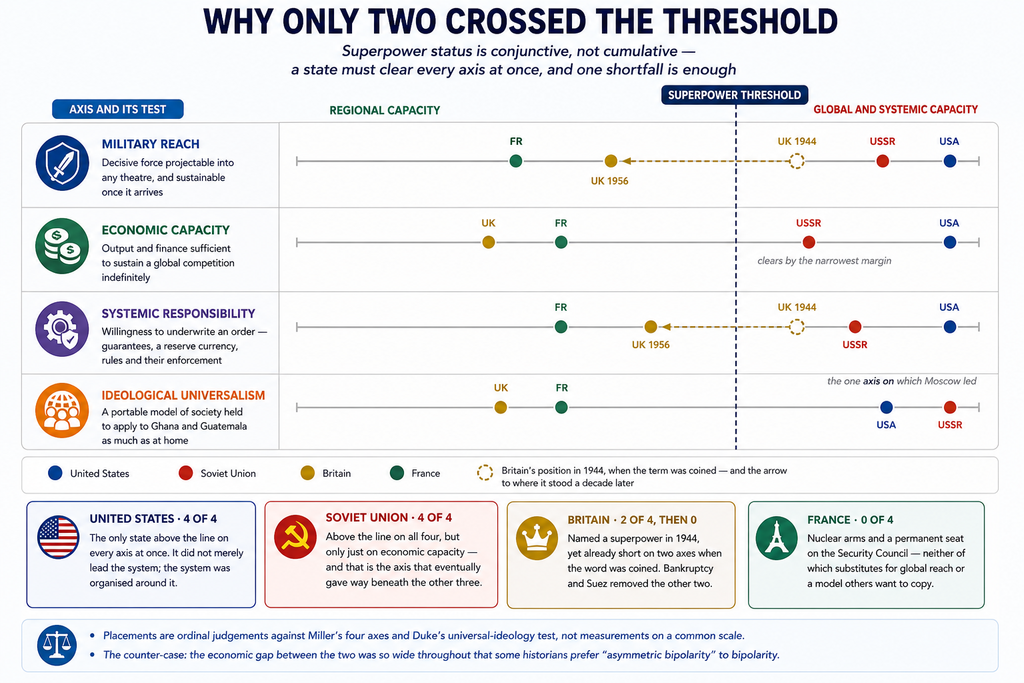
- Fox named three — the United States, the Soviet Union and Britain — defining a superpower as a state possessing “great power plus great mobility of power”, able to act globally rather than regionally.
- That Britain was on the list and fell off it within a decade is instructive: superpower status is a threshold, not a rank, and a state can hold every attribute of a great power and still fail to cross it.
- Lyman Miller refined this into four axes of power — military, economic, political and cultural. A state leading on all four at once is a superpower; one leading on some is a great power with specialisations.
- Kim Richard Nossal adds material preconditions: a continental landmass, a large population, resource self-sufficiency and a nuclear capacity understood as a survivable second-strike force.
- Paul Dukes gives the most demanding version, and the one closest to the Cold War — a superpower must conduct a global strategy including the capacity to destroy the world, command vast economic potential, and present a universal ideology.
Dukes’s third test is the interesting one. Raw capability is not enough: a superpower must offer the world an account of how societies ought to be organised and believe that account applies everywhere. That is what separates the two states of 1945 from the merely enormous powers of earlier centuries.
The four attributes, unpacked
- Global reach. Decisive force projectable into any theatre and sustainable there — blue-water navies, overseas basing, strategic airlift, intercontinental delivery systems. A great power acts in its neighbourhood; a superpower acts across oceans.
- Nuclear capability. Not mere possession but a survivable arsenal no adversary can disarm in a first strike. This makes a superpower unconquerable, and makes competition between two of them necessarily indirect.
- Ideological universalism. A portable model of society — claims about property, freedom, history and development held to apply to Ghana and Guatemala as much as at home. This converts rivalry over territory into rivalry over the internal arrangements of third states.
- Systemic responsibility. Willingness to underwrite an order rather than merely operate within one: security guarantees, a reserve currency, development finance, rules and their enforcement.
How a superpower differs from its neighbours in the classification of powers
| Category | Reach | Defining test | Cold War and later examples |
|---|---|---|---|
| Superpower | Global and systemic | Acts decisively in every theatre and offers a universal model; no global action is possible without reckoning with it | USA and USSR, 1945–91 |
| Great power | Global influence, regional decisiveness | Shapes outcomes worldwide but cannot set them alone; typically a UNSC seat and nuclear arms | Britain, France, China (Cold War); China, Russia, India today |
| Middle power | Niche and coalitional | Works through multilateral institutions and coalition-building rather than unilateral capability | Canada, Australia, Sweden, Norway |
| Regional power | Sub-systemic | Dominant within a region, marginal outside it | Brazil, Nigeria, South Africa, Indonesia |
| Empire | Territorial and direct | Rules subject peoples through formal sovereignty and administration | Rome, the British Raj, the Ottoman lands |
| Hyperpower | Unrivalled | The French foreign minister Hubert Védrine’s term for a superpower with no counterweight at all | USA in the 1990s |
- The superpower is not an empire, and the distinction is analytical rather than moral. An empire holds formal sovereignty over its possessions and administers them; a superpower holds influence over formally sovereign states through alliance, aid, currency, arms supply and, at the limit, intervention.
- The historian Geir Lundestad captured the Western half with the phrase “empire by invitation” — West European governments sought American protection and often complained Washington was doing too little.
- The Soviet half was closer to the older pattern: East European regimes were installed and sustained, and when they tried to leave — Hungary 1956, Czechoslovakia 1968 — they were stopped by force. Two structurally similar blocs, two very different binding mechanisms.
- A hegemon and a superpower are also not the same. Hegemony describes leadership within an order others accept as legitimate; superpower status describes capability. The United States was both; the USSR was a superpower that never achieved hegemony beyond the territory its army occupied.
And the name given to their confrontation
- The phrase “cold war” was not coined for this rivalry. George Orwell used it in an essay of October 1945 on the atomic bomb, foreseeing states unconquerable and therefore locked in “a permanent state of ‘cold war'” with their neighbours.
- Its application to the Soviet–American confrontation belongs to the financier Bernard Baruch, who told an audience in April 1947 that “we are today in the midst of a cold war” — a line drafted by his speechwriter Herbert Bayard Swope, who has the better technical claim to it.
- The columnist Walter Lippmann made it standard vocabulary later that year, in newspaper columns and the book assembled from them, insisting the thing was real and already under way rather than a metaphor.
- Lippmann simultaneously attacked Kennan’s containment as an open-ended commitment that would exhaust American resources on ground of the adversary’s choosing — the first serious critique of the doctrine, and the one that aged best.
A superpower is not the largest state in the system. It is the state the system is organised around.
The American Ascent: How One State Came to Hold Half the World’s Output
American primacy in 1945 was not an accident of victory. It compounded a geographic endowment, a pattern of late and cheap entry into other people’s wars, an industrial base the war expanded rather than destroyed, and a deliberate choice — reversing the interwar decision — to build and staff an international order rather than withdraw from one.
Geography and the price of admission to war
- The United States enjoyed what no European or Asian power had: two oceans and weak neighbours. The homeland was structurally insulated from the destruction that flattened Europe and Asia twice in thirty years, permitting the uninterrupted growth of a constitutional democracy and a continental market.
- It also created the option of choosing the moment of entry. The United States entered the First World War in 1917 and the Second in December 1941, each time after the other belligerents had been drained — securing victory at far lower relative cost.
- The material result by 1945 was without precedent in the history of the state system.
- It was the only major industrial economy not wrecked by bombing, invasion or occupation, and its industrial capacity had roughly doubled during the war rather than shrunk.
- It manufactured more than half the world’s produced goods, held about two-thirds of the world’s monetary gold, and accounted for over a third of global exports.
- Its navy was the largest ever assembled and controlled the sea lanes of both oceans — the physical basis of global reach — and it held, for four years, a monopoly on atomic weapons.
- The contrast is the point. The Soviet Union won on land and lost roughly 27 million people doing it; Britain won and went bankrupt; the United States won and became richer. Victory redistributed power far more than it redistributed territory.
The economic and financial foundation
- At Bretton Woods in July 1944 the United States wrote the rules of the post-war economy while the war was still being fought — creating the International Monetary Fund and the International Bank for Reconstruction and Development, and anchoring the system to a dollar convertible into gold at a fixed price.
- Every currency was pegged to the dollar and the dollar to gold, making the dollar the reserve currency by construction rather than by drift — what a French finance minister called America’s “exorbitant privilege”.
- That leverage, the ability to run deficits in a currency it alone issues, survived the collapse of the gold link in 1971 and survives still.
- Loans and aid did the reconstruction the institutions were too small to fund — the British loan of 1946, then the Marshall Plan’s roughly $13 billion.
- An open trading order through the General Agreement on Tariffs and Trade (1947) and a fixed-exchange-rate monetary order were built together, so that European and Japanese recovery took place inside an American-designed system rather than outside it.
Military supremacy and the alliance architecture
The most consequential American innovation was not a weapon. It was the decision — extraordinary for a state with no tradition of peacetime alliances — to make permanent, treaty-based security guarantees to other continents, and so become the guarantor of security for entire regions.
| Instrument | Date | Coverage | Structural effect |
|---|---|---|---|
| Rio Treaty | 1947 | The Americas | Turned the Monroe Doctrine from a unilateral declaration into a collective commitment |
| NATO | April 1949 | Western Europe, North America | First US peacetime alliance outside the hemisphere; Article 5 made an attack on one an attack on all |
| US–Japan Security Treaty | 1951, revised 1960 | Japan | Bases in East Asia, and security for Japan without rearmament |
| ANZUS | 1951 | Australia, New Zealand | Secured the South Pacific approaches |
| SEATO (Manila Pact) | 1954 | Southeast Asia | Extended containment to Indochina; included Pakistan and Thailand but few states it claimed to protect |
| Baghdad Pact, renamed CENTO in 1959 | 1955 | The “Northern Tier“ | Linked Turkey, Iraq, Iran, Pakistan and the UK; the US backed it and sat on its committees without acceding |
- The pattern is a belt of alliances from the North Atlantic through West Asia to the Pacific, physically encircling the Soviet landmass — containment as cartography, reinforced by a global network of bases that made formal guarantees credible.
- NATO worked because its members shared a threat perception and a political form. SEATO and CENTO worked far less well, assembled from states with divergent quarrels — Pakistan joined chiefly with India in mind — and neither survived as a functioning security body.
- The deeper consequence was that allies outsourced much of their own defence to Washington, buying the United States enormous influence over their foreign policies and creating the dependence that still resurfaces as a quarrel over burden-sharing.
The ideological offer
- The United States presented itself not as a victor but as the champion of a “free world” — a self-description drawing on the older myth of Manifest Destiny and given credibility by the defeat of fascism.
- The offer bundled political liberty, representative government, private property and open enterprise into one package and claimed it was universally applicable; against fascism and then Stalinism the contrast was easy to draw, and in Western Europe local populations drew it themselves.
- The appeal travelled as much by culture as by argument — Hollywood, jazz and later rock music, consumer goods, universities that drew the world’s students: what Joseph Nye would later name soft power, getting others to want what you want rather than compelling them.
- The limits were visible and exploited. Racial segregation at home was the most effective Soviet propaganda theme in Africa and Asia, and the damage it did abroad became one argument in the domestic civil rights debate.
Working on the rival’s weaknesses
- American strategy was not only about building strength but about imposing costs on the adversary, competing where the Soviet system was structurally weakest.
- An expensive arms race forced a much poorer economy to match spending in absolute terms, consuming a far larger share of its output.
- Keeping global energy prices low, through cooperation with oil-producing partners in the 1980s, attacked Moscow’s principal source of hard currency; technology denial regimes restricted advanced equipment eastward and widened the productivity gap.
- The conclusion should be stated carefully. The outcome owed at least as much to Soviet internal failure as to American pressure — the familiar formulation that the United States did not so much win the Cold War as the Soviet Union lost it captures a real point.
The order acquired a name: Pax Americana
- The composite of these five foundations acquired a name: Pax Americana, on the analogy of Pax Romana and Pax Britannica — a long great-power peace underwritten by the preponderance of one state.
- The phrase appears in print in the 1890s for a hemispheric peace; its modern sense dates from 1945, and the handover from Pax Britannica is conventionally placed in 1947.
- It names four concrete pillars rather than a mood: command of the seas and a global base network; security guarantees that relieved allies of the need to balance one another; the dollar and the Bretton Woods institutions; and a body of rules the guarantor wrote and enforced.
- Its achievement was removing the incentive for Germany and Japan to rearm competitively.
- The term is contested rather than descriptive. Critics read it as hegemony renamed — a peace real for the industrial core and absent in Korea, Vietnam, Iran, Guatemala and Chile — and note that it was purchased by the nuclear standoff rather than supplied by American benevolence.
- Taken literally it also misdescribes the Cold War, when American preponderance was contested by a peer. A Pax Americana with no counterweight existed only in the decade after 1991, and whether it survived Iraq, the financial crisis and China’s rise is taken up in the treatment of American hegemony and its decline.
The Soviet Ascent: Mass, Army and a Universal Doctrine
The Soviet Union arrived at superpower status by the opposite route — through catastrophe rather than insulation, state coercion rather than market accumulation, and an ideology held long before it had the power to export it.
A revolution with a universal claim
- The Bolshevik Revolution of October 1917 did not merely change the government of Russia; it installed a regime claiming to represent the future of all societies, not the interests of one state.
- The Communist International (Comintern), founded in 1919, institutionalised that claim, directing communist parties worldwide from Moscow and making Soviet foreign policy inseparable from transnational revolutionary organisation. It was dissolved in 1943 as a wartime concession and its function resumed in 1947 by the Cominform.
- Stalin’s “socialism in one country” subordinated world revolution to state-building without renouncing it. The tension between Russia as a state and communism as a cause runs through the whole Cold War, and Western analysts spent forty years arguing which was driving Soviet behaviour.
- Forced industrialisation under the Five-Year Plans from 1928 turned an agrarian economy into a heavy-industrial one within a decade, at a human cost — collectivisation, famine, the Gulag, the purges — inseparable from the achievement.
- What matters for international politics is that command planning demonstrably worked for one task: mobilising resources into steel, coal, machine tools and armaments. That capacity, relocated east of the Urals in 1941–42, survived the German invasion and out-produced it.
The cost and the prestige of the Great Patriotic War
- The Molotov–Ribbentrop Pact of August 1939 and its secret protocols partitioned Eastern Europe between Berlin and Moscow and bought Stalin twenty-two months. Operation Barbarossa, launched on 22 June 1941, ended the arrangement and very nearly ended the Soviet state.
- The Soviet Union then absorbed and defeated the bulk of the German army at a cost of roughly 27 million dead, the largest loss of any belligerent. Stalingrad (1942–43) and Kursk (1943) were the decisive land battles of the European war, and the Red Army reached Berlin in April 1945.
- This bought an asset Moscow had never possessed — immense international prestige, and communist movements with genuine resistance credentials among populations who had lived under occupation.
- The war also generated three grievances that shaped Soviet conduct, and which post-revisionist historians treat as central to the security dilemma that followed.
- The delay in opening a second front until June 1944 was read in Moscow as a decision to let Germany and the USSR bleed each other.
- The Manhattan Project was concealed from an ally — though Soviet intelligence had penetrated it — and the atomic bombing of Japan in August 1945 was read as much as a message to Moscow as a blow against Tokyo.
- The conferences at Tehran (1943), Yalta (February 1945) and Potsdam (1945) produced ambiguous language about “free elections” that each side read in its own favour — Stalin as acknowledgement of a sphere, the West as a promise of self-determination.
The consolidation of a bloc
- Between 1945 and 1948 the presence of the Red Army in the countries it had liberated was converted into a belt of subordinate communist states — Poland, Romania, Bulgaria, Hungary, Czechoslovakia and the Soviet zone of Germany.
- The mechanism was the “salami tactic”: coalition government, communist control of the interior ministry and police, progressive elimination of rivals. The Czechoslovak coup of February 1948 removed the last plausibly independent government in the region and did more than any single event to convince Western opinion that containment was necessary.
- The logic was defensible on its own terms — Russia had been invaded across the North European Plain in 1812, 1914 and 1941 — which is exactly why the security dilemma bit so hard. A buffer indistinguishable from an empire looks like an empire to everyone outside it.
- The institutional architecture followed the Western one move for move: the Cominform (1947), the Molotov Plan (1947) and COMECON (January 1949), and the Warsaw Treaty Organisation (May 1955).
- The first Soviet atomic test on 29 August 1949, years earlier than Washington predicted, ended the American monopoly — the moment the USSR became a superpower rather than a very large land power.
- The hydrogen bomb followed in 1953, and Sputnik (October 1957) demonstrated intercontinental delivery, which was the genuinely alarming part of that satellite.
What the Soviet Union had, and what it never acquired
| Dimension | Soviet strength | Soviet deficit |
|---|---|---|
| Military | The largest standing army in the world, an arsenal that reached and exceeded parity, a contiguous landmass its forces dominated | No comparable blue-water navy for most of the period; projection beyond the Eurasian rim depended on clients |
| Economic | Rapid extensive growth, resource self-sufficiency, proven capacity to mobilise for war | Chronically low productivity, no consumer economy, no innovation outside the military sector; the ruble was never a reserve currency |
| Ideological | Genuine appeal to the decolonising world as an anti-imperial, rapidly industrialising model | Appeal collapsed after 1956 and 1968, when the suppression of Hungary and Czechoslovakia was visible to all |
| Alliances | The Warsaw Pact and COMECON gave formal bloc cohesion | Almost no allies by choice — held by proximity and, when necessary, tanks; losing Yugoslavia (1948) and then China showed how brittle it was |
| Soft power | Real prestige in science, space and sport | No cultural exports anyone chose voluntarily; censorship made attraction structurally impossible |
- That asymmetry is the single most important fact about the Cold War’s material balance. The two superpowers were near-symmetrical in the ability to destroy and profoundly asymmetrical in the ability to attract. Moscow could match American missiles; it could never match American music, universities or supermarkets, and it knew it.
- It follows that the bipolarity was always more strategic than economic. At its peak the Soviet economy was perhaps half the American, and the Eastern bloc a small share of world trade. What made the USSR a pole was the army and the arsenal, not the balance sheet.
The Soviet Union achieved parity in the capacity to destroy and never came close to parity in the capacity to attract.
Bipolarity: Two Different Claims Bundled Into One Word
Polarity describes the number of centres of power around which the international system organises itself. It says nothing about intentions, only about how many states are consequential enough that everyone else’s choices are framed by them. The distinction between strategic and ideological bipolarity separates two claims that the Cold War happened to fuse.
Strategic bipolarity
- Strategic bipolarity is a distribution of capabilities in which two states are so far ahead that the gap between first and second is small relative to the gap between second and third.
- The operational test is not equality but non-substitutability: no combination of third parties can restore a balance if either pole withdraws. In 1950 no coalition of Britain, France and China could have replaced the United States as Western Europe’s guarantor.
- Its consequence is that alignment choices for every other state are structured by the two. Even choosing neither — India’s choice — is a decision defined by reference to them, which is why non-alignment is a Cold War concept and not a timeless one.
- Bipolarity in this sense is a feature of the system, not of the poles’ beliefs: two states can be strategically bipolar while sharing a religion, an economic model and a set of values.
Ideological bipolarity
- Ideological bipolarity is the presence of two rival universalist blueprints for social order, each treating the other’s continued existence as inherently threatening.
- The key word is universalist. A national ideology can coexist with its rival; a universalist one cannot accept a world containing the alternative, because the alternative’s success is evidence against its own claims.
- Its consequence is that the internal arrangements of third states become contested terrain — a coup in Guatemala, a land reform in Iran, a student movement in Indonesia all become moves in a global argument. This is why the Cold War produced so much intervention in domestic politics.
The two are logically independent
| Strategic bipolarity present | Strategic bipolarity absent | |
|---|---|---|
| Ideological bipolarity present | The Cold War, 1947–89 — the rare case where both coincided, which is why it was total | The Wars of Religion; the Sino-Soviet split after 1960, where the ideological quarrel was fierce but the capability gap was enormous |
| Ideological bipolarity absent | Athens and Sparta in Thucydides’s account, or a purely capability-based reading of US–China rivalry today | Nineteenth-century multipolar Europe under the Concert; the Anglo-German naval race before 1914, a pure power competition between two monarchies |
- The Anglo-German rivalry before 1914 illustrates the independence cleanly. Britain and Germany were both monarchical, industrial, capitalist European states with intermarried royal families; the rivalry was about capability and not at all about a model of society. It was strategic without being ideological, and it produced a world war anyway.
- The Sino-Soviet split illustrates it in the other direction, and it is the single event showing the two axes coming apart inside the Cold War itself.
- The rupture began with Khrushchev’s Secret Speech of 1956 and the doctrine of peaceful coexistence, which Beijing read as a betrayal of revolutionary purpose; it hardened when Moscow withdrew its advisers and cancelled nuclear assistance in 1959–60, and became open polemic from 1963.
- By March 1969 the two largest communist states were fighting on the Ussuri river at Zhenbao/Damansky Island; by 1972 Nixon was in Beijing.
- The lesson is exact: shared ideology did not produce a shared pole. Two states holding the same universalist doctrine became strategic adversaries, and one aligned with the ideological enemy against the other. Ideology does not reliably predict alignment; structure does.
- It follows that after about 1960 the system was ideologically tripolar and strategically bipolar — a distinction most contemporary commentary missed and American policy exploited from 1971.
Two states can share a doctrine and still be enemies. What they cannot share, in a bipolar system, is the pole.
- The Cold War’s distinctiveness lies in the superimposition. A capability distribution that would have produced rivalry anyway was overlaid with a moral contest that made every local dispute a referendum on the future of humanity, and made compromise look like apostasy on both sides.
Why the Structure Held: Waltz on Bipolar Stability
The most influential claim about this order is that it was structurally the most stable configuration the modern state system has produced. The argument belongs to Kenneth Waltz, made first in an essay on the stability of a bipolar world and then embedded in structural realism.
- Fewer relationships to manage. Two great powers make one great-power dyad; five make ten. Miscalculation, ambiguity and accidental commitment scale with the number of relationships, so fewer relationships mean fewer opportunities for error.
- No ambiguity about who balances whom. In multipolarity a state must guess which rising power to balance and with whom; in bipolarity each pole simply balances the other. Waltz treated this as decisive — the 1930s failed because nobody was certain whose job it was to stop Germany.
- Internal rather than external balancing. Because each pole outweighs any ally, it balances by building its own capabilities rather than acquiring partners — and a state can count on its own armaments as it cannot count on another government’s promises.
- No allied defection can change the balance. In multipolarity one alliance switch — Italy in 1915, the USSR in 1939 — reverses the distribution of power. In bipolarity allies are strategically marginal: losing China from the Soviet bloc, or France from NATO’s integrated command in 1966, was politically dramatic and structurally trivial.
- Recurrent crises are stabilising, Waltz argued counter-intuitively. Because each pole watches every corner of the world, disturbances are noticed early and handled while small — “rather a large crisis now than a small war later.”
- Preponderance absorbs shocks. The weight of the two let the system absorb decolonisation, revolutions and economic upheaval without the balance itself being called into question.
The nuclear overlay
- Waltz’s structural argument is reinforced, not replaced, by nuclear weapons: his claim is that these weapons made the Cold War cold.
- Once both held survivable second-strike forces, victory in a direct war became arithmetically impossible, and the incentive to test the other’s resolve where it mattered disappeared.
- The competition was therefore displaced into proxy wars, subversion, aid, sport, space and propaganda. The Cold War was cold at the centre and extremely hot at the periphery — a point worth holding against any account that treats it as forty years of peace.
- The stronger version of the claim runs together two independent variables, structure and technology, and it is not obvious which did the work. A bipolar world without nuclear weapons might have produced a third world war; a multipolar nuclear world might have been equally cautious.
The counter-case, compactly
- Against Waltz, Karl Deutsch and J. David Singer argued that multipolar systems are the more stable.
- More poles mean more interaction opportunities, so any single adversary absorbs a smaller share of a state’s attention and hostility; cross-cutting alignments — a partner on one issue, an opponent on another — restrain conflict as two sealed blocs cannot; and alliance flexibility lets a rising threat be met by recombination rather than armament.
- The record does not settle it. Bipolarity coincided with the longest great-power peace in modern history — and with an unprecedented arms build-up and millions of deaths at the system’s edges. The polarity-and-stability debate is developed in full in the companion treatment of the balance of power.
Containment as Doctrine: Design, Drift and Counter-Move
Containment is often described as a single American plan. It was not. It began as one diplomat’s political diagnosis, became within four years a global military commitment its author disowned, and at every stage produced a Soviet counter-move that entrenched the division further.
Kennan’s diagnosis
- George Kennan, then chargé d’affaires in Moscow, sent the Long Telegram of 22 February 1946 — over five thousand words explaining Soviet conduct not as a reaction to Western behaviour but as a product of internal necessity.
- Soviet leaders needed the belief in capitalist encirclement to justify the coercion by which they governed, so no Western concession could purchase Soviet goodwill; the hostility served a domestic function.
- The same analysis carried an optimistic corollary — the USSR was weaker than the West, averse to unnecessary risk, and would retreat before firmness. It needed not to be defeated but outlasted.
- The public version appeared as “The Sources of Soviet Conduct” in Foreign Affairs in July 1947, signed “X”, and gave the next four decades their vocabulary.
“…a long-term, patient but firm and vigilant containment of Russian expansive tendencies.” — George Kennan, the “X” article, 1947
- What Kennan actually meant is not what containment became, and he spent the rest of his life saying so — a distinction that separates the doctrine from its practice.
| Kennan’s conception | Containment as practised |
|---|---|
| Political and economic — rebuild industrial centres so communism has no constituency | Military and territorial — garrisons, alliances and bases along a perimeter |
| Selective: only five industrial-military centres mattered — the USA, Britain, the Rhine valley, Japan, the USSR | Global and undifferentiated: every state everywhere a stake, hence Korea, Vietnam, Angola |
| Assumes a differentiated communist world and exploits nationalism inside it, as with Tito’s Yugoslavia | Treats communism as monolithic, and so missed the Sino-Soviet split for a decade |
| A finite exercise ending in Soviet internal change | Open-ended, generating permanent mobilisation |
The Truman Doctrine and its Greek and Turkish origin
- The trigger was Britain’s announcement in February 1947 that it could no longer sustain its commitments to Greece, in civil war against communist-led insurgents, and Turkey, under Soviet pressure over the Straits.
- On 12 March 1947 Truman asked Congress for $400 million for the two states, framing the request in terms that far exceeded it — the world as a choice between two ways of life.
“It must be the policy of the United States to support free peoples who are resisting attempted subjugation by armed minorities or by outside pressures.” — Harry S. Truman, 12 March 1947
- The framing did deliberate work: a limited aid package justified by an unlimited principle, and it was the principle that became policy. The Truman Doctrine is the moment American commitment ceased to be geographically bounded.
The Marshall Plan and the refusal that split Europe
- Secretary of State George Marshall’s Harvard address of 5 June 1947 offered American finance for European recovery on condition that Europeans jointly drew up the programme. Enacted in April 1948, it delivered roughly $13 billion over four years.
- Its purposes were layered and all real: to stop economic collapse delivering Western Europe to communist parties, to create markets for American exports, and to bind European economies to each other and to the dollar. By requiring joint planning it also pushed West European economic integration towards the European Economic Community of 1957.
- The offer was formally extended to the Soviet Union and Eastern Europe, and Molotov attended the Paris talks before walking out.
- Moscow refused because participation required disclosing national economic data and submitting to joint allocation — American scrutiny of the planned economies and, in Stalin’s reading, Western capital bought at the price of political dependence.
- Moscow also forbade its neighbours to accept: Czechoslovakia and Poland had provisionally agreed and were compelled to withdraw, the clearest demonstration that Eastern Europe was not sovereign and, in Western eyes, the vindication of containment.
- This is the moment the division of Europe became economic as well as political — and it was a Soviet decision as much as an American one.
The Soviet counter-architecture
- The Cominform, founded in September 1947 in Poland, revived the Comintern’s coordinating function and imposed doctrinal discipline; its first act of enforcement was the expulsion of Yugoslavia in 1948.
- The Molotov Plan of 1947 offered bilateral Soviet aid and trade to the states forbidden the Marshall Plan, and was formalised as the Council for Mutual Economic Assistance (COMECON/CMEA) in January 1949.
- COMECON was never an equivalent. It rested on bilateral barter and administered prices rather than convertible currency and open trade, and for much of its life transferred resources from Moscow to its clients as underpriced energy — an empire that cost money rather than earned it.
- The Berlin Blockade (June 1948 – May 1949) and the Western airlift turned a currency dispute into the first direct confrontation, and NATO followed in April 1949.
- The Warsaw Pact of May 1955 was formed within days of West German accession to NATO — a sequence showing the Eastern bloc’s military institutionalisation trailing the Western one by six years.
The Baruch Plan and the failure of atomic control
- In June 1946Bernard Baruch placed before the UN Atomic Energy Commission a proposal for international ownership and control of all atomic energy activity, backed by inspection and by punishment immune from the Security Council veto. The Soviet counter-proposal reversed the sequence: destroy existing weapons first, then negotiate controls.
- The disagreement was not technical. The American plan preserved the monopoly through a transition of indefinite length and required Soviet openness to inspection; the Soviet plan required the United States to disarm before verification existed. Neither could accept the other’s ordering.
- The failure mattered out of proportion to the diplomacy: it foreclosed the one moment at which nuclear weapons might have been placed under collective authority, making the arms race a structural feature of the order rather than a policy choice.
NSC-68 and the militarisation of containment
- NSC-68, completed on 7 April 1950 by a State Department planning staff under Paul Nitze, restated containment far more starkly. It described a zero-sum global struggle in which any communist gain anywhere was a loss for the free world, dismissed negotiated settlement, and called for a sustained build-up.
- It abolished the distinction between vital and peripheral interests on which selective containment depended: if the contest is over credibility, no position can be conceded.
- It sat unfunded until June 1950, when the outbreak of the Korean War appeared to confirm every premise. Defence spending rose from about 5 per cent of GDP in 1950 to over 14 per cent by 1953, and the permanent national security state dates from that moment rather than from 1947.
Action and reaction: the sequence in one view
| Western move | Soviet counter-move | Net structural effect |
|---|---|---|
| Long Telegram and containment, 1946 | Zhdanov’s “two camps” doctrine, 1947 | Each side’s analysis of the other becomes official doctrine |
| Truman Doctrine, March 1947 | Cominform, September 1947 | Political division of Europe formalised |
| Marshall Plan, June 1947 | Molotov Plan, 1947; COMECON, 1949 | Economic division of Europe formalised |
| Currency reform in the western zones, 1948 | Berlin Blockade, 1948–49 | First direct confrontation; Germany becomes the fault line |
| NATO, April 1949 | Atomic test, August 1949 | Military bipolarity, then nuclear bipolarity |
| NSC-68 and Korean rearmament, 1950 | Rapid Soviet conventional and nuclear expansion | Containment militarised on both sides |
| West German accession to NATO, 1955 | Warsaw Pact, May 1955 | Two formal alliance systems facing each other |
- Read down the table and the mechanism is unmistakable: each defensive measure was read by the other side as offensive and answered in kind. This is the security dilemma in its purest form, and it is why the post-revisionist reading of responsibility has proved so durable.
The Ideological Contest: Two Accounts of History
What made this rivalry unusual is that both sides possessed a complete theory of history and believed the other’s eventual disappearance was written into it. Neither was defending a way of life it merely preferred; each was defending one it thought inevitable.
The competing blueprints
| Question | Liberal capitalism | Marxism–Leninism |
|---|---|---|
| What drives history? | The accumulation of individual choices in markets and elections; no predetermined destination | Class struggle over the ownership of the means of production, moving through fixed stages to communism |
| What is freedom? | Negative liberty — protection of the person, speech, property and conscience from the state | Freedom from exploitation and material want; formal political rights are dismissed as bourgeois form without content |
| What is the state? | A neutral referee constrained by law and periodic consent | An instrument of the ruling class, to be captured by the vanguard and eventually to wither away |
| How does a poor country develop? | Through markets, investment and integration into a trading order | Through state ownership, central planning and forced accumulation, which had visibly worked once |
| What is the other side? | A totalitarian tyranny abolishing freedom in the name of equality | An imperialist system whose prosperity rests on exploiting colonies and workers |
| Institutional expression | Bretton Woods, GATT, NATO, the “free world” | Comintern and Cominform, COMECON, the Warsaw Pact, the “socialist camp” |
The declarations of the division
- Churchill’s “Sinews of Peace” address at Fulton, Missouri, 5 March 1946, delivered as a private citizen with Truman on the platform, gave the division its enduring image.
“From Stettin in the Baltic to Trieste in the Adriatic, an iron curtain has descended across the Continent.” — Winston Churchill, Fulton, Missouri, 5 March 1946
- The Soviet mirror came eighteen months later. At the founding of the Cominform in September 1947, Andrei Zhdanov announced the “two camps” doctrine, which is the exact ideological counterpart of the Truman Doctrine and was framed as a reply to it.
The world is divided into “the imperialist and anti-democratic camp, on the one hand, and the anti-imperialist and democratic camp, on the other.” — Andrei Zhdanov, Cominform founding conference, September 1947
- Side by side the two statements make the structure visible. Each described a world of two camps and assigned the neutral ground to itself as a recruiting pool. By design neither recognised a legitimate third position — which is exactly the wall Indian foreign policy would run into.
The contest for the decolonising world
- Between 1945 and 1970 dozens of new states entered the system, and both blocs read them as the terrain on which the argument would be settled.
- The Soviet offer was formidable to nationalist leaders formed by anti-colonial struggle: an anti-imperialist pedigree with no colonies in Africa or Asia; a demonstrated development route, an agrarian country turned industrial and space power in forty years; and arms, dams and scholarships with far fewer conditions than Western finance carried.
- The American offer was different in kind: capital, technology, markets and consumer prosperity, plus the visible fact that the richest societies were also the freest.
- Against it stood association with the former colonial powers — France in Algeria, Britain at Suez, Portugal in Africa — and a record of supporting friendly autocracies from Iran in 1953 to Guatemala in 1954.
- Both sides converted development assistance into an instrument of alignment, and recipients learned that the competition could be worked to their advantage — a lesson India applied more systematically than anyone.
Propaganda, culture and the space race
- Information warfare was continuous and institutionalised — the Voice of America and Radio Free Europe against Soviet broadcasting and the Cominform press, jamming on both sides, and exhibitions and exchanges as instruments of state.
- Washington quietly funded intellectual magazines through the Congress for Cultural Freedom; Moscow ran the World Peace Council and a network of friendship societies.
- Sport became an explicit proxy: Olympic medal tables were read as evidence about social systems, and the boycotts of Moscow 1980 and Los Angeles 1984 show how far the framing had taken hold.
- The space race was the purest case of a technological programme pursued for ideological effect. Sputnik (October 1957), Gagarin’s flight (April 1961) and the first spacewalk were presented as proof that socialism produced faster scientific progress; Apollo 11 in July 1969 was the American answer, decisive because the world watched it live.
- The strategic content was real — the rocket that lifts a satellite lifts a warhead — but the prestige content was the point, and both governments said so.
- Here the asymmetry shows most sharply. The Soviet Union could win individual rounds and never won the argument, because its achievements were state achievements while the American ones arrived attached to things ordinary people wanted to own.
Each bloc told the world there were only two camps, and then spent forty years competing for the countries that refused to be in either.
Who Was Responsible: The Historiography
The question of blame is not a parlour game: each answer implies a different theory of how international conflict is generated, and the schools are told apart by what each takes to be the primary driver.
Orthodox or traditionalist
- The earliest Western account, dominant through the 1950s and represented by Herbert Feis, Arthur Schlesinger Jr. and Thomas Bailey, places responsibility on Soviet expansionism.
- The evidence offered: the imposition of regimes in Eastern Europe, the Czechoslovak coup of 1948, the Berlin Blockade, pressure on Iran, Turkey and Greece, and an ideology committed in principle to the global defeat of capitalism.
- On this reading American policy was reactive and defensive, and the wartime alliance an anomaly that could not have outlived Hitler.
- Weakness: it takes Soviet declaratory ideology at face value, discounts the security concerns of a state invaded three times in 130 years, and cannot explain why Stalin restrained communist parties in Greece, France and Italy where Western interests were engaged.
Revisionist
- Emerging in the 1960s against the background of Vietnam, the revisionist school inverts the causal arrow.
- William Appleman Williams argued that American policy was driven by the conviction that domestic prosperity required continuous access to foreign markets — an “Open Door” imperative that made a closed Soviet sphere intolerable regardless of Soviet intentions.
- Gabriel Kolko pressed the economic argument harder, treating post-war policy as a systematic attempt to reconstruct the world economy on terms favourable to American capital and to suppress the left in Europe and Asia.
- Gar Alperovitz supplied the most contested claim — that the atomic bombings of Hiroshima and Nagasaki were undertaken with at least one eye on intimidating Moscow, “atomic diplomacy”.
- On this reading the Truman Doctrine, Marshall Plan and NATO were expansionist instruments, and Soviet conduct the defensive response of a devastated state to encirclement.
- Weakness: strongest on American motives, weakest on Soviet ones; the archives opened after 1991 revealed a Stalin considerably more ideologically driven and opportunistic than the school allowed.
Post-revisionist
- The synthesis that has become the standard scholarly position, associated above all with John Lewis Gaddis and Melvyn Leffler, treats the Cold War as a security dilemma in a power vacuum.
- The collapse of German and Japanese power left a vacuum into which two suspicious victors moved for defensive reasons. Each side’s defensive measures appeared offensive to the other, and the spiral was mutually constructed: neither had a blueprint for global domination in 1945, but both had irreconcilable definitions of security.
- With the archives open, Gaddis restored weight to Stalin’s personality and ideology, arguing that a Soviet Union led by someone else might have produced a very different post-war decade — a shift towards contingency without a return to orthodoxy.
- Weakness: by distributing responsibility it risks making the conflict nobody’s fault, and can flatten the real asymmetry between a system that held elections and one that did not.
The structural realist reading
- Realists treat blame as misconceived: what matters is not what either government wanted but the shape of the system.
- The war left two survivors in an emptied field. Under anarchy the two strongest states are one another’s only possible threat, and each must treat the other’s capabilities rather than its intentions as the relevant fact.
- Ideology is epiphenomenal here — replace communism with any other doctrine and the structural pressure is identical. Conflict was not a policy failure but a structural certainty, and the interesting question becomes why it stayed cold.
- Weakness: structure explains the existence of rivalry but not its intensity, content or timing, and it did not predict the peaceful ending of 1989–91.
The constructivist reading
- Constructivists deny that the outcome was written into the material structure. Anarchy, in Alexander Wendt’s formulation, is what states make of it — the same distribution of capabilities is compatible with rivalry or with the amity that developed between the United States and a nuclear-armed Britain.
- What produced enmity was the mutual construction of identity: each side defined itself by opposition to the other, so hostility became self-reinforcing. Misperception did the operational work, each reading the other’s defensive moves through a frame already adopted — the mechanism Robert Jervis analysed.
- The implication is that the Cold War was not preordained, and that different leaders or a different sequence of early signals might have produced a manageable rivalry rather than a total one.
- Weakness: it is easier to show that ideas mattered than to show that any realistically available diplomacy would have worked on Stalin’s Soviet Union.
The schools compared
| School | Primary driver | Principal exponents | Verdict on responsibility |
|---|---|---|---|
| Orthodox / traditionalist | Soviet expansionism and ideology | Feis, Schlesinger, Bailey | The USSR; American policy was reactive |
| Revisionist | American economic expansionism and the Open Door | Williams, Kolko, Alperovitz | The USA; Soviet policy was defensive |
| Post-revisionist | Security dilemma in a power vacuum | Gaddis, Leffler | Both, though not equally; the standard position |
| Structural realist | Anarchy and the distribution of capability | Waltz, Mearsheimer | Neither — the system, not the states |
| Constructivist | Identity and misperception | Wendt, Jervis | Neither necessarily — enmity was made, and could have been unmade |
Was the Cold War Inevitable?
The honest answer is that the rivalry was close to unavoidable and its particular form was not — and that distinction is where the analytical work is done.
- What was structurally overdetermined. Two states of disproportionate capability, no third power able to mediate, occupying the ruins of the powers that had separated them, in a system with no authority above them. On any realist account competition follows from that configuration alone, and would have followed had both been democracies.
- The power vacuum in Central Europe and East Asia had to be filled, and there were only two candidates. The collapse of British power, which had historically balanced continental states, removed the one actor who might have complicated the arithmetic.
- What was not structurally required. The totality of the confrontation — its extension to every continent, technology, cultural field and the internal politics of unrelated states — followed from the ideological overlay, not from the capability distribution.
- Britain and Germany competed intensely before 1914 without either believing the other’s social system had to disappear. The Cold War’s distinctive feature is that both poles believed exactly that, and that belief, not the balance of forces, produced Guatemala, the Congo, Vietnam and Afghanistan.
- Timing and sequence were contingent too: a franker handling of the atomic project with an ally, an earlier second front, a differently drafted Marshall offer, a Soviet leader other than Stalin would each have altered how fast the division hardened.
- A defensible position. Given the structure of 1945, a prolonged Soviet–American rivalry was all but certain; a forty-five-year global ideological siege was not. The system made conflict; the ideologies and the men in charge determined its kind, its reach and its duration.
- Holding both halves explains what a single-cause account cannot: why the rivalry began before either side had done anything unambiguously aggressive, and why it ended without a war when one side’s ideology gave out.
India’s Refusal to Read the World as Bipolar
India became independent in August 1947 — five months after the Truman Doctrine, two months after the Marshall offer, one month before the Cominform. It entered a system being sorted into two camps and declined to be sorted, and the reasoning behind that refusal is itself a reading of the bipolar structure.
Why a newly independent state saw both blocs as forms of dependence
- Nehru’s central judgement was that alignment would mean surrendering the independence just won. A treaty commitment would put the decisions that matter most — war, peace, basing, the direction of the economy — in a foreign capital, which is what colonial rule had meant in practice.
- He put it structurally rather than morally: India could not be both a subordinate member of a bloc and a genuinely sovereign state, because bloc membership meant accepting someone else’s definition of the threat.
- The economic argument ran parallel. Development required capital, technology, food and fertiliser, and no single patron could supply all of it on acceptable terms; committing to one bloc meant foreclosing the other’s resources.
- The anti-colonial argument made both blocs suspect differently. Western Europe’s leading states were still colonial powers and the American alliance system included them; Soviet control of Eastern Europe looked, to Indian eyes, like a different technique for the same relationship.
- A domestic argument reinforced them. Indian opinion was divided — the right leaned West, the left leaned East — and non-alignment was the only external posture around which a national consensus could be built.
- Finally there was ambition. Aparna Pande notes that India was weak militarily and economically but sought a leadership role, and non-alignment let a poor state be consequential without capability, substituting diplomatic for material weight.
A posture, not a withdrawal
- Both capitals misread the position as neutrality, isolationism or mechanical equidistance; it was none of these. India was among the UN system’s most active members and judged each question on its merits — what is best described as principled distance. The diplomat K. Natwar Singh called it a doctrine and never a dogma.
- The record is not perfectly consistent, and pretending otherwise weakens the concept. India took American food aid, built Bhilai with Soviet help and Rourkela and Durgapur with West German and British, and signed the Indo-Soviet Treaty of 1971 — a quasi-alliance in all but name.
- C. Raja Mohan’s judgement that India was genuinely non-aligned mainly under Nehru is a serious criticism; the answer is that non-alignment was a strategy for maximising autonomy, not a vow of equidistance.
Working the bipolar structure
- Indian policy treated bipolarity as an opportunity structure rather than a constraint.
- Both blocs supplied resources: American food imports that carried India through the mid-1960s droughts and the collaboration behind the Green Revolution; Soviet steel, oil exploration, heavy engineering and, from the 1960s, most Indian military equipment on concessional rupee terms.
- Each superpower’s interest in denying India to the other was itself a resource, and Indian diplomacy said so openly.
- The cost was equally real: Washington’s alliance with Pakistan through SEATO and CENTO armed India’s principal adversary, and the Sino-Indian war of 1962 exposed how little non-alignment supplied in a crisis, pushing India towards Western arms and then towards Moscow.
How the two superpowers received it
- The American reaction was hostile and explicit. John Foster Dulles treated the refusal to choose as a moral failing rather than a policy.
“Neutrality has increasingly become obsolete and, except under very exceptional circumstances, it is an immoral and shortsighted conception.” — John Foster Dulles
- American policymakers read non-alignment as opportunism dressed as principle — the benefits of both camps, contributions to neither — and, given India’s positions on Western intervention, often as pro-Soviet in effect if not intent.
- The Soviet reaction was initially no warmer. Under Stalin the two camps analysis allowed no middle ground: a state not with the socialist camp was objectively with the imperialist one, and Indian independence was for a time dismissed as a transfer of power to a bourgeois class still tied to London.
- This changed sharply after Stalin’s death. Khrushchev’s visit in 1955 and Soviet support on Kashmir and Goa reflected a recalculation that a non-aligned India was worth more than a hostile one — evidence that the two-camps doctrine was never as rigid as its authors claimed.
- That both superpowers found the position irritating is the best evidence it was a real position. A stance that annoyed Washington and Moscow for opposite reasons was not equidistance; it was independence.
- India’s refusal supplied the foundation of a movement whose origins, aims and later trajectory are treated separately. What belongs here is the underlying claim: a bipolar structure does not oblige every state to become a pole’s dependent.
Is Bipolarity Returning?
The question is asked constantly of the US–China relationship, and it becomes answerable once the two components of bipolarity are kept apart.
- On strategic bipolarity the case is genuinely arguable. The United States is roughly 26 per cent and China 16 per cent of world output at market prices; in 2025 they spent $954 billion and $336 billion on defence, with the gap to the third-placed state now wide and widening.
- Øystein Tunsjø argues on this basis that bipolarity has returned, distinguished from the Cold War chiefly by geography — a maritime East Asian theatre rather than a continental European one.
- Against this, the gap in capability, alliances and financial infrastructure remains large: China has 620 nuclear warheads to the American 5,042, few treaty allies, and no currency competitive with a dollar still at 57.1 per cent of allocated reserves.
- On ideological bipolarity the case is much weaker. China offers no portable universalist blueprint: its model is framed as suited to Chinese conditions, there is no Comintern equivalent, and it takes no interest in partners’ internal arrangements.
- What it advances is a procedural claim about sovereignty and non-interference — attractive to many governments, but the opposite of a universal social blueprint.
- What a genuine bipolarity would additionally require, and today’s rivalry lacks.
- Two sealed blocs. India buys Russian energy and American aircraft; Turkey is in NATO and bought Russian air defences; Gulf states host American bases and price trade with China. Most states hedge, and hedging is unavailable in a genuinely bipolar system.
- Economic separation. The Cold War poles traded almost nothing with each other; the United States and China remain deeply interdependent in trade, supply chains, capital and students even as export controls erode it.
- A contest on every continent. The Sino-American rivalry is concentrated in East Asia and the technology domain, with much of the world engaged commercially rather than strategically.
- Third parties who do not disturb the arithmetic. Cold War bipolarity survived because no third party mattered; today the European Union, India, Japan and a range of middle powers each shape outcomes enough that neither capital can set them alone.
- The most defensible description is therefore an unbalanced distribution with two leading states, fluid alignment and no universalist ideology — closer to asymmetric multipolarity than to 1950. Whether this amounts to a second Cold War, and how the emerging order should be named, is taken up separately.
Conclusion
- The order of 1945–91 was the product of an unrepeatable conjunction: a war that destroyed every great power except two, a technology that made war between those two unwinnable, and two universalist ideologies each denying the other’s right to exist.
- The concept of a superpower is what that conjunction produced — not a very strong state but one combining global reach, a survivable arsenal, a portable model of society and responsibility for an order.
- Only two have ever satisfied all four tests at once, and they arrived by opposite routes: American primacy built on insulation, accumulation and consent, Soviet primacy on catastrophe, coercion and mass.
- The Cold War’s distinctiveness lies in the superimposition of two independent bipolarities. Strategic bipolarity would have produced rivalry; ideological bipolarity made it total — and the Sino-Soviet split proves the two axes were separable all along.
- The structure was more stable than it felt. Waltz’s mechanisms, combined with survivable nuclear forces, kept the centre cold while the periphery burned.
- On responsibility the post-revisionist synthesis remains the strongest position: a security dilemma in a vacuum, each defensive move read as offensive. The rivalry was near-inevitable; its totality and duration were not.
- India demonstrated that a bipolar structure does not compel bipolar alignment — that a weak state can convert great-power competition into resources and standing, provided it accepts being distrusted in both capitals.
- The contemporary question inherits the same tools. Any claim that bipolarity is returning must specify which bipolarity — and today the strategic case is arguable, the ideological one is not. That gap is what makes the present order less legible than the one it replaced.
Previous Year Questions
- Examine in brief the rise and fall of the Cold War. (2016)
- Comment: Pax Americana. (1991)
Syllabus unit: Changing International Political Order
PSIR Optional study material from LotusArise IAS
Two ways to prepare with us — the full self-study system, or just the notes you need right now.
| What you get | PSIR Mains Master Kit 2027 | PSIR Complete Notes (Store) |
|---|---|---|
| Paper 1 notes — Political Theory + Indian Government and Politics | Included | Included — Section A and Section B |
| Paper 2 notes — Comparative Politics and India and the World | Included | Included — Section A and Section B |
| Topic-wise PYQ bank | 1986–2026, with trend analysis and probables by Dec 2026 | 1991–2025 question papers, free with every notes pack |
| Practice question set for timed answer writing | ✅ Available now | ❌ |
| Answer toolkit — intros, conclusions, frameworks, thinker and example banks | By Dec 2026 | ❌ |
| Revision booklets for the last 60 days | ✅ Available now | ❌ |
| Format | Online articles + PDF | PDF download |
| Access | Valid until UPSC CSE Mains 2027 | Instant download after payment |
| Price | ₹1,770 (regular ₹5,000) | ₹1,180 for all four sections · ₹599 a paper · ₹354 a section |
| Best for | Aspirants who want the whole system in one place | Aspirants who want the notes now, in the parts they need |
