

Nine states hold nuclear weapons. In 1963 President Kennedy said publicly that he expected fifteen, twenty or twenty-five within a decade, and given how many programmes were then under way the fear was reasonable. That the forecast was wrong is the achievement of a body of treaties, agencies and supplier clubs assembled over sixty years. The argument about it has never been whether it works, but whose interests it was built to serve.
What a Nuclear Order Is, and the Bargain It Rests On

- A nuclear order is the ensemble of treaties, institutions, export controls and shared expectations governing who may possess nuclear weapons, on what terms the technology moves between states, and what the possessors owe everyone else in return for their monopoly.
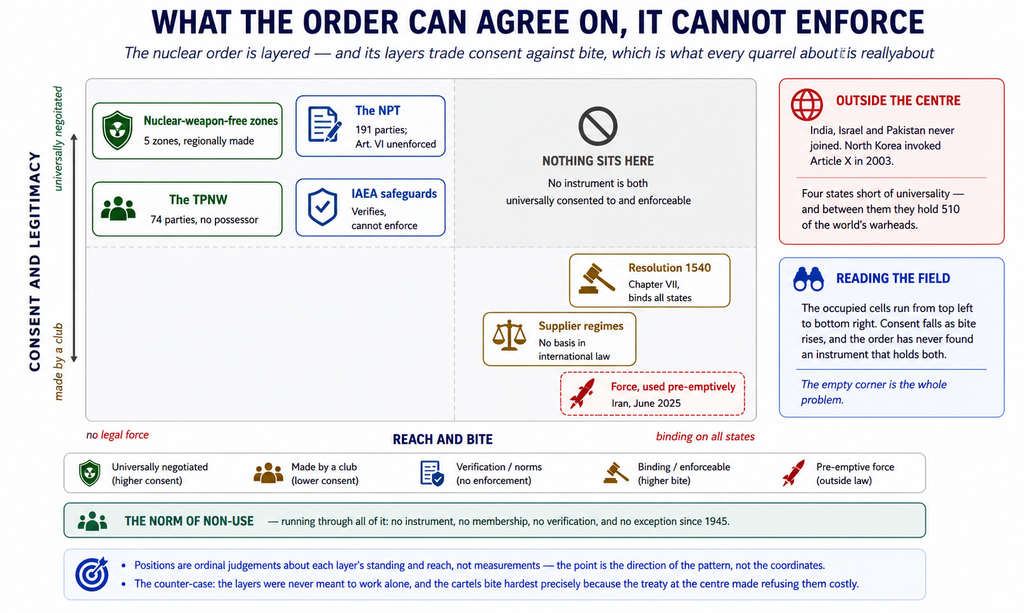
- It is not a single instrument but a layered regime — a universal treaty at the centre, an inspectorate attached to it, regional zones underneath, supplier cartels outside, and a norm of non-use running through all of it. It works by raising the cost of a choice, not by making it impossible.
- The bargain at the centre trades restraint for access, and for a promise. States without weapons undertake never to acquire them; in exchange they receive access to civil nuclear technology, and the possessors undertake to negotiate their way out of theirs.
- Two kinds of spread must be distinguished, and the architecture is far better at one. Horizontal proliferation — weapons reaching new states — is what it was built to stop, and largely has. Vertical proliferation — the growth and refinement of arsenals already held — it barely touches.
- Non-proliferation works on two components at once: the technical, denying critical assets or releasing them only under safeguards, and the political, working on intention through pressure, guarantees, sanctions and incentives. Capability is technical; the decision to weaponise is always political.
- The fissile-material barrier makes technical control possible at all: a device needs fifteen to twenty-five kilograms of highly enriched uranium or five to eight of plutonium.
- The complication is that the technology is dual-use. The centrifuge cascade fuelling a reactor and the one filling a weapon pit differ in how long they run, not in what they are.
- Why the bargain is called discriminatory is a question of legal form, not merely of sentiment.
- The treaty defines a nuclear-weapon state by a historical accident of timing rather than by conduct, so the category can be neither entered nor left.
- Safeguards fall on the non-weapon states alone, and the disarmament obligation is the only one with no verification attached to it.
- The possessors reply that the alternative to an unequal order is no order, and that a treaty demanding immediate equality would have been signed by nobody. Both propositions can be true, and the tension between them is the subject of this whole field.
“There exists an obligation to pursue in good faith and bring to a conclusion negotiations leading to nuclear disarmament in all its aspects under strict and effective international control.” — International Court of Justice, 1996
Why states seek or forgo the bomb, and whether proliferation is stabilising or dangerous, are questions of acquisition theory treated separately in this archive; so are deterrence as a doctrine and the bilateral arms-control sequence from SALT to New START. What follows takes the demand as given and examines the machinery built to frustrate it.
From Monopoly to Regime: How Non-Proliferation Policy Evolved
- Non-proliferation policy passed through four stages, each a reaction to the failure of the one before it.
- Secrecy and monopoly, 1943–53. Under the Quebec Agreement of 1943 the United States, Britain and Canada agreed to share nothing with third parties, and after Hiroshima extended that to the world.
- Liberalisation, 1953–68. Atoms for Peace opened civil nuclear technology to all comers on the assumption that generosity would buy restraint.
- Control through safeguards, 1968–74. The NPT made safeguards a universal norm rather than a bilateral condition.
- Reaction and denial, from 1974. India’s test produced the supplier cartels and national legislation such as the American Nuclear Non-Proliferation Act of 1978, and shifted the argument from technical to political ground.
- The first attempt at international control failed before the regime began.
- The Baruch Plan of 1946 proposed an International Atomic Development Authority with regulatory power over all dangerous nuclear activity; the Acheson–Lilienthal Report argued for an international body to control commercial development before weapons followed.
- Moscow refused a scheme freezing an American monopoly while it disarmed, and Washington passed the Atomic Energy Act of 1946, classifying all fissile-material information as secret. Denial produced what it was meant to prevent.
- Atoms for Peace reversed the policy in 1953, and by 1955 the United States had nuclear cooperation agreements with some twenty-seven countries. The programme distributed research reactors and trained a generation of foreign scientists; India’s early nuclear infrastructure, like Israel’s and Pakistan’s, was seeded in this liberal decade.
- China’s test of 1964 turned an East–West problem into a global one, and the question became diversion of civil material to military ends.
The Non-Proliferation Treaty: The Central Instrument
The NPT is the only near-universal arms-control treaty in existence and the reference point against which the rest of the architecture is judged. It was opened for signature on 1 July 1968 and entered into force on 5 March 1970, sponsored by the United States, the Soviet Union and the United Kingdom. Written to last twenty-five years, it was extended indefinitely in 1995, making permanent obligations many non-weapon states had accepted as temporary.
The three pillars
| Pillar | Core articles | What it obliges | How it is enforced |
|---|---|---|---|
| Non-proliferation | Articles I, II, III | Weapon states not to transfer weapons or assist acquisition; non-weapon states not to receive or manufacture them and to accept full-scope IAEA safeguards | IAEA inspection, with referral to the Security Council on non-compliance |
| Disarmament | Article VI | All parties to “pursue negotiations in good faith” on ending the arms race and on nuclear disarmament | Nothing. No timeline, no benchmark, no verification body |
| Peaceful use | Article IV | An “inalienable right” to develop, research, produce and use nuclear energy for peaceful purposes without discrimination, plus a duty to facilitate technology exchange | Conditioned on safeguards compliance; in practice further conditioned by supplier controls |
- The definition of a nuclear-weapon state is the treaty’s most consequential sentence and the source of every discrimination charge. Article IX defines one as a state that manufactured and exploded a nuclear weapon or other nuclear explosive device prior to 1 January 1967.
- That date admits exactly five states — the United States, the Soviet Union, the United Kingdom, France and China — who are also the permanent members of the Security Council.
- The category is closed by definition. India’s 1974 test could not create a sixth member, and no weapon state can leave the category by disarming.
- Safeguards are not symmetrical. Non-weapon states must conclude comprehensive safeguards agreements over all nuclear material in all peaceful activities; weapon states offer only selected facilities voluntarily and may withdraw them. Article X allows withdrawal on three months’ notice where extraordinary events have jeopardised a party’s supreme interests; it has been invoked once.
Membership, outsiders and the withdrawal problem
- The treaty has 191 states parties, the widest adherence of any security instrument ever negotiated, and that near-universality is its principal claim to authority.
- Three states never joined, and all three built weapons: India, which refused from the outset as the treaty was discriminatory in form; Pakistan, which says it will accede only if India does; and Israel, which has never confirmed possession.
- North Korea is the one member that used the exit. It acceded in 1985 under Soviet pressure as a condition of reactor supply, concluded a safeguards agreement only in 1992, announced withdrawal in 1993 and suspended the notice, then announced withdrawal again in January 2003 and left in April.
- Whether the withdrawal was legally effective remains contested, since Pyongyang was already in breach when it invoked Article X. South Sudan has not acceded, leaving the treaty four states short of universality.
- The withdrawal route is the architecture’s deepest flaw. A state may build a complete fuel cycle lawfully under Article IV, accumulate material and expertise under inspection, then leave on three months’ notice and weaponise what safeguards helped it perfect.
The review cycle and its record
- Article VIII requires a review conference every five years. The cycle is where the bargain is renegotiated in practice, and its record is the clearest measure of the regime’s health.
- 1995 was the decisive conference. The indefinite extension was packaged with the price non-weapon states demanded: a strengthened review process, Principles and Objectives on non-proliferation and disarmament, and a resolution on a Middle East zone free of weapons of mass destruction which has never been implemented.
- 2000 produced the high-water mark — the Thirteen Practical Steps, including an “unequivocal undertaking” by the weapon states to eliminate their arsenals — and 2010 a 64-point action plan.
- 2005, 2015 and 2022 all failed, 2015 on the Middle East zone and 2022 when Russia objected to language on the Zaporizhzhia plant.
- The Eleventh Review Conference, held in New York from 28 April to 22 May 2026 under the presidency of Do Hung Viet of Vietnam, closed without a consensus outcome document — the third consecutive failure.
- It broke on four faults at once: country-specific language on Iran, which Washington pressed and Tehran refused unless the June 2025 strikes on its facilities were condemned; Ukraine and the safety of nuclear facilities in wartime; the Middle East WMD-free zone; and the absence of any disarmament progress to report.
- States agreed only on process: the next review conference in 2031, with preparatory meetings from 2028.
Three consecutive review conferences without an agreed document mean the parties can no longer state in common what the treaty requires of them.
The Case Against the NPT
- The haves-and-have-nots objection is the oldest and most fundamental. The treaty does not prohibit nuclear weapons; it prohibits their spread, legitimising five arsenals while criminalising all others.
- Non-weapon states argued from the negotiations onward that the provisions were asymmetric: safeguards on them alone, unfettered commercial exploitation of peaceful uses for the weapon states, vague obligations in return, and no answer to their own security concerns.
- The charge is not that inequality exists in international politics but that a treaty writes it into law and makes it permanent.
- Article VI is the specific target. “Negotiate in good faith” imposes a duty of conduct with no object, no deadline and no measure of breach; fifty-six years on, the five retain thousands of warheads and are all modernising.
- The International Court of Justice advisory opinion of 8 July 1996 unanimously found the obligation is not merely to negotiate but to bring negotiations to a conclusion — acknowledged rhetorically and ignored in practice.
- The Article IV loophole cuts the other way, and is the criticism made by non-proliferation advocates rather than by the South.
- The “inalienable right” has been read to include enrichment and reprocessing — the technologies indistinguishable in kind from weapons work — so a state can build the whole industrial basis of a programme lawfully, under inspection, and be months from a device on the day it withdraws.
- The 2008 India exception damaged the treaty’s coherence more than any single act since 1970, since the Nuclear Suppliers Group permitted civil nuclear commerce with a state that had tested and refused to join.
- Whatever its merits as policy — and India’s non-proliferation record is better than that of some parties — it showed that the rules bend for the strategically valuable, which is what critics had always alleged. China now justifies its own nuclear commerce with Pakistan by analogy.
- Enforcement is borrowed, not owned. Non-compliance travels to the Security Council, where any permanent member can stop it. Iraq, Iran and North Korea were referred; each outcome turned on great-power alignment rather than on the finding of fact.
- The counter-case deserves stating. Membership is near-universal; the weapon states have grown by four in fifty-six years against forecasts of twenty-five; and several advanced programmes — South Africa, Brazil, Argentina, South Korea, Taiwan, Sweden, Libya — stopped or reversed.
- It also supplies the legal basis for safeguards, export controls and zones alike. No proposed replacement commands more support than the flawed instrument that exists.
The IAEA: Verification Without Enforcement
The International Atomic Energy Agency was established in 1957, eleven years before the treaty it now polices, as the institutional residue of Atoms for Peace. Its statute gives it a dual mandate in tension ever since: to enlarge the contribution of atomic energy to peace, health and prosperity, and to ensure the assistance it provides serves no military purpose. It is at once promoter and policeman.
Safeguards and how they work
- Safeguards are an accounting system before they are anything else, and rest on four elements whose logic still holds: review of facility design, so inspectors know what a plant can physically do; a system of records and accounts; a system of reports; and inspection to verify that declarations match reality.
- Comprehensive Safeguards Agreements, required of every non-weapon state party under Article III, cover all nuclear material in all peaceful activities — mines, conversion, enrichment, fuel fabrication, reactors, reprocessing and waste.
- The Agency’s finding is one of non-diversion of declared material: it says what has not left the declared inventory.
- That is the system’s built-in blind spot. Comprehensive safeguards were never designed to find a facility a state has not declared, and Iraq exploited exactly that gap.
- The Additional Protocol, adopted in 1997, answered Iraq and North Korea by changing the question from “is declared material accounted for?” to “is the declaration complete?”
- It requires an expanded declaration covering the whole fuel cycle including research, manufacturing and exports; grants complementary access at short notice to any location on a site and to undeclared locations; permits environmental sampling, which detects enrichment from trace particles; and gives inspectors long-duration visas and free communication.
- It is voluntary. Around 140 states have brought one into force; several with significant nuclear activity have not, and Iran’s was applied provisionally and then abandoned.
- Special inspections may be demanded where declared information is inadequate; the power exists in every comprehensive agreement and has effectively been used once, against North Korea in 1993, which refused and announced withdrawal instead. That precedent is why it is now avoided.
- The referral route runs to the Security Council, where the Board of Governors reports non-compliance, as it has against Iraq, Romania, North Korea, Libya, Iran and Syria. Referral is where its authority stops: it cannot sanction, compel entry, or act against refusal.
The record, stated honestly
- Iraq is the founding failure and success. Before 1991 the Agency inspected declared facilities at Tuwaitha and found nothing amiss while a large clandestine enrichment programme ran alongside using calutrons — a failure of safeguards design rather than of diligence, and the direct cause of the Additional Protocol.
- After 1991, under Security Council mandate, its Action Team dismantled the programme and removed the fissile material, reporting by 1998 that no meaningful capability remained — vindicated when the 2003 invasion found nothing.
- The other cases divide cleanly: verified successes in South Africa and Libya, a correct but powerless finding on North Korea, and competent but politically exposed work in Iran, each examined below.
- Two structural limits define the Agency.
- It depends on state cooperation and national intelligence: almost every clandestine programme was first exposed by a defector, a satellite image or an opposition group rather than by routine inspection.
- It has no enforcement power whatever. Verification and enforcement are separated by design, with the enforcement half behind a veto.
The Test-Ban Track: PTBT to CTBT
Testing is the hinge of the whole architecture. A state that cannot test cannot confidently field new designs, and a state that tests announces itself, so restricting tests attacks horizontal and vertical proliferation at once.
The Partial Test Ban Treaty, 1963
- The PTBT was signed in Moscow on 5 August 1963 by the United States, the Soviet Union and the United Kingdom — the first significant arms-control agreement of the nuclear age.
- It came directly out of the Cuban Missile Crisis, which convinced both leaderships they needed working channels and a demonstrable success; the hotline was agreed in the same season.
- What it banned: explosions in the atmosphere, in outer space and under water, and any explosion causing radioactive debris beyond the testing state’s borders. What it did not ban: underground testing, which then continued at higher volume than before.
- The qualitative arms race was untouched. France and China refused to sign, continuing atmospheric tests to 1974 and 1980.
- Its rationale was environmental and public-health, not strategic. Atmospheric testing had spread strontium-90 and caesium-137 through the food chain worldwide, and isotopes in children’s milk teeth had become a public campaign in America and Britain.
- Judged as arms control it was modest; judged as the first assertion that the nuclear powers owed something to everybody else’s air, it was foundational.
- India was among the original signatories, ratifying in October 1963, consistent with Nehru’s call in 1954 for a standstill agreement on testing — the first such proposal by any government.
- Two bilateral instruments later patched the gaps: the Threshold Test Ban Treaty of 1974, capping underground tests at 150 kilotons, and the Peaceful Nuclear Explosions Treaty of 1976.
The Comprehensive Nuclear-Test-Ban Treaty, 1996
- The CTBT prohibits any nuclear explosion, anywhere, by anyone, for any purpose — including the “peaceful nuclear explosions” the NPT had once promised to make available.
- Its verification regime is the most elaborate ever built for an arms-control treaty, and it operates today although the treaty does not.
- The International Monitoring System comprises 321 stations and 16 radionuclide laboratories reporting to an International Data Centre in Vienna, and it detected all six North Korean tests including the smallest.
- It uses four technologies: seismic for underground events, hydroacoustic for underwater, infrasound for atmospheric, and radionuclide sampling, which alone can confirm an event was nuclear.
- The treaty is not in force, and the obstacle is Article XIV and its Annex 2, which requires ratification by all 44 named states that held nuclear power or research reactors when it was negotiated.
- 188 states have signed and 179 ratified, but of the 44 Annex 2 states only 35 have ratified.
- Nine remain outstanding: China, Egypt, Iran, Israel, Russia and the United States have signed but not ratified; India, Pakistan and North Korea have never signed.
- Russia moved into that column in November 2023, revoking its ratification explicitly to mirror the American position. It remains a signatory, and so remains obliged not to defeat the object and purpose of an instrument it has signed.
- The American refusal is the pivot. The Senate rejected ratification in October 1999 by 51 votes to 48, arguing the treaty was unverifiable and the stockpile could not be certified reliable without testing; every administration since has observed the moratorium without seeking a further vote, and American ratification would probably unlock several others.
- India’s objections, stated at the Conference on Disarmament in 1996, have not formally changed.
- The treaty was not comprehensive. It bans explosions, not weapons development: subcritical experiments, hydrodynamic testing and computer simulation — techniques available only to states that have already tested hundreds of times — remain lawful.
- It therefore locked in an unequal capacity to improve arsenals, and it contained no linkage to disarmament; India had proposed accession conditional on a time-bound programme of elimination, and the weapon states refused.
- The entry-into-force clause named India among the required ratifiers, which India read as coercion — a treaty it had voted against binding it through the back door.
- India blocked consensus at the Conference on Disarmament; the text was carried to the General Assembly and adopted there as a resolution in September 1996.
“We will not sign this treaty today, tomorrow or in three years time.” — Arundhati Ghose, Conference on Disarmament, 8 August 1996
- The case for reconsidering is now argued in India by serious people, and rests on changed circumstance rather than changed principle: India completed the testing it needed in 1998, has since acquired simulation and computational capability of its own, and has maintained a unilateral voluntary moratorium ever since, so signature would formalise existing practice.
- The norm the treaty created without entering into force is its real achievement: over two thousand tests before 1996 and twelve after it, all of them North Korean.
- That norm is now visibly eroding. In October 2025 the American president announced that the United States would resume nuclear weapons testing; the Energy Secretary clarified days later that system and non-critical tests were meant rather than explosive ones.
- Russia responded in November 2025 by ordering preparations for resuming tests, while saying no decision had been taken.
The Fissile Material Cut-off Treaty: The Missing Cap
- An FMCT would prohibit the production of fissile material — plutonium and highly enriched uranium — for nuclear weapons. It is the one major instrument under discussion for thirty years that has never been negotiated.
- It is a cap, not a cut. Existing warheads and stocks would be untouched; states could keep what they have but make no more bomb material, so a capped arsenal can only shrink.
- It would also close the door behind the current possessors. The five weapon states have all stopped producing fissile material for weapons — they hold enough — while India, Pakistan and North Korea continue to produce.
- The treaty has been stalled in the Conference on Disarmament for three decades. The CD is the single multilateral disarmament negotiating forum, sits in Geneva with 65 members, and works by consensus on everything including its own agenda, so any one member can stop everything. It has produced no negotiated treaty since the CTBT.
- Pakistan is the blocking state, and its reason is arithmetic rather than ideology. It holds substantially less separated fissile material than India, so a cut-off at present levels would freeze it permanently behind India, and Islamabad says openly that it will not accept one.
- The Shannon Mandate of 1995 is both the agreed basis for negotiation and the site of the dispute. Named for the Canadian ambassador Gerald Shannon, it authorised a non-discriminatory, multilateral and effectively verifiable treaty and left open whether existing stocks fall within scope.
- Pakistan, Egypt and others insist stocks must be included, since a treaty covering only future production ratifies present inequality; the weapon states and India insist on future production only. No formula has bridged the two.
- India is formally committed to an FMCT — a commitment given in the July 2005 joint statement with the United States and repeated in 2008 — and its position on stocks tracks the weapon states’.
- Its absence is the largest hole in the architecture: no ceiling at all on material available to the states actively expanding, and no instrument that touches vertical proliferation.
Nuclear-Weapon-Free Zones: Regionalising the Bargain
Zonal treaties do something the NPT cannot: they let a region buy collectively an assurance the global treaty never gave individually, and Article VII of the NPT encourages them. Their motive is to remove the regional pressure that pushes states towards weapons, and they bar not manufacture only but presence.
| Zone treaty | Signed | In force | Coverage | Distinctive feature |
|---|---|---|---|---|
| Tlatelolco | 1967 | 1969, fully 2002 | Latin America and the Caribbean, 33 parties | The first populated zone; created its own agency, OPANAL; completed only when Brazil, Argentina, Chile and Cuba came fully in |
| Rarotonga | 1985 | 1986 | South Pacific, 13 parties | Bans dumping of radioactive waste at sea — a response to French testing at Mururoa |
| Bangkok | 1995 | 1997 | Southeast Asia, 10 parties | Extends to exclusive economic zones and continental shelves, which is why no nuclear state has signed its protocol |
| Pelindaba | 1996 | 2009 | Africa, 44 parties | Bans attacks on nuclear installations; named for South Africa’s weapons site, and possible only because South Africa disarmed |
| Semipalatinsk | 2006 | 2009 | Central Asia, 5 parties | The first zone in the northern hemisphere, and the first requiring the Additional Protocol of all parties; sited on the Soviet test ground |
- Parties to a zone undertake more than the NPT requires. Not to manufacture, acquire, possess or control nuclear explosive devices; not to permit their stationing on their territory; to accept comprehensive IAEA safeguards; and in most zones to prohibit testing and the dumping of radioactive waste.
- What the zones buy in return are negative security assurances, delivered through protocols the nuclear-weapon states are invited to sign.
- A negative security assurance is an undertaking not to use or threaten to use nuclear weapons against the zone’s parties — the closest thing non-weapon states have obtained to a legal quid pro quo for their restraint.
- The assurances are heavily qualified. The weapon states have attached reservations on transit rights, port visits, the maritime scope of zones, and the right to respond with nuclear weapons to an attack made in alliance with a nuclear state.
- The Bangkok protocol remains unsigned by all five because its maritime scope would constrain naval movement in the South China Sea.
- Three instruments cover environments rather than populations: the Antarctic Treaty of 1959, the Outer Space Treaty of 1967, banning weapons of mass destruction in orbit and on celestial bodies, and the Seabed Treaty of 1971.
- Mongolia is a category of one, having declared itself a single-state nuclear-weapon-free zone in 1992, a status the General Assembly welcomed and the five acknowledged in 2012.
- The zones together cover the entire Southern Hemisphere, and over 100 states live under one.
- The Middle East is the great absence, and it is not accidental. A zone free of all weapons of mass destruction there was proposed by Iran and Egypt in 1974 and made part of the price of the NPT’s indefinite extension in 1995.
- The 2012 conference mandated at the 2010 review was never convened, and the annual conference held since 2019 is attended by neither Israel nor the United States.
- The deadlock is structural: Israel will not discuss its arsenal before a regional peace, and the Arab states and Iran will not accept a process that leaves it out. The file has broken three consecutive review conferences.
Export Controls: The Supplier Cartels Outside the Treaty
The regimes described so far are treaties: negotiated multilaterally, open to all, with legal force. What follows is a different animal. Export-control regimes are informal arrangements among supplier states, with no treaty basis, no legal powers, restricted membership and decisions taken by consensus among members only — the part of the architecture the South has objected to most consistently.
The nuclear supplier regimes
- The Zangger Committee came first. Formed in 1971 and chaired by the Swiss official Claude Zangger, it agreed what Article III’s safeguards requirement meant for exports in practice, producing the Trigger List — items whose export “triggers” a requirement of IAEA safeguards on the receiving facility.
- The Nuclear Suppliers Group was founded in 1975 as a direct response to India’s test of May 1974, which used plutonium from a Canadian-supplied research reactor moderated with American heavy water, supplied for peaceful use.
- Originally the London Club, meeting in secret, it did what the Zangger Committee could not: it included France, then outside the NPT, and applied controls regardless of whether the recipient was an NPT party. It has 48 participating governments and decides everything by consensus, giving each a veto over membership and exceptions.
- Part 1 of its guidelines covers items especially designed or prepared for nuclear use; Part 2, adopted at Warsaw in 1992 after Iraq’s programme was exposed, covers dual-use goods with civil applications that can contribute to a weapons programme.
- Since 1992 it has required full-scope safeguards as a condition of supply, which is what made the 2008 Indian waiver an exception rather than an application.
- Three sister regimes cover the other technologies of mass destruction and are treated with the NSG as a set.
| Regime | Founded | Members | Covers |
|---|---|---|---|
| Zangger Committee | 1971 | 39 | Interpretation of NPT Article III export obligations; the Trigger List |
| Nuclear Suppliers Group | 1975 | 48 | Nuclear and nuclear dual-use exports, to NPT parties and non-parties alike |
| Missile Technology Control Regime | 1987 | 35 | Delivery systems — missiles and UAVs above 300 km range and 500 kg payload |
| Australia Group | 1985 | 43 | Chemical and biological weapons precursors and equipment |
| Wassenaar Arrangement | 1996 | 42 | Conventional arms and dual-use goods and technologies; successor to COCOM |
The two instruments that are universally binding
- Security Council Resolution 1540, adopted unanimously on 28 April 2004 under Chapter VII, is the only universally binding non-proliferation instrument in existence.
- It obliges every state to refrain from supporting non-state actors seeking nuclear, chemical or biological weapons; to adopt and enforce domestic legislation against such activity; and to maintain physical protection, accounting, border and export control over related materials.
- The Proliferation Security Initiative, launched by the United States in May 2003, is an activity rather than an organisation: political commitments to interdict shipments of proliferation concern.
- Its Statement of Interdiction Principles commits endorsers to board and search suspect vessels flying their flag and to cooperate in interdiction; over 100 states have endorsed it. It has no secretariat, no budget and no treaty, and its legality at sea rests on flag-state consent. India has not joined.
The critique from the South, stated properly
- The oldest grievance in the field, and it rests on four grounds, each of which deserves to be taken on its own terms rather than dismissed as special pleading.
- They are extra-legal. These regimes have no sanction of international law. They sit outside the United Nations, their membership is restricted to suppliers, and they generate rules that bind non-members in effect while excluding them from making the rules — substituting a club for a treaty and so undermining multilateralism.
- They contradict the bargain actually struck. Non-weapon states accepted the NPT in exchange for an “inalienable right” to peaceful technology and an Article IV duty on suppliers to facilitate exchange; cartels formed after the fact narrow that right unilaterally. Having accepted safeguards, developing states should have received access, not a second layer of denial.
- The dual-use lists freeze technological development. The lists of controlled substances, equipment and technologies are so extensive that they deprive developing countries of progress in whole fields — materials science, precision machining, computing, aerospace, sensors — with vastly more civil than military application.
- The motive cannot be verified. It is very hard to judge in any particular case whether a refusal is driven by non-proliferation or by the commercial interest of preventing a competitor from acquiring capacity, and a body of incumbent producers deciding in private by consensus offers no way to test the distinction.
- A fifth objection concerns the shape of the whole system. The haves keep their arsenals on a reduced scale while preventing others from acquiring any.
- Deterrence was not discarded when the Cold War ended but retained and refined for use against the states of the South — now themselves named as the principal threat to the possessors’ security.
- The suppliers’ answer is that the NPT never promised unrestricted transfer — Article IV conditions the right on Articles I and II — that a supplier may decide whom it sells to, and that slowing Iraqi, Libyan, Iranian and Pakistani procurement was a public good recipients also enjoy.
- The empirical answer is mixed: the regimes plainly slowed several weapons programmes, and several civil ones as well, India’s among them, for decades.
The supplier regimes are the part of the nuclear order least defensible in law and most effective in practice, and that combination is exactly why the argument about them never ends.
The Disarmament Track: From Article VI to the Ban Treaty
- The disarmament limb of the bargain has produced more text than reduction, and that gap generated the ban treaty. Its legal foundation is Article VI, read with the 1996 ICJ opinion which converted a duty to negotiate into a duty to conclude. Neither has a mechanism behind it.
- The abolitionist argument acquired unexpected sponsors in 2007, when four veteran American Cold War policymakers — Henry Kissinger, William Perry, George Shultz and Sam Nunn — reversed their positions and called nuclear weapons a source of extreme risk rather than of safety.
- Global Zero, launched in 2008, carried the case into a campaign; the abolition debate is treated elsewhere in this archive.
- The Humanitarian Initiative changed the subject, and is the immediate origin of the ban treaty.
- Three intergovernmental conferences — Oslo in March 2013, Nayarit in February 2014 and Vienna in December 2014 — examined the humanitarian consequences of a detonation rather than its strategic function, and found that no adequate humanitarian response was possible to even a single detonation in a populated area.
The Treaty on the Prohibition of Nuclear Weapons
- The TPNW was negotiated by 122 states, adopted on 7 July 2017 and in force on 22 January 2021 after the fiftieth ratification — the first instrument making nuclear weapons illegal for its parties as chemical and biological weapons already were.
- What it prohibits is unusually comprehensive, and the breadth is the point.
- Developing, testing, producing, acquiring, possessing or stockpiling nuclear weapons, and transferring them or receiving control.
- Using them and threatening to use them, which attacks the legality of deterrence itself; stationing another state’s weapons on a party’s territory, which forecloses nuclear sharing; and assisting or inducing any prohibited act.
- As of late 2025 it has 95 signatories and 74 states parties, largely the membership of the zonal treaties. Meetings of States Parties met in Vienna in June 2022 and New York in 2023 and March 2025, and the First Review Conference is scheduled for 30 November to 4 December 2026.
- No nuclear-armed state has joined, and neither has any member of NATO. The alliance rejected it collectively, and the five NPT weapon states declined any obligation arising from it.
- The case against it is made by possessors and allied non-possessors alike.
- It creates parallel and competing norms. Two treaties now define the legal status of nuclear weapons differently; advocates say it complements the NPT, critics that it splits the non-proliferation community and supplies a second forum in which to relitigate settled questions.
- The case for it is that prohibition has preceded elimination for every other class of weapon — landmines, cluster munitions, chemical weapons — and that stigmatisation works slowly, on procurement, financing and domestic politics. Its impact so far is entirely normative and its advocates say so.
- India’s position is careful and often misdescribed. It voted against the resolution convening the negotiation, did not participate, and has not signed — while supporting the goal, having advocated a nuclear-weapon-free world for longer than most of the treaty’s parties have existed as states.
- It objects to the process, which bypassed the Conference on Disarmament and set aside the consensus rule India regards as the guarantee of a genuinely universal instrument.
- It objects to the exclusion of the nuclear-armed states, without which the treaty can declare disarmament but not produce it, and has formally stated that it does not constitute customary international law.
- The continuity is that India wants comprehensive, universal, non-discriminatory and verifiable disarmament negotiated among all possessors — its position since 1954.
Nuclear Security and the Terrorism Problem
- Nuclear security is a different problem from non-proliferation. Non-proliferation concerns states; nuclear security concerns material and facilities, and the actors it worries about — thieves, insiders, smugglers, terrorists — are parties to no treaty.
- The Convention on the Physical Protection of Nuclear Material, 1979, is the foundation, and as adopted it covered only material in international transport.
- The 2005 Amendment extended it to material in domestic use, storage and transport and to protecting facilities against sabotage, and made the offences extraditable. It entered into force in May 2016 once the Nuclear Security Summits pushed ratifications past the threshold.
- The International Convention for the Suppression of Acts of Nuclear Terrorism, adopted 2005 and in force 2007, criminalises possessing or using radioactive material or a device with intent to cause death, injury or damage. India was the first state to sign it.
- The Nuclear Security Summits — Washington 2010, Seoul 2012, The Hague 2014 and Washington 2016 — were the most concentrated effort ever made on this subject, and produced gift baskets, joint pledges by coalitions of the willing, as their characteristic instrument.
- What they achieved: material removed entirely from more than a dozen countries, hundreds of commitments delivered, the physical-protection amendment brought into force, and the subject held at head-of-government level for six years.
- What they did not achieve: any binding standard. There is still no treaty setting minimum physical-protection requirements for military fissile material, which is most of it; the summits addressed civil material because that is what states would discuss.
- The A. Q. Khan network is the worst proliferation failure on record, and why nuclear security and non-proliferation are no longer separate subjects.
- Abdul Qadeer Khan stole centrifuge designs from the URENCO consortium in the Netherlands in the 1970s and built Pakistan’s enrichment programme on them.
- He then ran the acquisition network in reverse as a supply network, selling P-1 and P-2 centrifuge designs, components, feedstock and, to Libya, a Chinese-origin weapon design.
- The network was transnational and private — workshops in Malaysia, procurement in Dubai, engineering in Europe, shipping through free ports — and operated for two decades under the noses of every export-control regime.
- It was exposed only when the interdiction of the BBC China in October 2003, carrying centrifuge components to Libya, produced physical evidence. Khan confessed on Pakistani television in February 2004, was pardoned within a day, and was never made available for questioning.
- On nuclear terrorism the danger is real and the record reassuring, and neither cancels the other.
- No terrorist group has ever obtained a nuclear weapon or enough fissile material for one; the material is extremely hard to acquire and the engineering harder than popular accounts suggest. A radiological “dirty bomb” is far easier, needing only medical or industrial isotopes, and would cause contamination and panic rather than mass casualties.
- The persistent concerns are Pakistan’s arsenal, given the proximity of militant groups, and Russia’s very large inventory. Both are contested judgements rather than established facts.
The Architecture Tested: Cases of Proliferation and Rollback
Every case here tests the same machinery, and the results run from complete success to complete failure. What separates them is rarely the quality of the inspection and almost always the politics around it.
- Israel is the case of opacity. It built a plutonium capability at Dimona from the late 1950s with French assistance, never tested openly, never joined the NPT, and maintains a policy of amimut — neither confirming nor denying possession while saying it will not be the first to introduce nuclear weapons into the region.
- South Africa is the only state that built a complete arsenal and gave it up. Under apartheid it produced six gun-type devices and a seventh in production, driven by regional isolation and the Cuban presence in Angola.
- F. W. de Klerk ordered dismantlement in 1989, South Africa acceded to the NPT in July 1991, and the programme was disclosed in 1993 for IAEA verification — the only precedent for what disarmament verification would involve.
- The decision was political, a white government disarming before handing power over, which is why the case travels badly as a model.
- India and Pakistan in May 1998 were the regime’s largest failure of prevention. India tested five devices at Pokhran between 11 and 13 May and Pakistan replied at Chagai on 28 and 30 May; sanctions followed and were lifted within three years.
- The regime could not deter a determined state with an indigenous programme, and its penalties proved negotiable where the state mattered strategically.
- Libya is the clearest renunciation. Having bought a turnkey programme from the Khan network, Muammar Gaddafi renounced it on 19 December 2003, and the centrifuges and weapon design were shipped to the United States and verified by the IAEA.
- The negative lesson has proved the more durable. Gaddafi was overthrown and killed in 2011, and Pyongyang cites the sequence as proof that disarmament invites attack.
North Korea: the case the architecture lost
- North Korea alone joined the NPT, built weapons under it, left and tested. Each step exposes a different weakness.
- It acceded in 1985 as a Soviet condition of reactor supply and delayed a safeguards agreement until 1992; the IAEA immediately found plutonium discrepancies at Yongbyon, sought a special inspection, was refused, and Pyongyang announced withdrawal in 1993.
- The Agreed Framework of October 1994 froze Yongbyon in exchange for two light-water reactors and interim fuel oil. It held for eight years and collapsed in 2002 over an undeclared uranium enrichment route the framework had never covered.
- Withdrawal was announced in January 2003. The Six-Party Talks produced a statement of principles in 2005 and nothing durable; the first nuclear test followed in October 2006, and there have been six in all — 2006, 2009, 2013, twice in 2016 and September 2017, the last with a yield consistent with a thermonuclear device.
- Diplomacy since has been personal rather than institutional, and it has failed. The Singapore summit of 2018 produced a declaration without definitions; the Hanoi summit of February 2019 collapsed when North Korea offered Yongbyon alone against the lifting of most sanctions.
- Pyongyang has since abandoned negotiation as a goal. A 2022 law authorises automatic nuclear strikes if its command system is attacked, and a 2023 constitutional amendment wrote nuclear status into the constitution as permanent policy rather than a bargaining chip.
- The programme now spans the full range of delivery systems: solid-fuel ICBMs of the Hwasong-18 family, the Hwasong-19, and the Hwasong-20 unveiled at the October 2025 parade as its largest missile, plus hypersonic glide vehicles, cruise missiles and short-range systems for tactical use against the South.
- SIPRI credits it with about 60 assembled warheads and material for at least 30 more.
- The effect on the American position in East and Southeast Asia cuts two ways at once.
- The corrosive effect is on extended deterrence. Once Pyongyang can credibly threaten the American homeland, allies must ask whether Washington would trade San Francisco for Seoul. That doubt has produced open debate about indigenous nuclear weapons in South Korea, where majorities have polled in favour, and quieter debate in Japan.
- Alliance management has become more expensive: cost-sharing disputes, periodic suggestions that American forces might be withdrawn, and in 2025 American support for a South Korean nuclear-powered submarine, a hedge that concedes part of the argument.
- It has also driven consolidation. The Camp David trilateral of August 2023 institutionalised Japan–South Korea–United States cooperation that had been politically impossible for decades, and Japan’s defence build-up is partly a Korean story.
- In Southeast Asia the effect is indirect but real. North Korea showed that a determined small state can defeat sanctions, inspections and interdiction over three decades, which weakens every American assurance that the architecture will hold and reinforces the regional judgement that hedging between Washington and Beijing is prudent.
- China is why the pressure track failed. Beijing enforces sanctions selectively because a collapsed North Korea is worse for it than a nuclear one, and no coercive strategy survives that.
- North Korea is a nuclear-weapon state in fact, and no instrument in the architecture will disarm it. The live question has shifted from denuclearisation to arms control with an unrecognised possessor, for which the NPT has no vocabulary.
Iran: the case still open
- Iran’s programme was concealed for eighteen years and exposed in 2002, when an opposition group revealed the enrichment plant at Natanz and the heavy-water reactor at Arak. The IAEA reported extensive undeclared activity from 2003, the Security Council took the file in 2006, and six resolutions imposed broader sanctions while enrichment continued.
- The Joint Comprehensive Plan of Action of 14 July 2015 was the architecture’s most ambitious application: enrichment capped at 3.67% and 300 kg, two-thirds of centrifuges removed, the Arak core disabled, the Additional Protocol applied, continuous monitoring, and a snapback mechanism for UN sanctions, all endorsed by Resolution 2231.
- The United States withdrew on 8 May 2018 and reimposed sanctions; Iran exceeded the limits from 2019, reached 60% enrichment in 2021 and reduced monitoring by stages.
- The collapse completed in 2025. The E3 triggered snapback on 28 August 2025, UN sanctions returned on 28 September, and Resolution 2231 terminated on 18 October 2025.
- Israeli strikes on Iranian nuclear and military targets began on 13 June 2025, and the United States struck Fordow, Natanz and Isfahan on 22 June 2025 in Operation Midnight Hammer; damage assessments varied widely between agencies.
- Iran legislated to suspend cooperation with the IAEA in July 2025, and a framework agreed at Cairo that September has not restored access to the bombed sites; inspections continue only at undamaged facilities such as Bushehr.
- The case is the architecture’s central test and central embarrassment. A verified agreement that was working was abandoned by a party alleging no breach, and Iran is now less inspected than at any time since 2003.
- Military force was used against safeguarded facilities of an NPT party, which no instrument in the regime contemplates.
The Soviet collapse and the loose-nuclear problem
- The disintegration of the Soviet Union in December 1991 created the largest proliferation risk in history, and its management is the regime’s most underrated success.
- Four successor states inherited weapons: Ukraine held roughly 1,900 strategic warheads, the world’s third-largest arsenal, Kazakhstan about 1,400 and Belarus around 80, besides thousands of tactical weapons scattered across the union.
- The danger was not only the warheads. Fissile material sat in poorly secured facilities, the accounting was incomplete, and tens of thousands of weapons scientists faced unemployment — an obvious market for states and networks seeking expertise. That brain-drain risk was the period’s defining fear.
- Three instruments resolved it.
- The Lisbon Protocol of 23 May 1992 made Belarus, Kazakhstan and Ukraine parties to START I alongside Russia and committed all three to accede to the NPT as non-nuclear-weapon states and transfer their warheads to Russia.
- The Nunn–Lugar Cooperative Threat Reduction programme, authorised by the American Congress in 1991, paid for it — deactivating warheads, dismantling launchers, securing fissile material and employing weapons scientists on civilian work. Project Sapphire airlifted 600 kg of highly enriched uranium out of Kazakhstan in 1994.
- The Budapest Memorandum of 5 December 1994 supplied the political price: the United States, the United Kingdom and Russia gave the three states assurances to respect their independence and existing borders and to refrain from force and from economic coercion. The transfers were complete by 1996.
- What the assurances look like now is the uncomfortable part. Russia annexed Crimea in 2014 and invaded Ukraine in 2022 — the guarantor violating the undertaking it had itself given, while the other two provided assistance short of the defence the text never promised.
- The memorandum gave assurances, not guarantees: a political instrument with no enforcement mechanism, deliberately drafted that way.
- The precedent it sets is the opposite of the one intended: Ukraine surrendered the largest arsenal it could have kept and was invaded, Libya disarmed and its leader was killed, and North Korea kept its weapons and was never attacked.
India in the Global Nuclear Order
India is the only state to have been sanctioned by the regime, excluded from it for three decades, and then accommodated within it without ever accepting its central obligation. That trajectory — from principal target of the supplier regimes to member of three of the four — is the clearest illustration of how the nuclear order distributes its exceptions.
1974 and the decades of denial
- The test of 18 May 1974 at Pokhran was described as a “peaceful nuclear explosion”, a category the NPT itself had contemplated and Article V had promised to make available to non-weapon states.
- It used plutonium separated from the CIRUS research reactor, supplied by Canada with American heavy water for peaceful purposes; India had given no undertaking against explosives because none had been asked for.
- The direct consequence was the Nuclear Suppliers Group, formed the following year. Canada terminated cooperation, the United States passed the Nuclear Non-Proliferation Act of 1978 and cut off fuel for Tarapur, and India entered three decades of technology denial across nuclear, space, materials and computing.
- The denial had a paradoxical effect: it forced indigenous development of the fuel cycle and of heavy-water reactors, and made the nuclear question a matter of national self-respect in Indian politics.
- The 1998 tests ended the ambiguity — five devices between 11 and 13 May, a declaration of nuclear-weapon-state status, a voluntary testing moratorium, and a doctrine of credible minimum deterrence with no first use.
- Sanctions were imposed and substantially unwound by 2001, and that unexpectedly fast recovery began the accommodation that followed.
The 2008 accommodation
- The India–United States civil nuclear agreement is the largest exception ever made to the regime, assembled in stages between 2005 and 2008.
| Step | Date | What it did |
|---|---|---|
| Joint statement | July 2005 | The United States to seek full civil nuclear cooperation; India to separate civil and military facilities, safeguard the civil ones, keep the testing moratorium, support an FMCT and tighten export controls |
| Separation Plan | March 2006 | Identified 14 of 22 power reactors as civil and therefore safeguarded; fast-breeder and military facilities excluded |
| Hyde Act | December 2006 | American legislation exempting India from the prohibition on trade with non-NPT states, with conditions India objected to as extraneous |
| 123 Agreement | 2007–08 | The bilateral cooperation agreement, including reprocessing consent and fuel-supply assurances |
| IAEA safeguards | 1 August 2008 | An India-specific agreement over the declared civil facilities, in perpetuity but with corrective measures if fuel supply is disrupted |
| NSG waiver | 6 September 2008 | A consensus exemption from the full-scope safeguards requirement, permitting nuclear commerce with a non-NPT state for the first time |
- What India conceded was real: permanent safeguards over most of its civil sector, a codified separation of the two programmes, an explicit testing moratorium, and export controls aligned with the supplier regimes’ lists.
- What India did not concede was the point of the exercise: it did not sign the NPT, did not accept full-scope safeguards, did not cap fissile-material production, and retained an unsafeguarded military programme.
- The criticism was immediate and remains unanswered. The regime rewarded a state that had tested and stayed out, weakening the incentive to stay in.
- By freeing India’s limited domestic uranium for military use while imported fuel ran the civil reactors, it arguably enabled an expansion the regime exists to prevent. Pakistan’s veto in the Conference on Disarmament dates from this decision.
Inside three regimes, outside the fourth
- India joined the Missile Technology Control Regime in June 2016, the Wassenaar Arrangement in December 2017 and the Australia Group in January 2018.
- Each entry required consensus, and each brought India inside the rule-making body of a regime once aimed at it. China is not an MTCR member, so India’s presence inverts the usual asymmetry.
- India is not in the Nuclear Suppliers Group and its application has been blocked since 2016.
- China’s stated objection is procedural — that admitting a non-NPT state requires a general criteria-based approach rather than a country-specific decision — and its practical objection is that any criterion admitting India must also admit Pakistan, whose application it sponsors. The consensus rule means one determined objector suffices.
- India’s normative position has been consistent for seventy years and is distinct from its capability position, and it has never accepted that the two are in tension.
- Universal, non-discriminatory and verifiable disarmament as the only acceptable end state — a line running from Nehru’s 1954 call for a testing standstill through the Rajiv Gandhi Action Plan of 1988 to India’s annual General Assembly resolutions on reducing nuclear danger.
- No first use and no use against non-nuclear-weapon states, maintained as declaratory policy since 1998 and periodically questioned in Indian debate but not withdrawn.
- Refusal to accede as a non-nuclear-weapon state, which is the only way the NPT would admit it, and which no Indian government of any party has contemplated.
- The unresolved tension is worth naming. India argues for a nuclear-weapon-free world while building a triad, expanding its arsenal past Pakistan’s, and having negotiated its own way out of the order’s sanctions.
- Its answer is that the discrimination lies in the order’s structure, not in India’s response to it — coherent, and convenient.
India did not break into the nuclear order or overthrow it. It stayed outside long enough to become too valuable to exclude, and was let in through a door built for it alone.
The Order in 2026: Numbers, Modernisation and Erosion
- The arsenals are the first fact. SIPRI’s count for January 2026 puts the global inventory at 12,187 warheads, of which 9,745 are in military stockpiles and 4,012 deployed with operational forces, with 2,100 to 2,200 on high operational alert.
| State | Deployed | Stockpile | Total inventory |
|---|---|---|---|
| Russia | 1,796 | 4,400 | 5,420 |
| United States | 1,770 | 3,700 | 5,042 |
| China | 34 | 620 | 620 |
| France | 280 | 290 | 370 |
| United Kingdom | 120 | 225 | 225 |
| India | 12 | 190 | 190 |
| Pakistan | 0 | 170 | 170 |
| Israel | 0 | 90 | 90 |
| North Korea | 0 | 60 | 60 |
- The long trend is down and the short trend is not. From a peak of roughly 70,000 warheads in 1986 the total has fallen by four-fifths, almost entirely through American and Russian reductions. Deployed numbers are rising again and every possessor is modernising.
- China is expanding faster than any other state, having roughly doubled its warheads since 2020, and could field as many intercontinental missiles as Russia or the United States by the turn of the decade. India’s stockpile now exceeds Pakistan’s, reversing the position of a decade ago.
- New START expired on 5 February 2026 with no successor in force. For the first time since 1972, no legally binding limit constrains American and Russian strategic arsenals.
- The wider erosion is the context: the ABM Treaty abandoned in 2002, the INF Treaty collapsed in 2019, Open Skies after it, and Russia’s de-ratification of the CTBT in 2023.
- Alongside it: three failed review conferences, an FMCT that has never begun, and a ban treaty that divides the majority rather than uniting it.
- The structural change that makes the coming period harder is that bipolar arms control does not work in a three-body problem. Every instrument was designed for two large arsenals; China’s growth makes the old formulas unusable, and Beijing declines to negotiate limits from a position of inferiority.
Assessment
The architecture has done the thing it was built to do. Nine states hold nuclear weapons where twenty-five were forecast; several gave up weapons or programmes they had already built; no weapon has been used in war since 1945 and none has been stolen. Against the alternative that seemed likely in 1963, that is a considerable achievement of institutional design.
- It has done it unequally, and the inequality is now the binding constraint on doing more: the bargain’s first limb has been enforced and its third has not, and every review conference since 2015 has broken on that fact.
- The instruments that work are the ones with verification attached — safeguards, the monitoring system, the zonal treaties, the physical-protection conventions. The instruments that fail are the ones resting on good faith — Article VI, the Middle East resolution, the review cycle itself.
- The order is under more strain than at any time since it was built: bilateral limits gone, testing back in discussion, the century’s largest verified agreement abandoned and then bombed, one possessor beyond reach and another expanding fast.
- What follows is not collapse but drift. The treaties will not be denounced; they will simply stop producing agreements, and the norms they created will thin by degrees.
- A regime surviving only as unenforced text has a long half-life and very little power. The question for the next decade is whether the states that benefit most from it will pay anything to keep it.
Previous Year Questions
- “The development of advanced missile technology and nuclear threat by North Korea has challenged the American hegemony in South-East Asia.” Evaluate the above statement in the context of recent developments in the region. (2017)
- Discuss the evolution of non-proliferation of nuclear weapons in the post-Cold War period. (2016)
- Comment: Disintegration of the Soviet Union and the threat of nuclear proliferation. (1992)
Syllabus unit: Changing International Political Order
PSIR Optional study material from LotusArise IAS
Two ways to prepare with us — the full self-study system, or just the notes you need right now.
| What you get | PSIR Mains Master Kit 2027 | PSIR Complete Notes (Store) |
|---|---|---|
| Paper 1 notes — Political Theory + Indian Government and Politics | Included | Included — Section A and Section B |
| Paper 2 notes — Comparative Politics and India and the World | Included | Included — Section A and Section B |
| Topic-wise PYQ bank | 1986–2026, with trend analysis and probables by Dec 2026 | 1991–2025 question papers, free with every notes pack |
| Practice question set for timed answer writing | ✅ Available now | ❌ |
| Answer toolkit — intros, conclusions, frameworks, thinker and example banks | By Dec 2026 | ❌ |
| Revision booklets for the last 60 days | ✅ Available now | ❌ |
| Format | Online articles + PDF | PDF download |
| Access | Valid until UPSC CSE Mains 2027 | Instant download after payment |
| Price | ₹1,770 (regular ₹5,000) | ₹1,180 for all four sections · ₹599 a paper · ₹354 a section |
| Best for | Aspirants who want the whole system in one place | Aspirants who want the notes now, in the parts they need |
