

Security as the Organising Concept of International Politics

Security is the concept around which almost every other idea in international politics arranges itself. Realists explain state behaviour by the pursuit of it, liberals by the possibility of achieving it through institutions, Marxists by whose insecurity the system rests on, and constructivists by how it is talked into existence. The theories of international relations are in a real sense theories of security, differing less about the world than about what counts as being safe in it and who is entitled to be.
- Security is, plainly, the condition of not being under threat — but every word in that formulation is contested.
- Arnold Wolfers gave the definition that still frames the field, and its importance is that it has two halves, one measurable and one not.
“Security, in an objective sense, measures the absence of threats to acquired values, in a subjective sense, the absence of fear that such values will be attacked.” — Arnold Wolfers
- The objective half asks whether a threat exists, the subjective half whether it is felt. States can be objectively safe and subjectively terrified, and the second condition drives policy as much as the first.
- Barry Buzan called security an underdeveloped concept — used constantly, theorised rarely, left vague because vagueness is politically useful to those who invoke it.
- Security is an essentially contested concept: disagreement about its meaning is not a failure of definition that better scholarship will fix but a permanent feature of a term with value judgements inside it.
The Three Questions That Organise Every School
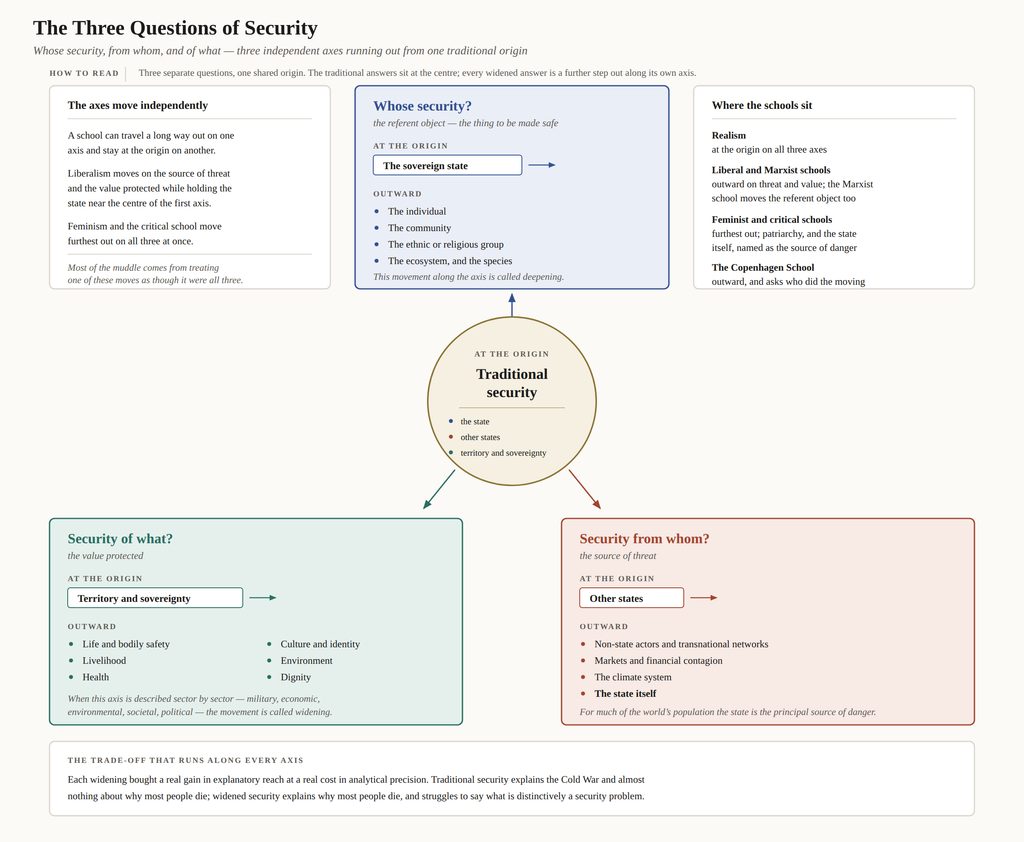
Every school can be located by the answers it gives to three questions, and the article returns to them at each stage.
- Whose security? — the question of the referent object, the thing to be made safe.
- The traditional answer is the state; the widened answers are the individual, the community, the ethnic or religious group, the ecosystem, the species.
- Security from whom? — the question of the source of threat.
- The traditional answer is other states; the widened answers add non-state actors, transnational networks, markets, the climate system and — decisively — the state itself, which for much of the world’s population is the principal source of danger rather than the guarantee against it.
- Security of what? — the question of the value protected.
- The traditional answer is territory and sovereignty; the widened answers are life, livelihood, health, culture, identity, environment, dignity.
Four Axes of Widening, and the Argument of This Article
- The concept has been widened along four axes simultaneously, and confusing them produces most of the muddle in the literature.
- The referent object moved from the state to the individual and the group — usually called deepening.
- The sources of threat moved from foreign armies to non-state actors, the environment, markets, and one’s own government.
- The sectors covered moved from the military to the economic, environmental, societal and political — usually called widening.
- The instruments moved from armies and alliances to development spending, public-health capacity, regulation, adaptation finance, rights protection.
- Each widening was a real gain in explanatory reach bought at a real cost in analytical precision. Traditional security explained the Cold War and explains almost nothing about why most people die; widened security explains why most people die and struggles to say what is distinctively a security problem.
A concept that covers everything that threatens human wellbeing has bought its comprehensiveness by giving up its power to discriminate.
Instrumentalist and Reflectivist Theories of Security
The most useful single cut across security theory is not realism against liberalism but instrumentalism against reflectivism — a division about what kind of question “what is security?” is.
- Instrumentalist theories treat security as a means, not an end — instrumental to survival, stability, prosperity or power, with its meaning taken as given and shared.
- Threats are treated as objectively present in the world and discoverable by analysis: weapons, geography, capabilities, growth rates.
- Realism, liberalism and Marxism are all instrumentalist, despite disagreeing entirely about what produces insecurity: each has a settled account of what security is.
- Reflectivist theories reflect on the meaning and use of the word “security” itself. They ask how and why an issue comes to be framed as a threat, and who benefits from the framing.
- Security here is not fixed but socially constructed: a state may feel threatened not by any real danger but by identity, historical memory or political convenience.
- Feminism, critical security studies, constructivism and the Copenhagen School are reflectivist, studying ideas, norms and discourse as the material threats are made of.
| Aspect | Instrumentalist theory | Reflectivist theory |
|---|---|---|
| Nature of security | An objective condition, given and knowable | A social construction, produced in discourse |
| Purpose of security | A means to survival, stability or power | Contested; the question is who the framing serves |
| Source of threats | Material — weapons, geography, capabilities | Narratives, perceptions, identities |
| Actors involved | States, governments, militaries | States plus individuals, movements, identity groups |
| Key focus | Power, deterrence, military strength | Norms, identity, securitisation and desecuritisation |
| Policy approach | Arms build-up, alliances, border control | Dialogue, reframing threats, human security |
| Theoretical base | Realism and neorealism | Constructivism, critical theory, the Copenhagen School |
| Key scholars | Morgenthau, Waltz | Wendt, Buzan, Wæver, Booth |
| Worked example | Russian missiles are a threat to Europe because of their range and number | Migration became a threat in Europe when leaders began describing it as one |
- The division cross-cuts the schools rather than replacing them. Feminism is reflectivist about gendered threat discourse and instrumentalist when it demands concrete protection for women in conflict; Marxism is instrumentalist about class and reflectivist about ideology.
- The payoff is that if threats are partly constructed, some insecurity can be dissolved by changing how it is described — which no amount of armament could achieve.
The Schools of Security
Each school can be summarised by its answers to the three organising questions: referent object, diagnosis, prescription.
The Realist School
- The referent object is the sovereign state, and security means its survival as a territorial and political unit.
- The source of insecurity is other states under anarchy. With no authority above them each must provide for itself, and the capabilities one builds are indistinguishable from those it would need to attack.
- The prescription is self-help: military capability, balance of power, alliances, deterrence and prudent diplomacy. (These instruments are developed in the companion articles Balance of Power and Deterrence.)
- Its strength is parsimony — few assumptions generating testable expectations about arms racing, alliance formation and great-power war. Its blindness is everything that kills people without an army: famine, epidemic, state repression and environmental collapse are not security questions on this definition.
The Liberal School
- The referent object expands to include both states and individuals, and security is understood as a condition that can be produced cooperatively rather than competitively.
- Insecurity arises not only from anarchy but from thin interaction, the absence of democracy and the weakness of institutions. Anarchy is a permissive condition, not a determining one.
- The prescriptions are a family of related mechanisms.
- Liberal institutionalism — institutions lengthen the shadow of the future, supply information about intentions and lower the transaction costs of cooperation.
- Functional cooperation — cooperation in technical, low-political sectors spills over into political trust.
- Security communities, in Karl Deutsch’s formulation — groups of states among whom war has become unthinkable and dispute settlement dependable, which is why Western Europe is not merely peaceful but structurally incapable of internal war.
- The trading state — Richard Rosecrance’s argument that conquest became less profitable than trade, so states shifted from military to commercial strategies of advancement.
- Democratic peace theory — democracies very rarely fight one another, whether from institutional constraints on war-making or normative habits of bargaining.
- Its weakness is that every mechanism assumes interdependence and institutional density much of the world does not have — and interdependence itself can be weaponised.
The Marxist School
- The referent object is the human being, and analysis begins from who is materially insecure rather than which state is militarily vulnerable.
- The source of insecurity is capitalism, which generates structural inequality, exploitation and alienation — and these, not foreign armies, leave most of humanity unsafe.
- Structural violence, in Johan Galtung’s term, is harm built into social arrangements rather than inflicted by an identifiable actor: deaths from preventable disease and malnutrition are violence without a shooter.
- National security discourse is on this reading an ideological instrument, identifying external enemies to obscure internal exploitation and legitimise expenditure that serves the arms industry.
- The prescription is transformation of the system rather than management within it — a classless order in which the structural sources of deprivation are removed.
- Its weakness is that it explains persistent deprivation far better than the specific conflicts security studies is asked about, and its prescription is not operational.
The Feminist School
- The referent object is the individual, and specifically the everyday insecurity of women and marginalised groups, which state-centric security studies renders invisible.
- A state can be perfectly secure — no border threatened, no army defeated — while a large share of its population lives with routine violence inside the home.
- Patriarchy is itself a source of insecurity, structurally analogous to anarchy: a system of gendered power distributing vulnerability unequally.
- Security discourse is gendered. Strength and rationality are coded masculine, vulnerability and care feminine, and the “protector–protected” framing licenses militarism abroad and control at home. Conflict is not gender-neutral: sexual violence as a weapon, the gendered composition of displacement, the exclusion of women from peace talks.
- The prescriptions are empowerment, gender mainstreaming in security policy, and bringing an ethic of care into international politics — treating relationship and responsibility, not autonomy and threat, as the basic categories.
- The institutional expression is the Women, Peace and Security agenda initiated by UN Security Council Resolution 1325, which requires women’s participation in conflict prevention and settlement.
- The wider theoretical apparatus of IR feminism — standpoint, postcolonial and poststructural variants — is developed in the companion article Constructivist Feminist Postmodern and Postcolonial Approaches to International Relations; what matters here is the security claim.
The Critical or Emancipatory School
- Associated with the Welsh School and above all Ken Booth, this approach holds that security cannot be separated from the freedom of actual human beings.
- Security is emancipation — what makes people secure is the removal of the constraints, war, poverty, poor education and political oppression, that stop them doing what they would freely choose.
“Security and emancipation are two sides of the same coin. Emancipation, not power or order, produces true security.” — Ken Booth
- The state is a means, not an end, and often an unreliable one: states are like houses, useful for shelter, but not to be confused with the life lived in them — and some are dangerous to their occupants.
- Andrew Linklater extends the argument into political community: the task is replacing territorial boundaries with moral boundaries, so that obligation is not arbitrarily cut off at a frontier.
- Grassroots democracy and ethical global governance are the practical programme, and the theorist is part of the emancipatory project rather than a neutral observer.
- Its weakness is utopianism, and the objection that emancipation is a Western value being universalised — a charge the postcolonial school presses hard.
The Copenhagen School
- Security is neither an objective condition nor a purely subjective feeling but an intersubjective act — something that becomes real when an actor persuades an audience that it is real.
- State and human security alike are shaped by social interaction, identity and norms rather than material factors alone, so insecurity is not fixed or inevitable. The school is treated at length below, because securitisation is the most productive concept the widening debate has generated.
The Postcolonial and Subaltern School
- Mainstream security theory is a generalisation from European history that does not describe most of the world.
- Mohammed Ayoob’s subaltern realism is the fullest statement. Third-world insecurity arises overwhelmingly from state-making — the coercive, contested and incomplete process of building central authority over plural societies — rather than from the international system.
- European states went through the same violence over centuries and without an international audience; postcolonial states are asked to complete it in decades under human-rights scrutiny.
- The characteristic threat is therefore internal — separatism, insurgency, contested legitimacy, communal violence — what Ayoob calls the insecurity dilemma.
- Amitav Acharya argues the security dilemma as usually stated may not apply to third-world states at all: in The Periphery as the Core (1997) he shows that most wars since 1945 have been internal wars in the Third World, not wars between neighbours.
- The implication is that prescriptions built for the European experience address the wrong problem when the danger is inside the state.
| School | Referent object | Source of insecurity | Prescription |
|---|---|---|---|
| Realist | The state | Anarchy and other states | Self-help, balance of power, alliances, deterrence |
| Liberal | States and individuals | Thin interaction, absent democracy, weak institutions | Institutions, functional cooperation, security communities, trade, democracy |
| Marxist | The human being | Capitalism and structural inequality | Transformation of the system |
| Feminist | Women and marginalised groups | Patriarchy and gendered discourse | Empowerment, mainstreaming, an ethic of care |
| Critical / emancipatory | The individual | All constraints on human freedom | Emancipation, moral rather than territorial boundaries |
| Copenhagen | Whatever is successfully claimed as one | The securitising move itself | Desecuritisation wherever possible |
| Postcolonial / subaltern | The weak state and its people | State-making and internal contestation | State capacity, legitimacy, political accommodation |
Traditional Security
Traditional or national security is the conception that dominated both the practice and the study of international politics from Westphalia to the end of the Cold War. It is coherent, internally consistent and, on its own terms, correct — which is why it survived the assault of the 1990s and returned to prominence after 2014.
- The referent object is the state — its territorial integrity, its sovereignty and the continuity of its political order.
- The threat is external military attack by another state. Everything else is a problem, but not a security problem.
- The instruments are military: defence, alliance, deterrence and balance of power, with diplomacy and intelligence in support.
The Three Traditional Approaches to a Security Problem
- Deterrence — preventing attack by convincing the adversary that its cost will exceed any gain. A psychological relationship requiring capability, credibility and communication, it fails against actors who are irrational, undeterrable or unidentifiable. (Developed in Deterrence.)
- Defence — the physical capacity to blunt or defeat an attack if deterrence fails: force structure, fortification, strategic depth and missile defence.
- Détente — deliberate reduction of tension through negotiation, confidence-building and mutual restraint, on the premise that some insecurity is generated by the relationship rather than by capabilities. This is the traditional paradigm’s one concession to the idea that threats are partly constructed.
The Assumptions That Make It Coherent — and Where They Break
| Assumption of traditional security | Where it breaks |
|---|---|
| The state is the natural referent | The state is often the threat — repression, majoritarian violence, engineered famine |
| Threats come from outside the border | Most armed conflict since 1990 has been intra-state; most insecurity is domestic in origin |
| The threat is military | Pathogens, price shocks, floods and code cause damage no army could |
| Security is zero-sum between states | Environmental and health security are positive-sum — no state is safe until others are |
| The state is a unitary rational actor | Regimes secure themselves against their populations and call it national security |
| Force is the effective instrument | Military power did not deliver outcomes in Vietnam, Iraq or Afghanistan |
- The strongest case for retaining it is empirical. World military expenditure reached $2,887 billion in 2025, 2.5% of world GDP, with Europe rising 14% to $864 billion. States that had comprehensively widened their security discourse rearmed within three years of a land war returning to Europe.
- The strongest case against it is also empirical: the Global Peace Index 2026 records 61 active state-based conflicts, the most since 1945, and violence costing about $21.8 trillion, 10.5% of global GDP — from a system organised around exactly this conception for eighty years.
Comprehensive Security
Comprehensive security is the first widening move: it keeps the state as the referent object but denies that the threats to it are only military. It is the conception most governments, including India’s, now use in official language.
- The core proposition is that a state’s survival depends on economic viability, ecological stability, social cohesion and political legitimacy as much as on repelling invasion.
- It is a widening without a deepening — the sectors expand, the referent object does not, which is why states that reject human security as intrusive accept it.
Buzan’s Five Sectors
Barry Buzan’s framework in People, States and Fear is the standard division, and its point is that each sector has its own referent objects, threats and logic of survival.
| Sector | What is threatened | Characteristic threat |
|---|---|---|
| Military | The state’s territorial integrity and armed capacity | Armed attack, coercion, invasion |
| Political | The state’s sovereignty, ideology and organisational stability | Recognition denial, subversion, delegitimation, external interference |
| Economic | Access to resources, finance and markets sustaining welfare and state power | Supply disruption, sanctions, financial contagion, resource dependence |
| Societal | Collective identity — language, religion, culture, national custom | Migration, cultural assimilation, demographic change, horizontal competition |
| Environmental | The biosphere on which all other activity depends | Climate change, ecosystem collapse, water and soil degradation, pollution |
- The sectors are analytical lenses, not separate worlds — viewpoints on a single field. An energy shock is simultaneously economic, environmental and military.
- The societal sector is Buzan’s most original contribution and the one that generates the sharpest politics, because the referent object is an identity group that may not be coterminous with the state.
Three Levels of Analysis
- Buzan organises security around three levels — the individual, the state and the international system — and argues that none is intelligible alone.
- Individual security is threatened by physical violence, economic deprivation, denial of rights and loss of position — and as much by the state as by anything outside it.
- State security rests on the physical base (territory and population), the institutions of government, and the idea of the state (its legitimating ideology and identity). Weakness in the idea is hardest to remedy and the commonest cause of state failure.
- System security concerns the structure of relations among states — the distribution of power, the density of institutions, the strength of norms.
- The levels interact perversely: strengthening the state can weaken the individual, and strengthening one state weakens the system. There is no single point at which security is maximised.
The Twenty-First-Century Security Policy
- Buzan’s conclusion is that security has become a multidimensional concept that can no longer be compartmentalised.
- A security policy built on this reading rests on five pillars — military, political, economic, societal and environmental — and treats any policy that optimises one at the expense of the others as self-defeating.
Comprehensive security widened what counts as a threat without widening who counts as a victim; that second step is what human security took.
The Copenhagen School and Securitisation
The Copenhagen School — Barry Buzan, Ole Wæver and Jaap de Wilde — made the decisive move in the widening debate by refusing to ask what a security threat is and asking instead how something becomes one, converting an unresolvable definitional argument into an empirical question about political practice.
- Securitisation is the process by which an actor transforms an ordinary subject into a matter of security, and in doing so licenses extraordinary means to deal with it.
- Security is a speech act. Saying “security” does not describe a pre-existing condition; it performs a political move, in the way that saying “I promise” does not report a promise but makes one.
- Whether an issue is a security matter depends on how we talk about it, not on any property of the issue itself.
- The school sits inside social constructivism but narrows it to threat discourse — applying the constructivist insight specifically to how threats are framed and acted upon, and converging on the claim that anarchy is what states make of it.
The Components of a Securitising Move
- The securitising actor — whoever performs the speech act: a government usually, but also parties, media, movements, expert bodies, international organisations.
- The referent object — what is claimed to be existentially threatened and entitled to survive: the state, the nation, the economy, a culture, the climate system.
- The audience — those who must accept the claim. Securitisation is incomplete until they do; an unsuccessful attempt is only a securitising move.
- Buzan’s own test for any security claim is three questions: who is speaking, what are they speaking about, who is the audience? Asking them in that order makes the speaker, rather than the threat, the object of study.
The Spectrum: Non-Politicised, Politicised, Securitised
| Stage | Where the issue sits | What is permitted |
|---|---|---|
| Non-politicised | Outside public debate; the state does not deal with it | Nothing; the issue is private or invisible |
| Politicised | Inside normal politics — debated, budgeted, legislated | Ordinary democratic procedure: deliberation, compromise, review |
| Securitised | Framed as an existential threat to a valued referent | Emergency measures outside normal politics — secrecy, speed, extraordinary powers, suspension of ordinary rules |
- The move from politicised to securitised is a move out of normal politics — not a flourish but a change in what a government may lawfully and legitimately do.
- Facilitating conditions determine success: the utterance must be recognisable as a security claim, the speaker must hold authority, and the threat must plausibly carry the framing. A health minister can securitise a virus; a philosopher cannot.
Desecuritisation
- The school’s normative position is that securitisation is generally undesirable and desecuritisation usually preferable — which surprises readers who expect a theory of security to recommend more of it.
- Securitisation is a failure of normal politics: an admission that an issue could not be handled by deliberation.
- Desecuritisation means shifting an issue back into ordinary political process, where it is argued about, budgeted for and subjected to review.
- The judgement is contextual, not absolute. Securitising a genuine emergency may be the only way to mobilise at speed; securitising a developmental problem permanently imports the wrong instruments and institutions.
Regional Security Complex Theory
- A regional security complex is a set of states whose security concerns are so interlinked that their national securities cannot be considered apart from one another.
- Security interdependence is regionally clustered because most threats travel more easily over short distances; the region, not the globe, is where security dynamics operate.
- Its structure comes from the distribution of power within it and from patterns of amity and enmity that no material calculation explains.
- South Asia is the textbook case: an insulated complex built around India–Pakistan rivalry, which outside powers penetrate rather than constitute.
Societal Security and Identity
- Wæver’s societal security takes the referent object to be collective identity — the ability of a society to persist in its essential character under changing conditions.
- The threat is not to the state’s survival but to the community’s sense of itself: language loss, religious change, demographic shift, cultural absorption.
- It reaches a class of politics state-centric security cannot, including nativist mobilisation in wealthy and militarily unthreatened societies.
- It is also the most dangerous of the sectors: the referent object — “our identity” — is defined by the securitising actor, and defending it authorises action against the people said to threaten it.
- Election campaigning is where societal securitisation is most often performed. A leader who tells a campaign audience that a minority community threatens the majority’s identity, demography or safety is making a textbook securitising move: the referent object is collective identity, the audience is the electorate, and acceptance licenses measures — surveillance, restrictions on residence, citizenship, worship or conversion, tolerated vigilantism — that ordinary politics would not sanction.
- The documented European instance is the Hungarian government’s 2018 election campaign, which framed Muslim migration as an existential threat to a Christian Europe and was followed within months by the “Stop Soros” legislation criminalising assistance to asylum seekers.
- The move is available wherever the societal sector is contested, and comparable electoral framings of religious minorities recur across Europe and South Asia.
- The analytical point is that the minority becomes a threat by speech act rather than by any act of its own — which is why Wæver treated the societal sector as the one in which securitisation does the most damage, and why desecuritisation is the school’s default prescription.
Securitisation at Work
| Case | Securitising move | Consequence |
|---|---|---|
| Migration in Europe | Population movement framed as a threat to societal identity and public order | Externalised border control, detention, the rise of parties organised around the frame |
| Ethnic relations after the Cold War | Ethnic difference framed as existential threat once superpower discipline lifted | Intra-state conflict and ethnic cleansing in the Balkans, the Caucasus and the Great Lakes |
| Counter-terrorism after 2001 | Terrorism framed as an existential threat to the state and to civilisation | Emergency legislation, mass surveillance, indefinite detention, permanent statutes |
| COVID-19 | A pathogen framed as a national emergency | Border closure, lockdown, emergency procurement — effective mobilisation and durable expansion of executive power |
| Climate change | Warming framed as a threat to international peace and security | Political salience gained; militarised framings and adaptation-as-defence risked |
- The Cold War’s end did not end securitisation; it redirected it. Where superpower conflict had supplied the organising threat, governments across the world securitised ethnicity, religion and migration instead — which is why the 1990s produced more intra-state violence, not less.
- A recurring political function is diversion: securitising one issue draws attention from problems a government would rather not be judged on, and the move is most useful when the threat is least real.
- Climate securitisation has a double edge. It raised the issue’s political rank, but the December 2021 Security Council draft sponsored by Ireland and Niger and co-sponsored by 113 states, which would have made climate risk standing Council business, was vetoed by Russia; India voted against and China abstained.
- India’s objection was explicitly anti-securitisation: that climate change belongs in the UN Framework Convention where all states negotiate, not in a Council of fifteen where a permanent five could authorise coercive measures over the development choices of others.
Critiques of Securitisation Theory
- The racism critique. Alison Howell and Melanie Richter-Montpetit argue the theory reproduces racial and civilisational hierarchy — treating orderly deliberative politics as the European condition and permanent emergency as the natural state elsewhere.
- Eurocentrism in the speech-act model. The theory presumes a functioning public sphere, an identifiable audience and a contestable speaker; where politics is not conducted that way, it cannot locate the moment of securitisation at all.
- Elite bias. Because a securitising move succeeds only when the speaker has standing, the theory explains what powerful actors do and structurally cannot account for the security claims of the marginalised — exactly the claims human security was invented to register.
- The narrowness of the speech act. Securitisation also happens through images, bureaucratic routine, risk management and procurement, none of which involves anyone saying anything; Thierry Balzacq’s sociological turn treats it as an institutional practice rather than an utterance.
- The desecuritisation problem. If some threats are real, the recommendation to desecuritise can amount to advising states to under-react — a charge that lands hardest on climate and pandemic policy.
Human Security
Human security is the deepening move: it shifts the referent object from the state to the individual and asks not whether borders are safe but whether people are. It is the widening debate’s most consequential result and its most contested.
- The founding text is the UNDP Human Development Report 1994, which argued that for most of the world’s people security had always meant something other than what security studies said it meant.
“Human security is not a concern with weapons — it is a concern with human life and dignity.” — Human Development Report 1994
- The two pillars, borrowed from Roosevelt’s four freedoms, remain the standard shorthand.
- Freedom from fear — protection from violence, coercion, repression and armed conflict.
- Freedom from want — protection from hunger, disease, destitution and daily livelihood insecurity.
- Freedom to live in dignity was added later, through the 2005 World Summit and subsequent UN practice, covering rights, rule of law and participation.
- Its decisive observation is that for most people insecurity arises from the ordinary conditions of daily life — the job, the harvest, the water, the police — not from foreign invasion.
The Seven Components
| Component | What it protects against | Contemporary illustration |
|---|---|---|
| Economic security | Assured basic income; unemployment, indebtedness, informality | Informal employment without social protection across South Asia and Africa |
| Food security | Physical and economic access to adequate food | 645 million people, 7.8% of the world, faced hunger in 2025 |
| Health security | Disease, lack of access to care, unsafe conditions | COVID-19, antimicrobial resistance, and air pollution as a mass mortality risk |
| Environmental security | Degradation, disasters, resource depletion | Sea-level rise for small island states; groundwater depletion in northern India |
| Personal security | Physical violence — war, crime, domestic violence, trafficking | Over 181,000 conflict deaths recorded in 2025 |
| Community security | Loss of traditional relationships, ethnic and communal violence | Ethnic and sectarian violence; displacement of indigenous communities |
| Political security | Repression, torture, disappearance, denial of civil rights | Shrinking civic space; only 7.2% of the world’s population lives in open or narrowed civic space |
The Four Characteristics
The 1994 report set out four properties of human security, and each carries a policy implication that its critics tend to skip.
- Universal — the concerns are common to rich and poor countries alike; unemployment, crime, pollution and rights violation are not developing-world problems.
- Interdependent — famine, disease, conflict and displacement are not containable within borders, and the components cannot be secured separately.
- Best assured through early prevention rather than later intervention — cheaper, more effective and less coercive than response, and the report’s least-acted-on argument.
- People-centred — concerned with how people live, how freely they choose, and whether they live in conflict or peace.
The Narrow and the Broad School
| Narrow — “freedom from fear” | Broad — “freedom from want” | |
|---|---|---|
| Associated with | The Canadian approach; the Human Security Network | The Japanese approach; the Commission on Human Security |
| Core content | Protection of individuals from organised violence | The full range of threats to survival, livelihood and dignity |
| Threats counted | Armed conflict, landmines, small arms, child soldiers, atrocity | Violence plus poverty, disease, hunger, environmental degradation |
| Instruments | Humanitarian law, ICC, arms conventions, protection missions | Development, health systems, social protection, environmental policy |
| Strength | Operational and actionable — you can ban a landmine | Analytically honest about what actually kills people |
| Weakness | Ignores the largest sources of premature death | Indistinguishable from development; no priority ordering |
- The narrow school produced results: the Ottawa Convention banning anti-personnel landmines, concluded in 1997 and signed by 122 states, the International Criminal Court, and the campaigns on child soldiers and small arms.
- The broad school produced a framework — comprehensive, intellectually satisfying and very hard to convert into a decision rule about what to do first.
Institutional Traction
- The Commission on Human Security, co-chaired by Sadako Ogata and Amartya Sen, reported in 2003 with Human Security Now, defining the object as protecting the vital core of all human lives, and pairing protection (top-down, by institutions) with empowerment (bottom-up, by people themselves).
- General Assembly Resolution 66/290 of 2012 gave human security an agreed intergovernmental definition — the right of people to live in freedom and dignity, free from poverty and despair, with equal opportunity to enjoy their rights and develop their potential.
- The limiting clauses matter as much as the definition. Human security is people-centred, comprehensive, context-specific and prevention-oriented; it does not entail the threat or use of force, does not replace state security, and is distinct from the responsibility to protect — the price developing states demanded for accepting the concept at all.
- The Human Security Unit and the UN Trust Fund for Human Security institutionalised it as a programming method for integrated, multi-agency projects, and its language runs through the Sustainable Development Goals even where the term is absent.
An Honest Assessment
- It changed the vocabulary more than the allocation. Governments adopted the language while defence budgets rose to record levels; the concept has not once redirected significant resources from military to human protection.
- It has no priority rule. If everything from landmines to unemployment is a security threat, the concept cannot tell a finance ministry what to fund first — the objection that human security is a rallying cry rather than an analytical category.
- It is resisted where it matters most. Developing states read it as circumscribing sovereignty just as their state-building is incomplete, and several see it as masking the ambitions of powers who apply it selectively and only to poor countries.
- The defenders’ reply is that human security is realised within and through the state, not against it — it requires more state capacity, and its programme is a democratic state that values its people and protects its minorities.
- The strongest defence is negative. The definition it replaced could not register the deaths of most people who die of insecurity, and a definition that misses the phenomenon is not saved by being precise.
Human security won the argument about what insecurity is and lost the argument about what budgets are for.
Non-Traditional Security Threats
Non-traditional security threats are dangers to survival and wellbeing that are not military in origin, not confined by borders, and not soluble by force. The analytically useful account of them is not a list but a set of mechanisms — what actually converts a condition into a security event.
Food
- Food insecurity is produced by price volatility, conflict and export restriction, not by absolute global scarcity. The world grows enough; the mechanism of crisis is access, not supply.
- The transmission chain: a production or energy shock raises grain prices; exporting states impose bans; bans cascade as each government reacts to the last; import-dependent states face simultaneous price and availability shocks; urban populations without buffers protest.
- The 2007–08 and 2022 spikes both ran this sequence, and in both the export restrictions did more damage to importers than the original shock.
- Price shocks contributed to the unrest across North Africa and West Asia in 2010–11 — bread prices did not cause those uprisings but supplied their timing and earliest slogans.
- The Black Sea Grain Initiative showed food to be an instrument of war.
- Signed on 22 July 2022 by Ukraine, Russia, Türkiye and the UN, it moved nearly 33 million tonnes of foodstuffs to 45 countries before Russia terminated it on 17 July 2023.
- Ukraine improvised a corridor through territorial waters, but a belligerent had shown it could hold the food supply of unrelated states hostage.
- The state of the problem: the State of Food Security and Nutrition in the World 2026 records 645 million people, 7.8% of the world, hungry in 2025 — a third consecutive annual decline — and about 2.1 billion in moderate or severe food insecurity, Africa carrying 309 million of the hungry.
Water
- The security mechanism runs through shared basins under stress, where upstream infrastructure decisions have downstream existential consequences and no adequate legal regime governs the outcome.
- The Nile and the Grand Ethiopian Renaissance Dam — Africa’s largest hydropower project, over 5,000 MW, inaugurated on 9 September 2025 without downstream agreement. Egypt, whose dependence on the Nile is near-total, and Sudan called it unilateral and a threat to stability.
- The Mekong — upstream dam cascades altering flow, sediment and fisheries tens of millions depend on.
- The Indus — the treaty that survived three wars held in abeyance by India since May 2025, converting a durable technical regime into a coercive lever.
- The Brahmaputra — no comprehensive treaty and upstream construction India and Bangladesh cannot influence.
- The evidence does not support the water-wars thesis. Study of transboundary basins finds cooperation far more frequent than conflict and interstate war over water almost absent from the record.
- What scarcity reliably produces is internal: displacement, rural–urban migration, farmer–herder conflict, local violence over wells and irrigation. The effect is real but domestic and slow, not international and sudden.
Climate as a Threat Multiplier
- Climate change rarely causes conflict directly; it degrades the conditions under which societies manage stress. That is the meaning of threat multiplier.
- Territorial existence — sea-level rise threatens the physical survival of small island states, the most literal security question available: the referent object may cease to have territory.
- Displacement — extreme events move populations, overwhelmingly internally and into cities already short of services.
- Agricultural viability — warming shifts the range of viable cropping in already fragile regions, turning marginal livelihoods into unviable ones.
- The debate over securitising climate is genuinely open, and the 2021 Security Council vote described above is its sharpest expression: raising climate’s political rank against the risk of handing an enforcement body jurisdiction over development policy.
Health
- COVID-19 showed a pathogen outperforming any conventional threat on every measure a defence ministry uses: deaths, economic contraction, disrupted mobility, strain on state capacity. It also showed the converse — public-health capacity is a security asset, and laboratories and manufacturing are strategic infrastructure.
- Preparedness has improved institutionally and not much materially. The WHO Pandemic Agreement was adopted in May 2025, but the Pathogen Access and Benefit-Sharing annex carrying its equity provisions was still under negotiation through 2026, and the agreement cannot enter into force until that annex is adopted and ratified.
- The unresolved question is the one that made vaccine distribution inequitable: whether states sharing pathogen samples are guaranteed a share of what is made from them.
Energy, Migration, Cyber and Terrorism
- Energy security — assured supply at bearable prices, with dependence as the mechanism: import concentration, chokepoint exposure, infrastructure vulnerability. Europe after 2022 showed interdependence built for efficiency becoming leverage in a crisis, and the transition substitutes critical-mineral dependence rather than removing dependence.
- Migration and displacement — 117.8 million forcibly displaced worldwide on UNHCR’s June 2026 count, one person in seventy, including 68.6 million internally displaced and 28.5 million refugees. Displacement is mostly a consequence of insecurity that is then securitised as a cause — the clearest case of framing doing the analytical work.
- Cyber — the fastest-changing domain and the one where categories break down completely. Attacks on critical infrastructure blur war and crime, and the attribution problem means the victim often cannot establish who acted, disabling deterrence, retaliation and law at once.
- Terrorism — non-traditional in actor and method, conventional in its violence, and the threat that most successfully invited a militarised response. The counter-terrorism state built after 2001 is the standing example of what securitisation licenses. (Treated in a dedicated article.)
What They Share
- Transnational — no state can address them alone; the capacity that matters is collective.
- Non-military in origin — defence budgets do not answer them; the instruments that work are regulatory, fiscal and scientific.
- Asymmetric — they fall hardest on the poorest people in the poorest states, who did least to cause them.
- Interlinked as a chain, not a set of items. Climate reduces yields, which raises prices, which drives displacement, which produces political instability, which reduces the state capacity needed to manage the next shock. Treating them as a list of separate threats is the single commonest analytical error about them.
The Security Dilemma and the Insecurity Dilemma
The security dilemma is the mechanism that makes realism a tragedy rather than a morality tale: it explains how war can arise between states that both want peace. The insecurity dilemma is the claim that for most states the mechanism runs inside the border rather than across it.
The Security Dilemma
- The core proposition: measures a state takes to increase its own security — armament, alliance, forward deployment — reduce the security of others, who respond in kind, leaving the first state no safer and everyone poorer and more frightened.
- John Herz coined the term from a Hobbesian reading of the state of nature: groups living alongside one another without a higher authority must fear domination, and the effort to escape that fear accumulates power, which frightens others — making power politics a permanent structural feature rather than a moral failing.
- Herbert Butterfield reached the same conclusion independently, calling it the absolute predicament and irreducible dilemma — a tragedy in which neither party can enter into the other’s counter-fear, each reading its own defensive intent as obvious and the other’s as concealment.
- Two conditions generate it: anarchy, so no authority can enforce a promise, and uncertainty about intentions, since present intentions do not guarantee future ones.
- Uncertainty is the operative condition, not malice. A state that could reliably read intentions would not face the dilemma even under anarchy.
Jervis, the Offence–Defence Balance and the Four Worlds
- Robert Jervis explained why the dilemma bites hard in some periods and barely at all in others, using two variables.
- Whether offence or defence has the advantage — whether it is easier to take territory or to hold it.
- Whether offensive and defensive weapons are distinguishable — whether a state can arm for defence in a way others can recognise as defensive.
| Offence–defence indistinguishable | Offence–defence distinguishable | |
|---|---|---|
| Offence has the advantage | Doubly dangerous — severe dilemma, arms racing, high war risk | No dilemma, but aggression is easy; status quo states are exposed |
| Defence has the advantage | Security dilemma, but the incentive to attack is low | Doubly safe — status quo states can arm defensively without alarming anyone |
- The dilemma is therefore variable and partly manageable: postures, deployments and doctrines can be made legible as defensive, which is the basis of non-offensive defence and of confidence-building measures.
- The spiral model against the deterrence model is Jervis’s other enduring contribution, and it is a diagnostic problem rather than a theoretical one.
- The spiral model says the adversary is frightened, so firmness confirms its fears and escalates; the remedy is reassurance.
- The deterrence model says the adversary is greedy, so conciliation confirms that aggression pays; the remedy is firmness.
- The prescriptions are exact opposites and the evidence rarely distinguishes the cases in time. Misdiagnosis produces appeasement or an avoidable war, which is why the dilemma resists technical solution.
Booth and Wheeler: Interpretation and Response
- Ken Booth and Nicholas Wheeler disaggregate the dilemma into two sequential problems, which clarifies where policy actually fails.
- The dilemma of interpretation — deciding what another state’s military preparations mean, under irreducible uncertainty and with no way to see intent.
- The dilemma of response — deciding whether to reassure or to deter, having made an interpretation that may be wrong.
- Resolved badly, both produce the security paradox: two states that intended no harm end in confrontation. The dilemma is therefore not automatic — transparency, restraint and costly signals of benign intent mitigate it, and treating it as fixed becomes self-fulfilling.
The Constructivist Reply
- The dilemma follows from how anarchy is interpreted, not from anarchy itself. Anarchy is a condition of the system; enmity is a relationship states construct within it — which is why Britain and France, under the same anarchy as India and Pakistan, experience no security dilemma.
- The prescription is communication, reassurance and constructed shared identity — which is why security communities are possible, and why the dilemma is a variable of relationships rather than a constant of structure.
The Insecurity Dilemma
- Georg Sørensen’s argument is that the classical dilemma describes a world of consolidated states that no longer includes most of the world’s states.
- Twenty-first-century states, especially weak and postcolonial ones, face their principal threats from inside — ethnic and separatist movements, non-state armed actors, civil war, criminal governance, state failure — none of it generated by the international distribution of power.
- Mohammed Ayoob’s subaltern reading supplies the history: these states are in the middle of state-making, and the insecurity dilemma is the ordinary condition of incomplete consolidation. The security dilemma is built on European history and of limited relevance to third-world states, which suffer far more from internal challenge than external threat.
- Amitav Acharya presses further: the army’s principal function is often internal, the state is a party to the conflict rather than its arbiter, and a framework built for great-power rivalry misdescribes the problem.
- The perverse dynamic is preserved, only the arena has moved inside: emergency powers, militarised policing and the co-option of one community against another reduce the security of the citizens they are imposed on, who then mobilise against the regime.
| Security dilemma | Insecurity dilemma | |
|---|---|---|
| Arena | Between states, across borders | Within the state, across society |
| Referent object | The state’s territorial survival | The regime, and the state’s very cohesion |
| Source of threat | Other states’ capabilities under anarchy | Ethnic movements, insurgents, civil war, state failure |
| Driving condition | Anarchy plus uncertainty about intentions | Incomplete state-making and contested legitimacy |
| Typical response | Armament, alliance, deterrence | Internal security forces, emergency law, co-option, repression |
| Perverse effect | Arms race and spiral to war | Repression breeding the insurgency it answers |
| Key scholars | Herz, Butterfield, Jervis, Booth and Wheeler | Sørensen, Ayoob, Acharya |
| Illustration | US–China, NATO–Russia | Sahel states, Myanmar, fragile states of West and Central Africa |
Contemporary Illustrations
- India–China after 2020. Infrastructure each side built for access and defence reads to the other as preparation for offence; Galwan and the ensuing forward deployments produced a mutual build-up neither began by intending. The dilemma of interpretation is live in the same terrain.
- India–Pakistan. Overlaid by nuclear weapons, which suppress large war while licensing violence below the threshold — the exchanges of 7–10 May 2025 after the Pahalgam attack of 22 April 2025, and India’s “new normal” treating terrorism as an act of war. (Developed in Deterrence.)
- US–China. Naval modernisation, alliance strengthening and export controls, each defensible as defensive and each read as containment or revisionism.
- NATO–Russia. One side’s enlargement is the other’s encirclement; NATO’s expansion to 32 members and the Hague summit’s 5%-of-GDP pledge are on one reading responses to threat and on the other its cause.
Arms Races and Militarisation
- The dilemma’s characteristic output is an arms race — reciprocal accumulation in which each increment answers the last and none yields advantage.
- Militarisation is the domestic residue: an industrial constituency, a strategic elite and a public discourse that acquire an interest in the threat continuing, so the race outlives its cause.
- The opportunity cost is itself a human-security question. In the year world military spending reached a record, 645 million people were hungry; the juxtaposition is the entire content of the widening argument. (Arms control is developed in Deterrence.)
Security and Liberty
- The standard framing is a trade-off: liberty must be curtailed to buy security, and the only question is how much. It is intuitive, it organises most public debate, and it is largely wrong.
- Three objections to the trade-off framing.
- The two are not commensurable. There is no exchange rate between a percentage of privacy and a percentage of safety, so “balance” is a metaphor doing the work of an argument.
- Costs and benefits fall on different people. Those whose liberty is restricted — minorities, migrants, dissenters — are rarely those whose security improves, so the balance is a distribution disguised as an optimisation.
- Liberty is itself a security good. Rights protection, independent courts and free information let societies detect state failure and correct policy error; states that suppress them lose the feedback that keeps them safe.
- The ratchet effect matters most: emergency powers are enacted as temporary, renewed, made permanent, and set the floor from which the next emergency begins.
- The post-2001 counter-terrorism turn is the archetype — indefinite detention, mass surveillance, watchlists, expanded proscription and secret evidence, almost none of it repealed when the threat receded. COVID-19 repeated the pattern on a compressed timescale.
- Is the liberal international order “security-friendly”? It is both the principal source of restraint and the principal author of the exceptions.
- In its favour: humanitarian law, human rights treaties, the prohibition on the use of force, independent courts, and a civil society capable of documenting abuse.
- Against it: the order’s leading states built the counter-terrorism exception, the surveillance architecture and the rendition practices, and the interventions conducted in its name are what made much of the world sceptical of security claims in liberal language.
- The securitisation reading resolves the paradox: the order is security-friendly in normal politics and suspends itself in securitised politics — and it has been in securitised politics for most of this century.
The Indian Material
- Preventive detention is written into the Constitution itself. Article 22 permits detention without trial, with clauses (4) to (7) supplying the safeguards — advisory board, maximum period, communication of grounds. India is unusual among democracies in constitutionalising the exception rather than treating it as an emergency departure.
- The Unlawful Activities (Prevention) Act is the principal counter-terrorism statute; its 2019 amendment allowed individuals, not only organisations, to be designated terrorists, and its bail provisions invert the ordinary presumption, prolonging pre-trial custody.
- The Armed Forces (Special Powers) Act confers extraordinary powers in areas declared disturbed, including protection from prosecution without central sanction. Its progressive reduction in the North-East since 2022 is the clearest example of desecuritisation in Indian practice.
- K. S. Puttaswamy v. Union of India established privacy as a fundamental right and laid down the proportionality test — legitimate aim, rational connection, least restrictive means, proportionate effect — which converts “balance” from rhetoric into a justiciable standard.
- The Pegasus proceedings established that a bare invocation of national security does not oust judicial review, even where operational detail need not be disclosed.
- Internet shutdowns are the routine instrument. Anuradha Bhasin held indefinite suspension impermissible and required orders to be published and reviewed. In practice India recorded 65 shutdowns in 2025 — the most of any democracy, second globally to Myanmar’s 95, of at least 313 across 52 countries.
The Over-Widening Critique
The objection to widening is not conservatism but a claim about what a concept is for, and it runs along three distinct lines.
- The coherence objection — Stephen Walt. Security studies is the study of the threat, use and control of military force; extending it to pollution, disease or recession destroys the field’s coherence.
“Defining the field of security studies to include issues such as pollution, disease, child abuse, or economic recessions would destroy its intellectual coherence and make it more difficult to devise solutions to any of these important problems.” — Stephen Walt
- The underlying point is methodological: a category that includes everything supports no generalisations, because there is nothing all its members have in common.
- The category-error objection — Daniel Deudney. Environmental degradation and national security are analytically distinct, and yoking them is a mistake three times over.
- The threats are dissimilar — one intentional, agent-driven and rapid, the other unintentional, diffuse and slow, so nothing learned about one transfers.
- The institutions are wrong — militaries are organised for secrecy, hierarchy and the identification of enemies, none of which suits a problem whose adversary is aggregate human behaviour.
- The metaphor militarises the response and may strengthen the nationalist zero-sum thinking that makes environmental cooperation impossible.
- The securitisation caution. Emergency measures applied to a developmental problem tend to make it worse — militarised borders against climate displacement, self-sufficiency drives against price shocks, surveillance against epidemic.
- The reply is not weak. A concept precise enough to satisfy Walt was precise about a category capturing a small and shrinking fraction of human insecurity, and defended a disciplinary boundary rather than an analytical one.
- Widening also proved politically productive: landmines, small arms, atrocity crimes, pandemic preparedness and climate adaptation gained standing they would not have had as development questions.
- The argument is genuinely unresolved, and should be. It turns on whether a concept is valued for analytical discipline or for its capacity to move resources — different goods, held by different people, for reasons neither can show the other to be wrong.
The widening debate has no correct answer because precision and relevance are being traded against each other, and the exchange rate is a political judgement.
India’s Security Conception and Its Widening
India tests the argument well, because its official security language widened at almost exactly the pace of the academic debate while its institutions and its budget widened much less.
- The traditional core has not gone away. A two-front military problem — a contested, partly undemarcated boundary with China and an adversary using sub-conventional violence under a nuclear overhang — remains the organising fact of defence planning. India is the world’s fifth-largest military spender at $92.1 billion in 2025, up 8.9%.
- Official language has shifted to comprehensive national security, treating economic strength, technological capability, energy access, food and water availability and internal cohesion as security variables rather than development ones.
- Internal security is the dominant operational burden — Sørensen’s and Ayoob’s insecurity dilemma in practice.
- Left-wing extremism has contracted from 126 affected districts in 2014 to roughly 7 by early 2026, only three of them “most affected”, with annual fatalities down from 1,005 in 2010 to about 100 in 2025 on official figures, against which the government declared its March 2026 target met.
- Insurgency in the North-East has declined enough for AFSPA’s area to shrink, though ethnic conflict in Manipur since 2023 shows how fast community security collapses where the state is a contested party rather than an arbiter.
- Kashmir is where external and internal security are inseparable and the liberty question sharpest.
- The non-traditional threats India faces are a near-complete inventory of the widened agenda.
- Water stress — among the most water-stressed large economies, with severe groundwater depletion in the north-west, upstream dependence on China for the Brahmaputra and a suspended Indus regime.
- Food security — self-sufficient in grain but vulnerable in pulses and edible oils, and locked in a WTO dispute over public stockholding, where minimum-support-price procurement collides with the Agreement on Agriculture’s subsidy ceilings and survives only under a peace clause India wants made permanent.
- Climate vulnerability — a long, densely populated coastline exposed to cyclones and sea-level rise; Himalayan glacial retreat and outburst floods threatening water supply and hydropower; heat stress now a mortality and productivity question.
- Air pollution — a mass health-security problem in the northern plain, with premature mortality on a scale no conventional threat approaches, and sources that are domestic and diffuse.
- Energy — heavy crude and gas import dependence, and a transition substituting dependence on critical minerals processed largely in one country; the Quad’s Critical Minerals Framework, launched at the New Delhi foreign ministers’ meeting on 26 May 2026, is a direct response.
- Cyber — attacks on power, health and financial infrastructure, with the attribution problem making retaliation and law equally difficult.
- The architecture, and the gap in it.
- The National Security Council system — the National Security Adviser, the Strategic Policy Group, the National Security Advisory Board of outside experts and the Council Secretariat — supplies coordination; the Defence Planning Committee created in 2018 was tasked with drafting a strategy.
- India has still not published a National Security Strategy. A draft prepared by the Integrated Defence Staff was not approved, and successive governments have discussed and never issued one.
- The arguments run both ways. A published strategy would force prioritisation across ministries and signal intent; senior officers argue it sacrifices flexibility, publicises trade-offs a plural polity would rather not debate, and constrains adaptation. The cost is that India’s widened security conception has no public document ranking the widened threats against one another.
- Human security exists substantially in Indian policy, rarely under that name.
- The National Food Security Act created a legal entitlement to subsidised grain for about two-thirds of the population — freedom from want in statutory form.
- The rural employment guarantee and its successor architecture are an income floor and a shock absorber — economic security in the UNDP sense.
- The disaster-management architecture — a national authority, a dedicated response force, state and district structures — turned relief into a permanent capability, and cyclone mortality has fallen by orders of magnitude. This is the clearest Indian case of a non-traditional threat addressed by non-military means and measurably reduced.
- The gap is political and community security. Civic-space rankings, shutdown counts and the treatment of dissent sit uneasily beside the achievements in food, disaster and livelihood security — which is the framework’s point, since progress on one component does not settle the account for another.
Conclusion
- The concept has widened along all four axes and there is no going back, because each widening registered something real the previous definition could not see.
- The cost is that security no longer names a distinct class of problem. When a term covers invasion, inflation, influenza and inundation, it has stopped discriminating, and what it gains in reach it loses in the ability to guide a decision.
- The most defensible position is not a definition but a discipline: ask the three questions every time — whose security, from whom, of what — and, following the Copenhagen School, who is making the claim and what making it licenses them to do.
- The empirical situation vindicates neither side. Record military spending, the most state-based conflicts since 1945 and a lapsed strategic arms regime vindicate the traditionalists; 645 million hungry, 117.8 million displaced and a pandemic more damaging than any post-1945 war vindicate the wideners.
- Both describe the same world, and the concept has to hold both.
Previous Year Questions
- Explain the non-traditional security threats in the context of food and environmental crises. (2025)
- Critically assess the changing nature of the concept of national security. (2014)
- Examine the idea of a ‘balance’ between ‘security’ and ‘liberty’ in modern international politics. Do you think the liberal international order is more ‘security – friendly? (250 words) (2012)
- Do you agree with the view that over-widening of the concept of ‘national security’ has made it a more amorphous concept? Discuss. (2011)
- What is comprehensive approach to national security? (2011)
- Examine the changing nature of security in the recent times. (2010)
- Explain the difference between security dilemma and insecurity dilemma. (2008)
- Comment: Changing nature and dynamics of national security. (2002)
Syllabus unit: Key Concepts in International Relations
PSIR Optional study material from LotusArise IAS
Two ways to prepare with us — the full self-study system, or just the notes you need right now.
| What you get | PSIR Mains Master Kit 2027 | PSIR Complete Notes (Store) |
|---|---|---|
| Paper 1 notes — Political Theory + Indian Government and Politics | Included | Included — Section A and Section B |
| Paper 2 notes — Comparative Politics and India and the World | Included | Included — Section A and Section B |
| Topic-wise PYQ bank | 1986–2026, with trend analysis and probables by Dec 2026 | 1991–2025 question papers, free with every notes pack |
| Practice question set for timed answer writing | ✅ Available now | ❌ |
| Answer toolkit — intros, conclusions, frameworks, thinker and example banks | By Dec 2026 | ❌ |
| Revision booklets for the last 60 days | ✅ Available now | ❌ |
| Format | Online articles + PDF | PDF download |
| Access | Valid until UPSC CSE Mains 2027 | Instant download after payment |
| Price | ₹1,770 (regular ₹5,000) | ₹1,180 for all four sections · ₹599 a paper · ₹354 a section |
| Best for | Aspirants who want the whole system in one place | Aspirants who want the notes now, in the parts they need |
