

Transnational Actors in International Relations

The Question Behind the Concept
For three centuries the study of international politics assumed that the significant actors were states and that everything else was an instrument or a detail. That assumption is no longer tenable, but the fashionable inference from its collapse — that the state is being displaced — is also wrong. Transnational actors have not replaced the state; they have changed what a state must do to remain in control of its territory, economy and information space.
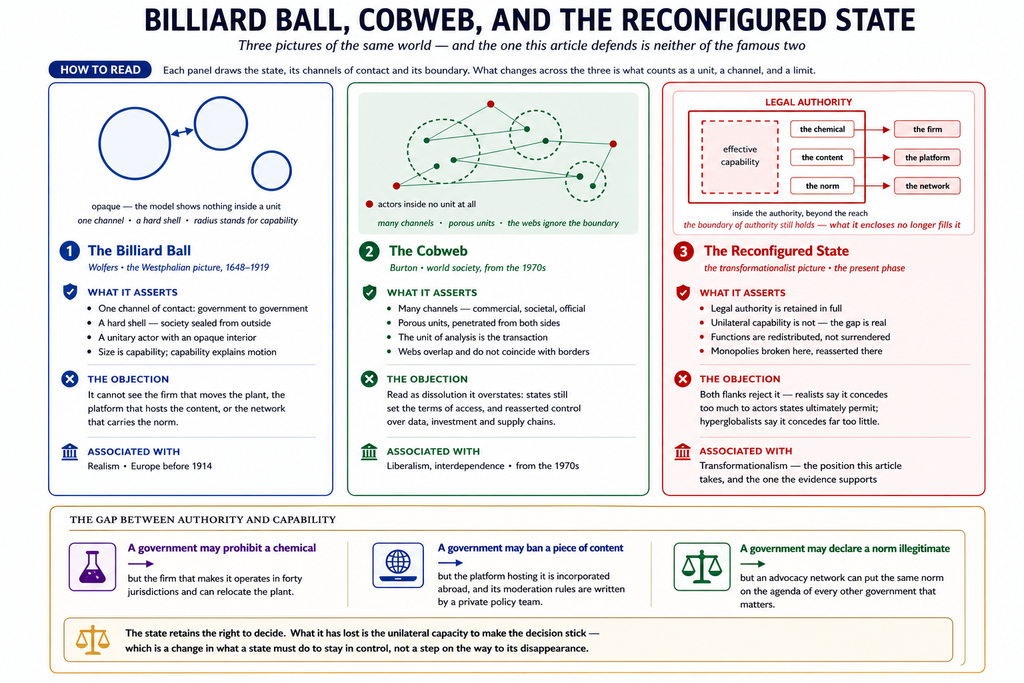
- The concept earns its place because it identifies a gap between authority and capability. States retain the legal right to decide; they increasingly lack the unilateral capacity to make the decision stick.
- A government may prohibit a chemical, but the firm that makes it operates in forty jurisdictions and can relocate the plant.
- A government may ban a piece of content, but the platform hosting it is incorporated abroad and its moderation rules are written by a private policy team.
- A government may declare a norm illegitimate, but an advocacy network can put the same norm on the agenda of every other government that matters.
- The argument is a transformationalist one. The evidence refutes both the realist claim that non-state actors are epiphenomenal and the hyperglobalist claim that the state is finished. It supports a third: the state has been reconfigured — functions redistributed, monopolies broken in some domains and reasserted in others.
What Counts as a Transnational Actor
The defining test
- A transnational actor is any entity that operates across state boundaries and influences world politics without acting as the agent of a state. Two conditions must both hold: activity across borders, and independence from governmental instruction.
- Keohane and Nye supplied the formulation that the field still uses, defining transnational interactions as the movement of items across boundaries where at least one party is not a state agent.
“The movement of tangible or intangible items across state boundaries when at least one actor is not an agent of a government or an intergovernmental organization.” — Robert Keohane and Joseph Nye, defining transnational interactions
- The test is functional, not legal. A firm chartered in Delaware and a network of activists with no legal personality at all can both qualify; a state-owned enterprise executing a government’s instruction does not, however commercial its form.
- The category is a spectrum rather than a binary. Sovereign wealth funds, state-backed champions and government-organised NGOs sit at the ambiguous edge, and the ambiguity is politically useful to the states that create them.
Transnational, international and transgovernmental
The three words are used interchangeably in ordinary speech and mean quite different things in the discipline. Keohane and Nye’s achievement was to separate them, and the separation is what made a systematic study of non-state actors possible.
| Type of relation | Who the parties are | Illustration | What it implies for the state |
|---|---|---|---|
| International / intergovernmental | State to state, through foreign offices | UN General Assembly; a bilateral treaty | The state acts as a unit, as realism assumes |
| Transnational | At least one party is not a state agent | An MNC negotiating with a host government; Amnesty International reporting on a state | The state is one actor among several |
| Transgovernmental | Sub-units of different states dealing directly, outside foreign-ministry channels | Central bankers in the Basel Committee; securities regulators; Interpol | The state is disaggregated into parts with their own foreign relations |
- Transgovernmental relations are the least noticed and the most consequential. They do not weaken states; they let regulators, judges and police agencies form networks that bypass the diplomatic channel entirely.
- International organisations are not themselves transnational actors, being created by and composed of states, though their secretariats acquire an autonomy that makes the boundary porous.
- “Non-state actor” is the genus and “transnational actor” a species within it. A purely domestic trade union or a local insurgency is a non-state actor without being transnational — and changes category the moment it opens funding channels abroad, which changes the tools available to the government facing it.
A classification of transnational organisations
- Genuine INGOs have only non-governmental members drawn from three or more countries — the World Council of Churches, Amnesty International, Greenpeace.
- Hybrid organisations mix governmental and non-governmental representation; the International Labour Organization, with its tripartite structure of governments, employers and unions, is the standing example.
- Transgovernmental organisations link governmental actors outside central foreign-policy control — Interpol, the Inter-Parliamentary Union.
- Business international non-governmental organisations, that is multinational enterprises, are excluded from most official registers because they exist to make profits for members — an exclusion that does nothing to reduce their political weight.
- ECOSOC Resolution 288(X) of 27 February 1950 fixed the residual definition that international law still relies on.
“Any international organization which is not established by intergovernmental agreement shall be considered as a non-governmental organization for the purpose of these arrangements.” — ECOSOC Resolution 288 B (X), 1950
- The UN Group of Eminent Persons preferred “transnational corporation” to “multinational corporation”, because most such firms operate from a single home base rather than being multinational in ownership or management. The two terms are used interchangeably below, as they are in practice.
Why they multiplied
- The growth of a society-centric world. Cross-border contact is no longer mediated by governments; individuals, firms and associations transact directly and at volume.
- The growth of interdependence. Economies that depend on each other generate constituencies, disputes and coalitions that do not respect the state as a container.
- The falling cost of coordination. Communications technology collapsed the price of organising a campaign, a supply chain or a criminal network across continents.
- Functional necessity. Problems transnational in mechanism — pandemics, climate, financial contagion, cyber — cannot be handled by any single state, which creates demand for differently constituted actors.
- Deliberate state choice. Liberalisation and privatisation transferred functions to firms and NGOs; much of the “erosion” of state capacity was legislated by states themselves.
A Typology of Transnational Actors
Each type is best understood by three questions: what resource gives it leverage, how does it convert that resource into influence, and to whom is it answerable. The third question is where the category as a whole is weakest — every transnational actor exercises authority for which no electorate is responsible.
| Actor | Principal resource | Mode of influence | Accountability deficit |
|---|---|---|---|
| MNCs / TNCs | Capital, technology, market access, jobs | Investment location, lobbying, standard-setting, transfer pricing | Answerable to shareholders and home-state law, not to host populations |
| INGOs and advocacy networks | Legitimacy, information, moral authority | Agenda-setting, naming and shaming, litigation, service delivery | Answerable to donors, not to the people they speak for |
| Epistemic communities | Certified expertise | Framing problems, defining what counts as evidence | Peer review substitutes for political authorisation |
| Terrorist and violent non-state actors | Willingness to use violence, secrecy | Coercion, provocation, asymmetric attack | None; they hold nothing at risk |
| Transnational criminal organisations | Illicit revenue, corruption, violence | Capture of officials, control of trafficking routes | None; they operate to evade accountability |
| Diasporas | Remittances, votes in host states, cultural authority | Lobbying, financing, long-distance nationalism | Influence in a polity they do not live under |
| Religious and civilisational movements | Belief, congregational networks, charity | Socialisation, mobilisation, welfare provision | Answerable to doctrine and clergy |
| Transnational social movements | Numbers, protest, symbolic action | Disruption, publicity, coalition | Self-authorising; leadership rarely elected |
| International media | Attention, framing power | Defining the agenda, the “CNN effect” on intervention | Answerable to owners and advertisers |
| Credit-rating agencies and private standard-setters | Judgements markets are obliged to price | Downgrades, benchmarks, technical standards | Quasi-regulatory power with no public mandate |
| Philanthropic foundations | Endowment capital, agenda-setting grants | Funding priorities that redirect public agencies | Answerable to a trust deed and a founder |
| Private military and security companies | Organised force for hire | Combat, training, logistics, protection | Contract law substitutes for the law of armed conflict |
| Platform and technology companies | Data, infrastructure, network effects | Content rules, market access, denial of service | Private governance of a public good |
- Credit-rating agencies exercise structural power without taking a decision. A sovereign downgrade raises a government’s borrowing cost automatically, disciplining fiscal policy more reliably than conditionality does, and the three firms that issue the ratings are private companies.
- Private standard-setters work in the same register — technical standards from the International Organization for Standardization, accounting rules from the International Accounting Standards Board, internet naming through ICANN. States accept these as given and legislate around them.
- Private military and security companies trade in the very thing Weber made definitional of the state; the Montreux Document of 2008 restated existing humanitarian law as it applies to them but does not bind.
- Philanthropic foundations fund global health at a scale that reorders public priorities, the largest having ranked among the top two funders of the World Health Organization.
Does the State Remain Primary? The Theoretical Debate
Whether transnational actors matter is not an empirical question that inspection settles; it is a question about what a theory is built to see. Each school’s answer follows from its assumption about what generates outcomes in world politics, and reading the schools against each other is the only way to get a defensible position.
Realism and the billiard-ball model
- Realism is state-centric by construction. The state is a unitary rational actor pursuing security under anarchy, and the units that matter are those able to make and enforce law over territory.
- The billiard-ball model is the image: states are hard, opaque spheres whose interactions are collisions at the surface. What happens inside a ball is irrelevant to the physics of the table, and non-state entities are simply not on it.
- Non-state actors are read as instruments. Terrorist organisations are treated as proxies of their sponsors; MNCs as extensions of home-state economic statecraft; NGOs as vehicles through which powerful states pursue soft-power objectives.
- Kenneth Waltz gave the position its most rigorous form. States are the units because they set the system’s terms; they are functionally alike and differ only in capabilities, so structure is specifiable by the distribution of capabilities alone. Firms and NGOs act in the system without being units of it.
- The realist reply to evidence of corporate power is that corporations operate at the pleasure of states. A state that chooses to nationalise, expropriate, tax or exclude can do so; that it usually chooses not to is a policy preference, not an incapacity.
- The counter-argument is that the realist position is definitionally true and therefore empty. If units are defined as those that make binding rules over territory, only states can be units, whatever else is happening; a theory that cannot be embarrassed by evidence explains nothing about it.
- A second objection is analytical: treating an actor as a proxy conceals independent behaviour. Sponsored groups routinely act against sponsor interests, and firms lobby their home states as often as they serve them.
Liberalism, pluralism and the cobweb model
- Liberal pluralism denies both that the state is unitary and that it is the only actor. Politics is transactions among many groups, and the state is the arena in which they are aggregated rather than a single will above them.
- John Burton’s cobweb model is the direct answer to the billiard ball. Map actual transactions — trade, mail, migration, finance, travel, ideas — and the resulting web bears no resemblance to a map of states.
- Burton’s claim in World Society was that the state boundary is one line among many, and not the most consequential.
- The billiard-ball map shows discontinuity at borders; the cobweb map shows continuity across them.
- The cobweb explains why an issue can mobilise identical constituencies in a dozen countries while dividing the population within each.
- Keohane and Nye’s transnational relations programme established that cross-border interactions outside foreign-office control were large, growing and consequential, and that treating them as noise was a modelling choice rather than a finding.
- Liberalism’s own weakness is the mirror image: a tendency to read the mere existence of transnational activity as a benign redistribution of power, when much of it is asymmetric and some predatory.
Complex interdependence
Complex interdependence is the ideal type Keohane and Nye constructed to describe what world politics would look like if the realist assumptions were reversed. It is not a description of the whole international system and was never offered as one; it is a model against which particular relationships can be measured.
- Three defining characteristics constitute the model.
- Multiple channels connect societies. Interstate channels (formal diplomacy), transgovernmental channels (agencies dealing directly) and transnational channels (firms, banks, NGOs, individuals) all operate simultaneously. Foreign policy ceases to be the monopoly of foreign ministries.
- There is no hierarchy among issues. Military security does not automatically dominate the agenda; trade, currency, energy, environment and migration compete for priority, and the distinction between “high” and “low” politics dissolves.
- Military force is not used by governments against one another within the relationship, though it may remain relevant to their dealings with outsiders. Between states in a condition of complex interdependence, force becomes an irrelevant or prohibitively costly instrument.
- Interdependence is not integration and not harmony. It means reciprocal costly effects — mutual dependence in which change in one place imposes costs elsewhere. Costly effects are what make interdependence a source of power rather than a substitute for it.
- The distinction between sensitivity and vulnerability is what saves the concept from naivety, because it converts interdependence from a claim about peace into a claim about bargaining leverage.
| Sensitivity interdependence | Vulnerability interdependence | |
|---|---|---|
| Definition | How fast and how heavily a state feels the costs of an external change, before it adapts | The costs a state still bears after it has adjusted its policies |
| Time horizon | Short run, policy framework unchanged | Long run, alternatives considered |
| Test | How much does the disruption hurt now? | What are the available substitutes, and at what cost? |
| Illustration | An oil-importing state’s immediate price shock | Whether that state has alternative suppliers, strategic reserves or a different energy mix |
| Political significance | Registers exposure | Determines who wins the bargain — the less vulnerable party holds the leverage |
- Asymmetrical interdependence is a power resource. The party with more alternatives can threaten disruption more credibly, which is why interdependence generates coercion as readily as cooperation. The literature on weaponised interdependence — chokepoints in payments, semiconductors, energy corridors and undersea cables — descends directly from this insight.
- Keohane and Nye’s own qualification is routinely lost in summary: complex interdependence is an ideal type at one end of a continuum whose other end is realism. The United States and Canada approximate it; India and Pakistan sit near the realist pole despite dense societal linkage.
Interdependence does not abolish power. It relocates power in the asymmetry of who can more cheaply walk away.
Nye’s three-dimensional chessboard
- Joseph Nye’s image answers the question of polarity by refusing to answer it once. Power in the contemporary world is distributed differently on three boards played simultaneously.
| Board | Domain | Distribution | Who is in control |
|---|---|---|---|
| Top | Military power | Unipolar — one state with global force projection | A single state |
| Middle | Economic power | Multipolar — the United States, China, the EU, Japan, India | Several states, bargaining |
| Bottom | Transnational relations — finance, crime, disease, climate, information | No polarity at all | No one |
- The bottom board is the one this article is about. Bankers moving capital, hackers, traffickers, migrants and pathogens do not arrange themselves into poles, and talk of unipolarity or multipolarity is inapplicable there. A state can be dominant on one board and helpless on another, and a strategy that reads only the top board will misjudge its own position.
- Cobweb, complex interdependence and the three-dimensional chessboard are the three models that build non-state actors into their structure rather than adding them as an afterthought.
Marxism: the corporation as the agent of capital
- Marxism recognises transnational actors emphatically, but not as autonomous ones. MNCs are the organisational form through which capital accumulates across borders, and the state is not their rival but their instrument.
“The executive of the modern state is but a committee for managing the common affairs of the whole bourgeoisie.” — Karl Marx and Friedrich Engels
- The critique of realism is that its silence is not neutral. When realists decline to treat MNCs as actors, they divert attention from what MNCs do; the theoretical choice has a political effect whether or not it has a political motive.
- The critique of liberalism is that its celebration is false consciousness, since presenting foreign investment as development obscures the transfer of surplus that accompanies it.
- The substantive charge is continuity, not novelty. Foreign capital in the periphery reproduces the drain of wealth — profits, royalties, dividends and fees flowing outward — and produces the development of underdevelopment, in which the periphery is deformed to serve accumulation elsewhere. The structure behind the claim is developed in World Capitalist Economy and Globalisation.
- The historical depth is the strongest part of the argument, because corporate sovereignty is a seventeenth-century phenomenon rather than a late-modern one.
- The English East India Company, chartered in 1600, could maintain armies, wage war, coin money, hold territory and administer justice. After Plassey in 1757 and the Diwani of Bengal in 1765 it was a territorial sovereign collecting land revenue; the Dutch VOC held comparable powers in the archipelago.
- The chartered company is the ancestor of the modern multinational, which makes the separation of corporation from sovereignty the historical exception rather than the rule.
- Missionary societies travelled with the companies, and the Marxist reading treats them as the soft-power arm of the same enterprise — education, medicine and conversion producing consent that force alone could not.
- The MNC and the home state serve each other reciprocally. Corporations carry their government’s interests abroad; governments carry their corporations’ interests into diplomacy, through investment treaties, sanctions relief and market-access demands.
- The environmental charge is that firms operating under weak host regulation have every incentive to externalise the costs of extraction onto populations without legal recourse.
Feminism: the gendered division of transnational labour
- Feminist analysis takes the global production chain as its object and asks who occupies which node. The answer is systematically gendered.
- The feminisation of low-wage export work is the central finding: export-processing zones, garment and electronics assembly and agro-processing recruit young women disproportionately, on the reasoning that they are cheaper and less unionised.
- Flexibility is purchased from those with least bargaining power. Contract labour, home-based piece work and dormitory regimes shift risk down the chain to workers with no legal counterparty.
- The invisibility of care is the deeper point. Social reproduction — the unpaid labour that sustains the workforce — is excluded from national accounts and falls disproportionately on women, and global care chains, in which migrant women leave their own dependants to care for others’, extend the pattern across borders.
- The “empowerment” claim is read critically. Wage employment can raise a woman’s household bargaining position and simultaneously lock her into an industry with no floor on conditions; the celebratory literature reports only the first.
Constructivism: norms, entrepreneurs and the boomerang
- Constructivism explains how transnational actors change outcomes without commanding resources. They alter what states regard as appropriate, and appropriateness constrains conduct as effectively as capability does.
- Norm entrepreneurs name a practice as wrong, supply a new standard and build a platform to carry it — the campaigns against landmines, apartheid and the death penalty.
- Finnemore and Sikkink’s norm life cycle models the process in three stages.
- Norm emergence — entrepreneurs persuade a first group of states, using existing organisational platforms.
- Norm cascade — past a tipping point, typically once about a third of states including critical ones have adopted it, others conform through socialisation and reputational pressure rather than conviction.
- Internalisation — the norm becomes taken for granted, enforced by professional training and bureaucratic routine.
- Keck and Sikkink’s boomerang pattern explains how a domestic group with no domestic leverage moves its own government.
- Domestic actors blocked by their state bypass it, appeal to transnational allies, and those allies mobilise their own governments and international organisations to press the original state from outside. Pressure that cannot travel upward travels outward and returns.
- The worked example is Argentina under the junta. The Mothers of the Plaza de Mayo could get no remedy at home; allied with Amnesty International and rights groups abroad, they secured US congressional hearings, aid restrictions under Carter, and an investigation by the Inter-American Commission on Human Rights whose 1980 report the junta could not ignore.
- The precondition is asymmetry of access, which is why the pattern works against states dependent on the states a network can reach, and fails against a great power.
- The standing critique is that the boomerang privileges causes legible to Northern audiences, and that the norms which cascade are the ones a well-funded network selects.
| School | Are transnational actors real actors? | What they are taken to be | Characteristic blind spot |
|---|---|---|---|
| Realism | No, not independently | Instruments and proxies of states | Cannot register autonomous corporate or network behaviour |
| Liberalism / pluralism | Yes, centrally | Sources of cooperation, welfare and development | Understates asymmetry and predation |
| Marxism | Yes, but not autonomous | Agents of capital; the state serves them | Reduces varied outcomes to a single mechanism |
| Feminism | Yes | Organisers of a gendered division of labour | Less developed on macro-political structure |
| Constructivism | Yes | Norm entrepreneurs and carriers of legitimacy | Weak on actors who ignore norms entirely |
The state has not been displaced. It has been made to compete for jurisdiction over things it once governed by default.
Multinational Corporations
What an MNC is and what forms it takes
- A multinational corporation owns or controls value-adding activity in more than one country, as distinct from a firm that merely exports. Ownership of foreign assets, not the crossing of a border by goods, is the criterion.
- Three structural forms recur: horizontally integrated firms replicating one activity in many markets; vertically integrated firms placing successive stages of a chain in different countries; and diversified conglomerates, which no single regulator can see whole.
- Three managerial orientations, in Perlmutter’s classification, measure how far a firm is genuinely multinational — ethnocentric (home-country management exported), polycentric (subsidiaries run locally), geocentric (integrated global structure). Most large firms sit closer to the first than their rhetoric suggests.
- The contemporary form is the global value chain, in which the lead firm may own very little manufacturing and control everything that matters — design, brand, standards, data and access to the final consumer.
Scale, and how not to overstate it
- The Fortune Global 500 list of 28 July 2026 records combined revenues of $43.1 trillion, up 3%, from companies based in 36 countries — roughly two-thirds of world GDP. Amazon ranked first, passing $700 billion in 2025 revenue; 141 of the 500 are American and 122 from Greater China.
- UNCTAD’s World Investment Report 2026 puts global foreign direct investment at $1.6 trillion in 2025, up 6%. Developing economies received $901 billion, growing 2% against 11% for developed economies, and the top twenty host economies absorbed over 80% of flows — investment concentrates rather than diffuses.
- Investment is increasingly strategic rather than commercial. AI infrastructure, semiconductors, critical minerals and energy-transition technology were 44% of global greenfield project value in 2025, up from 16% in 2020, which is why investment screening has become a security instrument.
- Two corrections to the figures usually quoted.
- TNCs account for roughly a third of world output and about two-thirds of international trade. The familiar claim that they control 80% of trade misstates it: the 80% figure describes trade within TNC-coordinated value chains, including arm’s-length suppliers the lead firm does not own.
- Comparing corporate revenue with national GDP is methodologically sloppy, because GDP measures value added and revenue measures turnover, so the same output is counted repeatedly along a chain. It still conveys the scale of resources one management controls, but it overstates by a wide margin.
The instruments of corporate influence
- The investment location decision is the master instrument, because it operates without any communication taking place.
- Charles Lindblom’s privileged position of business is the theoretical statement: in a market economy employment, investment and growth are in private hands, so governments must anticipate business reactions before they are expressed. Business need not lobby to be obeyed.
- This is structural power, distinct from the relational power of persuasion, and invisible to any study that counts lobbying expenditure. The credible threat to relocate production, headquarters or listing converts mobility into leverage over tax rates, labour law and environmental standards.
- Transfer pricing and tax competition. Because much of world trade occurs between units of the same firm, internal prices can book profit in low-tax jurisdictions; intangibles are especially mobile because their location is a legal fiction.
- Lobbying and regulatory capture — direct representation, industry associations, funded research, and the drafting of technical rules the regulator cannot write itself.
- Technology and standards control. Ownership of intellectual property, of the standards a market must meet and of certification determines who may participate at all.
- Control of value chains and the smile curve. Value added is high at the two ends of a chain — research, design and component technology at one, branding, distribution and after-sales at the other — and lowest in the middle, at assembly.
- The lead firm keeps the ends and outsources the middle, which is why a country can host enormous manufacturing volume and capture very little value.
- Access to finance. Multinationals borrow more cheaply than the governments of the countries they operate in, and outbid domestic firms for assets, talent and political attention.
Vital road to growth or perpetuation of underdevelopment
Both propositions are supported by real evidence, and the disagreement is not resolvable in the abstract because the outcomes genuinely differ across cases.
| Dimension | The case for MNCs as an engine of growth | The case for MNCs as perpetuating underdevelopment |
|---|---|---|
| Capital | Non-debt-creating finance that does not add to external liabilities | Profit repatriation frequently exceeds fresh inflows, making the firm a net drain over time |
| Technology | Transfer of process, product and management technology otherwise unavailable | Transfer of obsolete or assembly-only technology; R&D retained at headquarters, producing technological dependence |
| Skills | Managerial capability, quality systems and supplier discipline that diffuse to local firms | Enclave economies with weak backward linkages; the plant is connected to the world market, not to the domestic economy |
| Employment | Direct jobs at wages typically above the local average, plus indirect employment | Capital-intensive techniques inappropriate to labour-abundant economies; casualised and gendered work |
| Trade | Access to export markets and integration into global value chains | Integration at the low-value assembly node; exports rise while retained value does not |
| Domestic industry | Competition raises productivity and forces domestic firms to upgrade | Crowding out of infant industry through predatory pricing, brand power and cheaper capital |
| Standards | Global environmental and labour standards imported into weak-regulation settings | Race to the bottom — production migrates to where enforcement is weakest |
| Fiscal effect | Tax revenue, foreign exchange and formalisation of the economy | Transfer pricing and base erosion; incentives and tax holidays that make the net fiscal effect negative |
| Resources | Investment in capital-intensive extraction the host state cannot finance | Extraction without value addition, and export of unprocessed ore |
| Policy autonomy | Investment treaties provide the predictability that attracts capital | Erosion of policy space through investment treaties and investor-state dispute settlement |
| Structural effect | Faster convergence, as in the East Asian record | Premature deindustrialisation — manufacturing shares peaking at lower income levels than in earlier industrialisers |
- The positive evidence is specific. East Asian economies used foreign investment as one component of a directed industrial strategy; India’s software and business-services sector was built substantially on multinational demand and capability-building, and its electronics assembly base has grown rapidly under production-linked incentives.
- The negative evidence is equally specific. Rana Plaza, the garment building whose collapse near Dhaka on 24 April 2013 killed 1,134 workers, is the standing indictment of subcontracted production without enforceable liability. The Accord on Fire and Building Safety in Bangladesh that followed was itself a transnational instrument — a binding agreement between global brands and international unions, not a state regulation.
- India’s own accounts illustrate the repatriation problem without polemic. Reserve Bank data show gross FDI at a record $94.5 billion in 2025-26 but net FDI of only $7.65 billion, the gap being $53.6 billion of repatriation and disinvestment by foreign companies and $33.3 billion of outward investment by Indian firms. Gross inflows measure attractiveness; net inflows measure what remains.
What explains the variance
- The determinant is host-state capacity, not corporate nature. The same firm produces different outcomes in states with different abilities to bargain, regulate and absorb.
- Bargaining capacity — the ability to negotiate local content, technology transfer, joint-venture and employment conditions before entry.
- Regulatory capacity — tax administration able to detect transfer mispricing, environmental inspectorates that inspect, labour law that is enforced.
- Absorptive capacity — a domestic industrial and scientific base capable of receiving a spillover, without which technology transfer is a phrase rather than an event.
- Vernon’s obsolescing bargain models the dynamic: before investment the firm holds the leverage because it can go elsewhere; once capital is sunk and immobile, leverage shifts to the host state, which renegotiates. Renegotiation and nationalisation in extractive industries follow this logic.
- The model’s limits are as instructive as the model. The bargain obsolesces only where assets are genuinely sunk and specific. Where the firm’s advantage lies in mobile intangibles — brand, software, process knowledge, market access — there is little to expropriate and leverage never shifts, which is why investment treaties were designed precisely to prevent the bargain from obsolescing.
The variance in outcomes tracks the capacity of host states, not the character of the firms.
MNCs and the policy process in developing countries
- Influence operates through ordinary policy channels far more than through conspiracy.
- Investment treaties and ISDS. An investor can bypass domestic courts and sue the host state before an arbitral tribunal over measures reducing its investment’s value; UNCTAD recorded 1,440 known treaty-based ISDS cases as of 31 July 2025, with 136 states and the European Union as respondents.
- The deterrent effect — “regulatory chill” — exceeds the award record, because ministries avoid measures that might be challenged.
- Tax competition and special economic zones, in which jurisdictions bid against each other with holidays and enclave regulation — a transfer from public revenue to corporate profit.
- Standard-setting: where the regulator lacks technical capacity, the industry writes the standard and the ministry adopts it.
- The revolving door between regulators, ministries and regulated firms transfers information and sympathy alike, and industry associations aggregate corporate preferences into a single negotiating position while financing the research that frames the debate.
- Control of information. Small administrations depend on firms for the data on which policy is built.
- Investment treaties and ISDS. An investor can bypass domestic courts and sue the host state before an arbitral tribunal over measures reducing its investment’s value; UNCTAD recorded 1,440 known treaty-based ISDS cases as of 31 July 2025, with 136 states and the European Union as respondents.
- The extreme cases are political interference, and they should be stated precisely rather than loosely.
- ITT in Chile is the documented case. The United States Senate’s Subcommittee on Multinational Corporations established that International Telephone and Telegraph, whose Chilean holdings were at risk, offered funds to obstruct Salvador Allende’s confirmation in 1970, kept contact with American intelligence officers and Chilean opposition figures, and proposed economic pressure.
- The offer, the contacts and the lobbying are documented; direct corporate authorship of the 1973 coup is not established, and the covert action against Allende was a state programme.
- United Fruit in Guatemala is the other. Its uncultivated land was expropriated under Jacobo Árbenz’s 1952 agrarian reform; the company ran an extensive lobbying and public-relations campaign in Washington, and the government was overthrown in 1954 by a covert operation. Here too the instrument was the state and the interest partly corporate.
- The correct generalisation is that corporate interests have repeatedly been converted into state action against elected governments, not that corporations mount coups themselves.
- ITT in Chile is the documented case. The United States Senate’s Subcommittee on Multinational Corporations established that International Telephone and Telegraph, whose Chilean holdings were at risk, offered funds to obstruct Salvador Allende’s confirmation in 1970, kept contact with American intelligence officers and Chilean opposition figures, and proposed economic pressure.
- The charge has changed address. Developing countries now have their own multinationals, and Indian and Chinese firms in Africa and Latin America face the same accusations — land acquisition without consent, environmental damage, imported labour, opaque political financing. The argument about MNCs is not reducible to a North-South argument.
Regulating the corporation
| Instrument | Character | Standing weakness |
|---|---|---|
| UN Global Compact (2000) | Voluntary; ten principles on human rights, labour, environment, anti-corruption | No enforcement; criticised as reputational cover |
| OECD Guidelines for Multinational Enterprises | Government-backed recommendations with National Contact Points for complaints | Non-binding; outcomes depend on the willingness of each NCP |
| UN Guiding Principles on Business and Human Rights (2011) | The Ruggie framework — the state duty to protect, the corporate responsibility to respect, access to remedy | Soft law; the corporate limb is a responsibility, not an obligation |
| Binding treaty negotiations | The open-ended intergovernmental working group established by the Human Rights Council in 2014 | Slow and contested; the 11th session met 20-24 October 2025 and the 12th is set for 19-23 October 2026, with home states of major TNCs still largely disengaged |
| EU Corporate Sustainability Due Diligence Directive | Mandatory human-rights and environmental due diligence with extraterritorial reach | Substantially weakened in 2026 |
| OECD two-pillar tax solution | A 15% global minimum effective tax rate on large multinationals | Weakened by the January 2026 side-by-side arrangement |
- The CSDDD’s weakening shows that regulatory momentum can reverse. The Omnibus I package, given final Council approval on 24 February 2026 and published as Directive (EU) 2026/470 on 26 February 2026, raised the threshold to 5,000 employees and €1.5 billion turnover, deleted the EU-wide civil liability regime, removed the climate transition plan obligation, narrowed consultation and pushed transposition to 26 July 2028 and application to 26 July 2029.
- The tax settlement was diluted in the same season. The side-by-side package of 5 January 2026, agreed by the OECD Inclusive Framework, largely shields United States-parented groups from the Income Inclusion Rule and the Undertaxed Profits Rule, treating the American domestic minimum tax as a substitute — though it is computed on aggregate foreign profit rather than jurisdiction by jurisdiction, preserving the blending Pillar Two was meant to end.
- India’s contribution is statutory rather than voluntary. Section 135 of the Companies Act, 2013 obliges qualifying companies to spend 2% of average net profits on corporate social responsibility — the first mandatory CSR regime of its kind, and one that channels very large sums into NGOs, tying the two categories of transnational actor together.
International NGOs and Global Civil Society
Scale and legal standing
- Article 71 of the UN Charter authorises the Economic and Social Council to make suitable arrangements for consultation with non-governmental organisations, and is the only place where the Charter contemplates a non-state party at all.
- ECOSOC Resolution 1996/31 governs the arrangement and creates three categories — general consultative status for large organisations covering most of the Council’s agenda, special status for those with competence in a few fields, and the roster for occasional contributions.
- The growth is the finding. 41 NGOs held consultative status in 1945, over 700 by 1992, and more than 6,494 as of 31 December 2024. Counting all international non-governmental bodies rather than only accredited ones puts the number in the tens of thousands.
- Some INGO budgets exceed the national income of small states, which gives an unelected international secretariat a larger operational reach in a given country than the government of that country has.
What INGOs actually do
- Agenda-setting — placing an issue on the international agenda before any government wants it there.
- Information and expertise — supplying data intergovernmental bodies lack the mandate or field presence to gather.
- Standard-setting — drafting treaty text, model laws and certification schemes that states subsequently adopt.
- Service delivery and operational relief — health, education, development and humanitarian programmes, often as the implementing arm of official donors, and frequently better known to the public than the corresponding UN agency.
- Monitoring, naming and shaming — the reputational sanction that constitutes the boomerang’s return leg.
- Litigation — strategic cases in domestic and regional courts, and interventions before international tribunals.
Where NGO coalitions changed the outcome
- The Ottawa Process and the Mine Ban Treaty. The International Campaign to Ban Landmines built a coalition of over a thousand organisations, worked with middle powers led by Canada, and bypassed the consensus-bound Conference on Disarmament to produce a treaty in 1997 that entered into force in 1999. The campaign and its coordinator received the Nobel Peace Prize.
- The treaty’s recent history shows the limits of a norm without power behind it. Estonia, Latvia and Lithuania completed withdrawal in December 2025 and Finland and Poland followed in early 2026, all citing Russia; Ukraine’s attempt to “suspend” the treaty in July 2025 was rejected by states parties, there being no suspension clause. A norm cascade can run backwards.
- The Rome Statute of the International Criminal Court. The Coalition for the ICC, several thousand organisations strong, shaped the negotiating text, supplied expertise to smaller delegations and drove ratification after 1998.
- ICAN and the Treaty on the Prohibition of Nuclear Weapons. The International Campaign to Abolish Nuclear Weapons reframed nuclear weapons as a humanitarian rather than a strategic question, driving the treaty that entered into force on 22 January 2021.
- There are 95 signatories and 74 states parties as of December 2025, and no nuclear-armed state has joined — which is the point: the coalition changed the law without changing the arsenals.
- The Jubilee debt campaign made sovereign debt relief a political question in creditor countries, and the access-to-medicines campaign linked patient groups, southern governments and NGOs to secure the Doha Declaration on TRIPS and Public Health in 2001, affirming compulsory licensing for public-health purposes.
The critiques
- The accountability and representativeness problem. NGOs speak for constituencies that did not select them and cannot remove them; formal accountability runs to donors and boards, not to affected populations.
- Northern funding, Southern implementation. Agendas are set where the money is, and Southern organisations become subcontractors executing priorities determined elsewhere.
- Professionalisation and the NGO-isation of protest. As movements acquire legal form, project cycles and salaried staff they gain reach and lose edge; grievances become “deliverables”, confrontation becomes service delivery, and the political content of a struggle is managed away.
- The Marxist reading treats NGOs as soft-power instruments with a missionary genealogy — the charitable and educational societies that accompanied the chartered companies manufactured consent in the same way, and the modern NGO’s dependence on corporate CSR funding continues the arrangement.
- The regime-change accusation. Governments of every political colour have charged foreign-funded organisations with cultivating opposition movements — Russia expelled the United States Agency for International Development in 2012 — and restrictions on foreign funding have been legislated in a growing number of states.
- The counter-argument stands independently. A government that suppresses foreign-funded scrutiny is rarely protecting the public from imperialism, and the accountability question can be put to the state making the accusation.
Shrinking civic space
- The CIVICUS Monitor’s 2025 findings record a sharp deterioration.
- Only 7.2% of the world’s population lives in open or narrowed civic space, 7.5 percentage points worse than the previous year; 73% live under repressed or closed conditions and almost 31% under completely closed ones.
- 39 of 198 countries are rated open and 83 repressed or closed, and India is rated repressed.
- India’s Foreign Contribution (Regulation) Act puts both sides of the argument in one statute.
- The 2020 amendment prohibited sub-granting of foreign contributions to other organisations, cut administrative expenditure from 50% to 20%, required receipt into a designated State Bank of India account in New Delhi, and expanded the power to suspend registration.
- In Noel Harper v. Union of India, decided in April 2022, the Supreme Court upheld the amendments, holding that receiving foreign contribution is not a fundamental right and that a sovereign state may regulate foreign money entering its polity.
- The scale of the contraction is the substantive fact: by mid-2024 fewer than 16,000 organisations held live FCRA registration against more than 35,000 whose registration had been cancelled or allowed to lapse.
- The case for the regime is that foreign funding of domestic political advocacy is a legitimate sovereign concern and that many registrations lapsed for ordinary compliance failures. The case against is that the burden falls on research, rights and environmental bodies rather than charities, and that discretionary suspension permits selective enforcement without an adverse finding.
Epistemic Communities
- Peter Haas defined an epistemic community as a network of professionals with recognised expertise in a domain and an authoritative claim to policy-relevant knowledge within it.
- Four features constitute one: shared normative beliefs about why the work matters, shared causal beliefs about how the problem works, shared criteria of validity, and a common policy enterprise.
- The mechanism is uncertainty. Where decision-makers do not know what causes a problem or what an intervention would do, they delegate the framing to experts, and whoever frames a problem has largely determined the range of acceptable solutions.
- The ozone regime is the classic case. Atmospheric scientists established the chlorofluorocarbon mechanism and converted a contested question into a settled one across national bureaucracies, making the Vienna Convention of 1985 and the Montreal Protocol of 1987 politically possible.
- The Intergovernmental Panel on Climate Change is the largest current instance and shows the strain of the hybrid form: scientists write the assessment, governments approve the summary for policymakers line by line, and the consensus passes through a political filter before it reaches the public.
- The limits. Expert consensus is not self-executing where costs are concentrated and immediate; scientific authority can be manufactured by well-funded counter-communities; and delegation to experts is itself a transfer of authority away from representative institutions.
Track-Two Security Networks and CSCAP
- Track-two diplomacy is unofficial dialogue among academics, retired officials and research institutes acting in their personal capacities, which allows positions to be explored without committing governments.
- The Council for Security Cooperation in the Asia Pacific, established at Kuala Lumpur on 8 June 1993 after a 1992 meeting of strategic studies institutes in Seoul, is the standing example of a non-governmental network shaping an intergovernmental agenda.
- It works through national member committees of research institutes, a steering committee meeting twice yearly and issue-specific study groups, with its secretariat in Kuala Lumpur.
- It is the track-two counterpart of the ASEAN Regional Forum, launched in 1994, and has fed the ARF’s agenda on confidence-building, maritime security, preventive diplomacy, non-proliferation and transnational crime through memoranda governments can adopt without having authored.
- India joined as an associate member in December 1994 and became a full member in June 2000, its committee anchored in the Indian Council of World Affairs — an early instrument of the turn towards East and Southeast Asia.
- The significance is influence without resources: no money, no force and no legal standing, only the capacity to draft what officials find useful and to build consensus formal negotiation cannot reach.
Violent Non-State Actors and Criminal Networks
Terrorism as a concept is treated separately; what belongs here is the structural point about what kind of actor a violent network is, and why states find it so hard to handle.
- Violent non-state actors are not new. The First World War was triggered by the assassination of Archduke Franz Ferdinand, heir to the Austro-Hungarian throne, by a Bosnian Serb nationalist tied to a clandestine Serbian network.
- Asymmetric organisations proliferate where direct war has failed. After the successive defeats of Arab states in conventional war, armed movements substituted proxy and irregular struggle for interstate confrontation, and what began as a regional pattern is now global.
- The trajectory runs in both directions. The Palestine Liberation Organization moved from armed movement to recognised representative to governing authority, which shows the category is a stage rather than a fixed identity.
- State sponsorship makes the realist reading partly right. Sponsoring armed groups is an instrument of foreign policy for several states, and Noam Chomsky’s charge that the United States is itself the leading practitioner of state terrorism belongs to the same argument about who authorises violence.
- John Lewis Gaddis captured the post-Cold War transition with the image of a great power that killed the python and released a nest of poisonous snakes: the threat became diffuse, plural and harder to locate.
- They are hard to deter because they hold nothing at risk. Deterrence needs a return address and something valued that can be threatened; a network with no territory, population or fixed assets offers neither, so prevention, denial and disruption replace deterrence.
- Transnational criminal organisations run on the same logic without the ideology — narcotics, small arms, human trafficking, wildlife, counterfeits, and increasingly ransomware and cyber-enabled fraud.
- The scale is estimated rather than measured; the most-cited estimate puts transnational crime at $1.6-2.2 trillion a year, and the International Labour Organization estimated 27.6 million people in forced labour in 2021.
- Fusion with political violence is the security concern: armed groups finance themselves through trafficking, criminal networks buy political protection, and in weakly governed spaces the two become indistinguishable.
- The counter-instruments are themselves transgovernmental — the Financial Action Task Force, Interpol, Egmont Group financial intelligence units — networks of national agencies regulating through listing rather than treaty.
Diasporas, Media and Religious Networks
- Remittances are the largest and most stable external financial flow to developing countries, reaching roughly $905 billion globally in 2024 and exceeding both FDI and official development assistance for low- and middle-income countries, with India the world’s largest recipient. They are counter-cyclical, arriving in larger volume when the recipient economy is in trouble.
- Diaspora lobbying converts residence into influence — shaping the foreign policy of host states, financing parties and causes at home, and supplying skills, capital and advocacy.
- Long-distance nationalism is the corresponding risk: politics conducted at a safe remove can be more absolutist than politics conducted where the consequences land, and diaspora money has sustained armed movements as well as electoral ones.
- Transnational media approximate a global public sphere and decide which crises are visible. The “CNN effect” names the claim that saturation coverage compresses decision time and pushes governments towards intervention; the effect is real but weaker and more conditional than the phrase suggests.
- Transnational religious networks supply identity, welfare, education and finance across borders. They are among the oldest transnational actors and the least reducible to material interest, and they underwrite both humanitarian campaigns and some armed movements.
Platform and Technology Companies
- Platform companies are the newest category and the least theorised, because they combine three powers previously held by different actors: infrastructure ownership, rule-making authority and market gatekeeping.
- Content moderation is private governance of a public good. What speech is permitted is decided by corporate policy teams applying rules they wrote, at a scale no court can review, with effects on elections, protest and public health that states regard as their own domain.
- Data and market access are the second lever. Control of app stores, advertising, search ranking and cloud provision determines which businesses reach customers — a licensing power exercised without a licence.
- Infrastructure is the third and least visible. Submarine cables, data centres, satellite constellations and compute capacity are overwhelmingly privately owned, and states depend on assets they neither own nor can quickly replace.
- The Starlink case in Ukraine is where this became unambiguous. A private satellite network became the Ukrainian military’s principal battlefield communications system, and in September 2022 its owner declined a request to extend coverage for an attack on the Russian Black Sea Fleet at Sevastopol.
- Whatever view is taken of that decision, a commercial owner exercised an effective veto over a sovereign state’s military operation.
- AI companies have become actors in the governance debate itself, simultaneously the object of proposed regulation and the principal source of the expertise regulators rely on to draft it.
- States have responded by regulating rather than surrendering.
- The European Union’s Digital Services Act and Digital Markets Act created ex ante obligations for very large platforms and designated gatekeepers. The Commission fined Apple €500 million and Meta €200 million under the DMA in 2025, and issued its first DSA non-compliance decision, a €120 million fine on X, in December 2025.
- The Brussels effect, in Anu Bradford’s term, is how such rules travel: a firm that must comply in a large market often applies one global standard, so EU regulation becomes world regulation without a treaty.
- India’s instruments are the Information Technology Rules of 2021 — grievance officers, traceability, compliance with takedown orders — and the Digital Personal Data Protection Act, 2023. The 2021 standoff with major platforms established that a large market can compel compliance that had been refused elsewhere.
- Whether any of this is new is the open question. A chartered company that owned the infrastructure, wrote the rules of access and adjudicated within its own domain is exactly what the East India Company was. What is new is scale, speed and the absence of territory; what is old is the delegation of public functions to private hands.
A company that can switch off a battlefield’s communications is exercising a power states once reserved to themselves.
The Changing Nature of the Modern State
What has actually changed
- The state has lost monopolies it once held without contest — over information, now shared with global media and platforms that reach its citizens without passing through it; over standard-setting, ceded to private bodies whose technical rules markets treat as binding; and over the organised use of force, eroded at both ends by armed networks and security companies.
- Regulatory competition replaces regulatory autonomy: tax, labour and environmental rules are set with one eye on what mobile capital will tolerate.
- Anne-Marie Slaughter describes the disaggregation of the state — the unitary actor of realist theory broken into regulators, judges and legislators forming their own transgovernmental networks. Her claim is deliberately double-edged: this is a new mode of state activity, not decline.
- The shift from government to governance names the wider pattern — rule-making by public, private and hybrid bodies at several levels, with the state a participant rather than the author.
- Susan Strange made the strongest case in The Retreat of the State: authority had leaked upward to markets, sideways to private bodies and downward to sub-state actors, leaving gaps where nobody governs at all.
“The impersonal forces of world markets… are now more powerful than the states to whom ultimate political authority over society and economy is supposed to belong.” — Susan Strange
- Her more durable contribution is structural power — the power to shape the frameworks within which others operate, exercised through four structures: security, production, finance and knowledge. Whoever writes the framework need never win an argument.
- James Rosenau’s Turbulence in World Politics posits two worlds operating at once: a state-centric world of sovereignty-bound actors and a multi-centric world of sovereignty-free actors, neither subordinating the other.
- Kenichi Ohmae offers the strongest form of the claim — the borderless world organised around region states, with the nation state a nostalgic fiction. It is the most easily falsified position and useful chiefly as the limiting case.
What has not changed
- States still make the rules that constitute markets. Property, contract, corporate personality, limited liability and enforceable judgments are state products; the corporation is a creature of the law it is said to have escaped.
- Territory, borders and citizenship remain state monopolies, and migration control is a domain where state power has grown rather than shrunk.
- Legitimate large-scale violence remains a state monopoly wherever it is seriously contested.
- States have demonstrably reasserted themselves since 2008 through specific instruments: industrial policy in semiconductors and clean technology, data localisation, investment screening on security grounds, export controls, sanctions, and direct platform regulation.
- The pandemic was the clearest demonstration. When it mattered, borders closed, supply chains were commandeered, vaccines were requisitioned, and populations turned to governments rather than to firms or networks.
Reconfigured, not retired
The hyperglobalist claim that the state is finished and the sceptic claim that nothing has changed are refuted by the same evidence. Sovereignty is being reconstituted rather than eroded: authority and control have both become variable, functions are delegated outward, and new capacities are acquired to monitor the bodies to which they were delegated. The state that emerges is less the author of outcomes and more the indispensable regulator of everyone else’s. See Crisis of the Nation-State and Sovereignty, and, for the globalisation debate that frames it, Globalisation Meaning Dimensions and Theoretical Perspectives.
The Indian Experience
- India’s engagement with foreign capital has moved through three phases.
- Under the Foreign Exchange Regulation Act of 1973 foreign equity was to be diluted to 40%, and IBM and Coca-Cola left rather than comply in 1977-78 — the reference point for a state asserting terms and paying for it in technology access.
- Liberalisation from 1991 reversed the framework, and the current regime pairs an open FDI policy with production-linked incentive schemes that bargain market access for manufacturing capability.
- India now exports multinationals as well as hosting them — the Tata group’s acquisitions of Corus and Jaguar Land Rover, Bharti Airtel in Africa, ONGC Videsh’s overseas fields — and Indian firms abroad attract the criticisms Indian commentary directs at foreign firms at home.
- The Bhopal gas disaster of December 1984 is the standing case on corporate accountability, and its unresolved questions are jurisdictional: whose courts, which parent company’s liability, and what a settlement extinguishes. The $470 million settlement of 1989 and the Supreme Court’s dismissal of the curative petition for enhanced compensation in 2023 left the gap where it was found.
- India’s ISDS record produced a policy reversal. Adverse outcomes — the White Industries award, then the Vodafone and Cairn Energy awards arising from retrospective taxation — led India to terminate most older bilateral investment treaties, issue the 2016 Model BIT requiring exhaustion of local remedies for five years and excluding taxation, and repeal the retrospective tax in 2021.
- The FCRA regime, the CSR mandate, data localisation and the IT Rules are instances of one instinct: accept transnational actors, but set the terms domestically.
- The diaspora has become an instrument of policy rather than a constituency to be managed, and remittances are India’s most reliable source of external finance.
- Terrorism is India’s most consistent transnational-actor problem, and the response has been as much financial as military.
- India pressed for Pakistan’s placement on the Financial Action Task Force grey list from 2018 to 2022, and FATF adopted India’s own mutual evaluation report in 2024, placing India in the best-performing follow-up category.
- The grey list stood at 22 jurisdictions in June 2026, with Iran, North Korea and Myanmar blacklisted. Listing works because it is transgovernmental — it disciplines states through the private compliance decisions of banks.
Previous Year Questions
- Transnational actors have qualitatively transformed the world by the way of their fresh insights and actions. Illustrate your answer with suitable examples. (2025)
- What is ‘complex interdependence’? Discuss the role of transnational actors in the international system. (2021)
- “Some feel Multinational Corporations (MNCs) are a vital new road to economic growth, whereas others feel they perpetuate underdevelopment.” Discuss. (2018)
- Discuss the changing nature of modern state with reference to transnational actors. (2017)
- How do you explain the growing importance of multi-national corporations (MNCs) and civil society in contemporary international politics? (2014)
- “Transnational actors have become driving forces of global politics.” Elaborate. (200 words) (2013)
- Review the increasing role of Multi-National Corporations in the policy making process of developing countries. (150 words) (2012)
- Comment: Council for Security Cooperation in Asia Pacific. (1995)
Syllabus unit: Key Concepts in International Relations
PSIR Optional study material from LotusArise IAS
Two ways to prepare with us — the full self-study system, or just the notes you need right now.
| What you get | PSIR Mains Master Kit 2027 | PSIR Complete Notes (Store) |
|---|---|---|
| Paper 1 notes — Political Theory + Indian Government and Politics | Included | Included — Section A and Section B |
| Paper 2 notes — Comparative Politics and India and the World | Included | Included — Section A and Section B |
| Topic-wise PYQ bank | 1986–2026, with trend analysis and probables by Dec 2026 | 1991–2025 question papers, free with every notes pack |
| Practice question set for timed answer writing | ✅ Available now | ❌ |
| Answer toolkit — intros, conclusions, frameworks, thinker and example banks | By Dec 2026 | ❌ |
| Revision booklets for the last 60 days | ✅ Available now | ❌ |
| Format | Online articles + PDF | PDF download |
| Access | Valid until UPSC CSE Mains 2027 | Instant download after payment |
| Price | ₹1,770 (regular ₹5,000) | ₹1,180 for all four sections · ₹599 a paper · ₹354 a section |
| Best for | Aspirants who want the whole system in one place | Aspirants who want the notes now, in the parts they need |
