

Idealism and liberalism are the oldest continuous tradition of theorising about international politics, and the one against which every other approach has defined itself. They begin from a claim that sounds simple and is not: that war is a solvable problem — a defect of institutions, information and government rather than a permanent condition of human association. Everything else in the family follows from working out what would have to be true, and what would have to be built, for that claim to hold.
Locating the Family: Idealism, Liberalism, Neo-Liberalism

- The three labels are stages of one argument, not rival schools.
- Idealism is the interwar crystallisation, when the liberal claim became a programme of state policy.
- Liberalism is the wider tradition since the seventeenth century, of which idealism is one episode.
- Neo-liberalism, academically, rebuilds that argument on premises borrowed from realism.
- Liberalism is also called pluralism, because it denies that the state is the only significant actor and treats world politics as a system of bargaining among many kinds of actor.
- Three themes run through every strand: human beings are perfectible; democracy is the condition under which that perfectibility develops; and ideas matter as causes rather than as decoration on power.
- Idealism and liberalism overlap but are not co-extensive.
- Idealism is broader and more nebulous — an ethical orientation putting moral values ahead of power as the guide to foreign policy.
- Modern liberal theorising has largely disconnected from the idealist impulse, which is what “neo” marks.
- Realists use “idealist” pejoratively, to imply deluded moralising and an absence of empirical rigour.
The tradition’s characteristic move is the domestic analogy. Inside a state, anarchy is contained not because human beings changed but because institutions were built — courts, law, representative assemblies, a public that watches. Liberals ask why the same construction should be impossible one level up, and realists answer that the analogy fails precisely where it matters. That disagreement is the whole argument.
The Philosophical Roots of Idealism
The Christian-universalist beginning
- The liberal tradition begins in Christian universalism, the first alternative to the classical realist inheritance of Thucydides and Machiavelli.
- It supplied moral doctrines centred on peace and a common humanity — all persons in one moral community regardless of the polity they inhabit.
- It posited an ideal state of the human soul and therefore an ideal human society: if persons can be improved, so can relations between collectivities of persons. The early programme was literally a Kingdom of God on earth, a hope that later secularised into the idea of progress.
- The Renaissance moved the centre from God to the individual.
- Liberals came to hold that the more freedom a state grants individuals, the more peacefully states cooperate — a claim about the internal composition of states doing work at the international level.
- Faith in individual rationality displaced the concentration of religious authority in the Church, and rationality was then transferred from the individual to the state, which could likewise recognise the costs of war.
Grotius and the just-war tradition
- Hugo Grotius is where the moral tradition becomes law — relations between sovereigns governed by rules that are neither divine command nor mere prudence.
- The just-war doctrine sets three preconditions for a war to count as just, and the list is deliberately restrictive.
- Self-defence — resisting an attack under way or imminent.
- Protection of property — recovery of what was unlawfully taken.
- Revenge or compensation — punishment or reparation for a wrong committed.
- Beyond these three, human beings have no reason to go to war. What matters is the form of the claim: war is placed under a standard external to the ruler’s will.
- The lineage runs back to Thomas Aquinas, whose criteria Grotius secularised into a law of nations, and forward into modern international humanitarian law — the distinction between jus ad bellum and jus in bello is a Grotian inheritance.
Kant and Perpetual Peace
Immanuel Kant gives the tradition its most rigorous statement. Perpetual Peace argues that peace is not a hope but a constructible condition, and specifies the construction. Every later strand — democratic peace, institutionalism, cosmopolitan law — develops one of its three articles.
- The three definitive articles set out what a peaceful world would have to look like.
- Republican constitutions in every state — representative, law-bound government under a separation of powers, not mass democracy in the modern sense.
- A federation of free states, a foedus pacificum, expressly not a world government: states retain sovereignty and surrender only the right of war against each other.
- Cosmopolitan right, limited to hospitality — a stranger’s entitlement not to be treated as an enemy on arrival. Deliberately minimal, and the germ of the modern human rights idea.
- Why republics would vote against war is an argument about who bears the cost.
- The consent of the citizens is required, and citizens are the people who fight, pay and are ruined.
- An unaccountable ruler treats war as a diversion and bears none of its costs personally.
- Personal safety and property outweigh the abstractions rulers fight over, so rational persons who must pay will hesitate.
“If the consent of the citizens is required in order to decide that war should be declared, nothing is more natural than that they would be very cautious in commencing such a poor game.” — Immanuel Kant
- Kant’s “spirit of commerce” is the fourth mechanism, later separated out as commercial liberalism: trade generates mutual and reciprocal gain, and the material stake in peace grows with it.
- Kant was a believer in the improvable nature of human beings, but not a naive one — he thought perpetual peace could be reached even by a “nation of devils”, provided the constitution was right. The argument is institutional, not moral.
Rousseau, Bentham and Cobden
- Rousseau supplies the diagnosis: individuals are inherently good but corrupted by civilisation and society, so the defect lies in the arrangements, not the material.
- It follows that international politics improves as freedom spreads to all states, the corrupting arrangements being the unfree ones.
- He is also the awkward member of the family, doubting that a European confederation could be created without a war to create it — a realist objection made from inside the tradition.
- Jeremy Bentham coined the word international, argued for codifying international law, and proposed a common court of judicature and the abandonment of colonies as a route to peace among the European powers.
- Richard Cobden and the free-trade liberals make the economic case at its strongest.
- Free trade rests on comparative advantage, but its political value is that it draws states into a web of interdependence where the material costs of conflict become prohibitive.
- Cobden held that it would draw peoples of different races, creeds and languages together in the bonds of eternal peace.
- The claim runs negatively, through the fear of being cut off from vital goods, and positively, through shared values and mutual understanding built by commerce.
At its origin the liberal argument was about three things: the nature of human beings, the place of morality in statecraft, and the value of individual freedom. What the twentieth century added was the demand that these be turned into machinery.
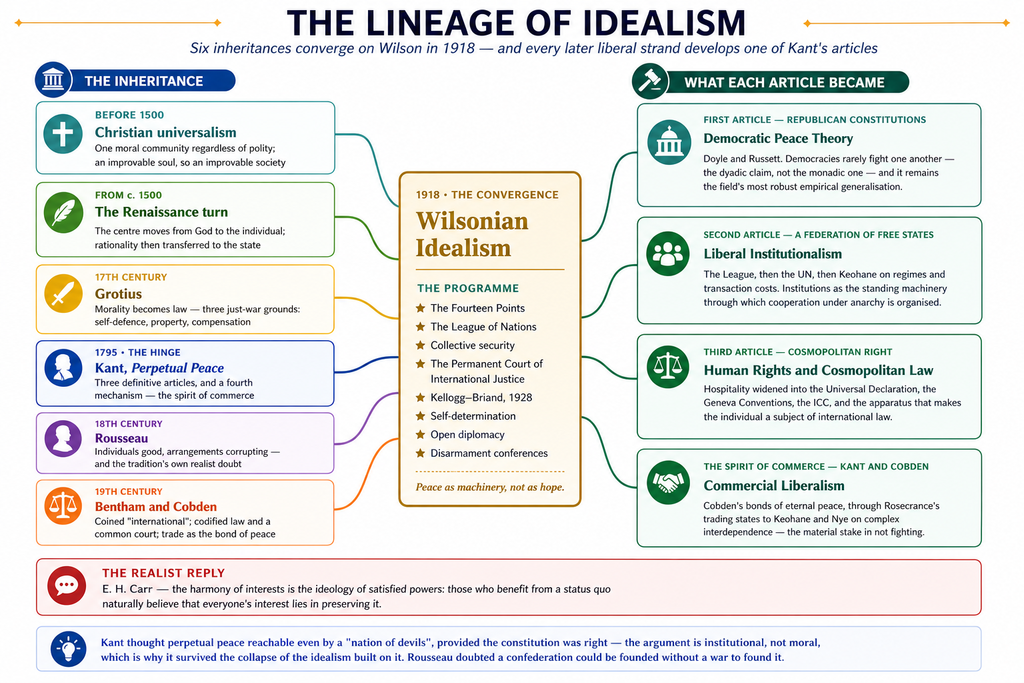
The Core Tenets of Idealism
Idealism proper crystallised out of the First World War and the conviction that the balance of power had not merely failed but had caused the catastrophe — a system of shifting alliances, secret commitments and arms competition converting a Balkan assassination into forty million casualties.
- Human nature is not fixed and is improvable through education, communication and institutions — the premise everything else stands on, and the exact point of rupture with classical realism.
- War is a remediable defect of institutions, not a permanent condition. Its causes are all fixable: misunderstanding, secret diplomacy, arms races, undemocratic government and the balance of power itself.
- There is a harmony of interests. The long-run interests of states do not fundamentally conflict; apparent conflicts arise from ignorance, bad institutions, or rulers whose interests diverge from their peoples’.
- International law and organisation can substitute for the balance of power — order from rules, adjudication and standing consultation rather than from equilibrium among powers.
- Informed public opinion is a force for peace. Peoples do not want war; they are led into it.
- Self-determination removes a principal cause of war, since multinational empires generate irredentist grievance that self-governing nations do not.
- Open diplomacy replaces secret treaties, which had converted a local crisis into a general war by pulling in parties whose obligations nobody could see.
- Democracy generalises the Kantian mechanism: accountable governments internalise the costs of war, so democratisation is itself a peace policy.
A tradition that treats war as an engineering problem must eventually be judged on whether the machinery it built actually holds.
The Idealist Programme
- Wilson’s Fourteen Points turned the tenets into a diplomatic agenda, each point mapping onto one of them.
- Open covenants openly arrived at — the attack on secret diplomacy.
- Freedom of navigation and the removal of economic barriers — the Cobdenite commercial argument.
- Reduction of armaments to the lowest point consistent with domestic safety.
- Self-determination for subject nationalities, applied mainly to the defeated European empires.
- A general association of nations guaranteeing political independence and territorial integrity to great and small states alike — collective security in a sentence.
- The League of Nations was the institutional core and collective security its operating principle: an attack on any member is treated as an attack on all, and the aggressor faces the combined weight of the system. Wilson took the idea from domestic politics, where anarchy is contained by the presence of an authority.
- The Permanent Court of International Justice, established at The Hague, supplied the adjudicative arm — disputes were to be settled by law rather than by force. Its successor is the International Court of Justice.
- The Kellogg–Briand Pact of 1928 renounced war as an instrument of national policy and was signed by more than sixty states.
- Easy to mock as a treaty that outlawed war eleven years before the largest war in history.
- Still the legal origin of the position that aggressive war is a crime, and the source of the charge of crimes against peace at Nuremberg.
- The disarmament conferences — Washington, London, and the Geneva conference that collapsed in 1934 — were the arms-control arm, and the naval treaties did briefly cap capital-ship construction.
Why the Programme Failed
The failure was not a failure of will alone. Collective security carries a structural problem that its designers never solved, and the interwar cases exposed it with unusual clarity.
- The United States never ratified the Covenant. The Senate refused, and the system’s designer and intended guarantor stayed outside it, leaving leadership to a Britain and France that were exhausted, indebted and divided.
- Manchuria, 1931. Japan seized Manchuria; the League commissioned an inquiry, published a report, declined to recognise the puppet state of Manchukuo — and Japan simply left the League. No sanction followed.
- Abyssinia, 1935. Italy invaded; the League voted economic sanctions but exempted oil, and Britain and France were simultaneously negotiating a secret partition of the territory. The gap between the machinery and the willingness to use it became public.
- The appeasement logic followed directly: with collective security discredited, the fear of communism and of another general war made accommodation of Germany and Italy look like the prudent course rather than the cowardly one.
- The structural problem still bites. Collective security requires every state to treat distant aggression as its own emergency.
- States do not reliably do this, because costs are concentrated and immediate while benefits are diffuse and deferred.
- It is a collective action problem, not a moral failing.
- The result was the return of old-style politics — protectionism, competitive alliances, rearmament — and the Second World War, out of which came realism and the discipline’s first great debate.
Carr’s Demolition of the Harmony of Interests
E. H. Carr’s The Twenty Years’ Crisis is the decisive attack, because it does not merely say the idealists were unlucky. It says they were doing something other than analysis, and that their central concept was an interest disguised as a truth.
- Utopianism mistakes aspiration for analysis. The interwar writers described the world they wished for, called the description a theory, and then read the gap between wish and world as others’ moral failure rather than as evidence against the theory.
- The harmony of interests is the ideology of satisfied powers. This is the sharpest move in the entire debate.
- Those who benefit from an existing distribution come to believe that everyone’s interest lies in preserving it, and they believe it sincerely — Carr is explicit that the doctrine is not cynical.
- Britain and France, holding the territory, the colonies and the seats, could describe the status quo as the common good of mankind without noticing it was also their own.
- For a dissatisfied power the same order is not harmony but subordination, and a doctrine forbidding revision freezes an advantage.
- International law inherits the bias. Law codifies the settlement that existed when it was made, so peaceful change has no procedure and the only route to revision is the one law forbids.
- Carr’s positive point is that a durable order must combine power and morality — utopia without power is impotent, power without utopia is naked coercion. He is not a pure realist.
“The doctrine of the harmony of interests thus serves as an ingenious moral device invoked, in perfect sincerity, by privileged groups in order to justify and maintain their dominant position.” — E. H. Carr
- The critique is permanent, not historical. Every subsequent claim that a particular institutional order is in everybody’s interest — the trading system, the non-proliferation regime, the rules-based order — invites the same question: satisfied for whom?
The Contemporary Relevance of Idealism
The tradition’s residue is not a memory. Almost the entire normative and institutional architecture that states now argue inside is idealist in lineage, including the parts realists use. The honest assessment has two halves, and giving only one of them is what makes the assessment worthless.
What survived, and why
- The United Nations is the League rebuilt with the flaw acknowledged — collective security survives in Chapter VII, but the veto was written in because the designers accepted that enforcement without great-power consent is fiction.
- The prohibition on force in Article 2(4) is Kellogg–Briand in binding form, and it changed the vocabulary of conquest: states that seize territory now deny having done so, which is itself evidence the norm constrains.
- The international human rights regime — the Universal Declaration, the two Covenants, the treaty bodies — universalises Kant’s cosmopolitan right far beyond hospitality.
- The International Criminal Court and the ad hoc tribunals make individual criminal responsibility permanent, which is Nuremberg institutionalised.
- International humanitarian law, the Geneva Conventions and their Protocols, is the Grotian jus in bello codified and near-universally ratified.
- Arms control from the Non-Proliferation Treaty to the Chemical Weapons Convention descends from the interwar disarmament effort and, unlike it, has produced verified reductions.
- Climate agreements are the newest layer: the Paris architecture of pledges, transparency and peer review is a liberal-institutional design built on information and reputation rather than sanction.
- Democratic peace theory is the field’s most robust empirical generalisation, and it is Kant’s first definitive article recovered as a testable proposition.
- Neoliberal institutionalism is idealism rebuilt on realist foundations — the same conclusions about cooperation, reached without any assumption of human perfectibility.
- Constructivism rebuilt the idealist insight on firmer ground, showing that norms and identities constitute interests rather than merely restraining them.
The honest qualification
- The collective-security record remains poor. Korea in 1950 and the 1991 Gulf coalition are the cases usually cited, and both worked because a great power’s own interest aligned with the collective one.
- The Security Council veto encodes power rather than law. The permanent five are the victors of 1945, and no case involving a permanent member or its client can reach enforcement.
- Enforcement is selective enough to be a standing charge against the edifice — the same conduct draws referral in one case and silence in another.
- The institutional layer is visibly strained. The WTO Appellate Body has been unstaffed since December 2019, leaving binding dispute settlement inoperative; MC14 at Yaoundé closed without a ministerial declaration on 30 March 2026; and the e-commerce moratorium in place since 1998 lapsed that same day, its first lapse ever.
- Great powers still evade constraint when they choose to. Where a court blocks an instrument, another instrument is found — the protection survives even when the legal authority for it does not.
| The idealist claim | The institutional residue | The qualification |
|---|---|---|
| Aggression can be made illegal | Article 2(4), Nuremberg, the ICC’s crime of aggression | Conquest is denied rather than abandoned; enforcement reaches the weak |
| Adjudication can replace force | PCIJ, ICJ, WTO dispute settlement, ITLOS | Compulsory jurisdiction is thin; the WTO’s appellate tier has not functioned since 2019 |
| Collective security can replace balancing | UN Charter Chapter VII | Works only where a great power’s interest coincides; the veto exempts the strongest |
| Informed opinion restrains governments | Free press, transparency norms, treaty reporting | Information environments are now contested terrain |
| Self-determination removes a cause of war | Decolonisation, near-universal UN membership | Applied selectively; secession claims inside states are unresolved |
| Law can govern the commons | Ozone regime, Law of the Sea, Paris Agreement | Compliance is pledge-based; large emitters face no enforceable ceiling |
- The fair verdict is that idealism is a persistent aspiration with real institutional residue rather than a description of how the system works. Its institutions did not abolish power politics; they changed the currency in which it has to be justified.
- Continuing relevance in peace-building is the most contested part of the claim.
- Post-Cold War liberal peacebuilding — elections, market reform, rule-of-law programming in post-conflict states — applied the idealist programme to societies rather than to the system.
- Oliver Richmond argues the praxis has exhausted itself: tied to neoliberal economics and militarised intervention, it produced a thin liberal peace that stabilised order without delivering justice, and its failure has enabled an authoritarian international order built on force and sovereignty — with neither able to produce sustainable peace.
- The surviving residue is real: mediation, preventive diplomacy, peacekeeping, transitional justice and truth commissions work where the parties want a settlement.
Liberalism as a Tradition
John Locke is conventionally the first liberal, and his contribution to the international argument is indirect but foundational: he saw great potential for human progress in modern civil society and a capitalist economy, and he made government’s legitimacy conditional on consent and the protection of rights. Liberals hold that the period since the late seventeenth century is a historical watershed, in which a multifaceted process of modernisation opened up the possibility of dramatic improvement in both the moral character and the material wellbeing of humankind.
The three stages of liberal theory
| Stage | Period | Centre of the argument | Diagnosis of war | Prescription |
|---|---|---|---|---|
| Liberal internationalism | Enlightenment to 1914 | The individual | The state itself; its interference generates the occasions for war | Less state; free trade; free movement |
| Liberal idealism | After 1914 | The state and the states system | The unjust balance of power and the denial of nationhood | Equality of states; self-determination; open diplomacy; an association of nations |
| Liberal institutionalism | Contemporary | Institutions of world governance | No machinery for communication, information and credible commitment | Institutions giving states a platform to negotiate and bind themselves |
- The first shift is the crucial one. Before 1914 liberals believed individual freedom sufficient; the war taught them that individual freedom was not enough and that something had to be done about the state and the system it inhabits.
- The second shift is a shift in ambition. Idealists tried to abolish power politics; institutionalists try to channel it, which is why the third stage survived the failure of the second.
The underlying assumptions of the liberal approach
- Individuals are the primary actors, and all progress is measured in terms of individual interests, the two being treated as inextricably intertwined.
- This does not marginalise the state: states remain the most important collective actors of the present era.
- But they are pluralistic actors whose interests and policies are set by bargaining among groups — parties, firms, bureaucracies, unions — rather than by an objective national interest.
- State interests are dynamic, not static, changing as individual values change and as power relations among interest groups evolve.
- The idea traces to Locke, Rousseau and Kant, and it is the deepest break with realism, which treats interest defined as power as a fixed compass.
- Survival and autonomy matter but are secondary to the primary interests of individuals.
- Interests are shaped by domestic and international conditions together.
- Domestically: the nature of the economic and political system, patterns of economic interaction, and personal values.
- Internationally: technological capabilities, patterns of interaction and interdependence, transnational sociological patterns, knowledge, and international institutions.
- States are therefore embedded entities — in their own societies and in the system simultaneously — and any theory that reads policy off structure alone loses half the causation.
- Mutual interests can sustain cooperation without a hegemon. Realists hold that a dominant power is a prerequisite for cooperation, because someone must pay for the order and enforce it.
- Liberals answer that cooperation can be achieved through non-coercive bargaining grounded in the identification of shared interests.
- This is the direct challenge to hegemonic stability theory, and the empirical question behind it — whether the trading order survives American retrenchment — is being tested now.
- Liberals are uncomfortable with the realist picture of anarchy as a simple absence of authority. Given the density of the institutional network, they hold it naive to leave institutions out of the conception of the system altogether.
Liberal Institutionalism
Liberal institutionalism took Wilson’s insight and detached it from his optimism. Its claim is narrow and defensible: international institutions and regimes promote cooperation between states, not by transcending anarchy but by changing what self-interested states can achieve within it.
What institutions and regimes are
- Keohane’s definition is deliberately broad: institutions include organisations, bureaucratic agencies, treaties and agreements, and informal practices that states accept as binding.
- More generally they are persistent and connected sets of rules and practices that prescribe roles, constrain activity and shape expectations.
- Regimes are social institutions based on agreed rules, norms, principles and decision-making procedures, governing state and non-state actors within an issue area.
- A regime needs no building and no secretariat: the global coffee market is governed by treaties, protocols and the interests of producers, consumers and distributors together.
The advantages of building institutions
- A platform for interaction and communication, which is how trust is built where none exists.
- Peaceful settlement of disputes, by supplying a procedure available before force is.
- Commitments become costly to abandon — exit from an international obligation carries reputational cost under the pressure of world opinion.
- Contemporary scholarship sustains the case: Keohane and Nye argue for institution-building on grounds that make no appeal to human goodness at all.
How institutions actually work
- They reduce transaction costs. A standing forum, an agreed procedure and a legal template make each new bargain cheaper than the last.
- They supply information. The core obstacle is not malice but uncertainty about what others will do; monitoring and verification convert private information into public knowledge and make cheating detectable.
- They lengthen the shadow of the future. Turning a one-off encounter into an indefinitely repeated one makes today’s defection costly tomorrow — changing the calculation without changing the actors.
- They reduce the fear of non-compliance, which neo-liberals identify as the biggest single obstacle to cooperation and which follows from sovereignty itself.
- They attract loyalty over time, as states shift resources to institutions once these are seen as mutually beneficial.
The limits, and the realist reply
- Realists hold institutions to be epiphenomenal — extensions of state power, built by states guided by national interest, making no qualitative difference to what states do. They are theatre stages on which the power play unfolds, and the play was written by the states.
- Joseph Nogee’s work on disarmament diplomacy names the pathology: states join negotiations they do not believe in because the cost of being seen as a spoiler exceeds the cost of attending. Presence is not commitment.
- Representativeness, transparency and accountability deficits give the institutions their own crisis of credibility — Security Council composition, Bretton Woods voting weights, the leadership conventions of the Fund and the Bank.
- The arms race continues despite the density of institutions.
- Cooperation is hardest where it is most needed — neo-liberals concede that where one side’s gain is read as another’s loss, in military and security areas, it is far harder to construct.
Hedley Bull and the English School: the Anarchical Society
Hedley Bull supplies the concept that resolves the argument’s central tension. In The Anarchical Society he accepts the realist premise — there is no government above states — and denies the realist inference that what follows is a war of all against all.
- An international system exists wherever states have enough contact and impact on each other’s calculations to behave as parts of a whole; it requires nothing but interaction.
- An international society exists where states, conscious of common interests and values, conceive themselves bound by a common set of rules and share in the working of common institutions.
- Anarchy has been converted into an anarchical society by the growth of institutions, law and regimes: international politics is neither a complete society nor a complete anarchy, and the in-between is where almost all of it happens.
- The institutions of international society, in Bull’s sense, are practices rather than organisations, and this is the distinctive English School claim.
- The balance of power — not the opposite of order but one of its instruments, preventing any single state from imposing universal empire.
- International law — supplying the rules that make expectations mutual.
- Diplomacy — the machinery of communication and mutual accommodation.
- War — paradoxically an institution, because it is rule-governed, limited and used as an instrument of enforcement and change.
- The great powers — whose managerial role in the system is an institution in itself.
- Order and justice pull against each other, and Bull refuses to collapse the tension: order is prior because nothing else is possible without it, yet an order delivering no justice will not command allegiance from those it disadvantages.
- The English School is a via media, taking seriously both the absence of world government and the reality of shared norms, and identifying three traditions in international thought — Hobbesian or realist, Grotian or rationalist, Kantian or revolutionist — of which it takes the middle.
- Its critique of realism is that realism is one-dimensional: it overlooks the cooperative strain in human nature, understates how far law governs relations between states, and misses the plurality of actors in world politics.
Anarchy is a description of the absence of world government, not a prediction about how states behave in its absence.
Sociological Liberalism and Communications Theory
Where institutionalists study relations between governments, sociological liberals study relations between societies — people, groups and organisations in different countries. Their wager is that the political class has its own vested interests, and that interaction between peoples addresses a trust deficit official channels cannot.
| Track one diplomacy | Track two diplomacy | |
|---|---|---|
| Who participates | Diplomats, heads of state, formal representatives | Academics, retired officials, journalists, civil society |
| What it produces | Treaties, official settlements, formal peace talks | Trust, new framings, unofficial channels |
| Constraint | Bound by public positions and domestic politics | Deniable, exploratory, free of political cost |
| Weakness | Freezes when relations break down | Cannot bind anyone |
| Studied by | Realists and liberal institutionalists | Sociological liberals |
- Transnationalism is the organising concept. James Rosenau defines it as the processes whereby international relations conducted by governments have been supplemented by relations among private individuals, groups and societies that have important consequences for events.
- Individuals have extended their reach through education, electronic communication and travel, while states’ capacity for control declines — including a considerable decline in their ability to keep surveillance on their own borders.
- The result is a world of better-informed, more mobile individuals far less tied than before to “their” states.
- Policy follows directly: open borders, visa liberalisation, student and scientific exchange and people-to-people contact become instruments of foreign policy rather than ornaments to it.
- John Burton’s cobweb model belongs here: a nation-state contains many groups with different external ties — religious, business, labour — so the picture is criss-crossing threads rather than colliding spheres, and cross-cutting memberships dampen conflict.
Karl Deutsch and the measurement of transactions
- Karl Deutsch turned the intuition into a research programme by measuring it, which is why the strand is also called the communications approach.
- He tracked international transactions: trade, tourists and travel, letters and telephone calls, visas issued, migration.
- His finding was that a high degree of transnational ties produces peaceful relations amounting to more than the mere absence of war — Western Europe internally, and Western Europe with North America, were his cases.
- Security communities are the endpoint, and the liberal alternative to the security dilemma.
- A security community is a group that has become integrated: a sense of community has been achieved and members agree that their conflicts and problems can be resolved, in Deutsch’s phrase, “without resort to large-scale physical force”.
- Members do not consider each other a threat; where threat exists it lies outside the perimeter, which is what makes the community cohere.
- The idea is borrowed from domestic politics — a nation-state is itself a security community, to be replicated regionally and then more widely.
| Amalgamated security community | Pluralistic security community | |
|---|---|---|
| Political form | Formal merger into a single unit with central authority | Separate sovereign states, no central authority |
| Example | The United States, whose federal structure exercises central control over a continent-sized region | North America and Western Europe; the trans-Atlantic case |
| Requirement | Constitutional fusion | Dependable expectations of peaceful change; unfortified borders |
- Both types are defined by the absence of intra-community war, and integration is both the process toward that condition and its end product.
- Adler and Barnett revived the concept, reframing security communities as socially constructed rather than merely transactional: shared identity, mutual trust and dependable expectations of peaceful change do the work, and communities pass through nascent, ascendant and mature phases. This is where sociological liberalism hands over to constructivism.
- The EU is the mature case; ASEAN is the standard candidate, having built dense consultative habits without any transfer of sovereignty.
- The negative finding matters as much. Many third-world states have not become security communities even domestically — where a state cannot generate dependable expectations of non-violence inside its own borders, the regional version has nothing to build on. This is where the strand’s Eurocentrism shows most clearly.
Functionalism as a Strand of the Family
- Functionalism holds that cooperation in technical, non-political sectors — health, transport, communications, standards — builds habits of collaboration that create interdependence and gradually make war irrational. Its slogan is peace by pieces and its mechanism is spillover, cooperation in one area opening avenues in others.
- Neo-functionalism concedes that technical matters cannot be separated from politics, so integration requires self-interested political elites to be brought in rather than kept out, and focuses on formal institutions and regional integration.
Interdependence Liberalism
The interdependence strand makes a materialist argument in a liberal register: not that states have become nicer, but that the cost-benefit ratio of force has moved decisively against it for the kind of state that now dominates the world economy.
- Richard Rosecrance draws the founding contrast between the military-political state and the trading state.
- Historically states sought power through military force and territorial expansion; for industrialised economies, economic development and foreign trade are cheaper and more effective routes to prominence.
- The costs of force have risen and its benefits fallen, because wealth now resides in skills, technology and market access rather than in seizable territory.
- Japan and Germany are the cases: both became trading states after 1945 and hold considerable weight in world affairs without commensurate armed force. The end of the Cold War made the military-political option less urgent even for very large states.
- The USSR is the negative case. It pursued the militaristic path, overstretched itself, and the cost of sustaining that posture contributed directly to its collapse.
- The argument extends to the United States, whose own military overstretch is among the reasons advanced for the relative decline of its primacy.
- China is the open question. For decades it limited itself to the trading-state model; naval expansion, territorial assertion and coercive economic statecraft suggest a crossing back toward the military-political type, which Rosecrance’s framework says should be costly.
- The strand challenges the realist premise of self-reliance — what happens in one economy affects others directly, so cooperation is necessary and harming a partner damages oneself. Because it grounds peace in market integration it is a neo-liberal argument rather than a classically idealist one: it appeals to interest, not virtue.
The Golden Arches theory and its falsification
- Thomas Friedman’s Golden Arches theory proposed that no two countries with McDonald’s franchises had gone to war with each other — a population prosperous enough to queue for burgers would rather queue than fight.
- The theory has been falsified. The 2008 Russia–Georgia war supplied the first clear counter-example and Russia’s 2022 invasion of Ukraine settled it, after which McDonald’s exited Russia entirely.
- Friedman’s own revision was the Dell Theory of Conflict Prevention, shifting the claim from consumer franchises to integration into global supply chains: states in just-in-time production networks have far more to lose than states merely hosting retail brands.
- The Dell Theory is better and still not a law. Supply-chain integration raises the cost of war without making it impossible, and the post-2022 scramble to de-risk shows states willing to pay that cost when the stake looks existential.
Democratic Peace Theory
Also called republican liberalism, this is Kant’s first definitive article turned into a testable proposition, and the closest thing the discipline has to an empirical law. Michael Doyle gave it its systematic modern statement; Bruce Russett supplied the quantitative testing.
- Doyle’s four-dimensional definition of a liberal state fixes what is being claimed about.
- Citizens juridically equal, with basic rights including education, a free press and religious toleration.
- A legislature holding only the authority the people invest in it.
- A right to own property, including the means of production.
- An economy in which allocation is driven by market forces of supply and demand rather than by bureaucratic direction.
- The zone of peace, or pacific union, is the core finding — not a formal arrangement but an informal region within which liberal democracies have simply not fought each other.
The distinction that decides the argument
| Form of the claim | What it asserts | Empirical standing |
|---|---|---|
| Monadic | Democracies are more peaceful toward all states | Not supported. Democracies have gone to war roughly as often as non-democracies |
| Dyadic | Democracies are more peaceful toward each other | Strongly supported — the robust finding, and the only one the theory needs |
| Systemic | The more democracies there are, the more peaceful the region or system | Weaker and contested; depends on how the boundary of the system is drawn |
- The dyadic form is the theory. Confusing it with the monadic form collapses the argument, because the monadic claim is straightforwardly false and the dyadic claim survives testing.
- Sorensen’s extension is that as the number of democracies grows, the prospects of a more peaceful world brighten and relations come to be characterised by cooperation rather than conflict — the systemic hope built on the dyadic finding.
The four mechanisms
- Norms of peaceful conflict resolution. Democracies practise dialogue and compromise at home and externalise the habit; citizens who control their governments are generally against waging war on other democracies.
- Shared liberal values. Common moral and political foundations generate mutual recognition as legitimate — a state whose claims deserve a hearing rather than a threat to be pre-empted.
- Public opinion and accountability. Leaders must justify war to those who pay for it, and free speech permits foreign policy to be criticised and corrected before it hardens.
- Economic interdependence. Commerce between democracies raises the cost of conflict — Kant’s spirit of commerce, producing reciprocal gain and rendering war obsolete within the pacific union.
The criticisms
- Coincidence. The absence of war between two democracies may be chance, given how few democratic dyads existed before 1945 and how many were on the same side of the Cold War.
- Confounding. Alliance, shared threat, American security guarantees, wealth and geography all correlate with democracy, and any could carry the explanation.
- The definitional problem. The finding depends on what counts as a democracy and what counts as a war; move the franchise or battle-deaths threshold and cases enter and leave the dataset.
- Selection effects. States may become democracies because they are already secure, rather than becoming secure because they are democracies.
- Democracy at gunpoint. The theory supplied cover for the Bush doctrine and for regime change presented as peace policy. Doyle himself noted that the ideologies keeping liberal states at peace with each other inspire idealistic wars against the illiberal.
- The view from Moscow and Beijing. Democracy promotion is read as regime change and the installation of clients, converting a peace theory into a security threat and producing the balancing it was meant to dissolve.
- The neo-realist reply: a liberal state can revert to authoritarianism and today’s friend may be tomorrow’s enemy, so building policy on the finding is imprudent even if it holds.
- The critical reply, from Barkawi and Laffey, is that the theory brackets out the colonial wars and coercive interventions liberal states conducted against non-liberal societies, measuring peace on a domain chosen to produce it.
- Kargil, 1999 is the hard case: India and Pakistan, both under elected governments, fought a limited war. Defenders reply that Pakistan’s democracy was shallow and its army autonomous — rescuing the theory only by conceding the definitional objection.
Democratic backsliding as the live problem
- The empirical core survives but the set it applies to is shrinking. V-Dem’s 2026 findings record nearly a quarter of the world’s states autocratising, six of the ten newly identified cases in Europe and North America, and freedom of expression the most drastically declining component worldwide.
- The unprecedented case is the United States, whose liberal democracy score fell sharply within a single year and whose ranking dropped from twentieth to fifty-first among 179 states.
- The theoretical consequence is uncomfortable. If democracy is a matter of degree and degrees are reversible, the pacific union has no stable membership list, and a theory with an unstable domain cannot predict reliably.
Complex Interdependence
Keohane and Nye formulated complex interdependence in the 1970s, and its most distinctive feature is easily lost: unlike the rest of the liberal family it is descriptive rather than prescriptive. It does not tell states what to do; it claims that under specified conditions world politics has come to work in a way realist assumptions describe badly.
- It is not simple interdependence. In earlier, simpler forms of mutual dependence, force remained available when conflict arose; complex interdependence names the condition where that option has lost its utility within the relationship.
- Interdependence is not harmony. States can be deeply interdependent and still in conflict — the condition forces cooperation without resolving disputes, compelling close dealings with a party one might otherwise keep at a distance.
The three characteristics
- Multiple channels connect societies, and the model names three.
- Interstate — the formal foreign-office relations realists assume are the whole of it.
- Transgovernmental — direct ties between agencies across borders, visible once we drop the assumption that states act as coherent units.
- Transnational — banks, corporations, NGOs and elite networks, visible once we drop the assumption that states are the only units.
- There is no hierarchy of issues. Military security does not consistently dominate; many issues arise from what used to be domestic policy, the domestic-foreign line blurs, several departments handle each issue at several levels, and poor coordination carries real cost.
- Military force is not used within the relationship, though it may matter with governments outside the region or on other issues — irrelevant to an economic dispute among allies, central to that alliance’s posture toward a rival bloc.
“Different issues generate different coalitions, both within governments and across them, and involve different degrees of conflict. Politics does not stop at the water’s edge.” — Robert Keohane and Joseph Nye
| Realism | Complex interdependence | |
|---|---|---|
| Goals of actors | Military security is the dominant goal | Goals vary by issue area; transgovernmental politics makes goals hard to define; transnational actors pursue their own |
| Instruments of policy | Military force most effective, economic instruments secondary | Power resources specific to each issue area; manipulation of interdependence, international organisations and transnational actors |
| Agenda formation | Set by shifts in the balance of power and by security threats | Set by changes in the distribution of resources within issue areas, the status of regimes, the rise of transnational actors, linkage and politicisation |
| Linkage of issues | Linkage by strong states reduces differences across issue areas and reinforces hierarchy | Linkage by strong states is harder since force is ineffective; linkage by weak states through organisations erodes hierarchy |
| Role of international organisations | Minor, limited by state power and the importance of force | Set agendas, induce coalition-formation, act as arenas for weak states; choosing the forum and mobilising votes becomes a political resource |
Sensitivity, vulnerability and asymmetry
- Sensitivity interdependence measures how fast and how costly the effects of an external change are felt within the existing policy framework — how much it hurts before you can adjust.
- Vulnerability interdependence measures the cost of the available alternatives after adjustment — how much it still hurts once you have done everything you can.
- Vulnerability is the real measure of power. A state can be highly sensitive and barely vulnerable if substitutes exist: an importer with diversified suppliers survives a price shock; one with a single supplier does not.
- Asymmetric interdependence is a power resource — the less dependent party holds bargaining leverage over the more dependent one, so interdependence describes not the absence of power politics but a different currency for it.
- Energy leverage, export controls, financial-system access and supply-chain chokepoints are vulnerability asymmetries used as instruments — evidence that interdependence has been weaponised rather than transcended.
Neo-Liberal Institutionalism and the Neo-Neo Debate
Neo-liberalism is the form in which liberalism became a rival to neo-realism rather than its opposite. Its distinguishing feature is a declining confidence in progress: post-war liberal scholars kept most traditional liberal beliefs but abandoned the optimism, having watched two world wars and a Cold War, and preferring, in the ethos of contemporary social science, to explain rather than to predict. They did not want to be branded idealists, and “neo” marks the distance.
- The decisive move is to concede the realist premises and still reach a different conclusion, which is what makes this a genuine debate rather than two theories talking past each other.
| Premise | Neo-realism | Neo-liberal institutionalism |
|---|---|---|
| Is the system anarchic? | Yes | Yes — conceded |
| Are states the central actors? | Yes, and effectively the only ones | Yes, but not the only significant ones |
| Are states self-interested? | Yes | Yes — conceded |
| Are states rational utility-maximisers? | Yes | Yes — conceded |
| What kind of gains do states pursue? | Relative gains — how much I gain compared with you | Absolute gains — whether I am better off than before |
| What blocks cooperation? | The structure itself, and the fear of relative loss | Fear of cheating and non-compliance, which is an information problem |
| Can institutions matter independently? | No — epiphenomenal, extensions of state power | Yes — they change information, costs and expectations |
| Prospect for cooperation | Thin and fragile | Real, durable, and observable |
- Absolute versus relative gains is the crux. If a bargain leaves both parties better off but one better off than the other, the neo-liberal says take it and the neo-realist says think again.
- Joseph Grieco argues relative gains are the fundamental obstacle: in anarchy today’s economic advantage becomes tomorrow’s military capability, so a partner who gains more becomes a more dangerous partner.
- Mearsheimer extends the point — institutions reflect the distribution of power and have no independent effect on the prospects for peace.
- Keohane answers that relative-gains concerns are real but bounded: they bite in security relationships, between rivals, and where gains convert into force, and matter far less across the economic and regulatory issues where most cooperation happens.
- Axelrod’s iterated prisoner’s dilemma supplies the formal foundation.
- In a single prisoner’s dilemma defection is individually rational and both parties end worse off — realist anarchy in miniature.
- Iterate the game and cooperation becomes rational, because defection today is punished tomorrow.
- Tit-for-tat — cooperate first, then do whatever the other did last — won Axelrod’s tournaments by being nice, retaliatory, forgiving and clear.
- Everything depends on the shadow of the future: cooperation emerges when actors expect indefinite interaction and value future payoffs. Institutions matter because they lengthen that shadow and make behaviour observable.
- Arthur Stein and Kenneth Oye set out the conditions for cooperation under anarchy.
- Stein distinguishes dilemmas of common interests from dilemmas of common aversions.
- Oye identifies payoff structure, the shadow of the future and the number of players as the decisive variables — each something institutions can engineer.
- Did neo-liberalism lighten neo-realism’s dark view? Yes, but by a specific route.
- Not by denying anarchy, self-help or self-interest — it accepted all three.
- By showing that the same assumptions, iterated and informed, generate cooperation rather than perpetual conflict: the difference lies in the environment, not the actors.
- The residual disagreement is narrow: whether states fear being cheated (neo-liberal) or being outgained (neo-realist), and whether institutions cause anything or merely register what power has decided.
- This convergence is the third great debate, and its narrowness is why constructivists and critical theorists could later dismiss both positions as a single rationalist orthodoxy disagreeing only about parameters.
Neo-liberalism did not refute realism’s premises; it showed that realism’s own premises, repeated over time, do not license realism’s conclusion.
Two senses of “neo-liberalism”
| Academic sense | Policy sense | |
|---|---|---|
| What it names | Neo-liberal institutionalism, or institutional theory in IR | Free markets, deregulation, privatisation, the Washington Consensus |
| Core claim | Institutions enable cooperation among rational egoists under anarchy | Market allocation outperforms state allocation |
| Associated with | Keohane, Nye, Axelrod, Stein, Oye | Structural adjustment and 1980s–90s conditionality |
- The two are unrelated, and conflating them is the standard error — treating an institutional theory of cooperation as a defence of privatisation, or reading a critique of structural adjustment as a refutation of regime theory.
- A third, looser usage appears in foreign policy: promoting free trade, open markets and Western democratic values, on the confidence that the institutions created after 1945 have stood the test of time.
Critiques of the Liberal Approach
The realist critique
- Human nature is the original quarrel, though both sides quietly retired it: neo-realists and liberals alike accepted that human nature is complex, and the behavioural turn moved the discipline from internal moral qualities toward observable data.
- Institutions are stages, not actors — states cooperate through them on their own decision and self-interest, and the strong prevail.
- Regime type is unreliable. A democracy can revert to authoritarianism, and today’s friend may be tomorrow’s enemy whether or not it holds elections.
- The harmony of interests is an ideology, per Carr — and the modern charge is that the “rules-based order” is one distribution of advantage described as the common good.
- Liberals under-weight the security dilemma. Where survival is at stake, the incentive to defect is not an information problem transparency can fix.
The Marxist critique
- Liberalism mistakes the superstructure for the structure. The primary units are classes and the primary structure is the world capitalist economy; interstate bargaining is the surface of a system whose motor is accumulation.
- The liberal international economic order is not neutral — it distributes gains toward those who wrote its rules, and free trade between unequally developed economies reproduces inequality rather than eroding it.
- Interdependence is a euphemism for dependency: asymmetric integration transferring surplus from periphery to core.
- Cox puts it most sharply — theory is always for someone and for some purpose, and liberal institutionalism is problem-solving theory that takes the existing order as given and makes it work better.
The post-colonial critique and the Eurocentrism charge
- The charge is that liberal international theory universalises a European historical experience — the sovereign state, the market, the rights-bearing individual — and measures everyone else against it as deviation.
- The standard-of-civilisation history is the evidence: nineteenth-century international law admitted states to the “family of nations” only on meeting a European standard, and non-European polities were governed by capitulations, protectorates and mandates because they were held to fall short.
- Liberal internationalism was entangled with empire. The mandate system placed colonies under trusteeship until they could “stand alone” — a liberal developmental logic supplying a fresh justification for continued rule, and several canonical liberals defended empire as tutelage.
- Humanitarian intervention reproduces the structure: the authority to judge when sovereignty may be overridden has rested with the same states, and the cases have run in one direction.
- But Eurocentric is not the same as imperialist, and the distinction is where the serious scholarship now sits.
- Hall and Hobson argue that classical liberalism was Eurocentric without uniformly producing pro-imperialist positions, identifying four variants of a polymorphous Eurocentrism, two supporting empire and two opposing it.
- Liberalism therefore had a protean career, crystallising into imperialist or anti-imperialist forms depending on which variant it was embedded in — Cobdenite free-traders and Bentham opposed colonies on liberal grounds, if not from any commitment to cultural pluralism.
- The corollary also cuts at post-colonial theory: treating Eurocentrism as monolithic flattens a record containing genuine internal opposition.
- The strongest counter-case is what anti-colonial movements did. Self-determination, sovereign equality and human rights were claimed and radically extended by the colonised against their rulers — Bandung and non-alignment used liberal universalism as a weapon precisely because its authors could not disown it without abandoning their own principle.
- The honest position is that liberal international theory is Eurocentric in origin, that this Eurocentrism was frequently but not necessarily imperialist, and that its universalist core proved appropriable by those it had excluded.
The Indian Anchor
India is the longest-running test of whether a state can be liberal-internationalist in its declared principles and realist in its conduct without the two cancelling out.
- Nehru’s internationalism was a liberal-internationalist position stated by a state just out of colonial rule, which is why it carried moral weight the European versions lacked.
- He committed India to the United Nations when a newly independent state had every realist reason to stay unencumbered.
- Panchsheel, agreed with China in 1954 — mutual respect for sovereignty and territorial integrity, mutual non-aggression, non-interference, equality and mutual benefit, peaceful coexistence — is a compact statement of the creed: sovereign equality, law over force, ordered coexistence between different systems.
- 1962 is the standing objection. Panchsheel did not survive contact with the border, and it remains the most-cited Indian evidence that declared norms do not restrain a state that has decided otherwise.
- Institutional engagement is the clearest liberal element of Indian practice.
- India is among the largest cumulative contributors to UN peacekeeping, with over 290,000 personnel across some fifty missions, including where no Indian interest was engaged.
- It is an active and often obstructive participant in the WTO, using dispute settlement, special and differential treatment and coalition-building — treating the institution as consequential rather than epiphenomenal.
- It ratified the Paris Agreement and presses its equity and finance arguments inside the regime rather than outside it.
- India as an institution-builder is the more interesting datum, since building is a costlier signal than joining.
- The International Solar Alliance, launched with France in 2015 and treaty-based since 2017, spans around 125 member countries and is the first such body headquartered in India.
- The Coalition for Disaster Resilient Infrastructure, announced in 2019, has grown to 58 member countries and 12 partner organisations.
- Both are functional, issue-specific and low-politics — exactly what the liberal-institutionalist argument predicts of a rising state seeking standing without confrontation.
- Interdependence liberalism in practice, and its limit.
- India has concluded five trade agreements since 2022: the UAE and Australia in 2022, EFTA in force from October 2025, the UK agreement in force from 15 July 2026, and the European Union agreement concluded on 27 January 2026.
- Against that stands the exit from RCEP in 2019, on the judgment that asymmetric exposure to Chinese manufacturing was a vulnerability rather than an interdependence.
- The pattern is a state choosing its interdependencies by partner — Keohane and Nye’s vulnerability argument applied deliberately as policy.
- The tension between rhetoric and practice should be stated plainly.
- India argues for multilateralism while pursuing strategic autonomy and multi-alignment: Quad membership without alliance, simultaneous SCO and BRICS participation, Russian defence and energy ties alongside a deepening American partnership.
- It stays outside the NPT and the ICC, and treats sovereignty as near-absolute on questions touching its own territory.
- Realists read this as hedging; liberals as selective institutional engagement; constructivists as identity continuity from non-alignment. The liberal reading is not the weakest, because India’s institutional investments are real and expensive.
- South Asia is where the liberal argument runs out. Dense societal ties, shared language and a common commercial history have not produced a security community, and high interaction does not breed peace where the political dispute is prior to the interaction.
Assessment
The liberal tradition has been declared dead after every major war and has outlived each obituary, because its institutional deposits survive the failure of its predictions. Its weakness is a persistent tendency to mistake what ought to be for what is; its strength is that a great deal of what ought to be has, over two centuries, actually been built.
Previous Year Questions
- Neo-liberalism lightened neo-realism’s dark view of international politics. Comment. (2025)
- Explain the various facets of the idealist approach to the study of international relations. Comment on its contemporary relevance. (2024)
- What are the core assumptions of idealism as an approach to study International Relations? Explain its continuing relevance in peace building. (2020)
- Do you agree that liberal international theories are essentially ‘Eurocentric‘ and not necessarily imperialist? (150 words) (2012)
- What are the major critiques of liberal internationalism? (2009)
- “The traditional principle of sovereignty which plays a central role in the foreign policies of all states, is now increasingly counteracted by the growing facts of interdependence…” Discuss. (1995)
Syllabus unit: Approaches to the Study of International Relations
PSIR Optional study material from LotusArise IAS
Two ways to prepare with us — the full self-study system, or just the notes you need right now.
| What you get | PSIR Mains Master Kit 2027 | PSIR Complete Notes (Store) |
|---|---|---|
| Paper 1 notes — Political Theory + Indian Government and Politics | Included | Included — Section A and Section B |
| Paper 2 notes — Comparative Politics and India and the World | Included | Included — Section A and Section B |
| Topic-wise PYQ bank | 1986–2026, with trend analysis and probables by Dec 2026 | 1991–2025 question papers, free with every notes pack |
| Practice question set for timed answer writing | ✅ Available now | ❌ |
| Answer toolkit — intros, conclusions, frameworks, thinker and example banks | By Dec 2026 | ❌ |
| Revision booklets for the last 60 days | ✅ Available now | ❌ |
| Format | Online articles + PDF | PDF download |
| Access | Valid until UPSC CSE Mains 2027 | Instant download after payment |
| Price | ₹1,770 (regular ₹5,000) | ₹1,180 for all four sections · ₹599 a paper · ₹354 a section |
| Best for | Aspirants who want the whole system in one place | Aspirants who want the notes now, in the parts they need |
