

India’s founders chose the parliamentary form deliberately, not by inheritance alone. It fuses the executive into the legislature and makes a government’s survival depend on a majority it must hold every day. Seventy-five years on, the form survives intact while the practice has drifted far from the design — and that gap is what the topic is really about.
The two dominant forms of representative democracy

- Representative democracy organises itself around a single structural question: whether the executive is separate from the legislature or drawn out of it.
- The parliamentary system answers by fusion — the executive is a committee of the legislature, sits in it, and survives only while it commands its confidence.
- The presidential system answers by separation — the executive is separately elected, holds a fixed term, and neither sits in the legislature nor depends on its confidence.
The parliamentary form
- Origin in Britain, where it grew by convention out of the monarch’s need for ministers who could carry the Commons, and spread through the Commonwealth as the Westminster model.
- Its defining feature is responsible government: the ministry holds office only so long as the elected chamber does not withdraw its confidence.
- The head of state is nominal, the head of government real, and the two offices are held by different persons — a dual executive.
- Because ministers are members of the House, legislation and administration are directed by the same people, which makes for coherent policy and rapid law-making.
The presidential form
- The American model rests on the separation of powers: Congress legislates, the President executes, and neither can dismiss the other.
- The President is both head of state and head of government, directly elected in substance, and appoints a cabinet of advisers who are not legislators and who are individually answerable to him alone.
- Accountability runs through fixed-term elections, impeachment and inter-branch checks — the legislative veto, the confirmation power, the appropriations power, congressional investigation — rather than through daily questioning.
- The cost of separation is gridlock under divided government, when the presidency and the legislature are controlled by opposing parties and neither can be removed.
The semi-presidential third type
- A third family places a directly elected president with real powers alongside a prime minister who is responsible to the legislature — France, Finland, Portugal and Russia are the standard examples.
- Maurice Duverger‘s definition is the working one: a popularly elected president holding substantial constitutional powers, plus a premier and cabinet who can be removed by parliament.
- Cohabitation is the type’s characteristic stress — the president and the parliamentary majority come from opposing camps, and executive authority is split between two rival leaders. France experienced it three times between 1986 and 2002.
- The 2000 reduction of the French presidential term from seven years to five, aligning it with the National Assembly’s term, was an institutional attempt to make cohabitation rarer.
- The type spans very different realities: Finland and Portugal have drifted towards parliamentarism, while Russia’s version concentrates power in the presidency to a degree that makes the parliamentary half largely formal.
A comparison across the working dimensions
| Dimension | Parliamentary | Presidential | Semi-presidential |
|---|---|---|---|
| Executive selection | Prime Minister is leader of the majority party or coalition, appointed by the head of state; cabinet drawn from the legislature | President directly elected by the people for a fixed term; cabinet appointed by him from outside the legislature | President directly elected; Prime Minister appointed but must be acceptable to the legislature |
| Tenure and removal | No fixed tenure; falls the moment it loses a confidence vote | Fixed term; removable only by impeachment for defined offences | President fixed-term; government removable by the assembly |
| Separation vs fusion | Fusion of powers — ministers are legislators, the lines between branches are deliberately blurred | Strict separation — a serving legislator cannot hold executive office | Split executive — separation from the president, fusion with the premier |
| Legislative–executive relationship | Executive controls the legislative agenda through its majority; legislature can destroy the executive | Each branch independent and rival; the executive cannot command a legislative majority as of right | Varies with whether the president’s party holds the assembly |
| Accountability | Daily and continuous — question hour, motions, debates, the standing threat of a no-confidence vote | Periodic — elections, impeachment, committee oversight and the confirmation power | Dual and often contested between the two heads |
| Stability vs flexibility | Flexible and less stable; a government can be replaced without an election | Stable but rigid; a discredited president serves out the term | Stable presidency, unstable governments |
| Role of the opposition | Institutionalised — a Leader of the Opposition, a shadow front bench, an alternative government in waiting | Diffuse — no single opposition leader; influence runs through committees and control of a chamber | Opposition may itself hold the presidency or the premiership |
| Risk profile | Instability and defection; executive dominance of a pliant legislature | Authoritarian drift and deadlock, zero-sum politics | Cohabitation conflict and constitutional ambiguity |
- The table compares the Indian and American types in their pure form; in practice both families admit many variants, and few systems match the ideal type exactly.
Bagehot on the dignified and the efficient
- Walter Bagehot supplied the vocabulary still used to describe the parliamentary executive, dividing the constitution into a dignified part that “excites and preserves the reverence of the population” and an efficient part by which it actually works and rules.
- The monarch is dignified, the cabinet efficient — and the confusion of the two is what allows a hereditary or ceremonial figure to lend legitimacy to a government the people never directly chose.
- The “efficient secret” of the English constitution, for Bagehot, was not the separation of powers at all but their near-complete fusion.
“A cabinet is a combining committee — a hyphen which joins, a buckle which fastens, the legislative part of the State to the executive part of the State.” — Walter Bagehot
- Bagehot also catalogued the nominal head’s residual influence as three rights — to be consulted, to encourage and to warn — which is exactly the space the Indian President occupies within Article 74.
- The Indian adaptation reproduces the structure with an elected occupant of the dignified role: the President as position of dignity, the Prime Minister as the efficient centre, and the Council of Ministers as the buckle between House and government.
Why the Constituent Assembly chose the parliamentary form
The Assembly did not drift into parliamentarism. A presidential executive was proposed and argued over, and the Drafting Committee’s answer turned on a specific claim about what a newly independent, deeply unequal society most needed from its government. The reasoning matters because the same arguments are recycled every time someone proposes a switch.
Ambedkar’s argument: responsibility over stability
- B. R. Ambedkar framed the choice as a trade-off between two properties a democratic executive ought to have — stability and responsibility — and observed that no system delivers both in equal measure.
- The American system buys stability: a president cannot be dislodged for four years however discredited. The British system buys responsibility: a ministry can be dismissed on any afternoon it loses the House.
“The Draft Constitution in recommending the Parliamentary System of Executive has preferred more responsibility to more stability.” — B. R. Ambedkar
- The mechanism of that responsibility is assessment by frequency, not merely by election. A presidential executive is judged periodically; a parliamentary executive is judged continuously.
“The daily assessment of responsibility which is not available under the American system is, it is felt, far more effective than the periodic assessment and far more necessary in a country like India.” — B. R. Ambedkar
- Ambedkar’s reason for thinking daily assessment “far more necessary in a country like India” was the social structure: a society organised by graded inequality would let an insulated executive do enormous damage in four years.
Familiarity and the colonial inheritance
- The Government of India Act 1919 introduced dyarchy and a partly responsible provincial executive; the Government of India Act 1935 extended full provincial autonomy with ministries answerable to elected legislatures.
- By 1946 India had two decades of practical experience with ministers, no-confidence motions, budget votes and the conventions of collective responsibility.
- K. M. Munshi made the argument from ingrained practice: the parliamentary form was not an import to be tested but the idiom in which Indian public life already operated, from the provincial ministries of 1937 to the Interim Government itself.
“We must not forget a very important fact that during the last one hundred years Indian public life has largely drawn upon the traditions of British Constitutional Law.” — K. M. Munshi
- The administrative machinery matched the form: a secretariat system built to serve ministers, rules of business drafted for cabinet government, and a bureaucracy trained in the conventions of ministerial responsibility.
The danger of a personality cult and an irremovable executive
- The Assembly worried explicitly about hero-worship in Indian politics, which Ambedkar described as a sure road to degradation and eventual dictatorship — a single directly elected executive would institutionalise exactly that.
- A presidential executive cannot be removed between elections except by impeachment, a remedy so difficult that it is effectively unavailable; in a plural society this converts every executive failure into a four- or five-year wait.
- Only the United States has run a durable presidential democracy over a long span; across much of the post-colonial world the form supplied the constitutional shell for personal rule.
The plural executive as representation
- The parliamentary form produces a plural executive — a Prime Minister with a Council of Ministers — rather than a single officeholder in whom all executive authority vests.
- That plurality is representational: a cabinet can be composed to carry regions, religions, castes, languages and coalition partners simultaneously, which no single elected president can.
- Continuous representation follows: as the composition of the House changes, so does the composition of the executive, without waiting for a presidential term to expire.
- The form also keeps government sensitive to public expectation between elections, because ministers who must answer questions on the floor cannot ignore what the questions are about.
The counter-arguments, then and since
- Instability was the standing objection in the Assembly — a government dependent on shifting majorities could be paralysed, and the post-1967 record of state governments proved the fear was not idle.
- Fusion weakens the separation of powers: the body meant to scrutinise the executive is controlled by it, so the check is only as real as the majority’s willingness to embarrass its own leadership.
- Ministers are amateurs: cabinet posts go to those who can win seats, not to those who understand the portfolio, and the technical demands of modern government sit poorly with that.
- Party discipline hollows out the individual legislator, a defect the Tenth Schedule later made constitutional rather than merely conventional.
- Continuous electioneering — a government that can fall at any time governs with one eye on the next by-election, which is the argument now recycled in the case for simultaneous elections.
The Assembly’s choice was not that responsibility matters more than stability everywhere, but that in a society this unequal an irremovable executive is the larger risk.
Features of the Indian parliamentary system
The dual executive: nominal and real
- The President is the nominal executive in whom executive power formally vests under Article 53, exercised on the aid and advice of the Council of Ministers under Article 74(1).
- The Prime Minister is the real executive, appointed under Article 75(1) and heading a Council of Ministers that takes every substantive decision in the President’s name.
- The 42nd Amendment (1976) made ministerial advice binding in the constitutional text; the 44th Amendment (1978) allowed the President to require reconsideration once, after which the reiterated advice binds.
- Two heads exist for two reasons — continuity, since the state persists while governments come and go, and neutrality, since the head of government represents a party while the head of state must represent the nation.
- R. Venkataraman‘s image of the President as an “emergency lamp” captures the constitutional position precisely: the Prime Minister is the main switch, and the lamp lights only when the main supply fails.
Collective and individual responsibility
- Article 75(3) makes the Council of Ministers collectively responsible to the Lok Sabha — the bedrock principle, meaning the ministry stands or falls together and only the directly elected House can bring it down.
- Collective responsibility carries three practical consequences: cabinet decisions bind every minister, dissent must be expressed inside the room or by resignation, and a minister who publicly repudiates a decision must leave.
- Article 75(2) provides that ministers hold office during the pleasure of the President, which in a parliamentary system means at the Prime Minister’s discretion — the textual basis of individual responsibility.
- Individual responsibility is the weaker limb in Indian practice: ministers resign for political embarrassment far more often than for departmental failure, and the British convention of answering for one’s officials has never taken firm root.
- Article 74(2) bars any court from inquiring into what advice was tendered, which insulates the collective decision from judicial reconstruction.
The remaining structural features
- Majority-party government — the head of state must invite whoever commands a majority, so the executive is a product of the legislative arithmetic and not of a separate election.
- Political homogeneity — the ministry is normally drawn from a single party or a pre-agreed coalition, sharing an ideology and a programme, which is what makes collective responsibility workable.
- Double membership — ministers are simultaneously members of the executive and of the legislature, and Article 88 gives every minister the right to speak in either House whether or not he is a member of it.
- Leadership of the Prime Minister — leader of the House, leader of the party, chairman of the cabinet, sole channel of communication with the President under Article 78, and the person whose resignation dissolves the entire ministry.
- Dissolution of the Lok Sabha — the Prime Minister may advise dissolution before the term expires, a weapon that exists nowhere in a presidential system and which disciplines the government’s own backbenchers.
- Secrecy of procedure — cabinet deliberations are confidential, ministers take an oath of secrecy, and the confidentiality is what allows genuine argument before a united front is presented.
The instruments of accountability
| Instrument | What it does |
|---|---|
| Question Hour | The first hour of a sitting; starred questions get oral answers and supplementaries, unstarred get written answers, short-notice questions need under ten days’ notice |
| Zero Hour | An Indian innovation with no rule behind it — the period after Question Hour when members raise matters of urgent public importance without notice |
| Adjournment motion | Sets aside normal business to discuss a definite matter of urgent public importance; carries an element of censure, so it is admitted rarely and is not available in the Rajya Sabha |
| Calling attention | A member calls a minister’s attention to a matter of urgent public importance and obtains a statement — a milder Indian device combining a question with a short debate |
| No-confidence motion | Moved only in the Lok Sabha with the support of 50 members; needs no stated grounds; if carried, the entire Council of Ministers must resign |
| Censure motion | May be moved against an individual minister or the whole Council, must state the grounds, and does not compel resignation if carried |
| Cut motions | Move to reduce demands for grants — policy cut (reduce to ₹1), economy cut (a specified sum), token cut (₹100 to air a specific grievance) |
| Half-an-hour discussion | Raises a matter of sufficient public importance already answered in a question, where the answer needs elucidation on a point of fact |
- The no-confidence motion has been decisive only rarely: governments have more often fallen on confidence motions they themselves moved, as Vajpayee did in 1999 by a single vote, or resigned mid-debate, as Morarji Desai did in 1979.
How India departs from the Westminster model
India took the Westminster form and altered it in ways that are frequently overlooked, and the alterations are not incidental — several of them go to the character of the system.
| Feature | Britain | India |
|---|---|---|
| Constitutional form | Uncodified; no distinction between constitutional and ordinary law | Written and supreme; the Constitution is the test of validity |
| Sovereignty | Parliamentary sovereignty in Dicey’s sense | Constitutional supremacy with judicial review under Articles 13, 32 and 226 |
| Head of state | Hereditary monarch, irremovable, immune | Elected President for five years, impeachable for violation of the Constitution |
| Legal responsibility of ministers | Ministers countersign the sovereign’s official acts and are legally answerable for them | No countersignature requirement; ministerial responsibility is political only |
| Second chamber | House of Lords overridable under the Parliament Acts 1911 and 1949 | Rajya Sabha with entrenched powers, exclusive functions under Articles 249 and 312, and no override mechanism |
| Ministers and membership | A minister must be a member of one House | A non-member may be appointed and has six months to secure a seat (Article 75(5)) |
| Opposition | Shadow cabinet by settled convention | No shadow cabinet; the Leader of the Opposition rests on a statute and a Speaker’s direction |
| Party discipline | Enforced politically; a rebel keeps his seat | Tenth Schedule disqualifies a member who defies the whip |
- No parliamentary sovereignty. A written constitution with an entrenched amending procedure and enforceable fundamental rights makes the Indian Parliament a created body of limited competence, not the source of all law.
- An elected head of state. The President is chosen by an electoral college of MPs and MLAs through the single transferable vote with weighted values, and can be removed by impeachment — so unlike the British monarch, he takes an oath to preserve the Constitution and can be called to answer for breaching it.
- No legal responsibility of ministers. In Britain the countersignature makes a minister legally liable for the act done in the sovereign’s name; India’s Constitution contains no equivalent, so a minister’s responsibility is entirely to the House and to the Prime Minister.
- A stronger second chamber. The Rajya Sabha is not the House of Lords: it cannot be bypassed by an override procedure, it alone can empower Parliament to legislate on a State List subject under Article 249 or create an All India Service under Article 312, and it is a permanent body that cannot be dissolved.
- The only deadlock mechanism is a joint sitting under Article 108, used just three times — the Dowry Prohibition Act 1961, the Banking Service Commission (Repeal) Bill 1978 and the Prevention of Terrorism Act 2002 — and never available for a money bill or a constitutional amendment.
- Ministers need not be members. Article 75(5) permits appointment of a non-legislator for six months, a flexibility Britain lacks; S. R. Chaudhuri v. State of Punjab (2001) closed the obvious abuse by holding that a non-member who fails to get elected within six months cannot simply be re-appointed for a fresh term.
- No shadow cabinet. Indian opposition parties do not maintain a designated alternative front bench, which weakens both the opposition’s preparation for office and the quality of specialised scrutiny.
- The anti-defection law. The Tenth Schedule has no British counterpart and changes the constitutional relationship between the member and the party: in Britain the whip is a political instrument, in India defiance of it costs the seat.
Parliamentary sovereignty and parliamentary supremacy
The two phrases are used interchangeably in ordinary speech and mean quite different things in constitutional law. Sovereignty is a claim about the absence of any legal limit; supremacy is a claim about relative position within a system that has limits. India’s Parliament is supreme within its sphere and sovereign nowhere.
Dicey’s doctrine
- A. V. Dicey gave parliamentary sovereignty its canonical statement, resting it on three propositions.
- Parliament can make or unmake any law — there is no subject matter beyond its competence, and no distinction between constitutional and ordinary legislation.
- No person or body has the right to override or set aside an Act of Parliament — the courts apply statutes and may not question their validity.
- No Parliament can bind its successor — a later Act impliedly repeals an earlier inconsistent one, so entrenchment is impossible.
- The doctrine is a product of Britain’s uncodified constitution: with no higher law to test statutes against, the last word necessarily belongs to the legislature.
- Judicial review in Britain therefore reaches only executive action, not primary legislation — the courts control ministers and delegated legislation, never the Act itself.
Why the Indian Parliament is supreme but not sovereign
- The Constitution is supreme, not Parliament. Parliament is a creature of the Constitution, exercising the powers the Constitution confers and no others.
- The federal division of legislative power under Articles 245–246 and the Seventh Schedule confines Parliament to the Union and Concurrent Lists; a law on a State List subject is void for want of competence, which is a limit no British statute can encounter.
- Fundamental Rights bind the legislature. Article 13 declares void any law inconsistent with Part III, and Articles 32 and 226 put the machinery of enforcement in the hands of the courts.
- Judicial review is itself constitutionally entrenched, so the Indian judiciary can and routinely does strike down primary legislation — an act structurally impossible for a British court dealing with an Act of Parliament.
- The basic structure doctrine is the outer limit. After Kesavananda Bharati (1973) Parliament may amend any provision but may not damage or destroy the Constitution’s basic features, so even the amending power under Article 368 is a limited power.
- Indira Nehru Gandhi v. Raj Narain (1975) struck down a constitutional amendment for the first time; Minerva Mills (1980) invalidated clauses of the 42nd Amendment that purported to make the amending power unlimited; I. R. Coelho (2007) subjected Ninth Schedule entries added after 24 April 1973 to basic-structure scrutiny.
- Parliament remains supreme in its own domain, however: within the Union and Concurrent Lists, subject to Part III and the basic structure, its legislative word is final, the executive is answerable to it, and no court may sit in judgment on the wisdom of its policy.
- The Assembly’s early expectation was closer to the British model. Nehru spoke of Parliament’s supremacy including an unlimited amending power, and the first two decades of a strong executive and a deferential court fitted that reading — Kesavananda ended it.
Even Dicey’s model has been qualified
- The European Communities Act 1972 and the House of Lords’ decision in Factortame (1991) produced the disapplication of a later British statute for conflict with directly effective Community law — an outcome Dicey’s third proposition said was impossible.
- Thoburn (2002) rationalised this by recognising a category of “constitutional statutes” immune from implied repeal, which concedes a hierarchy of legislation Dicey denied.
- The Human Rights Act 1998 empowers courts to read legislation compatibly with Convention rights where possible and, where it is not, to issue a declaration of incompatibility under section 4 — formally leaving the statute in force, in practice generating near-automatic legislative correction.
- In Jackson v. Attorney General (2005) several Law Lords doubted obiter whether sovereignty could really be unlimited, floating the possibility that courts might refuse to apply a statute abolishing judicial review altogether.
- Brexit restored much of the orthodox position — the withdrawal legislation repealed the 1972 Act and reasserted the primacy of domestic statute — but the episode showed that sovereignty is a political achievement rather than a logical necessity.
Parliament in India is supreme over the executive and subordinate to the Constitution, and the two propositions are not in tension — they are the design.
The working of the system: design against practice
The decline of Parliament as a deliberative body
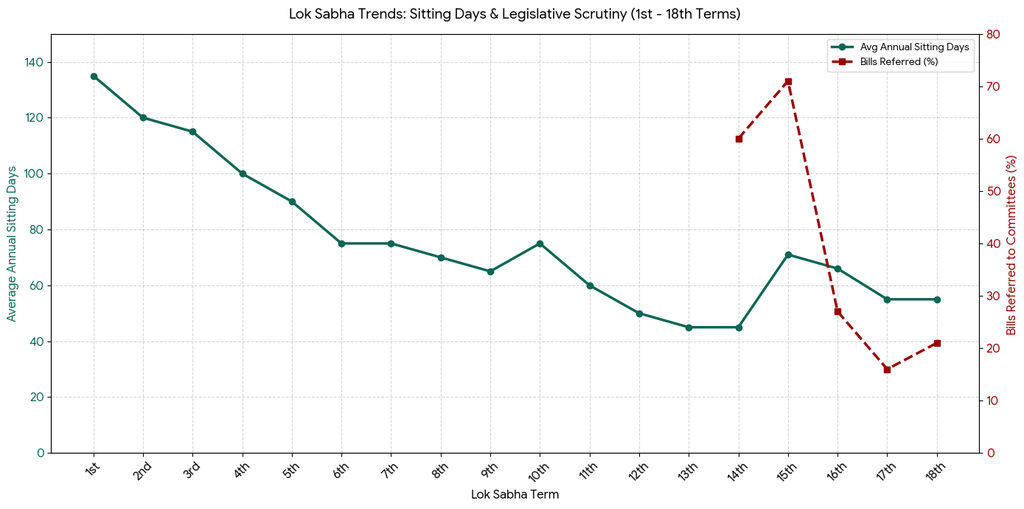
- Sitting days have collapsed. The first Lok Sabha averaged 135 sitting days a year; the 16th averaged 66 and the 17th just 55, with 2020 falling to 33 days.
- The 17th Lok Sabha sat 274 times in five years, the fewest of any full-term House, and 11 of its 15 sessions were adjourned early, cancelling 40 scheduled sittings.
- The constitutional floor is almost nothing: Article 85 requires only that six months not elapse between sessions, so the executive — which decides when to summon Parliament — controls how much scrutiny it faces.
- Bills are passed without scrutiny. In the 17th Lok Sabha 58% of bills were passed within two weeks of introduction and at least 35% were passed with less than an hour of discussion; only 9% were passed with recorded voting.
- The same-session pattern has hardened. Bills introduced and passed in a single session rose from 33% in the 16th Lok Sabha to 62% in the 17th, and stood at 53% in the 18th; in the Monsoon Session 2026 the figure was 92%.
- Committee reference has been abandoned as a norm. The share of bills sent to committees fell from 60% in the 14th Lok Sabha and 71% in the 15th to 25% in the 16th, 16% in the 17th, and 21% so far in the 18th.
- Financial control is largely formal. The guillotine puts undiscussed demands for grants to the vote when the allotted days expire — roughly 83% of the budget was passed without discussion in the 16th Lok Sabha — and the Comptroller and Auditor General reports only after the money is spent.
- Disruption consumes the time that remains. In the Monsoon Session 2026 the Lok Sabha functioned for 15% of scheduled time and the Rajya Sabha for 33%; Question Hour in the Lok Sabha ran for nine minutes across the session, one per cent of the time allotted, with two questions answered orally.
- Instruments fall into disuse. No adjournment motion was admitted in either the 16th or the 17th Lok Sabha; of 729 private members’ bills introduced in the 17th, only two were discussed; and the Lok Sabha has had no Deputy Speaker for more than seven years, contrary to Article 93.
- Suspension has become a management tool. Members were suspended on 206 occasions across both Houses in the 17th Lok Sabha, including 146 in the Winter Session of 2023 — a session in which major criminal law codes were passed with most of the opposition absent.
The money bill route
- Article 110 defines a money bill exhaustively by reference to taxation, borrowing and the Consolidated Fund, with clause (g) covering matters “incidental” to those subjects.
- A money bill bypasses the Rajya Sabha: the Council of States may only recommend amendments, which the Lok Sabha may reject, and must return the bill within fourteen days.
- The Speaker’s certificate is declared final by Article 110(3), and the practice grew of certifying as money bills measures whose substance had little to do with finance.
- The Aadhaar Act 2016 was so certified and upheld in Puttaswamy (Aadhaar) (2018) by 4:1, Justice Chandrachud dissenting on the ground that the Act’s core provisions could not be described as incidental to expenditure from the Consolidated Fund.
- The Finance Act 2017 restructured nineteen tribunals through a money bill; Rojer Mathew (2019) struck down the tribunal provisions for excessive delegation and referred the correctness of the Aadhaar majority’s Article 110 reasoning to a larger bench, where it has remained undecided.
- The route has since been used repeatedly, including for amendments to the Prevention of Money Laundering Act and, in August 2026, for the bill increasing the sanctioned strength of the Supreme Court — each use reviving the objection that a second chamber can be bypassed at will while the reference stays pending.
Ordinances as a substitute for legislation
- Article 123 allows the President to promulgate an ordinance when Parliament is not in session and immediate action is necessary; it lapses six weeks after Parliament reassembles.
- The device was designed for emergency and has become routine: 45 ordinances were promulgated during the 16th Lok Sabha alone, several of them re-issued when Parliament failed to pass the corresponding bill.
- D. C. Wadhwa v. State of Bihar (1987) exposed the extreme case — Bihar had kept 256 ordinances alive by successive re-promulgation between 1967 and 1981, some for over a decade, without ever placing them before the legislature.
- Krishna Kumar Singh v. State of Bihar (2017), a seven-judge bench, settled the law: re-promulgation is a fraud on the Constitution, the duty to lay an ordinance before the legislature is mandatory, the satisfaction of the President or Governor is not immune from judicial review, and an expired ordinance creates no enduring rights save where irreversibility requires it.
- The constitutional objection is structural rather than procedural: an ordinance is legislation by the executive, and normalising it inverts the relationship the parliamentary system exists to establish.
Executive dominance over the legislature
- The eclipse of legislatures is a global pattern, not an Indian pathology, and its causes are largely structural.
- The growth of delegated legislation. Modern statutes set frameworks and leave detail to rules, regulations and notifications made by departments, so the bulk of binding law is never voted on. India’s Committee on Subordinate Legislation scrutinises this, but after the fact and without the power to annul.
- The complexity and technicality of modern legislation. Finance, telecommunications, data protection and environmental regulation demand expertise that generalist legislators do not have and are not resourced to acquire.
- The executive’s monopoly of information. Ministries hold the data, the drafting capacity and the institutional memory; a legislator’s counter-argument rests on whatever the ministry has chosen to publish.
- The party whip. Where the executive is the leadership of the majority party, controlling the legislature is a matter of internal party discipline — and in India the whip is backed by the threat of disqualification.
- The security state. Defence, intelligence and internal security are the areas of greatest executive discretion and least legislative access, and their share of government activity has grown.
- Media-centred and personalised leadership. Campaigns are fought around leaders rather than parties or programmes, and a leader with a direct line to the electorate owes progressively less to the chamber.
- Emergency and crisis governance. Pandemic management, financial regulation and disaster response all reward speed, and speed is an executive property.
- The cumulative effect is the shift Bagehot’s “government by discussion” has undergone into government by executive — the legislature ratifying rather than deliberating, and scrutinising after the fact rather than before.
- The Indian version is sharpened by three local features: the Tenth Schedule removing the rebel’s weapon, the absence of a legislative research service comparable to the US Congressional Research Service, and the government’s control over when Parliament sits at all.
Prime-ministerial and presidentialised government
- Richard Crossman argued in Britain that cabinet government had already been replaced by prime-ministerial government, with the Prime Minister controlling appointments, the agenda, the machinery of government and the party.
- John Mackintosh made the parallel case from the growth of the premier’s personal staff and the decline of the cabinet as a genuine decision-making forum.
- The counter-case, associated with G. W. Jones, is the “elastic band” thesis: a Prime Minister’s power stretches with political circumstance and snaps back when colleagues, the party or the electorate resist — the office is powerful, not autonomous.
- Poguntke and Webb generalised the phenomenon as the “presidentialisation of politics”, operating on three faces — the executive face (resources shifting to the leader), the party face (leaders gaining autonomy from their organisations), and the electoral face (campaigns fought on leadership rather than programme) — without any change in the constitutional form.
- India’s trajectory maps onto this closely.
- The Nehru era established a genuine parliamentary culture — long sessions, serious debate, a Prime Minister who answered questions personally — though after Patel’s death Nehru’s stature made him less first among equals than moon among stars.
- Indira Gandhi centralised decisively: the Prime Minister’s Secretariat became the pivot of government, the cabinet was marginalised, and the Emergency demonstrated how far a parliamentary majority could be used against parliamentary government itself.
- Rajiv Gandhi continued the trend through reliance on technocrats and personal advisers rather than senior colleagues.
- The coalition era of 1989–2014 reversed it partly: allies with independent bases imposed real constraints, and Narasimha Rao, Vajpayee and Manmohan Singh each governed with a cabinet whose members could not simply be dismissed.
- Since 2014 a single-party majority, a centralised party organisation and a leadership-centred electoral strategy have restored and deepened concentration, with the PMO functioning as a parallel executive that coordinates and increasingly originates policy.
- The important qualification is that concentration tracks parliamentary arithmetic, not constitutional design: the coalition decades showed the form reasserting itself the moment the numbers changed.
- Pratap Bhanu Mehta‘s warning is the sharpest statement of the risk — that the rise of a single leader of colossal stature is itself a hazard to democratic functioning, whatever the leader’s intentions.
Presidentialisation in India has not altered a single article of the Constitution; it has altered where decisions are actually taken, which is why the text offers no remedy for it.
Majorities, defections and the stability of state governments
- A legislative majority is a necessary but not sufficient for stable government, because in India a majority is an aggregate of individuals whose party allegiance has repeatedly proved purchasable.
- The pre-1985 era. After the 1967 general elections coalition and opposition ministries in the states fell in rapid succession as legislators crossed the floor; the phrase “Aaya Ram Gaya Ram” entered the language from the Haryana MLA Gaya Lal, who changed parties three times within a fortnight in 1967.
- The 52nd Amendment (1985) inserted the Tenth Schedule, disqualifying a member who voluntarily gives up membership of his party or votes contrary to the party whip without permission, with exemptions for a merger and, then, for a split by one-third of the legislature party.
- The 91st Amendment (2003) closed the loophole that had made the law almost useless.
- The one-third split exemption was deleted, leaving only merger by two-thirds as a defence.
- The Council of Ministers was capped at 15% of the House’s strength (Articles 75(1A) and 164(1A), with a floor of twelve in the states), ending the practice of enlarging ministries to buy loyalty.
- A disqualified defector was barred from ministerial office for the remainder of the term (Articles 75(1B) and 164(1B)).
- The Speaker as the deciding authority is the structural weakness. Under Paragraph 6 the Speaker or Chairman decides disqualification, and the Speaker is a partisan officeholder who in India, unlike Britain, does not resign from his party.
- Kihoto Hollohan v. Zachillhu (1992) upheld the Tenth Schedule but struck down Paragraph 7, which had ousted judicial review, for want of ratification by the states; it held that the Speaker acts as a tribunal, so his decision is reviewable — but only after a final order, and only for mala fides, perversity or breach of natural justice.
- The minority judgment of Verma and Sharma JJ doubted whether a Speaker dependent on a majority could be an impartial adjudicator at all — a doubt the subsequent record has vindicated.
- Keisham Meghachandra Singh v. Speaker, Manipur Legislative Assembly (2020) held that a Speaker should ordinarily decide within three months and urged Parliament to consider vesting the power in an independent tribunal headed by a retired Supreme Court judge or a retired Chief Justice of a High Court.
- Delay has become the defection strategy. In Padi Kaushik Reddy v. State of Telangana (31 July 2025) the Supreme Court, holding that the Speaker enjoys no immunity under Article 212 while acting as a tribunal, directed the Telangana Speaker to decide within three months the petitions against ten BRS MLAs who had joined the Congress sixteen months earlier; the Speaker then dismissed every petition for want of evidence between December 2025 and February 2026, though two of the members had openly campaigned for the party they were said not to have joined.
- Maharashtra (2022–24) produced the same pattern in reverse order. Subhash Desai v. Principal Secretary, Governor of Maharashtra (2023) held that the Governor had no objective material to call a floor test and that the whip is appointed by the political party rather than the legislature party, but declined to restore the previous government because the Chief Minister had resigned without facing the vote; the Speaker later held the Shinde faction to be the real Shiv Sena, and the Nabam Rebia question — whether a Speaker facing a removal motion may decide disqualifications — was referred to a seven-judge bench.
- The floor test is the constitutional answer. S. R. Bommai v. Union of India (1994) held that a government’s majority must be tested on the floor of the House, not in the Governor’s assessment, and made proclamations under Article 356 justiciable — which sharply reduced the dismissal of state governments and correspondingly increased the incentive to engineer defections instead.
- The record of defection-driven change is now a settled political technique.
- Karnataka (2019) — the resignation and subsequent disqualification of seventeen MLAs brought down the Kumaraswamy government; in Shrimanth Balasaheb Patil (2019) the Court upheld the disqualifications but held the Speaker could not bar the members from contesting the resulting by-elections.
- Madhya Pradesh (2020) — twenty-two Congress MLAs resigned with Jyotiraditya Scindia and the Kamal Nath government fell before a floor test could be held.
- Maharashtra (2022) — a two-thirds faction claimed to be the original party, converting the merger exemption into a takeover device.
- Horse-trading and resort politics — the sequestration of legislators in hotels and resorts to prevent contact with the other side — is the visible symptom of a system in which the anti-defection law penalises the individual crossing but leaves the wholesale purchase of a two-thirds bloc untouched.
The opposition
- The Leader of the Opposition is a statutory office under the Salary and Allowances of Leaders of Opposition in Parliament Act, 1977, defined as the leader of the largest party in opposition recognised as such by the Speaker or Chairman.
- Recognition rests on a Speaker’s direction requiring 10% of the House’s strength — 55 seats in the Lok Sabha — a threshold traceable to the practice of the first Speaker and never enacted in the statute itself.
- The post lay vacant from 20 May 2014 to 8 June 2024, across the whole of the 16th and 17th Lok Sabhas, because no opposition party reached the threshold; it was restored when Rahul Gandhi took office on 9 June 2024 in the 18th Lok Sabha.
- The consequences were not merely symbolic, because the Leader of the Opposition sits ex officio on the selection committees for the Central Vigilance Commissioner, the Central Information Commission, the Lokpal, the Director of the Central Bureau of Investigation and the National Human Rights Commission.
- During the vacancy the government resolved the difficulty by inviting the leader of the single largest opposition party to those committees in some cases and by amending statutes in others — a workaround that depended on executive goodwill rather than entitlement.
- The deeper problem is that a threshold designed for a two-party House penalises a fragmented opposition: a coalition holding 40% of the seats may have no single party with 10%, and the chamber then has no recognised alternative government.
Parliamentary committees
Committees exist because the chamber cannot do the work the Constitution assigns it. Parliament sits for a few weeks a year, debates under television lights and party whips, and confronts legislation whose technical content exceeds what any generalist can master in an afternoon. The committee is the parliamentary system’s answer to its own limitations, and in India it is now the place where scrutiny substantially happens.
Why committees exist
- Parliament lacks the time. With fifty-five to seventy sitting days a year, detailed clause-by-clause examination of every bill and every ministry’s demands is arithmetically impossible on the floor.
- Parliament lacks the technical capacity. Committees can summon officials, call for papers and take evidence from experts and stakeholders, building a record the chamber never sees.
- Parliament lacks a non-partisan space. On the floor, positions are taken for the record and for the cameras; in committee there is no audience to perform for.
- Committees work year-round, unlike the House, which is what allows sustained engagement with a subject rather than a single debate.
- The American comparison — Congress in session is said to be Congress on display while Congress in committee is Congress at work, and the American committee can kill a bill outright without returning it to the floor.
Classification
| Type | Committees | Composition and function |
|---|---|---|
| Financial standing committees | Public Accounts Committee | 22 members, 15 Lok Sabha and 7 Rajya Sabha; examines the CAG’s audit reports; chaired by an opposition member by convention since 1967 |
| Estimates Committee | 30 members, Lok Sabha only; examines whether economies are possible in the estimates; ministers cannot be members | |
| Committee on Public Undertakings | 22 members, 15 and 7; examines the reports and accounts of public-sector enterprises | |
| Departmentally related standing committees | 24 DRSCs, created in 1993 | 31 members each — 21 Lok Sabha and 10 Rajya Sabha; examine demands for grants, bills referred to them, annual reports and long-term policy |
| Other standing committees | Committee on Subordinate Legislation, Committee on Government Assurances, Committee on Petitions, Business Advisory Committee, Rules Committee, Privileges Committee, Ethics Committee | Scrutinise delegated legislation, follow up ministerial assurances, and manage the House’s own business and conduct |
| Ad hoc committees | Select committees (one House) and joint committees (both Houses) | Constituted for a particular bill, reporting and then dissolving |
| Inquiry committees | Joint Parliamentary Committees on specific matters — the securities scam of 1992, the stock market scam of 2001, the 2G spectrum allocation |
- The financial committees are the oldest layer: the Public Accounts Committee dates from 1921, the Estimates Committee from 1950, and the Committee on Public Undertakings from 1964.
- The DRSC system created in 1993 was the decisive institutional reform, extending specialised scrutiny across every ministry rather than confining it to money already spent.
The cross-pollination claim
- Committees meet in camera. With no cameras and no press, there is no incentive to perform, and members argue rather than declaim.
- The whip does not formally operate in committee proceedings, so a member may support a recommendation his party opposes on the floor without constitutional consequence.
- Chairmanships are distributed across parties, and the Public Accounts Committee has been chaired by the opposition by convention since 1967 — an arrangement with no parallel in the chamber.
- Reports are normally adopted by consensus, which forces the drafting of language that members of rival parties can both accept.
- Standing committees draw from both Houses — 21 from the Lok Sabha and 10 from the Rajya Sabha — making them the principal institutional site where the directly elected chamber and the chamber representing the states work on the same text, which matters most for Concurrent List legislation.
- The result is that members deliberate as legislators, not partisans, which is precisely the exchange of ideas across party and chamber lines that the committee system is defended for.
The record
- The Insolvency and Bankruptcy Code is the standard success. The 2015 bill went to a Joint Committee which examined it clause by clause, took evidence from regulators, bankers and insolvency professionals, and returned it with substantial redrafting before enactment in 2016.
- The Joint Parliamentary Committee on the Personal Data Protection Bill reported in December 2021 after two years, recommending dozens of amendments including the extension of the framework to non-personal data — a report so far-reaching that the government withdrew the bill in 2022 and brought a fresh one in 2023 which it did not refer to any committee.
- The Public Accounts Committee has repeatedly forced disclosure the executive resisted, its examination of the CAG’s reports supplying the documentary basis for several of the largest post-independence financial controversies.
- Department-related standing committees have produced consistently expert reports on subjects — health infrastructure, agricultural pricing, criminal law reform — where floor debate produced only slogans.
- The Committee on Subordinate Legislation is the only sustained check on the rule-making that now constitutes most binding law.
The weaknesses
- Recommendations are not binding. A government may accept, reject or ignore a committee report, and there is no requirement of a time-bound reasoned response.
- Reports are often not even tabled or debated, so the scrutiny produces a document rather than a decision.
- Attendance is poor. Members treat committee work as secondary to constituency and party work, and quorum failures are common.
- Annual rotation destroys expertise. Members are appointed for one year, so knowledge accumulated on a technical portfolio is dissipated as soon as it becomes useful.
- no research support comparable to the Congressional Research Service or the Congressional Budget Office; members rely on the ministry’s own material or on private assistance.
- Ministers are not members, which keeps committees independent but also leaves them without a direct line into the decision they are trying to influence.
- Members receive no additional remuneration and no career advantage for committee work, so the incentive structure points away from it.
- The decisive weakness is that reference is optional. No rule compels the government to send a bill to a committee, and the referral rate has fallen from 71% in the 15th Lok Sabha to 16% in the 17th — the executive simply declines to use the institution that would scrutinise it.
- Pratap Bhanu Mehta and Devesh Kapur locate the root of these failings in the general weakness of Parliament itself: committees cannot be stronger than the institution they are part of.
Committees are where parliamentary scrutiny in India still happens, which is exactly why the decision whether to refer a bill has become a political choice rather than a procedural step.
Should India shift to a presidential system?
The case for
- Stability and a fixed term. A directly elected executive serving a fixed term cannot be brought down by defections, and the energy now consumed in majority management would go into governing.
- Expertise-based cabinets. A president could appoint economists, scientists and administrators to run ministries, unconstrained by the requirement that ministers first win elections.
- Clearer accountability. With a single identifiable executive, the voter knows who is responsible; parliamentary systems allow blame to be diffused across coalition partners and a collective cabinet.
- Separation of powers restored. A legislature that cannot be dissolved and does not contain the executive has both the independence and the incentive to scrutinise properly.
- A national mandate. Direct election would give the executive a legitimacy independent of party arithmetic, and would end the anomaly of a government formed by post-poll bargaining.
- The Indian proponents. Vasant Sathe campaigned publicly through the 1980s for a switch, arguing that parliamentary government had produced instability and unaccountable coalition bargaining; Arun Shourie and others have periodically revived the case, and proposals for direct election of the chief executive resurface after every hung verdict.
The case against
- The risk of authoritarianism in a plural society. A single elected executive concentrates in one person an authority that the plural cabinet distributes, and India’s own record of constitutional strain under a dominant Prime Minister suggests what an irremovable one might do.
- No national majority exists. No party has won half the popular vote in a general election; a president elected on a plurality in a first-past-the-post contest, or on a runoff between two national blocs, would represent far less of the country than a coalition cabinet does.
- Gridlock. A president facing a hostile legislature has no constitutional means of resolving the impasse — no dissolution, no confidence vote — and the deadlock runs the full term.
- Minority and regional representation would suffer. Cabinet composition is India’s principal instrument for including regions, communities and coalition partners in the executive; a president’s cabinet answers to him alone.
- The comparative record is poor. Presidentialism in Latin America, Africa and parts of Asia has repeatedly supplied the constitutional form for personal rule, and the United States remains the outstanding case of durable presidential democracy rather than the representative one.
- Juan Linz gave the classic statement of the objection.
- Dual democratic legitimacy — president and legislature both claim a popular mandate, and the constitution supplies no democratic principle for deciding between them.
- Rigidity — the fixed term cannot accommodate a president who loses authority, dies politically, or faces a crisis his mandate does not cover.
- The winner-take-all logic — a presidential election is a zero-sum contest for the whole executive, which raises the stakes of every election and hardens polarisation.
- The style of presidential politics — direct popular mandate invites the belief that the president embodies the nation, and encourages hostility to the parties and institutions that constrain him.
- Outsiders and amateurs — presidential systems reward candidates with no legislative experience and no party base, who then find they cannot govern.
“…the only presidential democracy with a long history of constitutional continuity is the United States.” — Juan Linz
- The parliamentary form’s Indian record is the strongest argument for keeping it. It has absorbed one-party dominance, a declared Emergency, three decades of coalitions and a return to single-party majority without a single interruption of constitutional government — a resilience no presidential system outside the United States can claim.
- The system’s failings are diagnosed correctly and prescribed for wrongly. Falling sitting days, unreferred bills and executive dominance are failures of practice and political incentive; a presidential system would not fix a single one of them, and would remove the daily accountability that is the parliamentary form’s distinctive contribution.
The reform agenda
- A guaranteed legislative calendar. The National Commission to Review the Working of the Constitution (2002) recommended a minimum of 120 sitting days for the Lok Sabha and 100 for the Rajya Sabha, and for state legislatures a floor of 50 days for houses under 70 members and 90 days for the rest.
- The calendar should be fixed in advance and not left to the executive, since a government that decides when Parliament meets decides how much scrutiny it undergoes. A private member’s bill for a statutory hundred-day year has been introduced in the Rajya Sabha.
- Mandatory reference of bills to committees, with an exception only for declared urgency recorded in writing, would convert scrutiny from a favour into a rule; a time-bound government response to each recommendation would make the reports consequential.
- Committee reform — longer tenures than the current one year, professional research support on the model of the Congressional Research Service, and a right for committees to take up subjects on their own motion.
- A legislated Leader of the Opposition. Recognition should follow from being the largest opposition party rather than from a 10% threshold set by direction, so that the statutory appointment committees are never left without an opposition voice.
- Reform of the anti-defection law. The recurring proposals are to transfer the decision from the Speaker to the Election Commission or an independent tribunal, to require decisions within a fixed period, and to confine disqualification to votes of confidence and money bills so that a member may vote his conscience on ordinary legislation.
- The NCRWC went further, recommending that all defectors, individually or in groups, resign and seek re-election, and that the power to decide the question vest in the Election Commission.
- A constructive vote of no confidence on the German model, under which a no-confidence motion succeeds only if it simultaneously elects a successor, was recommended by the NCRWC and would end the practice of bringing a government down with no alternative available.
- An insulated Speaker’s office. The British convention of a Speaker who resigns from his party and is returned unopposed has no Indian counterpart; without something like it, the officer who decides defections, certifies money bills and rules on disruptions remains a party politician.
- Other structural repairs — filling the Deputy Speaker’s post as Article 93 requires, restricting the money bill route by making the Speaker’s certificate reviewable, statutory limits on ordinance-making, codifying parliamentary privileges, and a Parliamentary Budget Office to end the executive’s monopoly of fiscal analysis.
- The larger point is that none of these requires a constitutional amendment of the system’s basic form; they are repairs to a design that still works where it is allowed to.
Conclusion
- The Constituent Assembly’s bargain was explicit: less stability for more responsibility, on the judgment that a society this unequal could not safely tolerate an executive it could not remove.
- The form has held. India retains a nominal head of state, a real executive answerable to the elected chamber, collective responsibility and the machinery of daily scrutiny, through every political configuration since 1950.
- The substance has eroded at the point where the bargain was supposed to pay off: a House that sits fifty-five days a year, passes a third of its bills in under an hour and refers one in six to a committee cannot deliver daily assessment.
- The Indian variations are not deviations but design choices — a written constitution, judicial review, an elected head of state and an entrenched second chamber — and they are the reason the Indian Parliament is supreme in its sphere without being sovereign anywhere.
- The remedies are political and institutional, not constitutional. Sitting days, committee reference, an insulated Speaker and a reformed Tenth Schedule address the actual failures; changing the form of government does not.
- What Ambedkar identified as the system’s distinctive contribution — that the executive is judged not once in five years but every day it sits — remains its strongest claim and, on the present record, its largest unmet promise.
Previous Year Questions
- Parliamentary Committees are a strong tool of Parliamentary Democracy. It provides for the opportunity for cross-pollination of ideas among members of the Parliament. Discuss. (2025)
- Differentiate parliamentary supremacy from parliamentary sovereignty. Would you consider the Indian Parliament as a Sovereign Parliament, Examine. (2017)
- Discuss the patterns of legislative-executive relationship prevalent in the world today. What factors and forces have enabled the executive to overpower the legislature, in most countries? (1997)
- Majority in legislatures does not necessarily contribute to the stability of the state Government in India. Discuss. (1992)
Syllabus unit: Salient Features of the Indian Constitution
PSIR Optional study material from LotusArise IAS
Two ways to prepare with us — the full self-study system, or just the notes you need right now.
| What you get | PSIR Mains Master Kit 2027 | PSIR Complete Notes (Store) |
|---|---|---|
| Paper 1 notes — Political Theory + Indian Government and Politics | Included | Included — Section A and Section B |
| Paper 2 notes — Comparative Politics and India and the World | Included | Included — Section A and Section B |
| Topic-wise PYQ bank | 1986–2026, with trend analysis and probables by Dec 2026 | 1991–2025 question papers, free with every notes pack |
| Practice question set for timed answer writing | ✅ Available now | ❌ |
| Answer toolkit — intros, conclusions, frameworks, thinker and example banks | By Dec 2026 | ❌ |
| Revision booklets for the last 60 days | ✅ Available now | ❌ |
| Format | Online articles + PDF | PDF download |
| Access | Valid until UPSC CSE Mains 2027 | Instant download after payment |
| Price | ₹1,770 (regular ₹5,000) | ₹1,180 for all four sections · ₹599 a paper · ₹354 a section |
| Best for | Aspirants who want the whole system in one place | Aspirants who want the notes now, in the parts they need |
