

Political theory was declared dead in 1956 and was flourishing again by 1971. What actually died in those fifteen years was one particular way of doing it, and the quarrel over why it died remains the best available answer to the question of what political theory is for.
This topic is therefore not a preface to the syllabus but its foundation. Every later argument about the state, justice, rights or democracy inherits a position taken here (see our complete PSIR Optional Notes) — about what counts as political, what counts as knowledge about it, and whether a claim about what ought to be can be knowledge at all.
What is Political Theory? Meaning, Definition & Nature

Definition of Political Theory (UPSC Focus):
Core Scholars: George Sabine (“Disciplined investigation of political problems”), Andrew Hacker (“Union of political science and political philosophy”), David Easton (“Authoritative allocation of values”).
Political theory is the systematic and analytical study of political concepts, values, institutions, and collective human behavior. It encompasses both normative inquiry (what ought to be—justice, liberty, equality, and the good society) and empirical analysis (what is—state authority, institutional power, and governance dynamics).
The word political comes from the Greek polis, the city-state whose institutions and activities were knit into a single life aimed at securing the good life for the community. Aristotle built his whole enterprise on the claim that man is by nature a political animal — one who lived outside the polis was “either a beast or a god”. Three modern answers compete over what inherits that word.
- The institutional or arena answer locates politics by place: politics is what happens in and around the institutions of government.
- This is the sense in which we speak of political parties, political office and political news, and it is the working assumption of the traditional approaches.
- Its defect is that it defines politics by location rather than activity, so anything outside the state apparatus is by definition not political — a caste panchayat, a corporate boardroom, a household.
- The power or process answer, from Lasswell and the behaviouralists, is that politics is who gets what, when and how — in Easton’s formulation, the authoritative allocation of values for a society.
- Politics now happens wherever power is exercised — in firms, unions, universities, families — which is analytically far more useful.
- The cost is over-inclusion: if everything is political, the category stops discriminating between a cabinet decision and a family quarrel.
- The conciliation answer, from Bernard Crick, holds that politics is the activity by which differing interests within a ruling unit are conciliated by giving each a share of power proportionate to its importance to the whole.
- On this reading politics is an achievement, not a universal feature of social life — a fragile alternative to coercion.
- It follows that totalitarian regimes abolish politics rather than practise it, which is a substantive claim, not a definitional trick.
- The feminist slogan “the personal is political” intervenes in exactly this debate.
- Its argument is not that families are governments, but that the boundary between political and private is itself a political settlement — drawn historically in a way that removed the sphere of women’s subordination from public scrutiny.
The definition of “political” is never innocent: every boundary drawn around the political simultaneously decides which forms of domination will count as questions of justice and which will be left to custom.
Political Theory vs. Political Philosophy vs. Political Science
These five terms are used interchangeably in ordinary speech and mean quite different things in the discipline. Getting the distinctions right is what allows the later debates about decline and revival to be stated precisely at all.
| Term | What it is | Method | Example |
|---|---|---|---|
| Political thought | The whole historical record of what has been said about politics in a period or tradition — pamphlets, speeches, constitutional argument | Descriptive, historical | Gandhi’s writings; the Constituent Assembly Debates |
| Political philosophy | The normative and evaluative core — what the state ought to do, what justifies obedience | Argument from premises; justification, not explanation | Plato‘s Republic; Rawls‘s original position |
| Political theory | Systematic, generalising reflection on political life, which may be normative or explanatory | Both; broader than philosophy, narrower than thought | Rawls on justice and Easton on the political system |
| Political science | The empirical study of political behaviour aspiring to explanation and prediction | Observation, measurement, verification | Voting studies; survey research |
| Political ideology | A holistic system of thought whose purpose is action and mobilisation | Assertion and persuasion | Liberalism, Marxism, fascism |
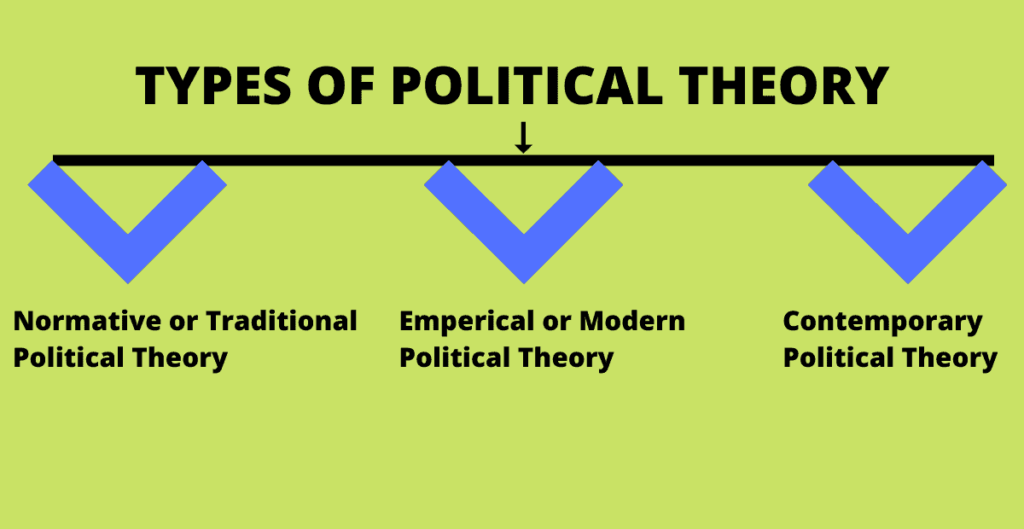
- Sabine’s definition remains the most economical: political theory is that which has characteristically contained the factual, the causal and the valuational.
- Hacker adds that every political scientist plays a double role — “part scientist and part philosopher” — and that no theorist contributes lastingly unless working in both realms.
- Catlin put the same point structurally: political theory is itself divided into political science and political philosophy.
- Political theory works with three kinds of statement, and almost every methodological dispute in the discipline turns on the status of the third.
- Empirical statements, based on observation through sense-experience — capable of verification.
- Logical statements, based on reasoning, true by the relations between their terms.
- Evaluative statements, based on value-judgement — “men are born free and equal” — which positivists deny are propositions at all.
- The distinction from ideology is one of intention, not of content. As Hacker warns, a theory must be dispassionate and disinterested; the ideologue is an interested party whose purpose is to justify or attack an existing distribution of power.
- Mannheim’s point that every ideology represents the interest of a particular class is a claim about function, not a licence to collapse all theory into ideology.
- When theory is clouded by ideology it is reduced to rationalisation — capitalists finding private property uniquely just, socialists finding social ownership uniquely just.
The Three Functions of Political Theory
- Description — establishing what political arrangements actually are and how they work. Political science, relying on empirical method, specialises here.
- Criticism — measuring those arrangements against standards of right and wrong. This is philosophy’s work.
- Reconstruction — proposing better arrangements. Also philosophy’s, and the function the behavioural period came closest to abandoning.
Raphael adds a fourth task cutting across all three — the clarification of concepts, since terms like authority, class, justice and democracy are general and vague. Clarification has three moments: analysis, specifying a concept’s elements, as in defining sovereignty as supreme legal authority; synthesis, showing logical relations, as in showing that a right entails an obligation; and improvement, recommending a usage that increases coherence.
“Taken as a whole, the tasks of political theory are unquestionably demanding. In the absence of their systematic pursuit, there is always the danger that politics will be left to the ignorant and self-interested, or to those simply with a ‘will to power’.” — David Held
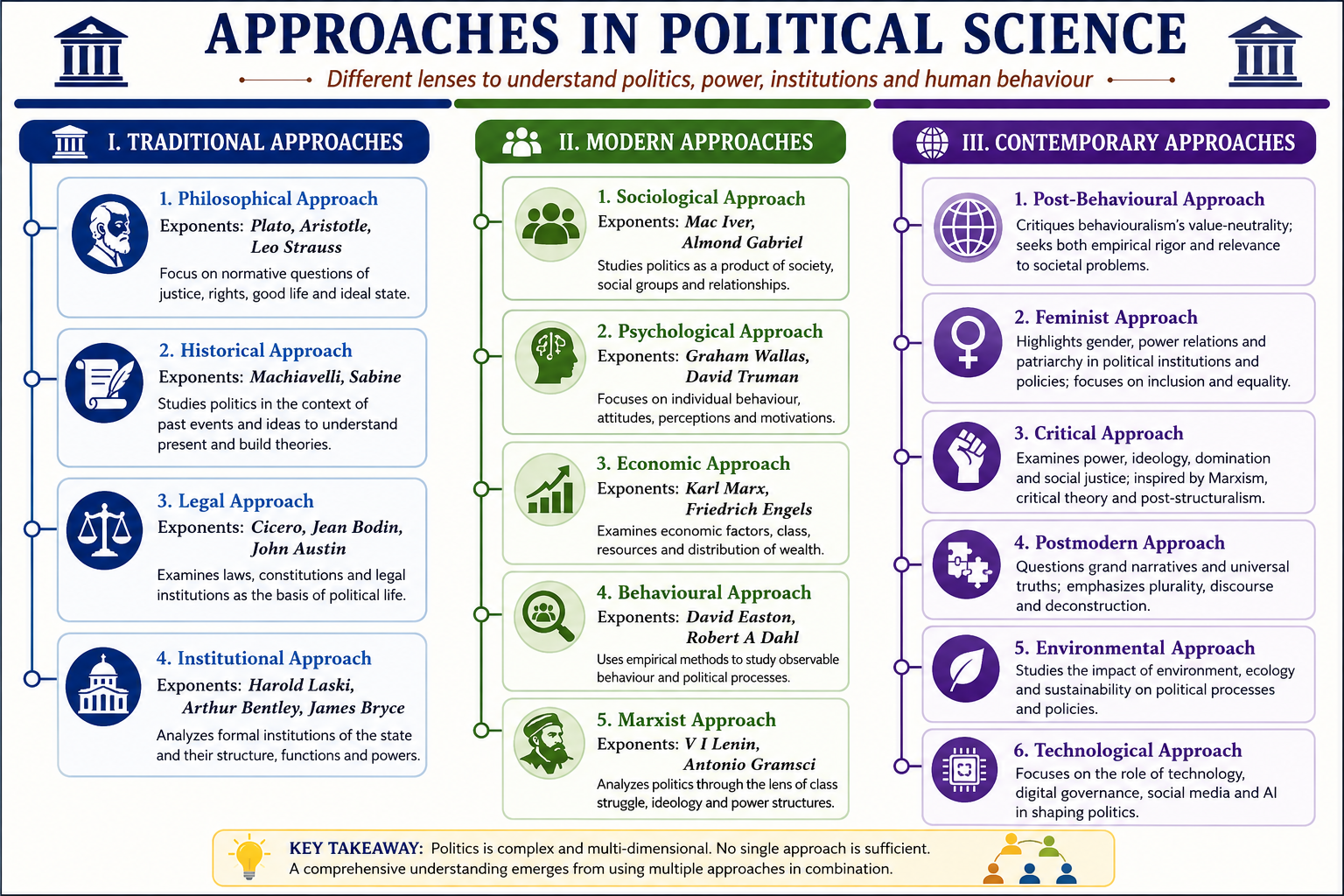
Traditional Approaches to Political Theory (Philosophical, Historical, Institutional)
Until the 1940s the discipline was carried by four approaches which are traditional not because they are old-fashioned but because each borrows its method from an older discipline — philosophy, history or law. Only the last of them gives politics a method of its own.
Philosophical or Normative Approach
- The oldest approach, and the one from which the discipline itself descends: political science began as a branch of philosophy.
- Socrates supplied the underlying theory of knowledge — real knowledge is knowledge of ideas, reached by dialectic, and superior because the world of ideas is a world of permanence while the physical world is a world of change.
- Plato turned this into method: it is not enough to describe existing states, one must grasp the idea of the state — its purpose — because only then can imperfect actual states be moved toward perfection.
- Its two working tasks are the clarification of concepts and the evolution of standards of right and wrong for evaluating existing institutions, laws and policies.
- Van Dyke captured the first: philosophical analysis is an effort to clarify thought about the nature of a subject and about ends and means in studying it.
- Classical thinkers characteristically began from a hypothesis about human nature and moved to two themes: the art of government and the grounds of political obligation.
- The chain of derivation from that second theme is worth holding in mind, because it explains the shape of the whole Paper I syllabus.
- Its contemporary champion is Leo Strauss, for whom political science and political philosophy are coterminous — both are attempts to obtain true knowledge of political things and of the standards of the right and the good.
- Criticisms cluster around three charges, and the honest defence concedes the first two.
- It is speculative and unverifiable — behaviouralists dismissed philosophical theories as “armchair theories”, and Bryce demanded instead “facts, facts and facts”.
- It substitutes the theorist’s preferences for evidence; Weldon argued that political philosophy is like a matter of taste, where one can only state one’s preference and walk away.
- It is culture-bound — the post-colonial objection, that a “universal” theory is a provincial European one in disguise.
- The decisive reply is that political practice is saturated with normative claims, so declining to examine them does not remove them; it only leaves them unexamined. Aristotle’s defence of slavery is not refuted by counting slaves.
Historical Approach
- The simplest and most common-sense approach: history is past politics; politics is present history. If history is the root, politics is the shoot.
- It was Machiavelli who insisted that history rather than philosophy is the better guide for a prince, and traditional international politics was for a long time studied simply as diplomatic history.
- Laski stated the premise: “Every thinker is a child of his times”, and no political idea is intelligible save in the context of its time.
- Sabine made it a method: political ideas are themselves products of the crisis phases of history, so recovering the circumstances that produced a theory is necessary to judging its present relevance.
- In its rigorous modern form the Cambridge School of Skinner and Pocock insists that a text be read as an intervention in the political argument of its own moment.
- Reading past thinkers as contributors to timeless debates produces anachronism: to know what Locke meant by trust one must know how his contemporaries used the word.
- Criticisms are serious and largely conceded even by its practitioners.
- History is too vast, and selecting the relevant portion is itself a theoretical act.
- Much of political science has no historical referent — the philosopher-king and full communism were never instantiated yet remain indispensable to the subject.
- History is itself a politicised discipline; Said’s Orientalism showed history-writing operating as a political project.
- Political scholars use history selectively — Machiavelli chose the examples that served his argument.
- Popper attacked historicism — the belief that historical processes are driven by an inherent necessity beyond human control — arguing that Hegel and Marx first discovered what was inevitable and then licensed totalitarian methods to bring it about.
- Plamenatz objected to making political ideas dependent on history at all; they should be assessed by logic.
- The deepest limitation is relativism: if Locke speaks only to 1688, the point of reading him today becomes obscure.
Legal Approach
- Politics understood in terms of law — the legal and constitutional framework within which organs of government must function, their respective powers, and the procedures that make their acts valid.
- Applied to India, this means reading politics through constitutional provisions, Supreme Court decisions and the opinions of jurists.
- Its inadequacy is that complex political forces operate outside the legal-formal frame — parties, factions, money, caste, informal bargaining.
- Yet it is far from insignificant, because both the procedure and the substance of political action are frequently prescribed by law, which fixes what must be done, what may not be, and the limits of the permissible.
Institutional Approach
- Alone among the traditional approaches, this one does not borrow its method from another discipline — it gives the systematic study of politics an independent identity.
- An institution is a set of offices and agencies arranged in a hierarchy, each with defined functions, powers and role-expectations; its activities extend beyond office-holders to the ordinary voters who constitute it.
- Its practitioners study the organisation and working of government, its organs, parties and other bodies affecting politics — Bryce, Wheare and Finer are the classic names.
- It marks a double shift within the traditional family: from normative to empirical, and from historical to contemporary concern.
- It nevertheless fails to qualify as a modern approach because it relies on description rather than explanation.
- Its four standard defects are the reason behaviouralism displaced it.
- Preoccupied with institutions, it neglected the individual; the study of voting behaviour and political attitudes was left to sociologists.
- Lacking overarching global institutions to describe, it neglected international politics, ceding the field to historians and international lawyers.
- Concerned only with established institutions, it ignored violence, movements, agitations, war and revolution.
- It missed the role of informal groups and processes.
- Above all, it could not explain why two states with identical constitutions behave completely differently — the question that mattered most as decolonised states adopted borrowed constitutions.
| Institutional approach | Behavioural approach | |
|---|---|---|
| Unit of study | Formal structures — constitutions, organs, offices | Individuals and groups — attitudes, voting, participation |
| Method | Legal, descriptive, comparative, historical | Empirical and quantitative — survey and statistical |
| Stance on values | Openly prescriptive; asks what a good constitution is | Value-neutral by design; keeps fact and value apart |
| Blind spot | Informal power, political culture, why identical rules work differently | Formal structure, history, institutional context, meaning |
| View of change | Change comes through constitutional design | Change is aggregate behavioural change |
| Typical finding on India | Federalism is quasi-federal in design | Voters increasingly split tickets between state and national polls |
Modern Approaches & The Behavioural Revolution in Political Science
Why It Happened
Behaviouralism was not merely a new technique. It changed the discipline’s epistemology and its ontology together — what counts as knowledge and what the subject is about — which is why it is called a revolution rather than a movement. Its object shifted from the institution to the individual and the group.
- The intellectual origins predate the revolution by four decades.
- Graham Wallas in Human Nature in Politics (1908) argued that human nature was too complex for simple utilitarian propositions.
- The political process could be understood only by analysing how people actually behave, not how they should or would behave.
- He compared political parties to firms marketing toothpaste and breakfast cereal — manufacturers of captive human beings.
- Arthur Bentley in The Process of Government (1908) pioneered the group approach, seeking not to describe political activity but to supply new tools of investigation, and rejecting the idea that feelings and ideas have independent causes — their source was overt behaviour.
- Charles Merriam, commonly called the father of behaviouralism, attacked the discipline’s lack of scientific rigour and called for a policy science using quantitative techniques already developed in psychology and sociology.
- Catlin argued for a value-free pure science treating power as the essence of politics, a line Lasswell developed into the study of politics as the analysis of power.
- Graham Wallas in Human Nature in Politics (1908) argued that human nature was too complex for simple utilitarian propositions.
- The historical circumstances mattered as much as the arguments, and this is the part most often left out.
- After the Second World War, political scientists were not being invited to the reconstruction and development conferences that drew economists, sociologists and psychologists. The discipline had nothing operational to offer.
- The Chicago School under Merriam became the institutional catalyst, with Lasswell teaching and Truman and Almond among its students.
- European émigré scholars brought a tradition of political sociology shaped by Weber.
- Wartime service in the war administration changed academics’ perception of how politics is actually played.
- Survey methodology matured rapidly, and enormous funding arrived from the Carnegie, Rockefeller and Ford Foundations.
- Dahl later described the result: the behavioural approach grew “from the deviant and unpopular views of a minor sect into a major influence”, and the radicals of the 1930s were the establishment of the 1950s.
Easton’s Eight Intellectual Foundation Stones
These are the canonical statement of the creed, set out by Easton in his writings of the early and middle 1960s — not in his 1969 address, which is the correction rather than the manifesto. Each stone drew a specific traditionalist reply.
| Foundation stone | The behaviouralist claim | The traditionalist reply |
|---|---|---|
| Regularities | There are discoverable uniformities in political behaviour, expressible as generalisations | No guarantee the same person behaves identically under identical conditions twice |
| Verification | Generalisations must be testable against relevant behaviour | Impossible for ideas like communism, which yield only to logical analysis |
| Techniques | Means of acquiring and interpreting data must be rigorous and refined | Few areas admit quantitative technique; do not sacrifice subject matter to method |
| Quantification | Precision requires measurement wherever possible | Restricts the discipline to the measurable, essentially electoral behaviour |
| Values | Ethical evaluation and empirical explanation are distinct and must be kept apart | Strauss: ignoring values is like refusing to distinguish clean water from dirty |
| Systematisation | Research must be theory-oriented and theory science-oriented; fact-gathering without theory is not knowledge | Social sciences are analytical; such systematisation is artificial |
| Pure science | Understanding precedes application; the discipline should aspire to pure science | The subject is inescapably practical and evaluative |
| Integration | Political research must not divorce itself from the other social sciences | Traditionalists integrate too — with philosophy, history and law, which behaviouralists reject |
The Systems Approach
Easton’s systems model was the attempt to give behaviouralism a grand theory — a single value-free framework applicable to the political system of any country, which is precisely what comparative politics needed as dozens of new states appeared. Talcott Parsons’s social system analysis in sociology was its immediate influence.
- A system is a set of elements in a state of interaction, where the interaction is patterned rather than haphazard, separated from its environment by a boundary.
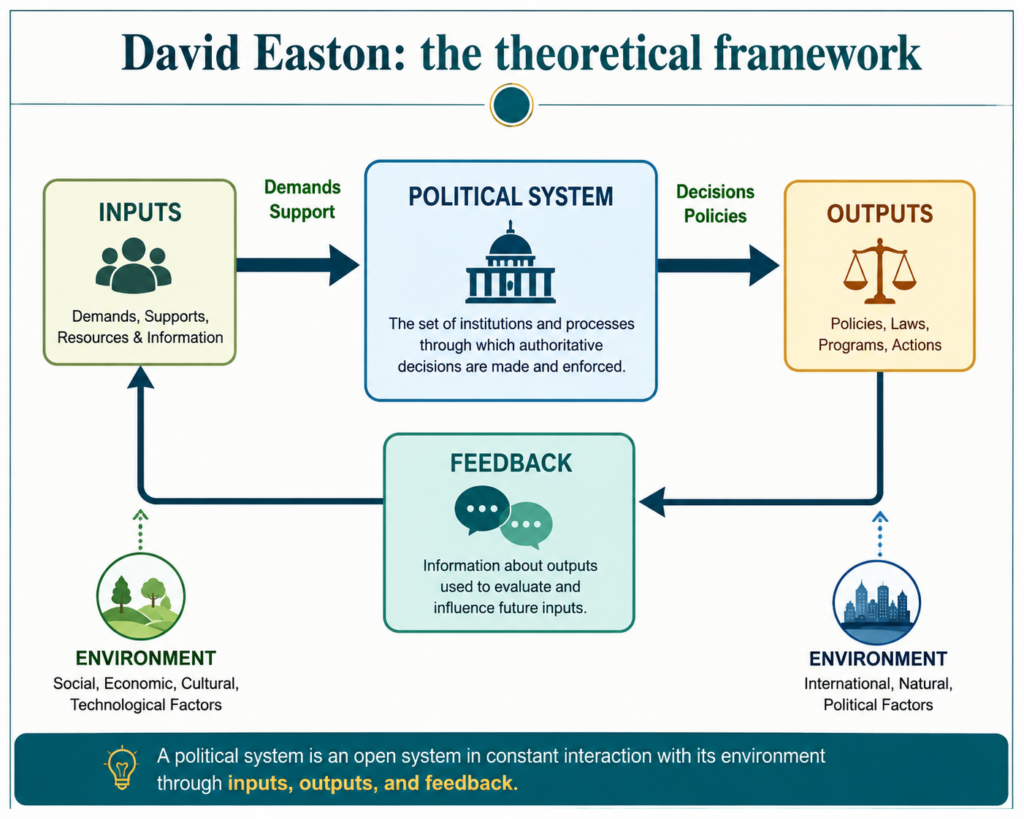
- The political system is conceived as a conversion machine which takes inputs from the environment and produces outputs.
- Inputs are of two kinds. Demands are what people want from the system — regulation, allocation, participation, communication. Supports are what sustains it — payment of taxes, obedience to law, participation in government programmes, attention to official communication.
- Conversion happens inside the system, and Easton was famously uninterested in its interior — hence the charge that his political system is a black box.
- Outputs are authoritative decisions and actions; a single decision is a decision, a pattern of decisions is a policy.
- Feedback returns outputs to the environment, where they reshape demands and supports and re-enter the system. Without a feedback loop the system collapses — this is the model’s central insight about persistence.
- Almond and Powell’s structural-functional approach was built on Easton’s frame but took a micro-view where Easton took a macro-view, borrowing from the anthropology of Malinowski and Radcliffe-Brown the idea that all societies perform certain essential functions while the structures performing them vary.
- This was the move that made genuinely cross-national comparison possible: every system must recruit leaders and make rules, but the structures doing so differ.
- Input functions — political socialisation and recruitment, interest articulation (interest and pressure groups), interest aggregation (political parties), and political communication.
- Output functions — rule-making (legislature), rule-application (executive) and rule-adjudication (judiciary), with the caveat that each organ performs some share of the others’ functions.
- Almond and Verba’sThe Civic Culture extended the frame to attitudes, combining Weber’s ideal types with Easton’s input-output model to produce three cultures.
- Parochial — people influence neither input nor output and see themselves at the periphery of the system.
- Subject — people cannot shape inputs but are affected by, and matter to, outputs; the system cares how they will react.
- Participant — people act at both ends, shaping the laws as well as receiving them.
- Civic culture is a mixture of all three, on the argument that universal, intense participation would tip democracy into instability — a claim that is itself a normative judgement smuggled into an empirical typology.
- Criticisms of the systems approach converge from two directions.
- Traditionalists object that it is a mechanical analogy that dissolves the state, the very concept at the heart of political enquiry, into an abstraction.
- Marxists object that it is status-quoist and not universal: modelled on Western systems, it treats system maintenance as the norm, cannot account for revolution, protest or breakdown, and presents the American system as the implicit ideal type.
- The model treats stability as normal and change as pathology, which is exactly backwards for the post-colonial world it was designed to explain.
- The same behavioural impulse generated a family of related frameworks, each an attempt to make comparison across dissimilar systems possible.
- Political development — Lucian Pye and Riggs on the capacity of a system to absorb rising demands, and on the development trap that follows when a system’s dimensions grow unevenly.
- Political modernisation — Huntington and Shils, with Huntington’s crucial dissent that modernisation without institutionalisation produces decay, so the real choice is between order and disorder rather than between ideologies.
- Political sociology and political economy — locating politics in social cleavage and in the economic base respectively.
- All inherit the same charge: they take the Western trajectory as the norm, so a system that develops differently registers as defective rather than different.
What Behaviouralism Achieved, and What It Cost
- The gains were real and permanent. The discipline acquired survey research, statistical inference and comparative data, and arrested its own first decline.
- Electoral behaviour became a genuine field of knowledge, useful to parties in framing strategy and to scholars in mapping cleavages.
- It exposed the gap between theory and practice — elitists and pluralists could now investigate what democracy in the West and socialism in communist states actually amounted to.
- It was most useful precisely where the legal-institutional approach was weakest: the developing world, where the distance between constitutional text and political context demanded fieldwork. Comparative politics became behaviouralism’s principal arena.
- The costs provoked the reaction.
- A tendency to stress what could easily be measured rather than what was theoretically important.
- A tendency to study the readily observable rather than the covert structural factors producing stability and change.
- Popper and Hempel attacked its inductivism: a collection of all the facts “would have to await the end of the world”, and even all the facts up to now cannot be collected, since they are infinite.
- Sheldon Wolin, in Politics and Vision, accused behavioural political scientists of abdicating their vocation in their preoccupation with method.
- Terence Ball’s verdict is the sharpest: behaviouralism succeeded in the short run through successful self-promotion and failed in the long run because the promises it made could not be met.
- It never achieved a Kuhnian consensus — a paradigm accepted by most practitioners. As Dahl noted, it is easy to say what behaviouralism is not and hard to say what it is; every practitioner “puts his own emphasis and thereby becomes his own behaviouralist”.
| Dimension | Traditional Approaches (Classical) | Modern / Behavioural Approaches (Scientific) |
|---|---|---|
| Primary Focus | Values, morals, ideal state, ethical institutions | Observable political behavior, processes, systems |
| Orientation | Normative (“What ought to be”) | Empirical & Descriptive (“What is”) |
| Sub-Schools | Philosophical, Historical, Legal-Institutional | Behavioural, Post-Behavioural, Systems, Rational Choice |
| Key Proponents | Plato, Aristotle, Machiavelli, Sabine, Dunning | Charles Merriam, David Easton, Robert Dahl, Harold Lasswell |
| Methodology | Deductive, speculative, qualitative, legal textual | Inductive, quantitative, statistical, interdisciplinary |
| Value Stance | Value-laden (explicit ethical justification) | Value-neutral (scientific objectivity) |
The Decline of Political Theory Debate (1950s–1960s)
The Charge Sheet
- Alfred Cobban opened the case in “The Decline of Political Theory”, arguing that political theory had lost its practical purpose.
- It once addressed rulers about what should be done; it had become an academic exercise addressed to other academics.
- He held this true of liberal and communist systems alike — bureaucracy and the military machine in one, party oligarchy in the other, and no role for theory in either.
- His conclusion was not despairing: political science must evolve criteria of judgement that would restore its relevance.
- Peter Laslett delivered the sentence: “For the moment, anyway, political philosophy is dead.” His diagnosis was partly logical positivism, which reduced normative statements to expressions of preference, and partly the shock of ideology, which had made grand political theorising look dangerous.
- Robert Dahl added that political philosophy was dead in the English-speaking world, killed by positivism and by the political scientist’s new empirical confidence.
- Seymour Martin Lipset argued in Political Man that the values of contemporary society had already been settled; American democracy was “the closest approximation to the good society itself in operation”, so the search for the good society was simply over.
Easton’s Four Causes
Easton’s own diagnosis in The Political System is the version most directly asked about, and it is a charge sheet against the traditionalists, not against theory as such.
- Historicism — historicists like Sabine and Dunning had made the discipline live parasitically on ideas a century old, producing histories of political ideas instead of a new political synthesis.
- Moral relativism — the drive to make politics scientific meant excluding values altogether, and Easton did not endorse this; he held that a value system must be built with a sensitive attitude to society’s real problems.
- Confusion between science and theory — over-reliance on scientific method to raise the discipline’s status gave method primacy over purpose.
- Hyperfactualism — political science had drowned in facts. Easton’s phrase for it is exact: “theoretical malnutrition and a surfeit of facts”. Scholars had grown adept at measuring opinion, voting and legislative leadership without giving the results any theoretical dimension.
Behind all four sat the end-of-ideology thesis of Bell and Lipset: if the great ideological battles were settled, only technical questions of administration remained, and means are an empirical matter. Add specialisation — the theorist reduced to a curator of a canon — and the picture is complete.
The Answers
- Leo Strauss argued that the new science of politics was itself a symptom of the decline, not its cure.
- By adopting positivism it treated all social values as equally important, denying that some things are intrinsically higher than others.
- The result, in his image, is obliterating the distinction between men and brutes — as mixing clean water with dirty destroys the identity of clean water.
- Dante Germino, in Beyond Ideology: The Revival of Political Theory, identified two causes of the long decline — the rise of positivism and the prevalence of ideologies culminating in Marxism — and then declared the decline over, pointing to Oakeshott, Arendt, de Jouvenel, Strauss, Voegelin and Rawls.
- His substantive claim is that political philosophy is neither reductionist behavioural science, which dissolves everything into sense-experience, nor opinionated ideology, which accepts principles without inquiring into their validity.
- Detachment is not ethical neutrality: a political philosopher cannot be indifferent to the political struggles of his time in the way a behaviouralist claims to be.
- Herbert Marcuse pointed to the political risk in the demand for a science of society: when the language of social science conforms to that of natural science, it lends support to the status quo.
- Isaiah Berlin’s reply in “Does Political Theory Still Exist?” is the argument that settled the question, and it is the one an answer on decline cannot omit.
- Political theory can disappear only if all political questions become empirical, or if all are dissolved as meaningless. Neither has happened.
- Political life consists of disagreement about ends, and no quantity of evidence about means can settle a disagreement about ends.
- Worse, values genuinely conflict: liberty and equality are both goods and cannot both be maximised, so choosing between them is unavoidable — and a choice between incommensurable goods cannot be delegated to a technique.
Was the Decline Real?
| The case that it was | The case that it was not |
|---|---|
| Between roughly 1950 and 1970 the leading Anglo-American journals published almost no systematic normative argument | The claim confuses a regional professional fashion with the health of a subject |
| Theory was taught as the history of ideas rather than practised as argument | Arendt’s The Human Condition, Strauss’s Natural Right and History and Oakeshott’s Rationalism in Politics all appeared during the supposed death |
| Practitioners themselves — Laslett, Dahl — reported the death from inside the discipline | Frankfurt School critical theory and the whole Marxist tradition never paused |
| A field whose leading figures agree the enterprise has stopped has, in the relevant sense, stopped | Behaviouralism was rejected outright outside the United States — Macpherson and Bay in Canada; Hayek, Oakeshott, Popper and Berlin in Britain; Sartre, Aron, Camus and Foucault in France; Adorno and Habermas in Germany |
The decline was real but local — a fifteen-year crisis of Anglo-American normative theory, mistaken by its own obituarists for the death of the subject.
Post-Behaviouralism and the “Credo of Relevance” (David Easton)
The discipline declined twice, and the second decline was caused by the cure for the first. The traditionalists’ historicism produced the first; behaviouralism itself produced the second. Through the 1950s and 1960s the United States was convulsed by civil rights, anti-war, women’s and environmental movements, and when policymakers turned to political scientists they again found nothing on offer. Behaviouralists were busy making the subject a pure science, at the cost of its scope and its relevance.
- Easton’s 1969 presidential address to the American Political Science Association, “The New Revolution in Political Science”, is the pivot — the author of the behavioural manifesto delivering the case against his own creation.
- He conceded the charge himself: political scholars “sitting in ivory towers, perfecting their techniques, have ignored the purpose for which the technique is used”.
- He called for creative theory, defined by two parameters — action and relevance.
- The credo of relevance has two slogans — substance must precede technique, and action must accompany contemplation — and seven propositions.
- Substance before technique: it is better to be vague about an urgent question than precise about an irrelevant one.
- Behavioural science conceals an ideology of empirical conservatism — describing what is tends to endorse it.
- Behavioural research loses contact with reality by abstracting from it.
- Research on values and their constructive development is an inseparable part of the study of politics.
- Intellectuals bear the historic role of protecting the humane values of civilisation.
- To know is to bear the responsibility to act, and to act is to reshape society.
- The politicisation of the profession follows: professional associations cannot stand aside from the issues of the day.
“It is better to be vague than non-relevantly precise.” — David Easton
- Post-behaviouralism is a correction, not a repudiation.
- If traditionalism is the thesis and behaviouralism the antithesis, post-behaviouralism is the synthesis: assumptions, methodologies and techniques all survive.
- Only two things change — technique may be compromised for relevance, and values are invited back in.
| Behaviouralism | Post-behaviouralism | |
|---|---|---|
| Place in the discipline’s development | Reaction against traditionalism | Reform within behaviouralism |
| Nature of enquiry | Searches for pure knowledge | Creative; seeks applied knowledge |
| Assumption | Political science is like natural science | Political science is a social science, not a natural one |
| Facts and values | Facts only; values excluded | Both facts and values |
| Level of analysis | Predominantly micro | Also macro |
| Test of good research | Technical purity | Relevance alongside technical purity |
| Relation to change | Not oriented to social change | Knowledge used for problem-solving and change |
- The credo attracts two serious objections that a complete treatment must state.
- If scholarship is openly committed, its findings become contestable as advocacy rather than evidence.
- Relevance is itself a value judgement — relevant to whom, and decided by whom — so the credo relocates the value problem rather than solving it.
- Easton returned to the question late in his career, arguing that dissatisfaction with behaviouralism had produced revisions favouring a revival of interpretative understanding and historical analysis, and announcing a neo-behaviouralism intended to restore theoretical unity to a fragmenting discipline.
- The revolt recurred a generation later, which is the best evidence that post-behaviouralism did not settle the argument.
- In 2000 an anonymous email signed “Mr Perestroika”, sent to the editors of the American Political Science Review, demanded the dismantling of what it called an Orwellian system in the profession.
- The Perestroika movement it triggered attacked the hegemony of quantitative and formal methods, arguing that it produced academic isolation and scholarship inaccessible to laypeople and to non-specialists.
- The complaint was Easton’s, thirty-one years later, aimed at the discipline he had already corrected once.
The Resurgence of Political Theory (Rawls, Berlin, Habermas)
- The revival is conventionally dated to Rawls‘s A Theory of Justice, joined by Nozick and Habermas, and its themes have been social justice, welfare rights, democratic theory, feminism, post-modernism, new social movements and the liberal-communitarian debate.
- Communitarianism filled much of the space left by the declining appeal of Marxism.
- What is striking about the revival is that normative theory came back armed with empirical discipline.
- Rawls’s original position is a device for anchoring moral argument in real distributive concerns.
- Popper, an exponent of scientific method, proceeded to draw conclusions about social values.
- Macpherson attacked the empirical theory of democracy of Schumpeter and Dahl with a rival normative theory.
- Marcuse and Habermas brought strong empirical insight to the critique of contemporary capitalism.
- The dispute has largely subsided into a division of labour: political science strengthens our means, political philosophy determines our ends, and since means and ends are interdependent the two are complementary rather than rival.
- The philosophy of science removed the ground from under the positivist claim while this was happening.
- Popper replaced verification with falsification and held all knowledge to be conjectural and tentative.
- Kuhn’s The Structure of Scientific Revolutions, with Lakatos and Hesse, rejected the notion of a unified science and showed that scientific practice is itself saturated with interpretation.
- Winch, Schutz and Charles Taylor pressed the point specific to social science: its object is a self-interpreting subject, so the enquiry is a double hermeneutic — an interpretation of interpretations. Weber had anticipated the problem with his paired requirements of causal adequacy and adequacy of meaning.
Contextualist Approach
- An approach to reading the classics, opposed to textual reading that treats a text as carrying universal, transcendental meaning.
- The Cambridge School — Skinner, Pocock — insists on recovering the linguistic context, since a term like Locke’s trust meant what his contemporaries took it to mean.
- Derrida’s deconstruction pushes further: there can be multiple interpretations, both the writer’s context and the reader’s must be understood, no meaning is ultimate, and every understanding may be a misunderstanding.
Rational Choice
- Politics modelled on the assumption of individual utility maximisation, borrowing method wholesale from economics.
- Downs’s theory of electoral competition is the paradigm case — voters seek maximum utility from an election result, parties are teams maximising their probability of office.
- These models are simultaneously explanatory and normative: they explain outcomes from stated premises, and they show what follows from adopting a given rule.
- Their weakness is a thin account of motivation — as Wallas argued long before, people do not always behave rationally, and it is dangerous for politicians to assume they will.
New Institutionalism
- From the 1980s institutions returned to the centre while accepting the behavioural critique — the most consequential methodological development since post-behaviouralism.
- Institutions here are not only formal bodies but rules, norms and standard operating procedures that structure behaviour.
- The claim of March and Olsen is that institutions matter because they shape preferences rather than merely aggregating them.
- Skocpol’s call to “bring the state back in” restored the state as an actor in its own right, with autonomous interests, against the behaviouralist move of replacing “state” with “system” on the ground that the state was a contested concept.
- Her later remark that “we are all institutionalists now” registers how completely the position won.
- The underlying objection was structural: the notion of the state lies at the heart of political enquiry, and dissolving it into a system was counter-productive.
Critical Approaches
- Marxist — political phenomena are explained by their relation to the mode of production and to class struggle. The state is not a neutral arbiter but an instrument or condensation of class power, and theory that ignores the economic base mistakes appearance for reality.
- Feminist — the tradition’s central categories are gendered.
- The public-private division that constitutes the political domain excludes precisely the sphere in which women’s subordination is organised.
- The abstract individual of liberal theory is tacitly male, so its universality is a claim rather than a fact.
- The approach is critical in exposing this and reconstructive in proposing an ethics of care, a politics of difference, or a reworked account of citizenship.
- Post-modern — following Foucault, Lyotard and Derrida, it rejects grand narratives and foundationalism. There is no view from nowhere; knowledge is bound up with power, and the apparently neutral categories of political science are instruments of ordering. In place of timeless structure it deploys discourse.
- Habermas’s objection is decisive and should always be stated: a thoroughgoing scepticism about foundations leaves no ground for the critique it wants to make.
- Post-colonial — the canon is provincial, universalising the European experience and treating colonised societies as deviations from it.
- Said, Bhabha, Spivak, Chatterjee and Chakrabarty attack Eurocentrism while working from within it, since their critical vocabulary comes from the same tradition.
- That double relation is the field’s defining tension rather than an inconsistency in it — Eurocentrism is both the target and the motive force.
- Comparative political theory, which crystallised as a field in the 1990s, is the constructive answer to that critique: rather than only exposing Eurocentrism, it reads non-Western traditions as sources of political theory in their own right and treats concepts as varying across cultures rather than radiating from one.
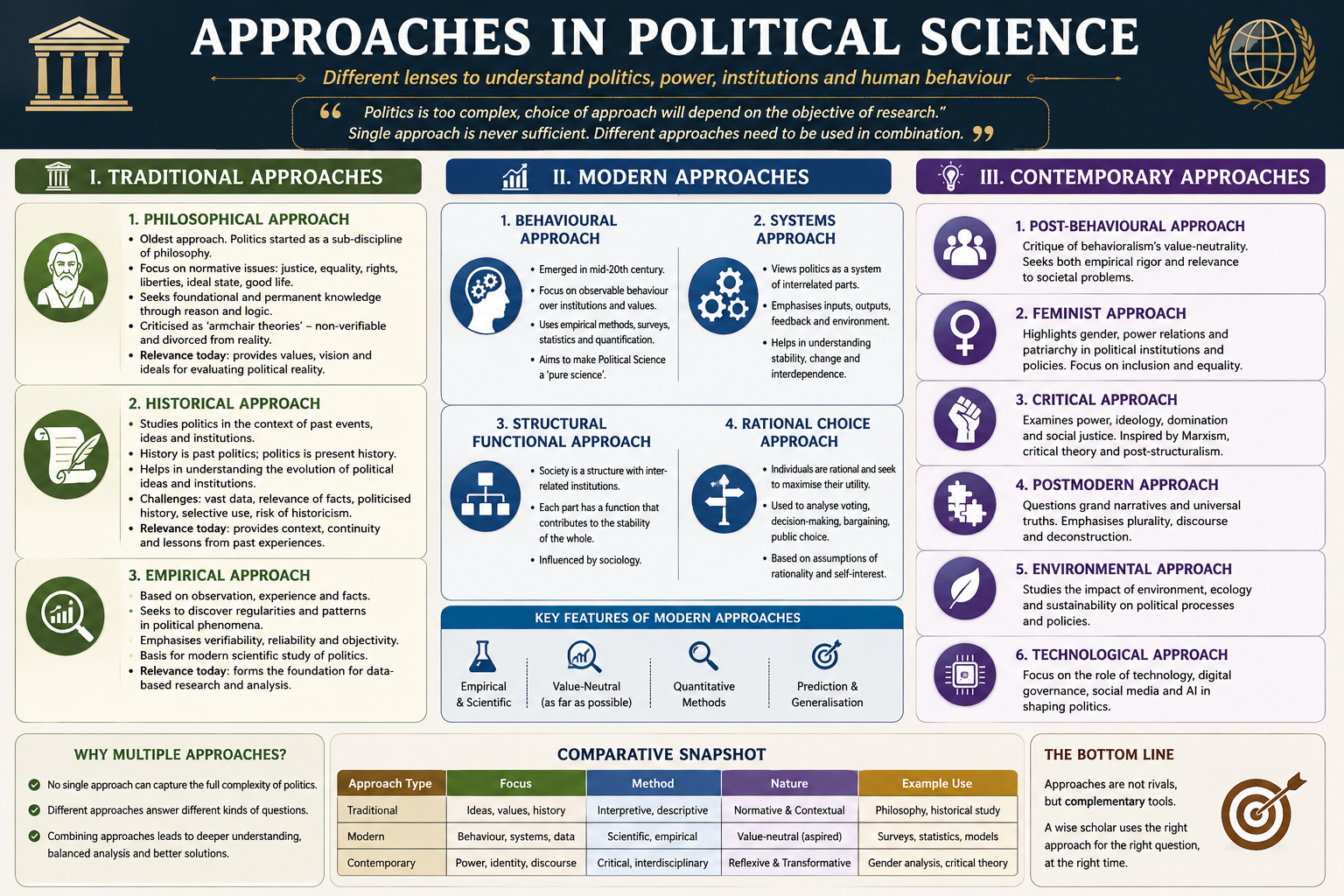
| Phase | Core Thesis & Critique | Key Thinkers & Seminal Works |
|---|---|---|
| Decline (1950s) | Political theory was declared “dead” or dying due to excessive historicism, positivism, and the obsession with value-neutral data collection that avoided major moral dilemmas. | David Easton (The Political System, 1953) Alfred Cobban (The Decline of Political Theory, 1953) Peter Laslett (Philosophy, Politics and Society, 1956) |
| Resurgence (1970s–Present) | Restoration of normative political philosophy addressing urgent social justice, inequality, and democratic legitimacy; triumph of substance over technique. | John Rawls (A Theory of Justice, 1971) Isaiah Berlin (Does Political Theory Still Exist?, 1962) Jürgen Habermas, Sheldon Wolin, Robert Nozick |
Is Political Science a Science, a Philosophy, or an Art?
Disciplines are usually sorted by their epistemology and ontology into the scientific, the philosophical and the applied or artistic. Political science has been claimed for all three, and the claim made determines which approach looks appropriate.
- Philosophy, for Strauss and those who follow him: the discipline originated as political philosophy, its central questions are questions of value, and philosophical method is therefore the fitting one.
- Science, for behaviouralists, positivists and empiricists: the discipline should seek law-like generalisations on the model of natural science.
- Even Easton eventually conceded the limits, settling for political science as an applied science rather than a pure one.
- Art, in Machiavelli’s conception: politics is an art and political theory is statecraft — the management of power, learned by practice and example rather than deduced.
- Interpretation, for post-modernists: theories are neither philosophy nor science but readings, which makes the discipline interpretative by nature.
- The decisive structural argument against pure science is linguistic. Political scholars work with human language rather than symbols, and language is sufficiently open-textured that the discipline cannot secure consensus even over its own terminology — as the failure to define behaviouralism itself demonstrated.
- What is not in dispute is the discipline’s utility and its distinctively democratic character: debate is the heart of politics, and therefore of any theory about it.
The Indian Context: Political Theory in Non-Western Societies
India is not a late recipient of these debates but a place where each of them was fought out with unusual sharpness, because a new state was simultaneously writing a constitution, running elections on an unprecedented scale, and building a discipline.
India’s Own Behavioural Moment
- Rajni Kothari founded the Centre for the Study of Developing Societies in 1963, and its early work was pioneering empirical research on Indian politics on exactly the model behaviouralism prescribed.
- His Politics in India was the first systematic study of the national political system by an Indian scholar, and it applied structural-functionalism directly.
- He then abandoned that framework in later work — a rejection from inside Indian political science that mirrors Easton’s own reversal.
- The National Election Studies, running since 1967 and unbroken since 1996, are the largest sustained programme of behavioural research anywhere in the developing world.
- The 2024 NES covered 19,663 respondents in its post-poll round across 23 states and union territories and 191 constituencies, with a pre-poll round of 10,019.
- This is the strongest evidence that behaviouralism’s techniques survived its philosophy: nobody defends value-free political science today, and everybody uses the survey.
- The centre then executed its own post-behavioural turn, moving to a profound questioning of Western modernity and a search for alternative, non-modern paradigms.
- Nandy’s The Intimate Enemy on the psychology of colonialism, Sheth on caste and democracy, and Kakar on indigenous healing traditions are the landmark works of that shift.
- The indigenisation debate that followed remains unresolved: whether Indian social science needs concepts generated from Indian experience (such as classical traditions in Dharmashastra or Kautilya’s Arthashastra, and modern radical alternatives like M.N. Roy‘s Radical Humanism), or whether “indigenous” categories risk becoming a nativism that insulates claims from criticism.
The Poverty of Indian Political Theory
- Bhikhu Parekh’s essay on the poverty of Indian political theory poses the question directly: why has a country of enormous philosophical richness, a free press and a working democracy produced so little original political theory since independence?
- His method is to identify the major problems thrown up by independent India’s political development, show that they have been inadequately theorised, and then ask why.
- He defines political theory broadly, to include sociologists, historians and economists addressing fundamental political questions — and finds the deficit across all of them, not just among political theorists.
- Political theory on his account is conceptual, defining and distinguishing concepts; explanatory, making sense of political life; and normative, judging arrangements. Indian scholarship has been strongest on the second and weakest on the first and third.
- The contrary evidence deserves equal weight, and the debate is more interesting than the thesis alone.
- The Constituent Assembly Debates are a sustained exercise in normative political theory conducted in public — on representation, minority rights, property, and the relation of directive principles to enforceable rights.
- Ambedkar‘s argument about the insufficiency of political democracy without social democracy is conceptual work of the first order, not applied politics.
- Gandhi‘s Hind Swaraj is a normative critique of modern civilisation that predates the post-colonial canon by six decades.
- Partha Chatterjee distinguishes civil society, the domain of citizens holding formal rights, from political society, where populations negotiate with the state through claims that are not strictly legal.
- This is a concept generated from Indian material that has since travelled worldwide — precisely the kind of theorising Parekh found missing.
Approaches Applied to Indian Politics
- The legal-institutional approach dominated the study of Indian politics for the first two decades and still supplies its vocabulary — quasi-federalism, parliamentary sovereignty, judicial review.
- It could describe the design but not the working, which is why the “envisaged role and actual working” formulation runs through the rest of the syllabus.
- The behavioural approach was most productive precisely here, in a system where constitutional text and political context diverge sharply.
- Its signal contribution was the study of caste as a political resource rather than a social survival — it is not that politics gets caste-ridden, but that caste gets politicised.
- The political culture frame maps onto Indian experience with unusual neatness.
- A largely subject political culture ran through the early decades, with elites constrained by anticipated popular reaction — one reason economic reform was deferred for so long.
- It gave way to markedly participant behaviour as turnout among the poor and the lower castes overtook that of the well-off.
- Post-colonial and subaltern approaches are India’s most substantial export to political theory — the one place where Indian scholarship sets the international agenda rather than following it.
Where the Discipline Stands Today
- The fact-value dichotomy is no longer a wall but a working boundary, and the current methodological debate is about how to combine the two rather than whether to.
- Recent work in political theory journals argues explicitly for a hybrid empirical-normative methodology, on the ground that normative theory which ignores feasibility is idle and empirical work which suppresses its normative premises is dishonest about them.
- A quantitative turn returned in the twenty-first century under a different name — the credibility revolution, built on experiments and design-based causal inference rather than on the survey.
- A study of over 91,000 articles across 156 journals for the period 2003–2023 finds that design-based research has grown and is cited more, while model-based work relying on strong assumptions has declined.
- But the shift is concentrated in top-tier journals and elite institutions, is driven largely by survey experiments, and leaves basic credibility practices such as placebo tests and power calculations uncommon. The authors’ verdict is “substantial but selective change, more consistent with a partial reform than a revolution”.
- The Eastonian question returns in a new form: a discipline can now identify causal effects with real confidence and still be unable to say which effects are worth identifying.
- The decolonising agenda has moved from critique to curriculum, with comparative political theory arguing that the canon should be plural in its sources, not merely self-critical about its provinciality.
- The relevance question is sharper than in 1969, not softer.
- Climate breakdown, artificial intelligence, democratic backsliding and deep inequality are all problems where the empirical evidence does not settle the political choice.
- That is Berlin’s argument arriving in a new century with better data and exactly the same structure.
Frequently Asked Questions (FAQs): Political Theory Meaning & Approaches
Conclusion & UPSC Answer Writing Key Takeaways
The history of this topic is a pendulum with a ratchet. It swings between the normative and the empirical — philosophy, then behaviouralism, then the credo of relevance, then the credibility revolution — but each swing leaves behind a technique or a scruple the discipline does not surrender.
- Behaviouralism lost its philosophy and kept its survey.
- Post-behaviouralism lost the claim to value-neutrality and kept the methods.
- New institutionalism recovered the state without giving up the behavioural critique of formalism.
What survives every swing is Berlin’s point, which is not a methodological position but a fact about political life: people disagree about ends, those ends genuinely conflict, and no technique can adjudicate between them. That is why political theory could be pronounced dead and go on being written, and why the approaches are not a menu to choose from but a set of instruments, each seeing what the others cannot.
Political theory does not survive because its questions are unanswerable; it survives because its questions are unavoidable.
UPSC Mains Previous Year Questions (PYQs): Political Theory
- Provide a comparative analysis of behavioural and institutional approach to the study of Political theory. (2025)
- Explain the Philosophical approach to the study of Political theory. (2025)
- Elucidate the meanings inherent in the term ‘political’ with appropriate illustrations. (2024)
- Write approximately 150 words on Behavioural approach to Political Science. (2024)
- ‘Credo of Relevance’ in post behavioralism advocates the importance of action science. Analyze. (2023)
- Comment on decline of political theory. (2023)
- Comment on normative approach in political science. (2023)
- Write on the Systems Approach. (2022)
- Examine the importance of behavioural approach in political theory. What led to its decline? (2021)
- Discuss the significance of normative approach to Political theory. (2020)
- Comment: Resurgence of the political theory. (2019)
- Comment in 150 words: Decline of Political Theory. (2018)
- Comment: The Post-Behavioural Approach. (2016)
- Discuss David Easton’s model of systems analysis. (2015)
- Comment in 150 words: “… Political theory is not an escape mechanism but an arduous calling.” (John Plamanetz) (2014)
- Comment on difference between normative and empirical theories of politics. (150 words) (2012)
- Examine the significance of the behavioural revolution in politics. (2011)
- Comment: “Political Theory is, quite simply, man’s attempts to consciously understand and solve the problems of his group life and organization… It is the disciplined investigation of political problems… not only to show what a political practice is, but also to show what it means. In showing what a practice means, or what it ought to mean, political theory can alter what it is.” (Sabine). (2009)
- Explain the changing analytical perspectives in the development of political theory. (2008)
- Examine the arguments in ‘the Normative vs. Empirical debate‘ in the study of political theory. (2002)
- Comment: Relevance of contextualist approach to the study of political theory. (2001)
- “Post-behaviouralism is not a negation of the behavioural revolution but only its corrective.” How does it seek to raise the status of the discipline of Political Science? (2000)
- Critically evaluate and bring out the weakest aspects of behavioural and post-behavioural approaches to the analysis of political system. What measurable and quantifiable criteria are available in political science to evaluate political behaviour? (1999)
- “A scientific politics can develop only if the materials of politics are treated in terms of systems of actions.” In the light of this statement of Kaplan with regard to application of systems theory to political science, critically examine the drawbacks of its application. (1999)
- What is meant by “behavioural approach” to politics? Is it a fool-proof approach? How far is it correct to say that the behavioural approach to political analysis appeared in order to counteract the Marxist approach? (1998)
- Discuss the importance of the Systems Theory in modern political analysis. (1997)
- Discuss the basic assumptions of behaviouralism. In what way post behaviouralism differs from behavioural theory? (1996)
- Examine the fact-value dichotomy in political science. To what extent has post behaviouralism resolved the conflict in the dichotomy? (1995)
- Examine the place of ‘obligation‘ in political theory. (1995)
- What is the nature of the crisis in political theory? Suggest remedies to overcome it. (1994)
- Estimate the utility of the systems theory in social sciences. (1993)
- Examine the limitations of Behaviouralism as an approach to the study of politics. (1992)
- ‘Political Science is a master-science, “architectonic” in its character, from which all other practical sciences take their cue’ (Ernest Barker). Discuss. (1991)
- Discuss the Normative and Behavioural Approaches to the study of political science and examine the limitations of Behavioural Approach. (1991)
Next Steps for PSIR Optional Preparation (UPSC 2027)
Political Theory is Unit 1 of Paper 1 (Section A). To build high-scoring, multi-dimensional answers with thinker citations and contemporary examples, explore our structured resources:
- Complete Syllabus Index: Browse all 230+ topic-wise notes on our PSIR Optional Notes Portal.
- Next Syllabus Topic: Continue to Topic 2: Theories of the State (Liberal, Neoliberal, Marxist, Pluralist, Postcolonial & Feminist).
- Download All 4 Sections: Get the complete, updated PSIR Optional Complete Notes PDF (Paper I + Paper II).
- Topic-Wise PYQ Solutions: Practice with 30+ years of solved papers in the PSIR Topic-Wise Question Papers Book.
Syllabus unit: Political Theory: Meaning and Approaches
PSIR Optional study material from LotusArise IAS
Two ways to prepare with us — the full self-study system, or just the notes you need right now.
| What you get | PSIR Mains Master Kit 2027 | PSIR Complete Notes (Store) |
|---|---|---|
| Paper 1 notes — Political Theory + Indian Government and Politics | Included | Included — Section A and Section B |
| Paper 2 notes — Comparative Politics and India and the World | Included | Included — Section A and Section B |
| Topic-wise PYQ bank | 1986–2026, with trend analysis and probables by Dec 2026 | 1991–2025 question papers, free with every notes pack |
| Practice question set for timed answer writing | ✅ Available now | ❌ |
| Answer toolkit — intros, conclusions, frameworks, thinker and example banks | By Dec 2026 | ❌ |
| Revision booklets for the last 60 days | ✅ Available now | ❌ |
| Format | Online articles + PDF | PDF download |
| Access | Valid until UPSC CSE Mains 2027 | Instant download after payment |
| Price | ₹1,770 (regular ₹5,000) | ₹1,180 for all four sections · ₹599 a paper · ₹354 a section |
| Best for | Aspirants who want the whole system in one place | Aspirants who want the notes now, in the parts they need |

Thank you sir
Notes are very well organized
thank you team
also please consider providing notes of comparative politics
Refer this PSIR page: https://lotusarise.com/optional/psir-political-science-optional-notes-upsc/