

The Green Revolution is the most consequential technological intervention in independent India’s history, and also the most contested. It ended famine as a policy problem and it created a class of prosperous farmers who went on to break the party system that had produced them. Almost every claim about it is true and its opposite is also true somewhere in India, which is why the topic rewards precision about where, when, for whom and at what cost rather than a verdict of success or failure.
What the Green Revolution Actually Was

- The Green Revolution was not a seed; it was a package. The core innovation was short-strawed, fertiliser-responsive, photoperiod-insensitive cereal varieties — but those varieties yield nothing extraordinary without controlled water, heavy nutrient application and a guaranteed price at harvest.
- Traditional tall varieties lodged — they fell over — when heavily fertilised, so nutrient application beyond a low threshold reduced rather than raised output. Dwarfing genes broke that ceiling, allowing the plant to convert nutrients into grain rather than straw.
- The technical term for what followed is a shift from area-led to yield-led growth. Until the 1960s Indian foodgrain output rose mainly because more land came under the plough; after 1966 it rose mainly because the same land produced more.
- It was therefore a strategy of “betting on the strong” — concentrating scarce inputs on the districts with assured irrigation and on farmers who could finance the package, rather than spreading them thinly across the whole country. That choice explains both the speed of the result and the shape of the grievance.
Getting the dating right
The precursor programmes are routinely collapsed into the Green Revolution itself, but they are distinct phases with distinct logics.
| Phase | Years | What it did | Why it is not the Green Revolution |
|---|---|---|---|
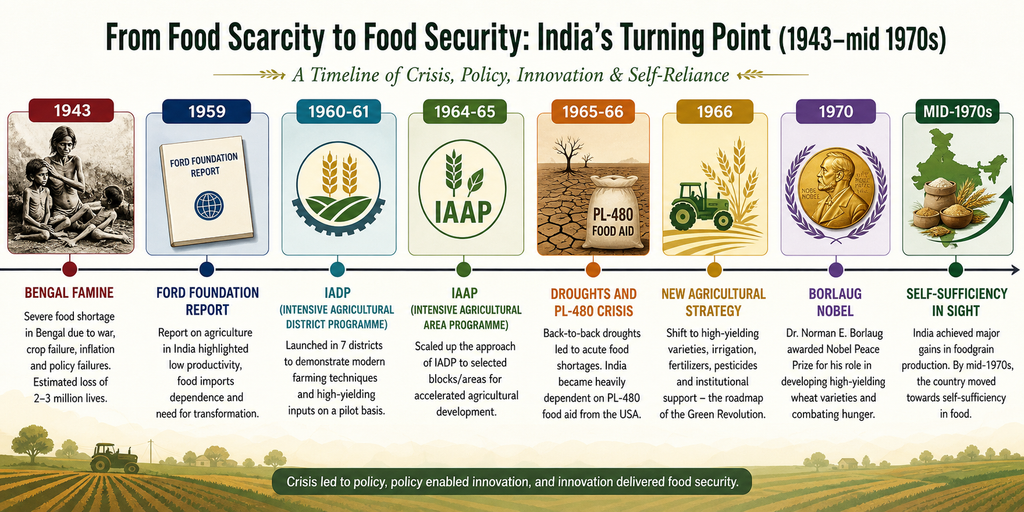
| Intensive Agricultural District Programme (IADP) | 1960-61 onward | Seven districts chosen for assured water and low disaster risk, given a concentrated package of credit, extension, fertiliser and improved local seed; extended to fifteen-sixteen districts by 1963-64 | Worked with existing tall Indian varieties; the yield ceiling was never broken |
| Intensive Agricultural Area Programme (IAAP) | 1964-65 | Extended the intensive-input approach to roughly 114 districts and to specific crops within them | Same technology, wider geography; still no dwarf germplasm |
| New Agricultural Strategy / High Yielding Varieties Programme | 1966 | Import of Mexican dwarf wheat and IRRI dwarf rice, backed by price guarantee, procurement and a new institutional apparatus | This is the Green Revolution proper — new genetic material plus a new incentive structure |
- IADP and IAAP were the delivery system the Green Revolution later used, and that is their real significance. They built the district-level extension machinery, the credit linkages and the administrative habit of concentrating inputs; when the dwarf seed arrived in 1966 there was already a channel to push it through.
- Dating the Green Revolution to 1961 therefore describes the plumbing rather than the water. Dating it to 1966 describes the technological and policy break. The honest formulation is that the Green Revolution began in 1966 on foundations laid from 1960-61.
Why India Had No Choice: The Pre-History
The Green Revolution is usually taught as a technological event. It is better understood as a political response to a humiliation. By 1966 India was importing roughly a tenth of its foodgrain consumption from a single foreign government that had begun to release shipments in monthly instalments tied to Indian policy behaviour. Food dependence had become a constraint on foreign policy, and the strategy that followed was designed at least as much to end that dependence as to end hunger.
Colonial stagnation and its arithmetic
- Foodgrain output in British India grew at close to zero for the first half of the twentieth century — the standard estimate is roughly 0.1 to 0.3 per cent a year for foodgrains between 1891 and 1946, against population growth that accelerated after 1921.
- Per capita foodgrain availability actually declined across the same period, sharply so in Bengal and eastern India.
- The colonial revenue systems described in the companion treatment of land reform were the structural cause: permanent settlement removed any incentive on the rentier to invest, while ryotwari extraction left the cultivator without a surplus to invest with.
- Colonial agricultural policy was extractive and commercial, not productive. Investment went into canal irrigation in Punjab and Sind and into plantation and export crops — indigo, jute, tea, cotton, opium — rather than into foodgrain yields.
- The one significant exception, the canal colonies of west Punjab, is a genuine ancestor of the Green Revolution: it created the irrigation base and the commercial-farming culture that the east Punjab districts inherited after Partition.
The shadow of 1943
- The Bengal famine of 1943 killed between two and three million people and did so with a food availability decline that was modest or absent — the classic demonstration, later formalised by Amartya Sen, that famine is a failure of entitlement and distribution rather than simply of harvest.
- Its political legacy was decisive. The famine occurred under an imperial government that had prioritised war supply, and the independence movement absorbed it as evidence that self-rule and food security were the same project. The Grow More Food campaign of 1943 was the colonial state’s belated and largely ineffective response.
Agriculture’s neglect in the Second and Third Plans
- The First Plan (1951-56) was agriculture-heavy — irrigation and agriculture took roughly a third of outlay, the Bhakra, Hirakud and Damodar Valley projects were begun, and output responded well, partly because it was recovering from a low base and partly because rainfall cooperated.
- The Second Plan (1956-61) shifted decisively to heavy industry on the Mahalanobis logic that capital-goods capacity determines the long-run growth ceiling. Agriculture’s share of plan outlay fell sharply, and the sector was expected to grow through institutional change — land reform and cooperatives — rather than through technology and inputs.
- The assumption was that redistribution would release production: give the tiller security, and output would follow. The land-reform record made that assumption untenable. Ceilings were evaded, tenancy reform was patchy, and cooperative farming — pushed hard at the Nagpur session of the Congress in 1959 — collapsed against the political resistance of landholders.
- The Third Plan (1961-66) restored agriculture rhetorically, not in resources, and it ended in the worst agricultural crisis since independence.
- The lesson the planners drew was blunt: since institutional change could not be delivered politically, production would have to come from technology instead. That substitution — technology in place of redistribution — is the origin of both the Green Revolution’s success and the deepest criticism of it.
The 1959 diagnosis
- The Ford Foundation agricultural production team’s 1959 report, India’s Food Crisis and Steps to Meet It, is the pivotal document. It warned that India faced a foodgrain shortfall of catastrophic proportions by the mid-1960s and that incremental improvement would not close it.
- Its prescription was concentration rather than dispersal: pick districts with assured irrigation and good soils, and give them the whole package of inputs, credit, extension and price incentive simultaneously.
- IADP was the direct implementation of that recommendation, launched in 1960-61 in seven districts — including Ludhiana, Thanjavur, West Godavari, Shahabad, Aligarh, Raipur and Pali — chosen precisely for low rainfall risk and existing irrigation.
- The report also marks the entry of American philanthropic and governmental agencies into Indian agricultural policy, which is the evidentiary basis for the Cold War reading of the Green Revolution examined later in this article.
1965-66: drought, war and the short tether
- Two consecutive monsoon failures in 1965-66 and 1966-67 cut foodgrain output from about 89 million tonnes in 1964-65 to roughly 72 million tonnes in 1965-66, with acute distress in Bihar, eastern UP and Odisha.
- The wars compounded it. The 1962 war with China and the 1965 war with Pakistan diverted resources, hardened the strategic case for self-reliance, and coincided with American displeasure at India’s position on Vietnam and its non-alignment.
- PL-480 — the United States Agricultural Trade Development and Assistance Act of 1954 — allowed India to buy American wheat with rupees rather than scarce dollars. By the mid-1960s imports approached 10 million tonnes a year, and Indian officials described the position as “ship-to-mouth”: grain moved from the dock to the ration shop with almost no buffer in between.
- President Lyndon Johnson’s “short tether” policy replaced long-term food agreements with month-by-month releases, personally cleared, and explicitly linked to Indian agricultural policy reform, family planning commitments and, in practice, to political compliance.
- The humiliation was the political trigger. Food aid had converted a shortage into a lever, and the Indian state’s response was to remove the lever rather than to argue about its use.
- Indira Gandhi’s 1966 Washington visit and the devaluation of the rupee in June 1966 belong to the same episode, and the domestic backlash against both sharpened the determination to become self-sufficient.
“The green revolution has won a temporary success in man’s war against hunger and deprivation; it has given man a breathing space.” — Norman Borlaug
The Authors of the Strategy
- C. Subramaniam, Food and Agriculture Minister from 1964, is the political author. He carried the new strategy against genuine cabinet and parliamentary opposition — from those who saw imported seed as dependence, from Gandhians who objected to chemical-intensive farming, and from planners defending the institutional-change model.
- He staked his office on the seed import, obtaining approval for the purchase of roughly 18,000 tonnes of Mexican wheat seed in 1966, at the time the largest seed transaction in history.
- He also secured the price guarantee, understanding correctly that no cultivator would adopt a costly package without assurance that a bumper harvest would not collapse the price.
- B. Sivaraman, Secretary in the Ministry of Food and Agriculture, is the administrative author — the official who converted the strategy into procurement schedules, fertiliser allocations, credit lines and district targets.
- M.S. Swaminathan, then at the Indian Agricultural Research Institute, is the scientific author on the Indian side. He identified the potential of the Mexican dwarf material, adapted it to Indian conditions and Indian consumer preference for amber grain, and organised the national demonstration programme that convinced cultivators.
- Norman Borlaug, working in Mexico, bred the semi-dwarf, rust-resistant wheats that made the whole thing possible, and received the Nobel Peace Prize in 1970 for it.
- The varieties themselves matter: Lerma Rojo 64A and Sonora 64 in wheat, later improved into Indian selections such as Kalyan Sona and Sonalika; and in rice, IR-8 from the International Rice Research Institute in the Philippines, the “miracle rice” that doubled yields where water was controlled but was widely disliked for its coarse grain and cooking quality.
- The New Agricultural Strategy was formally adopted in 1966, operationalised as the High Yielding Varieties Programme covering wheat, rice, maize, jowar and bajra, initially on about 1.9 million hectares, expanding to over 15 million hectares within five years.
“Exploitive agriculture offers great dangers if carried out with only an immediate profit or production motive. Intensive cultivation of land without conservation of soil fertility and soil structure would lead, ultimately, to the springing up of deserts.” — M.S. Swaminathan
That warning was issued in 1968, at the moment of triumph, by the strategy’s own principal scientist. The ecological critique of the Green Revolution is not a retrospective judgement imposed by later environmentalists; it was internal to the project from the beginning.
The Package, Stated as a Package
The analytical point that a list of inputs obscures is that the elements are complements, not substitutes. Seed without water fails; water without fertiliser under-performs; fertiliser without a guaranteed price is an unacceptable risk; and none of it is adoptable without credit. This is why the technology spread as a bloc into districts that already had all the preconditions, and barely at all into districts missing even one.
| Element | What it supplies | What happens without it |
|---|---|---|
| High-yielding dwarf varieties | The raised yield ceiling | Fertiliser causes lodging; output plateaus |
| Assured, controlled irrigation | Water on schedule, not on monsoon | HYVs perform worse than local varieties under stress |
| Chemical fertiliser | Nitrogen, phosphorus, potassium at high doses | The dwarfing advantage is never realised |
| Pesticides and herbicides | Protection of a genetically uniform monoculture | Uniformity becomes vulnerability |
| Mechanisation | Timeliness — tractors, tubewells, threshers, combines | Multiple cropping is impossible; the second crop misses its window |
| Institutional credit | The working capital to buy the package | Only the already-wealthy can adopt; or the moneylender captures the gain |
| Price and procurement guarantee | Downside protection against a good harvest | Rational cultivators do not adopt a costly, risky technique |
- Irrigation is the binding constraint of the whole system. The HYVs are not drought-tolerant; they are input-responsive. Under water stress they can yield less than the hardy local landraces they replaced, which is exactly why rain-fed India stayed out.
- Private tubewells, not canals, did most of the work. Canal command areas gave the initial base, but the explosive growth came from energised tubewells drawing groundwater on demand, which is also the origin of the ecological crisis three decades later.
- Timeliness explains mechanisation better than labour-saving does. The wheat-paddy rotation in Punjab leaves a window of days between harvesting one crop and sowing the next; the tractor and the thresher buy that window, and the combine harvester compresses it further.
The institutional scaffolding
- The Agricultural Prices Commission, established in 1965 — renamed the Commission for Agricultural Costs and Prices in 1985 — recommends the minimum support price on the basis of costs, demand and supply, price parity and terms of trade.
- It now recommends MSP for 23 crops: seven cereals, five pulses, seven oilseeds and four commercial crops. Fourteen kharif crops received revised MSPs for the 2026-27 marketing season, with paddy (common) at ₹2,441 per quintal.
- Since the 2018-19 Budget announcement, MSP is set at at least 1.5 times the A2+FL cost of production — that is, paid-out costs plus imputed family labour. The distinction from C2, which additionally imputes rent on owned land and interest on owned capital, is the entire content of the farm-movement demand and is dealt with below.
- The Food Corporation of India, created under the Food Corporations Act 1964 and operational from January 1965, does the physical work: procurement, storage, movement and issue to the states. MSP without a procuring agency is an announcement, not a price.
- Procurement, buffer stock and the public distribution system are one machine. Procured grain becomes the buffer; the buffer feeds the PDS; the PDS is what converts an aggregate surplus into individual food security.
- The National Food Security Act 2013 converted this from a scheme into a legal entitlement covering up to 75 per cent of the rural and 50 per cent of the urban population, and it is only affordable because the Green Revolution made grain domestically available.
- The machine has a defect that has become a burden: procurement concentrated in the surplus states means that the price incentive keeps reinforcing wheat and paddy in exactly the regions where their ecological cost is highest.
- The research and education apparatus was rebuilt for the purpose. The Indian Council of Agricultural Research was reorganised in 1965-66 with an expanded mandate over research and coordination; state agricultural universities on the American land-grant model — the first at Pantnagar in 1960, followed by Ludhiana, Hyderabad, Coimbatore and others — fused teaching, research and extension in a single institution; Krishi Vigyan Kendras from 1974 carried the results to the field.
- The National Seeds Corporation (1963) and the Seeds Act 1966 created a certified-seed industry where none existed, since the new varieties degenerate and must be replaced rather than saved.
- Credit was restructured around the package. Cooperative credit was supplemented by social control and then bank nationalisation in 1969, with priority-sector lending obligations, regional rural banks from 1975, and finally NABARD in 1982 as the apex refinancing institution for rural credit. The Kisan Credit Card, introduced in 1998, is the current retail instrument.
- The fertiliser retention-price scheme, introduced in 1977, guaranteed each domestic manufacturer a return on its own cost structure, which built self-sufficiency in urea at very high fiscal cost and very low efficiency incentive. It was replaced for phosphatic and potassic nutrients by the Nutrient Based Subsidy regime in 2010, while urea remained under a controlled maximum retail price — the source of the nutrient imbalance discussed below.
- The fiscal scale is now enormous: the fertiliser subsidy allocation for 2026-27 is about ₹1.71 lakh crore, of which roughly ₹91,000 crore subsidises indigenous urea and ₹54,000 crore the nutrient-based subsidy on phosphatic and potassic fertilisers.
The Green Revolution was less an agronomic discovery than an act of institution-building; the seed was the easy part.
What It Achieved
- The headline transformation is real and should not be diluted by the criticism that follows. Foodgrain output has risen from roughly 50.8 million tonnes in 1950-51 to a record 376.56 million tonnes in 2025-26 on the third advance estimates, an increase of more than seven times against a population increase of about four times.
- Wheat is the genuine revolution. Output rose from about 12 million tonnes in the mid-1960s to nearly 24 million tonnes by 1970-71 — a near-doubling in five years, which is why the word “revolution” is defensible — and stands at 120.65 million tonnes in 2025-26.
- Rice is the qualified case. Output has risen from roughly 35 million tonnes in the mid-1960s to 154.02 million tonnes in 2025-26, but the gains came later, more slowly and much more unevenly.
| Dimension | Wheat | Rice |
|---|---|---|
| Speed of response | Immediate — dramatic gains within five years | Delayed — significant only from the late 1970s |
| Geography | Concentrated and near-total in Punjab, Haryana, western UP | Dispersed; the eastern rice heartland largely missed out |
| Water regime | Grown in the rabi season under controlled irrigation — ideal for the package | Grown largely in the kharif under variable flooding — the package fits badly |
| Varietal fit | Mexican material adapted readily to north Indian conditions | IR-8 was pest-susceptible and unpopular for grain quality; local adaptation took two decades |
| Holding structure | Larger average holdings, easier input financing | Small and fragmented holdings, widespread tenancy in the east |
| Verdict | A genuine yield revolution | An extended evolution, still incomplete in eastern India |
- Famine ended as a policy problem. India has had severe droughts since 1966 — 1972, 1979, 1987, 2002, 2009, 2015-16 — and has had no famine. The combination of domestic buffer stocks, a national procurement and movement network, and democratic pressure through a free press explains this, and Sen’s argument about famine and democracy applies precisely here.
- Self-sufficiency was reached by the mid-1970s. Large-scale concessional food imports ceased in the early 1970s; India has since been a net exporter of cereals, and is among the world’s largest rice exporters.
- Growth rates changed character. Foodgrain output growth accelerated to roughly 2.5 to 3 per cent a year in the Green Revolution decades against near-zero in the colonial period, and agricultural and allied growth is estimated at 3.1 per cent in 2025-26.
- The strategic argument is the least discussed and among the strongest. Ending food-import dependence removed a lever that a foreign government had demonstrably been willing to use. The 1974 nuclear test, the 1971 intervention in East Pakistan and the refusal to sign the NPT were all made easier by the fact that India was no longer waiting on a grain ship.
- The rural economy diversified because of the surplus. Higher farm incomes in the Green Revolution belt generated demand for consumer goods, transport, construction and services — the multiplier that Bhalla and others document and that made Punjab, for two decades, the highest per capita income state in India.
The Costs
The costs are not a footnote to the achievement; they are its structure. Every one of them follows logically from the choice to concentrate a capital-intensive package where the preconditions already existed. They are set out here on five distinct axes because they operate independently — a policy fix for one does not touch the others.
Regional concentration
- The package required assured water, so it went where assured water already was. Punjab, Haryana and western Uttar Pradesh — with the canal network inherited from the colonial period, alluvial soils, and a cultivating community already commercially oriented — absorbed a wholly disproportionate share of the gains.
- Punjab’s paddy area rose from roughly 2.3 lakh hectares around 1960 to over 30 lakh hectares now, in a state that is not naturally rice country and whose traditional kharif crops were maize, cotton, groundnut and pulses.
- Punjab and Haryana together, on about 3.5 per cent of India’s cropped area, still supply a large share of the wheat and rice entering the central pool — the clearest single statistic on how narrow the base of national food security became.
- Eastern India — Bihar, eastern UP, Odisha, West Bengal, Assam — was left out, despite abundant water in aggregate, because that water arrives as floods and unregulated rainfall rather than as controlled irrigation, and because tenancy, tiny holdings and weak credit blocked the input package.
- Rain-fed India, roughly half the net sown area, was excluded almost by definition. The semi-arid Deccan, the central tribal belt and the dry zones of Rajasthan grow the crops the Green Revolution ignored, on land it could not reach.
- Inequality widened at two levels simultaneously — between states, as Punjab pulled away from Bihar; and within states, as irrigated districts pulled away from rain-fed ones in the same state, which is why Maharashtra contains both a sugar belt and Vidarbha.
- The later spread matters and is often omitted. From the late 1970s the technology reached coastal Andhra Pradesh, the Kaveri delta in Tamil Nadu, parts of Gujarat, and later central and western Uttar Pradesh and pockets of Madhya Pradesh — wherever tubewell irrigation and procurement arrived together. Madhya Pradesh’s wheat expansion after 2005, driven by procurement plus bonus, shows the mechanism still works wherever the incentives are supplied.
Class differentiation
- A capital-intensive technology distributes its gains in proportion to access to capital. The package cost money at sowing and returned money at harvest; the constraint was therefore not knowledge but financing, and financing tracks landholding.
- The immediate beneficiary was the substantial owner-cultivator with enough land to justify a tubewell, enough collateral for institutional credit and enough marketed surplus to interest a procurement agency — not the landlord living on rent, and not the smallholder.
- Tenants were the clearest losers. As land became far more profitable to cultivate directly, landowners resumed land for “personal cultivation” — a permitted exception in almost every state tenancy law — and evicted or informally displaced tenants and sharecroppers.
- This is the precise sense in which the Green Revolution reversed the gains of land reform. Tenancy did not disappear; it went oral, concealed and insecure, which stripped tenants of the recorded status that the reforms had been designed to give them.
- Rural indebtedness rose among small and marginal cultivators, who adopted the package under competitive pressure but on borrowed money and without the scale to absorb a bad year. V.K.R.V. Rao’s account of small and marginal farmers losing land to debt describes this mechanism.
- The counter-evidence deserves stating: several field studies, including G.S. Bhalla and G.K. Chadha’s work on Punjab cultivators, found that small farmers adopted the new varieties at rates comparable to large farmers — seed and fertiliser are divisible, unlike tractors — and that yields per hectare on small holdings were often higher.
- The reconciliation is that adoption was broadly neutral to scale while the accumulation of surplus was not. Everyone could plant the seed; only some could convert the proceeds into a tubewell, a tractor, a rice mill, a truck or their children’s education.
- The 2015-16 Agriculture Census records that about 86 per cent of operational holdings are below two hectares, on an average holding of roughly 1.08 hectares. A technology whose returns scale with holding size operates on a countryside where holdings are overwhelmingly tiny — that mismatch is the class question in one sentence.
Crop bias and the nutritional consequence
- The strategy was a cereal strategy, and within cereals a wheat strategy. Dwarfing genes existed for wheat and rice; they did not exist for pulses, oilseeds or millets, and the research and price system followed the technology rather than correcting it.
- Pulses were displaced twice over — pushed off irrigated land by wheat and paddy, and denied research attention. Per capita pulse availability fell from about 60 grams a day around 1950 to roughly 40 grams by the early 2000s, recovering only recently after a dedicated mission and sharp MSP increases.
- Coarse cereals and millets — jowar, bajra, ragi and the small millets — lost area continuously for four decades. They were the food of the dry regions and the poor, they are nutritionally superior in protein, fibre, iron and calcium, and they need a fraction of the water paddy needs.
- Oilseeds stagnated until the Technology Mission on Oilseeds of 1986 produced the “yellow revolution”, and the gain was later lost to import liberalisation; India today imports well over half its edible oil requirement, the clearest surviving hole in the self-sufficiency claim.
- The nutritional outcome is the paradox of the whole exercise: calories rose while dietary quality did not. India has cereal surpluses, buffer stocks and exports alongside persistent stunting, anaemia and micronutrient deficiency.
- NFHS-5 (2019-21) recorded 35.5 per cent of children under five stunted, 32.1 per cent underweight and 57 per cent of women aged 15-49 anaemic. These are not the numbers of a country short of grain; they are the numbers of a country short of protein, iron and dietary diversity.
- The policy chain is direct: MSP and procurement favour wheat and rice, PDS distributes wheat and rice, so relative prices and public purchasing power both push consumption toward the two crops the Green Revolution improved. The technology’s bias became the food system’s bias.
Ecological damage
- Groundwater depletion is the most serious and the least reversible cost. Punjab’s stage of groundwater extraction stands at 156.36 per cent — it withdraws more than half again as much as is annually recharged — with Rajasthan at 147.11 per cent and Haryana at 136.75 per cent, against a national average of about 60.6 per cent.
- Nationally, 730 of 6,762 assessment units (10.8 per cent) are classified over-exploited, with 201 critical and 758 semi-critical. In Punjab, over 110 of roughly 150 blocks are over-exploited — the aquifer under the Green Revolution’s own heartland is being mined.
- Free or flat-rate electricity for agricultural pumping, adopted across states from the 1980s for electoral reasons, removed the last price signal restraining extraction. The Punjab Preservation of Sub-Soil Water Act 2009, which pushes paddy transplanting later to align it with the monsoon, is a partial and much-copied corrective.
- Soil degradation followed intensive continuous cropping. In canal command areas with poor drainage, waterlogging and salinity took land out of cultivation; elsewhere, continuous nutrient mining produced deficiencies in zinc, sulphur, boron and iron, and organic carbon fell to low levels across much of the intensively farmed belt.
- Nutrient imbalance is a policy artefact. Because urea alone remains price-controlled while phosphatic and potassic fertilisers move with world prices under the nutrient-based subsidy, cultivators over-apply nitrogen. The applied NPK ratio has repeatedly drifted far from the agronomically recommended 4:2:1, in some states to extremes.
- The declining response ratio is the single most telling number on diminishing returns. In the early Green Revolution period roughly ten kilograms of additional grain were obtained per kilogram of fertiliser nutrient applied; the ratio has fallen to around three to four kilograms — more input for less output, which is the definition of an exhausted technology.
- Stubble burning connects Punjab’s fields to Delhi’s air. The combine harvester leaves standing paddy stubble, and the narrow window before wheat sowing makes burning the cheapest disposal; the smoke is a major seasonal contributor to the Indo-Gangetic plain’s winter particulate load.
- The trend has recently improved sharply — Punjab recorded about a 53 per cent decline in farm fires in the 2025 kharif season, and the reduction against the 2021 baseline is of the order of 90 per cent, achieved through crop-residue management machinery, ex-situ industrial use of straw and administrative penalties rather than through crop diversification.
- Pesticide residue in the cotton and paddy belts of Malwa in southern Punjab produced the phenomenon behind the popular name of the Abohar-Jodhpur passenger service — the “cancer train” carrying patients from Bathinda district to treatment in Bikaner. Causation is contested and heavy-metal contamination of drinking water is a competing explanation, but the association drove Punjab’s own pesticide regulation and cancer-registry response.
- Biodiversity loss is the quietest cost. Rice landraces once cultivated in India ran into the tens of thousands, and varietal uniformity creates epidemic vulnerability — the standard illustration being the grassy stunt virus episode in Asian rice, contained only by resistance found in a wild relative.
Employment, labour and migration
- Whether the Green Revolution destroyed or created agricultural employment is genuinely contested, and the answer depends on whether mechanisation or cropping intensity dominates in a given place and period.
- The labour-displacing case: tractors replaced draught animals and the labour that tended them; threshers eliminated the largest single labour operation in the wheat calendar; combine harvesters removed harvesting itself, historically the peak-demand operation; herbicides cut weeding, which was disproportionately women’s work.
- The labour-absorbing case: cropping intensity rose sharply as the same field carried two or three crops a year, transplanting paddy is extremely labour-intensive, higher yields mean more to harvest and handle, and irrigation, input application and marketing all generate work.
- The empirical resolution is sequential. Labour demand rose in the first phase, when intensification came before mechanisation; it flattened and then fell in the second, once combines and herbicides arrived in the 1980s and 1990s.
- Real wages are the contested measurement. Money wages rose steeply in Punjab and Haryana — this is not disputed. Whether real wages rose depends on the deflator, and the food-price inflation that accompanied the boom absorbed a substantial part of the nominal gain.
- Long-distance migration transformed the labour market. From the 1970s seasonal migrant labour from Bihar and eastern Uttar Pradesh — the very regions the Green Revolution had bypassed — moved into Punjab and Haryana for transplanting and harvesting.
- This is the most elegant illustration of regional inequality: the technology’s exclusion of eastern India supplied the cheap labour that the technology’s success in Punjab required.
- The social consequences were serious. Cheap in-migration capped the bargaining power that tight local labour markets would otherwise have given Punjabi labourers; the resulting resentment among local labour, much of it Dalit, is one strand in the deterioration of Punjab’s social order in the 1980s.
- It also dissolved the older jajmani relationship between cultivating and labouring households — a relationship that was hierarchical and often exploitative, but that carried obligations of subsistence support which the cash-wage market did not replace.
- Feminisation of agriculture followed the outmigration of men. Cultivation and farm labour fell increasingly to women, who bore the operational burden without corresponding land titles, credit, extension contact or decision-making authority — a gap between women’s share of the work and of recorded landholdings that persists.
The Scholarly Argument
This is the intellectual heart of the topic, and it is a genuine argument rather than a menu of criticisms. The disputants disagree about facts — did real wages rise? — about causation — did the technology cause Punjab’s militancy or merely coincide with it? — and about the counterfactual — what would have happened without it? Setting out the positions against each other is more useful than listing them.
The wage and bargaining-power debate
- G.S. Bhalla and G.K. Chadha are the strongest optimists on distribution. Their work on Punjab cultivators found that agricultural wages multiplied several times over in the Green Revolution belt, that labour’s bargaining power strengthened as demand outran local supply, and that small cultivators shared in the gains because seed and fertiliser are perfectly divisible inputs.
- Their broader claim is that absolute gains for the poor matter more than relative inequality: the Punjab agricultural labourer of 1985 was substantially better off in real consumption than his counterpart of 1965, even though the gap with the landowner had widened.
- S.S. Grewal supplies the systematic rebuttal, in three distinct moves, each a different kind of objection.
- First, an accounting objection: the increase in agricultural money incomes was substantially offset by inflation in food prices, so the real gain was far smaller than the nominal one.
- Second, a labour-market objection: whatever bargaining power tight local markets created was neutralised when landowners began importing cheap labour from Bihar and Uttar Pradesh. The employer’s response to scarcity was to widen the market, not to concede.
- Third, a social and political objection: migration itself carried costs — resentment among displaced local labourers, which fed into the rise of militancy in Punjab; and, once men left for other work, agriculture became the responsibility of women, who were more vulnerable because they had less access to information, credit and institutional support.
- The disagreement is partly definitional. Bhalla and Chadha measure outcomes for cultivating households in the peak decades; Grewal measures outcomes for labouring households net of prices and over a longer horizon. Both can be right about their own object of measurement, which is why the debate has never resolved.
V.K.R.V. Rao on the social and political price
- V.K.R.V. Rao framed the central proposition that the rest of the literature elaborates: the gains of the Green Revolution came at a substantial social and political cost.
- It widened the gap between rich and poor within the countryside, converting a differentiated but relatively flat agrarian structure into a sharply stratified one.
- It increased rural indebtedness, because small and marginal cultivators had to borrow to buy seed, fertiliser and implements that larger farmers financed from surplus.
- It reversed the process of land reform, with small and marginal farmers losing land — through debt and distress sale, and through the resumption of tenanted land for personal cultivation.
- Rao’s framing matters because it is not anti-technology. He does not argue that the yield gains were illusory; he argues that a distributive question was answered by default, and that the answer had political consequences the planners had not costed.
Francine Frankel and the polarisation thesis
- Francine Frankel’s India’s Green Revolution: Economic Gains and Political Costs is the foundational political-science study and the source of the framing that everything since has used.
- Her method was comparative fieldwork across districts at different stages of adoption and with different agrarian structures — Ludhiana in Punjab, West Godavari in Andhra, Thanjavur in Tamil Nadu, Burdwan in West Bengal and Palghat in Kerala — which is why her conclusions vary by region rather than generalising a single national outcome.
- Her core finding is polarisation: the new technology sharpened the distinction between those who owned enough land to benefit and those who did not, dissolved the vertical patron-client ties that had contained rural conflict, and produced a countryside organised around horizontal class interest rather than vertical dependence.
- Thanjavur is her demonstration case — a district where the technology, an entrenched landlord class and an organised labour movement produced open agrarian conflict rather than shared prosperity.
- Her wider argument, developed in later work, is about the Indian state itself: that accommodative politics — the practice of buying off every organised interest rather than confronting any — has repeatedly jeopardised the radical content of Indian policy. The Green Revolution is her strongest example of a policy that succeeded technically because it avoided the distributive fight.
Rudolph and Rudolph and the bullock capitalists
- Lloyd and Susanne Rudolph, in In Pursuit of Lakshmi, supply the most useful single concept in the literature: the “bullock capitalists”.
- They are self-employed cultivators on middling holdings — very roughly two and a half to fifteen acres — who own their means of production, work them mainly with family labour and bullock power, and produce a marketed surplus.
- They are defined by what they are not. They are not landlords, because they cultivate themselves and do not live on rent; they are not agricultural labourers or the landless, because they own their land; and they are not fully mechanised capitalist farmers, because their scale does not justify a tractor.
- The political consequence is the point. This class is numerically enormous, geographically dispersed, and located in the median constituency of northern and western India, which in a first-past-the-post democracy makes it the most electorally consequential group in the country.
- Its demands are sectoral rather than class-revolutionary: higher output prices, cheaper inputs, subsidised power and water, credit and debt relief. It seeks transfers rather than transformation.
- The Rudolphs read the Green Revolution as one cause of the end of the Congress system — a new, self-confident, organised rural interest that Congress could neither absorb through its old vote-bank machinery nor afford to ignore.
- They also connect it to the rise of regional and state-level parties, in prosperous and backward regions alike, and they record that the technology reversed the gains of land reform for the classes below the bullock capitalists.
- They add the caste dimension explicitly: the new agrarian prosperity strengthened rather than dissolved caste as a political resource, since the middle peasant castes were the class that benefited and caste supplied their ready-made organisational network.
Vandana Shiva and the ecological-epistemic critique
- Vandana Shiva’s The Violence of the Green Revolution is the most radical attack, and it is important to state it accurately because it is frequently reduced to an environmental complaint when its argument is epistemological.
- Her ecological claim: the strategy substituted monoculture for polyculture, chemical inputs for internal nutrient cycling and irrigation for rainfed adaptation, and thereby degraded soil, drew down water and destroyed the genetic diversity that had been the farming system’s insurance.
- Her epistemic claim is the more distinctive one: the Green Revolution treated peasant knowledge as ignorance and nature as deficient, replacing a system that had evolved over centuries with a laboratory package designed elsewhere. She calls the resulting displacement of local knowledge a form of “monoculture of the mind”.
- Her political claim concerns seed sovereignty: once seed must be bought rather than saved, the cultivator’s autonomy passes to the seed supplier, and the later extension of intellectual property to plant varieties completes the transfer.
- Her most contested claim links the Green Revolution to Punjab’s violence in the 1980s — arguing that ecological stress, agrarian frustration, cultural dislocation and centre-state conflict over water and revenue converged into militancy.
- The counter-arguments against her account are serious and belong in any honest treatment.
- On the counterfactual: she does not adequately answer what would have fed the population that the surplus fed. Projections of Indian food demand against pre-1966 yield trends imply either mass import dependence or mass hunger.
- On causation in Punjab: the militancy has substantial independent explanations — the Anandpur Sahib Resolution’s federal demands, river-water and territorial disputes with Haryana, the manipulation of religious politics for electoral advantage, and the sequence of central interventions. Prosperity, not immiseration, was the demonstrable condition of the region when militancy began, which is difficult to reconcile with a simple deprivation account.
- On agronomy: critics point out that some of her yield and diversity claims rest on selective comparison, and that traditional systems carried their own recurring famine risk, which is precisely what the new technology removed.
- On the class question: her framework locates the villain in technology and Western science, which under-weights the domestic class and caste structure that determined who captured the gains — the point the Marxist critics press.
- What survives the counter-arguments is substantial: the water crisis is real and worsening, the varietal narrowing is real, the seed-market dependence is real, and the epistemic point about displaced local knowledge has been vindicated by the current turn toward agro-ecology and natural farming.
The Marxist and distributive critics
- Utsa Patnaik approaches the question through class analysis rather than technology. Her “labour exploitation criterion” classifies agrarian households by whether they are net users or net suppliers of others’ labour, which produces a much sharper picture of differentiation than the standard size-of-holding classification.
- Her broader argument is that the Green Revolution accelerated capitalist differentiation in the countryside, converting rich peasants into agrarian capitalists and pushing marginal cultivators into the labour force, while leaving the underlying land question untouched.
- She has also argued forcefully that cereal surpluses and stagnant per capita foodgrain availability can coexist, because the surplus reflects deficient purchasing power among the poor rather than genuine abundance — the entitlement point applied to the post-Green Revolution economy.
- Pranab Bardhan’s contribution is the most directly political. In his account of the Indian political economy, the state is dominated by a coalition of three proprietary classes — industrial capitalists, rich farmers and the professional-bureaucratic elite — whose competing claims on public resources produce a stalemate resolved through subsidies to all.
- The Green Revolution manufactured the second of those classes. Once rich farmers existed as an organised national interest, the pattern of subsidy-heavy, investment-poor agricultural policy became structurally self-reinforcing: the coalition can agree on transfers and cannot agree on the investment or reform that would benefit some at others’ cost.
- T.K. Oommen examines the same process from sociology rather than economics: the transformation of rural social structure as ritual hierarchy gave way to economic stratification, the growth of agrarian mobilisation, and the emergence of unrest generated by rising rather than falling expectations — prosperity unevenly distributed produces more protest than uniform poverty does.
- The common thread among the distributive critics is that the poor distributive outcome, not the technology, produced the frustration and unrest, and that a technology introduced without a distributive settlement inevitably assumes the existing structure of ownership as its starting point.
The mode-of-production debate
- The mode-of-production debate ran through the 1970s and asked a question the technology forced: had Indian agriculture become capitalist? The Green Revolution supplied the evidence both sides used.
- The semi-feudal position, associated with Amit Bhaduri and others, held that the interlocked markets of the eastern countryside — where the same person is landlord, employer, creditor and buyer — created a structure in which the dominant class positively benefits from keeping productivity low, since technical improvement would free the tenant from dependence.
- Terry Byres argued that Indian agriculture was undergoing a real if partial capitalist transition, and supplied the distinction that made the debate tractable: capitalism from above, driven by landlords converting into capitalist farmers using wage labour and machinery, against capitalism from below, driven by accumulating rich peasants.
- His reading of India is that the transition was “from above” and incomplete — enough commercialisation to change class relations, not enough to generate the industrial dynamism that a classic agrarian transition delivers.
- His comparative point is the sharpest: Indian agriculture produced a surplus without producing a transformation, because the surplus was consumed, invested in land and moneylending, or converted into political influence rather than into industrial capital.
- Ashok Rudra found capitalist behaviour without a capitalist class in the strict sense, and the debate closed on the recognition that Indian agriculture is a hybrid — market-oriented and wage-employing, yet still organised around caste, family labour and tiny holdings.
Varshney, Lipton and the politics of the countryside
- Michael Lipton’s urban-bias thesis is the theoretical backdrop against which India’s experience must be read.
“The most important class conflict in the poor countries of the world today is not between labour and capital. Nor is it between foreign and national interests. It is between the rural classes and the urban classes.” — Michael Lipton
- His argument: development policy in poor countries systematically transfers resources from countryside to city — through overvalued exchange rates, cheap-food policies, terms of trade turned against agriculture and public investment concentrated in urban infrastructure — because urban interests are concentrated, articulate and close to power while rural interests are dispersed.
- Ashutosh Varshney’s Democracy, Development and the Countryside is the decisive rebuttal from the Indian case, and it is the most important political-science argument in this section.
- His observation: India’s countryside was supposed to be politically weak on Lipton’s model, and it was not. From the late 1970s the farm lobby extracted rising output prices, cheaper inputs, subsidised power, water and fertiliser, and repeated loan waivers.
- His explanation is electoral demography. In a democracy where a large majority of voters lived in villages, numbers substituted for concentration. Rural interests could not lobby quietly, but they could vote and they could obstruct, and both were sufficient.
- His crucial qualification, which is what makes the argument sophisticated: rural political power delivered price and subsidy transfers, not development. The countryside won on procurement prices and power tariffs and lost on rural education, health, roads and agricultural research investment.
- He also identifies why the countryside mobilises only intermittently: rural politics is expressed through caste, region and religion most of the time, and coalesces into a sectoral identity only when a price or subsidy issue is salient enough to override those cleavages.
- Together, Lipton and Varshney frame the political-economy question exactly: the Green Revolution created a rural constituency powerful enough to protect its output prices and its subsidies, and not coherent enough to demand the public investment that would have made the subsidies unnecessary.
The counter-insurgency reading
- A substantial international literature argues that the Green Revolution was promoted by American agencies as an alternative to redistributive land reform — the proposition that raising output would defuse the rural discontent that Communist movements fed on, and thereby make land redistribution unnecessary.
- Nick Cullather’s The Hungry World documents the American development apparatus’s Cold War logic in Asia; John Perkins’s work on the geopolitics of the Green Revolution traces the same reasoning through the foundations and the wheat-breeding programmes.
- The evidence for the claim is real: American food aid was explicitly conditioned on Indian policy behaviour; the Ford and Rockefeller Foundations were central to the research and the diagnosis; the technology was rolled out across precisely the Asian states where Communist insurgency was a live concern; and the phrase “green revolution” was itself coined in 1968 by a USAID administrator in explicit contrast to a “red revolution”.
- The evidence against a conspiratorial reading is equally real: the 1965-66 food crisis was not manufactured; India adopted the strategy for its own reasons of autonomy against American pressure; the adaptation and diffusion were substantially Indian; and the land-reform failure had domestic causes — state-list jurisdiction, landholder power in state legislatures, administrative weakness — needing no external explanation.
- The defensible formulation is that the Green Revolution was over-determined: it served American strategic interests and Indian national interests simultaneously, and it was attractive to Indian policymakers because it offered production gains without the political cost of confronting landowners. That last point is the criticism that survives, and it is a criticism of Indian politics as much as of American intentions.
K.R. Narayanan and the warning
- K.R. Narayanan, as President, gave the argument its sharpest political formulation: that the failure to complete land reform was generating a counter-revolution already visible in rural India, and that a green revolution must not be allowed to end in a red revolution.
- The warning was substantially borne out. The districts of the Maoist corridor — in Chhattisgarh, Jharkhand, Odisha, Bihar and Telangana — are almost exactly the districts that the Green Revolution never reached and where land questions were never settled, and successive governments have described left-wing extremism as the country’s gravest internal security challenge.
- The formulation is analytically exact: technology can raise output without touching ownership, and where ownership is the grievance, output growth does not answer it.
| Position | Principal claim | Where it is strongest | Where it is weakest |
|---|---|---|---|
| Bhalla and Chadha | Wages multiplied; labour’s bargaining power rose; small farmers adopted too | Punjab in the boom decades, on absolute living standards | Ignores the price offset and the post-1990 stagnation |
| Grewal | Real wages offset by food inflation; in-migration neutralised bargaining power | The labourer’s ledger, and the social cost of migration | Understates genuine absolute gains for rural labour |
| V.K.R.V. Rao | Gains came at social and political cost; indebtedness; land reform reversed | The smallholder’s trajectory into debt and land loss | Not a full account of who did gain and why |
| Frankel | Polarisation; vertical ties dissolved into horizontal class conflict | Comparative district evidence, especially Thanjavur | Conflict was less generalised than the thesis implies |
| Rudolph and Rudolph | A bullock-capitalist class reshaped the party system | Explaining the end of the Congress system | Treats a diverse stratum as more unified than it is |
| Shiva | Ecological and epistemic violence; seed dependence; Punjab’s violence | Water, soil and biodiversity, vindicated by events | Causation on militancy; the missing counterfactual |
| Utsa Patnaik / Bardhan | Capitalist differentiation; a rich-farmer proprietary class captures the state | Explaining subsidy-heavy, investment-poor policy | Less predictive of the technology’s actual reach |
| Byres | Capitalism from above, incomplete; surplus without transformation | The comparative agrarian-transition question | Category boundaries contested in the Indian case |
| Varshney | The countryside was politically strong, but won prices, not development | Explaining Indian policy against urban-bias theory | Rural power is intermittent and unevenly distributed |
Technology answered the production question so effectively that India was able to postpone the ownership question for sixty years; the postponement, not the technology, is the failure.
The Political Fallout
The Green Revolution’s most durable product was not grain but a political class. A technology adopted to solve a food emergency created, within a decade, an organised, prosperous, caste-anchored rural interest that broke the one-party dominance under which it had been created and has shaped Indian politics ever since.
The making of a new dominant class
- The beneficiaries were overwhelmingly the middle peasant castes — cultivating communities with land, numbers and a not-too-low ritual position, but historically excluded from the upper-caste monopoly of office and education: Jats in Punjab, Haryana and western UP; Yadavs and Kurmis in UP and Bihar; Patidars in Gujarat; Marathas in Maharashtra; Vokkaligas and Lingayats in Karnataka; Kammas and Reddys in Andhra.
- These were exactly M.N. Srinivas’s “dominant castes” — locally powerful through land and numbers regardless of varna rank — and the Green Revolution converted local dominance into state-level and then national political weight by giving it money, marketed surplus and a shared economic grievance.
- The mechanism was straightforward: agrarian surplus financed education, urban property, transport businesses, rice mills, cold stores and, above all, electoral politics. Economic assertion preceded and enabled political assertion.
Charan Singh and the ideology of the kisan
- Charan Singh gave the class its doctrine. Against the Nehruvian priority to heavy industry, he argued that India’s future lay in a countryside of secure peasant proprietors, that cooperative farming was an assault on the peasant’s independence — a position he pressed successfully against the Nagpur resolution — and that the terms of trade had been rigged against agriculture to subsidise urban industry.
- His practical demands defined the farm agenda for fifty years: remunerative output prices, cheap inputs, protection of small holdings against ceilings that would have hit the rich peasant, and public investment in rural rather than urban India.
- He broke from Congress in 1967, became Uttar Pradesh’s first non-Congress Chief Minister, founded the Bharatiya Kranti Dal, which became the Bharatiya Lok Dal in 1974 and the Lok Dal in 1980, and briefly held the office of Prime Minister in 1979-80.
The breakdown of the Congress system
- The 1967 general election is the hinge. Congress retained a thin majority at the Centre and lost office in eight states to Samyukta Vidhayak Dal coalitions, ending the era in which the party’s internal bargaining substituted for competitive politics.
- The causal chain runs through the technology. Congress’s dominance rested on brokerage — locally dominant landholders delivering blocs of votes in return for patronage. A class that could finance its own politics had no need of the broker, and once it organised on its own account the vote-bank machinery ceased to function.
- The rise of state-level and regional parties in prosperous and backward regions alike follows from the same fact: the new agrarian interest was regionally specific in composition and demands, and expressed itself far more naturally through state parties than through a national one.
Farmer movements and “Bharat versus India”
- Mahendra Singh Tikait’s Bharatiya Kisan Union mobilised the Jat cultivators of western Uttar Pradesh from the mid-1980s around electricity tariffs, canal water charges, sugarcane prices and debt, using mass sit-ins at Shamli and Meerut and a vast encampment at Delhi’s Boat Club in 1988.
- Its distinctive feature was its ostentatiously non-party, khap-anchored character — a producer’s movement claiming to be above politics while exercising decisive electoral influence.
- Sharad Joshi’s Shetkari Sanghatana, founded in Maharashtra in 1979, organised onion and cotton growers and supplied the movement’s most durable slogan: “Bharat versus India” — the exploited agrarian hinterland against the subsidised, protected, English-speaking urban economy.
- Joshi’s diagnosis was the terms of trade, not landlordism. He argued that the peasant was poor because the state suppressed farm prices and taxed agriculture indirectly through industrial protection, and his prescription was therefore remunerative prices and freer markets, not redistribution — which is why he later supported liberalisation and opposed the farm lobby’s protectionist wing.
- The two movements together mark the shift from a class politics of land to a sectoral politics of prices, and they excluded the landless almost entirely, since farm-gate prices divide the cultivator from the labourer who buys food.
- The line runs unbroken to the present: the agitation against the three farm laws of 2020, their repeal in December 2021, and the continuing demand of the Samyukt Kisan Morcha for a legal guarantee of MSP are the current instalment of a politics the Green Revolution created.
Subsidies as the permanent settlement
- The durable political economy of the surplus-producing farmer is transfer-based: fertiliser subsidy of about ₹1.71 lakh crore in 2026-27, free or flat-rate agricultural power in most states, subsidised canal water and credit, procurement at rising support prices, and periodic loan waivers at state and central level.
- The fiscal consequence is the trap Bardhan predicted: the subsidy bill crowds out the public investment in irrigation, drainage, research, extension and rural roads that would raise productivity, so the sector becomes more dependent on transfers over time rather than less.
- The ecological consequence is that the incentive structure now works against the environment: free power subsidises groundwater extraction, urea pricing subsidises nutrient imbalance, and open-ended paddy procurement subsidises water-intensive cropping in the driest states.
The caste consequence
- Agrarian prosperity translated into caste assertion in a direct sequence: the middle peasant castes acquired resources, then demanded office and educational access proportionate to their numbers, then found reservation the natural instrument of that demand.
- Ram Manohar Lohia’s programme of preferential opportunity for backward castes supplied an ideology that fitted the new class exactly, and the Kalelkar Commission of 1953, long shelved, provided the precedent.
- The Mandal Commission’s report of 1980, implemented in 1990, nationalised what had been a set of state-level assertions, producing OBC-anchored parties and a counter-mobilisation on religious lines.
- The class made by the Green Revolution and the caste bloc made by Mandal are substantially the same people — which is why the agrarian question in northern India cannot be discussed apart from the caste question.
Punjab: prosperity to militancy
- Punjab is the case that resists every simple model. It was the Green Revolution’s greatest success and became, within fifteen years, its most violent theatre.
- The economic strains were real: falling profitability as input costs rose faster than output prices, holdings fragmenting below viable size across generations, an educated rural youth with no non-agricultural employment in a state that had industrialised very little, and rising indebtedness even among prosperous families.
- The political grievances were separable from these — the Anandpur Sahib Resolution of 1973 and its demands for state autonomy, the river-water and territorial disputes with Haryana, and the deliberate cultivation of religious factionalism for electoral advantage.
- The honest reading holds three propositions together: agrarian stress created a mobilisable constituency of frustrated young men; the specific content of the movement came from federal and religious politics, not from agronomy; and the state’s own manipulation and then repression converted a political dispute into an insurgency. The Green Revolution is a necessary part of that explanation and nowhere near a sufficient one.
Does India Need a Second Green Revolution?
- The first model cannot simply be extended, for four reasons. The easy irrigation is already built and the aquifers are already over-drawn; fertiliser response has collapsed from roughly ten kilograms of grain per kilogram of nutrient to three or four; the excluded regions were excluded because their constraints are institutional — tenancy, tiny holdings, flooding, weak credit — not varietal; and India’s binding problem is no longer aggregate cereal output but nutrition, farm income, water and climate resilience.
- The eastern-India attempt is the direct test. Bringing Green Revolution to Eastern India, launched in 2010-11 across Assam, Bihar, Chhattisgarh, Jharkhand, Odisha, eastern Uttar Pradesh and West Bengal, promoted assured irrigation, hybrid seed, line transplanting and the system of rice intensification, and raised eastern rice output appreciably. Its limit is instructive: yields rose, but incomes and tenancy security did not, because the programme could deliver technology and not institutions.
- The vocabulary has multiplied because the objective has. The “rainbow revolution” of the National Agriculture Policy 2000 gathers the sectoral revolutions — white in milk under Operation Flood and Verghese Kurien, yellow in oilseeds from 1986, blue in fisheries, golden in horticulture, silver in eggs — and its point is that diversification, not another cereal push, is the growth frontier. Livestock, fisheries and horticulture already grow faster than crops and now contribute more to agricultural value than foodgrains do.
- M.S. Swaminathan’s Evergreen Revolution is the most coherent alternative frame: raising productivity in perpetuity without ecological harm, through integrated pest management, integrated nutrient management, conservation agriculture, precision inputs and the conservation of genetic diversity.
- The National Commission on Farmers, which he chaired, submitted five reports between 2004 and 2006 and made the recommendation still at the centre of farm politics: MSP at C2 plus 50 per cent — comprehensive cost including imputed rent and interest — against the government’s A2+FL plus 50 per cent formula in force since 2018-19.
- Its more radical proposal is usually forgotten: the Commission’s central concern was farmers’ net income and dignity, not output, and it proposed asset reform, credit reform and a national land-use advisory service alongside price policy.
| First Green Revolution | The agenda now |
|---|---|
| Output of cereals | Farm income and nutrition |
| Wheat and rice | Pulses, oilseeds, millets, horticulture, livestock, fisheries |
| Assured-irrigation districts | Rain-fed, eastern and hill India |
| Water as a free input | Water pricing, micro-irrigation, aquifer management |
| Uniform national package | Agro-ecological, region-specific technique |
| Crop-specific price incentives | Crop-neutral incentives and direct income support |
- The current scheme architecture already reflects the shift, if unevenly: the National Food Security Mission and Rashtriya Krishi Vikas Yojana, rationalised into PM-RKVY with an ₹8,500 crore allocation for 2025-26; Soil Health Cards from 2015; PMKSY with “Per Drop More Crop” micro-irrigation; PM-KUSUM solarising pumps, which reduces the power subsidy while doing nothing by itself to restrain extraction; PMFBY for insurance; eNAM and the 10,000 FPO programme for marketing scale; and PM-KISAN as direct income support.
- The National Mission on Natural Farming, approved in November 2024 with a ₹2,481 crore outlay, targets 7.5 lakh hectares in 15,000 clusters, 1 crore farmers and 10,000 bio-input resource centres; over 10 lakh farmers had enrolled by mid-2025.
- The International Year of Millets in 2023, secured at India’s initiative, and the rebranding of millets as Shree Anna have given coarse cereals policy attention for the first time since 1966. India produces about 38 per cent of the world’s millets, roughly 18 million tonnes, but millets remain marginal in procurement and in the PDS, which is where the incentive actually operates.
- PM Dhan-Dhaanya Krishi Yojana, approved on 16 July 2025, runs for six years in 100 districts chosen for low productivity, low cropping intensity and low credit, converging 36 schemes across 11 departments — an explicitly district-targeted, convergence-based design rather than an input-push one.
- The biotechnology question is the most contested frontier.Bt cotton, approved in 2002, made India the world’s largest cotton producer within a decade, then ran into pink bollworm resistance and stagnant yields — evidence that a single-trait technology without agronomic management repeats the Green Revolution’s own pattern.
- Bt brinjal was placed under an indefinite moratorium in 2010, the first food crop to be halted after regulatory clearance. GM mustard DMH-11 received environmental-release clearance from the regulator in 2022 and was challenged; the Supreme Court delivered a split verdict in July 2024, with the matter referred onward and the Court directing the framing of a national policy on genetically modified crops with public consultation.
- Genome editing has been the practical way past the deadlock. Site-directed nuclease techniques that introduce no foreign DNA were exempted from the GM approval process in 2022, and in May 2025 India announced its first genome-edited rice varieties — DRR Dhan 100 (Kamala) and Pusa DST Rice 1 — bred for higher yield and for drought and salinity tolerance, the first release of their kind anywhere.
- Digital agriculture is the newest layer. The Digital Agriculture Mission and the AgriStack — a farmer registry, a geo-referenced village map and a crop-sown registry — had generated over 10.31 crore farmer IDs by 2026, intended to target credit, insurance and advisory precisely. The unresolved questions are data ownership, exclusion of the unregistered and tenant cultivators who appear on no land record, which is the old distributive problem in a new medium.
- The honest verdict is that “second Green Revolution” is the wrong frame. The phrase implies another supply-side technological push, when the demonstrated constraints are water, soil, nutrition, price incentives and income.
- Where a second revolution is genuinely needed is eastern and rain-fed India, and there it must be institutional before it is technological — tenancy recording, land consolidation, functioning credit, drainage and flood management, and procurement that actually reaches the region.
- Where it is not needed is Punjab and Haryana, which need the opposite: diversification out of paddy, water pricing or volumetric regulation, crop-neutral procurement, and remunerative alternatives — for which maize, pulses and oilseeds need the price and procurement assurance that paddy has enjoyed for sixty years.
- Agriculture’s structural position frames all of it: the sector produces roughly a sixth of gross value added while supporting close to 46 per cent of the workforce, which means that the decisive intervention for farm incomes is not agronomic at all but the creation of non-farm employment.
Conclusion
The Green Revolution did exactly what it was designed to do and almost nothing it was not. It ended food imports, famine and food-aid dependence by concentrating a capital-intensive package where water and capital already existed.
- That design is also the explanation of its costs: the gains were regionally narrow, class-skewed and financed by an aquifer no one was metering.
- Its most enduring product was political — a farming class that dissolved the Congress system and secured a permanent settlement of subsidies and support prices that no government has since been able to withdraw.
- The task now is to reverse its incentives: to pay for water rather than for pumping it, and for income rather than for output.
Previous Year Questions
- What has been the political fallout of the Green Revolution in India? Explain. (2019)
- What do you understand by Green Revolution? Do you think that a Second Green Revolution is needed to adequately address the agrarian challenge in contemporary India? Examine. (2017)
- Critically examine Green Revolution as a strategy for sustainable agricultural development. (2012)
Syllabus unit: Planning and Economic Development
PSIR Optional study material from LotusArise IAS
Two ways to prepare with us — the full self-study system, or just the notes you need right now.
| What you get | PSIR Mains Master Kit 2027 | PSIR Complete Notes (Store) |
|---|---|---|
| Paper 1 notes — Political Theory + Indian Government and Politics | Included | Included — Section A and Section B |
| Paper 2 notes — Comparative Politics and India and the World | Included | Included — Section A and Section B |
| Topic-wise PYQ bank | 1986–2026, with trend analysis and probables by Dec 2026 | 1991–2025 question papers, free with every notes pack |
| Practice question set for timed answer writing | ✅ Available now | ❌ |
| Answer toolkit — intros, conclusions, frameworks, thinker and example banks | By Dec 2026 | ❌ |
| Revision booklets for the last 60 days | ✅ Available now | ❌ |
| Format | Online articles + PDF | PDF download |
| Access | Valid until UPSC CSE Mains 2027 | Instant download after payment |
| Price | ₹1,770 (regular ₹5,000) | ₹1,180 for all four sections · ₹599 a paper · ₹354 a section |
| Best for | Aspirants who want the whole system in one place | Aspirants who want the notes now, in the parts they need |
