

Land in India carries an income, a social rank and a political weight at the same time, which is why redistributing it was always going to be harder than redistributing anything else. Independent India passed more land reform legislation than any other country in the world and changed its rural class structure less than almost any comparable one. Understanding why is not merely a policy post-mortem: the attempt produced India’s most consequential constitutional doctrine, and its unfinished business is still visible in the countryside today.
The agrarian order India inherited

Land before the British: rights in use, not titles in property
- Pre-colonial India had no single owner of land in the sense modern property law understands the word. What existed was a layered structure of simultaneous claims on the same field — the cultivator’s hereditary right to till, the community’s right to allocate waste and common land, the superior holder’s right to a share of the crop, and the state’s right to a share of the produce as revenue.
- The ruler’s claim was on the produce, not on the soil. A Mughal zamindar was a revenue collector with a hereditary right to a share (nankar, malikana), not a landlord in the English sense, and could not ordinarily evict the cultivating peasant, whose khud-kasht right was itself hereditary.
- Land was rarely alienable. Because a field carried claims held by different people, none could sell it outright, and in most regions there was no land market to sell it into. Land was abundant relative to labour; the scarce thing a ruler competed for was cultivators, not acres.
The Permanent Settlement of 1793 and the manufacture of a landlord class
The colonial state needed two things the old system could not deliver: a revenue flow predictable enough to budget against, and a small number of identifiable persons legally answerable for paying it. Both requirements pointed to inventing owners.
- The Permanent Settlement of 1793, associated with Lord Cornwallis and covering Bengal, Bihar, Odisha and later parts of Madras Presidency and Varanasi, fixed the revenue demand in perpetuity and vested proprietary right in the zamindar, converting a revenue functionary into the legal owner of an estate.
- Two devices did the real damage. The Sunset Law provided that an estate whose revenue was unpaid by sunset on the appointed day would be auctioned, and the settlement made land saleable and mortgageable for the first time. Together they created a land market, and the early decades saw a large turnover of estates into the hands of urban merchants, officials and speculators with no customary tie to the villages they now owned.
- The cultivator’s occupancy right was not written into the settlement, so a hereditary claim became, in law, a tenancy at the landlord’s will. The Bengal Rent Act of 1859 and Bengal Tenancy Act of 1885 tried to restore occupancy protection and largely failed, because a tenant could rarely prove twelve years of continuous cultivation in a record that had never noted him.
- Because the demand was frozen while prices rose, the zamindar’s margin widened with no obligation to invest: Cornwallis expected an improving landlord and got a rentier.
- Sub-infeudation compounded it. A zamindar leased his collection right to an intermediary, who leased to another — in parts of Bengal the chain ran to more than fifty tiers between the state and the man holding the plough, every tier taking a cut of the same crop. This is the structure the abolition laws of the 1950s had to dismantle.
Ryotwari and mahalwari: one revenue logic, different social results
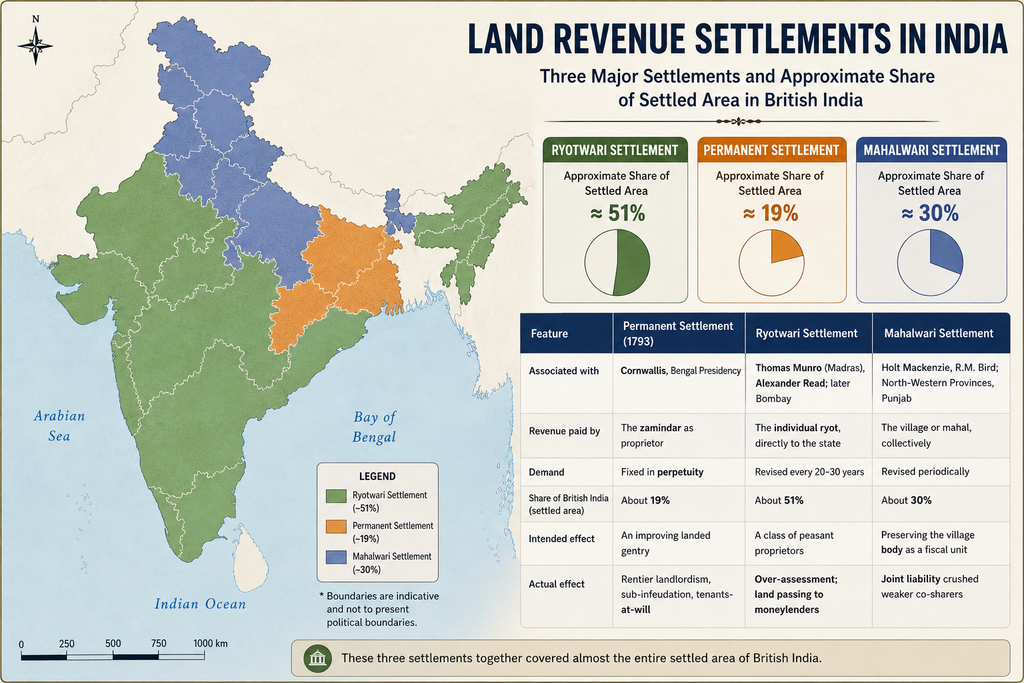
| Permanent Settlement (1793) | Ryotwari | Mahalwari | |
|---|---|---|---|
| Associated with | Cornwallis, Bengal Presidency | Thomas Munro (Madras), Alexander Read; later Bombay | Holt Mackenzie, R.M. Bird; North-Western Provinces, Punjab |
| Revenue paid by | The zamindar as proprietor | The individual ryot, directly to the state | The village or mahal, collectively |
| Demand | Fixed in perpetuity | Revised every 20-30 years | Revised periodically |
| Share of British India | About 19% | About 51% | About 30% |
| Intended effect | An improving landed gentry | A class of peasant proprietors | Preserving the village body as a fiscal unit |
| Actual effect | Rentier landlordism, sub-infeudation, tenants-at-will | Over-assessment; land passing to moneylenders | Joint liability crushed weaker co-sharers |
- Ryotwari was the more progressive design in principle, recognising the actual cultivator and cutting out the intermediary. In practice it substituted a direct and inflexible state demand for a landlord’s: assessments were pitched on estimates of gross produce, payable in cash on a fixed date regardless of harvest, and revised upward at settlement.
- The ryot’s new proprietary right included the right to mortgage and sell, which is what made him bankable — and therefore what made him lose the land. To pay a cash demand out of an uncertain crop he borrowed from the sahukar; default transferred title. Ryotwari did not prevent the concentration of land, it routed it through the moneylender rather than the zamindar.
- Mahalwari made the village jointly and severally liable, so a weak co-sharer’s default fell on the rest. The North-Western Provinces settlements of the 1820s and 1830s were assessed at levels the countryside could not sustain, and the resulting distress fed into the agrarian character of the 1857 revolt in the Doab.
What the settlements did to rural society
- Land became alienable private property. This is the single largest rupture: a resource governed by custom, community and use became an asset that could be sold, mortgaged, foreclosed and inherited as a commodity, and every subsequent agrarian problem is downstream of it.
- Revenue maximisation, not agricultural development, was the organising purpose. No colonial settlement contained an investment obligation that was ever enforced.
- Commercialisation followed the cash demand — indigo in Bengal and Bihar, opium in the Gangetic plain, cotton in the Deccan and Berar, jute in eastern Bengal. Cultivators were pushed, and under the indigo and opium systems contractually forced, into crops they could not eat and into world price movements they had no protection against.
- A rentier layer grew at the top and a mass of tenants-at-will, share-croppers and landless labourers at the bottom. The agricultural labourer as a permanent propertyless category is substantially a colonial creation.
- Famine was the recurring result of an export-oriented, cash-demanding, credit-dependent agriculture with no buffer — the Bengal famine of 1770, the Orissa famine of 1866, the Deccan famine of 1876-78, and the famines of 1896-97 and 1899-1900.
The colonial state’s own correctives
- The Deccan Riots of 1875 in Poona and Ahmednagar were directed not at the state but at Marwari and Gujarati moneylenders — peasants seized and burnt bonds and decrees rather than attacking persons, a precise statement of what they thought the problem was.
- The Deccan Agriculturists’ Relief Act of 1879 empowered courts to go behind the bond and reopen accounts, restricted imprisonment for debt, and limited transfer of land in execution of decrees. It is the first admission in Indian law that formally free contract between unequal parties produces expropriation.
- The Punjab Land Alienation Act of 1900 prohibited permanent transfer of land from “agricultural tribes” to non-agriculturist castes. It slowed alienation to urban moneylenders, but by defining protection by caste it froze the existing landed hierarchy and did nothing for tenants or labourers inside the agricultural castes.
- Both establish that restricting the free alienability of agricultural land is a very old Indian instrument, not a socialist invention, and both anticipate today’s acquisition and leasing arguments.
Thorner’s map of the agrarian structure
- Daniel Thorner argued that the countryside could not be read through census categories like “cultivator” and “labourer”, which describe activity, when the real structure is the relation between rights in land and work done on it.
- His three-fold classification cuts across caste and region:
- Maliks — those whose income derives principally from property rights in the soil, from large absentee landlords to rich owners who supervise rather than work.
- Kisans — working peasants who cultivate with their own and their family’s labour, on small proprietary plots or insecure tenancies.
- Mazdoors — those who live by selling labour on other people’s land: share-croppers without security, casual labourers, attached and bonded workers.
- Thorner’s other contribution is the built-in depressor: the structure itself, by placing the surplus with those who did not cultivate and the cultivation with those who had no claim on the surplus, destroyed the incentive to invest at every level. The tenant would not improve land he could be evicted from; the landlord would not improve land whose rent he collected regardless. This is a productivity case for land reform, not only a justice case.
- Thorner also framed the paradox everything after him answers: India has the largest body of land reform legislation in the world and one of the largest populations of poor and hungry people. Legislation is not the scarce input.
Why land reform became a national commitment
The peasant in the freedom movement
- The Congress became a mass organisation at the moment it took up agrarian grievances, and the early Gandhian campaigns were all land campaigns — Champaran (1917) against the tinkathia system of forced indigo, Kheda (1918) for revenue remission in a failed harvest, and Bardoli (1928) against a 22% revenue enhancement.
- Swami Sahajanand Saraswati’s Bihar Provincial Kisan Sabha (1929) mobilised occupancy tenants against zamindari exactions, and the All India Kisan Sabha, founded at Lucknow in April 1936 with Sahajanand as president and N.G. Ranga as general secretary, gave the demand a national platform.
- The AIKS programme was far more radical than anything later legislated: abolition of zamindari without compensation, a halving of rent and land revenue, cancellation of agricultural debts, security of tenure, a living wage for agricultural labourers, and recognition of peasant organisations.
- Two late movements set the post-independence terms. The Tebhaga movement (1946-47) in Bengal demanded that the share-cropper’s share rise from one-half to two-thirds of the crop — the direct ancestor of Operation Barga. The Telangana armed struggle (1946-51) against the Nizam’s jagirdars and deshmukhs redistributed land across roughly three thousand villages, and its suppression by the Indian army after 1948 was the first demonstration that the independent state would not permit redistribution from below.
The programmatic commitments
- The Karachi Congress of 1931 and its Resolution on Fundamental Rights and Economic Policy committed the Congress to reform of land tenure, revenue and rent, relief for the smaller peasantry, and exemption for uneconomic holdings — agrarian restructuring written into the movement’s constitution-in-waiting.
- The Congress Agrarian Reforms Committee of 1949, chaired by J.C. Kumarappa, set the template every state statute then followed: abolish all intermediaries between the state and the tiller; prohibit absentee landlordism, on the principle that land should belong to the person who works it; ban subletting except for widows, minors and the disabled; impose ceilings with the surplus redistributed; and organise cooperative farming for holdings below a viable size.
- The First Five Year Plan devoted a chapter to land policy and argued developmentally: the agrarian structure barred agricultural growth, so reform was a precondition of the food targets. Successive plans repeated the commitment with declining conviction, and by the Fourth Plan the documents effectively conceded failure.
- The slogan carrying all of it was “land to the tiller” — that the person who works a field should hold it. The whole record can be read as the distance between that sentence and what happened.
The four arguments for redistribution
- Justice. Land concentration in India was not merely an income distribution; it was the material base of caste subordination and bonded labour. Redistribution was a condition of citizenship, which is why it sits in the Directive Principles rather than in a farm policy document.
- Productivity — the inverse relationship. Farm management surveys from the 1950s found output per hectare falls as farm size rises, because small owner-cultivated farms apply family labour intensively. Amartya Sen’s early work explained why: family labour is applied until its marginal product nears zero, hired labour only until it equals the wage. If so, redistribution raises output, and equity and efficiency point the same way.
- Investment. Secure tenure changes the time horizon: a tenant who can be evicted at season’s end will not dig a well or plant a tree; an owner will. Tenure security is an investment policy, and this survives every criticism of the redistributive case.
- Power. Concentration of land in an agrarian society is concentration of credit, employment, votes and the local administration of the state. Reform was meant to change the rural power structure, not only the rural income distribution.
Land reform was never only about who eats. It was about who in a village can afford to disobey.
The constitutional architecture and the property litigation it generated
The starting position
“The State shall, in particular, direct its policy towards securing that the ownership and control of the material resources of the community are so distributed as best to subserve the common good.” — Article 39(b), Constitution of India
- Alongside it, Article 39(c) directs that the economic system not result in “the concentration of wealth and means of production to the common detriment”. Together they are the constitutional mandate for land redistribution, and both became the pivot of the litigation.
- Agriculture, land and tenures are Entry 18 of the State List. The consequence is structural and permanent: there is no Indian land reform, there are fifteen or more state land reforms — fifteen sets of definitions, exemptions, record systems and revenue bureaucracies. The Union’s only instruments have ever been guidelines, model bills and plan conditionalities.
- Against the mandate stood the original Article 19(1)(f), the right to acquire, hold and dispose of property, and Article 31, requiring that property be taken only by authority of law, for a public purpose, on payment of compensation. The Constitution of 1950 contained both a redistributive command and a justiciable property right, and land reform was the collision between them.
Kameshwar Singh and the First Amendment
- The Bihar Land Reforms Act, 1950 was struck down by the Patna High Court in Kameshwar Singh because its compensation scheme — graded so the largest zamindars received proportionately less — violated Article 14. The law’s most redistributive feature was the reason it fell.
- The First Constitutional Amendment of 1951 responded by inserting Article 31A, saving laws acquiring “estates” from challenge under Articles 14, 19 and 31; Article 31B, giving blanket immunity to statutes listed in a new schedule; and the Ninth Schedule itself, which began with thirteen state land reform acts and has grown past 280 entries.
- Passed by a provisional Parliament that was also the Constituent Assembly, it established the technique — amend the Constitution to immunise a statute — used for the next quarter-century.
The amendment chain
| Amendment | What it did | Why land reform required it |
|---|---|---|
| First (1951) | Inserted Articles 31A, 31B and the Ninth Schedule | To save zamindari abolition after Kameshwar Singh |
| Fourth (1955) | Made the adequacy of compensation non-justiciable; widened 31A | Courts were valuing estates at rates states could not pay |
| Seventeenth (1964) | Widened “estate” to cover ryotwari land, jagir, inam, muafi | 31A protected only “estates”; ceiling laws in ryotwari states were exposed |
| Twenty-fourth (1971) | Affirmed power to amend any part, including Part III | To reverse Golak Nath |
| Twenty-fifth (1971) | Replaced “compensation” with “amount”; inserted Article 31C | To end review of quantum, and give Articles 39(b) and (c) primacy over 14, 19 and 31 |
| Twenty-ninth (1972) | Put the Kerala Land Reforms Acts of 1969 and 1971 in the Ninth Schedule | Kerala’s abolition of landlordism was the most radical and most litigated statute |
| Thirty-fourth (1974) | Added a further twenty state ceiling and tenancy statutes | The 1972 round of ceiling laws was under challenge everywhere |
| Forty-second (1976) | Extended 31C to all Directive Principles | Struck down in Minerva Mills (1980); 31C survives in its pre-1976 form |
| Forty-fourth (1978) | Repealed 19(1)(f) and 31; property became a legal right under Article 300A | Removed the property right from Part III, ending the collision at source |
- Land reform is the single most amendment-generating subject in Indian constitutional history. Nine of the first forty-four amendments were substantially or partly about it.
The judicial chain
- Shankari Prasad (1951) upheld the First Amendment, holding that “law” in Article 13(2) means ordinary law and not a constitutional amendment. Sajjan Singh (1965) upheld the Seventeenth on the same reasoning, but two judges recorded doubts — the first crack.
- Golak Nath (1967), by 6:5, reversed the position: an amendment is “law” for Article 13, so Parliament cannot abridge fundamental rights. Prospective overruling saved existing amendments, but the amending power was capped. The case concerned the Punjab Security of Land Tenures Act — a ceiling statute.
- Kesavananda Bharati (1973), decided by thirteen judges, overruled Golak Nath and restored the power to amend Part III, subject to the condition that no amendment damage or destroy the basic structure. The petitioner was a mathadhipati challenging the Kerala Land Reforms Act’s ceiling on his math’s land. India’s most important constitutional judgment is a land reform case.
- Waman Rao (1981) drew the operative line: Ninth Schedule entries made before 24 April 1973, the date of Kesavananda, are immune; anything inserted after is open to basic-structure challenge. I.R. Coelho (2007), unanimously and by nine judges, confirmed it and applied a rights test and essence-of-rights test to the substance of the impugned statute, so the Ninth Schedule is no longer a safe harbour.
- The irony is exact. The most redistributive programme the Indian state ever attempted produced the doctrine that now limits the very immunity which made it possible.
The 2024 coda: what “material resources of the community” now means
- In Property Owners’ Association v. State of Maharashtra, decided 5 November 2024, a nine-judge bench revisited Article 39(b) in a challenge to the Maharashtra Housing and Area Development Act’s power to acquire dilapidated buildings with 70% occupant consent.
- By 8:1 the Court held that not every privately owned resource is a “material resource of the community”, and laid down a context-specific enquiry — the nature of the resource, its scarcity, the consequences of concentrating it in private hands, and whether it is inherently public in character.
- The majority departed from the line running from Justice Krishna Iyer’s minority opinion in Ranganatha Reddy (1977) through Sanjeev Coke (1982), holding that the expansive reading embedded an economic ideology the Constitution does not mandate.
- Unanimously, all nine judges held that Article 31C as it stood before the Forty-second Amendment survives, so laws genuinely giving effect to Articles 39(b) and (c) retain protection from Articles 14 and 19.
- The constitutional basis for redistribution has narrowed at exactly the moment its political constituency has thinned. Agricultural land, being finite and community-affecting, would still plausibly satisfy the majority’s test — but the automatic assumption that private property is a community resource no longer holds.
India’s most famous constitutional doctrine was invented to protect the redistribution of land, and now constrains it.
The components of land reform and what each achieved
| Component | What was attempted | Outcome |
|---|---|---|
| Abolition of intermediaries | Zamindari, jagirdari, inamdari and malguzari tenures abolished from 1950 | The one substantial success — about 20 million tenants brought into direct relation with the state; but heavy compensation, pre-emptive eviction and retention of sir and khudkasht land turned zamindars into large owner-cultivators |
| Tenancy reform | Rent ceilings, security of tenure, right of purchase | Largely failed outside two states. The personal-cultivation resumption clause drove leasing underground; Kerala (1969) and Operation Barga (1978) are the exceptions |
| Ceilings on holdings | Statutory limits, surplus vested in the state | The weakest component — benami transfers, partition, sham divorce, wide category exemptions |
| Distribution of surplus | Vested land allotted to the landless, priority to SC and ST | About 51-53 lakh acres to some 57-58 lakh beneficiaries — a little over 2% of operated area |
| Consolidation of holdings | Scattered plots exchanged for compact blocks | Successful in Punjab, Haryana and western UP; barely attempted in the east and south; reversed by inheritance |
| Cooperatives | Cooperative farming, credit, processing, marketing | Cooperative farming abandoned after Nagpur (1959); cooperative processing succeeded, largely as rich-farmer enterprise, with dairy the exception |
Abolition of intermediaries
- The programme began at once — Madras in 1948, the UP Zamindari Abolition and Land Reforms Act, 1950, the Bihar Land Reforms Act, 1950 — with jagirdari and inamdari abolition following in the princely states and the Deccan.
- It succeeded because the target was politically isolated. Zamindars were few, had been the collaborating class of the colonial revenue system, were seen as belonging to the imperialist camp, and had mostly stood aside from the national movement, so no constituency inside the Congress would defend them.
- The gains were real: perhaps twenty million tenants and sub-tenants came into direct relation with the state, a whole tier of rent-extraction disappeared, and the state gained a relationship with the cultivator that made later credit, procurement and subsidy possible.
- The losses were built into the statutes:
- Compensation was heavy, running into hundreds of crores at 1950s prices and financed by the states — money that did not go into irrigation or extension. The AIKS demand for abolition without compensation was never seriously entertained.
- Resumption for “personal cultivation” let zamindars retain any land they declared self-cultivated, and because the definition usually included cultivation “under personal supervision”, it required no personal labour at all.
- Sir and khudkasht land was retained outright, and in the years between the announcement of intent and commencement, mass eviction of tenants converted tenanted land into self-cultivated land on paper.
- The net effect was transformation, not dispossession. Zamindars re-emerged as large owner-cultivators and rural capitalists, moving capital into rice mills, cold stores, transport, sugar and trade, and converting economic into political weight in the new assemblies. Abolition removed a parasitic layer without altering the distribution of land, and so did not by itself eradicate rural poverty.
Tenancy reform
- Three instruments were legislated almost everywhere: regulation of rent, typically capped at a fourth or fifth of gross produce against customary shares of a half or more; security of tenure against arbitrary eviction; and the right of purchase, conferring ownership after a period of continuous cultivation on payment of a multiple of rent.
- The resumption loophole destroyed all three. Nearly every statute allowed resumption for personal cultivation, so a landowner facing the loss of a tenant simply evicted him first — and since the laws were announced years before commencement, the interval was used.
- The deeper failure was informational. Tenancy responded by going underground. Written leases gave way to oral, seasonal arrangements — shikmi in Maharashtra, batai and adhiya in the north, bhag and barga in the east — rotated annually so no tenant could accumulate the possession the law required. A law that makes a relationship illegal does not end it; it makes it unrecorded.
- The actual beneficiaries were the upper tenants of the intermediate cultivating castes — Jats, Yadavs, Kurmis, Kammas, Reddys, Marathas, Patidars — who held recorded occupancy rights and could pay the purchase price; the sub-tenant, share-cropper and landless labourer got nothing. Their rise as the dominant force in state politics from the late 1960s follows directly from who tenancy reform enriched.
The two exceptions, and why they are exceptions
- Kerala. The Kerala Land Reforms (Amendment) Act, 1969, in force from 1 January 1970 under the E.M.S. Namboodiripad government, abolished landlordism outright: tenancy was ended, the janmi tenure dismantled, ownership vested in the cultivating tenant, and — uniquely — hutment dwellers (kudikidappukars) were given ownership of the plot beneath their homes, conferring a house site on hundreds of thousands of landless families.
- West Bengal. Operation Barga, launched in 1978 by the Left Front, redistributed no land at all. It registered share-croppers (bargadars) where they stood, through joint teams of settlement officials and party cadre holding camps in the villages rather than expecting an illiterate share-cropper to file a distant claim. Roughly 1.5 million bargadars gained heritable, non-evictable rights and an enforceable crop share.
- What the two share is what the rest of India lacked: a party with an explicit ideological commitment, a cadre organisation reaching into the village that could implement independently of the revenue bureaucracy, and a support base among the beneficiaries, so implementation was electorally rewarded rather than punished.
- Both had limits. Kerala ended tenancy and gave house sites but exempted plantations and distributed little ceiling surplus; West Bengal secured the share-cropper’s position without making him an owner.
Ceilings on holdings
- The First Plan recommended ceilings; the states legislated in the late 1950s with limits so generous and definitions so permissive that little surplus emerged. The national guidelines of 1972, adopted at the Chief Ministers’ Conference, tightened them substantially.
- It graded ceilings by land quality — roughly 10 to 18 acres of assured double-cropped irrigated land, about 27 acres single-cropped, up to 54 acres dry; the family of five replaced the individual as the unit, additions capped at twice the basic ceiling; and priority went to landless workers, especially Scheduled Castes and Scheduled Tribes.
- Every element was evaded:
- The announcement-to-enactment gap — ceiling intentions were public for years before the laws commenced, and the interval was used for transfers.
- Benami transfers — land held in the name of relatives, servants, deities and non-existent persons.
- Partition of joint families, real and notional, to multiply the number of ceiling units.
- Sham divorces, since husband and wife counted as separate units once legally separated — formal divorce as a land-holding device.
- Category exemptions for plantations of tea, coffee, rubber and cardamom, orchards, mechanised farms, factory sugarcane farms, religious and charitable trusts, cooperative farming societies and specialised livestock and seed farms. In several states the exempted categories covered more land than the ceilings reached.
- Litigation — around 1.6 million acres of the surplus declared by the mid-1980s was still frozen in courts.
- The outcome: of roughly 73 lakh acres declared surplus, about 65 lakh were taken into possession and 51-53 lakh acres distributed among some 57-58 lakh beneficiaries — a little over 2% of operated area, against a potential most estimates put several times higher. A substantial quantum vested in government has still not been distributed at all.
- What happened afterwards mattered as much. Allottees often received land that was poor, unirrigated, or still physically held by the former owner, with no credit, inputs or extension accompanying the title, and much was resold, mortgaged back or re-encroached within a decade. A title without capital is not a livelihood.
Consolidation of holdings
- Consolidation (chakbandi) attacks fragmentation rather than concentration, exchanging scattered strips for compact blocks of equivalent value and creating space for field roads, drainage and irrigation channels.
- It was carried through comprehensively in Punjab, Haryana and western Uttar Pradesh, where it is an underrated precondition of the Green Revolution, since tubewells and tractors are hard to justify on scattered fragments. It was patchy in Maharashtra and Madhya Pradesh and barely attempted in Bihar, Bengal, Odisha, Assam and the south.
- It is the one component demography reverses automatically: every generation divides holdings among heirs, so gains erode without a permanent programme.
Cooperatives and cooperative farming
- The Nagpur session of the Congress in January 1959 resolved that agriculture be organised on joint cooperative farming, with village cooperatives owning land within three years. It was the high point of the Nehruvian agrarian imagination and the logical next step after ceilings.
- The backlash was immediate and decisive. C. Rajagopalachari left to found the Swatantra Party explicitly in response, and Charan Singh, from inside the Congress, defended peasant proprietorship against what he called collectivisation by another name. Within two years the resolution was dead. The propertied peasantry had demonstrated it could veto agrarian policy from within the ruling party.
- Cooperative farming therefore never happened; cooperative processing and credit did, producing a distinctive political formation. The sugar cooperatives of western Maharashtra and the cooperative complexes of Gujarat became in practice joint-stock enterprises controlled by rich farmers, whose chairmanships were the ladder into state politics. The form delivered scale economies to those who already had land and nothing to those who did not.
- The genuine success is dairy. Amul — the Kaira District Cooperative Milk Producers’ Union, founded in 1946 — and the National Dairy Development Board under Verghese Kurien scaled through Operation Flood from 1970 into the largest cooperative structure in the world.
- Why dairy worked where farming cooperatives did not is instructive: milk is produced daily, so payment and incentive are immediate; the asset is a buffalo, not a field, so nobody pools the thing carrying their social identity; landless and marginal households own many of the animals; and the cooperative supplied processing, veterinary services and a guaranteed market — the complementary infrastructure ceiling allottees never received.
Why land reform failed: an anatomy
- Absence of political will at implementation. Every state passed the laws and almost none pursued them; the commitment was national and rhetorical, the execution state-level and administrative.
- The dominant landed castes inside the Congress. At state and district level the Congress was the landed peasantry — its legislators, committees and financiers. A party of the propertied could not be the instrument of dispossessing the propertied, and the reforms were in the most literal sense drafted and administered by the class they were meant to expropriate.
- No organised peasant movement outside Kerala and Bengal. Elsewhere the beneficiaries — share-croppers, labourers, Dalits — were unorganised, illiterate, dependent on the very landowners the law targeted, and unable to bear the cost of asserting a claim. Rights that must be individually litigated by the powerless against the powerful are not rights.
- Missing and manipulated land records. Much of the system was a revenue record, not a record of rights: it named the person liable to pay, not the person who cultivated. You cannot redistribute what the state cannot see.
- Corruption and bureaucratic incentives. The patwari, talathi or karnam who writes the record is the lowest-paid and least supervised officer in the chain and lives in the village he administers; a single entry could confer or destroy a claim, and the price of an entry was well understood.
- The state-subject problem. Fifteen legislatures produced fifteen definitions of “personal cultivation”, fifteen exemption schedules and fifteen ceiling regimes. There was never an Indian land reform to evaluate.
- Loophole-ridden drafting. Resumption clauses, delayed commencement, generous family-unit definitions and open-ended exemptions were not accidents of craft but the negotiated price of getting the bill passed.
- Litigation and the courts. The availability of a stay order let a landowner convert legal defeat into a thirty-year delay; the Ninth Schedule was invented for exactly this and did not stop it.
- Beneficiary disorganisation and missing complementary support. Where land did reach the landless it arrived without credit, irrigation, seed, extension or physical possession, and much of it flowed back.
- The reform came too late in the political cycle. Maximum radical possibility existed in 1947-52; by 1972, the class that had gained from intermediary abolition and the Green Revolution was strong enough to stop ceilings.
India did not fail to legislate land reform. It legislated it so thoroughly that it never had to implement it.
What the scholars say
The state-capacity explanations
- Daniel Thorner’s diagnosis was that legislation targeted legal categories — zamindar, tenant, estate — while the actual structure of dependence operated through caste, credit and custom, which no statute touched. Hence a massive body of law and no change at village level.
- Gunnar Myrdal, in Asian Drama, gave the failure its most durable name: the soft state, whose formal authority is not matched by any capacity to enforce obligations on its own citizens — laws enacted and not applied, compliance negotiated rather than commanded, corruption systemic rather than deviant. His deeper point is that this is not a moral failing of individuals but a structural property of states that must govern through the very elites they wish to regulate, which is why even Nehru could not deliver.
- Atul Kohli made the argument empirical. Comparing West Bengal, Karnataka and Uttar Pradesh, he asked why identical national policy produced radically different outcomes, and answered that what varies is the political and organisational capacity of the regime to confront the propertied classes — whether it has a disciplined, ideologically coherent party organised below district level with a base among the poor. Where it does, as in Kerala and Left Front Bengal, the state can act; where the ruling party is a coalition of local notables it cannot, because confronting the propertied means confronting itself. Despite the rhetoric, the Congress remained the party of the dominant class.
The class-character explanations
- Francine Frankel argued that accommodative politics — pursuing socialist goals without breaking with the propertied classes on whose support the Congress rested — meant radical objectives were consistently announced and consistently traded away at implementation. The commitment was real; the willingness to pay its political price was not.
- Pranab Bardhan gave the sharpest structural account with his dominant proprietary classes: the state is autonomous of any one class but constrained by a coalition of three — the industrial bourgeoisie, the rich farmers enfranchised by intermediary abolition and enriched by the Green Revolution, and the professional-bureaucratic elite. Because none can dominate, the state’s output is subsidies that buy off all three rather than redistribution that would hurt one — and land reform was precisely the policy requiring the second to be hurt.
- Sudipta Kaviraj read the sequence as a passive revolution in Gramsci’s sense: transformation from above by a state acting on society rather than by one class overthrowing another, in which the old landed order is absorbed and reconstituted inside the new capitalist order. Zamindars becoming capitalist farmers is not a failure of the model but what a passive revolution looks like. Kaviraj and Bardhan converge: implementation was unenthusiastic because the state expressed propertied interests.
- Hamza Alavi’s overdeveloped post-colonial state — an apparatus inherited from colonial rule, stronger than any indigenous class, mediating between them rather than serving one — applies with modification: India’s stronger civil society and competitive elections qualify it, but an inherited bureaucratic apparatus does not become an instrument of social transformation merely because its political masters change.
The legal and administrative explanations
- Ronald Herring, in Land to the Tiller, asked the question the others assume away: why did the laws contain the loopholes they contained? The loopholes were not drafting errors but the substance of the legislative bargain — the price at which landed legislators would vote for the bill. He also showed the perverse consequence of tenancy law: it induced eviction, informalisation and a shift to self-cultivation with hired labour.
- P.S. Appu, who wrote the definitive official assessment as a civil servant, located the failure in implementation and land records rather than policy design: the statutes, whatever their defects, would have transferred substantial land had survey, settlement and record-of-rights machinery been functional and honest.
- Herring says the laws were written to fail; Appu says the laws were adequate and the administration failed. The record supports both by component — ceilings support Herring, tenancy in the eastern states supports Appu.
The mode-of-production debate
- Through the 1970s a debate ran over whether Indian agriculture after the Green Revolution was capitalist, semi-feudal, or something specific to a colonial trajectory. It matters because the diagnosis determines the prescription: if the countryside is semi-feudal, land redistribution is the primary task; if already capitalist, the task is wages, terms of trade and labour organisation.
- Utsa Patnaik argued for capitalist development within a still-unequal structure, using a labour-exploitation criterion — the ratio of hired to family labour — to classify farms, and holding that a class of accumulating capitalist farmers had clearly emerged, with persistent rent and usury reflecting the incompleteness of the transition rather than feudalism.
- Amit Bhaduri advanced the semi-feudal case, showing that a landlord who is simultaneously the share-cropper’s creditor has a positive interest in the tenant’s continued indebtedness and will therefore block productivity-raising technology that would free him from dependence — a precise account of why growth alone does not dissolve agrarian backwardness.
- Ashok Rudra’s survey work found neither pure type in the data and argued for a coexistence of relations rather than a single mode — the position that has largely prevailed.
- Partha Chatterjee shifted the question to the form of peasant politics: the peasantry is not a class awaiting proletarianisation but a distinct political community engaging the state in the domain of “political society” — negotiated and often extra-legal — rather than rights-bearing civil society. Hence agrarian demands take the form of protest, blockade and negotiated exception rather than litigation.
The dissenting position
- Tirthankar Roy and others in the economic history tradition make the counter-case: land reform was neither the only nor the best route out of rural poverty, since the real problem is too many people on too little land with too little non-farm employment, and redistributing a tiny average holding would have produced uniformly unviable farms.
- The uncomfortable fact behind this is real: there was never enough surplus land. Even complete and honest ceiling enforcement at 1972 limits would have yielded well under a tenth of operated area for a landless population many times larger.
- The counter-argument is equally strong. The inverse relationship implies redistribution would have raised output as well as equity; Japan, South Korea and Taiwan, where thoroughgoing land reform preceded industrial takeoff, suggest an egalitarian agrarian structure is a precondition of broad-based growth rather than a drag on it; and too little land does not explain why tenancy security, which requires no land at all, also failed.
- Amartya Sen’s framing bears directly on this. Poverty is deprivation of capability and its worst form is hunger, but Indian hunger has for decades not been caused by an absence of food — the state held buffer stocks while malnutrition persisted and procured grain rotted in warehouses — but by an absence of effective public action connecting food to entitlement. Land is one route to entitlement; employment, wages and public provisioning are others.
Agrarian structure and agrarian classes today
Operational holdings
- India’s agrarian structure is now defined less by concentration at the top than by pulverisation at the bottom. Operational holdings have risen from about 7 crore in 1970-71 to over 14.6 crore, while the average size has fallen from 2.28 hectares to 1.08 hectares.
- Marginal holdings below 1 hectare are about 68% of all holdings and operate around 24% of area; small and marginal together, below 2 hectares, are about 86% of holdings and 47% of area. Large holdings above 10 hectares are well under 1% of holdings but still operate around 9%.
- The direction matters more than the level: the average holding has shrunk in every census since 1970-71, driven by inheritance division rather than any redistributive policy. India’s land distribution has grown more equal chiefly because everyone’s plot is getting smaller.
- Two consequences follow. A majority of Indian farms are below the size at which cultivation alone can support a household — the fact behind both the agrarian crisis and the growth of non-farm income. And the policy question has shifted from breaking up large holdings to giving small ones scale, through leasing, aggregation, producer organisations and custom hiring.
Tenancy in reverse, and the invisible tenant
- Official statistics record leased-in land at a low single-digit share of operated area; field studies consistently find the true figure several times higher, because informal, oral and seasonal tenancy is deliberately kept off the record by both parties — a direct legacy of legislation that made leasing legally dangerous for the owner.
- The composition of tenancy has inverted. Classic tenancy ran downward, a large owner leasing to a poor cultivator. Today a large share runs the other way: small and marginal owners, and households whose adults have moved to non-farm work, lease out to better-capitalised cultivators who lease in — reverse tenancy, prominent in Punjab, Haryana, western UP and coastal Andhra.
- The costs of invisibility fall on the tenant. Because entitlements are keyed to the record of rights, an unrecorded cultivator cannot obtain a Kisan Credit Card, register for crop insurance, claim disaster relief, enrol for input subsidy or income transfer, or sell at a procurement centre in his own name — while the absentee owner in the register receives all of it.
- Legalising and recording tenancy is therefore the most consequential land reform actually available today, and the failure of states to enact leasing legislation is a live policy failure rather than a historical one.
Labour, caste and landlessness
- Agricultural labourers are the largest and fastest-growing rural occupational category. They outnumber cultivators, and the ratio has moved against cultivators for five decades. A structural transformation in which people leave cultivation for agricultural labour rather than for industry is not development.
- Landlessness is caste-structured. Scheduled Caste households are around a fifth of the rural population and own a far smaller share of agricultural land; a large majority are effectively landless, and the SC share among agricultural labourers is roughly double their share of population. The Dalit question in rural India is, to a first approximation, the land question.
- Scheduled Tribes present the mirror image: better land access in absolute terms, but held under insecure, unsurveyed or contested title in forest and Fifth Schedule areas, converting a nominal advantage into permanent vulnerability to alienation.
- Intermediary abolition and tenancy reform did nothing for either group, because both were designed around the tenant with a recorded right, and neither Dalits nor forest-dwelling Adivasis were in the record.
Women’s land rights
- Women perform a large and rising share of agricultural work as male out-migration proceeds, yet operate around one holding in seven in their own name. Ownership, as distinct from operation, is lower still.
- The Hindu Succession (Amendment) Act, 2005 made daughters coparceners in joint family property by birth, on the same footing as sons, and — critically for agriculture — deleted Section 4(2), which had exempted agricultural tenancy holdings and left them to state tenurial laws that overwhelmingly favoured male lineal heirs.
- The gap between the law and the record is enormous: daughters relinquish claims under family pressure, mutation does not follow succession, several state tenancy laws still carry male-preferential devolution rules, and a share of a two-acre holding is an interest a woman often cannot physically use.
- Bina Agarwal’s A Field of One’s Own is the foundational argument, economic as much as rights-based: land in a woman’s own name changes welfare (consumption shifts toward food, health and schooling), efficiency, bargaining power and exit options from violence or abandonment — and joint titling is not a substitute for independent title.
“The single most important economic factor affecting women’s situation is the gender gap in command over property.” — Bina Agarwal
Land and livelihood: a weakening link
- The most important change in agrarian relations over three decades is that land has become a less complete determinant of rural livelihood. Non-farm income — construction, transport, petty trade, services, remittances — now rivals or exceeds cultivation income for the average rural household.
- The survey evidence is explicit: for agricultural households, wages rather than crop production are the single largest income source, and adding animal husbandry and non-farm business, cultivation is a minority of the total.
- This cuts two ways. It weakens the constituency for redistribution, since land is no longer the sole route to security, while it raises the value of a clear title — land is now collateral, an insurance asset, a claim on acquisition compensation and an urbanisation lottery ticket, which is why land conflict has intensified even as farming’s income share has fallen.
The agrarian crisis
The cost-price squeeze
- The crisis is at bottom a squeeze between rising costs and stagnant realised prices. Seed, fertiliser, pesticide, diesel, electricity, machine hire and wage labour have risen faster over long stretches than the prices farmers receive, so output can rise while net income does not.
- Terms of trade with non-agriculture have moved erratically and, for much of the post-liberalisation period, unfavourably. Public investment in agriculture as a share of agricultural GDP fell sharply from the 1980s and was substituted by input subsidies, which fund input consumption rather than the irrigation, roads, storage and research that raise productivity permanently.
- Fertiliser illustrates the trap. Urea’s controlled price alongside the nutrient-based subsidy on phosphatics and potash has produced a badly skewed NPK ratio, nitrogen overuse, soil degradation and a large recurring fiscal liability, while yields plateau.
- Liberalisation added exposure without adding protection. Agriculture was the sector least helped by the post-1991 model: growth stagnated, public investment fell, and world price volatility was passed to producers with no hedging instruments.
The MSP regime
- The Minimum Support Price is announced before each sowing season on the recommendation of the Commission for Agricultural Costs and Prices (CACP), set up in 1965, for 22 mandated crops — 14 kharif, 6 rabi and 2 commercial (jute and copra) — plus a derived price for toria and de-husked coconut. It is an administrative announcement, not a statutory entitlement, which is the entire content of the current dispute.
- The cost concepts matter:
- A2 — all paid-out costs: seed, fertiliser, pesticide, hired labour and machinery, fuel, irrigation charges, rent for leased-in land.
- A2+FL — A2 plus the imputed value of unpaid family labour. This is the government’s basis.
- C2 — A2+FL plus the imputed rental value of owned land and interest on owned fixed capital. This is what the National Commission on Farmers under M.S. Swaminathan recommended as the base, with a 50% margin.
- Since 2018-19 the declared policy has been an MSP of at least 1.5 times the all-India weighted average cost of production on A2+FL; for the latest kharif season the announced margin was about 50% for most crops and higher for some pulses and coarse cereals. The farmers’ demand is C2+50%, materially higher, plus a legal guarantee that no transaction may occur below it.
- Very few farmers actually sell at MSP. The High Level Committee on restructuring the Food Corporation of India, chaired by Shanta Kumar (2015), found only about 6% of farm households sold to procurement agencies. Effective procurement concentrates in wheat and paddy and in Punjab, Haryana, Madhya Pradesh, Chhattisgarh, Telangana and Andhra Pradesh.
- The result is a double distortion: farmers outside the procurement belt receive a price signal they cannot realise, while those inside are locked into a paddy-wheat cycle unsuited to their groundwater.
Credit, debt and the politics of waivers
- Institutional credit has expanded enormously — the Kisan Credit Card, priority-sector targets, interest subvention bringing effective short-term crop loan rates to around 4% on prompt repayment — and the share of agricultural households borrowing solely from institutional sources rose from about 60% to about 75% between the last two national rural finance surveys.
- Yet non-institutional credit persists where need is greatest. The moneylender, input dealer and commission agent lend without collateral or paperwork, immediately, and for consumption and emergencies, which formal lenders do not. The tenant, invisible in the record, is the moneylender’s core market.
- Indebtedness is now the majority rural condition: about half of agricultural households were indebted at the last full assessment, with an average outstanding loan around ₹74,000, and the share of all rural households with outstanding debt rose from 47.4% in 2016-17 to 52.0% in 2021-22.
- Loan waivers are the standard political response, and the critique is well established: they reach only formal borrowers, excluding tenants and the deepest-distressed; they damage the credit culture and deter lending in waiver-prone districts; they crowd out state capital expenditure; and they leave the cost-price structure untouched. They persist because they are visible and electorally legible in a way irrigation investment is not.
Markets, storage and extension
- APMC regulation was itself a reform, created to protect farmers from unregulated buyers, but the mandi system ossified into a licensed cartel of traders and commission agents (arhatiyas), with limited entry, high market fees and interlocked credit in which the arhatiya is simultaneously lender, buyer and price-setter.
- eNAM, launched in 2016, has integrated over 1,650 mandis and 1.8 crore farmers, with cumulative trade past ₹4.8 lakh crore — but most recorded trade is intra-mandi rather than inter-state, because assaying, grading, dispute resolution and logistics for distant buyers remain thin.
- Post-harvest losses remain very large across fruit, vegetables and grains, reflecting shortages of cold chain, warehousing and rural connectivity — every unit lost is income the farmer paid to produce.
- Extension has collapsed as a public service. The training-and-visit era’s village worker has largely disappeared, a majority of farm households access no formal technical advice, and the effective advisers are now input dealers, whose interest is in selling more inputs.
Risk: water, weather and insurance
- Roughly half of net sown area remains unirrigated, so much of Indian agriculture is a direct bet on the monsoon, and the states with the worst distress indicators are largely rainfed.
- Where irrigation exists it is often groundwater-based and driven by subsidised electricity, producing serious depletion in the north-west and in peninsular hard-rock aquifers. The Green Revolution’s water debt is now being called in.
- Climate risk now compounds the monsoon risk: shifting onset, more intense rainfall events, unseasonal rain at harvest and heat stress at grain-filling in wheat.
- The Pradhan Mantri Fasal Bima Yojana (2016), voluntary for loanee farmers since 2020, has scaled past 78 crore farmer applications and ₹1.8 lakh crore in claims — but its record is patchy: delayed settlement, disputes over crop-cutting experiments and area-based loss assessment, exclusion of tenants without recorded rights, and withdrawal by several states over premium costs.
Farmer suicides: what the data does and does not support
- The evidence base is the National Crime Records Bureau’s Accidental Deaths and Suicides in India, which reports suicides by profession. For 2023 it recorded 10,786 deaths in the farming sector — 4,690 farmers and cultivators and 6,096 agricultural labourers — about 6.3% of India’s 1,71,418 total suicides.
- The geographic concentration is extreme: Maharashtra alone accounted for around 38% and Karnataka roughly 22%, followed by Andhra Pradesh, Madhya Pradesh and Tamil Nadu. Distress is concentrated in the rainfed cotton, sugarcane and horticulture belts of the Deccan, with high input costs and volatile prices.
- What the data supports: a persistent, regionally concentrated phenomenon strongly associated with indebtedness, crop failure and price collapse in cash-crop agriculture. Note that agricultural labourers now outnumber cultivators among the deaths, shifting the focus from farm ownership to rural wage dependence.
- What it does not support is causal attribution. NCRB records a profession, not a motive, classification varies across states, and tenants and women cultivators are systematically undercounted, since a person without a land record is not registered as a farmer. The figure is a floor, not a measurement of agrarian causation.
Incomes: the doubling target and the evidence
- The Committee on Doubling Farmers’ Income, chaired by Ashok Dalwai, identified seven sources of growth — crop and livestock productivity, resource-use efficiency, cropping intensity, diversification to high-value crops, better real prices, lower post-harvest losses, and shifting people from farm to non-farm occupations. Its most important conclusion is routinely ignored: doubling required moving people out of agriculture.
- The measured position: the last Situation Assessment Survey put average monthly income per agricultural household at ₹10,218, of which wages were ₹4,063 and crop production only ₹3,798, with average land possessed of 0.512 hectares and 50.2% of households indebted. The NAFIS survey for 2021-22 put average monthly rural household income at ₹12,698, up 57.6% in nominal terms over five years — a real increase, but short of doubling and unevenly distributed.
- Farm incomes have risen nominally while remaining structurally inadequate, and the binding constraint is the number of people dependent on agriculture relative to the value it produces: close to half the workforce for under a fifth of gross value added. No price policy can close a gap of that shape.
Fiscal federalism and agriculture: the Finance Commission channel
- Because agriculture is a State List subject, the Union’s principal influence over agricultural spending is fiscal, and the constitutional instrument is Article 280 and the Finance Commission, which fixes the vertical share of the divisible pool going to states and its horizontal distribution among them.
- The Fourteenth Finance Commission, chaired by Y.V. Reddy and reporting for 2015-16 to 2019-20, made the largest single change in the history of Indian fiscal devolution: it raised the states’ share of the divisible pool from 32% to 42%, a ten-point jump against the incremental one-point moves of its predecessors.
- Its horizontal formula weighted income distance at 50%, area at 15%, 1971 population at 17.5%, demographic change at 10%, and — for the first time — forest cover at 7.5%, channelling resources toward states with large forest and tribal tracts, precisely where forest and Fifth Schedule land questions are live.
- Its distinctive philosophy was untied transfer. It declined to recommend sector-specific grants, including for agriculture, reasoning that states judge their own sectoral priorities better than a central commission — consistent with agriculture’s place in the State List. It abolished the plan/non-plan distinction, and raised grants to panchayats and municipalities to about 3% of the divisible pool, reaching the tier that delivers rural water, sanitation and village infrastructure.
- How this bears on agricultural development:
- The positive case. States received far more unconditional, formula-based resources, deployable on irrigation, extension, marketing infrastructure, agricultural universities, farm power and rural roads according to local agro-climatic need, rather than the spending patterns embedded in centrally designed schemes. For a sector this regionally heterogeneous, untied money fits the problem better than a uniform national scheme.
- The federalism case. Larger tax devolution reduced dependence on discretionary and conditional grants, strengthening the autonomy the Constitution assumes when it places agriculture with the states.
- The qualification. The higher devolution came with a restructuring of centrally sponsored schemes, following the sub-group of Chief Ministers on rationalisation, under which the Union’s share in most agricultural schemes was cut and the states’ matching share raised, typically to 60:40 (90:10 for the North-Eastern and Himalayan states).
- The net effect was uneven. Fiscally stronger states used the untied space to expand agricultural spending; weaker states found the extra devolution substantially offset by the higher matching requirement, so capital expenditure on agriculture rose less than the headline number suggests. Because transfers carried no earmark, nothing guaranteed the increase reached agriculture rather than salaries, subsidies or debt service.
- The successors moved back. The Fifteenth Finance Commission trimmed the share to 41% and returned to sector-specific and state-specific grants, including performance-based grants for agriculture conditioned on states reforming land leasing and marketing law; the Union did not act on them. The Sixteenth Finance Commission, for 2026-31, held the share at 41% and provided ₹7.91 lakh crore for local bodies.
- The underlying tension is permanent: conditional grants can direct money to agriculture but intrude on state autonomy over a State List subject, while untied devolution respects autonomy but cannot guarantee the money reaches agriculture. The Fourteenth chose autonomy; the Fifteenth tried to buy reform with conditionality; neither resolved it.
The politics of land now
Acquisition: from 1894 to 2013
| Land Acquisition Act, 1894 | RFCTLARR Act, 2013 | |
|---|---|---|
| Purpose test | “Public purpose“, effectively self-certified | Defined categories; private projects and PPPs brought within the law |
| Consent | None required | 80% of affected families for private projects, 70% for PPPs |
| Prior assessment | None | Mandatory Social Impact Assessment with gram sabha consultation |
| Compensation | Market value, historically undervalued | Two times market value urban, up to four times rural, plus solatium |
| Rehabilitation | No statutory entitlement | Statutory R&R schedule, covering the landless and livelihood-losers |
| Urgency clause | Section 17, used routinely | Confined to defence and disaster |
| Unused land | No provision | Returns to owner or land bank after five years |
- The 2013 Act passed with rare cross-party consensus after a decade of acquisition conflict. The RFCTLARR (Amendment) Ordinance of 2014-15 sought to remove consent and SIA for five categories including industrial corridors and defence; it was re-promulgated three times and lapsed in August 2015. That episode established that the consent clause is politically immovable nationally — though several states have since diluted it under Article 254(2) with Presidential assent.
- Land banks and land pooling have become the preferred route around consent: states assemble land in advance, or offer owners a share of developed plots instead of cash, as in the Amaravati capital-region scheme. Pooling can favour owners with clear title; it is worse for tenants, labourers and the landless, who lose a livelihood and are not parties to the pool.
Singur, Nandigram and what they changed
- Singur (2006-08), where roughly 1,000 acres of multi-cropped land in Hooghly were acquired for a Tata Motors plant, and Nandigram (2007), where a proposed chemical SEZ triggered resistance and police firing that killed at least fourteen people, are the hinge events of Indian land politics.
- Their consequences outran their scale. They ended thirty-four years of Left Front rule in West Bengal, made the 1894 Act politically indefensible and directly produced the 2013 statute, showed that fertile, densely tenanted land cannot be acquired by administrative fiat in a competitive democracy, and — in the Supreme Court’s 2016 judgment quashing the Singur acquisition for want of a genuine public purpose — produced a judicial check on the purpose test itself.
- The Special Economic Zones Act, 2005 is the wider context — large assemblies for private industrial enclaves, often on agricultural land, which generated a wave of protest between 2006 and 2008 and substantial de-notification thereafter.
Forest rights: the last major redistribution
- The Scheduled Tribes and Other Traditional Forest Dwellers (Recognition of Forest Rights) Act, 2006 is best understood as the largest redistribution of land rights since the 1950s, and the only one framed as correcting a “historical injustice” — the non-recording of forest-dwellers’ rights during colonial forest settlement.
- It recognises individual forest rights up to 4 hectares under self-cultivation, community forest rights over grazing, minor forest produce and traditional resource areas, and community forest resource rights to manage the forest — with the gram sabha as the initiating and determining authority, a genuine devolution away from the forest department.
- The record is mixed at best. On the government’s 2025 reporting, of roughly 51.2 lakh claims filed, about 25.1 lakh titles had been distributed (49%), while about 18.6 lakh claims (36%) had been rejected and 7.5 lakh remained pending. Community forest resource rights, the most transformative provision, are the least implemented.
- The Supreme Court’s order of 13 February 2019 in Wildlife First v. Union of India directed eviction of rejected claimants — potentially over a million households — and was stayed on 28 February 2019 after the Union sought recall, rejections having often been made without due process or reasons. The stay holds; the fate of rejected claimants remains unresolved.
- The Forest (Conservation) Amendment Act, 2023 and the narrowing of prior gram sabha consent for certain categories of forest diversion have reopened the argument about whether FRA rights survive competing land uses.
PESA, Fifth Schedule land and alienation
- The Panchayats (Extension to the Scheduled Areas) Act, 1996 extends panchayati raj to Fifth Schedule areas with special provisions: the gram sabha must be consulted before land acquisition and resettlement, and has authority over minor minerals, minor forest produce and the prevention of land alienation, including power to restore unlawfully alienated tribal land.
- Fifth Schedule areas are also covered by state land transfer regulations barring transfer of tribal land to non-tribals. Both are widely circumvented — through benami holdings, long leases, mortgage-and-possession arrangements and simple non-enforcement — and the mining and industrial belt of central and eastern India runs straight through these areas.
- The failure of agrarian justice in the Fifth Schedule districts is a substantial part of the causation of left-wing extremism, and the security response has repeatedly been ordered without the land settlement the grievance concerns.
Farm laws, the protest, and MSP
- The three farm laws of 2020 — on trade outside APMC yards, contract farming, and removal of stockholding limits under an amended Essential Commodities Act — were opposed less for their text than for what the absence of a price floor outside the mandi implied: farmers in the procurement states read deregulation as the beginning of the end of assured procurement.
- The Samyukt Kisan Morcha, a coalition of over four hundred farm organisations, sustained the Delhi border protest from November 2020; the laws were suspended by the Supreme Court in January 2021 and repealed in December 2021.
- The repeal settled nothing. The central unmet demand is a legal guarantee of MSP at C2+50% with assured procurement across crops. Agitation resumed in 2024 and has continued through 2026, the charter now bundling the MSP law with compensation for families of farmers who died by suicide and a comprehensive loan waiver, opposition to free trade agreements exposing Indian agriculture to subsidised imports, repeal of the four labour codes, restoration of a stronger rural employment guarantee after MGNREGA’s replacement by the Viksit Bharat Rozgar and Ajeevika Mission (Gramin) Act, 2025, and protection against forced acquisition and corporate land pooling.
- The case against a universal legal MSP is serious: outlawing sub-MSP transactions across 22 crops would require either fiscally enormous universal procurement or an unenforceable prohibition driving trade underground, would raise consumer prices, distort cropping, and sit awkwardly with WTO domestic-support disciplines. The case for it is equally serious: an administrative price most farmers cannot realise is not a support price, and no other instrument reaches the small producer at the moment of sale.
Leasing legalisation
- The Expert Committee on Land Leasing chaired by T. Haque produced the Model Agricultural Land Leasing Act, 2016, calibrated to the failure described earlier: it legalises leasing and removes the owner’s fear of losing title, bringing tenancy into the open; it records the lessee so he can reach institutional credit, insurance and disaster relief; and it leaves rent and duration to contract with fast dispute resolution.
- Very few states have enacted it. Uttarakhand, Madhya Pradesh and a handful of others have moved; most have not, because legalising leasing is politically read as restoring landlordism — a legacy of the very reforms that made tenancy illegal. The 1950s tenancy laws are now the principal obstacle to helping tenants.
Records: the land reform actually being attempted
- Under the Digital India Land Records Modernisation Programme, around 98.5% of rural land records have been digitised over roughly fifteen years, along with a large majority of cadastral maps.
- Bhu-Aadhaar / ULPIN assigns a unique 14-digit identifier to every land parcel, geo-referenced to its coordinates, so a plot can be tracked across transactions, mutations and subdivisions. Coverage remains partial — only about 30% of rural land parcels had an identifier at the most recent reporting, with completion targeted for 2026.
- SVAMITVA applies drone survey to inhabited (abadi) rural land, never surveyed before, and issues property cards conferring recorded rights on rural homesteads. By early 2026 survey was complete in about 3.29 lakh of 3.44 lakh targeted villages, with roughly 3.10 crore cards prepared and 2.65 crore distributed — turning a house site into bankable collateral for households with no recorded asset of any kind.
- The unfinished element is decisive. Indian land titles remain presumptive, not conclusive: a record entry is evidence of ownership, not proof of it, so every title is defeasible by a better claim — the root cause of the enormous volume of land litigation in Indian civil courts. Conclusive titling requires a state guarantee, an indemnity fund and resolution of existing disputes, none of which digitisation supplies by itself.
- Land records modernisation is the land reform of the present — technocratic, uncontroversial and well funded, and likely to do more for the tenant, the woman inheritor and the Adivasi claimant than any redistributive statute now conceivable, but only if what gets recorded includes them and not only the existing owner. Digitising an exclusionary record produces an exclusionary database.
Is land reform a closed chapter?
The case that it is not
- The redistributive potential is not zero. Ceiling surplus still lies undistributed and under litigation; land vested but never possessed, unallotted bhoodan land and unassigned government waste land form a stock settleable on the landless without fresh expropriation.
- The Naxal belt is an agrarian belt. Left-wing extremism concentrated in the Fifth Schedule districts of Chhattisgarh, Jharkhand, Odisha, Telangana and Bihar precisely where land alienation, unrecorded tenancy and forest rights denial are worst. A security problem whose grievance is a land problem is not solved by security alone.
- The Dalit land question is untouched. SC households remain overwhelmingly landless in a countryside where land still carries social standing, and homestead plots plus allotment of surplus and waste land remain the most feasible redistributive act available.
- Women’s titles are the largest equity gain available at the lowest political cost, because they redistribute within households rather than between classes — which is why the resistance is social rather than political, and why mutation practice matters more than fresh legislation.
- Tenancy remains a live injustice. An unrecorded cultivator excluded from credit, insurance and procurement is materially worse off than the recorded tenant of 1955, and the fix costs the exchequer almost nothing.
The case that it is
- The political constituency has dissolved. No major party campaigns on redistributing agricultural land, and the organised farm movement’s demands are about prices, debt and acquisition, not ceilings. The 2020-21 protest was mounted by landowning farmers defending output prices, not by the landless demanding land — itself the clearest measure of how far the agenda has shifted.
- There is not enough land. With an average operational holding around a hectare and most holdings marginal, redistribution now would divide small farms into unviable ones. The arithmetic that made “land to the tiller” plausible in 1950 does not hold today.
- Land is no longer the whole of rural livelihood. With cultivation providing a minority of farm household income, the binding constraints have moved to non-farm employment, rural wages, education and migration.
- The leverage has moved to tenancy legalisation, conclusive titling, women’s mutation, forest rights implementation, non-farm job creation and a functioning price and credit system — none of which is redistribution in the classical sense, and all of which are available.
What follows practically
- Bring the issue back into public argument. Redistributive land policy has lost intellectual as much as political standing; restoring it as a subject of public reasoning is a precondition of movement, and is the work of scholars, courts and civil society rather than parties alone.
- Organise the beneficiaries. Reforms succeed where their beneficiaries are organised; independent organisations are also the most credible agencies for identifying genuine beneficiaries where the revenue machinery is compromised.
- Complete and clean the record. Finish ULPIN and cadastral geo-referencing, record tenancy, harmonise state tenurial succession rules with the Hindu Succession (Amendment) Act, 2005, and move toward conclusive titling with a state guarantee and indemnity.
- Enact leasing legislation on the lines of the Model Agricultural Land Leasing Act, 2016, so the cultivator rather than the absentee owner receives credit, insurance and income support.
- Clear the legal backlog through Lok Adalats and dedicated land tribunals, disposing of decades-old ceiling, tenancy and mutation disputes that function as a de facto veto on distribution.
- Plug evasion. Enforce the prohibition on benami holdings in agricultural land, restrict the conversion of agricultural land to non-agricultural use to planned and compensated processes, and audit exempted categories under ceiling law.
- Distribute what the state already holds — government waste land, undistributed ceiling surplus, unallotted bhoodan land and homestead plots require no new expropriation and no new constitutional argument.
- Attach support to title. Land without credit, water, extension and physical possession returns to the seller; distribution must be a package, not a certificate.
Conclusion
The Indian land reform record is not a programme that was tried and did not work; it is a programme legislated in order not to be tried. Intermediary abolition succeeded because its victims had no defenders inside the ruling party.
- Everything requiring a confrontation with the cultivating landed castes — ceilings, tenancy, cooperative farming — was passed with the loopholes that made it survivable, administered by a bureaucracy embedded in the same rural hierarchy, and litigated for decades by people who could afford to wait.
- Kerala and West Bengal are the controls in the experiment: same constitution, same national policy, different party organisation and social base, visibly different result.
- What is left is a countryside whose inequality is expressed less in vast estates than in the difference between the recorded and the unrecorded — the tenant who cultivates but cannot borrow, the woman who inherits but is not mutated, the Adivasi whose claim was rejected without a hearing, the labourer who was never in the record at all.
- The redistributive question has not disappeared; it has migrated from the ceiling law to the record of rights, and from the demand for land to the demand for a price.
- The doctrine the attempt generated — that Parliament may amend but may not destroy — has outlived the statutes it was invented to protect, which is a fair summary of the episode entire: India got a basic structure out of its land reform, and the countryside kept the structure it already had.
Previous Year Questions
- Land reforms programs led to some constitutional amendments. Comment. (2025)
- Discuss the policy initiatives of the Fourteenth Finance Commission aimed towards promising and strengthening agricultural development in India. (2022)
- Exmine the various causes of agrarian crisis in India. (2018)
- Land reforms have failed in the eradication of rural poverty. Comment. (2016)
Syllabus unit: Planning and Economic Development
PSIR Optional study material from LotusArise IAS
Two ways to prepare with us — the full self-study system, or just the notes you need right now.
| What you get | PSIR Mains Master Kit 2027 | PSIR Complete Notes (Store) |
|---|---|---|
| Paper 1 notes — Political Theory + Indian Government and Politics | Included | Included — Section A and Section B |
| Paper 2 notes — Comparative Politics and India and the World | Included | Included — Section A and Section B |
| Topic-wise PYQ bank | 1986–2026, with trend analysis and probables by Dec 2026 | 1991–2025 question papers, free with every notes pack |
| Practice question set for timed answer writing | ✅ Available now | ❌ |
| Answer toolkit — intros, conclusions, frameworks, thinker and example banks | By Dec 2026 | ❌ |
| Revision booklets for the last 60 days | ✅ Available now | ❌ |
| Format | Online articles + PDF | PDF download |
| Access | Valid until UPSC CSE Mains 2027 | Instant download after payment |
| Price | ₹1,770 (regular ₹5,000) | ₹1,180 for all four sections · ₹599 a paper · ₹354 a section |
| Best for | Aspirants who want the whole system in one place | Aspirants who want the notes now, in the parts they need |
