

For forty-two years roughly a third of humanity lived under an economic order that was not a defective version of the Western one but a deliberate alternative to it. Its international arm was the Council for Mutual Economic Assistance, founded in Moscow in January 1949 and wound up in Budapest in June 1991.
Reading Comecon as a failed imitation of Bretton Woods misses the point. It was a different answer to the same question — how do sovereign states trade with one another? — and it failed for a reason inside its own logic rather than outside it.
The Question Comecon Was Built to Answer

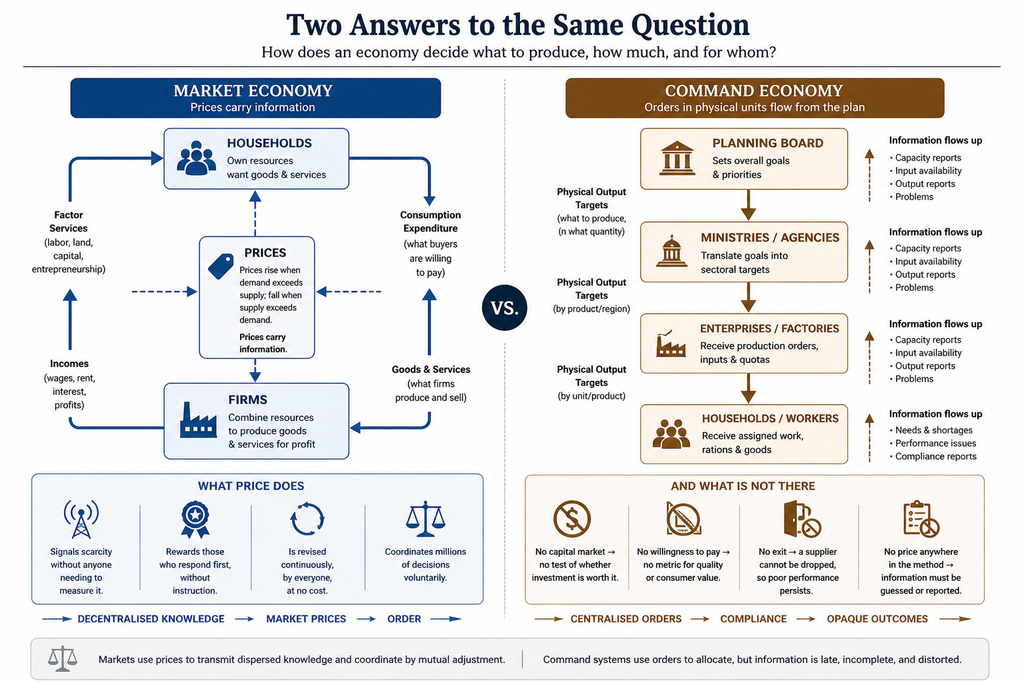
Every international economic order has to solve one problem before it solves any other: on what terms will goods move across a border when the two sides answer to different governments. The Western answer after 1944 was convertible currencies, market prices and multilateral clearing. The socialist answer was plan coordination between states whose planners had already abolished the market at home.
- The two orders were not competing versions of one design but rival solutions to a common problem.
- The Bretton Woods system assumed prices carried information and money could be exchanged, so the task was to keep exchange rates stable and finance temporary imbalances.
- Comecon assumed prices carried nothing and money did not cross borders, so the task was to match physical output plans between countries by negotiation.
- The socialist bloc’s foreign trade was an extension of domestic planning, not a separate policy field.
- Because the state monopoly of foreign trade placed all imports and exports in the hands of ministry agencies, there was no such thing as a firm choosing to export.
The Socialist Economic Model
Social ownership of the means of production
- Social ownership replaced private ownership of productive assets, which is the founding move from which every other feature follows.
- Land, factories, mines, banks and transport were vested in the state, or in cooperatives that were state-directed in practice.
- With no owners bidding for assets there were no capital markets, hence no interest rate, hence no market test of whether an investment was worth making.
- The abolition of the market was intended, not accidental.
- Marx and Engels treated the market as the mechanism through which social production is rendered anarchic and labour is exploited; removing it was the emancipatory act, not a means to some other end.
- The political theory of the socialist state — the party-state, democratic centralism, the nomenklatura — belongs to a separate treatment; what matters here is the economic machinery those institutions drove.
How a plan was actually made
Understanding Comecon requires understanding what a plan physically was, because the international body inherited every limitation of the domestic method. A Soviet plan was not a forecast or a budget. It was a set of binding physical instructions, arrived at by a method with no price in it anywhere.
- Gosplan, the State Planning Committee, sat at the centre of the process and drew up the plan in successive iterations with ministries and enterprises.
- The Five-Year Plan set strategic direction and major investment; the annual operational plan (tekhpromfinplan at enterprise level) was the document that actually bound managers.
- Material balances were the technique that replaced price equilibrium, and the concept is the single most useful key to the whole system.
- For each of thousands of products, planners drew a balance sheet in physical units — tonnes of steel, metres of cable, units of machine tools — with sources of supply on one side and uses on the other.
- Where the two sides did not match, planners closed the gap by cutting allocations, raising output targets or importing, then re-ran the balances because every change disturbed other balances.
- The method is iterative approximation, not optimisation: it produces a consistent plan, but consistency is a far weaker property than efficiency. A plan can balance perfectly and still be making the wrong things.
- The number of balances Gosplan could handle ran into the thousands; the number of distinct products in a modern economy runs into the millions, so the plan was always an aggregate over categories that concealed enormous variety.
- The information flowed the wrong way for accuracy.
- Enterprises supplied the data on which their own targets were set, giving every manager an interest in understating capacity and overstating input needs — the practice of building a “safety factor” into the plan.
Targets in physical units and the incentives they created
- Success indicators in physical quantity generated systematically perverse behaviour, and the examples are not curiosities but the normal working of the rule.
- A nail factory told to produce a tonnage of nails makes few heavy nails; told to produce a number, it makes many tiny ones. The Soviet satirical press ran the joke as a cartoon of one vast nail hanging from a crane.
- Alec Nove used the family of such cases to show that the flaw lay in the indicator, not in the manager.
- Quality had no metric that a plan could bind, because quality is precisely what a customer’s willingness to pay reveals and there was no such willingness to observe.
- Ratchet effects punished good performance.
- Because next year’s target was set from this year’s achievement, a manager who over-fulfilled substantially was rewarded once and penalised permanently.
- The rational strategy was to over-fulfil modestly and consistently, which is exactly what enterprises did — and it meant the system never learned how much any factory could actually produce.
- Innovation carried private cost and delivered public benefit, so it was avoided.
- The Soviet Union was strong at invention and weak at diffusion — an asymmetry that became decisive once the technology frontier moved.
Collectivised agriculture
- Collectivisation from 1929 eliminated the peasant household as an independent producer and made agriculture the plan’s most persistent failure.
- The kolkhoz (collective farm) and sovkhoz (state farm) were the two forms; compulsory deliveries at low state procurement prices transferred resources out of agriculture to finance industry.
- The most telling statistic of the mature system: private plots occupying a tiny fraction of sown area produced a substantial share of potatoes, vegetables, eggs and meat — an internal demonstration of what the incentive structure was doing to the rest.
- From the 1960s the Soviet Union became a net grain importer, buying from the United States, Canada and Argentina — an ideological embarrassment and a hard-currency drain.
Heavy industry over consumption
- Group A (means of production) held permanent priority over Group B (consumer goods) in every plan, and this was doctrine rather than circumstance.
- It delivered genuine results in the extensive phase — steel, coal, electricity, machine tools, cement — and those results are real and should not be dismissed.
- It also meant that the consumer sector was the residual claimant on resources, absorbing every shortfall elsewhere. Queues were not a malfunction; they were where the plan’s slack was stored.
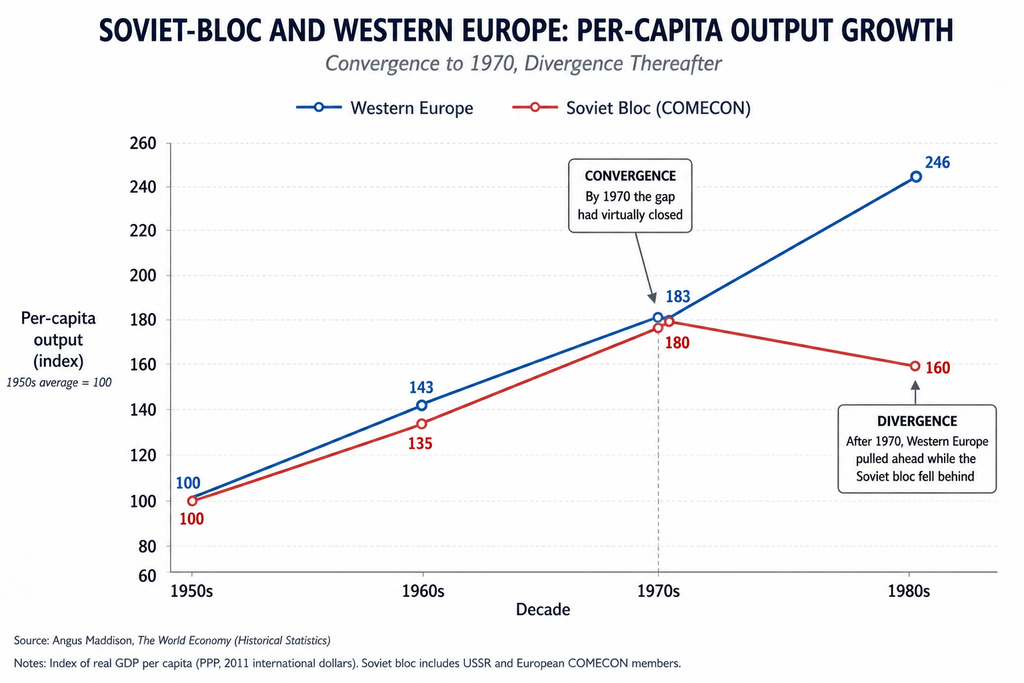
- Growth was extensive rather than intensive, which set a ceiling the system met in the 1970s.
- Once the reserves of underemployed rural labour were exhausted and capital deepening ran into diminishing returns, the growth rate fell steadily from the late 1960s onward and no amount of further mobilisation restored it.
Administered prices
- Prices were set by decree and revised rarely, which severed the last link between cost, scarcity and decision.
- Retail prices for necessities — bread, rent, transport, energy — were held far below cost and covered by budget subsidy, producing chronic excess demand at the posted price.
- Because prices were fixed, inflation appeared as shortage rather than as a rising price level — repressed inflation, visible in queues, waiting lists and empty shelves rather than in an index.
- This is the point on which the whole system turns. A price in a market is a piece of compressed information about relative scarcity that nobody had to compute. Administered prices are a decision recorded, not information discovered — so a planner reading them learns only what a previous planner decided.
The state monopoly of foreign trade
- All external trade passed through state foreign trade organisations, and this is the single most important institutional fact for understanding Comecon.
- Domestic prices and world prices were separated by a price equalisation account in the budget, which absorbed the difference — so a world price movement reached no producer or consumer inside the country as a signal.
- The consequence is decisive: the domestic economy was insulated from world prices by design, so comparative advantage could not reveal itself even if planners had wanted to find it.
- Autarky was the default disposition, softened but never abandoned; and because both sides of any transaction were governments, every trade was simultaneously an economic and a diplomatic act.
The absence of convertible currency
- The rouble and the East European currencies were not convertible, into each other or into anything else.
- Hard currency was a rationed strategic resource allocated by the state, which is why hard-currency earnings from Soviet oil and gas mattered so disproportionately.
- Without convertibility a trade surplus is worthless, because there is nothing the surplus can be spent on other than goods the counterparty is willing to release.
| Dimension | Market economy | Command economy |
|---|---|---|
| Allocation mechanism | Decentralised exchange; millions of bilateral decisions | Material balances; a central board matching physical flows |
| Prices | Discovered by bidding; carry information about scarcity | Administered by decree; record a past decision |
| Ownership | Private, with residual claim on profit and loss | Social/state, with no residual claimant |
| Budget constraint | Hard — persistent loss ends the firm | Soft — loss is covered by subsidy, credit or tax remission |
| Adjustment to error | Exit and entry; resources move | Petition and negotiation; the plan is amended |
| Characteristic pathology | Unemployment and demand deficiency | Shortage and hoarding of inputs |
| Innovation | Driven by competitive rent-seeking; diffusion is automatic | Driven by administrative campaign; diffusion has no carrier |
| Foreign trade | Firms trade; currency convertible | State monopoly; currency inconvertible |
The Economic Calculation Debate
This argument, conducted mostly between the 1920s and the 1940s, is the intellectual backdrop against which Comecon’s record has to be read. It asked a question that sounds abstract and turned out to be the most practical question in twentieth-century political economy: can a planning authority allocate resources rationally without market prices for the means of production?
The impossibility case
- Ludwig von Mises argued in 1920 that socialism faced not a difficulty but an impossibility.
- His point was narrow and therefore powerful. Physical planning can tell you how to make a thing, but a planner choosing between two techniques must compare incommensurable bundles — so much steel and electricity against so much timber and labour.
- Under social ownership nobody owns capital goods, so nobody trades them, so no prices for them exist, so the comparison cannot be made and the planner is guessing.
“Where there is no free market, there is no pricing mechanism; without a pricing mechanism, there is no economic calculation.” — Ludwig von Mises
- Friedrich Hayek shifted the argument from calculation to knowledge, and in doing so made it far harder to answer.
- The relevant knowledge is not a set of technical coefficients that could in principle be collected; it is dispersed, tacit, local and perishable — knowledge of a particular machine, a particular supplier, a particular moment.
- The price system works because it compresses this knowledge into a single number that people can act on without knowing why it moved.
“…the knowledge of the circumstances of which we must make use never exists in concentrated or integrated form but solely as the dispersed bits of incomplete and frequently contradictory knowledge which all the separate individuals possess.” — Friedrich Hayek
The market-socialist reply
- Oskar Lange answered that the objection proved too much, and his reply was taken by most economists at the time to have won.
- Lange accepted that prices are needed, and denied only that private ownership is needed to generate them.
- His Central Planning Board would announce a set of prices; managers would be instructed to produce where marginal cost equals price and to choose the input mix that minimises cost at those prices.
- The Board would then observe inventories — rising stocks mean the price is too high, shortages mean it is too low — and adjust, converging by trial and error exactly as a Walrasian auctioneer would.
- Abba Lerner supplied the rule that made the scheme operational, in The Economics of Control.
- The Lange–Lerner position dominated academic opinion for a generation, and its influence explains why planning was regarded in the 1950s and 1960s as a technically respectable alternative rather than a doomed one.
What the record actually showed
- The historical outcome bears on the argument, but not as simply as either side claims.
- No socialist economy ever attempted the Lange model. Real planning used physical balances and cost-plus prices, not iterative price announcement with marginal-cost rules, so the experiment was never run.
- The objections that turned out to bind were the ones Lange treated as secondary.
- Incentives: the rule “produce where marginal cost equals price” presupposes a manager who wants to obey it. Under a soft budget constraint, none did.
- Innovation: the Lange model is a theory of static allocation among known products with known techniques. It has nothing to say about who introduces a product that does not exist, and that turned out to be the whole game.
- Political economy: a board with the power to set every price is a board with the power to do everything else, and no institution existed that could stop it using prices politically.
- Tacit knowledge: Hayek’s objection was never met, only sidestepped, and computerised planning proposals of the 1960s foundered on it as thoroughly as pencil-and-paper ones.
The calculation debate was settled less by argument than by forty years of shelves.
Kornai and the Shortage Economy
The most powerful account of how socialist economies actually behaved was produced from inside one. János Kornai, a Hungarian economist who had worked as an economic journalist and then in the planning apparatus, built a positive theory of the system rather than a critique from outside it, and his vocabulary is now standard even among economists who reject his politics.
Shortage as a systemic property
- Kornai’s central claim in Economics of Shortage is that shortage under socialism is chronic, general and self-reproducing, not a symptom of bad planning that better planning could cure.
- Capitalist economies are demand-constrained: firms can produce more than buyers will take, so the binding limit is sales, and the characteristic pathology is unemployment.
- Socialist economies are resource-constrained: buyers will take more than firms can supply, so the binding limit is inputs, and the characteristic pathology is shortage.
- Shortage is not the same as scarcity. Scarcity is universal; shortage is the specific condition in which the posted price does not clear the market and the excess demand persists indefinitely because nothing adjusts.
The soft budget constraint
- The soft budget constraint is the mechanism, and it is Kornai’s most transferable idea.
- A budget constraint is hard when an organisation that spends more than it earns ceases to exist. It is soft when the organisation expects to be rescued.
“The behavior of every organization concerned is affected by the expectation that it will be bailed out if it gets into serious financial trouble.” — János Kornai
- Rescue came in four standard forms: soft subsidies, soft taxation, soft credit and soft administered prices — the state could raise the enterprise’s output price, forgive its tax, extend its loan or simply cover the gap.
- An enterprise that cannot fail will not economise.
- Price sensitivity collapses: if the input bill will be met whatever it is, there is no reason to search for a cheaper supplier or a leaner technique.
- Effort migrates from production to lobbying: the highest-return activity becomes cultivating the ministry that grants relief.
Investment hunger and the quantity drive
- Investment hunger follows directly: demand for investment goods becomes effectively insatiable because nothing on the demand side limits it.
- Every enterprise and every ministry wants to expand; no financial penalty attaches to wanting too much; so the aggregate of requests permanently exceeds available capacity.
- The result is a chronic investment cycle — a rush of project starts, resources spread too thin, long gestation periods, unfinished construction accumulating for years.
- The quantity drive is the corresponding behaviour in current production.
- Since inputs are the binding constraint, the drive for volume becomes a drive to acquire and hold inputs.
- Hoarding is the rational response of every actor, and it is what makes shortage self-reproducing.
- An enterprise uncertain of supply stockpiles materials and over-employs labour against future need.
- Every hoarding decision removes resources from the pool and worsens the shortage that motivated it, so shortage generates the behaviour that generates shortage.
- The bloc’s economies therefore ran simultaneously with very high inventories and severe input shortages — a combination unintelligible on market assumptions and perfectly intelligible on Kornai’s.
Forced substitution and the queue
- Forced substitution is what shortage does to the consumer, and it is why measured output overstated welfare.
- The buyer who cannot obtain the wanted good takes an inferior available one, postpones the purchase, or joins a waiting list — for a car, a telephone line, an apartment, waits ran to years.
- Substitution is recorded in the statistics as a sale, so the plan is fulfilled while the consumer is worse off, and national accounts systematically flatter the system.
- The queue is the socialist analogue of the price, and the parallel is exact enough to be worth stating carefully.
- In a market, excess demand raises the price and rations by willingness to pay. Under fixed prices, excess demand lengthens the queue and rations by willingness to wait.
- Both are rationing devices; the difference is where the surplus goes. A price transfers it to the seller, who is thereby told to produce more. Queuing time is destroyed — it accrues to nobody and signals nothing.
- This is why shortage persisted for decades rather than correcting: the rationing device carried no information back to the producer.
- Rationing by connection compounded it: blat, the informal exchange of favours and access, allocated much of what the queue did not, and it distributed goods by proximity to power.
- Paternalism is Kornai’s name for the underlying relationship, and it explains why partial reform failed.
- Hardening the budget constraint therefore requires the state to accept bankruptcies, unemployment and the political cost of both, which is a political decision and not an economic technique.
Shortage was not a planning error the planners could have corrected; it was the system operating correctly.
- Kornai’s later position deserves recording, because he did not become a cheerleader for the alternative.
- In The Road to a Free Economy he argued for market transition but warned against rapid mass privatisation, preferring organic growth of a private sector and orderly sale of state assets.
- He described the transition’s outcome with a phrase that captures its ambivalence — the “great transformation” delivered political freedom and material abundance at a social cost he refused to minimise, and in his last years he wrote critically of both the Hungarian and the Chinese trajectories.
The Founding of Comecon
Comecon was born as a Cold War instrument, and its founding date is legible only against what had happened in the two preceding years. The Soviet Union had just refused, on behalf of its neighbours, an offer of American reconstruction money, and having refused it had to supply something in its place.
- The Marshall Plan of 1947 was the immediate provocation, and the sequence matters more than the fact.
- Poland and Czechoslovakia initially indicated they would attend the Paris conference on the European Recovery Programme in July 1947. Stalin ordered them to withdraw, and the Czechoslovak delegation was summoned to Moscow and told to reverse its decision.
- That refusal cut Central Europe off from its traditional Western markets and suppliers, which created the problem Comecon then existed to solve.
- The Molotov Plan — a set of bilateral trade and aid agreements between the USSR and its neighbours from 1947 — was the improvised predecessor that Comecon institutionalised.
- The Western institution being answered was the OEEC, the Organisation for European Economic Co-operation, set up in April 1948 to administer Marshall aid and later to become the OECD.
- The organisation was constituted at a Moscow conference in early January 1949 and announced publicly on 25 January 1949, with headquarters in Moscow.
- Its early years were far more modest than the name suggests.
- Between 1949 and 1953 activity was largely confined to registering bilateral trade and credit agreements already concluded between members.
- Serious work on industrial specialisation began only after Stalin’s death in 1953, and intensified after the creation of the European Economic Community in 1957 gave the bloc a rival to measure itself against.
| Member or participant | Status | Entered | Left or ceased |
|---|---|---|---|
| Soviet Union | Founding member | January 1949 | Dissolved with the organisation, 1991 |
| Bulgaria | Founding member | January 1949 | 1991 |
| Czechoslovakia | Founding member | January 1949 | 1991 |
| Hungary | Founding member | January 1949 | 1991 |
| Poland | Founding member | January 1949 | 1991 |
| Romania | Founding member | January 1949 | 1991 |
| Albania | Full member | February 1949 | Ceased active participation end-1961 after the Soviet–Albanian split; formal withdrawal 1987 |
| German Democratic Republic | Full member | September 1950 | October 1990, on German reunification |
| Mongolia | Full member | June 1962 — the first non-European member | 1991 |
| Cuba | Full member — the first outside Europe and Asia | 1972 | 1991 |
| Vietnam | Full member — the last to accede | 1978 | 1991 |
| Yugoslavia | Associate participation under a 1964 agreement, in trade, finance, currency and industry; took part in a majority of Comecon bodies without full membership | 1964 | 1991 |
| China | Observer | 1956 | Withdrew as the Sino-Soviet split hardened, from 1961 |
| North Korea, Laos, Angola, Ethiopia, Afghanistan, South Yemen | Observers at various dates | — | — |
| Finland, Iraq, Mexico, Nicaragua, Mozambique | Non-socialist cooperant states under formal cooperation agreements | 1973 onwards | — |
- Yugoslavia’s position is analytically the most interesting entry in the table.
- Belgrade had been expelled from the Cominform in 1948 and developed workers’ self-management as an alternative socialist model with enterprise autonomy and a functioning market for goods.
- It was therefore the one European socialist economy Comecon could not absorb — not because it refused, but because the two systems could not be made to interlock. A self-managed enterprise choosing its own output could not be written into another country’s material balance.
Structure and Decision Rules
- The formal architecture looked substantial and was deliberately weak.
- The Session of the Council was the supreme organ, meeting annually in member capitals at head-of-government level.
- The Executive Committee, created in 1962, was the principal executive body, composed of deputy prime ministers and meeting quarterly in Moscow.
- The Secretariat in Moscow was the only permanent body and was always headed by a Soviet official — a detail that says more about the organisation than its charter does.
- Standing Commissions by sector — eight in 1956, twenty-four by the 1980s — covered coal, machine building, chemicals, agriculture and foreign trade, and could only make recommendations.
- Informally, the meetings of communist party first secretaries were where decisions were actually taken, which is the standard pattern of a party-state system projected outward.
- The interested-party principle is the structural key.
- Recommendations of the Council bound only those members that declared an interest and accepted them; a member could simply decline to participate without blocking anyone else.
- The 1971 Comprehensive Programme said so explicitly, stating that socialist economic integration “does not involve the creation of supranational bodies” — a promise no European Community text has ever contained.
- Comecon was far less supranational than the EEC, and the difference was not one of degree.
- Comecon had recommendations that members could opt out of, no court, no directly effective law, and a customs union that was never even attempted — there were no common external tariffs because there were no meaningful tariffs.
- The paradox is worth stating plainly: the bloc of centrally planned states built the less centralised international organisation. Planning at home coexisted with something close to intergovernmental voluntarism abroad, because each state guarded the integrity of its own plan.
| Feature | Comecon | Bretton Woods institutions | European Economic Community |
|---|---|---|---|
| Basis of membership | Political and ideological alignment; effectively Soviet consent | Open and near-universal; subscription of quota | Regional, conditional on democracy and market economy |
| Decision rule | Recommendation binding only on interested parties; no majority coercion | Weighted voting by quota; supermajorities for major decisions | Community method; Commission initiative, Council voting, direct effect |
| Adjudication | None — disputes settled by negotiation and Soviet arbitration | Board interpretation; later WTO binding dispute settlement | Court of Justice with binding, directly applicable rulings |
| Currency arrangement | Transferable rouble — a unit of account, neither transferable nor convertible | Convertibility obligation under Article VIII; SDRs as a reserve asset | Convertible national currencies, then the euro |
| Price formation | Administered, from the lagged Bucharest formula | Market prices; the Fund polices exchange rates, not prices | Market prices within a common market |
| Trade settlement | Bilateral balancing, largely barter | Multilateral clearing in convertible currency | Multilateral within a customs union and single market |
| Supranationality | Very low — explicitly disclaimed | Moderate — binding conditionality, but on borrowers only | High and increasing |
| Direction of transfer | Core to periphery through underpriced energy | Periphery to core in debt service through the 1980s | Core to periphery through structural funds |
How Trade Actually Worked
Because no currency could be exchanged and no price meant anything, Comecon trade had to be organised by a method that presupposes neither. What emerged was a system of government-to-government barter dressed in accounting language.
Bilateral balancing
- Trade was balanced country by country rather than across the bloc, and this is the practical difference from every multilateral order.
- Each pair of governments negotiated a five-year trade protocol and annual implementing lists, specifying quantities of named goods in each direction.
- The two flows had to balance against each other, because a surplus with one partner could not be used to pay a deficit with another.
- Multilateral clearing — the basic service the Western system provides — was therefore unavailable, and this alone capped the volume of intra-bloc trade far below what specialisation would have supported.
- Goods were sorted informally into “hard” and “soft” categories, and the distinction governed everything.
- Hard goods were those saleable on the world market for convertible currency — oil, gas, timber, cotton, grain, non-ferrous metals, overwhelmingly Soviet exports.
- Soft goods were manufactures of a quality only another bloc member would accept — much East European machinery and equipment.
The Bucharest formula
- Intra-Comecon prices were derived from world market prices with a deliberate lag, an arrangement known from where it was agreed as the Bucharest formula.
- Prices were originally fixed for the whole five-year plan period at an average of recent world prices, and revised at each new plan.
- After the 1973 oil shock made a five-year freeze untenable, the rule was changed in 1975 to annual revision based on a moving average of world prices over the preceding five years (initially three).
- After 1973 the formula meant Eastern Europe bought Soviet oil far below the world price, and kept doing so for a decade.
- Because the moving average trailed a sharply rising spot price, the gap ran in the buyers’ favour throughout the 1970s — and reversed in the mid-1980s when world prices collapsed and the lagged Comecon price stayed high.
- The bloc consequently experienced the oil shocks late, in muted form and in the wrong direction, which is one reason its economies looked healthy in the mid-1970s and deteriorated sharply afterwards.
The implicit subsidy and its direction
- The Soviet Union transferred resources to its satellites through the terms of trade, which is the opposite of what an imperial relationship is supposed to look like.
- Michael Marrese and Jan Vaňous made the case in the 1980s that the USSR sold hard goods below and bought soft goods above their opportunity cost, and put the cumulative transfer to Eastern Europe at roughly $100 billion for 1971–81.
- Their explanation was political: the USSR was purchasing security, reliability and ideological conformity, and the subsidy was the price of an empire that could not be run at a profit.
- The scale is genuinely disputed, and the estimate should not be treated as settled.
- Critics argued the estimate depends on counterfactual world prices for goods that would not have sold on the world market at all, and that the “subsidy” partly reflects the low quality of what the USSR received rather than generosity.
- What is not disputed is the direction: by the 1970s and 1980s the metropole was subsidising the periphery on the trade account, which inverts the classic dependency picture and is one of the more instructive facts about the whole arrangement.
- When the subsidy stopped, the dependent economies stopped with it. The 1991 shift to world prices in hard currency was, for Eastern Europe, simultaneously a price shock, a payments shock and a demand shock.
The transferable rouble
- The transferable rouble, introduced in 1964, was a unit of account and nothing more.
- It was not transferable, because a credit balance with one member could not be reassigned to settle a debt with another without that member’s separate consent.
- It was not convertible, into gold, into Western currency, or into the domestic currencies of members.
- Why this mattered more than any other single defect: a surplus in transferable roubles bought nothing.
- A member that over-exported simply accumulated claims it could not spend, so the rational policy was to avoid running surpluses at all.
- The 1971 Comprehensive Programme set a timetable for convertibility by 1980. It was not met, and no member other than Hungary took even preparatory steps.
The two banks
- The International Bank for Economic Cooperation (IBEC), 1963, was created to operate the transferable rouble system and settle multilateral accounts.
- It cleared balances and extended short-term credit, but could not solve a problem that was not banking in origin — a clearing house cannot make claims spendable if there is nothing on offer to buy.
- The International Investment Bank (IIB), 1970, financed joint investment projects across members and could borrow on Western capital markets.
- It funded a share of the bloc’s large joint ventures, notably in energy and pipelines, and was one of the few Comecon bodies with a genuinely multilateral function.
The International Socialist Division of Labour
The idea was straightforward and, on its own terms, correct: ten planned economies each building a full range of industries is ten times the waste of one doing so. The attempt to act on it produced Comecon’s sharpest political crisis.
- The problem being addressed was “parallelism” — every member building its own steel industry, its own machine tools, its own vehicle plants, all below efficient scale.
- The Basic Principles of the International Socialist Division of Labour were adopted at the end of 1961 and endorsed by the Council in 1962.
- In November 1962 Khrushchev went further, proposing a single common planning organ with authority to allocate production across members — genuine supranational planning, and the high-water mark of the integration project.
- Romania refused, and the refusal held.
- Under Gheorghe Gheorghiu-Dej, Romania was assigned the role of agricultural and raw-material supplier to the industrialised north of the bloc and rejected it outright, insisting on completing its own heavy industrial base — above all the Galați steel combine.
- Bucharest framed the objection in the language the charter itself used: supranational planning violated sovereign equality and non-interference, principles the Soviet Union could not repudiate without cost.
- The April 1964 “Statement on the Stand of the Romanian Workers’ Party” put the position on the record and became the founding document of Romania’s semi-independent line, later carried much further by Nicolae Ceaușescu.
- The outcome was a compromise that conceded the principle.
- Khrushchev’s planning organ was reduced to a Bureau for Integrated Planning with advisory powers only, and the interested-party provisions were reaffirmed.
- This is the clearest single instance in the bloc’s history of national interest overriding bloc logic.
- Even under overwhelming asymmetry a determined member could refuse, because the organisation had given itself no instrument of compulsion short of tanks it did not wish to use for this purpose.
- The 1971 Comprehensive Programme for Socialist Economic Integration was the second and last serious attempt.
- It replaced the word “cooperation” with “integration“, set a fifteen-to-twenty-year horizon, and proposed a larger role for money, prices and exchange rates alongside plan coordination.
- Its concrete results were real but narrow: the Orenburg gas project and the 2,677-kilometre Soyuz pipeline, completed in 1978 at a cost of some $5–6 billion and financed jointly, was the largest.
- The 1985 Comprehensive Programme for Scientific and Technical Progress, adopted under Gorbachev, aimed to close the technology gap by joint research and arrived far too late to matter.
Specialisation without prices is not specialisation; it is allocation by argument, and the strongest argument wins.
What Comecon Achieved
An honest treatment has to record the achievements, because a purely negative account cannot explain why the arrangement lasted four decades or why parts of it outlived the bloc.
- Physical infrastructure integration was the organisation’s most durable product.
- The Mir unified electric power grid, with a Central Dispatching Board established in 1962, linked the national systems of Eastern Europe and the western USSR and allowed load-sharing across time zones — a genuine engineering achievement that survives in the interconnected grids of the region.
- The Druzhba (“Friendship”) pipeline, begun in 1960 and among the longest oil pipelines in the world, carried crude from the Volga–Urals region to Poland, East Germany, Czechoslovakia and Hungary, and still supplies refineries there.
- Sectoral joint bodies did modest but real work.
- Intermetall, from 1964, coordinated rolled steel production and orders between members and is often cited as the most functional of the sectoral organisations.
- Interkosmos, from 1967, put citizens of member states into orbit on Soviet missions and remains the most visible symbol of the bloc’s scientific cooperation.
- Rapid industrialisation from a very low base was real in the southern members.
- Bulgaria and Romania entered the period as agrarian societies with mass illiteracy and left it with substantial industrial sectors, urbanised populations and universal schooling.
- Social provision was broad and its achievements are not in dispute.
- Near-full employment, free health care and education, subsidised housing, transport and staple food, and high female labour-force participation were delivered across the bloc.
- What none of this amounted to was integration. Trade between members remained a set of bilateral deals; specialisation remained administrative; and the achievements were engineering projects and social policies rather than a working economic union.
- Nor did any of it reach beyond the bloc. Where the Fund, the Bank and the GATT were built to be global and open to any state that accepted their rules, Comecon was a closed regional system whose integration stopped at the edge of the socialist sphere.
Why Comecon Failed
- No price signals, so specialisation was administrative rather than efficient.
- Deciding who should make tractors requires knowing where tractors are cheapest to make, and that is precisely the fact administered prices concealed.
- No convertibility, so trade could not multilateralise, so volumes stayed below even what administrative specialisation would have justified.
- A widening technology gap with the West, which became the decisive failure.
- The bloc kept pace in steel, cement, machine tools and military aerospace — the technologies of the extensive phase — and fell progressively behind in electronics, semiconductors, computing, telecommunications and precision instruments.
- The reason is Kornai’s: the system could invent but could not diffuse. A market spreads an innovation because rivals must adopt it or lose; a planned economy spreads it only if an administrative campaign carries it, and campaigns are slow, partial and politically directed.
- Software and networked computing were structurally impossible in a system that treated the photocopier as a security risk and controlled every duplicating machine.
- The Western export-control regime tightened the gap from outside.
- CoCom, the Coordinating Committee for Multilateral Export Controls, operating from 1949 among NATO members and Japan, maintained lists of goods and technologies barred from export to the bloc.
- The debt trap of the 1970s converted a technology problem into a solvency crisis.
- Faced with stagnating productivity, several members chose in the détente years to import Western machinery on hard-currency credit, expecting the resulting exports to service the loans. Recycled petrodollars made the credit cheap and abundant.
- The exports did not materialise, because imported machinery cannot fix an incentive problem: plant bought with borrowed dollars was operated by enterprises with the same soft budget constraints as before. Poland’s licence-built tractor and vehicle projects became the standard illustration.
- When US interest rates rose sharply from 1979 and world demand contracted, the debt became unserviceable, and Poland suspended payments to Western creditors in 1981.
- Romania instead repaid in full by imposing austerity and rationing without parallel in Europe, finishing in 1989 months before its government was overthrown.
- The 1979–83 recession across the bloc was the turning point, and with the possible exceptions of East Germany and Bulgaria, no member ever recovered its earlier growth path.
- The autarkic bias survived every reform.
- The result was that Comecon members traded far less with each other than comparably sized and comparably located market economies did, despite forty years of an organisation dedicated to increasing exactly that.
- The absence of any exit mechanism meant obsolete capacity was never retired: in a market, loss-making plants close and their labour and materials move on; under a soft budget constraint nothing closes.
Reform Attempts Inside the System
Every serious reform attempt inside the bloc ran into the same wall: a market needs prices, prices need scarcity, scarcity needs a hard budget constraint, and a hard budget constraint means firms fail and workers lose jobs in a system whose legitimacy rested on neither happening.
- The Liberman debate opened the question in the Soviet Union in 1962.
- Evsei Liberman, an economist at Kharkov, argued in Pravda that enterprises should be judged on profitability — the ratio of profit to capital employed — rather than on gross output, with bonuses tied to it.
- The Kosygin reforms of September 1965 were the resulting attempt at implementation.
- Binding plan indicators were cut from about thirty to nine; sales realised and profitability replaced gross output as the leading success measures; enterprises retained profit in three incentive funds for wages, welfare and investment.
- The reform failed for reasons that generalise. Wholesale prices were never recalculated, so profitability computed at arbitrary prices measured nothing; ministries went on issuing binding instructions; and supply shortages meant an enterprise free to buy still could not.
- The Soviet intervention in Czechoslovakia in August 1968 ended the political space for reform talk; by 1969 output indicators were back and by the early 1970s the incentive funds had been reversed.
- Hungary’s New Economic Mechanism, launched on 1 January 1968, went furthest of any Comecon member.
- Compulsory plan targets for enterprises were abolished outright — the single most radical step taken anywhere in the bloc — and firms were told to respond to prices and profit.
- A three-tier price system was created: fixed, limited-range and free prices, with the free segment widening over time; some consumer prices were allowed to move.
- Its limits are the more instructive part: the budget constraint stayed soft, because loss-making firms were still rescued through individually negotiated taxes and subsidies, so the price signals the reform created were promptly cancelled by the bargaining it left in place.
- Czechoslovakia’s 1968 reform was the one that tried to change the politics with the economics.
- Ota Šik‘s programme combined enterprise autonomy, market prices and workers’ councils with the political opening of the Prague Spring under Alexander Dubček — “socialism with a human face”.
- The Warsaw Pact invasion of August 1968 ended it, and the subsequent “normalisation” reversed the economic measures along with the political ones.
- Yugoslav self-management was the excluded alternative rather than a failed reform.
- Enterprises were run by workers’ councils that appointed managers, set output and distributed income; the state retained ownership formally but not operationally; goods traded at market prices and the economy was open to the West.
- Its significance here is structural: it was the model that could not be fitted into Comecon, and its exclusion shows how narrow the bloc’s tolerance of institutional variety actually was.
- Poland’s crisis fused economics and politics irreversibly.
- The Gierek strategy of the 1970s — Western credit to buy technology and consumer goods, expecting exports to repay it — produced a decade of visible improvement followed by insolvency.
- Attempts to raise subsidised food prices triggered strikes in 1970, 1976 and 1980; the last produced the Gdańsk Agreement and the independent trade union Solidarity, ten million strong within a year.
- Martial law from December 1981 suppressed the union without solving anything, and by 1989 the government negotiated with the people it had interned. The Round Table Talks and the June 1989 elections began the bloc’s unravelling.
- Gorbachev’s perestroika removed the guarantee on which Comecon rested.
- Perestroika from 1985 combined enterprise self-financing, legalised cooperatives and joint ventures with glasnost, and its economic effect was to dismantle plan discipline without installing market discipline.
- The Sinatra doctrine — abandoning the Brezhnev doctrine and letting Eastern Europe “do it their way” — withdrew the Soviet military guarantee.
- Comecon’s members had been held in an economic order by a political fact; when the political fact went, the economic order had nothing of its own to hold them with.
The Collapse
- 1989 removed the governments on which the organisation depended, in a sequence that ran from Poland’s June elections through Hungary’s border opening, the fall of the Berlin Wall in November and Romania’s violent December.
- The decisive economic act was the switch to hard currency and world prices on 1 January 1991.
- Trade among former members would henceforth be settled in convertible currency at world prices — the Soviet Union, needing hard currency, had pressed hardest for it.
- The effect was immediate and severe. Eastern European exporters lost their captive market overnight; importers faced world prices for energy they had bought below it; and nobody had the dollars to pay. Intra-bloc trade collapsed by more than half in a single year.
- This “CMEA trade shock” is a large and often underweighted part of the transition recession: a substantial share of the output fall in Central Europe in 1991 was the loss of the Soviet market rather than the effect of any domestic reform programme.
- The organisation was renamed the Organisation for International Economic Cooperation in early 1991, and members were reduced to a pledge to coordinate on quotas, tariffs and payments.
- Comecon was formally dissolved at its final session in Budapest on 28 June 1991, with liquidation to follow within ninety days.
- The Warsaw Pact was dissolved three days later, on 1 July 1991, in Prague — the economic institution went first, which is a fact worth noticing about which of the two had already ceased to function.
- The Soviet Union itself ended on 26 December 1991, six months after the organisation it had built to bind its neighbours.
The Transition and the Argument That Ran Through It
Twenty-nine countries had to be converted from plan to market simultaneously, with no precedent and no theory of the sequence. The argument about how to do it was the largest applied economics controversy of the late twentieth century, and it was conducted while the experiment was running.
The case for shock therapy
- The core claim was that partial reform is worse than either extreme, because a half-liberalised economy generates arbitrage between plan and market prices that enriches insiders and discredits reform.
- Jeffrey Sachs, the most visible advocate, argued that stabilisation, liberalisation and privatisation had to move together and fast, and used the metaphor that one cannot cross a chasm in two jumps.
- Poland’s Balcerowicz Plan, in force from 1 January 1990, was the model case.
- Leszek Balcerowicz combined price liberalisation, the removal of most subsidies, a sharply restrictive monetary and fiscal stance, current-account convertibility at a fixed and heavily devalued zloty, and an opening to imports.
- Shortages ended within weeks and queues disappeared; inflation, which had reached hyperinflationary rates in 1989, was broken within two years; and output fell sharply for two years and then grew.
- Poland was the first transition economy to regain its 1989 output level, in the mid-1990s.
- The Paris Club agreed in March 1991 to a 50 per cent reduction of Poland’s official debt — relief no post-Soviet state received, and routinely omitted when Poland is cited as proof that shock therapy works.
- Russia’s version under Yegor Gaidar from January 1992 produced a very different result.
- Prices were freed at once; the state’s fiscal and monetary control was far weaker; and the rouble zone persisted across the former republics, so no single authority controlled the money supply. Inflation reached several thousand per cent in 1992.
- Voucher privatisation from 1992 distributed shares to the whole population, and the vouchers were rapidly bought up cheaply by managers and financiers.
- The loans-for-shares scheme of 1995, in which the state’s stakes in oil, metals and telecoms were pledged for loans it did not repay, transferred the commanding heights to a small group at a fraction of value. The Russian oligarchy was created by the design of privatisation, not by its abuse.
- Russia defaulted on domestic debt and devalued the rouble in August 1998, ending the first transition decade in a crisis that discredited the programme politically as thoroughly as the output figures had discredited it economically.
The case for gradualism
- Kornai himself argued against rapid mass privatisation, from precisely the analysis that had exposed the old system.
- His warning was that ownership without effective control does not harden the budget constraint, and a privatised firm that is still rescued behaves exactly like a state one — a prediction the post-Soviet record confirmed.
- Joseph Stiglitz made the institutional argument in Globalization and Its Discontents and elsewhere.
- Markets are not a default state that appears when the state withdraws; they require contract enforcement, company law, bankruptcy procedure, bank regulation, competition policy and a functioning tax administration, none of which the socialist economies possessed.
- Liberalising before these exist does not produce a market but asset-stripping, because the most profitable available activity is appropriation rather than production.
- He argued the sequencing was reversed: institutions first, then privatisation, and criticised the advice given to Russia as ideology mistaken for economics.
What the record shows
- The transition recession was deeper and longer than anyone predicted, and its depth is the central fact.
- Every transition economy’s output fell, most for several consecutive years; the fall was roughly a fifth in Central Europe and around two-fifths in the former Soviet Union, with industrial production falling further still.
- Russia’s output fell by more than 40 per cent between 1990 and 1995 and did not regain its 1990 level until the middle of the following decade; several post-Soviet states had still not done so twenty-five years on.
- Kornai named the phenomenon the transformational recession and insisted it was not a normal cyclical downturn: the old coordination mechanism was destroyed faster than the new one could be built, and output fell in the gap.
- The human cost was severe and unevenly distributed.
- Russian male life expectancy fell from 64.2 years in 1989 to 57.6 in 1994, a drop of six and a half years in five, with female life expectancy falling 3.3 years — a peacetime mortality reversal with few modern parallels.
- The discriminating variable turned out to be institutions, not speed.
- Poland, Hungary, the Czech Republic, Slovakia, Slovenia and the three Baltic states joined the European Union in May 2004; Bulgaria and Romania in 2007. The acquis communautaire supplied, ready-made, the legal and regulatory apparatus that Stiglitz said had to come first.
- The post-Soviet states without that anchor — Russia, Ukraine, Belarus, Central Asia — liberalised prices as fast or faster and built institutions far more slowly, and diverged accordingly.
- The honest conclusion is that the shock-versus-gradualism framing was the wrong axis. Speed of price liberalisation mattered much less than the quality of the state doing the liberalising, and the countries usually cited as shock-therapy successes were also the countries with the strongest institutional anchor and the most external help.
| Shock therapy | Gradualism | |
|---|---|---|
| Core proposition | Partial reform is worse than none; move on all fronts at once | Sequence matters; markets need institutions built first |
| Advocates | Sachs, Balcerowicz, Gaidar, the Fund in the early 1990s | Kornai, Stiglitz, Murrell; Chinese practice |
| Political theory | Use the window of extraordinary politics before opposition reforms | Sustain reform by keeping losers compensated and support intact |
| Privatisation method | Rapid and mass — vouchers, giveaways, speed over price | Slow and case-by-case — real buyers, real prices, hard budgets |
| Where tried | Poland 1990, Czechoslovakia, Estonia; Russia 1992 | Hungary and Slovenia in part; China and Vietnam by a different route |
| Best evidence for | Poland — shortages ended fast, output recovered first in the region | China — sustained high growth with no output collapse at all |
| Best evidence against | Russia — a 40 per cent output fall, oligarchy, the 1998 default | Ukraine and Belarus — slow reform without institution-building fared no better |
| What the record suggests | Speed helped where the state was capable and an EU anchor existed | Sequencing helped where institutions could actually be built |
The Chinese and Vietnamese Alternative
The most powerful objection to the whole European transition experience is that two socialist economies dismantled central planning without either an output collapse or a change of regime, and did it by the opposite method.
- The Chinese reform inverted the European sequence: economics first, politics not at all.
- Deng Xiaoping’s programme from December 1978 left the Communist Party’s monopoly untouched and changed the economy underneath it, which is precisely what Gorbachev did not do.
- The household responsibility system was the decisive first move.
- Beginning with local initiatives in Anhui in 1978 and generalised by 1983, collective land was contracted to households which owed a fixed quota to the state and kept the surplus.
- Grain output and rural incomes rose sharply within a few years, on the same land with the same technology — the clearest natural demonstration available of what the incentive structure had been costing.
- The dual-track price system was the characteristic Chinese device.
- Enterprises met their plan quota at plan prices and sold anything above it at market prices, so the plan was frozen in absolute terms while the economy grew past it.
- No one was expropriated of their planned entitlement, so reform created few losers, and the market track expanded until the plan track became irrelevant.
- Barry Naughton described this as “growing out of the plan” — the plan was not abolished, it was outgrown.
- Township and village enterprises supplied the growth that state industry could not.
- Collectively owned by local governments rather than private or central, TVEs faced hard budget constraints because a county could not print money, and they absorbed rural labour on an enormous scale through the 1980s and early 1990s.
- Special economic zones from 1980 — Shenzhen, Zhuhai, Shantou, Xiamen — brought in foreign capital, technology and export markets under rules that did not apply nationally, containing the political risk of opening.
- Vietnam’s Đổi Mới, adopted at the Sixth Party Congress in December 1986, followed the same logic in a poorer and more war-damaged economy.
- Decollectivisation of agriculture, price liberalisation, legalisation of private business, a unified exchange rate and openness to foreign investment turned a rice importer into one of the world’s largest rice exporters within a few years.
- The honest counter-point is that the comparison is not a clean natural experiment.
- China in 1978 was overwhelmingly agrarian, with some four-fifths of its population rural and an enormous reserve of underemployed farm labour whose marginal product was near zero. Moving that labour into light manufacturing generated growth almost automatically.
- The Soviet bloc was over-industrialised and fully employed, with its labour already in the wrong industries rather than idle in the right ones. Its reform problem was not mobilisation but reallocation, which necessarily destroys jobs before creating them.
- The conclusion is not that gradualism was right and shock wrong, but that initial structure constrained the feasible set, and the two blocs did not start from the same place.
China did not solve the calculation problem; it grew a market alongside the plan until the plan no longer mattered.
The Indian Anchor
India is the third case, and the most useful for an Indian reader precisely because it belonged to neither camp: it borrowed the Soviet model’s planning apparatus without its ownership structure, and traded with the bloc without joining it.
- Indian planning drew explicitly and openly on the Soviet experience.
- The Planning Commission (1950) and the Five Year Plans were modelled on Soviet practice, and the ideological frame — the socialistic pattern of society adopted by the Congress in 1955 — made the borrowing explicit.
- The Mahalanobis model, devised by P. C. Mahalanobis for the Second Five Year Plan (1956–61), is the analytical core.
- Its two-sector version divides the economy into capital goods and consumer goods and makes the long-run growth rate depend on the share of investment going to the capital-goods sector — the formal case for heavy industry, and a close cousin of the Soviet doctrine of Department I.
- The institutional apparatus followed from the model.
- The Industrial Policy Resolution of 1956 reserved the commanding heights — steel, heavy engineering, coal, power, transport, communications — to the public sector.
- Industrial licensing under the Industries (Development and Regulation) Act 1951 required government permission to start, expand or relocate a plant, producing what came to be called the Licence Raj and a set of rent-seeking pathologies recognisable from Kornai’s analysis.
- Rupee–rouble trade linked India to the bloc’s payments system without joining it.
- From the 1953 trade agreement onward, Indo-Soviet trade was conducted under rupee payment arrangements: Soviet imports were paid for in non-convertible rupees held in accounts in India, which the USSR could spend only on Indian goods.
- The arrangement was genuinely useful to a foreign-exchange-scarce economy: it let India import oil, fertiliser, steel and defence equipment without spending hard currency, and gave Indian textiles, tea, tobacco, leather and pharmaceuticals a large assured market.
- The Soviet Union was India’s single largest trading partner by the late 1980s, with bilateral trade above $5 billion a year — a share of Indian exports that no other single market matched.
- The collapse of that trade was a direct cause of the 1991 balance-of-payments crisis.
- When the Soviet trading system disintegrated in 1990–91, the market for those exports vanished with almost no notice, and the settlement mechanism vanished with it.
- It compounded the Gulf War oil price spike and the loss of remittances from Indians working in Kuwait and Iraq.
- Reserves fell to about $1.2 billion in January 1991, barely two to three weeks of imports, and India pledged 67 tonnes of gold in all — 20 tonnes to the Union Bank of Switzerland in May 1991 and 47 tonnes to the Bank of England in July 1991.
- India learned from both models and adopted neither whole, and the timing of the lesson is not a coincidence.
- The 1991 reforms — devaluation in July, the abolition of industrial licensing for most sectors, the dismantling of import licensing, opening to foreign investment and the beginning of public-sector disinvestment — arrived in the same months as the Soviet model’s terminal failure.
- India retained democratic politics, private ownership and a price system throughout, so it had no transformational recession to suffer: it was liberalising a mixed economy, not rebuilding a destroyed one.
Legacy, and What the Episode Is Evidence For
- The Bretton Woods institutions became near-universal because Comecon ended.
- Former members joined the International Monetary Fund and the World Bank in the early 1990s, and most acceded to the WTO over the following two decades — Poland, Hungary, Romania, the Czech and Slovak republics as founder members in 1995; China in 2001; Vietnam in 2007; Russia in 2012.
- The arguments have reappeared, in different vocabulary and on the other side.
- Industrial policy is openly practised by the states that spent thirty years advising against it, and the questions it raises — who can identify a sector worth backing, and what stops support outliving its use — are the calculation and soft-budget questions again.
- The soft budget constraint is now standard in analysis of bank bailouts, state-owned enterprise reform, subnational government debt and China’s local-government financing vehicles; Kornai’s concept long outlived the system it described.
- Two failures should not be conflated. Central planning’s failure is not an argument against public ownership, redistribution or a large state; the Nordic economies have all three with hard budget constraints and market prices. What failed was allocation without prices, which is a narrower and more specific proposition.
- The closing assessment should stay open.
- The model’s failure was economic before it was political: growth stalled in the 1970s, the technology gap widened through the 1980s, and the political crisis followed the economic one rather than causing it.
- The two cannot finally be separated. The absence of prices and the absence of politics had the same root — the conviction that a society’s needs can be known centrally and in advance, so that neither market competition nor political competition has anything to discover.
- The contrast that decided the century was adaptability. Western economies met their own severe crisis in the 1970s — stagflation, the end of the par-value system, the oil shocks — and changed course; the bloc met its crisis in the same decade and borrowed rather than reformed.
- A system that suppressed both feedback mechanisms could not learn, and an economy that cannot learn is eventually overtaken by one that can, however unjust the latter is in other respects. That is the durable finding, and it is narrower than either side’s triumphalism made it.
Previous Year Questions
The CMEA was asked about directly for the first time in 2026:
- How did the Council of Mutual Economic Assistance (CMEA) reflect geo-political division of the world during the cold war? (2026)
The nearest earlier questions, both answered elsewhere in this unit, are:
- How has the development of Global Capitalism changed the nature of socialist economies and developing societies? (2017) — treated with the world capitalist economy.
- The central focus of global politics is no longer the conflict between Socialism and Capitalism, but North versus South. Explain. (1992) — treated with the North–South divide.
Syllabus unit: Evolution of the International Economic System
PSIR Optional study material from LotusArise IAS
Two ways to prepare with us — the full self-study system, or just the notes you need right now.
| What you get | PSIR Mains Master Kit 2027 | PSIR Complete Notes (Store) |
|---|---|---|
| Paper 1 notes — Political Theory + Indian Government and Politics | Included | Included — Section A and Section B |
| Paper 2 notes — Comparative Politics and India and the World | Included | Included — Section A and Section B |
| Topic-wise PYQ bank | 1986–2026, with trend analysis and probables by Dec 2026 | 1991–2025 question papers, free with every notes pack |
| Practice question set for timed answer writing | ✅ Available now | ❌ |
| Answer toolkit — intros, conclusions, frameworks, thinker and example banks | By Dec 2026 | ❌ |
| Revision booklets for the last 60 days | ✅ Available now | ❌ |
| Format | Online articles + PDF | PDF download |
| Access | Valid until UPSC CSE Mains 2027 | Instant download after payment |
| Price | ₹1,770 (regular ₹5,000) | ₹1,180 for all four sections · ₹599 a paper · ₹354 a section |
| Best for | Aspirants who want the whole system in one place | Aspirants who want the notes now, in the parts they need |
