

In 1978 China’s economy was smaller than Italy’s. Within four decades it was the largest manufacturing power in history and the only country credibly discussed as a peer of the United States. What that ascent means for the international order is the central unsettled question of contemporary world politics — and the answers range from a second Cold War already under way to a plural order in which the metaphor of two camps has stopped describing anything.
The Ascent: How China Became the Second Economy

China’s rise is not a single event but a sequence of decisions, each of which could have gone differently. Reading it as a chain of choices rather than an inevitability matters, because both the case that the ascent continues and the case that it stalls rest on whether those choices can be repeated under harder conditions.
“The lion has woken up, but it is peaceful, pleasant and civilised.” — Xi Jinping
Reform and opening, 1978 onwards
- Deng Xiaoping’s reform and opening from December 1978 reversed the Maoist model without ever formally repudiating it. The sequence was gradual, experimental and deliberately unideological.
- Special Economic Zones — Shenzhen, Zhuhai, Shantou and Xiamen from 1980 — created enclaves where foreign capital, foreign management and export production were legal before they were legal anywhere else.
- The reform was sequenced in the opposite order to the Soviet one. Beijing liberalised the economy while retaining the party’s political monopoly; Moscow opened politics first and never delivered the economic gains that might have bought legitimacy.
- Deng’s Southern Tour of 1992 relaunched reform after the post-Tiananmen freeze and produced the formula of a “socialist market economy” adopted by the Fourteenth Party Congress.
“It doesn’t matter whether a cat is black or white, so long as it catches mice.” — Deng Xiaoping
- Accession to the World Trade Organization on 11 December 2001 was the hinge: it bound China into the rules of the trading system, gave its exports permanent access to Western markets, and forced reforms a purely domestic politics would not have carried.
- The bargain assumed convergence — that a market-integrated China would liberalise politically and accept the order’s rules. That assumption is what Washington now regards as falsified, and the revision of it is the intellectual foundation of the current rivalry.
The size of the economy, and why the measurements disagree
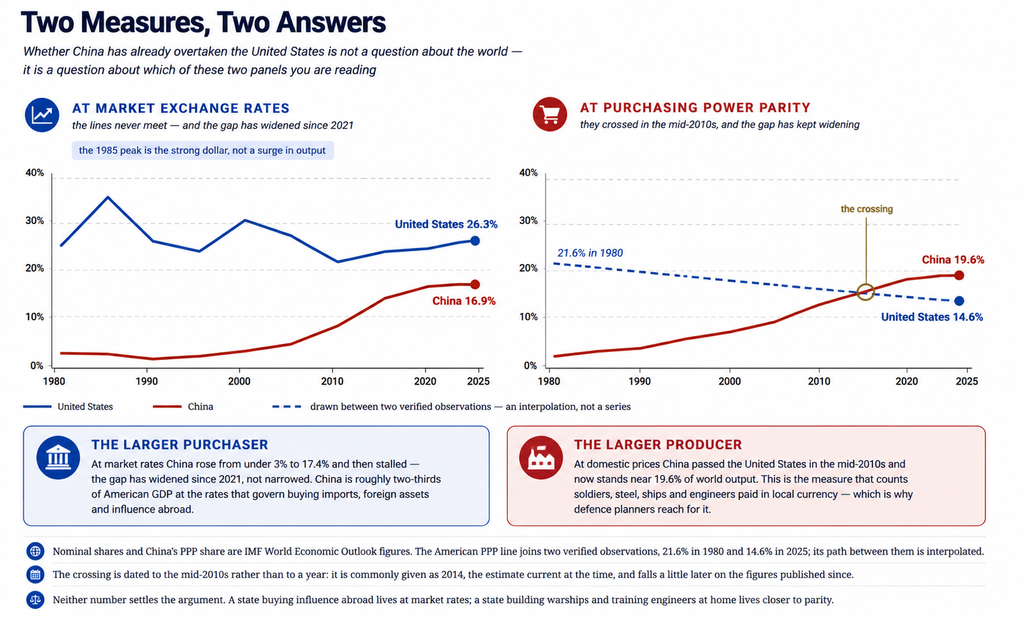
- China’s economic scale gives two different answers depending on how it is measured, and almost every dispute about whether China has already overtaken the United States is a dispute about which measure is meant.
| Measure | What it captures | The China–US comparison | What it is good for |
|---|---|---|---|
| Market exchange rates (nominal) | Output valued at prevailing exchange rates | China roughly two-thirds of US GDP and the gap has widened since 2021, not narrowed | International purchasing power — buying imports, foreign assets, overseas influence |
| Purchasing power parity (PPP) | Output valued at a common basket of domestic prices | China is already larger, and has been since about 2014; roughly 19% of world output against the American share | Domestic resource mobilisation — soldiers, steel, ships, engineers paid in local prices |
| Per capita | Output per person | China around a sixth of the American level; still classified as an upper-middle-income country | Development level, and the pressure of ageing before affluence |
- The PPP figure flatters and the market figure understates, and both are used tendentiously. A state buying influence abroad lives at market rates; a state building warships and training engineers at home lives closer to PPP. Neither number settles the argument — China is the larger producer and the smaller purchaser.
- Manufacturing is where Chinese preponderance is least ambiguous. China accounts for roughly thirty per cent of global manufacturing value added, more than the United States, Japan and Germany combined, and has driven over thirty per cent of the growth in world manufacturing since 2021.
- China’s 2025 trade surplus reached $1.189 trillion, nearly $1.2 trillion and the largest ever recorded, with net exports contributing an extraordinary share of that year’s growth — a figure that reads as strength and weakness at once.
The slowdown and what it consists of
- Growth has decelerated from double digits to the low-to-mid single digits, and the composition of the slowdown matters more than its headline. The official figure for 2025 was around 5%; independent estimates put actual growth materially lower, with the largest discrepancies in investment.
- The property sector, approaching a quarter of GDP at its peak once linkages are counted, has contracted severely: new housing starts are more than seventy-five per cent below their 2021 peak, and developer failures have destroyed household wealth in a country where property is the principal savings vehicle.
- Local government financing vehicles carry off-balance-sheet debt accumulated to fund infrastructure, and the collapse of land sales — historically the main local revenue source — has removed the means of servicing it.
- Deflationary pressure has persisted — falling prices, weak retail sales, credit growth at historic lows. Deflation is the signature of an economy producing more than its own citizens can buy, and the surplus is pushed outward into the trading system, which is what generates the political reaction abroad.
Technological ambition
- Made in China 2025, announced in 2015, set self-sufficiency targets across ten priority sectors and is the single most consequential industrial policy of the century so far. Its record is genuinely mixed, and both the alarm and the derision it attracts are overdone.
- Where it succeeded: electric vehicles, with indigenous producers at roughly ninety per cent of the domestic market and China the largest car exporter in the world; solar at over eighty per cent of global manufacturing capacity; wind turbines above sixty; shipbuilding, space and biopharmaceuticals.
- Where it failed: semiconductors above all, at a fraction of the fifty per cent self-sufficiency target; also commercial aviation, high-end machine tools, advanced materials and robotics.
- The pattern is legible: China succeeds where scale, process engineering and state-directed capital decide, and struggles where the binding constraint is a single irreplaceable input controlled abroad — extreme-ultraviolet lithography above all.
- The frontier push now runs through artificial intelligence, quantum computing and communications, and semiconductors, funded by successive tranches of the national integrated-circuit investment fund.
- Rare earths and the clean-energy supply chain are the point of maximum Chinese leverage. China mines a majority of the world’s rare earths and refines the overwhelming majority, and dominates permanent magnets, battery cells, cathode and anode materials, and solar wafers.
- The April 2025 export controls on heavy rare earths and magnets halted production lines at European and Japanese carmakers within weeks. The October 2025 controls went further, adding a foreign direct product rule that reached any foreign-made good containing Chinese-origin rare earth material.
- The controls were suspended for a year under the October 2025 truce, but the demonstration effect is permanent: a chokepoint used once is a standing instrument thereafter.
Military modernisation and the milestone years
- The People’s Liberation Army has been rebuilt from a mass continental infantry force into a theatre-capable joint force, with the emphasis moving from the army to the navy, air force, rocket force and the domains of space, cyber and electromagnetic warfare.
- The PLA Navy is now the largest navy in the world by hull count, with three aircraft carriers commissioned and the fourth under construction, and a shipbuilding capacity that dwarfs the American.
- The milestone sequence structures the whole modernisation programme and is stated openly.
| Milestone | Content | What it is not |
|---|---|---|
| 2027 | Centenary of the PLA’s founding; accelerated development of mechanisation, informatisation and intelligentisation and the capability to prevail in a Taiwan contingency | Not a stated deadline for invasion — a capability target that Western officials have sometimes reported as an intention |
| 2035 | Basically complete modernisation of national defence and the armed forces | — |
| 2049 | Centenary of the People’s Republic; a “world-class” military | The vaguest of the three, and deliberately so |
- Spending remains far below the American level. China spent $336 billion on defence in 2025 against the United States’ $954 billion — second in the world, but roughly a third of the leader.
- The nuclear expansion is the sharpest single change. China holds around 620 warheads, roughly double its 2020 figure, and is expanding faster than any other nuclear-armed state. On current trajectories it could field as many intercontinental ballistic missiles as either Russia or the United States by the turn of the decade.
- “The Party commands the gun” remains the organising principle of civil–military relations, enforced through the Central Military Commission chaired by the paramount leader. Modernisation has always been constrained by the leadership’s unwillingness to let a professionalised force escape political control.
- This converts the strategic nuclear relationship from a bilateral into a trilateral problem, with no established doctrine, no shared vocabulary and no negotiating machinery for three parties.
- Two facts stand against all of this that the capability tables do not show.
- The PLA has not fought a war since 1979, when its punitive campaign against Vietnam went badly.
- It has been convulsed by corruption purges reaching the highest levels — two defence ministers, both Central Military Commission vice-chairmen including He Weidong, the Political Work Department head Miao Hua, and every past commander of the Rocket Force.
- Whether this reflects a system cleaning itself or a system that cannot trust its own commanders is genuinely unresolved — and it is the single largest uncertainty in any assessment of Chinese military capability.
Capability tables measure equipment. They cannot measure whether the officers operating it believe their own chain of command.
The Instruments of Chinese Influence
Great powers project influence through instruments, and China’s are distinctive in what they include and what they conspicuously omit. There are no overseas garrisons on the American scale, no treaty alliances, no ideological export in the Soviet sense. What there is instead is infrastructure, finance, trade architecture, supply-chain position, and declaratory doctrines aimed at states that resent conditionality.
The Belt and Road Initiative
- The Belt and Road Initiative, announced in 2013, now counts some 150 participating countries and is the largest infrastructure programme ever attempted by a single state.
- Its instruments are the policy banks — the China Development Bank and the Export-Import Bank of China — and state-owned construction firms, not grants. BRI lending is commercial lending, which is central to every argument about it.
- The “debt-trap diplomacy” thesis holds that China lends deliberately beyond a borrower’s capacity in order to seize strategic assets on default. It has become the standard Western and Indian framing, and it has serious academic critics who should be taken as seriously as its proponents.
- The case for: lending concentrated in strategically located ports and corridors; opaque contracts with confidentiality and cross-default clauses; collateralisation against commodity revenues; and the political leverage debt distress creates regardless of intent.
- The case against, argued by Deborah Brautigam and by Lee Jones and Shahar Hameiri, is that the thesis is a meme rather than a finding.
- On the paradigm case of Hambantota, the port was proposed by Colombo and rejected by other lenders as unviable; the 2017 ninety-nine-year lease raised dollars to service debt owed overwhelmingly to Western bondholders and multilateral lenders; and no debt was cancelled for the asset.
- The defensible position sits between the two. Deliberate entrapment is unproven and probably misreads a decentralised, commercial lending system. Structural leverage over indebted states is nonetheless real, arises whether or not anyone planned it, and is available to be used.
The interesting question about Chinese lending is not whether Beijing set a trap, but what a creditor can do once a debtor cannot pay.
Parallel institutions and trade architecture
| Instrument | Founded | What it does | How far it displaces the Western order |
|---|---|---|---|
| Asian Infrastructure Investment Bank | 2016 | Multilateral infrastructure lender, over 100 members including most European states | Largely complementary — co-finances with the World Bank, follows comparable safeguards. An alternative venue, not an alternative regime |
| New Development Bank | 2015 | The BRICS bank, headquartered in Shanghai, lending in members’ local currencies | Modest in scale; constrained by its exposure to sanctioned members |
| Regional Comprehensive Economic Partnership | Signed 2020, in force 2022 | Fifteen members — ASEAN plus China, Japan, South Korea, Australia, New Zealand; the largest trade bloc by population and output | Shallow on services, labour and standards, but it exists while the Western alternative does not — the United States is a member of no Asian trade agreement |
| Shanghai Cooperation Organisation | 2001 | Eurasian security and political grouping including India, Pakistan and Iran | A convening platform rather than an alliance; its heterogeneity limits it |
| CIPS | 2015 | Cross-Border Interbank Payment System — renminbi clearing infrastructure | Growing fast — volumes rose over 40% in 2024 — but complementary to, not yet independent of, the dollar system |
- The declaratory doctrines package Chinese preferences as global proposals: the Global Development Initiative (2021) putting development above political conditionality, the Global Security Initiative (2022) advancing indivisible security and opposing bloc politics and unilateral sanctions, and the Global Civilisation Initiative (2023) denying the universality of any single political model.
- They are thin on operational content and best read as positioning for the Global South. Their common thread, sovereignty and non-interference, is also their limit: a doctrine built on non-interference cannot easily justify supplying order.
The renminbi against the dollar
- Currency internationalisation meets its hardest constraint here. The renminbi settles roughly thirty per cent of China’s own trade, up from a tenth in 2017, and over ninety per cent of Russia–China trade since 2022.
- But the global position remains small. The renminbi is about 2% of allocated foreign exchange reserves against the dollar’s 57.1% and the euro’s 20.0%, and a comparably small share of global payments.
- The obstacle is political, not technical. Reserve-currency status requires open capital accounts, deep bond markets, courts that enforce contracts against the state, and a willingness to run external deficits — every one of which conflicts with the party-state’s preference for capital control.
Soft power, sharp power and the wolf-warrior turn
- China has invested heavily in instruments of attraction — Confucius Institutes, large scholarship programmes, global expansion of state media, and the Beijing Olympics as showcase.
- The returns have been poor for structural reasons. The hard/soft/sharp/structural vocabulary of power is developed elsewhere in this archive; what belongs here is why the investment underperformed.
- Soft power in Nye’s sense is generated by civil society, not by ministries. A system that treats culture as a state output cannot easily produce the spontaneous appeal that makes attraction credible, and Confucius Institutes have since closed in large numbers on academic-freedom grounds.
- Sharp power, the term introduced by Christopher Walker and Jessica Ludwig, names what the investment produced instead: influence through manipulation, censorship pressure, co-option of elites and information distortion rather than attraction. The distinction matters because sharp power provokes defensive reaction where soft power does not.
- The “wolf-warrior” turn — named for a patriotic film franchise — describes the confrontational diplomatic style that emerged around 2019–20, in which diplomats traded insults publicly and pressed historical grievance.
- It was costly and measurably so: favourability ratings for China in developed democracies fell to record lows, and the association with the pandemic’s early handling hardened opinion in Europe, Japan, South Korea, Australia and India at once.
- Beijing has since moderated the style, but the reputational damage has outlasted the tactic: it is cheaper to acquire a reputation than to shed one.
Will China Become a Superpower?
This question deserves argument on both sides rather than a list. A superpower is not simply the largest economy: it is a state with global military reach, global economic weight, an attractive model, allies who choose it, and the willingness to bear the costs of supplying order. China has the second and is acquiring the first. The other three are where the argument lies.
The case for
- Scale is not a detail: 1.4 billion people, the largest manufacturing base in history, the largest engineering graduate output and the largest domestic market give China a resource base no rival except India approaches.
- State capacity to concentrate resources is genuinely unusual — capital can be directed into a sector for a decade without electoral interruption, and losses absorbed that a listed firm could not bear.
- The model has genuine attraction for states that find Western conditionality intrusive: finance without governance requirements, a demonstrated path from poverty to middle income in two generations, and a claim that development need not wait for democracy. For many governments this is not propaganda but a description of what they want.
The case against
- Demography is the hardest of the constraints because nothing can be done about it now. China’s population has fallen for four consecutive years and stood at about 1.405 billion at the end of 2025, with 7.92 million births against 11.31 million deaths.
- The phrase that captures it is ageing before affluence: an old-age dependency burden at a per capita income roughly a sixth of the American level, where Japan, Korea and Europe all grew rich first.
- The balance-sheet overhang compounds the demographic one: a property sector down more than three-quarters, financing vehicles unable to service debt without land sales, and households deleveraging — a debt-deflation dynamic monetary easing has not broken.
- The middle-income transition names the problem analytically. Growth from moving labour off farms and accumulating capital ends when the transfer is complete and the capital stock is deep.
- What follows must come from productivity, which requires capital allocated by price signals, tolerance of failure and free movement of information — all of which sit awkwardly with tightening political control.
- The absence of allies of choice is the least quantifiable and possibly the most important constraint.
- The United States has treaty allies who fought alongside it, host its forces voluntarily and would probably fight again. China has partnerships, not alliances — Russia as a partner of convenience, Pakistan as a client, North Korea as a liability, and no state anywhere that has chosen it out of affinity.
- Every neighbour with the capacity to hedge is hedging against China: Japan, South Korea, India, Vietnam, the Philippines, Australia, Indonesia.
- A power that generates balancing rather than bandwagoning has a structural problem no amount of GDP fixes.
- The willingness question is the deepest. A superpower supplies global public goods — freedom of the seas, financial stability, crisis lending, disaster response, a stable climate — and bears the costs because the benefits accrue to it too.
- China’s emphasis on non-interference and sovereignty has so far meant declining the burdens as much as the interference. It is the second-largest funder of UN peacekeeping and contributes on public health and climate, but has not underwritten crises, organised coalitions or lent as a systemic lender of last resort.
- This is Nye’s Kindleberger trap: a China too weak or unwilling to help produce order, free-riding on one it did not build, rather than a China too strong. Under-provision is a way orders fail, and it is the less discussed one.
Five structural limitations
- The most systematic sceptical account sets out five structural and strategic limitations that impede China’s rise to superpower status.
| Limitation | The argument | Why it bites |
|---|---|---|
| Fragile political structure | A centralised system concentrating power in the Communist Party and lacking democratic institutions breeds internal insecurity | Brittleness undermines the stability that sustained global leadership requires; a system that fears its own society cannot project confidence |
| Lack of soft power | Cultural and political models with limited global appeal, and assertive foreign policies that alienate other states | Hampers the building of the alliances and goodwill superpower status requires |
| Economic and technological headwinds | An ageing population, environmental degradation, and the difficulty of the transition from manufacturing to innovation; technology met with suspicion over security and intellectual property | Growth cannot be assumed forward, and the technological gains attract pushback rather than adoption |
| Global perception and trust deficit | Damage from the handling of the pandemic and from territorial disputes; a lack of transparency compounding aggressive diplomacy | Makes other states wary of Chinese intentions and reduces influence directly |
| Counterbalancing by other powers | Established and emerging powers — the United States, India and the European Union — strengthening their positions in response | Limits China’s ability to shape global norms and institutions unilaterally, which is the operative test of superpower status |
- Its conclusion is that economic and military achievements are insufficient without corresponding reform and trust-building, and that the combination of internal vulnerability and external resistance makes the path to superpower status genuinely fraught.
- The judgement worth holding is narrower than either camp’s. China will be the second pole of the system and the dominant power in East Asia. Whether it becomes a superpower in the full sense — able to organise an order rather than obstruct one — turns on legitimacy, alliance and willingness, which no growth rate answers.
Sino-American Strategic Rivalry
The relationship between the United States and China is the organising axis of contemporary world politics, and it is unlike anything the Cold War produced. The two are each other’s rivals and each other’s customers, competitors for technological leadership and partners in the supply chains that produce it. Understanding the rivalry means holding the antagonism and the entanglement in view at once.
The structural reading and its limits
- Power transition theory and the Thucydides trap supply the standard structural frame: war becomes likely when a rising power approaches the capabilities of a dominant one and the dominant one fears the shift. The theory itself is developed elsewhere in this archive; what belongs here is its application and its critics.
- Graham Allison examined sixteen historical cases over five hundred years in which a rising power challenged an established one, and found war in twelve. The exceptions he identifies include Spain overtaking Portugal, the United States overtaking Britain, a reunified Germany’s rise after 1990, and the Soviet challenge.
“There is no such thing as the so-called Thucydides trap in the world. But should major countries time and again make the mistakes of strategic miscalculation, they might create such traps for themselves.” — Xi Jinping
- The critics of the frame are substantial.Joseph Nye objects that Allison’s case count rests on an unclear definition of a case, that the First World War had many causes beyond a rising Germany, and that today’s power gap far exceeds the Anglo-German gap of 1914.
- Metaphors, Nye warns, are useful as precautions and dangerous when they suggest inevitability. Donald Kagan showed that Athenian power was in fact no longer growing when the second Peloponnesian War broke out: it was policy error, not impersonal force, that made Sparta think war worth the risk.
“It was the rise of Athens and the fear that this instilled in Sparta that made war inevitable.” — Thucydides
- The rivalry was formalised in doctrine before it was in tariffs. The American National Security Strategy of 2017 and National Defense Strategy of 2018 named China a primary strategic competitor; China’s defence White Paper of 2019 acknowledged in turn that Washington had shifted from counter-terrorism to open competition.
- John Mearsheimer puts the offensive-realist case at its sharpest: China’s rise threatens a century of American primacy, and Xi is more ambitious than Mao, seeking to reshape the order militarily, economically, politically and ideologically. On this reading no amount of good management dissolves the competition.
The economic and technological domains
| Domain | What is contested | The instruments used | Direction of travel |
|---|---|---|---|
| Trade and tariffs | Market access, surpluses, industrial subsidy | Tariffs, quotas, anti-dumping actions, export licensing | Escalation punctuated by truces; average tariff levels far above pre-2018 |
| Semiconductors | Access to the frontier of computation | US export controls on advanced chips and toolmaking equipment; entity listings; allied controls through the Netherlands and Japan | The defining battleground; China closing the gap slowly at high cost |
| Critical minerals | Rare earths, magnets, battery inputs | Chinese export licensing and the foreign direct product rule of October 2025 | China’s principal counter-leverage, demonstrated and then suspended |
| Artificial intelligence | Frontier models, compute, talent, standards | Compute restrictions, investment screening, talent controls | Contested; Chinese labs closer to the frontier than compute restrictions assumed |
| Standards and governance | Who writes the rules for 5G, AI, data, digital currency | Standards bodies, UN agencies, technical committees | Slow, unglamorous and consequential |
- Decoupling gave way to de-risking, and the shift is not cosmetic. Full decoupling of two economies trading in the hundreds of billions is neither achievable nor desired; de-risking targets specific dependencies — chips, minerals, pharmaceutical precursors, critical infrastructure — and leaves the bulk of commerce alone.
- Weaponised interdependence, in Henry Farrell and Abraham Newman’s formulation, explains the shape of the competition. Networks of finance, data and supply are not flat: they have hubs, and whoever sits at a hub can cut off access or collect information through it.
- The United States sits at the financial and semiconductor-design hubs; China sits at the minerals-processing and manufacturing hubs. Both have discovered that interdependence is an instrument, and both have used it.
- The consequence is that every state now reads its supply chains as a security question — which is itself a structural change in the international economy.
- The tariff record since 2018 runs from the first Section 301 actions through successive escalations to the very high rates of early 2025 and the truce agreed at Busan on 30 October 2025 — American tariffs on Chinese goods cut from about 57% to 47%, rare-earth controls suspended for a year, agricultural purchases resumed.
- Trump’s state visit to Beijing in May 2026 produced a declaratory framework of “strategic stability”, aircraft orders and a partial relaxation of advanced-chip sales, resolving no structural question.
- Xi Jinping’s state visit to Washington in September 2026 extended the Busan truce, due to lapse on 10 November 2026, to 10 January 2027.
- The pattern is managed antagonism: periodic escalation, periodic truce, no settlement of the underlying disagreement about industrial policy and technological access.
The South China Sea
- The South China Sea is where Chinese claims meet those of five other governments and where the law of the sea is most openly contested.
- The nine-dash line — sometimes now drawn with ten dashes — encloses the great majority of the sea, overlapping the exclusive economic zones of Vietnam, the Philippines, Malaysia, Brunei and Indonesia’s Natuna waters.
- The arbitral award of 12 July 2016, issued by a tribunal constituted under Annex VII of UNCLOS in the case brought by the Philippines, is the central legal fact.
- It held that China’s historic-rights claim within the nine-dash line has no legal basis under the Convention; that no Spratly feature generates an exclusive economic zone; and that Chinese conduct at Mischief Reef and Scarborough Shoal violated Philippine rights.
- China rejected the award entirely, declining to participate and declaring it null.
- The award has not been enforced and cannot be — which is the standing demonstration of what international adjudication can and cannot do against a permanent member of the Security Council.
- Island building and militarisation turned seven Spratly features into artificial islands with runways, radar, missile emplacements and harbours between 2013 and 2016.
- Grey-zone coercion follows: coast guard and maritime militia rather than warships, water cannon rather than gunfire, as at Second Thomas Shoal from 2023 and Scarborough Shoal through 2026 — pressure calibrated to stay below the threshold that would trigger the American treaty commitment.
Taiwan and the first island chain
- Taiwan is the flashpoint with the highest consequences and the least room for compromise. For Beijing, unification is the unfinished business of the civil war and the condition of national rejuvenation. For Taipei, the practical status quo is a self-governing democracy of 23 million people.
- American policy rests on strategic ambiguity — the One China policy, the Taiwan Relations Act obligation to supply defensive arms, and silence on whether the United States would intervene. Its purpose is dual deterrence: deterring forcible unification and deterring a declaration of independence.
- The strategic value of Taiwan is not sentimental. It sits at the centre of the first island chain, running from the Japanese archipelago through the Ryukyus to the Philippines and Borneo — the line that, in Chinese planning, confines the PLA Navy to near seas and, in American planning, supplies the geography of forward defence.
- Taiwan also makes most of the world’s most advanced semiconductors, so any contingency is a global economic event — the silicon shield, whose deterrent value is disputed.
Alliances against partnerships
| The American system | The Chinese system | |
|---|---|---|
| Form | Treaty alliances with mutual defence commitments — Japan, South Korea, Australia, the Philippines, Thailand, NATO | Partnerships graded by adjective — comprehensive strategic, all-weather, no-limits — with no defence obligations |
| Forward presence | Bases and permanently stationed forces across the western Pacific and Europe | One overseas base at Djibouti; access arrangements elsewhere, notably Cambodia’s Ream |
| Binding mechanism | Reciprocal obligation and integrated command | Bilateral dependence — each partner tied to Beijing rather than to each other |
| Chief weakness | Entrapment and abandonment fears; dependence on American domestic politics | No one is obliged to help; partnerships are revocable and untested |
| Chief strength | Aggregation of capability and legitimacy | No entanglement in others’ wars, and no allied veto on Chinese choices |
- Beijing’s aversion to alliances is doctrinal, rooted in non-interference and in the memory of the Sino-Soviet split. It buys freedom of action at the price of aggregation.
What Walt actually argues about the rivalry
- Stephen Walt resists the standard framing of the Sino-American contest as a rerun of the Cold War, and his account of what it actually is has three components.
- Deep economic interdependence. The United States and the Soviet Union barely traded. The United States and China are entangled through supply chains, capital markets, student flows and technology stacks neither can sever without severe self-harm.
- Technological competition as the central arena, in place of the territorial and ideological competition of the Cold War.
- Rival visions of order. Washington defends a liberal, rules-based international system; Beijing advances a Westphalian model built on state sovereignty and non-interference. This is a disagreement about the rules, not about the nature of society — which is why it does not generate two ideological camps.
- His warning is about the cost of misdescription: mischaracterising the competition invites policy error and unnecessary escalation. If the contest is read as an ideological crusade, the responses chosen will be the wrong ones and the escalation will be self-inflicted.
The Rivalry’s Consequences for South and South-East Asia
No region has more at stake in the Sino-American contest than the Asian arc from Karachi to Manila: it contains China’s land and sea frontiers, the world’s busiest trade routes, and the states least able to insulate themselves. The response has been remarkably consistent — almost nobody has chosen.
ASEAN centrality and the refusal to choose
- ASEAN centrality holds that regional architecture should be organised around ASEAN’s convening institutions — the Regional Forum, the East Asia Summit, the Defence Ministers’ Meeting Plus — rather than around any great power.
- It suits everyone: agency for small states, a venue no great power dominates. Its limit shows in the South China Sea, where consensus lets Chinese economic weight secure a veto and Code of Conduct talks have run two decades without a binding text.
- Hedging is the regional default — economic engagement with China maintained alongside security cooperation with the United States, refusing the exclusivity either would prefer.
| State | Posture | What drives it |
|---|---|---|
| Philippines | The clearest realignment — expanded American base access under EDCA, restored joint patrols, publicity as a tactic against grey-zone coercion | Direct confrontation at Second Thomas and Scarborough Shoals; a treaty ally with an unresolved sovereignty dispute |
| Vietnam | “Bamboo diplomacy” — strong roots, flexible branches; upgraded ties with the United States, Russia, Japan, China and India simultaneously, while refusing alliances | The longest history of resisting China and the deepest economic integration with it; a formal four-noes defence policy |
| Indonesia | Non-aligned by tradition, quietly firm on the Natuna waters, unwilling to be organised | Size, self-image as a leader of the South, and BRICS membership since 2025 |
| Singapore | Hosts American logistics, trades overwhelmingly with China, argues loudly against forcing a choice | Existential dependence on an open trading system |
| Cambodia and Laos | The closest to alignment with Beijing — Chinese investment dominance, and Cambodia’s Ream naval base upgrade | Debt, investment dependence and the absence of alternatives |
| Myanmar | A civil war in which China holds leverage over both the junta and several armed groups | Pipelines and the corridor to the Indian Ocean |
| Thailand and Malaysia | Textbook hedging — American treaty or partnership ties alongside deepening Chinese trade | No territorial confrontation acute enough to force a choice |
- The Korean peninsula is where the rivalry has an unresolved third party. North Korea’s nuclear and missile programmes, developed in defiance of successive Security Council resolutions, are the most persistent security problem of the post-Cold War period in the region.
- China is Pyongyang’s dominant trading partner, has voted for sanctions while tolerating evasion, and prioritises avoiding collapse and war over denuclearisation — a unified peninsula aligned with Washington being the worse outcome for Beijing.
- The American deployment of the THAAD missile-defence system in South Korea after the 2016–17 tests produced sustained Chinese economic retaliation against Seoul — an early and instructive demonstration that the region’s states are punished for the security choices the rivalry forces on them.
How the region reads the balancing coalitions
- The Quad — the United States, Japan, India and Australia — was revived in 2017 and elevated to leader level in 2021. It is a consultative minilateral, not an alliance, and its agenda spans vaccines, critical technology, maritime domain awareness, infrastructure and undersea cables.
- It is presently at its weakest since revival. The leaders’ summit India was to host has not been held, American engagement under the second Trump administration has been minimal, and all three partners have grievances about tariffs and reliability. A grouping whose value was signalling is damaged when the signal stops.
- AUKUS commits Australia to nuclear-powered attack submarines with British and American assistance, alongside a second pillar on hypersonics, quantum, AI and undersea capability. A Pentagon review completed in late 2025 endorsed the submarine transfers, though delivery timelines and American production capacity remain the binding constraint.
- Regional reactions were mixed rather than uniformly welcoming. Indonesia and Malaysia registered proliferation and arms-race concerns; the Philippines, Japan and Singapore were relaxed or supportive. The episode showed that balancing coalitions are read in the region as both reassurance and provocation.
- The Indo-Pacific concept carries strategic content: redefining the theatre from “Asia-Pacific” to a single two-ocean space writes India into the maritime balance, and Beijing reads it, correctly, as designed to dilute Chinese centrality. ASEAN’s Outlook on the Indo-Pacific of 2019 accepts the geography while insisting on inclusiveness.
- India’s contributions are Act East, upgrading the older Look East policy into defence and connectivity engagement; SAGAR, Security and Growth for All in the Region, from 2015; and MAHASAGAR, announced in Mauritius in March 2025, extending the framework from the Indian Ocean neighbourhood to the wider Global South.
South Asia and the string of pearls
- Chinese presence across India’s neighbourhood has grown through infrastructure lending, port development and political relationships; Indian strategic debate reads it through the string of pearls hypothesis, a chain of dual-use facilities encircling India.
- The framing overstates by treating commercial ports as bases they are not, and understates because access arrangements can become basing arrangements quickly.
- Pakistan is the deepest relationship: the China–Pakistan Economic Corridor, the flagship BRI project, runs from Kashgar to Gwadar — a potential Arabian Sea outlet, through territory India claims. Its economics have disappointed and its security costs have been high.
- Sri Lanka has Hambantota port and Colombo Port City; Bangladesh takes Chinese infrastructure and defence supply alongside a close Indian relationship; Nepal and the Maldives have both elected governments on platforms of rebalancing toward or away from Beijing — the clearest evidence that this is contested domestic politics rather than completed encirclement.
- Tariffs and supply-chain reconfiguration are a second-order shock to these economies. “China plus one” relocation benefited Vietnam, India, Thailand, Mexico and Bangladesh; American tariffs aimed at transshipment then hit precisely those beneficiaries. Small open economies are absorbing the costs of a quarrel they are not party to.
The Indian Ocean and the Zone of Peace
- The Indian Ocean carries a third of world bulk cargo and around two-thirds of seaborne oil, and its chokepoints — Hormuz, Bab-el-Mandeb, Malacca — make it the most strategically concentrated ocean on earth. It is also the ocean where the littoral states have least control over what happens in their own waters.
- The 1971 Declaration of the Indian Ocean as a Zone of Peace, adopted as UN General Assembly Resolution 2832 (XXVI) on Sri Lankan initiative, called for the elimination of great-power bases and nuclear weapons from the region and for the ocean to be kept free of great-power rivalry.
- It went nowhere, for structural rather than accidental reasons.
- The architecture that did emerge is cooperative rather than exclusionary, and that is the significant shift.
- IORA, the Indian Ocean Rim Association, founded in 1997, now has 23 members and a dozen dialogue partners — including China, the United States, Japan and the European Union. Its six priority areas run from maritime safety to the blue economy, and its consensual, low-institutionalisation model limits it to convening.
- Diego Garcia is the standing exception and the standing grievance. Excised from Mauritius in 1965 and its population removed, it has been the principal American base in the ocean ever since.
- The United Kingdom–Mauritius treaty of 22 May 2025 provided for transferring sovereignty over the Chagos Archipelago to Mauritius while leasing the base back for 99 years, extendable by 40, at an average of about £101 million a year. Ratification then stalled: the United Kingdom paused the treaty in April 2026 after the United States withdrew its support, and the enabling Bill lapsed.
- India supported the settlement, treating it as decolonisation completed while accepting the base’s continuation — which is a precise illustration of how littoral states now behave: pressing the legal principle without seeking to remove the presence.
- Can littoral states shape it? Only partially, and not by exclusion.
- The realistic ambition is not a zone of peace but a zone of rules, in which extra-regional powers operate under arrangements the littoral states help write.
A demilitarised Indian Ocean was never within the gift of the states that asked for it. A rule-governed one might be.
Is This a Second Cold War?
The phrase “Cold War 2.0” is now routine in commentary about a confrontational Russia, an assertive China and a more protective United States. There is no consensus on whether it applies. Some hold that today’s rivalries, however serious, differ fundamentally from the original; others find the parallels in hostility and distrust too strong to ignore. The disagreement matters, because a metaphor that fixes how a rivalry is understood also fixes how it is handled.
Walt’s objections
- Stephen Walt (“I Knew the Cold War. This Is No Cold War”, Foreign Policy, 12 March 2018) argues that calling present American–Russian tensions a new Cold War is misleading, and gives four reasons.
- The system is not bipolar but “lopsided multipolar.” The United States remains preeminent, Russia is a distant second-tier player, and China is the emerging peer competitor. Russia’s economy of roughly $2 trillion is dwarfed by an American economy of some $27 trillion.
- Walt’s image for the mismatch: if the Cold War was Godzilla against King Kong, the present American–Russian contest is Godzilla against Bambi.
- There is no global ideological binary. Liberal democracy and communism were rival universal projects with adherents everywhere. Today’s Russia offers no transnational ideology comparable to Soviet communism; the competition is about geopolitical interest, not about winning minds.
- The confrontation is geographically narrower. Friction concentrates in Eastern Europe, West Asia and cyberspace rather than every theatre; Cold War proxy conflicts ran from Asia to Africa to Latin America.
- The metaphor risks focusing on the wrong adversary. Treating Russia as the principal antagonist diverts attention from China, the larger long-term challenge, and obscures that Washington now faces a potential two-front rivalry rather than the single focus it had on Moscow.
- The system is not bipolar but “lopsided multipolar.” The United States remains preeminent, Russia is a distant second-tier player, and China is the emerging peer competitor. Russia’s economy of roughly $2 trillion is dwarfed by an American economy of some $27 trillion.
Brands and Gaddis and the case for the parallel
- Hal Brands and John Lewis Gaddis (“The New Cold War: America, China, and the Echoes of History”, Foreign Affairs, November/December 2021) reply that a new cold war is already under way, and that the hostility, distrust and arms-racing in the relationship genuinely do mirror a Cold War climate, in a changed environment.
- The arms-control architecture has collapsed — the ABM Treaty in 2002, the INF Treaty in 2019, Open Skies, and New START’s expiry on 5 February 2026 leaving no legally binding limit on the two largest arsenals for the first time since 1972.
The comparison set out
| Dimension | The Cold War, 1947–1991 | The present, 2026 |
|---|---|---|
| Structure | Genuinely bipolar — two roughly comparable superpowers | Lopsided multipolar — one preeminent power, one rising peer, one disruptive second-tier state, several consequential middle powers |
| Ideological content | Two universal projects competing for the same converts everywhere | No transnational ideology on offer. A disagreement about rules and sovereignty, not about how societies should be organised |
| Economic relations | The USSR and USA barely traded; two separate economic systems | Deep entanglement. Hundreds of billions in annual trade, shared supply chains, capital and student flows — the sharpest single difference |
| Alliance behaviour | Rigid blocs; membership was near-permanent and exclusive | Multi-alignment. India buys Russian arms and joins the Quad; Turkey is in NATO and buys Russian missiles; Gulf states hedge across all three |
| Nuclear arithmetic | Bilateral, with a shared vocabulary and negotiating machinery | Trilateral and unregulated — China’s expansion makes the old calculus obsolete and there is no framework for three |
| Arms control | Dense: SALT, ABM, INF, START, the hotline, verification regimes | Effectively absent. No binding limits, no verification, no successor negotiation in force |
| Geographic scope | Every continent, through proxy war and client relationships | Concentrated — Eastern Europe, the western Pacific, West Asia, and the non-geographic domains of cyber and technology |
| Institutional overlap | Two parallel systems with almost no shared membership | Shared membership everywhere — the WTO, the G20, the Security Council, climate regimes |
A judgement
- The Cold War analogy fails as a description and succeeds only as a warning. The two features that made the Cold War what it was — a bipolar structure and a global ideological binary — are both absent, and the feature most conspicuously present today, economic interdependence, was absent then.
- What is genuinely Cold War-like is narrower and worth naming precisely: the erosion of arms control, the hardening of threat perception, the securitisation of ordinary commerce, and the assumption on both sides that the other’s gains are its own losses.
- The better description of the Sino-American relationship is competitive interdependence — a rivalry conducted through, rather than in the absence of, deep economic connection. This is historically unusual and there is no ready template for managing it, which is why the temptation to reach for the Cold War template is so strong and so dangerous.
- The risk Walt identifies is the operative one. Learning the wrong lesson — underestimating the danger, or over-reacting and manufacturing the confrontation feared — is how a metaphor becomes a policy and a policy becomes a war. History does not repeat, but it rhymes, and statecraft is what keeps the rhyme from becoming a repetition.
America First and the Chinese Dream
- Two national projects, announced within a few years of each other, have done more to reshape the operating rules of world politics than any treaty of the period.
| America First | The Chinese Dream | |
|---|---|---|
| Content | National interest defined narrowly and transactionally; burden-shifting to allies; scepticism of multilateral commitment; trade deficits treated as losses | National rejuvenation by the centenaries of 2021 and 2049 — a moderately prosperous society, then a strong, modern socialist country; recovery from the “century of humiliation” |
| Trading system | Tariffs as the primary instrument; withdrawal from the Trans-Pacific Partnership; renegotiation of NAFTA into USMCA; blocking Appellate Body appointments, leaving it unstaffed since December 2019 | Mercantilist integration — using WTO membership and state support to build export dominance while restricting reciprocal access; building RCEP and applying to the CPTPP |
| Alliances | Framed as cost centres; demands for higher allied spending; questioning of automatic commitments | Alliances rejected in principle; a network of graded partnerships instead |
| Institutions | Withdrawal or defunding — the Paris Agreement, the Iran deal, the WHO, UNESCO, the Human Rights Council | Working inside existing institutions to shift them while building parallel ones — the AIIB, the NDB, the BRICS |
| The developing world | Aid cut and conditioned; migration restricted; the language of partnership replaced by the language of deals | Infrastructure finance without political conditionality; the Global Development, Security and Civilisation Initiatives; leadership claims on behalf of the Global South |
- The two doctrines interacted, and the interaction produced more change than either alone. American retreat from trade leadership left an open field that Chinese trade architecture partly filled; Chinese mercantilism supplied the grievance that made American tariffs politically irresistible.
- The shared casualty was multilateralism itself. Both doctrines treat universal institutions as instruments rather than as constraints, and an institution that constrains nobody eventually convenes nobody.
- The second Trump term has sharpened rather than moderated the pattern: very high tariffs across the board and not only against China, an explicit burden-shifting and hemispheric framing in the National Security Strategy of December 2025, minimal engagement with the Quad, and bilateral settlement of trade disputes.
- The India–US agreement of February 2026 cut the reciprocal tariff from 25% to 18% and removed the Russian-oil penalty.
- Xi’s positioning into a fourth decade rests on the same logic in reverse: continuity of leadership, the “great changes unseen in a century” formula treating American decline as structural, and a claim to lead the Global South as Washington withdraws from it.
- The one countervailing fact is that allied defence spending rose sharply under the pressure: all 32 NATO allies met the 2% target for the first time in 2025, NATO-wide spending passed $1.4 trillion at 2.77% of combined GDP, and European allies and Canada spent $574 billion.
- Burden-shifting worked as a spending policy; whether it worked as an alliance policy is another question.
Naming the Present Order
- The present is most simply described as post-post-Cold War: unipolarity has waned and a contested multipolarity is emerging. American power remains predominant militarily and in alliances but is challenged regionally by Russia and globally by China, while the Western-designed institutions keep their formal authority and lose their effectiveness to parallel bodies.
- Four descriptions compete, and they are not interchangeable — each implies a different account of where power sits and therefore a different politics.
| Description | Claim | Strength | Weakness |
|---|---|---|---|
| Multipolar | Several great powers, none preponderant | Accurate about economic weight and about diplomatic autonomy | Inaccurate about military reach, where the asymmetry remains very large, and about the dollar |
| Non-polar (Richard Haass) | Power diffused among states, corporations, NGOs, cities, militias and networks, with no concentration at all | Captures the genuine dispersal of capability below the state level | Underrates how much still turns on the decisions of two governments |
| Multiplex (Amitav Acharya) | Not a return to nineteenth-century multipolarity but multiple modernities, multiple regional orders, overlapping institutions and complex interdependence — a cinema running several films at once, with no single showing | Describes what is actually observable, and does so from a non-Western vantage | Descriptive rather than predictive; it names the condition without telling you what follows |
| Unbalanced multipolarity / partial unipolarity | The United States remains first among unequals but cannot determine outcomes alone | Preserves the asymmetry the flat multipolar label loses | Clumsy, and unstable as a category |
- Shivshankar Menon compresses the difficulty: the world is economically multipolar, politically confused and militarily unipolar — three distributions coexisting, which is why no single label fits.
- The observable features are agreed even where the label is not.
- The return of great-power competition as the organising fact, after two decades in which terrorism and intervention organised policy.
- Weaponised interdependence — networks of finance, data and supply used as instruments of coercion.
- Minilateralism — the Quad, AUKUS, I2U2, IPEF — purpose-built coalitions of the willing displacing universal institutions that can no longer act.
- Regionalisation of security, as extended deterrence is doubted and states build their own capability.
- Contested rather than shared norms — sovereignty against intervention, development against conditionality, state control of information against openness.
- The description worth defending is Acharya’s multiplex order, for two reasons the alternatives cannot supply.
- It is the only one that accounts for states belonging to overlapping and inconsistent groupings at once — India in the Quad, in BRICS and in the SCO — which the polarity vocabulary treats as anomaly and multiplex treats as the norm.
- It captures that the regional level is now where most order actually gets made, with global institutions ratifying outcomes rather than producing them.
- What multiplex must not be allowed to obscure is the residual asymmetry. The United States still has the only global force-projection capability, the reserve currency, the frontier of computation and the deepest capital markets. A multiplex order with one very large actor in it is not the same as a flat one.
The International Political Economy After the Cold War
The economics of globalisation, the Bretton Woods institutions and the WTO are treated at length elsewhere in this archive. What belongs here is narrower: what the changes in the world economy since 1991 did to the order.
- The universalisation of markets was the first and largest change: the socialist bloc’s exit from central planning, Chinese and Indian liberalisation, and structural adjustment across Africa and Latin America left nearly every economy operating on broadly similar principles.
- The Washington Consensus — the term coined by John Williamson in 1989 — codified them: fiscal discipline, redirected public spending, tax reform, market-determined interest and exchange rates, trade liberalisation, openness to foreign direct investment, privatisation, deregulation and secure property rights.
- Its critics held that free trade is not always in a developing economy’s interest, that infant industries need protection, that privatisation abandons low-income markets and social needs, and that deregulated finance is unstable — a case the 2008 crisis made for them.
- Chinese state-backed infrastructure lending then supplied an alternative carrying none of the conditions.
- The WTO’s creation in 1995 converted a negotiating forum into a rules-based organisation with binding dispute settlement. It now has 166 members. Its Appellate Body has been unstaffed since December 2019, with the MPIA serving as a partial stopgap among willing members.
- The 2008 crisis was the pivot: it discredited the deregulated model at its source, elevated the G20 to leaders’ level, shifted growth toward Asia, legitimised state intervention everywhere, and produced the parallel institutions — BRICS, the New Development Bank, the AIIB — built to hedge against a governance reform that never came.
- The turn since 2016 has been toward fragmentation: simultaneous industrial policy in the United States, Europe, Japan, India and China; tariffs as ordinary policy; export controls, investment screening and subsidy races; “friend-shoring” as a supply-chain criterion. Efficiency has been subordinated to security.
Deutsch, interdependence and whether integration has grown
- Karl Deutsch’s transaction-based model holds that community between states is built by the density of communication and exchange — trade, travel, migration, shared media — and that when flows become dense and mutually responsive enough, a security community forms in which war ceases to be contemplated.
- The model itself is set out in this archive’s note on systems approaches.
- What it explains well: the North Atlantic and Nordic cases, and European integration’s logic of building interdependence deliberately as a peace project.
- What it misses: that transactions can raise conflict as well as lower it — Britain and Germany traded heavily in 1913; that asymmetric interdependence generates leverage rather than community, which is what weaponised interdependence describes; and that causation may run the other way, with political community permitting exchange rather than exchange producing community.
- Has integration grown steadily since 1991? The honest answer is that it has gone in opposite directions along different dimensions, and the aggregate question is badly posed.
| Dimension | Direction since 1991 | Evidence |
|---|---|---|
| Trade | Rose sharply to about 2008, then plateaued as a share of world output | Global trade-to-GDP flat for over a decade; value chains shortening |
| Finance | Grew, then retrenched after 2008 and again under sanctions | Cross-border banking claims below their pre-crisis share |
| People and information | Continued growth, interrupted by the pandemic | Migration stocks, students, data flows all higher |
| Technology | Actively reversing | Export controls, separate technology stacks, investment screening, standards divergence |
| Security | Fragmenting | Arms-control collapse, minilateral blocs, regionalised deterrence |
- The conclusion Deutsch’s framework supports is that transaction density has not fallen enough to dissolve interdependence but has been reorganised into blocs — dense within trusted groups, thin across the strategic divide. That is interdependence rearranged along lines of political trust: a very Deutschian outcome reached by a route he did not anticipate.
India as the Swing State
- India is the largest state that has declined to choose, and its refusal is consequential rather than merely evasive.
- Multi-alignment in practice means simultaneous membership of groupings with contradictory purposes: the Quad; BRICS and the SCO alongside China and Russia; the RIC troika; I2U2 and IMEC; and continued Russian defence procurement alongside deepening technology cooperation with Washington.
- Non-alignment was abstention from blocs; multi-alignment is participation in many, extracting from each while conceding exclusivity to none.
- The border remains the binding constraint on any Sino-Indian rapprochement. The Galwan clash of June 2020 killed twenty Indian soldiers and an undisclosed number of Chinese, and ended three decades of a working understanding on the Line of Actual Control.
- The patrolling agreement of October 2024 restored access at Depsang and Demchok and enabled a leaders’ meeting at Kazan; 2025 brought the resumption of the Kailash Mansarovar pilgrimage, direct flights after five years, visa easing and resumed border trade talks.
- This is stabilisation, not settlement. The boundary is undelimited, forces remain forward-deployed, and the post-2020 buffer zones have not been unwound. The thaw is tactical on both sides — India seeking room while managing American unpredictability, China seeking to limit the coalition forming against it.
- The economic asymmetry cuts against the strategic contest. China is India’s largest import source and has displaced the United States as its largest trading partner, the bilateral deficit reached $112.16 billion on $151.1 billion of trade in 2025–26, and Indian manufacturing — including in sectors meant to substitute for China — runs on Chinese intermediates, machinery and rare-earth magnets.
- India’s own weight has grown into the argument: the fastest-growing large economy, the fifth-largest military spender at $92.1 billion in 2025, a nuclear-weapon state whose stockpile now exceeds Pakistan’s, and holder of the 2026 BRICS chairship, hosting the summit in New Delhi on 12–13 September 2026.
- India’s refusal is itself a constraint on any second Cold War forming, and the argument should be stated carefully. A cold war requires blocs, and blocs require that consequential states choose.
- The refusal is a structural fact about the system, not a preference held by one government. As long as a large group of consequential middle powers finds hedging both profitable and safe, neither Washington nor Beijing can assemble the exclusive coalitions a cold war requires.
- The condition of that refusal is that neither side forces the issue. If either imposes a genuine binary — secondary sanctions, technology exclusion, alliance-or-nothing demands — hedging becomes unaffordable, and the system moves toward the bipolarity it currently lacks.
Conclusion
- China’s ascent is the largest redistribution of relative power since the industrial revolution, and it has already ended the unipolar interval. But it has flattened at precisely the moment its momentum was assumed, and the qualities that made it possible — a party-state directing capital at long horizons — are the qualities now obstructing the transition to an innovation economy.
- China will be the second pole and the dominant power in East Asia, which is change enough. Whether it becomes a superpower turns on allies, legitimacy and willingness, which no growth rate answers, and the five structural limitations remain unaddressed.
- The rivalry with the United States is real, structural and durable — and it is not a second Cold War. There is no bipolar structure, no ideological binary, no bloc discipline, and, decisively, an economic entanglement the Cold War never had.
- What exists instead is a multiplex order: several regional systems, overlapping institutions and multi-aligned middle powers coexisting under one very large but no longer organising power.
- The danger is not that the world becomes bipolar. It is that two governments talk themselves into behaving as though it already had.
Previous Year Questions
- Critically examine the rise of People’s Republic of China (PRC) as a great power and its implications on Asian Political order. (2022)
- Critically analyze the implications of Sino-American strategic rivalry for the South and South-East Asian region. (2020)
- Discuss the consequences of Trump’s “America First” and Xi’s “Chinese Dream” on World Politics. (2018)
- Identify the major changes in the International Political economy in post-Cold War period. (200 words) (2013)
- Explain how far Deutsch’s model explains the framework of international interdependence. Do you think that the processes of interdependence and integration have grown steadily in the post-Cold War globalization trajectory? (2009)
- Do you think Cold War still exists after the disintegration of the Soviet Union? (2003)
- Assess the role of the rim countries of the Indian Ocean in taking it a peace zone in the post-Cold War era. (1998)
Syllabus unit: Changing International Political Order
PSIR Optional study material from LotusArise IAS
Two ways to prepare with us — the full self-study system, or just the notes you need right now.
| What you get | PSIR Mains Master Kit 2027 | PSIR Complete Notes (Store) |
|---|---|---|
| Paper 1 notes — Political Theory + Indian Government and Politics | Included | Included — Section A and Section B |
| Paper 2 notes — Comparative Politics and India and the World | Included | Included — Section A and Section B |
| Topic-wise PYQ bank | 1986–2026, with trend analysis and probables by Dec 2026 | 1991–2025 question papers, free with every notes pack |
| Practice question set for timed answer writing | ✅ Available now | ❌ |
| Answer toolkit — intros, conclusions, frameworks, thinker and example banks | By Dec 2026 | ❌ |
| Revision booklets for the last 60 days | ✅ Available now | ❌ |
| Format | Online articles + PDF | PDF download |
| Access | Valid until UPSC CSE Mains 2027 | Instant download after payment |
| Price | ₹1,770 (regular ₹5,000) | ₹1,180 for all four sections · ₹599 a paper · ₹354 a section |
| Best for | Aspirants who want the whole system in one place | Aspirants who want the notes now, in the parts they need |

 Geography Optional 300+ Score Pack with PYQ Solutions | UPSC Mains 2027