

What Social Change Means

- Social change is a significant alteration in the structure and functioning of a society’s social relationships — its institutions, norms, values, and patterns of interaction — over time.
- Wilbert Moore frames it precisely: a significant alteration of social structure, including the consequences and manifestations of that alteration embodied in norms, values, and cultural products. The operative word is significant — it rules out the routine, everyday variation every social system displays without actually restructuring itself.
- MacIver and Page treat society itself as a web of social relationships, so for them social change simply means a change in that web — in the pattern and content of social interaction, not in any single individual’s biography.
- Morris Ginsberg keeps it even sparer: social change is a change in the social structure, meaning the size of a society, the composition or balance of its parts, or the type of its organisation.
- Auguste Comte, founder of the discipline, split the entire subject matter of sociology into social statics (what holds a society together at a point in time) and social dynamics (how and why it changes) — a division that still organises how the syllabus itself is taught.
Practise this topic on real UPSC questions. 99 UPSC questions from Social Change in Modern Society (1985–2026) are solved in Sociology Optional PYQ Solutions, each with a full model answer: introduction, thinkers applied, Indian examples and a conclusion.
Change Is Not Progress, Development, or Evolution
- These four words get used loosely outside sociology, but each names something distinct, and confusing them is the fastest way to lose precision in an answer.
- Progress is a value judgment about direction — it says a change is for the better. Change itself is a neutral, descriptive term that carries no such verdict.
- Development is directed, purposive change toward a specified goal, pursued by an identifiable agent (a state, a planning body, an international institution). Social change need not have any agent or goal at all — it can be entirely unplanned.
- Evolution names change of a particular kind: cumulative, directional differentiation toward greater complexity. It is a hypothesis about the shape change takes, not a synonym for the fact of change.
- Nineteenth-century sociology’s classical evolutionism collapsed these three into one another — change was assumed to be progress, and progress was assumed to look like European industrial modernity. Untangling them is the first move any theory of change has to make before it can be evaluated on its own terms.
- A related distinction, from MacIver and Page, separates social change (change in relationships) from cultural change (change in technology, values, ideas, and artefacts) — the two do not necessarily move at the same pace, and the entire theory of cultural lag later in this note is built on exactly that gap.
Four Axes for Placing Any Theory
- Every theory covered below can be located on the same four dimensions, which is a more useful way to compare them than treating each as a standalone list of features.
- Direction — does the theory see change as linear (evolutionary), cyclical (rise and fall), or directionless (conflict-driven, contingent)?
- Cause — what does the theory treat as the engine of change: material/technological conditions, ideas and values, demographic pressure, or class conflict?
- Pace — is change gradual and adaptive, or sudden and revolutionary?
- Level — does the theory operate at the level of the whole civilisation, the society, an institution, or a group?
Forms of Social Change
- Change in the system covers the incremental, quantitative adjustments that occur continuously inside an existing structure without altering its basic character — a shift in family roles, a new law, a change in dress or diet.
- Change of the system is qualitative and structural: the entire arrangement is replaced by a different one, as when a caste-based order gives way to a class-based one, or feudalism gives way to capitalism.
- This in-system/of-system split runs through the whole unit: evolutionary and functionalist theories are mostly theories of change in the system, while conflict theory’s central claim is about change of the system.
Direction of Social Change
- Change has no single fixed trajectory, but MacIver and Page identify three recurring patterns worth distinguishing.
- Forward or linear change — a sustained movement in one direction, most visible in science and technology, where each advance builds cumulatively on the last.
- Backward or degenerative change — an initial rise followed by decline, visible in the life cycle of industries, currencies, or even cities that boom and then decay.
- Wave-like or oscillating change — a back-and-forth movement without a settled direction, characteristic of fashion, taste, and lifestyle trends that cycle and recur rather than accumulate.
Nature of Social Change: Working Assumptions
- A short set of working assumptions underlies almost every theory that follows, and stating them up front avoids having to repeat them thinker by thinker.
- Change is universal — no society, however isolated or traditional, is genuinely static; only the speed and visibility of change vary.
- Change is a community-level phenomenon, not an individual one — a change in one person’s life is biography, not social change, unless it is patterned across a group.
- Change proceeds through chain reactions: an alteration in one interdependent part of the social system propagates into others, since institutions are interlinked rather than isolated.
- Change is rarely the product of one cause acting alone — theories that try to explain it through a single master variable (a purely technological or purely economic account) are usually called out for being reductive.
Factors and Sources of Change
- Sources of change are conventionally split into those originating inside a society and those introduced from outside it.
- Internal (endogenous) factors include demographic shifts, changes in the process of production, individual ambition and innovation, and internal conflict between groups.
- External (exogenous) factors operate mainly through cultural contact, which can be direct (conquest, colonisation, migration) or indirect (trade, media, the internet).
- Contact produces acculturation when two cultures interact and modify each other over sustained exposure.
- It produces assimilation when one culture is substantially absorbed into another rather than merely modified by it.
- It produces diffusion when a specific trait spreads without the wholesale absorption of the culture it came from.
- India’s long exposure to Islamicate and later Western/colonial culture, and its accelerated absorption of digital-era global culture today, are both instances of exogenous change working through cultural contact.
- Morris Ginsberg offers a more granular checklist of the specific mechanisms that actually trigger change in any given case, useful precisely because it resists reducing change to one factor.
- Conscious decisions and desires of individuals or groups pursuing a goal.
- Individual acts that are themselves shaped by changing external conditions.
- Structural strain — internal contradictions or tensions building up within the existing arrangement.
- External influences transmitted through contact with other societies.
- The interventions of specific outstanding individuals or reform movements.
- The confluence of independently arising causes converging at one moment (several unrelated pressures reinforcing each other into a single large change, as in a revolution).
- Fortuitous or chance occurrences — events with no underlying structural cause, such as a natural disaster, a pandemic, or an accidental discovery.
Evolutionary Theories of Social Change
- Evolutionary theory is the founding family in this unit, and every later approach — cyclical, functionalist, conflict — takes shape partly as a reaction against it.
- Its shared assumption is that societies move from simple to complex forms along a single line of development, and that this movement is both natural and, in some sense, progress. This picture was heavily borrowed from Charles Darwin’s biological evolution, transplanted onto social life.
Classical Evolutionism
- Auguste Comte’s law of three stages treats intellectual development as the engine: human thought, and with it social organisation, passes from the theological stage (phenomena explained by the will of gods), through the metaphysical stage (explained by abstract forces), to the positive stage (explained by observed, scientific law).
- Herbert Spencer gave the theory its most systematic form by treating society as an organism made of interdependent parts (institutions), governed by a single cosmic law of evolution.
- He defined it in his own formulation: “Evolution is an integration of matter and concomitant dissipation of motion; during which the matter passes from an indefinite, incoherent homogeneity to a definite, coherent heterogeneity.” — Herbert Spencer
- In plain terms, a simple, undifferentiated society becomes progressively more differentiated (specialised parts) while simultaneously becoming more integrated (new mechanisms to hold the differentiated parts together).
- He traced this through four stages of increasing scale and complexity: simple societies (band or herd), compound societies (tribe, chiefdom), doubly compound societies (city-state, kingdom), and trebly compound societies (empire, modern nation-state).
- A second, less remembered Spencerian axis runs from the militant society (organised for war, compulsory cooperation, centralised control) to the industrial society (organised for production, voluntary cooperation, contractual relations) — and it was Spencer, not any biologist, who coined “survival of the fittest,” later extending it into a Social Darwinist justification for laissez-faire economics and colonial hierarchy.
- Lewis Henry Morgan, in Ancient Society (1877), staked out a materialist version keyed to technology rather than ideas: as human needs multiply, people innovate new technologies to meet them, and technological change pulls every other dimension of social life along with it.
- He proposed three broad stages — savagery, barbarism, and civilisation — each internally divided by specific technological markers (fire, the bow, pottery, metallurgy, writing). This scheme directly supplied Friedrich Engels the raw material for The Origin of the Family, Private Property and the State.
- L.T. Hobhouse substituted the advancement of human knowledge for technology as his index of development, tracing five stages: preliterate societies, literacy and proto-science (Babylon, China), reflective thought (the Vedic period), critical thought (classical Greece), and modern science (from the sixteenth century onward).
- Émile Durkheim gave the classical family its most defensible statement, because his mechanism is sociological rather than purely technological or ideational.
- Society evolves from mechanical solidarity — a stage of strong collective conscience, minimal division of labour, and a mental uniformity so complete that people obey norms almost automatically — to organic solidarity, where increasing division of labour makes individuals different from and dependent on one another, generating cohesion through interdependence rather than sameness.
- The engine, for Durkheim, is demographic: rising volume (population size) and rising material and moral density (physical proximity and intensity of interaction) intensify competition for the same resources and occupational niches.
- Specialisation is the peaceful resolution to that competition — once people pursue different occupations, they stop competing directly for the same goal and can instead cooperate. As he put it: “The division of labor varies in direct ratio with the volume and density of societies, and, if it progresses in a continuous manner in the course of social development, it is because societies become regularly denser and generally more voluminous.” — Émile Durkheim
- Ferdinand Tönnies supplies the same transition with the opposite emotional valuation: Gemeinschaft (community — natural will, kinship, and place-based ties) yields to Gesellschaft (association — rational will, contract, and calculated self-interest). Where Durkheim saw a functional new solidarity emerging, Tönnies saw something being lost.
Neo-Evolutionism: Dropping the Ladder
- Classical evolutionism fell out of favour by the mid-twentieth century, but the basic intuition — that societies do show cumulative, patterned complexity over time — was revived after 1950 in a form that dropped the assumption of a single fixed ladder every society must climb.
- Franz Boas had already supplied the sharpest early rebuttal from within anthropology: he rejected the idea that any universal law governs the development of all societies, arguing instead for studying each culture on its own historical terms (historical particularism) rather than slotting it into a predetermined sequence.
- Leslie White proposed energy captured per capita per year as a single, measurable index of cultural advance — the more energy a society can harness and control, the more “evolved,” in his terms, its culture.
- Julian Steward’s multilinear evolution replaced White’s one universal ladder with several parallel developmental lines, each shaped by the specific ecological setting a society adapts to — desert, river valley, forest — so that similar adaptive pressures can produce structurally similar societies without implying they are all rungs on the same ladder.
- Sahlins and Service later reconciled White and Steward by separating general evolution (an overall, society-wide rise in complexity) from specific evolution (adaptation to one particular environment), allowing both processes to be true simultaneously.
- Gerhard Lenski’s ecological-evolutionary theory keys the whole developmental sequence to the dominant subsistence technology of an era — hunting-and-gathering, horticultural, agrarian, and industrial societies each generate a characteristic scale of surplus, inequality, and political organisation.
- Lenski frames cumulative change as running through innovation (new variations arising) and selection (which variations persist and spread), operating simultaneously at the level of a single society and at the level of the wider world-system that societies borrow from and compete within.
- Talcott Parsons built the most influential neo-evolutionary scheme, modelling social evolution on the biological principle that organisms which survive are those best able to adapt to their environment. For Parsons, the core of evolutionary advance is a rising capacity for adaptation, produced by two linked processes.
- Structural differentiation — a single, multi-purpose social unit splits into several specialised ones, each better suited to a narrower function.
- Integration — new mechanisms have to be invented to coordinate the now more numerous, more specialised parts, so that differentiation does not simply produce fragmentation.
- Parsons adds two further processes that make the differentiated whole workable: adaptive upgrading (each newly specialised unit becomes more efficient at its narrower task) and value generalisation (society’s shared values become abstract enough to legitimate the newly diverse structure — accepting, for instance, that education, economic production, and religious life can each follow different institutional logics without the society losing its coherence).
- He classified societies into five types along this differentiation-integration axis: primitive (Australian aboriginal societies), archaic (Mesopotamia, ancient Egypt), historical (China, India), seedbed (Israel, classical Greece), and modern (the United States, the Soviet Union, Western Europe, Japan).
- His concept of evolutionary universals — structural innovations such as stratification, bureaucracy, money and markets, and a generalised legal order — explains how a society at a lower stage can leap over one or more intermediate stages if it adopts a universal that originated elsewhere. Feudal Europe, on Parsons’s account, was less evolved than the contemporary Indian or Chinese empires, yet by absorbing universals inherited from Roman, Hellenistic, and Judaic civilisation it leapt ahead into modern advanced society.
Critique of Evolutionary Theories
- Unilinearity — classical evolutionism assumes every society must climb the same single ladder in the same order, which the historical record does not bear out: societies borrow stages, skip them, regress, or stagnate indefinitely.
- Value bias and Eurocentrism — nineteenth-century evolutionists shared their era’s belief in human progress, so their classification of some societies as “primitive” or “savage” against a European civilisational endpoint reflected a value judgment dressed up as a neutral scientific finding. The two World Wars, breaking out in precisely the European societies supposedly at the apex of “civilisation,” delivered the sharpest empirical rebuke to this romantic self-image.
- Weak empirical method — most classical evolutionists worked from their armchairs, relying on second-hand travellers’ and missionaries’ accounts of “primitive” societies rather than direct fieldwork, which is exactly the failing that later fieldwork-based anthropology (Boas, Malinowski) was built to correct.
- No account of small-scale or reversible change — the theory can gesture at long-run civilisational trajectories but has little to say about routine, day-to-day, or short-run change, and it cannot easily explain why societies at similar evolutionary stages can still look very different from one another.
- Neo-evolutionism answers the unilinearity charge directly by trading the single ladder for parallel lines (Steward), a measurable index (White), or a flexible universals-and-leapfrogging mechanism (Parsons) — but Parsons’s own scheme inherits a version of the value-bias problem, since “modern” still ends up meaning the industrial West.
Cyclical Theories of Social Change
- Cyclical theory is the direct answer to evolutionary optimism: change is real, but it goes nowhere in particular. Civilisations rise, mature, decay, and are replaced, and no stage — including modernity — has any privileged claim to be the final destination.
- Each thinker in this family defines a different unit of analysis and a different internal engine for the cycle, which is exactly what distinguishes them from one another and what gets them confused with each other in a hurried answer.
Spengler’s Civilisational Organism
- Oswald Spengler, in The Decline of the West (1918–22), treats each civilisation as a biological organism with a natural life-span of roughly a thousand years, passing through spring, summer, autumn, and winter.
- A culture is alive and creative in its spring and summer; once it hardens into a technical, urbanised, and imperial civilisation, it has already entered its winter — decline is not a possible outcome, it is the organism’s destiny.
- Studying eight major civilisations including the West, Spengler concluded the modern West had entered exactly this final stage, its wars, internal conflicts, and social breakdown being symptoms of terminal decay rather than temporary crises.
- The method is morphological analogy — treating history as if it obeyed the same fixed life-cycle biology imposes on an organism — which is also its central weakness: the theory fits any outcome after the fact and offers no independent test of its own claims.
Toynbee’s Challenge and Response
- Arnold Toynbee, in A Study of History (1946), studied twenty-one civilisations and replaced Spengler’s fixed biological clock with a mechanism: challenge and response.
- A civilisation is born and grows when a creative minority devises successful responses to challenges — first from the physical environment, later from internal tension and external rivals — and the wider population follows through imitation (mimesis).
- Challenges have to be of the right severity: too mild and nothing forces adaptation, too severe and the society is simply crushed before it can respond.
- Breakdown occurs when the creative minority degenerates into a merely dominant minority, ruling by coercion rather than by the voluntary attraction it once commanded; an internal proletariat alienated from the ruling minority and an external proletariat at the civilisation’s borders both eventually secede or invade.
- Toynbee’s decisive break from Spengler is optimistic rather than fatalistic: decline is not inevitable, because each new civilisation can learn from the mistakes of its predecessors and borrow selectively from other cultures, so successive cycles can in principle reach a higher level of achievement rather than merely repeating the last one.
Sorokin’s Socio-Cultural Dynamics
- Pitirim Sorokin, in Social and Cultural Dynamics (1937–41), gives the most systematic and sociologically ambitious cyclical theory, built around oscillation between two polar conceptions of reality and value.
- Sensate culture treats reality as only what the senses can register; truth is empirical, needs are material and hedonistic, and social position is earned through the accumulation of material wealth and sensory gratification.
- Ideational culture treats reality as fundamentally spiritual; truth is a matter of faith, needs are spiritual, and social standing is measured by religious and ethical accomplishment rather than material possession.
- Idealistic culture is the rare, creative synthesis between the two extremes, blending rational, empirical, and spiritual elements — a genuine transitional integration rather than a simple midpoint average.
- The engine of the cycle is what Sorokin calls the principle of immanent change: a cultural supersystem changes because of what it fundamentally is, carrying the seeds of its own transformation within itself, not because of any purely external shock.
- His companion principle of limits holds that each supersystem eventually exhausts its own internal possibilities for further development in the same direction and must give way to its opposite — comparable, as one commentator put it, to a piano key that produces sound in proportion to the force applied to it, but only up to the point where the mechanism itself gives out.
- The movement between stages is irregular, not evenly paced — sometimes rapid, sometimes slow, sometimes seemingly stalled — which makes the exact timing of any given swing impossible to predict in advance, even though the overall oscillation itself is the theory’s core claim.
- Sorokin judged the contemporary West’s sensate culture to be overripe and in crisis, its materialism having exhausted its own creative possibilities — though the theory’s own logic implies this verdict can only ever be confirmed retrospectively, once the next swing has actually occurred.
- Recent cultural currents could be read, tentatively, as an early swing away from pure material accumulation: the growth of wellness and mindfulness movements, the language of intergenerational responsibility in sustainability and ESG discourse, and a renewed public interest in indigenous and spiritual frameworks within climate debates.
- Sorokin’s own framework would caution against declaring any such verdict before the swing has fully played out — a cyclical theory can only ever be confirmed with hindsight.
Pareto’s Circulation of Elites
- Vilfredo Pareto, in The Mind and Society, divides every social system into a small governing elite and the masses, and further divides the elite itself into two psychological types he calls “residues.”
- Residues of combination (“foxes”) are imaginative, entrepreneurial, willing to take risks, and comfortable with manipulation and negotiation — politically these are innovators and dealmakers, economically speculators, and ideologically non-idealists.
- Residues of group-persistence (“lions”) value stability, tradition, prudence, and loyalty to the group — politically they rule by direct force and conviction, economically they are rentiers living off stable holdings, and ideologically they are idealists.
- The circulation of elites is the cyclical mechanism: when foxes hold power, rapid but ultimately shallow and manipulative change occurs, and once people recognise the foxes’ cunning and lack of substance, disillusionment sets in and creates an opening for lions, who win support by projecting stability and conviction.
- In time, however, a lion-led order that produces no fresh creativity or innovation grows stagnant, and the ground is again prepared for foxes to retake power — an endless rotation rather than a one-time transition.
- Pareto’s own summary of the underlying claim is that history is, in his phrase, “a graveyard of aristocracies” — revolution, on this view, never abolishes elite rule, it only replaces one elite with another.
Ibn Khaldun’s Asabiyyah
- Ibn Khaldun, writing the Muqaddimah in 1377, gives the deepest historical precedent for cyclical theory and deserves to be named alongside the better-known European thinkers.
- Asabiyyah — group solidarity or social cohesion — is strongest among austere, materially simple desert or tribal groups bound tightly by kinship and shared hardship.
- This solidarity is precisely what carries such a group to conquer and rule over settled, urbanised populations, but the very luxury and comfort that conquest brings then dissolves the same solidarity over successive generations, leaving the ruling dynasty vulnerable to a fresh, more cohesive group repeating the cycle.
- Ibn Khaldun estimated roughly four generations per dynastic cycle — solidarity built in hardship, exercised in conquest, dissolved in comfort, and replaced.
Comparing the Cyclical Theorists
| Thinker | Unit of analysis | Engine of the cycle | Named phases or types |
|---|---|---|---|
| Spengler | Culture as organism | Fixed organic life-span (~1000 years) | Spring, summer, autumn, winter |
| Toynbee | Civilisation | Challenge and response; failure of the creative minority | Genesis, growth, breakdown, disintegration |
| Sorokin | Cultural supersystem | Immanent change and the principle of limits | Ideational, idealistic, sensate |
| Pareto | Governing elite | Alternation of residues as elites decay | Lions (force) and foxes (cunning) |
| Ibn Khaldun | Dynasty and tribe | Rise and dissolution of asabiyyah through comfort | Roughly four generations per cycle |
Critique of Cyclical Theories
- Explanatory scale mismatch — because these theories operate at the level of whole civilisations or elite structures, they are poorly equipped to explain why any particular change happened at a specific moment in a specific institution.
- Unfalsifiability — Spengler’s and Toynbee’s periodisation is largely fitted to the evidence after the fact; almost any observed outcome can be reinterpreted as consistent with the theory, which makes the theory difficult to test or disprove.
- Overly capacious categories — Sorokin’s sensate/ideational/idealistic distinctions are broad enough to accommodate almost any cultural configuration, which weakens their power to make a sharp, testable prediction.
- No account of why societies respond differently — critics such as Horton and Hunt point out that cyclical theories struggle to explain why comparable societies facing comparable pressures often take entirely different paths.
- Neglect of the masses — Ritzer’s criticism is that these theories, particularly Pareto’s and Spengler’s, treat ordinary people as largely passive, ignoring the socio-psychological dimension of how change is actually experienced and enacted from below.
- What the family still gets right, despite these limits: it takes civilisational decline and collapse seriously as a real historical outcome, refusing evolutionary theory’s built-in assumption of automatic progress, and Pareto’s elite circulation and Ibn Khaldun’s solidarity-dissolution mechanism remain genuinely useful lenses on the rise and fall of specific political orders.
Malintegration Theory of Social Change
- Where evolutionary and cyclical theories operate at civilisational scale, malintegration theory works at the level of the social system’s internal parts, asking how tension between those parts generates pressure for change.
Smelser’s Value-Added Model
- Neil Smelser argues that over time, incompatibilities can develop between different parts of a social system, producing conflicting pressures and demands across sectors of society — sometimes along existing group divisions, sometimes cutting across them.
- These accumulated incompatibilities generate structural strain, but strain alone is not sufficient to produce a change-oriented collective movement; Smelser lays out a sequence of additional conditions that must combine, value-added fashion, for a social movement actually to emerge.
- Structural conduciveness — the existing social structure must permit or facilitate this particular kind of movement in the first place.
- Structural strain — a genuine tension, deprivation, or ambiguity that needs resolving.
- Growth and spread of a generalised belief — a shared explanation for the strain takes hold and circulates among the affected group.
- Precipitating factors — a specific triggering event that dramatises the underlying strain and converts diffuse discontent into a live issue.
- Mobilisation of participants for action — organisers and leadership channel the aroused group into coordinated activity.
- Operation (or failure) of social control — how authorities and existing institutions respond either contains the movement or allows it to escalate into significant change.
Merton’s Dysfunction and Functional Alternatives
- Robert Merton breaks with orthodox functionalism’s assumption that every part of a system serves the whole by insisting that a given structural arrangement can be dysfunctional for the system, or for some groups within it, even while remaining functional for others.
- Over time, the accumulation of dysfunctional parts produces malintegration — a poor fit or maladjustment among a system’s components — which typically surfaces as manifest conflict.
- Because a system under sustained conflict has to resolve that tension to survive, the dysfunctional element is eventually replaced by a functional alternative (or functional equivalent) — a different structural arrangement capable of performing the same necessary function without generating the same strain.
- This yields Merton’s distinctive version of change: partial, piecemeal, and corrective rather than systemic — a dysfunctional part is swapped out, not the whole system overturned.
Diffusionist Theory of Social Change
- Diffusionist theory locates the trigger for change outside the society altogether, in contact between cultures, and asks what happens once that contact occurs.
- When two cultures meet, a given cultural trait can be accepted in full, accepted after modification (syncretism), or rejected outright — and which of these outcomes occurs depends systematically on two conditions.
- The intensity of contact: direct, sustained contact (colonisation, conquest, prolonged trade) drives deeper acculturation than brief or indirect contact (media exposure, occasional trade).
- The depth of the trait relative to core values: traits touching only the peripheral aspects of a culture (dress, food, leisure) are absorbed easily — India’s rapid adoption of jeans, fast food, and international sportswear illustrates this — while traits that touch a culture’s core values (kinship norms, religious practice, gender roles) meet far stronger resistance, and a threat to core values can even provoke a revivalist counter-movement that reasserts the traditional trait more assertively than before.
Redfield’s Great and Little Tradition
- Robert Redfield, studying Mexican peasant communities, first distinguished a folk society (small, isolated, homogeneous, governed by custom) from an urban society, and later refined this into the more influential distinction between the great tradition and the little tradition.
- The great tradition is the reflective, literate, formally codified culture of a civilisation’s elite — scriptural religion, classical philosophy, formal law.
- The little tradition is the culture of the ordinary, mostly unlettered peasantry — local custom, oral belief, folk ritual — which is not simply a diluted copy of the great tradition but has its own logic and content.
- Change through diffusion, in this framework, has to be examined at both levels at once: how an idea or practice moves from elite to folk culture, and how folk practices sometimes move upward and get absorbed into the formal, literate tradition.
Extending the Model: Marriott, Singer, and Y. Singh
- McKim Marriott and Milton Singer applied and sharpened Redfield’s framework specifically for Indian civilisation, since India offered an unusually clear case of a codified elite (Sanskritic, textual) tradition coexisting with enormous regional and local folk variation.
- Marriott’s fieldwork in the north Indian village of Kishan Garhi produced two precise terms for the two directions of movement: universalisation (a local, little-tradition element is absorbed upward and generalised into the pan-Indian great tradition) and parochialisation (an element from the great tradition moves downward and is localised, simplified, or reinterpreted to fit a specific little-tradition context).
- Yogendra Singh applied this same great/little tradition apparatus to the specific problem of Indian modernisation, identifying four distinct processes through which cultural change actually occurs on the ground.
- Cultural adaptation — an external element is absorbed with minimal alteration to itself or to the recipient culture.
- Assimilation — fuller incorporation of the external element into the existing structure.
- Cultural fusion — a genuinely new synthesis emerges from indigenous and external elements combining.
- Cultural reinterpretation — the outward form of a tradition is retained while a substantially new meaning is attached to it.
- Together, this extended diffusionist model explains why cultural borrowing in a large, internally diverse civilisation like India is never a single uniform process — the same external influence can be universalised in one region, parochialised in another, and reinterpreted rather than simply copied in a third.
Conflict Theory: Marx and the Dialectics of Change
- For Marx, change is not something a stable system occasionally undergoes — it is what the system is made of. Contradiction is built into every social arrangement from the start, and the real question is only when it becomes visible and who acts on it.
The Dialectical Mechanism
- Marx took the dialectical form of change from Hegel — history moving through the clash and resolution of opposites — but replaced Hegel’s idealist content (the unfolding of Spirit) with a materialist one: the unfolding of the mode of production. This is why his theory is called historical materialism, or dialectical materialism.
- Marx and Engels’s dialectic, as later systematised, rests on three linked laws of change.
- The law of unity and conflict of opposites: every phenomenon contains internal, mutually opposed tendencies that presuppose each other and cannot coexist peacefully forever — their contradiction is the actual motor of development, not an accident to be smoothed over.
- The law of the negation of the negation: history proceeds as successive old orders are negated by new ones, which are in turn negated later — as Raymond Aron put it, capitalism is the negation of feudal society, and socialism would be the negation of that negation.
- The law of the transition of quantity into quality: change is not smooth and gradual but accumulates quantitatively until, at a threshold, it tips into a qualitatively new state altogether — the way heating water produces no visible change until, at boiling point, it suddenly becomes steam.
- Applied to production, the sequence runs: the forces of production (technology, tools, raw materials, labour power) continually develop; the existing relations of production (who owns the means of production, who does not) that once enabled this development eventually turn into a fetter on it; the resulting contradiction is expressed through class struggle; and at a critical stage the old relations are “burst asunder” in revolution, installing new relations of production suited to the now-more-developed forces.
- A precise point worth holding onto: this makes Marx’s theory a claim about the contradiction between forces and relations, not a claim that technology alone determines history — reading the well-known line about the hand-mill giving society the feudal lord as pure technological determinism misses that the relations Marx is describing are social relations, not technical facts about the mill itself.
Class-in-Itself to Class-for-Itself
- A class-in-itself is an aggregate of people who objectively occupy the same position with respect to the means of production but have not yet developed a shared political awareness of that fact.
- A class-for-itself is the same aggregate once it becomes conscious of its shared interest and organises collectively to pursue it — the transition from the first state to the second is, for Marx, the entire practical problem of revolutionary politics, since being objectively exploited does not automatically produce organised resistance to that exploitation.
- What blocks the transition is ideology: the class that owns the means of material production also tends to control the means of intellectual production, and uses this control to present its own particular interest as though it were the general interest of the whole society.
Why the Revolution Didn’t Arrive
- Marx’s prediction of an inevitable proletarian revolution in the advanced capitalist economies has not been borne out, and later theorists in the Marxist tradition offer several distinct explanations for why.
- Antonio Gramsci’s concept of hegemony argues the ruling class secures compliance mainly through manufactured consent in civil society — schools, churches, media — rather than through coercion alone, so subordinate classes come to experience an unequal arrangement as simply natural rather than as one contestable option among others.
- Louis Althusser formalised this into a distinction between the Ideological State Apparatuses (family, education, media, religion, which secure consent) and the Repressive State Apparatuses (police, military, courts, which secure compliance by force when consent fails).
- Vladimir Lenin’s notion of a labour aristocracy — a relatively privileged, better-paid stratum of workers with a stake in the existing order — describes one mechanism by which working-class solidarity fractures rather than consolidates.
- The welfare state, universal suffrage, and the institutionalisation of trade unions gave organised labour a stake in incremental reform through the existing system rather than its overthrow, blunting revolutionary pressure through concession rather than repression.
- The separation of corporate ownership from day-to-day management, and the growth of a large salaried professional and managerial middle class, produced a more complex class map than Marx’s two-class model anticipated.
Responses to Marx: Weber, Dahrendorf, and Coser
- Each of the following thinkers accepts that conflict drives change but revises Marx’s specific account of where the conflict comes from and how far it goes.
Weber’s Critique
- Max Weber rejected the idea that inequality would ever polarise cleanly into two mutually hostile camps, arguing instead that class position is a market situation shaped by more than raw ownership — scarce, marketable skills and credentials matter just as much.
- He observed that the white-collar administrative and clerical stratum expands rather than contracts as capitalism develops, since a rationalised bureaucratic economy needs an ever-larger body of administrative staff — a diversification of classes, not the polarisation Marx anticipated.
- Weber treated revolution as only one possibility among several, and a comparatively rare one at that, since rising social mobility and the growth of the welfare state in industrial societies dampen rather than sharpen revolutionary sentiment.
Dahrendorf’s Authority-Based Theory
- Ralf Dahrendorf, in Class and Class Conflict in Industrial Society (1959), relocated the source of conflict from property ownership to authority relations. Every organisation is an imperatively coordinated association in which some members command and others obey, so conflict is a general and ineradicable feature of social organisation, not a peculiarity of capitalism specifically — a point the command structures of the officially propertyless Soviet state illustrated rather starkly.
- Two structural developments blunt the sharp two-class polarisation Marx expected: the decomposition of capital (ownership separating from day-to-day managerial control) and the decomposition of labour (the workforce fragmenting into skilled, semi-skilled, and unskilled strata with genuinely divergent interests).
- Because modern industrial societies have also built institutions to regulate conflict — collective bargaining, labour courts, arbitration — Dahrendorf describes the resulting order as post-capitalist society: conflict persists and continues to drive change, but it is channelled into continuous, incremental adjustment rather than erupting as revolutionary rupture.
- Randall Collins frames the underlying dynamic in similarly general terms: conflict is fundamentally a struggle over the legitimacy of authority relations, present in some form in every society, which is exactly why he treats social change as effectively continuous rather than an occasional, exceptional event.
Coser’s Functions of Conflict
- Lewis Coser, reworking Georg Simmel’s earlier insight, argued in The Functions of Social Conflict (1956) that conflict is frequently functional rather than purely destructive.
- Conflict with an external group clarifies a group’s own boundaries and strengthens internal cohesion and solidarity.
- Conflict can create new alliances between groups that would otherwise have had no reason to cooperate — Coser’s own example is the emergence of the Red Cross during the First World War, a genuinely new cooperative institution generated directly out of wartime conflict.
- Conflict can also act as a safety valve, releasing accumulated hostility through a channel that does not threaten the underlying relationship itself, thereby preserving that relationship rather than destroying it.
- Coser’s crucial qualifying point is about rigidity: a flexible social structure that permits conflict to be expressed and processed tends to produce ongoing, adaptive change, whereas a rigid structure that suppresses or denies conflict allows tension to accumulate silently until it eventually shatters the structure altogether.
- This gives a direct answer to the standing question of whether conflict causes change or merely results from it — Coser’s framework makes clear it does both, in a loop: change disturbs the existing distribution of resources and status, that disturbance generates conflict, conflict redistributes resources and status, and that redistribution is itself further change. Whether a given society absorbs this loop through adaptive adjustment or breaks under it depends on exactly the rigidity Coser identifies.
Functionalist Theories of Social Change
- Functionalism was originally built to explain social order, so it had to be substantially retrofitted to say anything about change at all — and the retrofit shows in its central assumptions: change here is gradual, adaptive, generated from within the system, and ultimately self-correcting.
Parsons’s Moving Equilibrium
- Talcott Parsons frames change not as a disturbance that threatens social order but as something that shifts the system to a new state of equilibrium — his concept of moving equilibrium.
- He identifies two broad sources from which strain toward change can arise.
- External sources — contact with other societies, shifts in ecology or resources, or historical circumstances such as diffusion of new ideas from abroad.
- Internal sources — the adjustments a system must make when its own values and motivational orientations generate tension against its existing structure, including demographic pressure, technological change, and new religious or ideational movements.
- Where classical evolutionism spoke only of a single ladder, Parsons distinguishes change within the social system (routine adaptation of existing structures to strain) from change of the social system itself (a shift from one overall societal type to another — he traces movement from Archaic, through Intermediary, to Lead societies, driven by population growth, education, and events like the Industrial and French Revolutions).
- Parsons does allow for revolution as one path of systemic change, but he denies that any revolution produces the absolute, radical transformation Marx envisaged — in practice, revolutionary movements develop their own internal self-interest, and their original goals typically prove only partially achievable, so what results is a further, if larger, degree of adaptive change rather than a genuine rupture.
The Mechanism of Structural Differentiation
- The concrete engine of Parsonian change is structural differentiation: a single institution performing multiple functions splits into several specialised institutions, each performing one function more efficiently.
- Parsons’s standard illustration is the family: in simpler societies it performs reproduction, education, socialisation, economic production, and recreation all at once; as society grows more complex, the school, the factory, and the state each take over one of these functions, leaving the family concentrated mainly on primary socialisation and personality stabilisation.
- Because a newly differentiated set of institutions cannot simply be left to operate independently, new integrative norms have to be established — rules governing the relationship between school and home, for instance — and bridging institutions such as courts must resolve the conflicts that inevitably arise between the now-separated components.
- Neil Smelser’s Social Change in the Industrial Revolution (1959) supplies the empirical demonstration of this exact mechanism, tracing how the Lancashire cotton industry and the Lancashire family were both progressively differentiated through industrialisation — and adding the important qualification that differentiation typically generates real disturbance and disruption before new integrative mechanisms catch up with it.
Critique of the Functionalist Account
- Cannot theorise rupture — because change is modelled as adaptation toward a new equilibrium, functionalism has no real vocabulary for revolution, sudden collapse, or genuine structural rupture; it can describe such events only awkwardly, as an unusually large adaptive adjustment.
- Under-weights external and coercive causes — by locating the source of strain mainly inside the system, functionalism systematically underplays war, conquest, colonialism, and a society’s position in the wider world economy as drivers of change.
- Assumes integration too readily — the theory’s built-in tendency toward re-equilibration leaves it with little to say about persistent, structured, unresolved conflict, which conflict theory treats as the normal condition rather than the exception.
- Equilibrium is a postulate, not a finding — the claim that systems tend toward equilibrium is asserted as a starting premise of the theory rather than demonstrated as an empirical result, which makes the whole framework somewhat circular when it comes to explaining any specific instance of change.
- Pierre L. van den Berghe’s critique targets the Parsonian scheme directly: reaction to external, extra-systemic change is not always smoothly adjustive as the theory implies; change can instead be sudden, revolutionary, and profound; a social structure can generate change through its own internal conflicts and contradictions rather than only absorbing external strain; and dysfunctions can accumulate cumulatively to the point that a chaotic, non-adaptive break becomes effectively unavoidable.
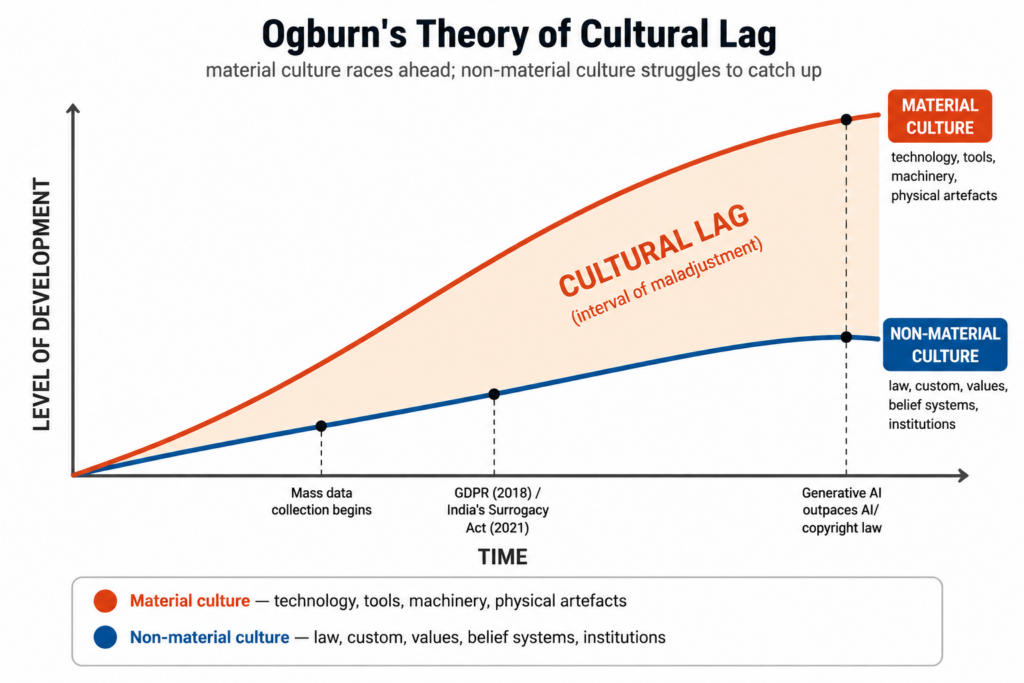
Ogburn’s Theory of Cultural Lag
- William F. Ogburn, in Social Change (1922), supplies the single most tested concept in this entire unit, and it deserves to be understood in full rather than as a one-line definition.
Material and Non-Material Culture
- Ogburn divides culture into two broad components that are meant to function together but do not always change at the same speed.
- Material culture covers technology, tools, machinery, and physical artefacts — the tangible apparatus a society uses to act on its environment.
- Non-material (or adaptive) culture covers law, custom, values, belief systems, and social institutions — the normative and cognitive apparatus that governs how a society interprets and regulates its use of that material apparatus.
- Cultural lag is the interval of maladjustment that opens up when one of these two correlated parts changes faster than the other, so that the slower-changing part has not yet caught up with, or adapted to, the faster-changing one. In Ogburn’s own account this gap is usually — though, as Sorokin’s counter-argument below shows, not always — a case of material culture racing ahead of non-material culture.
The Four Mechanisms of Cultural Growth
- Ogburn treats cultural change as fundamentally cumulative and exponential, because new advances are built out of existing ones rather than appearing from nowhere, and describes this cumulative process through four linked mechanisms.
- Invention — the combination of existing cultural elements into a genuinely new form; because inventions recombine what already exists, a larger existing cultural base makes further invention progressively easier and faster.
- Accumulation — successful inventions add to that existing cultural base, so the stock of available material for future recombination keeps growing.
- Diffusion — an invention or cultural trait spreads outward from the point where it originated to other groups and societies that did not themselves invent it.
- Adjustment — the slower process by which the non-material side of culture (law, values, institutions) reorganises itself to fit the changed material conditions; it is precisely the delay in this fourth mechanism that constitutes the cultural lag.
Contemporary Examples of Cultural Lag
- Generative artificial intelligence — mass-market generative AI tools were deployed and adopted at enormous scale well before the law caught up: the European Union’s AI Act was only formally adopted in May 2024, with its provisions phasing in through 2025 and into 2026, years after the underlying technology had already been placed in the hands of hundreds of millions of users. Questions of copyright liability, misinformation, and algorithmic accountability remain substantially unsettled even as deployment continues to accelerate.
- Gig and platform work — ride-hailing, food-delivery, and other app-mediated work arrangements have operated at national scale for well over a decade, while labour law’s basic categories of “employee” and “independent contractor” are still being litigated, redrafted, and renegotiated around the world, including through the European Union’s Platform Work Directive and India’s continuing effort, under the Code on Social Security, to define and extend protections to “gig” and “platform” workers as categories distinct from traditional employment.
- Data privacy — digital platforms built extensive infrastructures for collecting and monetising personal data years before comprehensive data-protection law arrived to govern that collection.
- India’s Digital Personal Data Protection Act was passed only in 2023, with its detailed rules still being finalised well after passage.
- The European Union’s own General Data Protection Regulation arrived only in 2018, long after large-scale commercial data collection was already routine — the same lag playing out in an earlier jurisdiction first.
- Reproductive technology and family law — assisted reproductive technology, surrogacy, and genetic testing expanded rapidly for years before family law caught up with new questions of legal parentage and commercial regulation; India’s Surrogacy (Regulation) Act came into force only in 2021, well after ART clinics had already proliferated across the country.
- These examples share the same structure Ogburn described a century ago: the material or technological capability arrives first, is adopted at scale, and only afterward does the slower work of building adequate non-material regulation, norms, and legal categories begin to catch up.
Limits of the Cultural Lag Thesis
- Technological determinism — the theory assumes material culture is always the independent variable driving the process, when in practice values, ideology, and law can just as easily lead and pull technology or economic behaviour after them.
- Sorokin’s counterpoint — Sorokin himself argued that non-material culture can sometimes change faster than material culture, reversing Ogburn’s usual direction of lag; a shift in social attitudes or political will can precede, and actively drive, a subsequent wave of technological or institutional adoption rather than merely reacting to it.
- “Maladjustment” presupposes an ideal fit — the theory implicitly assumes there exists some correct, well-adjusted state between the material and non-material, when in practice what counts as adequate “adjustment” is itself a contested, value-laden judgment rather than a neutral fact.
- Retrospective rather than predictive — a cultural lag is easy to identify after the fact, once the maladjustment has already produced visible strain, but the theory offers little ability to predict in advance how large a lag will open up or how long it will take to close.
- Dipankar Gupta’s “mistaken modernity” offers a distinctively Indian parallel to Ogburn’s idea, though it inverts the emphasis: Gupta argues Indian society has often adopted the outward, material trappings of modernity — consumer goods, urban infrastructure, digital technology — without a corresponding shift in underlying values toward modernity’s substantive commitments, such as individual rights over ascriptive status, achievement over birth, and rational-legal rather than personalised authority.
- Where Ogburn’s lag is mainly about timing (the non-material side will eventually catch up), Gupta’s mistaken modernity is a sharper claim about substance — that outward material change can occur without the value shift supposed to accompany it ever actually arriving.
Comparing the Major Traditions
- Returning to the four axes introduced at the start of this note makes the disagreements between these families explicit rather than leaving them as a list of unconnected theories.
| Tradition | Direction of change | Primary cause | Typical pace | Level of analysis |
|---|---|---|---|---|
| Evolutionary (Comte, Spencer, Durkheim, Parsons) | Linear, cumulative complexity | Ideas / technology / division of labour / adaptive capacity | Gradual | Whole society |
| Cyclical (Spengler, Toynbee, Sorokin, Pareto, Ibn Khaldun) | Circular; rise and decay | Organic life-cycle / value system / elite psychology / group solidarity | Slow, generational | Civilisation or elite |
| Functionalist (Parsons, Smelser, Merton, Ogburn) | Adaptive, toward re-equilibration | Structural strain / dysfunction / technological-normative gap | Gradual, self-correcting | Institution and system |
| Conflict (Marx, Dahrendorf, Coser) | Directionless / dialectical; rupture possible | Class struggle / authority struggle / functional conflict | Can be sudden (revolution) or continuous (channelled conflict) | Class, association, group |
| Diffusionist (Redfield, Marriott, Y. Singh) | No fixed direction; depends on contact | External cultural contact | Variable, contact-dependent | Cross-cultural / civilisational |
Applying the Theories to Contemporary Change
- These frameworks are not museum pieces — reading a live contemporary disruption through more than one of them at once is itself a useful exercise, because each family highlights a different feature of the same event.
- The COVID-19 pandemic functioned as an external shock of exactly the kind Parsons’s functionalism is built to absorb — a disturbance to the existing equilibrium in work, education, and public health institutions.
- The scale and abruptness of the disruption (mass remote work adopted almost overnight, entire schooling systems shifting online within weeks) sits uneasily with functionalism’s preference for gradual, adaptive change.
- A conflict-theoretic reading fits just as well: the pandemic exposed and sharpened existing inequalities in who could work remotely, who retained income, and who bore the health risk, redistributing burden along already-existing class and occupational lines rather than randomly.
- Generative AI’s rapid diffusion through the economy is a live instance of Ogburn’s cultural lag playing out in real time.
- It is equally readable through Marx’s forces-and-relations lens: a powerful new productive force (large-scale automation of cognitive and creative labour) is emerging faster than existing relations of production and employment law can absorb it, generating exactly the kind of contradiction historical materialism identifies as the trigger for renegotiated social arrangements.
- The visible symptoms are disputes over AI-related job displacement, copyright, and the classification of AI-assisted work — the contradiction playing out in real institutions rather than remaining abstract.
- Climate change stresses cyclical and conflict theories differently from evolutionary ones.
- It undercuts the evolutionary assumption that later necessarily means better, since the same technological “advance” that raised material living standards is also the cause of ecological strain.
- Conflict theory’s attention to unequal burden helps explain why the societies and groups least responsible for emissions are frequently absorbing the earliest and most severe consequences — a redistribution of harm that itself becomes a new source of social and geopolitical conflict.
- None of these applications require abandoning the classical vocabulary — they show that the vocabulary of forces and relations, equilibrium and strain, lag and adjustment, and rise and decay was built to be reusable well beyond the specific historical cases each thinker had directly in mind.
Previous Year Questions
- Illustrate the conflicts and tensions experienced by societies undergoing social change. (2013)
- Examine any two theories of social change in detail. (2017)
- Critically examine the cultural theories of social change with suitable examples. (2013)
- Explain the relevance of the idea of ‘cultural lag’ in understanding social change. (2015)
- Is the theory of cultural lag valid in present times? Discuss. (2018)
- Does collapse of functionalism and bankruptcy of Marxism coincide with the rupture of modernity? Discuss. (2018)
- ‘Social conflict is both a cause and a consequence of social change.’ Explain. (2016)
- Write short note on the following from a sociological perspective: Theory of Cultural Lag – Ogburn and Nimkoff. (2012)
- ‘Revolutionary changes have some specific characteristics.’ Discuss with examples. (2012)
- Discuss various theories of social change. Explain the limitations of unilinear theory of social change. (2024)
- Do you think Talcott Parsons gave an adequate theory of social change? Justify your answer. (2021)
- How does Marx view social conflict as an essential element in social change? (2020)
- Bring out a comparative analysis of Marxian and Parsonian views of social change and examine the relevance of each view for social development in the contemporary India. (2004)
- Pitirim A. Sorokin sees the course of history as a continuous but irregular fluctuation between two basically different kinds of culture. While explaining this stand of Sorokin, analyse whether it is appropriate to characterize such a notion of change as a cyclical theory of social change. (2000)
- Elaborate on the concept of structural change. Discuss the endogenic factors of structural change in a society, with suitable examples. (1999)
- Explain the classical concept of social change and critically examine the contribution of the linear theories of social change. (1995)
- Examine the relationship between social structure and social change. Has the Indian social structure facilitated or hindered the process of change? (1984)
Solved PYQs for every Sociology topic
Notes tell you what a thinker said. Sociology Optional PYQ Solutions shows you how UPSC asks it and how a strong answer is written, on every question since 1985.
- 1,500+ solved PYQs (1985–2026), Paper-1 and Paper-2
- Topic-wise across all 25 syllabus units, newest exam year first
- A full model answer for each question, shaped to 10 or 20 marks
- Online plus PDF download, 12 months access, one-time payment
₹1,499 ₹2,500 · instant access, no subscription
