

The Definitional Problem: What Sociologists Mean by Religion

- Sociology of religion does not ask whether God exists; it asks what religion does, how it is organised, and how it changes — a study of religion as a social fact, not a theological inquiry into its truth.
- Sociologists therefore set aside their own personal belief when studying religion, treating it as socially constructed by human beings rather than divinely decreed, and ask human-centred rather than theological questions: how is a given religion organised, what are its principal beliefs and values, how does it relate to the wider society around it, and what explains its success or failure at recruiting and retaining believers.
- In everyday usage, religion is often equated with theism — belief in one or more supernatural deities. Sociology resists this shortcut because several major traditions, Theravada Buddhism among them, organise elaborate belief and practice around spiritual forces rather than a creator god at all.
- The discipline has instead split between two rival ways of defining religion, and the choice one makes silently decides what counts as religion before the analysis even begins.
Practise this topic on real UPSC questions. 54 UPSC questions from Religion and Society (1985–2026) are solved in Sociology Optional PYQ Solutions, each with a full model answer: introduction, thinkers applied, Indian examples and a conclusion.
Substantive versus Functional Definitions
- A substantive definition specifies what religion is, by its content. E.B. Tylor‘s “minimum definition” in Primitive Culture (1871) — belief in spiritual beings — is the classic example: precise and testable, but it excludes Theravada Buddhism and most of Confucianism, both of which sustain elaborate practice without any creator-spirit at their centre.
- A functional definition specifies what religion does for the individual or the group, regardless of its specific content. Durkheim‘s is the canonical version: religion is “a unified system of beliefs and practices relative to sacred things… which unite into one single moral community called a Church all those who adhere to them.” Because it does not require a god, it survives the Buddhism problem that sinks Tylor’s definition.
- Steve Bruce‘s later definition tries to bridge both approaches: beliefs, actions and institutions premised on the existence of supernatural entities with powers of action, or impersonal powers or processes possessed of moral purpose, that can set the conditions of or intervene in human affairs — substantive in requiring some transcendent referent, but wide enough to admit impersonal forces alongside personal gods.
- The trade-off between the two approaches is exact: substantive definitions are precise but ethnocentric (built, in Tylor’s case, around a template drawn from Christianity), while functional definitions are inclusive but so wide that they risk admitting nationalism, Marxism, and even football fandom as forms of “religion.”
- Robert Bellah‘s concept of civil religion is the test case for whether that over-inclusiveness is a flaw or a genuine insight — the flag, the founding myths, and the ritual calendar of a modern nation-state generate the same unifying, sacred-communal effect Durkheim assigned to totemism, without reference to any supernatural being at all.
Weber’s and Marx’s Refusal to Define
- Weber deliberately withheld a definition of religion at the start of his Sociology of Religion, holding that a definition could only be offered, if at all, at the end of an enquiry into meaning rather than presupposed at its start — a methodological stance flowing from his commitment to Verstehen (interpretive understanding of the actor’s own meaning), not an oversight.
- Marx offered no definition at all, because for him religion is not a thing with a stable essence but a symptom of alienation and class exploitation; the question worth asking is not “what is religion” but “what produces it.”
- A fourth, less commonly cited approach is the polythetic or family-resemblance definition, which identifies religion by a cluster of recurring traits — ritual, belief in the supernatural, a moral code, a bounded community, sacred texts — with no single trait treated as strictly necessary or sufficient on its own.
How Sociologists Study Religion
- Religion is treated as a major social institution and a primary carrier of a society’s deepest norms and values, but the social form that carrying takes varies enormously across traditions.
- Christianity and Judaism have historically organised religious practice through formal, often bureaucratic organisations; Hinduism and Buddhism have historically located much religious practice in the home or other everyday settings rather than in a single formal organisation.
- Religion is also treated as a major potential source of social solidarity: shared norms, rituals and bonds create a moral community in which members know how to behave toward one another, so a single dominant religion tends to stabilise a society while several competing religions can, under the wrong conditions, generate destabilising conflict instead.
- Sociologists tend to explain the appeal of religion through social forces rather than through purely personal, spiritual or psychological factors. Peter Berger‘s formulation is representative: people often turn to religion when their fundamental sense of social order is threatened — by economic hardship, loneliness, grief, or suffering — which points the explanation toward the social conditions that make religion attractive rather than toward the psychology of any one believer.
Émile Durkheim: Religion as Society Worshipping Itself
- Durkheim’s argument in The Elementary Forms of the Religious Life (1912) is that religion is society misrecognised: believers are not deluded about the existence of a force greater than themselves, only mistaken about its true address.
- His method was to study the simplest documented society available, in order to isolate religion’s essential elements in as uncluttered a form as possible. He chose the Arunta (Aranda) of central Australia, working from Spencer and Gillen‘s ethnographic reports rather than from his own fieldwork.
- The choice of the “simplest” case is itself part of the argument: if even the most rudimentary religion can be shown to perform a social function, that function should generalise upward to more elaborate religions built on the same foundation.
The Sacred, the Profane, and the Totem
- Durkheim defines religion through a single, absolute classification of the entire world into two mutually exclusive domains — the sacred (set apart, forbidden, approached with reverence and awe) and the profane (mundane, utilitarian, part of ordinary routine).
- Nothing is sacred because of any property intrinsic to it; sacredness is entirely conferred by the group, which is why the same object can be sacred to one community and profane to another.
- The totem — an animal or plant species taken as a clan’s emblem — is the clan’s most sacred object, and Durkheim’s central inferential move is that since the totem is merely the clan’s own emblem, worship of the totem is, in substance, worship of the clan itself.
- His conclusion, stated directly: the god of the clan can be nothing else than the clan itself, divinised.
“A society has all that is necessary to arouse the sensation of the divine in minds, merely by the power it has over them; for to its members it is what a god is to his worshippers.” — Émile Durkheim
- Collective effervescence is the mechanism producing this misrecognition. When the clan assembles for a ceremonial gathering, the concentration of bodies, chanting, and shared movement generates an emotional intensity no isolated individual could produce alone.
- Members feel a real force acting on them from outside, and — lacking any abstract concept of “society” — attribute that force to the totem instead. Ritual exists precisely to recharge this feeling periodically, since the emotional charge of any single gathering fades with time.
- So religion, for Durkheim, is true but misdescribed: its cognitive content (spirits, totemic ancestors, divine sanction) is false, but its social reference — that something real and greater than the individual exists and makes claims on him — is entirely correct. Society is the actual object of worship.
Religion, Knowledge, and Ritual
- Elementary Forms is also a sociology of knowledge: Durkheim argues that the most basic categories of human thought — time, space, number, causality, class — are not innate but derived from the rhythms and divisions of social organisation.
- Time, for instance, was first marked out by the recurring calendar of religious rites; the very idea of a “class” of things was modelled on the clan’s own division into segments.
- Ritual comes in three types, each doing distinct social work.
- Negative rites (taboo, fasting, asceticism) keep the sacred and profane apart through prohibition.
- Positive rites (sacrifice, and imitative, commemorative and representative ceremonies) actively bind participants to each other and to the sacred order.
- Piacular rites (mourning) reconstitute the group after a loss. Durkheim’s striking claim here is that mourning is not the spontaneous expression of private grief but a duty imposed by the group on its members.
- Durkheim believed traditional, god-centred religion was fading with modernisation — “the old gods are dead,” in his own phrase — but expected new, secular forms of collective ritual, built around values like liberty, equality and human dignity, to take over religion’s integrative function rather than integration itself disappearing.
Criticisms of Durkheim
- Evans-Pritchard objected that the Arunta were neither the simplest society available nor typical of Aboriginal Australian life more broadly, and that Durkheim’s second-hand ethnographic data (filtered through Spencer and Gillen) was thin for the theoretical weight placed on it.
- Alexander Goldenweiser showed that totemism is neither a universal stage of religious development nor even a single, coherent institution across the societies where it is found.
- The whole argument has also been called circular: society is invoked to explain the sacred, while the sacred is in turn defined entirely by reference to what society designates as such.
- Malinowski replied that the sacred/profane boundary is nowhere near as absolute in practice as Durkheim’s scheme requires, and that religion demonstrably serves the anxieties of individuals, not only the solidarity of the group.
Max Weber: Meaning, Theodicy, and the Protestant Ethic
- Where Durkheim asks what religion does for society, Weber asks what religious ideas mean to the believer and what conduct those meanings make rational — a method flowing from his broader commitment to interpretive understanding (Verstehen) rather than external functional explanation.
- From that starting point, Weber builds his most famous argument: that a purely religious idea helped produce the modern capitalist economic order — a direct, and frequently misread, rebuttal to Marx’s claim that economic structure alone determines belief.
The Protestant Ethic Thesis
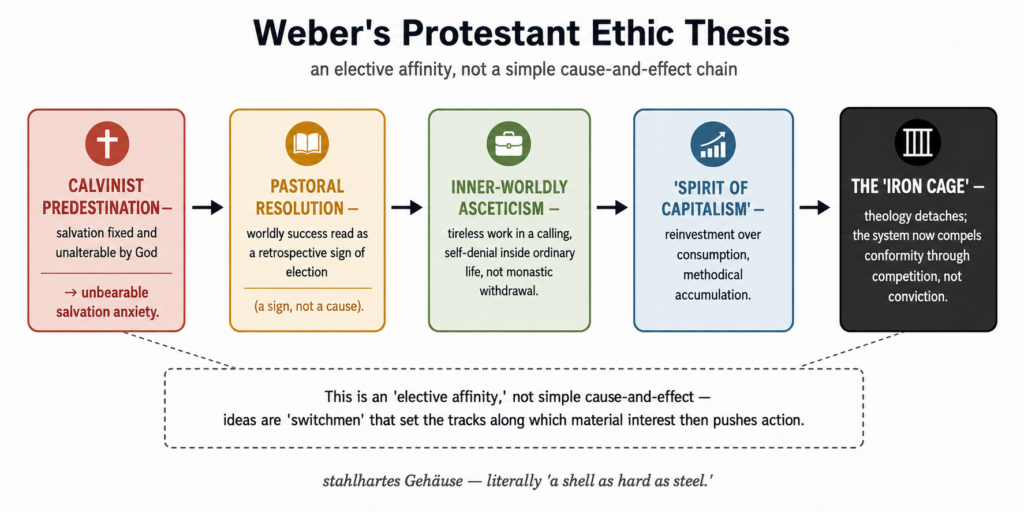
- In The Protestant Ethic and the Spirit of Capitalism (1904–05), Weber traces a precise psychological-to-economic mechanism, not a vague cultural mood.
- Calvinist predestination held that God had already, and unalterably, decided who was saved and who was damned — a doctrine that produced unbearable salvation anxiety, since no ritual, confession, or good deed could change a fixed decree.
- Pastoral practice supplied a psychological, not a theological, resolution: methodical worldly success in one’s calling could be read, retrospectively, as a sign (not a cause) of election.
- This produced inner-worldly asceticism — rigorous self-denial practised inside ordinary working life rather than through monastic withdrawal from it — expressed as tireless work in a calling, avoidance of consumption, and reinvestment of profit rather than its enjoyment.
- Money accumulates under this ethic precisely because spending it is sinful and idleness is worse; once this disposition is detached from its original theology, what remains is the spirit of capitalism.
- The causal claim is precise and limited, and overstating it is the single most common error in reproducing this theory. Weber describes an elective affinity between the religious idea and the economic interest, not a simple cause-and-effect relationship, and explicitly calls the spirit of capitalism an unintended consequence of a purely religious motive.
- Weber’s own image for this relationship is that ideas act as “switchmen” who set the tracks along which action is subsequently pushed by the dynamic of material interest — neither a pure epiphenomenon of economic interest, as orthodox Marxism would have it, nor an autonomous prime mover by itself.
- Once capitalism was institutionally established, Weber argued, it no longer needed the religious ethic that had incubated it, leaving behind what he called a stahlhartes Gehäuse — rendered in the standard English translation as the “iron cage” — a self-sustaining economic order that now compels conformity through competition rather than conviction.
The Comparative Sociology of Religion
- Weber extended this method into a genuinely comparative programme across the “world religions” — those with enough adherents to have shaped the course of global history — producing The Religion of India, The Religion of China, and Ancient Judaism (he did not live to complete a projected study of Islam).
- His governing question was why capitalism of the specifically modern, rational kind did not originate in India or China, despite both having significant periods of commerce, credit, urbanism, and rational administration.
- His answer was not that these civilisations were “backward,” but that each had developed different, internally coherent religious values that pointed conduct elsewhere.
- Hinduism, in Weber’s reading, is an other-worldly religion: its highest values orient the believer toward escape from the material world into a higher plane of spiritual existence, not toward mastering or reshaping that world.
- The karma–samsara complex, combined with caste’s ritual barriers that sanctified occupational fixity, gave Hinduism what Weber ranked as the single most logically consistent theodicy ever devised — a complete explanation for every instance of inequality and suffering, with no residue left unexplained.
- Confucianism similarly directed effort away from active mastery of the world, prizing harmony and adjustment to existing conditions instead.
- Christianity, by contrast, is a salvation religion: the believer must actively struggle against sin to be rescued by God’s grace, which generates a tension and emotional dynamism largely absent from the Eastern religions Weber studied, giving it genuine revolutionary potential — reforming prophets periodically arise to challenge the prevailing order in God’s name.
- Theodicy — the intellectual problem of explaining why suffering and undeserved fortune exist under a divinely or cosmically ordered world — is Weber’s term for this recurring religious task; its social effect, in the Indian case, was to legitimate the existing order rather than generate pressure for changing it.
Religious Virtuosi and the Fate of Religion
- Weber classified the carriers of religious authority into three types.
- The prophet is charismatic and proclaims a genuine break with existing doctrine — either ethical (Muhammad, the Hebrew prophets, who command in God’s name) or exemplary (the Buddha, who shows a path through his own life rather than issuing commands).
- The priest holds authority by virtue of an office within an established, routine organisation, not by personal charisma.
- The magician coerces spirits for a fee, on behalf of a client, without founding any lasting community of belief.
- A brief aside on two related terms: a sect forms when a group of qualified converts breaks away from an established church in protest at its perceived compromise with the surrounding world; a cult, by contrast, is a loosely organised, often new or imported grouping built around a charismatic figure or a fresh revelation, with no established church to have broken away from.
- Charismatic authority is inherently unstable and cannot outlive its founder without transforming into something else. This routinisation of charisma into either traditional or legal-rational authority is the general mechanism behind the historical transition from sect to established church.
- Disenchantment (Entzauberung) names the long-run effect of rationalisation on religion: the world does not become less mysterious because science has disproved it, but because rational calculation makes it seem, in principle, masterable without appeal to incalculable, mysterious forces — and religion correspondingly retreats into the private and the irrational.
“The fate of our times is characterized by rationalization and intellectualization and, above all, by the ‘disenchantment of the world.'” — Max Weber
Criticisms of Weber
- R.H. Tawney, in Religion and the Rise of Capitalism, reversed Weber’s causal direction, arguing capitalism was already emerging and reshaped Protestant doctrine to fit its own needs, rather than the other way round.
- Karl Kautsky read Protestantism as simply the ideology of an already-rising bourgeoisie, restating the orthodox Marxist position Weber’s thesis was designed to complicate.
- Werner Sombart pointed to Jewish and Catholic merchant capital thriving well before, and alongside, Protestant capitalism, undercutting any exclusive Protestant claim on the spirit of capitalism.
- Hugh Trevor-Roper noted that many of the entrepreneurial Calvinists Weber cited were religious and ethnic migrants, so minority and migrant status — not theology as such — may better explain their economic drive.
Karl Marx: Religion as Ideology
- Marx wrote comparatively little on religion, and almost all of it early in his career, so what survives is best read as a diagnosis rather than a developed sociology of religious institutions.
- His core text is the 1843–44 Introduction to A Contribution to the Critique of Hegel’s Philosophy of Right, where he inherits Feuerbach‘s projection thesis from The Essence of Christianity — that human beings create God in their own image and then kneel before their own creation — and adds the question Feuerbach never asked: what material conditions make that act of projection necessary in the first place?
- The most quoted line in the sociology of religion is also the most frequently mistreated. In full, Marx first calls religious suffering both the expression of real suffering and a protest against real suffering, and only then calls religion the opium of the people.
“…the sigh of the oppressed creature, the heart of a heartless world, and the soul of soulless conditions. It is the opium of the people.” — Karl Marx
- Truncating this to just “opium of the people” loses the analytic point entirely: religion is protest against real distress before it is anaesthesia for it. Opium here names an analgesic that dulls pain without curing its cause, not a conspiracy of manipulative priests — religion soothes the pain of alienation without touching the exploitative relations that produce it, which is precisely why it postpones revolt rather than provoking it.
- Structurally, religion belongs to the superstructure: conditioned by the economic base, it functions as ideology in the strict sense, producing false consciousness by presenting the ruling class’s particular interest as a universal, natural, or divinely sanctioned order.
- It performs this legitimating work differently under each mode of production — divine right of kings under feudalism, the promise of otherworldly reward for earthly submission under capitalism.
- Because religion is a symptom of alienation rather than its cause, Marx expects it to wither away along with its material conditions once those conditions are transformed, not to require suppression by state decree.
- Marx also folds religion directly into his theory of alienation: following Feuerbach, he argues that the more of himself a person attributes to God, the less he retains of himself — the believer’s own creative and moral capacities are projected outward into an imagined external force and experienced thereafter as demands made on him rather than powers belonging to him.
- Engels qualified the strict base-determines-superstructure model in a way later Marxists rely on heavily. In The Peasant War in Germany, he showed early Christianity, and Thomas Müntzer‘s peasant rising, using religious language as the idiom of revolt itself — conceding religion a genuinely mobilising and change-producing role rather than a purely conservative one.
Critiques of Marx on Religion
- The theory struggles to explain religion in classless, hunter-gatherer societies, where there is no ruling class whose interests religion could be legitimating.
- Weber‘s entire comparative programme stands as an empirical rebuttal, showing religious ideas actively producing economic change rather than merely reflecting an already-existing economic base.
- Liberation theology in twentieth-century Latin America, and the role of the Black church in the American civil rights movement, are historical instances of religion functioning as an engine of emancipation rather than of pacification.
- Gramsci offered a more supple successor account within the Marxist tradition itself: religion, like other elements of common sense, operates inside hegemony — a terrain that is contested and can be won by subordinate groups, not simply imposed wholesale from above.
- The fair verdict is that Marx is strongest on religion’s legitimating function under conditions of existing class rule, and weakest on explaining religion’s origins and its capacity for genuine autonomy from economic interest.
Auguste Comte: The Religion of Humanity
- Auguste Comte, who coined the term “sociology,” held in his Law of Three Stages that human thought — and with it, the way society explains events to itself — passes through three successive stages: the theological (explanation by supernatural agency, itself subdivided into fetishism, polytheism, and finally monotheism), the metaphysical (explanation by abstract forces such as Nature or Reason), and the positive or scientific stage, which explains phenomena through observed laws rather than through first or final causes.
- On this scheme, religion belongs to humanity’s intellectual infancy, destined to be superseded as societies mature into positive, scientific self-understanding — yet in his later career Comte reversed course and tried to found a religion of his own rather than simply predicting religion’s disappearance.
- His “Religion of Humanity” proposed replacing the worship of God with the organised worship of Humanity itself (le Grand Être, “the Great Being”) — complete with a positivist priesthood with Comte at its head, a calendar of secular saints drawn from history’s benefactors of humanity, and a positivist catechism of prescribed rites.
- T.H. Huxley‘s verdict on the project — that it amounted to “Catholicism minus Christianity” — captures why it is remembered today as a curiosity rather than as a practice that was ever widely taken up.
- Its significance for the sociology of religion is programmatic rather than substantive: Comte correctly intuited that a modern, scientific society would still need some functional equivalent of religious ritual to bind it together, but it took Durkheim — treating society itself, rather than an abstraction called “Humanity,” as the true object of collective worship — to actually work out how and why that substitution occurs.
The Post-Durkheimian Anthropological Tradition
- A second generation of anthropologists accepted Durkheim’s basic premise that religion is functional, and then disagreed sharply over whose function it served and what fieldwork on the ground actually showed.
Malinowski: Magic, Science, and the Management of Anxiety
- Bronislaw Malinowski, working among the Trobriand Islanders, relocated religion’s function from society at large to the anxious individual.
- His canonical evidence is the contrast between two forms of fishing: Trobrianders perform elaborate magic before dangerous open-sea fishing beyond the reef, where outcomes are unpredictable, but perform none at all for safe, predictable lagoon fishing. The variable determining whether magic appears is risk, not ignorance of technique.
- Life-crisis rites are the second site where religion clusters. Birth, puberty, marriage, and above all death disrupt the group, and funeral ritual gives the bereaved a script to follow, counters the disruptive urge to simply flee from the corpse, and reasserts solidarity precisely when it is most threatened.
- Malinowski insisted that magic, religion, and science coexist as separate domains even within a single “primitive” society: Trobrianders garden with genuine, accurate horticultural knowledge and reserve magic only for the margin that knowledge cannot reach.
- This finding directly demolished Frazer‘s influential evolutionary claim that human thought progresses along a single ladder from magic, to religion, to science — Malinowski showed all three operating side by side, doing different jobs, in the same community at the same time.
Radcliffe-Brown: Ritual Creates the Anxiety It Relieves
- A.R. Radcliffe-Brown, in The Andaman Islanders, inverted Malinowski’s causal arrow entirely: rites do not simply relieve a pre-existing anxiety, they manufacture the very anxiety and sense of dependence that ritual then appears to resolve.
- Without the taboo, on this argument, there would be nothing to fear in the first place — the ritual, and the “ritual value” it confers on an object or occasion, is what teaches the individual to feel bound to the social order at all.
- This is a genuinely contradictory claim, not a minor variant of Malinowski’s, and the two should never be collapsed into a single “functionalist” position.
- Radcliffe-Brown’s own theoretical allegiance is structural-functionalist and stands closer to Durkheim than to Malinowski: religion, for him, expresses and sustains the individual’s sense of dependence on the very society that formed him.
Evans-Pritchard: Azande Witchcraft and the Limits of Armchair Theory
- E.E. Evans-Pritchard‘s Witchcraft, Oracles and Magic Among the Azande (1937) showed Azande witchcraft belief to be a coherent explanatory system, not a mistake about causation — it answers a question that empirical, technical knowledge does not even pose: why this particular misfortune befell this particular person at this particular time (why did this granary collapse on this man, on this day, rather than any other).
- Belief here is rational within its own idiom, once the question it is answering is properly understood.
- In Theories of Primitive Religion (1965), Evans-Pritchard turned this fieldwork-based standard into a direct critique of Tylor, Durkheim, and Freud together, accusing all three of armchair theorising — explaining believers’ beliefs away from a theoretical armchair, rather than understanding what those beliefs actually mean to the people who hold them.
Talcott Parsons: Religion and the Problem of Meaning
- Talcott Parsons carried Weber’s problem of meaning into structural functionalism: religion supplies the ultimate values that anchor a society’s normative order, and manages the residual problems — death, undeserved suffering, unpunished injustice — that the ordinary social system’s institutions cannot fully absorb or resolve on their own.
- Parsons treated the erosion of religion in officially atheist state-socialist societies as evidence for, rather than against, this functional necessity, arguing that a social order without any religious or quasi-religious source of ultimate legitimation loses part of what holds it together over time.
The Shared Blind Spot
- Every theory in this tradition explains religion by its contribution to integration, which leaves all of them structurally embarrassed by the same set of facts: religious schism, communal violence, and holy war are not exceptions requiring a footnote but recurring features of religious life that an integration-only account cannot generate from within its own premises.
Comparative Assessment: Functions, Dysfunctions, and Change
Marx, Durkheim, and Weber Side by Side
| Dimension | Marx | Durkheim | Weber |
|---|---|---|---|
| Central question | Whose interest does religion serve? | What does religion do for the group that holds it? | What meaning does religion give the believer, and what conduct does that meaning make rational? |
| What religion “really” is | Ideology: a symptom of alienation that legitimates class exploitation | Society itself, misrecognised as a supernatural force | A response to the problem of theodicy that actively shapes worldly conduct |
| Relation to social order | Conservative — legitimates existing property relations | Integrative — binds the moral community together | Variable — can legitimate (Indian theodicy) or unsettle (prophetic revolt) the existing order |
| Relation to social change | Generally conservative, though Engels concedes a mobilising role | Largely conservative at the level of the collectivity | Can be a genuine, independent motor of change (Protestant ethic and capitalism) |
| Method | Historical-materialist critique of ideology | Comparative structural study of the “elementary” (simplest) forms | Comparative-historical Verstehen across the world religions |
| Key text | Contribution to the Critique of Hegel’s Philosophy of Right (1843–44) | The Elementary Forms of the Religious Life (1912) | The Protestant Ethic and the Spirit of Capitalism (1904–05) |
- Read together rather than as rivals, the three theories are largely complementary. Marx correctly identifies religion’s recurring use as ideological legitimation — Christian doctrine was routinely used to justify slavery and the colonial subjugation of “heathen” peoples well into the nineteenth century.
- Weber correctly identifies religion’s equally real capacity to unsettle an existing order — church leaders who had earlier tolerated slavery were later central to the movement to abolish it, and to the American civil rights movement afterward.
- Durkheim correctly identifies the integrative, ritual core that both the legitimating and the revolutionary uses of religion ultimately draw on: neither the conservative nor the revolutionary use of religion is possible without the underlying communal solidarity his theory describes.
Why Religious Beliefs and Practices Arise in the First Place
- No single explanation is treated as sufficient in the literature; the classical theories instead identify distinct, non-exclusive social needs that religious belief and practice answer, particularly in pre-modern societies that lacked the differentiated secular institutions later societies use to perform the same work.
- An intellectual need to explain the inexplicable — natural phenomena, dreams, death, and especially undeserved suffering — which Tylor’s minimum definition of religion and Weber’s concept of theodicy both address, from different angles.
- A psychological need to manage anxiety and uncertainty in situations where practical, empirical knowledge runs out, which Malinowski’s Trobriand evidence demonstrates directly.
- A social need for integration and continuity, especially at moments of life-crisis (birth, puberty, marriage, death) that threaten to disrupt the group, which Durkheim’s account of ritual and Radcliffe-Brown’s account of “ritual value” both address, from otherwise opposed premises.
- A structural need for legitimation of whatever distribution of power, labour, and resources a given society has already settled into, which Marx’s account of ideology addresses.
- Pre-modern societies in particular lacked a formal legal system, an organised science, or a welfare state to take over these functions piecemeal, which is one reason religion in such societies is not a separate “sphere” alongside kinship, economy and polity, but is diffused through all of them at once.
Functions and Dysfunctions in a Pluralistic Society
- Across the theories surveyed above, religion performs a recurring cluster of functions in any society, plural or not.
- Integrative: binding believers into a moral community through shared ritual (Durkheim).
- Cognitive: supplying explanations for otherwise inexplicable suffering and misfortune (Weber’s theodicy).
- Psychological: reducing anxiety around uncertain or dangerous undertakings and structuring life-crisis transitions (Malinowski).
- Normative: reinforcing a society’s moral code by attaching supernatural sanction to its rules (Radcliffe-Brown, Weber).
- Legitimating: justifying the existing distribution of power and resources (Marx).
- Identity-conferring: in a plural, multi-religious society specifically, religious affiliation supplies an additional, often primary, source of group identity operating alongside — and sometimes against — class, region, or language.
- In a genuinely pluralistic society, the same mechanisms that integrate within a religious community can simultaneously fracture society as a whole.
- Robert Merton‘s concept of dysfunction captures this precisely: a single, shared religion can promote solidarity, but when a society holds several competing religious moral communities side by side, religion can just as easily become the axis of disorganisation and conflict rather than of unity — a point Durkheim’s own emphasis on internal cohesion tends to obscure.
- Competing theodicies, competing sacred calendars, and competing claims on the same sacred symbol or space can turn the very intensity of religious commitment — which Durkheim treats as socially healthy — into fuel for inter-group conflict.
- India and the United States illustrate this dual character concretely: in both, religion functions as a source of identity, charitable activity, and moral community within particular groups, while periodically also becoming a fault line for majoritarian assertion, minority anxiety, or organised communal and sectarian conflict between groups.
- The functionalist response to declining formal religious participation in modern societies is to treat it as religious change rather than religious disappearance: individualised, privatised belief, or an entirely secular “civil religion” and quasi-religious loyalty to a nation, a party, or an ideology, can perform the same integrative work in a different form — which is exactly the possibility Durkheim’s own remarks on the “old gods” and Merton’s question about whether communism shares religion’s operational logic were both gesturing toward.
The Feminist Critique: Are World Religions Inherently Patriarchal?
- Feminist sociology reads religion, in a structural move parallel to Marx’s, as a conservative force that helps sustain an unequal status quo — except that the inequality being sustained is patriarchy, not class.
- Simone de Beauvoir argued that religion functions for women the way Marx argued it functions for the working class: it teaches meekness and acceptance of inequality and suffering in this life, in exchange for a promised reward in the next, without ever addressing the underlying inequality itself.
- Patriarchy is reproduced through religion along three distinct channels.
- Scripture and teaching: several traditions cast the first woman as a temptress responsible for humanity’s fall (Eve, in Genesis), assign women’s primary religious role to nurturing and childbearing, and are, as a simple textual fact, overwhelmingly authored, narrated and interpreted by men — male gods, male prophets, and male saints dominate the canon across traditions.
- Ritual and practice: menstruation and childbirth are treated as ritually impure or polluting in several traditions — menstruating women are barred from touching the Quran in mainstream Islamic practice, for instance — and men and women are frequently required to worship separately, restrictions Jean Holm argues cumulatively devalue women’s religious standing.
- Organisational structure: formal religious authority remains overwhelmingly male across traditions. The Roman Catholic priesthood and hierarchy are exclusively male, most branches of Islam do not recognise female imams, Orthodox Judaism excludes women from public religious leadership even though Reform Judaism has ordained women rabbis since the 1970s, and the Church of England did not consecrate a woman bishop until two decades after it first ordained women priests.
- Concrete traditions supply the specifics of this pattern across the same “world religions” Weber himself studied comparatively.
- Hinduism: classical texts such as the Manusmriti prescribe lifelong dependence of women on male relatives — father, husband, son — notwithstanding a parallel tradition of goddess (Shakti) worship.
- Islam: practices of purdah and veiling are read by many feminists as institutionalising female seclusion, though this reading is itself contested from within the tradition (below).
- Buddhism: despite a doctrinal emphasis on equal capacity for enlightenment, early monastic orders were male-dominated and imposed additional disciplinary rules on nuns that were never applied to monks.
- Judaism and Christianity: Karen Armstrong and Rosemary Radford Ruether both link the rise of monotheism specifically to the entrenchment of religious patriarchy, arguing that earlier polytheistic traditions with prominent goddesses and priestesses were displaced by traditions built around a single, authoritative male God. Ruether extends this into an ecofeminist argument that the same logic subordinating women to men also subordinates nature to human domination.
- The critique is not unanimous, and the disagreement is worth holding onto rather than flattening.
- Nawal El Saadawi argues religion is not the direct cause of women’s oppression but a tool that already-powerful men have reinterpreted to serve patriarchal interests that predate and outlast any specific religion.
- Linda Woodhead resists the claim that religion is intrinsically patriarchal, describing a “religious feminism,” and specifically defends the veil against a purely Western feminist reading — for many Muslim women, she argues, veiling has been a positive, chosen practice that historically enabled entry into public life and paid work in restrictive settings. El Saadawi, working from the same evidence, has separately described the veil as a direct instrument of women’s oppression, which shows that feminists themselves divide sharply on this specific question.
- Sylvia Walby situates religion as only one of six interlocking structures (alongside paid work, the household, culture, sexuality, violence, and the state) through which patriarchy operates — a reminder that religion is a site through which patriarchy works rather than necessarily its sole cause.
- The defensible synthesis: most world religions, as currently institutionalised, do reproduce patriarchal structures across scripture, ritual, and organisation — but the stronger claim is that patriarchal societies have shaped their religions in this direction over historical time, rather than that patriarchy is an unavoidable, built-in feature of religious belief as such.
Religion as Both Emancipation and Alienation
- The theoretical strands above converge on a genuine paradox: religion has historically functioned simultaneously as a force that emancipates and a force that alienates, often through the very same belief.
- It emancipates when it supplies the moral vocabulary for resistance — Engels’s peasant revolts fought in Christian idiom, liberation theology’s preferential option for the poor, the American civil rights movement’s roots in the Black church, and any prophetic movement of Weber’s “ethical” type that reinterprets existing doctrine to challenge a prevailing power structure.
- It alienates, on Marx’s reading, precisely to the degree that it redirects energy that could confront exploitation directly into otherworldly consolation instead — projecting human powers outward onto an imagined external force and teaching resignation rather than resistance.
- A modern secular society does not escape this paradox merely by secularising: civil religion, nationalism, consumer culture, and ideological attachment to a party or a market can perform exactly the same double function Marx and Weber identified in traditional religion — mobilising real collective energy and meaning, while simultaneously naturalising an existing distribution of power as though it were simply the given order of things.
Previous Year Questions
- How do theories of Marx, Weber and Durkheim differ in understanding religion? Explain. (2025)
- What functions does religion perform in a pluralistic society? (2023)
- State the reasons for the various religious beliefs and practices in pre-modern societies. (2020)
- Are all world religions patriarchal? Substantiate your answer with examples. (2019)
- Give an assessment of Durkheimian notion of ‘sacred’ and ‘profane’ in sociology of religion. (2017)
- How is Durkheim’s theory of religion different from Max Weber’s theory of religion? (2016)
- Define sect, cult and religion. In what way do Weber’s views on religion differ from those of Durkheim? (2011)
- Write short note on Positive Religion. (2010)
- In what important ways can religion be a force both for social stability and social change? Discuss. (2008)
- Write short note: Origins of religious beliefs and practices in premodern societies. (2005)
- Examine the functional as well as dysfunctional aspects of religion in a pluralistic society taking India and the United States of America as illustrative models. (2004)
- Critically examine functional and dysfunctional aspects of religion. (2000)
- “Religion is said to have emancipated human beings on the one hand but it also alienates them on the other.” Bring out the paradoxical functions religion plays in a modern secular society. (1990)
- Write short note: Religion and Society. (1985)
- Write short note: Religious factor in economic development. (1984)
Solved PYQs for every Sociology topic
Notes tell you what a thinker said. Sociology Optional PYQ Solutions shows you how UPSC asks it and how a strong answer is written, on every question since 1985.
- 1,500+ solved PYQs (1985–2026), Paper-1 and Paper-2
- Topic-wise across all 25 syllabus units, newest exam year first
- A full model answer for each question, shaped to 10 or 20 marks
- Online plus PDF download, 12 months access, one-time payment
₹1,499 ₹2,500 · instant access, no subscription

Nice work. Citation for Hammond, 1992 please