

Patriarchy, Sex and Gender: Foundational Distinctions

- Patriarchy, literally “rule of the father,” names a system that concentrates power, authority, and value in men and subordinates women within it.
- Sociologically, a structure is called patriarchal when several features coincide: descent is reckoned patrilineally, major property passes from father to son, residence after marriage is patrilocal, and authority within the household is concentrated in senior males.
- No documented society reverses all four features at once. Even in the rare societies where descent and residence are matrilineal and matrilocal, control over major property and formal authority still typically rests with men — with the mother’s brother, not the mother herself. This is why matriarchy, understood as female rule mirroring patriarchy, is best treated as a misnomer: there is no conclusive evidence of any society, historical or contemporary, organised on that basis.
- Sexual division of labour refers to the allocation of tasks between men and women on the assumption that certain work belongs “naturally” to one sex — housework, cooking, cleaning, and childcare to women; income-earning, physically demanding, or public-facing work to men.
- The allocation is not symmetrical in value: when a task performed unpaid by women at home becomes paid work, men readily take it up — most professional cooks and tailors are men, even though cooking and tailoring inside the home are coded as women’s work.
- Women’s actual labour is far broader than housework: in rural India, women fetch water, collect fuel, and work in the fields; in urban India, poor women work as domestic help while middle-class women hold office jobs. Most women perform paid work in addition to domestic labour, yet this combined labour is systematically under-recognised.
- The move that turns the sexual division of labour into a sociological problem, rather than a natural fact, is the distinction between sex and gender.
- Sex refers to the permanent, biological characteristics distinguishing male and female bodies — broadly immutable across societies and historical periods.
- Gender refers to the roles, behaviours, and traits a society attaches to each sex — socially constructed, and therefore variable across cultures and across time, even where individuals experience them as natural or inevitable.
- The distinction matters because it separates what biology fixes from what culture assigns: two societies with identical biological differences can allocate radically different tasks, temperaments, and rights to men and women, which is intelligible only if the allocation is gender, not sex, at work.
- Gender relations are the specific mechanisms through which a culture assigns functions and responsibilities to each sex, while simultaneously determining access to resources — material resources such as land, credit, and training, and less tangible resources such as power and voice in decision-making. This reach into land rights, employment, education, and political voice is what makes gender relations a structural question rather than a private, domestic one.
Practise this topic on real UPSC questions. 70 UPSC questions from Systems of Kinship (1985–2026) are solved in Sociology Optional PYQ Solutions, each with a full model answer: introduction, thinkers applied, Indian examples and a conclusion.
The Sexual Division of Labour: Theoretical Debate on Its Origins
Biological and Functionalist Explanations
- Four thinkers supply the classical case that the sexual division of labour is rooted in biology rather than culture, and each anchors the claim differently.
- Tiger and Fox argued that human behaviour is governed by a genetically-based “biogrammar” — an inherited behavioural programme predisposing men toward aggression and dominance.
- They trace this to humanity’s long history as hunting societies: sustained hunting selected for physically dominant, aggressive men over evolutionary time, and because genetic change is far slower than cultural change, that hunting-era biogrammar is still operating in modern populations.
- On this view, male dominance is a sex-linked characteristic, and the resulting division of labour is biological, not social, in origin.
- G.P. Murdock grounded the division of labour in physical difference rather than temperament: men’s superior strength suits them to strenuous tasks (mining, land clearance, house-building, hunting), while women, constrained by the physical burdens of pregnancy and nursing, are better suited to gathering, cooking, and textile work.
- Murdock surveyed 221 societies, from hunting-and-gathering bands to modern states, and reported some form of sexual division of labour in every one — a finding he read as confirming its biological basis.
- Talcott Parsons located the division of labour inside the functional requirements of the isolated nuclear family, which he argued performs two irreducible functions: the primary socialisation of children and the stabilisation of adult personalities.
- Effective socialisation requires a warm, supportive environment, which Parsons assigned to the woman’s expressive role — providing emotional support and tension-management for the family.
- The man’s complementary instrumental role — breadwinning, connecting the family to the wider economy — generates stress that the expressive role exists to relieve.
- Parsons argued this division is functionally necessary, not incidental: a couple competing for the same role would generate conflict, so a clear-cut division is what allows the family to operate as a stable social system.
- John Bowlby supplied a psychological version of the same conclusion: mental health in infancy requires a warm, intimate, and continuous relationship with the mother specifically, implying a genetically-based need for close mother-child bonding that only a woman anchored at home can reliably meet.
The Feminist Critique
- Ann Oakley mounted the most direct rebuttal to the biological case.
“The division of labour by sex is not universal, and there is no reason why it should be.” — Ann Oakley
- Her argument: human cultures are diverse and endlessly variable, the product of human inventiveness rather than fixed biological forces, and if the sexual division of labour were genuinely rooted in unchanging biology, it should not vary or change as cultures change — yet it demonstrably does.
- She attacked Murdock directly, arguing his cross-cultural survey was compromised by a Western and male bias in how he read other cultures’ arrangements.
- She attacked Parsons on the same ground: the expressive housewife-mother role is not functionally necessary for the family to operate — it exists for male convenience, since it is men who benefit from a wife’s unpaid emotional and domestic labour.
- Her conclusion: gender roles are culturally, not biologically, determined; biology does not bar women from any occupation, and the “mother role” itself is a cultural construction — evidence from several societies shows children do not require an exclusive, continuous bond with a female caregiver specifically.
- Sherry Ortner relocated the source of women’s subordination from biology to the cultural meaning attached to biology.
- Her argument: women are universally devalued not because of their biology as such, but because every culture defines and evaluates female biology in a particular way — associating women, through their reproductive role, with nature, and men, through their wider engagement in politics, warfare, and religion, with culture.
- Because nature is everywhere ranked below culture, women’s association with it produces their devaluation — universal in occurrence but cultural, not biological, in cause. If the cultural evaluation changed, Ortner argued, the basis for female subordination would be removed.
- Ernestine Friedl supplied a resource-based mechanism, testing it against hunting-gathering and small-scale horticultural societies.
- Her claim: prestige attaches to whoever controls the distribution of a scarce or irregularly available resource — meat in a hunting society — so men accrue disproportionate prestige because they typically control that distribution, not because hunting itself is inherently more valuable than gathering.
- She extended this to horticultural societies, where defending property requires risk and physical courage; because a society can better absorb the loss of men than of women (needed for reproduction), dangerous and prestige-bearing tasks fall to men — a division rooted in social logistics, not innate male superiority.
- Shulamith Firestone pushed the critique further, arguing that the biological fact of mothering itself — not any social role built around it — is the root cause of the sexual division of labour, and that only removing reproduction’s centrality to women’s lives could produce genuine gender equality.
Cross-Cultural Evidence: Why Task Assignment Is Not Fixed
- The standing empirical refutation of any purely biological account is the sheer cross-cultural variability in which tasks are labelled male or female — weaving, trading, and farming are men’s work in some societies and women’s work in others, which a genetically fixed biogrammar cannot explain.
- Meigs, studying the Mundurucu of the Amazon, described a “chauvinistic” ideology rooted in men’s self-image as warriors: men hunt, fish, and clear forest for gardens, while women plant, harvest, and process the staple crop, manioc — yet men’s work carries the higher social value, showing that value is assigned by ideology, not by a task’s intrinsic difficulty.
- Murphy and Murphy, studying the same region, argued that “male ascendancy does not wholly derive from masculine activities but is to a considerable degree prior to them” — male dominance functions as a symbolic given that then colours how any activity men happen to perform gets valued, rather than dominance being earned by the activity itself.
- Martin and Voorhies found that women’s agricultural workload rises specifically when root crops are replaced by cereal crops and when animal traction replaces manual labour — a shift in technology and crop type, not biology, that changes how much of the workload falls on women.
- Many contemporary egalitarian hunter-gatherer societies divide labour along a simple men-hunt/women-gather line without this producing the hierarchy Tiger and Fox’s theory would predict — task division and status inequality are not the same thing, and one does not automatically produce the other.
- Goodale‘s study of the Tiwi of Australia found a culture that actively emphasises equality between men and women, while the Agta Negritos of the northern Philippines show even greater female economic parity: Agta women contribute substantially to the daily food supply, control its distribution, and trade it within the community — directly contradicting the assumption that pregnancy and childcare are incompatible with subsistence hunting, since Agta women also developed contraceptive and birth-spacing methods precisely to manage that balance.
- Lepowsky‘s study of the Vanatinai, a horticultural and matrilineal people of a Pacific island, documents pronounced gender egalitarianism: women hold a prominent position in exchange relationships and other public activities, in a hand-tool horticultural economy where their productive contribution is indispensable.
At a Glance: Two Accounts Compared
| Account | Core claim | Key thinkers | Main weakness |
|---|---|---|---|
| Biological / functionalist | Sexual division of labour is rooted in genetic predisposition or physical difference, and is functionally necessary for family stability | Tiger & Fox, Murdock, Parsons, Bowlby | Cannot explain cross-cultural variability in which tasks are coded male or female; treats a historically specific arrangement as natural |
| Feminist / cultural | The division of labour and women’s subordination are products of cultural meaning and social arrangement, not fixed biology | Oakley, Ortner, Friedl, Firestone | Some variants risk their own biological determinism by tying liberation solely to reproductive technology |
Patriarchy as a Concept: Divergent Theoretical Meanings
- Patriarchy is the single most invoked and least carefully defined term in this area — Weber, Millett, Walby, Lerner, Kandiyoti, and Delphy each use it to mean something measurably different, and treating it as a free-floating adjective rather than naming whose patriarchy is being discussed produces a thin, imprecise answer.
Weber: Patriarchalism as Traditional Domestic Authority
- Max Weber used “patriarchalism” in a narrow, technical sense, as one form of traditional authority: a household head commands obedience by virtue of inherited status, unconstrained by codified rules, and legitimated by custom rather than law or charisma.
- This describes a domestic power structure, not yet a society-wide system — the sense feminist sociology later expanded into a general theory of gender domination.
Millett: Patriarchy as a Political Institution
- Kate Millett, in Sexual Politics (1970), made the decisive move of treating patriarchy as a political institution rather than a private or domestic arrangement — for her, it is the most pervasive ideology of the culture, reproduced through the socialisation of children into gender roles.
- Her central claim is that “the personal is political”: the family is not a refuge from power relations but one of their primary sites, since patriarchal power is first learned and enforced inside it.
Engels: The Materialist Account
- Friedrich Engels, in The Origin of the Family, Private Property and the State (1884), gave patriarchy a materialist origin story: the emergence of a productive surplus and private property in herds and land created a need for certain paternity to transmit that property, which required controlling women’s sexuality.
- He described the resulting subordination of women as the “world-historic defeat of the female sex” — the overthrow of an earlier “mother-right.” Monogamous marriage, on this account, was instituted as an instrument of inheritance, not of romantic love.
- The theory’s acknowledged weakness is that it rests on Lewis Morgan and J. J. Bachofen‘s account of an original stage of primitive matriarchy preceding patriarchy — a sequence modern anthropology does not support with evidence.
Gerda Lerner: Patriarchy Has a Beginning, and Therefore an End
- Gerda Lerner, in The Creation of Patriarchy (1986), makes the strongest historical case against treating patriarchy as universal or eternal: she dates its emergence to roughly the second millennium BCE in Mesopotamia, arising alongside the state, the emergence of class society, and the systematic appropriation of women’s reproductive capacity.
- Her conclusion carries a deliberately optimistic charge.
“If it was made, it can be unmade.” — Gerda Lerner
- This is the standard reference point for any question asking whether patriarchy is a universal phenomenon: Lerner’s answer is no — it is a specific historical formation with an identifiable point of origin, not a permanent feature of human society.
Sylvia Walby: Theorizing Patriarchy
- Sylvia Walby, in Theorizing Patriarchy (1990), builds the most systematic architecture: patriarchy is “a system of social structures and practices in which men dominate, oppress, and exploit women.”
- She treats patriarchy and capitalism as distinct systems that interact rather than collapse into one another — sometimes harmoniously, as when capitalism benefits from a sexual division of labour supplying cheap or unpaid female labour, sometimes in tension, as in wartime, when capitalism’s need for labour pulled women into paid work against patriarchal preference for their confinement to the home.
- Her key innovation is to reject any single “essential cause” of women’s oppression — male violence alone, or reproduction alone — in favour of six relatively independent structures that interlock.
- Household production relations — a husband expropriates his wife’s unpaid domestic labour, such as housework and childcare.
- Paid work — women are excluded from certain jobs, paid less, and segregated into lower-skilled work.
- The patriarchal state — state policy and priorities are systematically biased toward patriarchal interests.
- Male violence — patterned and systematic rather than a set of isolated acts, and effectively condoned by state non-intervention except in exceptional cases.
- Patriarchal sexuality — enforced through compulsory heterosexuality and a sexual double standard that judges men’s and women’s sexual conduct by different rules.
- Patriarchal cultural institutions — media, religion, and education produce representations of women that shape identity and prescribe acceptable behaviour.
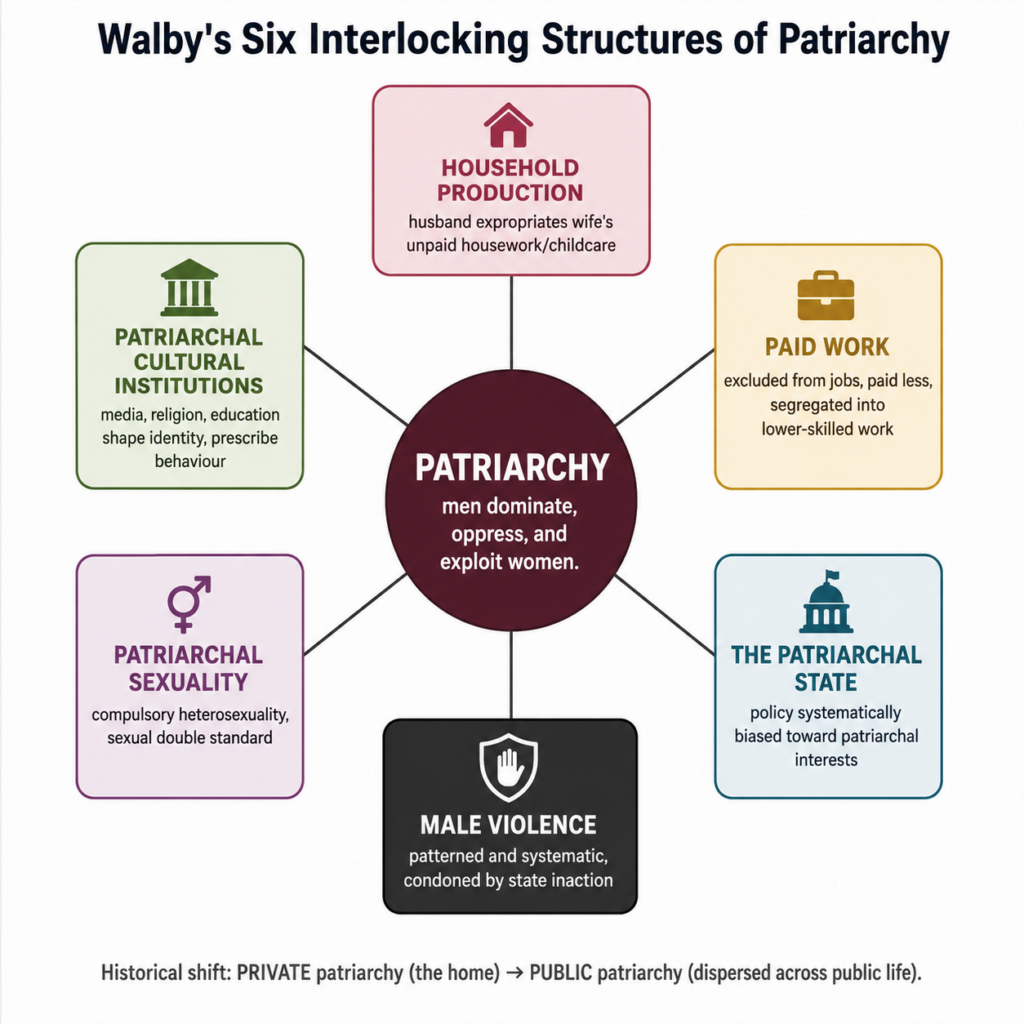
- Walby further distinguishes two historical forms this system can take.
- Private patriarchy operates within the household, at the hands of an individual patriarch, through an exclusionary strategy that keeps women out of public life altogether.
- Public patriarchy is collective rather than individual: women are admitted into public arenas such as politics and the labour market, but remain segregated from wealth, power, and status once inside them.
- Studying Britain, Walby argues that the narrowing wage gap and gains in women’s education demonstrate a shift in the degree, not the defeat, of patriarchy — its form has shifted from private to public, dispersing oppression once concentrated in the home across the whole of public life.
“Liberated from the home, women now have the whole of society in which to be exploited.” — Sylvia Walby
Delphy, Hartmann and the Marxist-Feminist Debate over Domestic Labour
- Christine Delphy, with Diana Leonard in Familiar Exploitation (1992), argues for a domestic mode of production existing alongside the capitalist mode: within it, a wife’s unpaid labour is appropriated directly by her husband, not by capital.
- On this view, women constitute a class defined by their relationship to this domestic mode of production, and the immediate exploiter is the man in the household, not the capitalist economy at large.
- This directly challenges the Marxist-feminist position associated with Margaret Benston and Eli Zaretsky, who argue that women’s unpaid domestic work primarily serves capital — by reproducing labour power (feeding, resting, and raising the next generation of workers) at no cost to the employer — rather than serving the individual husband as such.
- Heidi Hartmann‘s dual systems theory refuses to resolve this dispute by folding patriarchy into capitalism, calling that fusion the “unhappy marriage of Marxism and feminism.”
- Her position: patriarchy and capitalism are two analytically distinct systems that sometimes cooperate, as when capital benefits from patriarchal control over women’s cheap labour, and sometimes conflict, as over whether women’s wage labour should be encouraged or restricted.
Deniz Kandiyoti: Bargaining with Patriarchy
- Deniz Kandiyoti (1988) reframes women from passive victims of patriarchal structures into strategic actors who bargain within the constraints a given patriarchal system imposes, in pursuit of maximum security and benefit.
- Her key example is “classic patriarchy,” found in a geographic belt running from North Africa through the Middle East and South Asia to East Asia: a young bride accepts subordination and seclusion within her husband’s household in exchange for the authority she will eventually wield over her own sons’ wives once she becomes a senior woman.
- This bargain explains two things a simple domination model cannot: why women often police other women’s conformity to patriarchal norms, since they have a stake in the system they will eventually benefit from, and why backlash follows when the bargain breaks down — for instance, if changing economic conditions remove the promised future authority — without a replacement arrangement to take its place.
Bourdieu and Connell: Domination Without Coercion
- Pierre Bourdieu, in Masculine Domination, explains why patriarchal arrangements persist without needing constant coercion: gender hierarchy is inscribed into bodies and dispositions as habitus — an internalised, largely unconscious set of tendencies — so the dominated come to apply the dominant group’s own categories to themselves.
- He calls the resulting mechanism symbolic violence: domination that operates through consent rather than force, because the categories that justify it feel natural to those it subordinates.
- R. W. Connell‘s concept of the gender order extends this by showing that men do not benefit uniformly either: masculinity itself is internally stratified into a hegemonic form, the culturally dominant ideal, and various subordinated or marginalised masculinities.
- Even so, most men collect a “patriarchal dividend” — a diffuse advantage in status, authority, or material benefit that follows simply from being categorised as male, distinct from the greater rewards hegemonic masculinity specifically confers on some men.
Early Feminist Foundations: Wollstonecraft and Mill
- Mary Wollstonecraft, in A Vindication of the Rights of Woman (1792), wrote against a legal and social order in which women could not vote, were considered unfit for education, were barred from most occupations, held no independent right to property, and had no real recourse to divorce.
- Her argument — that women, like men, are rational beings and therefore entitled to equal rights — laid the intellectual ground for later campaigns on education, employment, property, and suffrage.
- John Stuart Mill, in The Subjection of Women (1869), argued that women were in no way intellectually inferior to men, and pressed for their full legal and political rights on those grounds.
Quick Reference: Patriarchy’s Major Theorists at a Glance
| Thinker | What “patriarchy” means for them |
|---|---|
| Weber | A form of traditional authority: a household head’s inherited, custom-based domestic command |
| Millett | A political institution reproduced through socialisation; the personal is political |
| Engels | A historical product of surplus, private property, and the need for certain paternity |
| Lerner | A historically datable system, arising c. second millennium BCE in Mesopotamia, not a universal constant |
| Walby | A system of six interlocking structures, shifting historically from private to public form |
| Delphy | A domestic mode of production in which husbands appropriate wives’ unpaid labour |
| Hartmann | A system distinct from, but interacting with, capitalism (dual systems theory) |
| Kandiyoti | A set of rules women strategically bargain within, rather than simply submit to |
| Bourdieu | A hierarchy reproduced as habitus, through symbolic violence rather than coercion |
| Connell | A gender order granting most men a “patriarchal dividend,” though masculinity is itself stratified |
Housework and the Second Shift: Patriarchy Inside the Household Economy
- Ann Oakley‘s empirical study, published as The Sociology of Housework and Housewife (1974), moved the argument on domestic labour from theory to data: interviewing forty London housewives, she found seventy per cent dissatisfied with their role.
- She analysed housework itself as a form of alienated labour, carrying the classic features associated with alienation — monotony, fragmentation into repetitive small tasks, long and unbounded hours, no pay, and no colleagues.
- Her broader argument is historical: the modern “housewife” role is not a biological given but a product of industrialisation, which physically removed production from the home and left women with a form of essential labour that is structurally invisible because it generates no wage.
- She also demolished Young and Willmott’s claim of a “symmetrical family,” in which husbands had supposedly become equal partners in housework: Oakley showed their coding of “help” was generous enough to manufacture an appearance of symmetry that closer observation did not support — men who occasionally assisted with housework were not, on any serious measure, equal partners in it.
- Arlie Hochschild, in The Second Shift (1989), documents the same pattern in dual-earner American households and gives it its most cited name.
- Her finding: women’s paid work rose sharply, but men’s share of domestic work barely moved, so employed women effectively work two full jobs — a paid one, and an unpaid domestic one that begins the moment they get home.
- She calculates the resulting leisure gap at roughly an extra month of twenty-four-hour days per year for women compared to their husbands — patriarchy adapts to women’s entry into paid work not by redistributing domestic labour, but by adding a second shift on top of the first.
- India’s Time Use Survey (2024) confirms the same structure persists at a national scale: women spend close to five hours a day (around 289 minutes) on unpaid domestic services for their households, against under an hour and a half (about 88 minutes) for men — a gap of well over three to one that had barely narrowed from the previous Time Use Survey in 2019, even as women’s own paid work participation rose over the same period.
- If this unpaid domestic work were valued as economic output, it is estimated at roughly 15 to 17 per cent of India’s GDP — a figure that captures exactly the invisibility problem Oakley’s alienation argument first identified: labour that is real, extensive, and economically significant, yet uncounted because it is unpaid.
Patriarchy, Women’s Work and Development: The Indian Context
- Land reform offers a clear historical illustration of how a structural change can loosen patriarchal constraints: the abolition of landlordism and the breakdown of the socio-cultural milieu built around it — the seclusion norms, restricted mobility, and dependence that large landholding households imposed on their women — affected Indian women’s position positively, by dismantling the material base that sustained those norms.
- Mencher and Saradamoni‘s research on agricultural labour found that women’s income is often essential to households living below the poverty line, where women’s work typically falls into overlapping categories: participation in the formally recognised labour force, domestic work, and other unpaid or informally counted activities.
- Despite this economic indispensability, poor working women remain doubly disadvantaged, victimised both by their sex and by their poor economic background, so that essential labour does not translate into recognition or bargaining power.
- Karuna Ahmad identified recurring trends in Indian women’s employment showing that education and employment growth have not eliminated the patriarchal patterning of work.
- Women cluster into a narrow band of occupations — teaching, nursing, clerical work — rather than being spread across the economy.
- Within occupations, women cluster at lower ranks and levels rather than rising proportionately into senior positions.
- Women are paid less than men for comparable work.
- A high proportion of highly educated, professionally trained women remain unemployed.
- Women’s occupational location tends to reflect caste, class, and educational background as much as merit, so employment outcomes reproduce existing social hierarchies rather than flattening them.
- Agnihotri and Aggarwal apply a Marxist framework to gender relations in production, arguing that questions about gender get systematically obscured within the way production itself is organised.
- Their broader finding: despite decades of reform and some individuation of women’s legal status, older patterns — an emphasis on female chastity, patriarchal authority, a rigid division of labour, the treated sacredness of marriage, and women’s seclusion within the household — persist underneath the surface of formal change.
- Recent labour-market data complicates this picture further. The Periodic Labour Force Survey (PLFS) 2023-24 recorded a sharp rise in India’s female labour force participation rate, from 23.3 per cent in 2017-18 to 41.7 per cent in 2023-24 — but the rise is concentrated almost entirely among rural women re-entering agriculture, often as unpaid family workers, rather than a broad-based shift into salaried, formal, or urban work; the share of rural working women employed in agriculture actually rose over this period, while their presence in industry and services fell.
- This connects directly to what researchers call India’s “education paradox”: female labour force participation fell for decades even as women’s access to higher education rose sharply, and research documents a U-shaped relationship between education and work — moderately educated women participate less than either the least or the most educated, and states with higher levels of patriarchal social norms are precisely the states where the largest share of graduate and postgraduate women stay out of the labour force altogether.
- Proposed mechanisms include a rising-income effect (educated women marrying into higher-earning households, reducing the economic necessity of paid work), a cultural premium on women’s domestic presence as a marker of family status, occupational segregation that excludes moderately educated women from suitable clerical and sales jobs, and safety and mobility constraints on women’s movement outside the home.
- The implication for whether education alone erodes patriarchal discrimination is that it does not do so automatically: education raises women’s capability and, in many studies, their say in household decisions, but converting that capability into economic and social autonomy still depends on labour-market structure, norms around “respectable” work for educated women, and the domestic division of labour — precisely the structures Walby, Kandiyoti, and Oakley describe.
Previous Year Questions
- Does women’s education help to eradicate patriarchal discriminations? Reflect with illustrations. (2023)
- How do you understand the relationship between patriarchy and social development? (2022)
- What is the impact of gender division of labour on the development of society? (2020)
- Define patriarchy. How does patriarchy manifest in interpersonal relations? (2018)
- Examine ‘patriarchal bargain’ as gendered division of work in contemporary India. (2017)
- To what extent is patriarchy a cause for the problems of women? Discuss. (2016)
- Is patriarchy a universal phenomenon? Critically examine how does patriarchy affect sexual division of labour in societies. (2013)
- Write short note: Gender Roles in Changing Structure of Family. (2004)
- Distinguish between Sex and Gender issues with suitable examples. (2002)
- Write short note: Impact of changes in sex-role on family. (1996)
- How do changes in the age and sex roles in the family affect the social structure itself? (1989)
Solved PYQs for every Sociology topic
Notes tell you what a thinker said. Sociology Optional PYQ Solutions shows you how UPSC asks it and how a strong answer is written, on every question since 1985.
- 1,500+ solved PYQs (1985–2026), Paper-1 and Paper-2
- Topic-wise across all 25 syllabus units, newest exam year first
- A full model answer for each question, shaped to 10 or 20 marks
- Online plus PDF download, 12 months access, one-time payment
₹1,499 ₹2,500 · instant access, no subscription

You have very fine content. Thank you so much for providing it here for free ❣
“You’re welcome. It’s a pleasure.” Keep Reading
Thank you…. Good content at one place
Thanks content is designed very sophisticated ly but plzz add their important work too like most vital publications and central concept and research areas