

Sociology and Common Sense Knowledge

What Common Sense Means, and Why Sociology Treats It Differently
- The standard reflex answer to “how does sociology differ from common sense” — “common sense is unscientific, sociology is scientific” — is both thin and only partly true. The two differ chiefly in their rules of reasoning, not merely in their accuracy, and a good account should go further to show where the boundary between them actually blurs.
- Max Weber defined common sense simply as the routine, taken-for-granted knowledge people carry about their everyday world and activities. It may rest on genuine observation and experience, or equally on ignorance, prejudice and mistaken interpretation — and, crucially, common sense makes no distinction between the two. It does not ask itself why it holds a given view.
- Common sense can therefore be defined more formally as the stock of taken-for-granted, unexamined knowledge that members of a society draw on to navigate everyday life. It is practical, local, acquired through ordinary socialisation rather than deliberate inquiry, and — unlike scientific knowledge — it is not required to be internally consistent.
Practise this topic on real UPSC questions. 61 UPSC questions from Sociology as a Science (1985–2026) are solved in Sociology Optional PYQ Solutions, each with a full model answer: introduction, thinkers applied, Indian examples and a conclusion.
The Core Differences: Bauman’s Four Points
- Zygmunt Bauman, in Thinking Sociologically, offers the clearest structure for this comparison — four specific differences worth setting out in full:
- Responsible speech: sociology submits itself to explicit rules of evidence, method and public scrutiny, and must show its workings so that another researcher could check or repeat them. Common sense answers to no one and shows no such workings.
- The size of the field: sociology draws on a far wider canvas of comparative evidence than any individual’s own biography and immediate personal experience, which is all common sense has to draw upon.
- The mode of sense-making: sociology explains conduct through webs of interdependence and structural position — how a person’s location in class, caste, gender or community shapes their action. Common sense explains the very same conduct through individual intentions, motives and character — treating outcomes as a simple product of personal choice or nature.
- Defamiliarisation: sociology’s characteristic effect is to render the familiar strange and therefore questionable; common sense does the opposite, continually confirming and naturalising what is already familiar.
- Of these four, the mode of sense-making is the one that matters most, because it names sociology’s real methodological advantage over common sense, not just its greater accuracy. C. Wright Mills‘s distinction between personal troubles and public issues (developed fully in the “Scope of the Subject” article) is exactly this same move in a different vocabulary.
The Naturalistic and Individualistic Fallacy
- Common sense explanation is typically individualistic (it explains an outcome by the personal qualities of the individual concerned) and naturalistic (it treats a socially produced pattern as though it were simply natural or God-given). Sociology’s task is to show that both moves are inadequate.
- Poverty is the standard illustration: common sense holds that people are poor because they are lazy, come from “problem families,” cannot budget, or lack intelligence. The sociological explanation instead locates contemporary poverty in the structure of inequality within a class society — experienced specifically by those who suffer chronic irregularity of work and low wages, regardless of individual effort or ability.
- Gender roles supply the other classic illustration. Common sense typically assumes that differences in men’s and women’s behaviour follow directly from biological and physiological differences between the sexes. Margaret Mead‘s fieldwork in Sex and Temperament in Three Primitive Societies (1935), conducted in Papua New Guinea, directly undermines this assumption by showing the same “natural” traits distributed completely differently across three neighbouring tribes:
- Among the Arapesh, both men and women displayed a gentle, cooperative, nurturing temperament that Western common sense would label purely “feminine.”
- Among the Mundugumor, both men and women displayed an aggressive, violent temperament that Western common sense would label purely “masculine.”
- Among the Tchambuli, gender roles were sharply differentiated but reversed relative to the Western common-sense expectation: women were dominant, managerial and impersonal, while men were comparatively decorative, emotionally dependent and socially subordinate.
- Since the underlying biology of these three populations was identical, the striking variation in “male” and “female” temperament across them cannot be explained biologically at all — it must be explained as a product of social conditioning and cultural convention, learned through socialisation rather than given by nature. This is precisely the sociological correction of a naturalistic common-sense assumption.
- The general principle both examples illustrate: sociology rejects the individualistic explanation because it ignores the wider social forces acting on a person that they cannot personally control, and it rejects the naturalistic explanation because it mistakes a socially learned pattern for a biologically fixed one.
- Émile Durkheim took an even harsher view of common sense than most later sociologists. In The Rules of Sociological Method (1895), he argued that prenotions (praenotiones) — the crude, self-flattering, pre-scientific ideas that observers bring with them into any inquiry — must be systematically eradicated before genuine investigation can begin. Borrowing the language of Francis Bacon’s idola (“idols” of the mind that mislead reasoning), Durkheim treated common sense not as a helpful starting point but as an active obstacle standing between the observer and the social fact. His foundational methodological rule follows directly from this: “social facts must be treated as things” — that is, studied objectively, from the outside, exactly as a natural scientist studies a physical phenomenon, rather than assumed to be already understood because we all live inside society. As he put it elsewhere, “common sense perceptions are prejudices which can mar the scientific study of the social world.”
Common Sense Is Not Merely Unproven — It Is Contradictory
- The sharpest illustration of this is that common sense frequently supplies a proverb for every possible outcome, and a body of “knowledge” that can explain anything after the fact predicts nothing in advance:
- “Birds of a feather flock together” and “opposites attract” are both accepted as common sense.
- “Absence makes the heart grow fonder” and “out of sight, out of mind” are both accepted as common sense.
- Duncan Watts, in Everything Is Obvious: Once You Know the Answer (2011), presses exactly this point: common sense explains events only after they have already happened, which is precisely why it feels so obviously true in hindsight — while explaining nothing reliably in advance. This is the key epistemological weakness sociology’s systematic method is designed to correct.
- Peter L. Berger, in Invitation to Sociology, gave sociology’s characteristic stance toward common sense a memorable label: a “debunking attitude towards the world taken for granted.” In Berger’s own words, “the fascination of sociology lies in the fact that its perspective makes us see in a new light the very world in which we have lived all our lives… the first wisdom of sociology is that things are not what they seem.” Sociologists insist that what feels “commonsensical” or “natural” is frequently neither universal nor eternal, but specific to a particular society or historical period — which is exactly the point Mead’s tribal comparison demonstrates concretely.
Common Sense as an Instrument of Power: Gramsci’s Hegemony
- Antonio Gramsci adds a political dimension often missing from standard answers: for Gramsci, the dominant class (the bourgeoisie) develops a hegemonic culture and actively propagates its own values and interests until they come to be accepted, unreflectively, as simply “common sense” by society as a whole. On this reading, common sense is not a neutral, innocent stock of folk wisdom but can function as a mechanism that naturalises existing inequality and helps maintain the status quo — precisely the kind of “unreflective” and “status-quoist” quality that sets it apart from sociology’s explicitly change-oriented, critical stance.
The Necessary Concession: Common Sense Is Not Simply the Enemy
- A balanced account does not stop at listing sociology’s advantages — it concedes real ground back to common sense too.
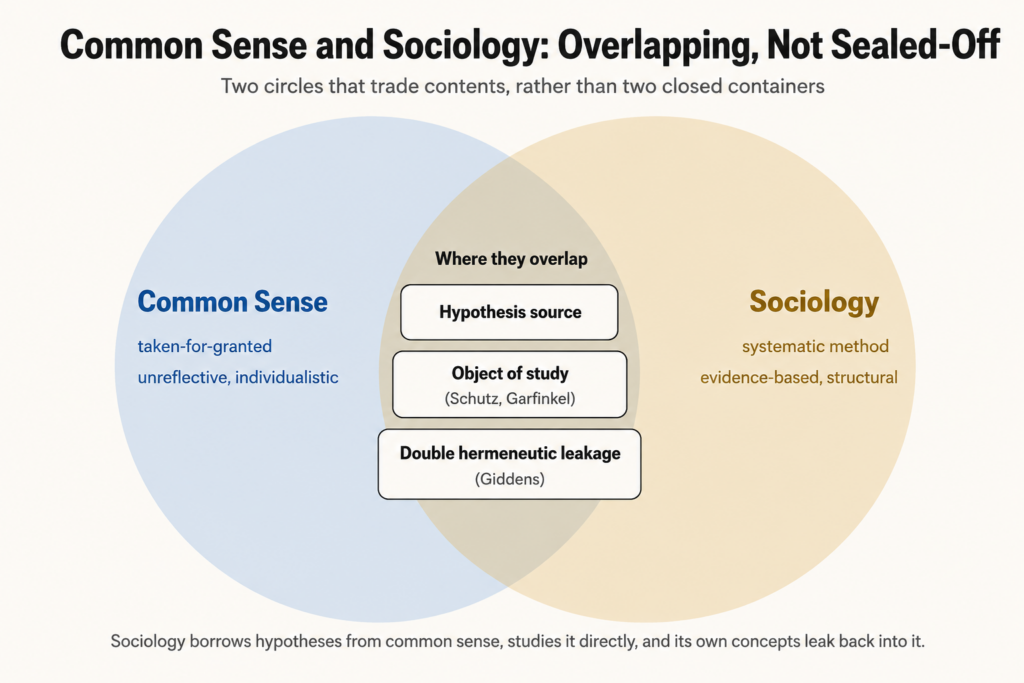
- Common sense can be true, and it is very often the actual starting point of sociological research. It supplies raw material and hypotheses, tells the researcher what a given society itself considers problematic, and provides an entry point into the world being studied.
- Its real defect, properly stated, is not that it is false but that it is untested and not organised to be testable. Sociology’s task, on this more sophisticated view, is to convert common sense propositions into properly testable ones, and then accept whatever the evidence actually shows — even when that confirms the common-sense belief.
- Ronald Fletcher captured this concessive point neatly by calling common sense knowledge “science in embryo” — an immature but not worthless precursor to systematic inquiry, rather than its opposite.
The Deepest Reversal: Common Sense as Sociology’s Own Object of Study
- The most sophisticated point available on this theme is that for an entire strand of sociological theory, common sense is not a rival to be corrected at all, but the very phenomenon sociology exists to study.
- Alfred Schutz‘s phenomenological sociology treated everyday common sense as an organised, typified “stock of knowledge at hand” — a structured set of taken-for-granted assumptions that people rarely question, but which sociology can make its central object of analysis.
- Harold Garfinkel‘s ethnomethodology treats ordinary members’ common-sense reasoning as its actual research topic rather than as an error to be corrected. His famous “breaching experiments” — deliberately violating small, unstated common-sense rules of everyday interaction (for instance, responding to “how are you?” with a demand for a precise medical report) — work specifically by exposing the implicit, unnoticed common-sense rules that ordinarily make smooth social interaction possible at all.
- Peter Berger and Thomas Luckmann‘s The Social Construction of Reality (1966) makes common-sense knowledge the central subject of the sociology of knowledge, on the ground that it is precisely this taken-for-granted knowledge — not expert or scientific knowledge — that actually constitutes the social reality people inhabit day to day.
Giddens’s Double Hermeneutic: The Two Feed Each Other
- Anthony Giddens‘s concept of the double hermeneutic completes the picture and offers the most sophisticated closing point on this relationship. Unlike molecules or planets, the human beings sociologists study already have their own common-sense theories about what they are doing — so the sociologist is always interpreting an already-interpreted world (the “first” hermeneutic circle, of the subjects’ own self-understanding, nested inside the sociologist’s “second” circle of academic interpretation).
- More strikingly still, sociological concepts routinely leak back out and become common sense, at which point they can actually change the very behaviour they were coined to describe. Words like “charisma,” “lifestyle,” “role model” and “peer group” all began as technical sociological or social-scientific terms and are now ordinary common-sense vocabulary.
- The conclusion this supports: common sense and sociology are not two sealed, permanently separate containers — they continuously exchange contents with one another, which is exactly why treating sociology as simply “common sense with better manners” understates the relationship in both directions.
The Focal Point Is Interaction
- One influential framing holds that sociology’s focal point is interaction, and the symbolic-interactionist answer follows directly from Giddens’s and Garfinkel’s points above: common-sense knowledge of shared rules and meanings is precisely what makes ordinary social interaction possible in the first place, and sociology’s task is to make explicit the very rules that participants themselves follow fluently but could rarely state outright if asked.
- This connects directly back to G. H. Mead‘s symbolic interactionism (developed further under the “Sociological Thinkers” unit): each person interprets shared symbols somewhat differently based on their own social position and experience, which is exactly why interaction — not simply the accumulation of individual actions — has to be sociology’s proper starting point.
Common Sense vs. Sociology, Side by Side
| Common sense | Sociology |
|---|---|
| Takes cues from surface appearance | Looks for interconnections and root causes |
| Relies on conjecture and stereotype | Relies on reason, logic and evidence |
| Rests on unexamined assumptions | Rests on tested evidence |
| Individualistic and naturalistic | Explains via structure and empirical testing |
| Intuitive | Objective and methodical |
| Particularistic (case by case) | Generalising, oriented to theory-building |
| Status-quoist, confirms the familiar | Change-oriented, defamiliarises the taken-for-granted |
| Unreflective — does not question its own origin | Built on unending debate, self-scrutiny and revision |
| Value-laden | Aspires to objectivity |
| Enforced through unquestioned tradition | Sceptical, open to revision by evidence |
Quick-reference box: Key Positions on Common Sense, at a Glance
- Weber — common sense is routine, taken-for-granted knowledge of everyday life; may or may not be accurate.
- Durkheim — common sense supplies “prenotions” that are prejudices to be eradicated before scientific inquiry can begin; treat social facts as things.
- Gramsci — common sense can be manufactured by the dominant class into “hegemonic” values that sustain existing inequality.
- Berger — sociology has a “debunking” attitude; the first wisdom of sociology is that things are not what they seem.
- Watts — common sense explains everything after the fact and predicts nothing in advance.
- Fletcher — common sense is “science in embryo,” not the opposite of science.
- Schutz — common sense is an organised “stock of knowledge at hand,” and a legitimate object of study.
- Garfinkel — common-sense reasoning is ethnomethodology’s actual research topic, studied through breaching experiments.
- Berger and Luckmann — common-sense knowledge is the central subject of the sociology of knowledge; it constitutes everyday social reality.
- Giddens — the “double hermeneutic”: sociologists interpret an already-interpreted world, and sociological concepts leak back into common sense.
- Mead — cross-cultural fieldwork (Arapesh, Mundugumor, Tchambuli) shows “natural” gender common sense is in fact culturally variable.
In Sum
- Sociology is not “common sense with better manners” but a discipline that makes common sense answerable to evidence — while acknowledging that the boundary between the two is porous rather than fixed: common sense feeds sociology hypotheses, becomes its object of study, and continually exchanges vocabulary with it in both directions.
Previous Year Questions
- What is common sense? How are common knowledge and sociology related to each other? Explain. [2025] (10 marks)
- Do you think that common sense is the starting point of social research? What are its advantages and limitations? Explain. [2023]
- How is Sociology related to common sense? [2021]
- The focal point of sociology rests on interaction. How do you distinguish it from common sense? [2018]
- Is sociology common sense? Give reasons in support of your argument. [2016]
Solved PYQs for every Sociology topic
Notes tell you what a thinker said. Sociology Optional PYQ Solutions shows you how UPSC asks it and how a strong answer is written, on every question since 1985.
- 1,500+ solved PYQs (1985–2026), Paper-1 and Paper-2
- Topic-wise across all 25 syllabus units, newest exam year first
- A full model answer for each question, shaped to 10 or 20 marks
- Online plus PDF download, 12 months access, one-time payment
₹1,499 ₹2,500 · instant access, no subscription

Very good notes sociology