

Scope of the Subject and Comparison with other Social Sciences

Why the Scope of Sociology Is Genuinely Contested
- The scope of sociology is genuinely vast: it can examine an interaction between two friends, or a national issue like unemployment or caste conflict, or a global process like the effect of flexible labour regulations on the working class. What actually defines sociology as a discipline is therefore not simply what it studies (family, villages, trade unions) but how it studies whatever it studies — the distinctive angle of vision it brings to a shared human subject matter.
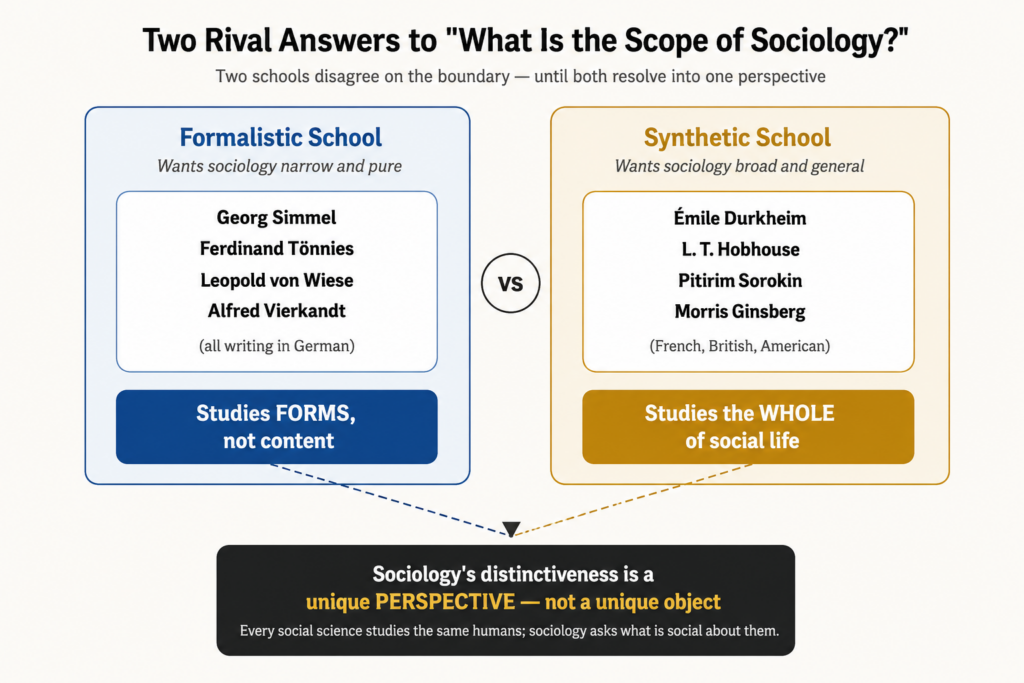
- Because of this breadth, there has been long-standing controversy among sociologists themselves about how to delimit the subject’s boundaries — a genuine academic debate about where one discipline ends and another begins. The debate is best organised around two rival schools.
Practise this topic on real UPSC questions. 42 UPSC questions from Sociology: The Discipline (1985–2026) are solved in Sociology Optional PYQ Solutions, each with a full model answer: introduction, thinkers applied, Indian examples and a conclusion.
The Formalistic (Specialistic) School: Keep Sociology Pure and Narrow
- The Formalistic School — associated chiefly with Georg Simmel, Ferdinand Tönnies, Leopold von Wiese, Alfred Vierkandt, and, in a qualified sense, Max Weber (notably, nearly all German thinkers) — wants sociology to be an independent, narrowly-defined science, distinct from every other social science.
- Georg Simmel‘s core move: sociology should study only the recurring forms of social relationships — competition, domination, subordination, imitation, division of labour — abstracted away from their concrete content. His famous analogy: sociology relates to the other social sciences the way geometry relates to physics. Geometry studies the spatial form of objects (a triangle, a sphere) regardless of what they are made of; sociology, likewise, should study the form of a relationship (say, conflict) regardless of whether that conflict occurs in a marriage, a market, or a war, since the formal properties recur across radically different content.
- Alfred Vierkandt held that sociology becomes a genuine, definite science only when it abstains from the historical study of concrete societies, and confines itself instead to the irreducible categories of mental or psychic relationship — love, hatred, cooperation, competition.
- Leopold von Wiese classified human relationships into two broad kinds of social process — associative processes (contact, approach, adaptation) and dissociative processes (competition, conflict) — plus mixed forms, yielding, in his scheme, roughly 650 distinct forms of human relationship that sociology should catalogue and study.
- Ferdinand Tönnies‘s own Gemeinschaft/Gesellschaft distinction (community versus association, discussed in the emergence-of-sociology topic) is itself a formal typology, which is why he is classed with this school.
- Max Weber‘s position is more qualified but shares the formalist instinct for a defined scope: sociology, for him, should interpret and understand social action — behaviour to which the actor attaches subjective meaning and which takes account of the behaviour of others (Verstehen). Weber identified action as traditional, affectual (emotional), value-rational, or instrumentally-rational, and insisted sociology study social behaviour specifically, not human behaviour as such.
- Albion Small put the formalist principle simply: every science has a delimited scope, and sociology’s is the study of the genetic forms of social relationships, behaviour and activity — not the whole of social life.
- Criticism of the Formalistic School — worth listing individually as a structured rebuttal, not a vague dismissal:
- Other sciences also study forms of social relationships. International law necessarily studies relationships like conflict, agreement and alliance; political science studies sovereignty and authority as social relationships. Sociology cannot claim exclusive ownership of “form.”
- A wholly “pure” sociology is not practical. Despite extensive formalist literature, no sociologist has actually produced a pure sociology in practice — no science can be studied in total isolation from its neighbours.
- The geometry analogy breaks down. Geometric forms have a fixed, definite spatial shape; social relationships have no such fixed shape and cannot be studied in genuine separation from their concrete content.
- Form cannot be separated from content in real social life. How could competition, conflict or love be studied in the abstract, without reference to their actual concrete circumstances? Pitirim Sorokin‘s objection is the classic rebuttal, worth quoting directly: “We may fill a glass with wine, water or sugar without changing its form, but we cannot conceive of a social institution whose form would not change when its members change.” Morris Ginsberg made the same point differently — the idea of a “pure” sociology is impractical because no social science can genuinely be studied in isolation.
- The Formalistic School unduly narrows sociology’s scope. If forms cannot be studied apart from content, sociology must widen its ambit to include concrete social relationships, behaviour and activity — not merely their abstract forms.
The Synthetic School: Make Sociology the General Science of Society
- The Synthetic School — led by Émile Durkheim, L. T. Hobhouse, Morris Ginsberg, Pitirim Sorokin, and (in a qualified sense) Karl Mannheim — moves in the opposite direction: sociology should be a broad, general synthesis of the social sciences, since social life is an interconnected whole that cannot be carved up without distortion.
- Auguste Comte is also properly placed here: his famous claim that sociology is the “queen of the sciences” rests exactly on this synthetic ambition — that it alone studies both the reasons for society’s continuity and the conditions producing social change.
- Émile Durkheim‘s own scheme divides sociology into three parts:
- Social morphology — the study of society’s geographical and demographic substratum: population size, density, and territorial distribution, and how these affect the quality of social relationships and groups.
- Social physiology — the study of the genesis and functioning of particular social institutions: religion, law, morality, economic life.
- General sociology — the synthesising, philosophical part of the discipline, aimed at formulating general social laws that draw together the findings of social morphology and social physiology.
- L. T. Hobhouse held that the whole social life of humanity is properly sociology’s sphere, and that its relationship to the other social sciences is one of mutual exchange and stimulation, not rigid separation.
- Pitirim Sorokin distinguished general sociology (the study of properties and relationships common to social phenomena everywhere) from special sociologies (of caste in India, or race in the United States, for instance).
- Morris Ginsberg divided the field into social pathology (diagnosing the causes and consequences of social problems) and general social processes, and set out sociology’s chief functions: to classify types and forms of social relationships; to determine the relationships between different parts of social life; and to disentangle the fundamental conditions of both social change and social persistence.
- Karl Mannheim distinguished systematic and general sociology from historical sociology.
- The key evaluation: the formalists secure sociology’s independence but at the price of triviality (a form with no content is empty, and Sorokin’s glass-of-wine objection stands); the synthetic school captures social life more realistically but risks turning sociology into an undisciplined “science of everything,” with no boundary genuinely its own.
The Working Resolution — and a Timeline of the Debate
- The resolution most departments actually adopt today: sociology’s distinctiveness lies not in a unique subject matter but in a unique perspective. Every social science ultimately studies the same human beings; what makes an inquiry sociological is that it asks what is social about their conduct — how it is patterned by group life, social structure, and shared meaning.
- It helps to see this debate as something that evolved historically rather than as a single frozen dispute:
- Phase one (from 1838, through the 1880s): Comte and Spencer work at the macro, “grand theory” level — social statics and dynamics, positivism, evolutionary organicism.
- Phase two (1880s–1940s): Weber introduces the micro, interpretive dimension (Verstehen), and the Formalistic and Synthetic schools crystallise as distinct camps.
- Phase three (1940s–1980s): The two schools begin to blend. Talcott Parsons‘s structural-functionalism and, especially, Robert Merton‘s theory of anomie and his concept of latent and manifest functions deliberately combine psychological (micro) and structural (macro) levels of analysis. C. Wright Mills‘s sociological imagination and Anthony Giddens‘s later theory of structuration (and his concept of the double hermeneutic) continue this synthesis. On the formalist side, Alfred Schutz‘s phenomenology and Harold Garfinkel‘s ethnomethodology extend the micro tradition inward, into the study of everyday meaning-making itself.
- Phase four (1980s onward): the rise of postmodernist and poststructuralist currents widens sociology’s territory into entirely new domains — environment, healthcare, information technology, media — while simultaneously questioning whether any single, totalising theory (“metanarrative”) of society is even possible. Jacques Derrida‘s deconstruction, Michel Foucault‘s discourse analysis, and Jean Baudrillard‘s argument that mass-media signs and images, rather than the economic base, now dominate social life, all belong here; Alan Bryman‘s advocacy of methodological pluralism reflects the same widening. Marxism and feminism, having emerged with real force from the 1960s onward, do not fit neatly into either the formalist or synthetic camp and are best treated as separate, cross-cutting traditions.
- The contemporary twist: sociology’s boundaries with behavioural economics, political sociology, historical sociology, social psychology and cultural studies are visibly dissolving. The right way to argue this is that such border traffic is a sign of the discipline’s health, not evidence of “scope creep” — while still insisting that the sociological question (what is social about this?) remains distinct even as its objects multiply.
Sociology and the Other Social Sciences: The Cut Each Discipline Makes
- A bare list of similarities and differences produces a thin, mechanical account. The stronger claim is that the social sciences differ by the question they ask, not by the human beings or societies they study. All of them study the same social reality; each discipline simply makes a different “cut” into it.
Sociology and Economics
- Classical economics, on Lionel Robbins‘s influential definition, studies the allocation of scarce means among competing ends, built around an abstracted, utility-maximising “economic man.” Sociology instead treats economic behaviour as embedded in social norms, values, networks and institutions — not as isolated, asocial calculation.
- Karl Polanyi‘s The Great Transformation (1944) argued that the self-regulating market was a historical anomaly that had to be politically constructed, and that in most times and places the economy is embedded within, rather than separate from, the rest of society.
- Mark Granovetter‘s “Economic Action and Social Structure: The Problem of Embeddedness” (1985) attacked both the “undersocialised” view of classical economics and an “oversocialised” caricature sometimes found in sociology, and his earlier “The Strength of Weak Ties” (1973) showed empirically that people typically find jobs through loose acquaintance networks rather than through price signals alone.
- Max Weber‘s The Protestant Ethic and the Spirit of Capitalism (1904–05) remains the classic demonstration that a religious ethic — an apparently non-economic factor — can decisively shape economic conduct, an almost exact inversion of economic determinism.
- Pierre Bourdieu, in a much-quoted 1998 remark, argued for “an economics of happiness” that would count all the costs of an economic arrangement — including crimes, suicides, and the costs of insecurity — not merely the costs that show up on a corporate balance sheet.
- Feminist economics has pushed the discipline to treat gender as a central organising principle — for instance, examining how unpaid domestic work sustains productivity in the paid economy outside the home.
- Two-way traffic is genuine, not one-sided: Durkheim treated the division of labour as a social fact requiring a different (moral/solidarity-based) explanation than Adam Smith‘s purely economic one, while Talcott Parsons and Neil Smelser‘s work treats economic behaviour as inseparable from its wider social milieu. In India, the jajmani system shows caste-based social relations directly organising economic exchange — a clear instance where sociological and economic explanation must work together.
- Sociology’s comparative advantage: unlike economics, it does not usually offer ready technical solutions, but it supplies a questioning, critical perspective on the social desirability of goals themselves, not just the efficiency of means to a given end.
Sociology and Political Science
- Conventional political science historically focused on two things: political theory (ideas about government, from Plato to Marx) and government administration (the formal structure of the state) — with comparatively little direct study of actual political behaviour.
- Sociology, by contrast, studies power wherever it operates — in the family, the caste panchayat, the workplace, the classroom — not merely where it is formally licensed by law.
- Max Weber‘s definition of the state, from Politics as a Vocation (1919), is itself a profoundly sociological one: the state is the human community that successfully claims a monopoly on the legitimate use of physical force within a given territory — and legitimacy is a matter of shared belief, not merely statute.
- Michels, Weber and Pareto‘s elite theories, and later C. Wright Mills‘s account of the American “power elite” (the coalescing interests of top business, political and military leaders), sit squarely in the overlap the discipline calls political sociology.
- Talcott Parsons‘s AGIL scheme treats “goal attainment” — essentially, politics — as one of society’s four basic functional prerequisites, formally integrating political activity into general sociological theory.
- Contemporary illustrations: sociological analysis of voting behaviour, party membership, and the political mobilisation of caste, ethnicity and religion (India’s Patidar agitation is a ready example, alongside Brexit and recent US presidential elections as instances of the “convergence of international politics and global sociology” that Immanuel Wallerstein‘s world-systems thinking anticipates). Events like the Arab Spring and the Tiananmen Square protests are useful illustrations of society confronting the political system directly.
- In sum: as the modern state increasingly assumes welfare functions, a sociological lens on political activity is gaining rather than losing relevance, and it is becoming genuinely difficult to draw a firm line between political science and political sociology.
Sociology and History
- The oldest and most quotable formulation of this relationship comes from E. H. Carr: “The more sociological history becomes, and the more historical sociology becomes, the better for both.”
- Wilhelm Windelband‘s 1894 distinction supplies precise vocabulary for this: history is idiographic — concerned with the unique, particular, once-occurring event — while sociology is nomothetic — seeking generalisations and law-like regularities across cases. A. R. Radcliffe-Brown applied this distinction directly to the sociology–history relationship.
- History traditionally worked from documents and archives about the past; sociology adds survey, observation and interview, and can study the living present as well.
- Conventional history’s traditional focus on “kings and wars” left less glamorous subjects — changes in land relations, or in gender relations within the family — comparatively understudied; these became, by contrast, core sociological concerns.
- The line has been visibly dissolving in both directions. Philip Abrams‘s Historical Sociology (1982) argued the two are, in principle, indistinguishable, since both ultimately study the structuring of human action over time. Barrington Moore‘s Social Origins of Dictatorship and Democracy (1966) and Theda Skocpol‘s States and Social Revolutions (1979) are historical sociology practised at full strength. Marx’s historical materialism and Weber’s comparative studies of world religions are genuinely unclassifiable as belonging to either discipline alone. Marc Bloch and Lucien Febvre, founders of the influential Annales School of long-duration social history, were directly influenced by Durkheim’s sociology.
- G. E. Howard‘s epigram is a useful line to have ready: “Sociology is present history, and history is past sociology.”
- In the Indian context, G. S. Ghurye‘s and Louis Dumont‘s Indological approach to caste itself rests heavily on historical textual material, showing the two disciplines cannot be neatly separated even at the level of method.
Sociology and Social Anthropology
- The classical division between the two was originally one of subject matter and technique, not of underlying logic: social anthropology traditionally studied small-scale, pre-literate, technologically simple, relatively homogeneous — usually colonised — societies, holistically, through long immersive fieldwork, following Bronisław Malinowski‘s pioneering Argonauts of the Western Pacific (1922); sociology traditionally studied large-scale, literate, complex, usually Western societies through surveys and statistics.
- E. E. Evans-Pritchard stated plainly that social anthropology is, properly speaking, a branch of sociology.
- This division has substantially collapsed in practice: anthropologists today study stock exchanges, laboratories and their own cities, while sociologists routinely conduct ethnography. In India, the distinction arguably never held in the first place — G. S. Ghurye trained under W. H. R. Rivers at Cambridge, M. N. Srinivas trained first under Ghurye and then under Radcliffe-Brown and Evans-Pritchard at Oxford, and Srinivas’s own The Remembered Village is a piece of ethnography written by the country’s most eminent sociologist.
- Method has crossed both ways: sociology has absorbed field concepts like cultural lag (from E. B. Tylor‘s cultural anthropology); Durkheim‘s study of Australian Arunta totemism, which grounded his theory of the elementary forms of religious life and the division of labour, is itself an anthropological field study. In India, M. N. Srinivas, André Béteille and S. C. Dube all used intensive village field studies to build sociological theory.
- Franz Boas and later anthropologists critically reassessed earlier anthropological theories of unilinear evolution, environmental and economic determinism, and organismic analogy — partly under the influence of sociological thinking.
- A genuinely contemporary point worth including: Akhil Gupta and James Ferguson, writing reflexively about anthropological fieldwork, questioned the very idea of “the field” as a bounded space of cultural “otherness,” arguing that decolonisation, industrialisation and globalisation have made the traditional notion of a neatly demarcated field site increasingly untenable — a field today may be as much social and political as geographical (India’s own subaltern studies tradition reflects a similar move, recovering perspectives previously studied only from an elite vantage point).
- A useful working division for contemporary India that several sources converge on: sociology can study tribal communities displaced by industrialisation, while anthropology today studies slum-dwellers in modern cities — each discipline crossing comfortably into what was once considered the other’s territory.
Sociology and Psychology
- Psychology is chiefly concerned with the individual — intelligence, learning, motivation, memory, personality. Sociology is concerned with the group and with patterned relations between individuals.
- The clearest statement of the boundary is Durkheim‘s methodological rule from The Rules of Sociological Method (1895): “The determining cause of a social fact must be sought among antecedent social facts, and not among the states of individual consciousness.” His study Suicide (1897) is the classic demonstration: he took the most seemingly private, psychological act imaginable and showed that its rate is stable, patterned across groups, and explained by levels of social integration and regulation — not by individual despair alone. As Durkheim put it elsewhere, society “is not simply an aggregate of individuals; it is a system formed by their association and represents a specific level of reality possessing its own characteristics.”
- The opposing, reductionist position also deserves to be named: J. S. Mill believed a genuine social science could not be considered established until its generalisations could be logically derived from the laws of individual psychology, and George Homans, in “Bringing Men Back In” (1964), argued that sociological propositions must ultimately reduce to psychological propositions about individual behaviour.
- Most sociologists occupy an intermediate position: Morris Ginsberg held that many sociological generalisations are strengthened by relating them to established psychological laws, and post-Freudian psychologists Karen Horney and Erich Fromm stressed the interdependence of the two fields — Fromm’s concept of social character is designed precisely to link individual psychological patterns to the characteristics of a given social group.
- G. H. Mead‘s symbolic interactionism occupies the productive bridge between the two disciplines directly: each person interprets shared symbols somewhat differently, and therefore behaves differently, making the self itself a product of social interaction rather than a purely internal, psychological given.
- The clean formulation: for a psychologist, a suicide raises the question “why this person?”; for a sociologist, the same event raises the question “why this rate, and why this group rather than another?” — same event, different unit of analysis, different kind of answer, and neither is wrong.
Sociology and Philosophy
- Modern philosophy and sociology emerged in roughly the same period, both responding to the social crisis of nineteenth-century Europe, and the relationship between them runs deeper than is often acknowledged in accounts that focus only on economics, political science, history, anthropology and psychology.
- There is, first, a “philosophy of sociology” in the same sense that there is a philosophy of science — a critical examination of sociology’s own methods, concepts and arguments (this is, in effect, what the separate “Sociology as Science” unit of the syllabus is devoted to).
- Second, there is a close relationship with moral and social philosophy: philosophy studies values in the abstract, while sociologists study values and human valuation as empirical facts — how they actually operate in social life.
- Durkheim himself held that sociology must necessarily contribute to a renewal of certain philosophical (specifically epistemological) questions, and Karl Mannheim‘s sociology of knowledge was explicitly understood by him to carry philosophical implications.
- Sociological theories themselves sometimes harden into full ideologies with a philosophical foundation — Marxism, feminism and critical theory are the standard examples, each combining an empirical social theory with a normative, philosophically-grounded programme for social transformation.
- Alfred Vierkandt‘s remark is worth quoting for its economy: sociology is genuinely productive only when it rests on a philosophical basis.
- Shared concepts that are simultaneously values and empirical facts — dharma, individualism, liberalism, alienation — sit exactly at this meeting point of social logic and philosophy, which is sometimes called social philosophy in its own right.
Sociology’s Distinctiveness at a Glance
| Discipline | Its characteristic question | Its typical unit of analysis | How sociology differs | The overlap |
|---|---|---|---|---|
| Economics | How are scarce means allocated among competing ends? | The rational, utility-maximising individual or firm | Treats economic action as embedded in social relations and norms, not asocial calculation | Economic sociology — Polanyi’s embeddedness, Granovetter’s networks, Weber’s Protestant Ethic |
| Political Science | How is the state organised, and how is authority exercised through it? | The state and its formal institutions | Studies power wherever it operates — family, caste, workplace — and its social bases | Political sociology — Weber on legitimacy; elite theory of Pareto, Mosca and Michels |
| History | What happened, in this place, at this time? | The unique, particular event (idiographic) | Seeks generalisation across cases (nomothetic); can study the living, not only the archive | Historical sociology — Abrams, Barrington Moore, Skocpol; Marx and Weber belong to both |
| Social Anthropology | How does this whole way of life hang together, from the inside? | The small-scale, relatively homogeneous community | Classically studied large, complex, literate societies via survey and statistics; division was of territory, not logic | Ethnography now common to both; never a sharp line in India (Ghurye, Srinivas) |
| Psychology | Why does this individual think, feel and act this way? | The individual mind | Explains social facts by antecedent social facts, not individual consciousness (Durkheim); asks about rates, not single cases | Social psychology; Mead on the social genesis of the self; Homans’ reductionist counter-argument |
| Philosophy | What ought to be valued, and why? | Values and ideas in the abstract | Studies values and human valuation as empirical, observable facts | Sociology of knowledge; ideologies like Marxism and feminism straddling both |
Why the Scope Matters: The Practical Significance of Sociology
- Beyond the academic boundary-drawing, the “scope” theme also carries a genuinely practical dimension:
- Policy relevance: a sound social policy requires prior sociological knowledge of the conditions it is meant to address — sociology supplies the diagnostic groundwork planning and administration depend on.
- The dignity and understanding of others: sociology trains us to appreciate the motives and conditions under which people very different from ourselves live, correcting the natural human tendency to treat one’s own way of doing things as the only sensible one (a point close to Lowie‘s formulation).
- A changed understanding of deviance: sociological study has shifted public understanding of crime away from treating offenders as simply wicked, toward recognising social and structural causes — reshaping rehabilitation as a goal rather than pure punishment.
- International understanding: sociology helps explain the tensions and misunderstandings that divide nations even as physical science has brought the world materially closer together.
- C. Wright Mills‘s sociological imagination, from The Sociological Imagination (1959), is the single most useful bridging concept linking sociology’s scope to its practical significance, and deserves its own treatment:
- It is the capacity to grasp the intersection of biography and history within society, and to see the relationship between the two.
- Its signature distinction is between personal troubles of milieu and public issues of social structure: one person unemployed in a city of 100,000 is a personal trouble, explicable by that individual’s character and skills; fifteen million unemployed in a nation of fifty million is a public issue that no account of individual character can explain. The same logic extends to divorce, farmer suicides, or caste discrimination.
- Mills posed three orienting questions for studying any society: what is its structure, and how do its parts relate; where does it stand in human history, and what mechanisms drive its change; and what varieties of people prevail in it, and what is that society doing to them?
- Mills wrote this partly as a polemic against Parsons‘s abstract “grand theory” (systems with no empirical bite) and Lazarsfeld‘s technically polished but socially inconsequential “abstracted empiricism” — which is why the book is equally at home in the research-methodology part of the syllabus.
- This is also a scope claim in its own right: sociology’s territory is precisely the point where the personal meets the structural — ground no other social science claims for itself.
Previous Year Questions
- In what way is the scope of sociology unique? Explain. [2025]
- What is the relationship (similarities and differences) between sociology and history in terms of their area of study and methodology? Discuss. [2025]
- Discuss the nature of sociology. Highlight its relationship with social anthropology. [2024]
- Delimit the scope of Sociology in relation to other social sciences. [2022]
- From the viewpoint of growing importance of multidisciplinary, how do you relate sociology to other social sciences? [2021]
- In the Context of globalization, has the scope of Sociology been changing in India? Comment. [2020]
- “The sociological imagination enables us to grasp history and biography and the relationship between the two in a society.” — C. W. Mills. Explain. [2018]
- Discuss the changing equations of discipline of sociology with other social sciences. [2017]
- Write short answer of the following in about 150 words: How is sociological approach to human actions different from that of psychological approach? [2014]
- Compare and contrast Sociology with Anthropology. [2013]
- What can Sociology show us about our actions? Discuss the practical significance of Sociology. [2011]
- “Sociology without History is rootless and History without Sociology is fruitless.” Elaborate. [2010]
- Write short note on: Comparison between Sociology and Economics. [2009]
- Write short note: Sociology and its relationship with economics and political science. [2005]
- Write short note: Sociology as an interpretative discipline. [2001]
- Write short note: Sociology and social anthropology. [2000]
- Explain the basic premises of the anti-positivist attack on sociology. Do you agree with these? Substantiate your answer. [1988]
- Do you agree with the view that sociology can never be a science? What limitations need to be taken into consideration in the scientific study of social phenomena? [1984]
Solved PYQs for every Sociology topic
Notes tell you what a thinker said. Sociology Optional PYQ Solutions shows you how UPSC asks it and how a strong answer is written, on every question since 1985.
- 1,500+ solved PYQs (1985–2026), Paper-1 and Paper-2
- Topic-wise across all 25 syllabus units, newest exam year first
- A full model answer for each question, shaped to 10 or 20 marks
- Online plus PDF download, 12 months access, one-time payment
₹1,499 ₹2,500 · instant access, no subscription

Good morning sir,,sir I don’t know whether this topic is complete or not here bcz I am a new beginner for upsc..kindly tell me is this material sufficient for this topic ?
I think this is enough
More than enough
Sir how can I get hard copy notes of sociology optional
Download PDF and Print them
https://store.lotusarise.com/product-category/sociology-optional/