Sociology Optional · Paper II · Social Changes in India
Politics and Society in India Notes · PYQs · Solved Answers
Free notes, every previous year question and the solved answers for Politics and Society in India (Paper II, Social Changes in India), arranged so you can read a topic and immediately see how UPSC has asked it. Syllabus: Nation, democracy and citizenship; political parties, pressure groups, elites; regionalism and decentralisation; secularization.
63
Solved answers
1985–2026
Years covered
65
Questions listed
3
Free notes
On this page
Free notes Previous year questions Solved answers All Sociology Optional units
Paper II · Unit 04
Politics and Society in India notes
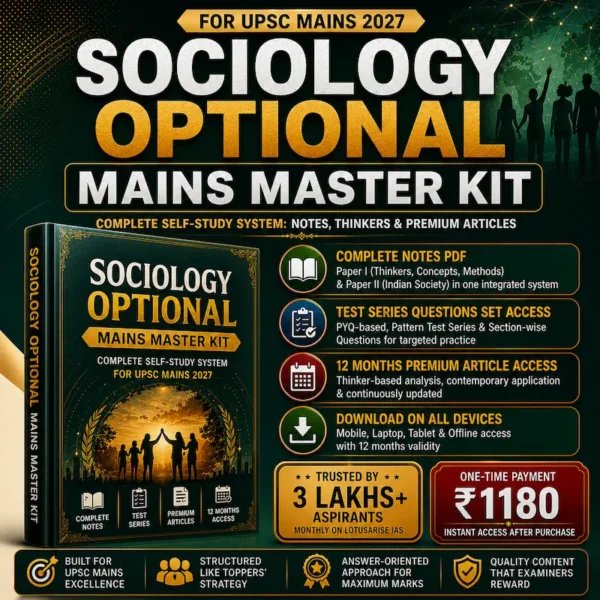
Topic-wise notes for this unit in syllabus order. Read a topic, then open its previous year questions below.
Free notes
Free practice
Previous year questions: Politics and Society in India
Every question UPSC has asked from this unit, year-wise, with a link to its solved answer.
Topic-wise question list
Year-wise question papers
-
UPSC Sociology Optional Question Paper 2026
-
UPSC Sociology Optional Question Paper 2025
-
UPSC Sociology Optional Question Paper 2024
-
UPSC Sociology Optional Question Paper 2023
-
Sociology Optional Question Paper 2010
-
Sociology Optional Question Paper 2011
-
Sociology Optional Question Paper 2012
-
Sociology Optional Question Paper 2013
-
Sociology Optional Question Paper 2014
-
Sociology Optional Question Paper 2015
-
Sociology Optional Question Paper 2016
-
Sociology Optional Question Paper 2017
-
Sociology Optional Question Paper 2018
-
Sociology Optional Question Paper 2019
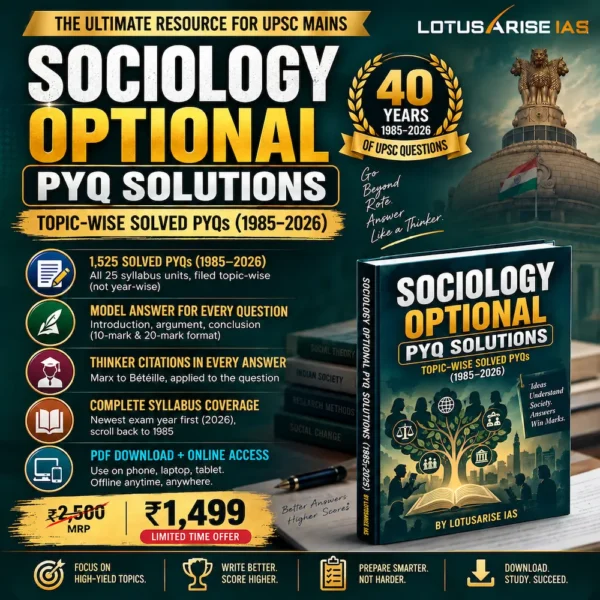
Sociology PYQ Master Pack
Solved PYQ answers: Politics and Society in India
Topic-wise model answers, newest exam year first. Members open the full answer; everyone else sees the question and can join the pack.
PYQ Solutions
-
How does the concept ‘secular’ go beyond any religion in plural society like India? Analyse.
-
Discuss the social bases of political mobilization in Independent India. Has some change occurred in these during the last 60-70 years?
-
What do you mean by nation-building? What is the role of religion in nation-building? Elaborate your answer.
-
In what respects have the constitutional provisions changed the socio-economic and political conditions of Scheduled Castes and Scheduled Tribes in India? Critically examine.
-
What are pressure groups? Discuss their role in decision-making in democracy.
-
What do you understand by decentralisation of power? What is its role in strengthening the roots of democracy in India? Elaborate.
-
How do you account for the increasing significance of religion in public and personal spheres in the context of secularization thesis in India? Explain.
-
Analyse the sociological interconnections between Social Media and Mass Mobilization in India.
-
Discuss the role of pressure groups in strengthening democracy.
-
Examine different understandings of secularisation in India.
-
Bring out the various issues involved in Dalit movements in India.
-
Does regionalism essentially lead to decentralization of power? Substantiate your answer with relevant examples.
-
Is social democracy a precondition for political democracy? Comment.
-
‘Secularism was an outcome of 20th century humanistic radicalism.’ Comment on this statement.
-
Analyze the issues related to the citizenship in contemporary India. Give suitable illustrations.
-
What do you understand by democratic federalism? How does it promote decentralization of power in India?
-
Comment on the changing democratic profile of India.
-
Discuss the implications of ‘Swachha Bharat Abhiyan’. Do you think that civil society has a role to play here? Substantiate your answer with examples.
-
Media is the fourth pillar of democracy. Discuss,
-
Elaborate various forms of Dalit assertions in contemporary India? What are its implications on the Indian political system?
-
With increase in education and economic development is Indian society becoming more secular?
-
Explain the concepts of ‘dominant caste’ and ‘vote bank’, giving examples from specific regions.
-
Give an account of the problems relating to the ‘creamy layer’.
-
To what extent does nation building depend on strengthening of pluralities in Indian society.
-
Comment on the increasing significance of caste in politics.
-
Write short notes with a sociological perspective on the following in about 150 words : Gandhi’s efforts on communal harmony.
-
Who are the elites ? Discuss their roles in bringing social transformation.
-
Write short note with a sociological perspective on the following : Regional political elites and the democratic process.
-
Critically examine the concepts of nation and citizenship in the context of globalization.
-
‘Protective discrimination not only protects but also discriminates.’ Comment.
-
Distinguish between ‘secularism’ and ‘secularisation’. Analyse the nature and extent of secularisation in contemporary India.
-
Write short note on Factors responsible for increasing demands for the formation of separate states.
-
Identify the reasons for the resilience of democratic system in India.
-
Write short note on New rural elite and leadership.
-
Write short note : Regionalism.
-
Discuss the social base of political parties in India. What has been its impact on Indian democracy ?
-
Write short note : Pluralism and national unity.
-
‘The 73rd and the 74th constitutional amendments have motivated social mobilisation in rural India.’ – Discuss.
-
Differentiate between pressure groups and interest groups. Describe the role of some prominent pressure groups in contemporary Indian politics.
-
Write short note : Reservation and Panchayat Raj institutions.
-
Elaborate the concept of political elite. Explain how social structural origins of political elites influence their political orientations.
-
What is meant by democratic decentralization? Assess the working of Panchayati Raj in India.
-
What have been the functions of democracy in India ? Has democracy been successful in eliminating some of the traditional social inequalities ?
-
Discuss 73rd and 74th Constitutional Amendments with reference to decentralization of power.
-
Write short note : National Unity.
-
Write short note : Implications of emergence of regional political parties.
-
Describe the socio-cultural background of the political elites of contemporary India. What has been the influence of the background on their political orientations?
-
Describe the traditional power structure in rural India. Discuss the factors that have contributed to its changing pattern in recent years.
-
Write short note : Role of pressure groups in Indian politics.
-
Write short note : Changing social origins of political elites in India.
-
It is often alleged that the social situation in India is not conducive to the efficient functioning of a democratic polity. Comment.
-
Write short note : Decentralisation of power and local development.
-
Evaluate the role of state in social and economic reconstruction of Indian Society since Independence.
-
Write short note : Panchayati Raj and rural leadership.
-
Discuss the executive measures and peoples’ participation in implementing various development programmes at the village level in India.
-
Explain how emerging rural-urban nexuses are reshaping the character of Indian political elite and functioning of political institutions.
-
Is legitimacy of key political institutions declining in India ? Discuss this issue in the context of the process of nation-building.
-
Write short note : Social responsibility of political elites.
-
Write short note : Electoral Reform in India.
-
Write short note : Democratic Decentralisation.
-
Write short note : The emerging pattern of rural leadership.
-
Write short note : Protective discrimination : its sociology and politics.
Premium content · how to get access
These solutions are part of the Sociology Optional PYQ Solutions pack.
Every solved answer below opens with one enrolment. One-time payment, no subscription.
- Topic-wise solved PYQs with thinker citations and examiner insights
- Model structures you can reuse in the exam
- Access on phone, laptop or tablet
Full pack
₹1,499 ₹2,500 40% off
One-time payment · instant access · UPI, cards, RuPay