Sociology Optional · Paper II · Social Structure
Caste System Notes · PYQs · Solved Answers
Free notes, every previous year question and the solved answers for Caste System (Paper II, Social Structure), arranged so you can read a topic and immediately see how UPSC has asked it. Syllabus: Perspectives on caste (Ghurye, Srinivas, Dumont, Beteille); features of the caste system; untouchability.
88
Solved answers
1984–2026
Years covered
88
Questions listed
3
Free notes
On this page
Free notes Previous year questions Solved answers All Sociology Optional units
Paper II · Unit 02
Caste System notes
Topic-wise notes for this unit in syllabus order. Read a topic, then open its previous year questions below.
Free notes
Free practice
Previous year questions: Caste System
Every question UPSC has asked from this unit, year-wise, with a link to its solved answer.
Topic-wise question list
Year-wise question papers
-
UPSC Sociology Optional Question Paper 2026
-
UPSC Sociology Optional Question Paper 2025
-
UPSC Sociology Optional Question Paper 2024
-
UPSC Sociology Optional Question Paper 2023
-
Sociology Optional Question Paper 2010
-
Sociology Optional Question Paper 2011
-
Sociology Optional Question Paper 2012
-
Sociology Optional Question Paper 2013
-
Sociology Optional Question Paper 2014
-
Sociology Optional Question Paper 2015
-
Sociology Optional Question Paper 2016
-
Sociology Optional Question Paper 2017
-
Sociology Optional Question Paper 2018
-
Sociology Optional Question Paper 2019
Sociology PYQ Master Pack
Solved PYQ answers: Caste System
Topic-wise model answers, newest exam year first. Members open the full answer; everyone else sees the question and can join the pack.
PYQ Solutions
-
Where would you locate the tribal community in the Varna system of India? Discuss.
-
How do Louis Dumont and André Beteille differ in their approaches in understanding caste system in India? Explain.
-
Which measures would you suggest for preventing caste conflicts in India? Justify your argument.
-
What are the different forms of untouchability still practised in India? Discuss with suitable illustrations.
-
What, according to you, are the factors responsible for the continuance of caste system in India? Explain.
-
Critically examine the concept of Sanskritization with suitable illustrations.
-
Contextualize Louis Dumont’s concept of ‘binary opposition’ with reference to caste system in India.
-
Are Tradition and Modernity antithetical to each other? Comment.
-
In the context of the changing Indian society, how do you view Andre Beteille’s conceptions of harmonic and disharmonic social structures?
-
Explain different forms of untouchability in India.
-
Caste System studies in India have been dominated by the ‘book-view’ initially. How did the entry of ‘field-view’ bring about a balance in the study of Indian caste system? Discuss.
-
What does Dr. B.R Ambedkar mean by the concept of ‘Annihilation of Caste’?
-
Caste-like formations are present in Non-Hindu religious communities as well. Discuss with examples.
-
Is Indian society moving from ‘hierarchy’ towards ‘differentiation’? Illustrate your answer with suitable examples.
-
What are the various forms of untouchability in India? Critically examine.
-
How do you justify Dumont’s deliberate stress on ideology that produced intellectualized account of Indian society?
-
Discuss Whitehead’s contention that caste has potential to displace class and colonial contradiction.
-
Write a note on Ghurye’s conception of caste in India.
-
What do you understand by discrete castes and muddled hierarchies?
-
Has caste system hindered democracy and adult franchise in India? Discuss.
-
Which is more significant, the principle of ‘hierarchy’ or the principle of ‘difference’, in intercaste relations in the present day?
-
How have the struggles against untouchability changed their forms and perspectives from Gandhian to Ambedkarite positions?
-
What are the changes in the cultural and structural aspects of the caste system since independence?
-
How has B.R. Ambedkar identified the features of caste system? How is it different from the mainstream treatment of caste features?
-
Discuss Andre Beteille’s account of the relationship between caste, class and power as a change from symmetrical to asymmetrical One.
-
Write short note with a sociological perspective: Louis Dumont’s perspective on Indian caste system.
-
Write short note with a sociological perspective: How far Gandhi was trusted by the untouchables.
-
Is caste system changing, weakening or disintegrating in India?
-
Write short note with a sociological Perspective: How far Srinivas’s Sanskritization is modernizing force or traditionalizing force in understanding the changes in caste system?
-
Discuss B.R. Ambedkar as a wise democrat.
-
Write short notes with a sociological perspective on the following in about 150 words : Features of caste system.
-
Write some of the important social reforms in India for the removal of untouchability.
-
How do caste and class come together in creating the category of extreme poor?
-
What are the main features of Dr. B.R. Ambedkar’s views on annihilation of caste?
-
Critically evaluate Louis Dumont’s Homo Hierarchicus.
-
What are the features of M.N. Srinivas’ concept of dominant caste? How effective is it in understanding today’s reality?
-
Write short note with a sociological perspective: Perspectives on the study of caste by M.N. Srinivas and Andre Beteille.
-
Analyze the term ‘dalit’ and the evolution of the related concept as a reflection of the changing consciousness and self-assertion of the dalit community.
-
‘Casteism is the modern edition of the caste system.’ Do you agree with this statement? Discuss with arguments.
-
Analyze the changing nexus between caste and tribe.
-
Comment critically on Dumont’s concept of Homo Hierarchicus.
-
Critically assess the forms in which untouchability continues to be practised.
-
Discuss the inter-relationships between caste, class and power.
-
In the context of the caste system, critically examine Louis Dumont’s concept of purity and pollution.
-
Write short note: Concept of Hierarchy in Louis Dumont’s writings
-
Discuss the social factors responsible for the emergence of Dalit consciousness in India. What have been the social consequences of this phenomenon?
-
Write short note: Racial Theories of origin of caste.
-
Write short note: Impact of Muslims on Indian Society.
-
Write short note: Caste among Muslims.
-
Describe the characteristics of dominant caste. Discuss its role in village politics in India.
-
Discuss the Louis Dumont’s concept of purity and pollution. How far these concepts are relevant in explaining the Hindu Caste system.
-
Write short note: Emergence of Dalit Consciousness.
-
Write short note: Caste and Indian Polity.
-
Which means of social mobility were available in the traditional caste system? Describe the form of social mobility in contemporary Indian society.
-
Write short note: Caste among Indian Christians.
-
Write short note: Social Justice.
-
Write short note: Modes of contents of expression of Dalit consciousness.
-
Write short note: Role of caste associations.
-
‘Caste is becoming weaker and stronger at the same time in present day India.’ Discuss the factors responsible for continuity and change.
-
Do you think that caste and democracy are compatible with each other? Discuss with reference to some studies conducted on this issue in India.
-
Write short note: Varna-asrama dharma.
-
Avenues of caste mobility in traditional Indian society
-
Write short note: Equality and social justice.
-
Write short note: Cultural and structural aspect of caste.
-
Caste and occupational mobility
-
Write short note: Ritual purity and pollution in Hindu Society
-
Discuss the changes in the structure of power relationships of various castes at the regional levels.
-
‘Institutionalized inequality in India has its cultural and economic coordinates’. Discuss.
-
Discuss the process of mobility that has taken place in the caste structure in India. In this context, explain the convergence of caste and class.
-
Sociological perspectives of “Right to work” in India
-
Write short note: Purushartha.
-
The organic solidarity of caste has given way to competitive solidarity. Discuss this statement in the context of the processes of fission and fusion in the Caste System.
-
Industrialisation and Caste
-
Is the caste system immobile? Bring out the factors promoting intra-caste and inter-caste mobility.
-
Write short note: Convergence of class and caste.
-
Write short note: The case for a uniform civil code.
-
‘Despite all the fusion and fission that the caste system has undergone through the ages, it has binded to maintain the permanency of it form’. Comment.
-
Write short note: Kula, Vansa and Gotra.
-
Comment on the distinction between ‘hierarchy’ and ‘social stratification.’ Which of the two will be a more appropriate term to describe the caste system and why?
-
Write short note: Caste among the non-Hindu.
-
Write short note: Scheduled caste elites.
-
What is the structural perspective on the caste system? Is it not an oversimplification to describe the system as a hierarchy of statuses based on the opposition of the pure and impure?
-
Describe the main characteristics of the Jajmani system. Do you agree with the view that it is basically an institution of politico-economic dominance and dependence?
-
Discuss the social consequences of economic development in India. Do you share the view that it has increased economic inequality and failed to promote social justice?
-
Examine the role of caste as a pressure-group in contemporary Indian politics.
Premium content · how to get access
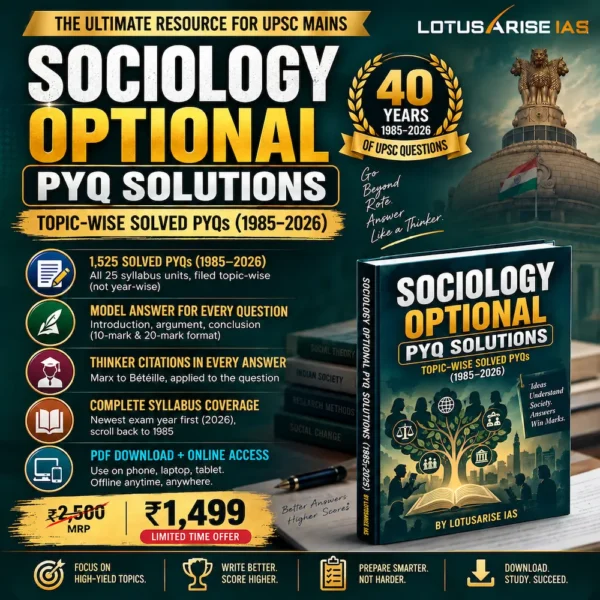
These solutions are part of the Sociology Optional PYQ Solutions pack.
Every solved answer below opens with one enrolment. One-time payment, no subscription.
- Topic-wise solved PYQs with thinker citations and examiner insights
- Model structures you can reuse in the exam
- Access on phone, laptop or tablet
Full pack
₹1,499 ₹2,500 40% off
One-time payment · instant access · UPI, cards, RuPay