Sociology Optional · Paper I · Fundamentals of Sociology
Politics and Society Notes · PYQs · Solved Answers
Free notes, every previous year question and the solved answers for Politics and Society (Paper I, Fundamentals of Sociology), arranged so you can read a topic and immediately see how UPSC has asked it. Syllabus: Theories of power; power elite, bureaucracy, pressure groups, parties; nation, state, citizenship, democracy, civil society, ideology; protest, movements, revolution.
104
Solved answers
1982–2026
Years covered
80
Questions listed
4
Free notes
On this page
Free notes Previous year questions Solved answers All Sociology Optional units
Paper I · Unit 07
Politics and Society notes
Topic-wise notes for this unit in syllabus order. Read a topic, then open its previous year questions below.
Free notes
Free practice
Previous year questions: Politics and Society
Every question UPSC has asked from this unit, year-wise, with a link to its solved answer.
Topic-wise question list
Year-wise question papers
-
UPSC Sociology Optional Question Paper 2026
-
UPSC Sociology Optional Question Paper 2025
-
UPSC Sociology Optional Question Paper 2024
-
UPSC Sociology Optional Question Paper 2023
-
Sociology Optional Question Paper 2010
-
Sociology Optional Question Paper 2011
-
Sociology Optional Question Paper 2012
-
Sociology Optional Question Paper 2013
-
Sociology Optional Question Paper 2014
-
Sociology Optional Question Paper 2015
-
Sociology Optional Question Paper 2016
-
Sociology Optional Question Paper 2017
-
Sociology Optional Question Paper 2018
-
Sociology Optional Question Paper 2019
Sociology PYQ Master Pack
Solved PYQ answers: Politics and Society
Topic-wise model answers, newest exam year first. Members open the full answer; everyone else sees the question and can join the pack.
PYQ Solutions
-
How does Max Weber’s ‘theory of authority’ shape bureaucracy? Analyse.
-
Elaborate major sociological theories of power. How do power elite shape the political process in modern societies?
-
How are the concepts of nation, state and citizenship interrelated in a democracy? Elaborate.
-
Are pressure groups a threat to or a necessary element of democracy? Explain with suitable illustrations.
-
What would you identify as the similarities and differences in the elite theories of Mosca, Michels and Pareto? Discuss their main/crucial issues.
-
How do ‘Civil Society Organisations’ such as ‘NGOs’ and ‘Self-Help Groups’ contribute to grassroots-level social changes? Discuss.
-
How is ‘power’ different from ‘authority’? Discuss various types of authorities as theorized by Max Weber.
-
Democracy needs a vibrant culture of civil society in order to strengthen its foundation of citizenship. Comment.
-
Underline the role of social media in contemporary social movements and describe its challenges.
-
Is Weber’s idea of bureaucracy a product of the historical experiences of Europe? Comment.
-
What, according to Robert Michels, is the iron law of oligarchy? Do lions and foxes in Vilfredo Pareto’s theory essentially differ from each other? Substantiate.
-
How is civil society useful in deepening the roots of democracy?
-
Do you think that the social media has brought significant changes in the forms of protest? Argue your case.
-
Analyse the nature of transition from ideology to identity politics in India.
-
Discuss how ‘environmentalism’ can be explained with new social movements approach.
-
Illustrate with examples the role of pressure groups in the formulation of social policies.
-
Highlight the roles and functions of civil society in a democratic system.
-
Critically examine the relevance of Vilfredo Pareto’s theory of Circulation of Elites in the present scenario.
-
According to Mills, “Elites rule in institutional terms rather than psychological terms.” Comment.
-
Explain democracy as an order of society. What are the factors preventing people’s participation in politics?
-
What are the theoretical models of societal power? Which one of them is most applicable in advanced industrial societies?
-
Discuss the concept of circulation of elite.
-
What is civil society? Present a note on civil society engagement with science and technology policy in India.
-
How is terrorism a new form of asymmetrical warfare? What are some of the challenges in trying to win the war on terrorism?
-
What, according to Pareto, are the basic characteristics of elites? Discuss.
-
Discuss the changing interface between state and civil society in post-independent India.
-
Examine the dynamics of pressure groups in multi-party political system.
-
Discuss the importance of ‘power elite’ in democracy.
-
“Ideology is crucial for social transformation in a democracy.” Discuss.
-
Explain the conditions under which a collective action transforms into a social movement.
-
Caste ideology appears to have strengthened democracy. Comment.
-
“Globalization involves deterritorialization.” Examine with reference to the nation-state.
-
Discuss T. H. Marshall’s views on citizenship.
-
Distinguish between Political Parties and Pressure Groups.
-
“Power is not a zero-sum game”. Discuss with reference to Weber’s and Parsons’s views.
-
Examine the role of pressure groups in parliamentary democracy.
-
Evaluate how civil society and democracy mutually reinforce each other.
-
Critically examine the role of civil society in democracy.
-
Write short note on the following from a sociological perspective: Citizenship and Civil Society
-
Are social movements always influenced by ideologies? Discuss.
-
What do you understand by nation? Is the nation same as the state? Discuss.
-
Write short note on Power Elite from a sociological perspective.
-
Highlight prerequisites of social movement. Bring out the difference between social movement and revolution.
-
“Collective action in politics can bring integration and disintegration in society.” Comment.
-
Explain the concept of Participatory Democracy. What conditions are assumed to be conducive to participation?
-
Write short note on Identity Politics.
-
List the sources of power and explain the various indicators based on which power can be measured.
-
Write short note: Social movement as an expression of protest.
-
Explain the meaning and modes of political participation. What are the factors preventing people’s participation in politics in India?
-
Discuss modes of political participation and voting behaviour in India.
-
Write short note: Power elite in society and the emergence of new elite in power structure
-
Write short note: Authority and Legitimacy.
-
Write short note: Bureaucracy in New Capitalist Economy.
-
Write short note: Social Structure and Political Participation.
-
Write short note: Community Power.
-
Write short note: Informal structure of Bureaucracy.
-
Write short note: Sources of legitimacy of power.
-
Write short note: Role of pressure groups in democracy.
-
Impact of the democratic political system on the traditional social structure.
-
Explain the concept of power. Distinguish between power and authority.
-
Discuss the meaning and role of voluntary organizations in the efforts of transformation of society through state-action.
-
Write short note: Social disorganization.
-
Evaluate the functioning of political parties in the democracies of the Third World.
-
Write short note: Dysfunctions of bureaucracy.
-
Write short note: Merits and demerits of secret ballot in democracy.
-
What role can the power of unorganised masses play in bringing about social change in a democratic society?
-
Write short note: Bureaucracy and economic development.
-
Write short note: Formal and Informal Structure of Bureaucracy.
-
Write short note: Power of the Elite.
-
What do you understand by community power structure? Discuss the major changes in recent times in the pattern of the distribution of power in Indian society.
-
Critically examine the statement, ‘A study of power inevitably involves an investigation of social class’.
-
Write short note: Authoritarian Personality.
-
Write short note: Legitimacy.
-
Write short note: Bureaucracy in developing societies.
-
Write short note: Power.
-
Explain the role of community power structure in the political decision-making processes in the society. Are power and authority getting broad based in India today?
-
Write short note: Power of the elite and the masses in democratic societies.
-
Write short note: Pressure groups and economic development.
Premium content · how to get access
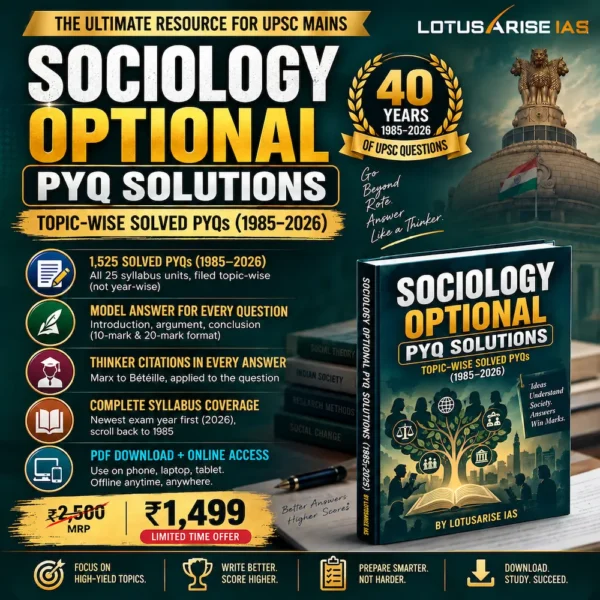
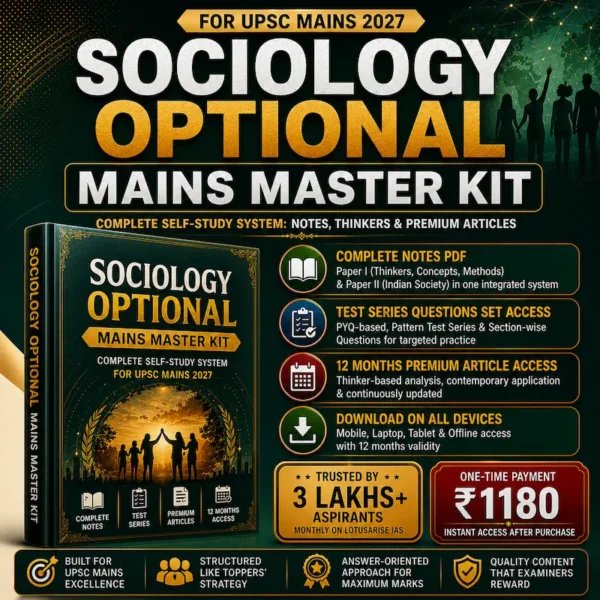
These solutions are part of the Sociology Optional PYQ Solutions pack.
Every solved answer below opens with one enrolment. One-time payment, no subscription.
- Topic-wise solved PYQs with thinker citations and examiner insights
- Model structures you can reuse in the exam
- Access on phone, laptop or tablet
Full pack
₹1,499 ₹2,500 40% off
One-time payment · instant access · UPI, cards, RuPay