Sociology Optional · Paper II · Social Changes in India
Rural and Agrarian Transformation in India Notes · PYQs · Solved Answers
Free notes, every previous year question and the solved answers for Rural and Agrarian Transformation in India (Paper II, Social Changes in India), arranged so you can read a topic and immediately see how UPSC has asked it. Syllabus: Programmes of rural development, Green Revolution, changing modes of production, rural labour, bondage, migration.
47
Solved answers
1984–2026
Years covered
44
Questions listed
4
Free notes
On this page
Free notes Previous year questions Solved answers All Sociology Optional units
Paper II · Unit 02
Rural and Agrarian Transformation in India notes
Topic-wise notes for this unit in syllabus order. Read a topic, then open its previous year questions below.
Free notes
Free practice
Previous year questions: Rural and Agrarian Transformation in India
Every question UPSC has asked from this unit, year-wise, with a link to its solved answer.
Topic-wise question list
Year-wise question papers
-
UPSC Sociology Optional Question Paper 2026
-
UPSC Sociology Optional Question Paper 2025
-
UPSC Sociology Optional Question Paper 2024
-
UPSC Sociology Optional Question Paper 2023
-
Sociology Optional Question Paper 2010
-
Sociology Optional Question Paper 2011
-
Sociology Optional Question Paper 2012
-
Sociology Optional Question Paper 2013
-
Sociology Optional Question Paper 2014
-
Sociology Optional Question Paper 2015
-
Sociology Optional Question Paper 2016
-
Sociology Optional Question Paper 2017
-
Sociology Optional Question Paper 2018
-
Sociology Optional Question Paper 2019
Sociology PYQ Master Pack
Solved PYQ answers: Rural and Agrarian Transformation in India
Topic-wise model answers, newest exam year first. Members open the full answer; everyone else sees the question and can join the pack.
PYQ Solutions
-
Despite the efforts of the government, bonded labour still continues in India. Discuss.
-
Discuss the challenges faced by the cooperative movements in India. Suggest measures to strengthen the movement at the grass-roots level.
-
What is ‘reverse migration’? Discuss its features, causes and consequences in India.
-
Critique the victory narratives of Green Revolution in the context of Indian society.
-
Explain how land reforms brought about desired agrarian transformation.
-
What role do co-operatives play in poverty alleviation in rural India?
-
What are the sociological reasons and implication of “reverse migration” during the recent pandemic in the India.
-
Comment on the role of co-operatives in rural development.
-
Discuss the dynamics of ‘migrant workers’ in India in the context of Corona pandemic.
-
Point out the benefits of ‘green chemistry’ for agrarian transformation in India.
-
Do you think MSP (Minimum Support Price) Scheme for agricultural produce can help in rural development? Elaborate your response with suitable examples.
-
Discuss the challenges in implementing the Rural Development Programs in India.
-
Highlight the main features of the ‘Inter-linking of Rivers’ project in India. What could be its probable advantages to Indian agriculture?
-
How do the recommendations of Swaminathan Commission (2004-2006) ensure food and nutrition security for the Indian masses?
-
Has ‘Green Revolution’ led to the formation of new power elite in rural India? Elaborate your answer.
-
Write a short note on ‘changing means of production and increased rural poverty.’
-
Write short notes with a sociological perspective: Mahatma Gandhi National Rural Employment Guarantee Scheme for rural development.
-
Write a note on the uneven impact of ‘Green Revolution’ on rural society.
-
Bring out the impact of the declining significance of the agrarian economy.
-
Write short note with a sociological perspective: Green Revolution. (150 words)
-
Write short note on the following with a sociological perspective: Changing rural power structure.
-
Bring out some positive and negative social consequences of green revolution. How has green revolution changed the rural social structure?
-
Write short note on the following in not more than 150 words. Your answer should have a sociological perspective: Impact of Green Revolution on rural class structure.
-
Comment on the factors responsible for the growth and consolidation of middle level peasantry in rural India. How is it related to capitalism in Indian agriculture?
-
Write short note on Possibilities of slum reform.
-
Describe the salient features of the poverty alleviation programmes. What modifications would you suggest to make them more effective?
-
Write short note : Strategies of rural development.
-
Outline the factors responsible for unrest in agrarian communities of India. What suggestions will you give to arrest this trend?
-
Write short note : Social consequences of green revolution.
-
Write short note : Poverty alleviation programmes.
-
Critically evaluate the child welfare programmes in India. Have they benefited all sections of children in India.
-
What do you mean by ‘Green Revolution’ and what are its socio-economic consequences? Discuss.
-
How far did the Community Development Projects help in realising the goals of planned change? Examine critically
-
Write short note : Faction in rural life.
-
“Poverty breeds poverty in rural India.” Evaluate Integrated Rural Development Programme in the light of this statement.
-
Write short note : Rural credit and its bearing on poverty.
-
Write short note : TRYSEM – as a measure for rural development.
-
Write short note : Bonded-labour.
-
Write short note : Political power and rural development in India.
-
Write short note : Green Revolution and Social Tensions.
-
Write short note : Grass root Planning.
-
Write short note : Integrated Rural Development Programme.
-
Write short note : Reaching development to the rural poor.
-
Stress the importance of regional development in the context of national planning in India. Can regional disparities be reduced within the framework of a centralist planning?
-
Write short note : Planning for the rural poor: IRDP and NREP.
-
Write short note : The social background of poverty.
Premium content · how to get access
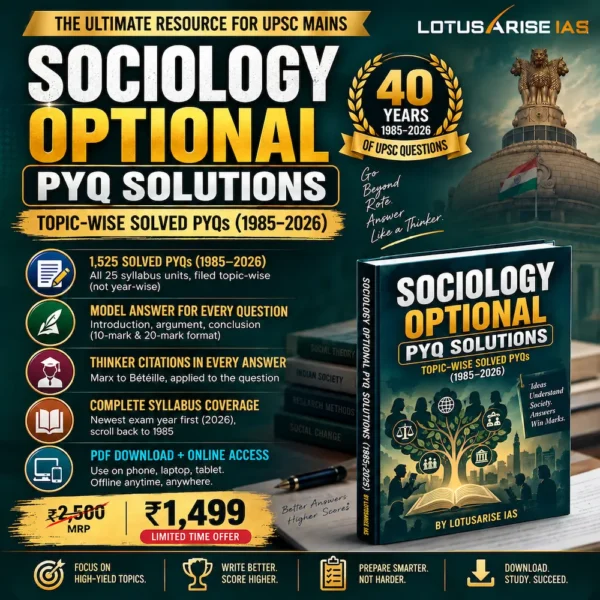
These solutions are part of the Sociology Optional PYQ Solutions pack.
Every solved answer below opens with one enrolment. One-time payment, no subscription.
- Topic-wise solved PYQs with thinker citations and examiner insights
- Model structures you can reuse in the exam
- Access on phone, laptop or tablet
Full pack
₹1,499 ₹2,500 40% off
One-time payment · instant access · UPI, cards, RuPay