- Like fertility, mortality is another major component of population change, and this section deals with the concept, measurement, trends and patterns of mortality both at the global level and in India, highlighting its significance in shaping population dynamics.
- The term mortality is derived from the Latin root “mortis” meaning death, and it can be simply understood as the occurrence of death in a population; according to the United Nations (UN) and the World Health Organisation (WHO), death is defined as the permanent disappearance of all evidence of life after birth, i.e., the post-natal cessation of vital functions without the possibility of resuscitation.
- A crucial clarification in demographic studies is that death is considered only after a live birth, and therefore, the interval between birth and death constitutes life, while events such as abortions and stillbirths are not classified as deaths but as foetal deaths, ensuring conceptual clarity in mortality measurement.
- Significance and Role of Mortality in Population Dynamics:
- The study of mortality focuses on the impact of death on population size, structure, and growth, and historically, mortality has played a dominant role in determining population growth patterns, particularly before the onset of modern demographic transition.
- The rapid population growth in European countries during the Industrial Revolution (18th–19th century) was largely the result of a decline in death rates due to improvements in food supply, sanitation, and medical advancements, and similarly, developing countries experienced significant population growth in the late 20th century due to declining mortality levels.
- Mortality as an Indicator of Development:
- The level of mortality, particularly during early childhood (infant and under-five mortality), is regarded as one of the most reliable indicators of socio-economic development, as it reflects the quality of healthcare, nutrition, sanitation, and overall living conditions in a society.
- Recognising this, the international community has consistently set targets for mortality reduction, beginning with the World Summit for Children (1990), which aimed to reduce under-five mortality by one-third (or below 70 per 1000 live births) between 1990 and 2000, followed by the International Conference on Population and Development (ICPD), 1994, which further emphasised long-term mortality reduction goals.
- The Millennium Development Goals (MDGs), adopted in 2000, included a specific target under Goal 4 to reduce under-five mortality by two-thirds between 1990 and 2015, thereby institutionalising mortality reduction within the global development agenda.
- Subsequently, under the Sustainable Development Goals (SDGs), particularly Goal 3 (Good Health and Well-being), the focus has expanded to include ending preventable deaths of newborns and children under 5 years by 2030, with specific targets such as reducing neonatal mortality to at least 12 per 1,000 live births and under-five mortality to at least 25 per 1,000 live births, along with reducing the maternal mortality ratio (MMR) to less than 70 per 100,000 live births.
Measurements of Mortality

- Mortality analysis begins with the availability of reliable and good quality data on deaths, which are primarily obtained from sources such as the population census, vital registration systems, health surveys, and hospital records, and in the Indian context, important sources include the decennial Census, National Family Health Survey (NFHS), Sample Registration System (SRS), and Medical Certification of Cause of Death (MCCD), all of which help in generating comparable and meaningful mortality indicators across regions and populations.
(i) Crude Death Rate (CDR)
- The Crude Death Rate (CDR) is the most commonly used and simplest measure of mortality, defined as the number of deaths in a given year divided by the mid-year population, and it is generally expressed per 1000 population, thereby providing a basic measure of the overall mortality level in a region.
- The formula for CDR is:
CDR = (D / P) × 1000, where D represents the total number of deaths and P represents the total mid-year population. - Although CDR is easy to calculate and requires minimal data, it is considered a crude indicator because it does not account for age and sex composition of the population, and therefore, it may not accurately reflect mortality differences between populations with different demographic structures, making it less suitable for inter-regional comparisons.
(ii) Age-Specific Death Rate (ASDR)
- The Age-Specific Death Rate (ASDR) provides a more refined measure of mortality, as it considers age-wise variations in death rates, recognising that probability of death differs significantly across age groups.
- The formula for ASDR is:
ASDR = (Dₓ / Pₓ) × 1000, where Dₓ denotes deaths in a specific age group and Pₓ denotes the population of that age group. - ASDR can also be calculated separately for males and females, and when plotted graphically, age-specific mortality typically shows a U-shaped curve, indicating high mortality in infancy and old age, and relatively low mortality in the working-age population.
(iii) Infant Mortality Rate (IMR)
- The Infant Mortality Rate (IMR) is regarded as one of the most sensitive indicators of socio-economic development and public health conditions, and has been described as the “most sensitive barometer of the social environment” (Lewis Mumford).
- IMR is defined as the number of deaths of infants below one year of age per 1000 live births in a given year, and is calculated as:
IMR = (D₀ / B) × 1000, where D₀ represents infant deaths (below age 1) and B represents total live births. - Despite improvements in medical science and living standards, IMR remains relatively high in many developing countries, often exceeding mortality rates of other age groups, reflecting deficiencies in maternal care, nutrition, and healthcare services.
- Infant mortality is further classified into neonatal mortality (deaths within first 28 days) and post-neonatal mortality (deaths between 28 days and 1 year), both of which provide deeper insights into healthcare quality and environmental conditions.
(iv) Still Birth Ratio (SBR)
- The Still Birth Ratio (SBR) is an important measure of foetal mortality, even though still births are not included in conventional mortality statistics.
- It is defined as the number of still births per 1000 live births, and is calculated as:
SBR = (SB / B) × 1000, where SB denotes number of still births and B denotes number of live births.
(v) Maternal Mortality Ratio/Rate (MMR/MMRate)
- Maternal mortality refers to the death of a woman due to pregnancy-related causes during pregnancy or within 42 days of termination, as defined by the World Health Organisation (WHO) and ICD-10, and it reflects the overall status of maternal health services and reproductive care in a region.
- The Maternal Mortality Ratio (MMR) is defined as the number of maternal deaths per 100,000 live births, and is calculated as:
MMR = (MD / B) × 100000, where MD represents maternal deaths and B represents live births, and it is considered a measure of obstetric risk. - The Maternal Mortality Rate (MMRate), on the other hand, is defined as the number of maternal deaths per 1000 women of reproductive age (15–49 years), calculated as:
MMRate = (MD / P_f) × 100000, where P_f represents female population in reproductive age group, and it provides a broader demographic perspective of maternal mortality. - Maternal mortality is essentially a cause-specific mortality indicator, as it is linked specifically to pregnancy and childbirth-related causes.
(vi) Cause-Specific Death Rate (CSDR)
- The Cause-Specific Death Rate (CSDR) measures the mortality attributable to a particular cause, such as diseases (e.g., cancer) or events (e.g., accidents), thereby helping in epidemiological analysis and health planning.
- It is calculated as:
CSDR = (Dₛ / P) × K, where Dₛ represents deaths due to a specific cause, P represents the population at risk (usually mid-year population), and K is a constant (typically 100 or 100,000). - Ideally, the denominator should be person-years at risk, but due to practical constraints, mid-year population is often used, making it a useful but approximate measure.
(vii) Life Expectancy
- Life expectancy (longevity) is a comprehensive measure that reflects the overall mortality conditions of a population, indicating the average number of years a person is expected to live under prevailing mortality conditions.
- It is calculated using life tables, which track a hypothetical cohort of individuals subjected to current age-specific mortality rates, and estimate the number of survivors at different ages.
- For example, life expectancy at birth indicates the average number of years a newborn is expected to live, assuming that current mortality patterns remain constant, and thus serves as a key indicator of development and quality of life.
Trends and Patterns: World and India
- It is beyond doubt that mortality, as measured by various indicators, shows significant regional variations, and among all measures, the Infant Mortality Rate (IMR)—defined as infant deaths per 1000 live births—is widely regarded as the best indicator of socio-economic development.
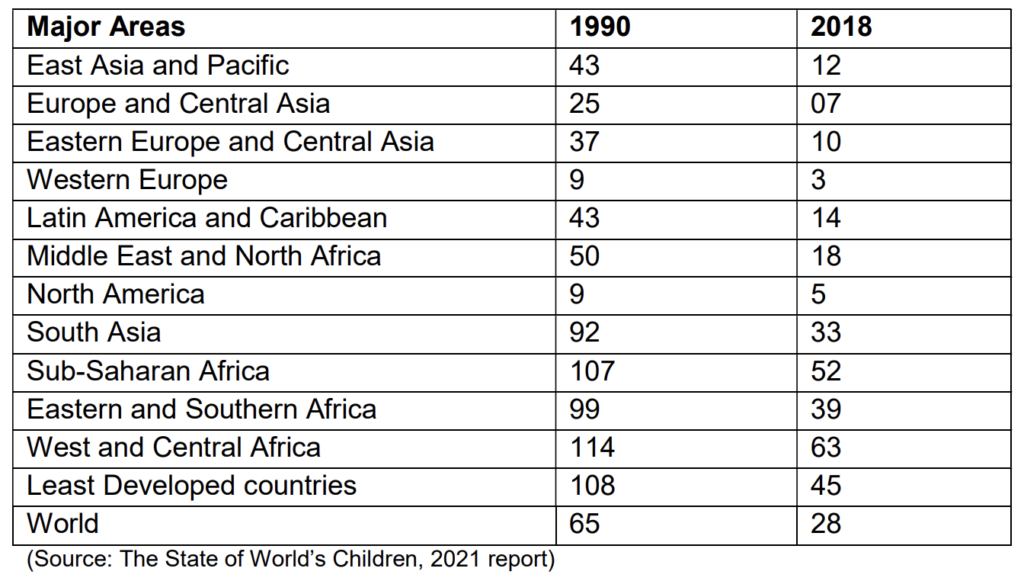
- According to United Nations estimates (The State of World’s Children, 2021), about 4 million infant deaths occurred globally in 2018, accounting for nearly 75% of all under-five deaths, and the global IMR declined from 65 in 1990 to 29 in 2018, though the pace of decline varies considerably across regions.
Global Trends in Infant Mortality
- IMR has declined in all major regions of the world between 1990 and 2018, indicating improvements in healthcare, nutrition, and living standards, but regional disparities remain stark.
- The decline has been most significant in regions like East Asia & Pacific (43 → 12) and Latin America & Caribbean (43 → 14), reflecting rapid socio-economic development and public health interventions.
- Developed regions such as Western Europe (9 → 3) and North America (9 → 5) already had low IMR levels, and have achieved further marginal reductions due to advanced healthcare systems.
- In contrast, Sub-Saharan Africa (107 → 52) and West & Central Africa (114 → 63) continue to record very high IMR, indicating persistent issues of poverty, malnutrition, poor healthcare access, and weak institutional capacity.
- South Asia (92 → 33) has shown considerable improvement, yet continues to have relatively high IMR compared to developed regions, highlighting ongoing developmental challenges.
- The global average IMR declined from 65 to 28, while least developed countries still have an IMR of around 45, reflecting a clear inverse relationship between level of development and infant mortality.
Inter-Country Variations
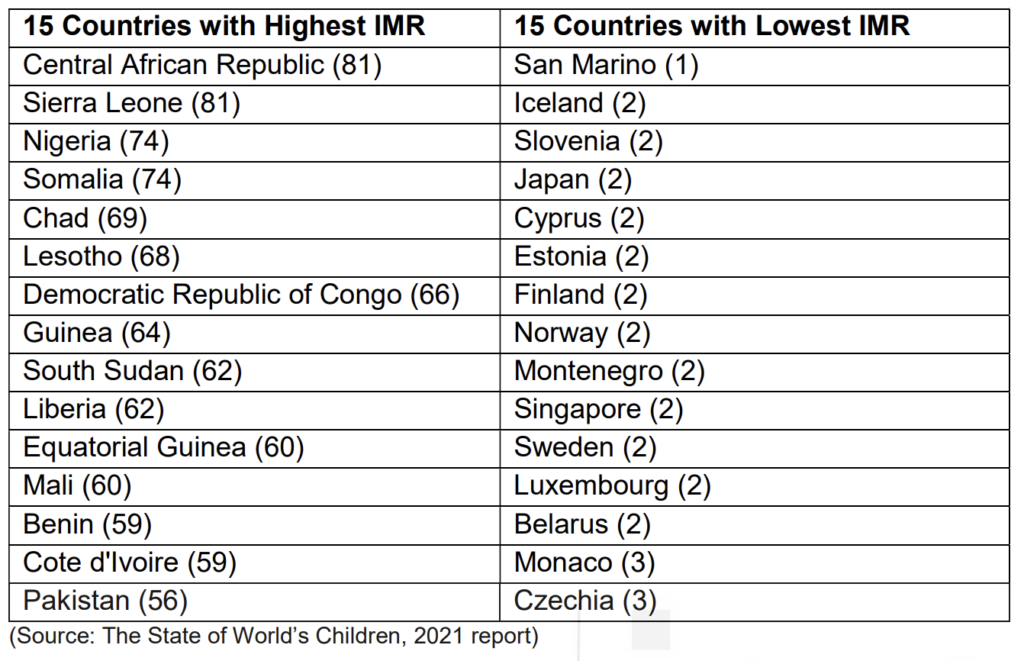
- There exists extreme variation at the country level, with the highest IMR recorded in countries such as Central African Republic (81), Sierra Leone (81), Nigeria (74), and Somalia (74), most of which are located in Africa, indicating structural underdevelopment and fragile health systems.
- In contrast, the lowest IMR is observed in highly developed countries such as San Marino (1), Iceland (2), Japan (2), Singapore (2), and Scandinavian countries like Norway, Sweden, and Finland (2), reflecting high standards of healthcare, nutrition, and social security.
- Among the 15 countries with highest IMR, almost all belong to Africa except Pakistan, which underscores the continental concentration of high infant mortality.
- Overall, the pattern clearly shows that IMR is inversely related to economic development, human development, and quality of life indicators.
India: Trends and Regional Patterns
- India has witnessed a significant decline in IMR over time, with the rate falling from 79 deaths per 1000 live births in 1992–93 (NFHS-1) to 35 in 2020–21 (NFHS-5), indicating substantial improvement in healthcare access, maternal care, and child survival programmes.
- However, national averages conceal wide regional disparities, as IMR varies significantly across states and Union Territories, reflecting uneven socio-economic development and healthcare infrastructure.
State-Level Variations in India (NFHS-5)
- The highest IMR is observed in Uttar Pradesh (50.4), followed by Bihar (46.8), Chhattisgarh (44.2), Madhya Pradesh (41.3), Jharkhand (37.9), and Odisha (36.3), all of which are economically weaker states with relatively poor healthcare indicators.
- The lowest IMR is recorded in Puducherry (2.9), followed by Kerala (4.4), Goa (5.6), Sikkim (11.2), Tamil Nadu (18.6), Arunachal Pradesh (12.9), and Jammu & Kashmir (16.3), indicating better health infrastructure and social development.
- Ladakh records an IMR of 20, while in the majority of other states and UTs, IMR ranges between 20 and 35, suggesting a moderate level of demographic transition.
Key Observations
- The overall trend clearly indicates that infant mortality has declined globally and in India, but the decline is uneven across regions and countries.
- There exists a strong inverse relationship between development and IMR, where higher income, better education, improved healthcare, and stronger institutions lead to lower infant mortality.
- In India, inter-state disparities highlight the need for region-specific health interventions, particularly in high IMR states of the BIMARU region and eastern India.