Biogeographic realms and regions are large-scale geographic areas possessing distinct assemblages of flora and fauna, shaped over millions of years by historical (evolutionary, tectonic) and ecological processes. Understanding them helps explain why similar climates on different continents host completely different sets of species — the core puzzle that founded biogeography as a discipline.
Realms vs. Regions

| Concept | Definition | Basis of Division |
|---|---|---|
| Biogeographic Realm | The broadest divisions of Earth’s land surface, reflecting the deep evolutionary history of organisms within each. | Natural barriers — oceans, deserts, mountain ranges — that have historically restricted species exchange between landmasses. |
| Biogeographic Region | Smaller subdivisions within realms, sharing broadly similar species distribution characteristics. | Finer ecological and distributional similarities within a realm. |
| Bioregion / Ecoregion | Further subdivisions of regions — the most specific units, defined by particular ecosystem types and species assemblages. | Local ecosystem type, climate and habitat structure. |
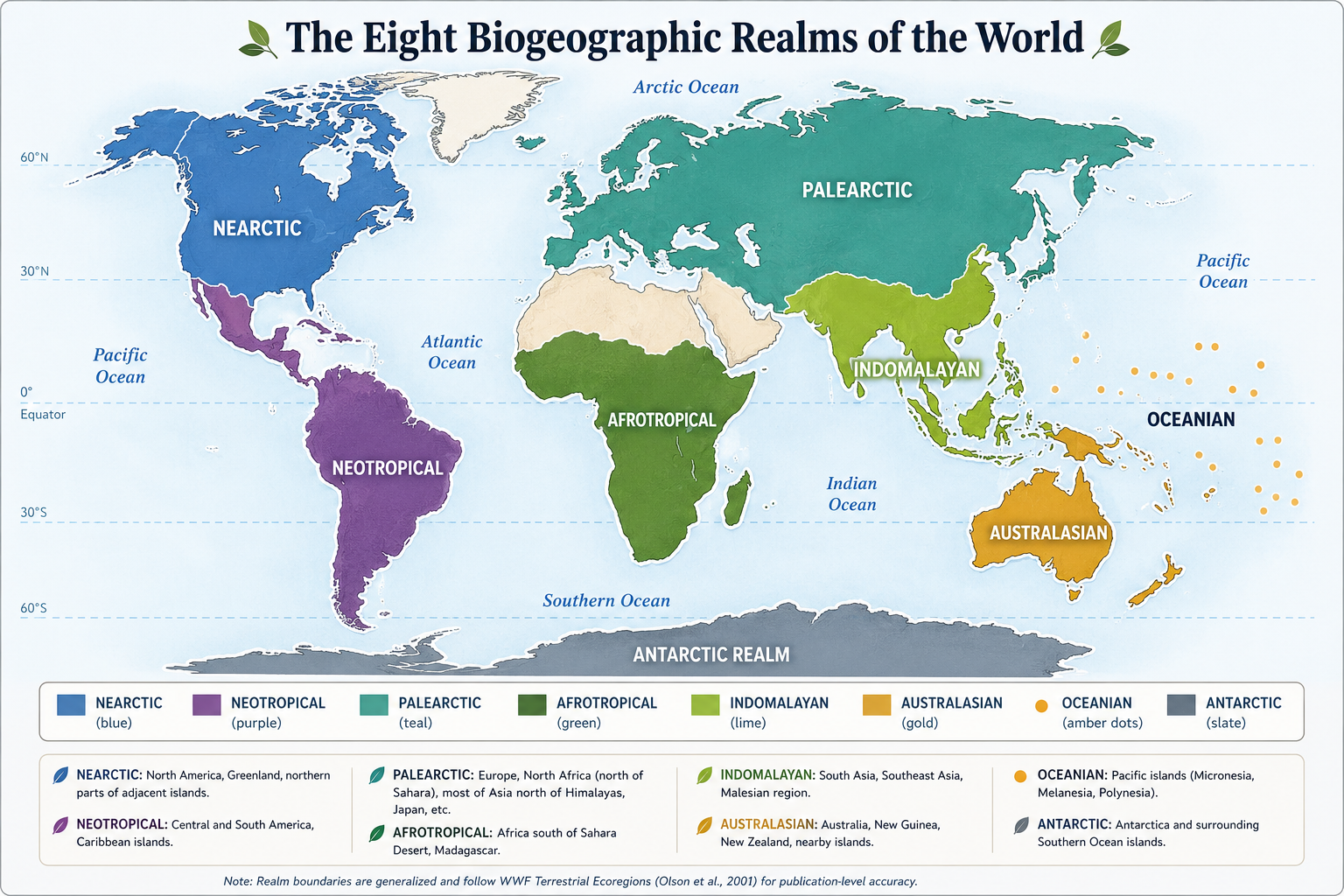
There are eight recognised terrestrial biogeographic realms, first systematically outlined in the tradition of Alfred Russel Wallace’s zoogeographic work (1876), and later refined into the modern realm scheme used in conservation biogeography today.
| # | Realm | One-line Coverage |
|---|---|---|
| 1 | Palearctic | Europe, North Africa, and most of Asia |
| 2 | Nearctic | North America |
| 3 | Neotropical | South and Central America |
| 4 | Afrotropical | Sub-Saharan Africa |
| 5 | Indomalayan | South Asia and Southeast Asia |
| 6 | Australasian | Australia, New Guinea, and neighbouring islands |
| 7 | Oceanian | Islands of the central and South Pacific |
| 8 | Antarctic | Antarctica and sub-Antarctic islands |
The Eight Major Biogeographic Realms
01. Palearctic Realm
Europe · North Africa · most of Asia (north of the Himalayas)
- The Palearctic is the largest of the eight realms, spanning a vast latitudinal and climatic range — from Mediterranean scrublands and North African deserts to the temperate forests of Europe and the boreal taiga and tundra of Siberia. This immense environmental diversity is matched by a correspondingly wide range of habitats and species.
- Its biodiversity has been shaped by a complex evolutionary history involving ancient continental shifts, repeated glacial cycles, and — more recently — extensive human modification of landscapes. The interplay of historical vicariance (splitting of populations by geographic barriers) and dispersal events explains the realm’s varied ecological character.
Key fauna: European bison, Siberian tiger, migratory birds
Key biomes: Boreal forest, tundra, temperate forest, Mediterranean scrub, desert
Defining process: Glaciation-driven range shifts
02. Nearctic Realm
North America · Greenland · Canadian Arctic Archipelago · Mexican highlands
- The Nearctic covers an ecosystem gradient running from Arctic tundra and boreal forest in the north, through temperate deciduous forest, grasslands and deserts, to Mediterranean woodland in the south-west. This range of habitats supports a rich wildlife assemblage.
- Its flora includes extensive coniferous and deciduous forests, prairie grasses, and desert vegetation. Historically, glaciation events were the dominant force shaping species distribution and evolution here, repeatedly compressing and releasing populations as ice sheets advanced and retreated — a pattern later compounded by more recent human activities. The realm plays a crucial role in global biodiversity, offering unique habitats and a wide range of species that contribute to its ecological complexity.
Key fauna: American bison, gray wolf, bald eagle, grizzly bear
Key flora: Coniferous & deciduous forest, prairie grasses, desert vegetation
Location detail: Includes Greenland & Canadian Arctic Archipelago
Relationship: Shares many taxa with Palearctic (jointly termed “Holarctic”)
03. Neotropical Realm
South & Central America · Caribbean islands · southern Mexico
- Renowned for possessing the highest biodiversity of any realm on Earth, the Neotropics host the Amazon — the world’s largest tropical rainforest — alongside the ecologically diverse Andean mountain range. The realm’s complex geography and climatic variation create numerous microhabitats that support this exceptionally high level of biodiversity.
- The Neotropical realm is home to a vast array of flora and fauna, including iconic species like jaguars, sloths and macaws, and an enormous variety of plants, many of which are endemic to the region. It is also significant for its cultural diversity, with many indigenous communities living in harmony with the environment. Conservation efforts here are critical given the scale of threats from deforestation, habitat loss and climate change.
Key fauna: Jaguar, sloth, macaw
Key flora: Enormous plant diversity, high endemism
Key biomes: Amazon rainforest, Andean mountain range
Chief threats: Deforestation, habitat loss, climate change
04. Afrotropical Realm
Sub-Saharan Africa · Madagascar · south-western Arabian Peninsula
- This biogeographic region is characterised by its rich and diverse ecosystems, ranging from savannas and tropical rainforests to deserts and mountainous areas. The Afrotropical realm is home to iconic wildlife such as elephants, lions, rhinoceroses and gorillas, along with a plethora of bird, insect and plant species — many of which are endemic to the region, particularly on the isolated island of Madagascar. The diverse habitats support a high level of biodiversity and complex ecological interactions.
- Sub-Saharan Africa is equally notable for its cultural diversity, with numerous indigenous groups and traditional practices deeply connected to the natural environment — making conservation here as much a socio-economic as an ecological challenge, given threats from habitat destruction, poaching and climate change.
Key fauna: Elephant, lion, rhinoceros, gorilla
Also rich in: Bird, insect & plant species (many endemic)
Key biomes: Savanna, tropical rainforest, desert, mountainous areas
Chief threats: Habitat destruction, poaching, climate change
05. Indomalayan (Oriental) Realm
Indian subcontinent · southern China · Malay Peninsula · Philippines · Indonesian archipelago
- Distinguished by lush tropical rainforests and extensive mangrove ecosystems, the Indomalayan realm is one of the world’s richest in biodiversity, sustaining tigers, elephants, rhinoceroses and numerous primate species, alongside a very high level of endemism — many species here occur nowhere else on Earth.
- The realm’s intricate ecological interactions and complex food webs are increasingly stressed by deforestation, habitat fragmentation and climate change, all of which threaten both biodiversity and the human communities that depend on these forests for their livelihoods.
Key fauna: Tiger, elephant, rhinoceros, numerous primates
Key ecosystems: Tropical rainforest, diverse mangrove ecosystems
Sub-units: Indian Subcontinent, Southeast Asian Forests, Malaysia & Western Indonesia
06. Australasian Realm
Australia · New Guinea · New Zealand · eastern Indonesian archipelago
- This biogeographic region is renowned for its distinctive and highly diverse flora and fauna, much of which evolved in relative isolation. Australia is home to unique marsupials like kangaroos, koalas and wombats, as well as monotreme mammals such as the platypus and echidna — a textbook case of allopatric speciation under prolonged geographic isolation.
- The diverse ecosystems range from the arid outback and vast savannas to lush rainforests and coastal reefs, including the Great Barrier Reef — the world’s largest coral reef system. New Guinea boasts rich tropical rainforests and a high level of endemism, with numerous bird species like the birds of paradise. The region’s isolation has led to significant speciation and the presence of many species not found elsewhere; however, it now faces habitat loss, invasive species and climate change.
Key fauna: Kangaroo, koala, wombat, platypus, echidna, birds of paradise
Key biomes: Arid outback, vast savannas, rainforest, coral reef
Signature ecosystem: Great Barrier Reef
Chief threats: Habitat loss, invasive species, climate change
07. Oceanian Realm
Islands of the central and South Pacific — Polynesia, Micronesia, Melanesia
- Characterised by its vast marine environments and a multitude of isolated islands — each with unique ecosystems — the Oceanian realm’s flora and fauna exhibit a very high degree of endemism due to the islands’ isolation. Notable species include the flightless kagu of New Caledonia, various species of giant fruit bats, and an array of unique plant species like endemic palms and ferns.
- Coral reefs, particularly in places like Fiji and the Solomon Islands, support a rich diversity of marine life, including numerous fish species, corals and other invertebrates. The region’s biodiversity is under threat from habitat destruction, invasive species, overfishing and climate change, which impacts coral reefs and sea levels.
Key fauna: Kagu, giant fruit bats, reef fish, corals, invertebrates
Key flora: Endemic palms and ferns
Key ecosystem: Coral reef systems (Fiji, Solomon Islands)
Chief threats: Habitat destruction, invasive species, overfishing, sea-level rise
08. Antarctic Realm
Continent of Antarctica and surrounding sub-Antarctic islands
- This biogeographic region is characterised by its extreme cold, ice-covered landscape, and unique ecosystems. Despite the harsh conditions, Antarctica supports a range of specialised life forms, including various species of penguins — such as the Emperor and Adélie penguins — seals, and a diversity of seabirds. The surrounding Southern Ocean is rich in marine life, including krill, which form the basis of the food web, supporting whales, seals and seabirds.
- The sub-Antarctic islands, like South Georgia and the South Sandwich Islands, are important breeding grounds for many marine birds and mammals. The Antarctic region is also crucial for scientific research, particularly for studying climate change, given its acute sensitivity to global temperature changes. Conservation efforts here are essential to protect this pristine environment from human impacts such as overfishing and tourism.
Key fauna: Emperor penguin, Adélie penguin, seals, krill, seabirds
Breeding grounds: South Georgia, South Sandwich Islands
Scientific role: Climate change sentinel
Chief threats: Overfishing, tourism, climate change
Comparative Snapshot of the Eight Realms
| Realm | Location | Signature Species | Defining Feature |
|---|---|---|---|
| Palearctic | Europe, N. Africa, most of Asia | Siberian tiger, European bison | Largest realm; glaciation-shaped biodiversity |
| Nearctic | North America | Bison, grizzly bear, bald eagle | Shares Holarctic affinity with Palearctic |
| Neotropical | South & Central America | Jaguar, sloth, macaw | Highest biodiversity of any realm (Amazon) |
| Afrotropical | Sub-Saharan Africa, Madagascar | Elephant, lion, gorilla | Savanna megafauna + Madagascar endemism |
| Indomalayan | South & Southeast Asia | Tiger, Asian elephant, rhinoceros | High endemism; includes India’s biodiversity hotspots |
| Australasian | Australia, New Guinea, NZ | Kangaroo, koala, platypus | Marsupial/monotreme fauna from prolonged isolation |
| Oceanian | Pacific islands | Kagu, giant fruit bats | Island endemism; extreme isolation effect |
| Antarctic | Antarctica, sub-Antarctic islands | Emperor penguin, krill | Extreme-cold specialists; climate sentinel region |


Applications in Biogeography
The study of biogeographic realms and regions is far more than a descriptive exercise in cartography — it is central to understanding the fundamental patterns and processes of biodiversity:
- Understanding endemism: The realm framework explains why certain species are restricted to particular regions and nowhere else — a direct consequence of long-term geographic isolation.
- Tracing speciation: Comparing closely related taxa across realm boundaries reveals how vicariance (barrier-driven separation) and dispersal have jointly produced new species over evolutionary time.
- Revealing historical connections: Similarities in species composition between distant regions (e.g., shared plant families across the former Gondwanaland fragments) offer direct evidence of past continental configurations and plate tectonic history.
- Guiding conservation prioritisation: Realm and region boundaries inform where biodiversity hotspots, protected area networks and reserve design should be concentrated for maximum conservation return.
Illustrative example:
The distinctive marsupial fauna of the Australasian realm — kangaroos, koalas, wombats — is a direct signature of that realm’s prolonged geographic isolation following the break-up of Gondwanaland, standing in sharp contrast to the placental mammal-dominated faunas of every other realm. This single example neatly demonstrates how realm-level biogeography encodes deep evolutionary history within present-day species distributions.