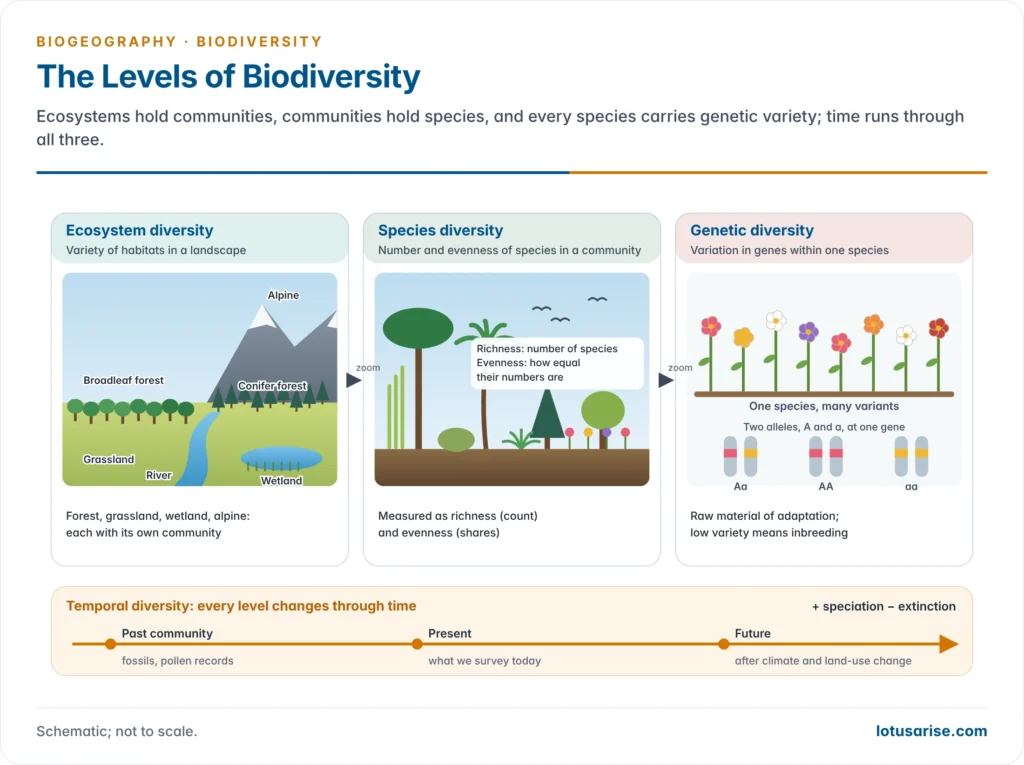
- Biodiversity is the variety of life at every level, from the genes within a species to the species of a region and the ecosystems of a landscape.
- Endemism is the restriction of a taxon to one defined area and nowhere else. It is the main tool for reading the evolutionary history of a region and for setting conservation priorities.
- The two ideas meet in biodiversity hotspots: areas rich in endemic species that have lost most of their natural habitat.
Biodiversity: Concept and Levels

The biosphere as a “biological factory”
- The biosphere works like a vast, self-sustaining biological factory in which countless communities of plants and animals live across an enormous range of environments.
- A biome is a large natural ecological system in which the biotic (living) and abiotic (non-living) conditions are broadly alike: desert, tropical rainforest, tundra or grassland.
- Natural systems vary horizontally (from the equator to the poles) and vertically (from ocean trenches to mountain summits), so a great variety of biomes has emerged, each with its own physical and biological character.
- The number of biomes in a country, and the variety and abundance of species within them, is one of the best indicators of its ecological health. This variety of life forms is biodiversity.
- Biodiversity has underwritten every civilisation. Societies that used nature’s resources wisely endured; those that over-exploited them declined.
- It is a foundational economic resource, not a peripheral curiosity: it supplies medicines, crops and their wild relatives, fibre, timber and industrial raw materials, the basis of sustainable development.
Definitions
- Biological diversity covers three things:
- the differences in genes among individuals of a species;
- the variety and richness of species at local, regional, national and global scales;
- the diversity of ecosystem types, terrestrial and aquatic, in an area.
- The Convention on Biological Diversity (1992), Article 2: “the variability among living organisms from all sources including, inter alia, terrestrial, marine and other aquatic ecosystems and the ecological complexes of which they are part; this includes diversity within species, between species and of ecosystems.”
- Origin of the term: “biological diversity” came into use around 1980. The contraction “biodiversity” was coined by Walter G. Rosen (1985) for the 1986 National Forum on BioDiversity in Washington. Edward O. Wilson popularised it in the forum volume BioDiversity (1988).
Working definitions
- Generic or functional: the diversity of plant and animal species in ecosystems with specific environmental conditions.
- Genetic biodiversity: variation at the level of lineages within plant and animal species.
- Species biodiversity: the type and diversity of species (plants, animals, micro-organisms) in the biological communities of a natural ecosystem.
- Biodiversity hotspot: an area with rich biological communities dominated by endemic species.
- With time included: the variety of genes, species and habitats in a given area or ecosystem, including the variability of organisms over time, since the biological composition of a region keeps changing.
- Within and among species: the diversity of species, together with the genetic heterogeneity within each species, in an area or ecosystem.
- The common thread: biodiversity is never measured at one level alone. It is at once genetic (within species), taxonomic (among species) and spatial-ecological (among ecosystems), with a temporal dimension across all three.
Elements and levels of biodiversity
- Biodiversity is studied at three nested levels; temporal variation cuts across all three.
1. Genetic diversity
- Every individual carries a unique combination of genes, so no two members of a population are identical (identical twins and clones apart).
- Genetic diversity keeps a breeding population healthy. When numbers fall, genetic variety declines and inbreeding sets in, lowering fertility and resistance to disease, which can drive a species towards extinction.
- The Asiatic cheetah in India died out by the mid-20th century. The Gir lion population passed through a narrow genetic bottleneck early in the 20th century and is still genetically uniform.
- Wild species form the gene pool from which crops and domestic animals were bred. Modern breeding still draws on crop wild relatives for yield, drought tolerance and disease resistance; these are stored in gene banks and gene pool centres.
2. Species diversity
- Species diversity is the number of species in a region (species richness) and their relative abundance (evenness), in natural or farmed systems.
- Measuring species diversity: species richness simply counts species. Diversity indices also weigh evenness:
- the Simpson index gives the probability that two individuals picked at random belong to different species;
- the Shannon–Wiener index measures the uncertainty in predicting the species of the next individual, and rises with both richness and evenness.
- A forest of 20 species with one dominant tree is less diverse than one of 20 equally common species, though their richness is the same.
- Undisturbed tropical forests hold far more species than timber plantations. A natural forest also yields many non-wood products (fruit, fuelwood, fodder, fibre, gum, resin, medicine) on which local communities depend.
- Traditional agro-pastoral systems that grow many crops together keep more diversity than modern monocultures.
- About 2.17 million species had been described by 2025. Estimates of the true total run to about 8.7 million eukaryotic species (Camilo Mora and colleagues, 2011), so most remain undiscovered, especially insects, fungi and marine life.
- Megadiverse countries: 17 countries, India among them, hold about 70% of the world’s species (Conservation International, 1998).
- India, with about 2.4% of the world’s land, has about 7–8% of recorded species. Its first complete faunal checklist (2024) lists 1,04,561 animal species.
3. Ecosystem diversity
- Ecosystem diversity is the variety of distinct, interconnected ecological systems in a region: forests, grasslands, deserts, mountains, rivers, lakes and seas, and human-made systems such as cropland and pasture.
- An ecosystem is natural when largely unaffected by people, and modified when converted to farming, settlement or other use.
- Ecosystem degradation: overuse and mismanagement steadily lower an ecosystem’s productivity.
- India, spanning many climatic and physiographic zones, has an extraordinarily diverse set of ecosystems, from Himalayan alpine meadows to Thar dunes, Sundarbans mangroves and Lakshadweep atolls; they are grouped into ten biogeographic zones.
4. Temporal variation
- Temporal variety is the series of phases through which a biological community passes over time.
- Biodiversity in any place must be read against a timeline: what the community was, what it is now and how it is likely to change.
- This directs attention to the continuing processes of speciation (species gain) and extinction (species loss).
Alpha, beta and gamma diversity
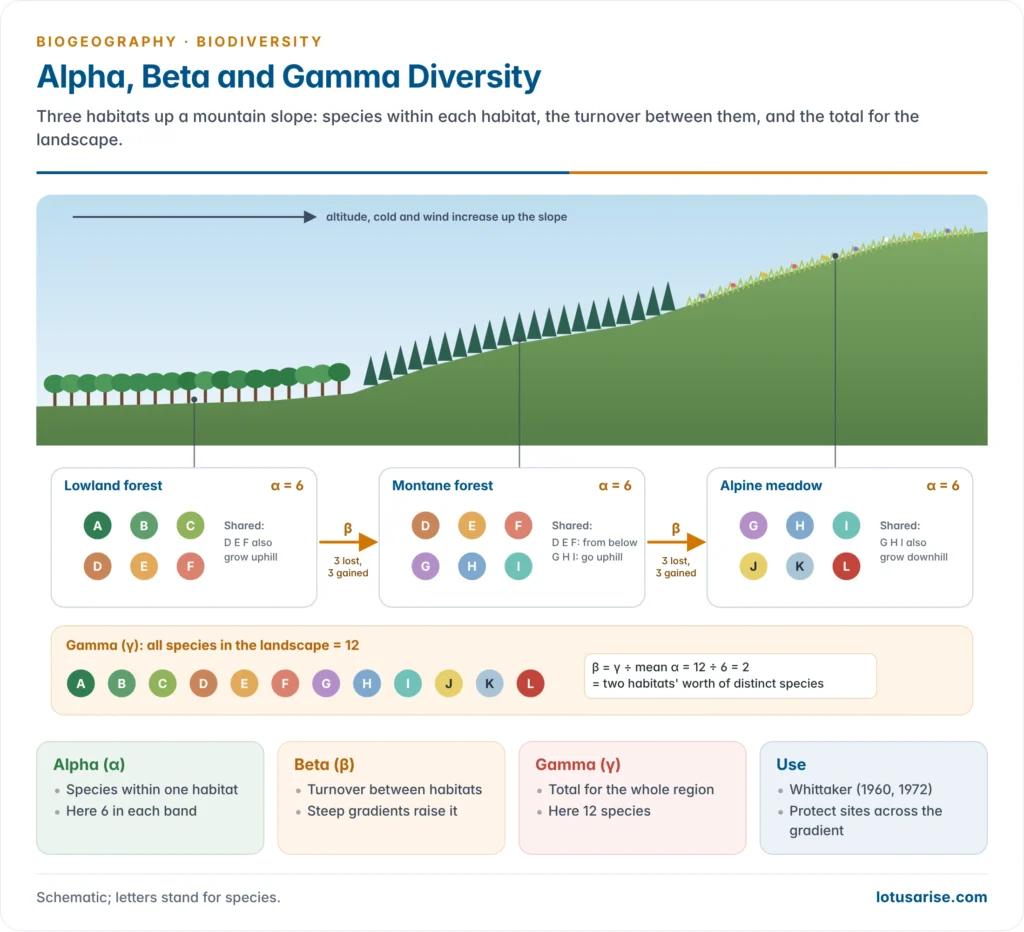
- Robert Harding Whittaker (1960, 1972) divided species diversity by spatial scale into three measures:
- Alpha (α) diversity: species richness within a single community or habitat, for example the species in one patch of forest.
- Beta (β) diversity: the turnover of species between communities along a gradient of altitude, moisture or soil. High beta diversity means neighbouring habitats share few species.
- Gamma (γ) diversity: the total species richness of a whole landscape or region, combining all its habitats.
- Whittaker’s relation: β = γ / ᾱ, where ᾱ is the mean alpha diversity of the habitats. Beta shows how many “distinct communities” the region contains.
- Example: three habitats on a mountain slope with 20, 25 and 15 species have a mean alpha of 20. If together they hold 50 species (gamma), beta = 50 / 20 = 2.5. Had each habitat held the same 20 species, gamma would be 20 and beta only 1.
- Why it matters: a region gains species both by richer habitats (alpha) and by more different habitats (beta).
- The Western Ghats and the Himalaya owe much of their gamma diversity to steep altitudinal and rainfall gradients, which raise beta diversity.
- Conservation needs a network of sites across the gradient, not one large site.
- This three-tier scale is used alongside the genetic–species–ecosystem framework. At the global scale, richness falls from the equator to the poles: the latitudinal diversity gradient.
Types of biodiversity
| Type | What it measures | Key significance |
|---|---|---|
| Genetic diversity | Variation in hereditary information within a species, passed from generation to generation | Basis of speciation and of adaptation under natural selection; often greater where environments are varied, though not in every group |
| Species diversity | Number and relative abundance of species in a region | Supports ecosystem resilience and productivity; higher in undisturbed natural systems than in monocultures |
| Ecosystem diversity | Variety of habitat types and their interacting species | Underpins ecosystem services (water regulation, nutrient cycling, climate moderation); assessed at alpha, beta and gamma scales |
- An ecosystem is a community of biotic components interacting continuously with abiotic components (soil, water, air, sunlight).
- Ecosystems range in scale from the Great Barrier Reef to the microhabitat on the back of a single spider crab’s shell, which carries sponges, algae and worms.
- Diversity must be maintained at all three levels, with their alpha, beta and gamma gradations, to sustain the complexity and resilience of life.
Global pattern and biodiversity hotspots
- Biodiversity is unevenly spread. It is richest in the humid tropics, on tropical mountains, in Mediterranean-climate regions and on old, isolated islands, and in the sea on coral reefs.
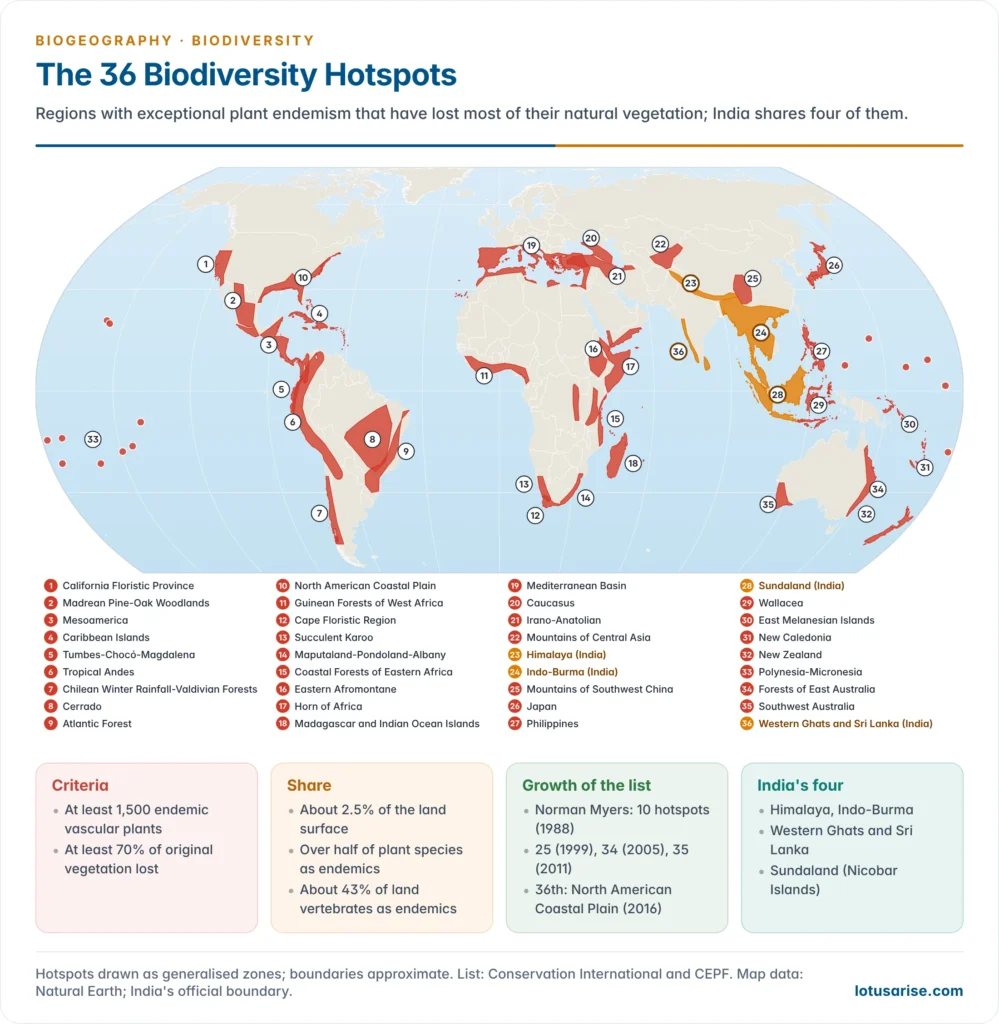
- Norman Myers (1988) identified 10 tropical forest “hotspots”: areas with exceptional plant endemism facing severe habitat loss. Conservation International adopted the idea in 1989.
- Criteria (since 1999): at least 1,500 endemic vascular plant species, and loss of at least 70% of the original natural vegetation.
- Growth of the list: 25 hotspots in 1999, 34 in 2005, 35 with the Forests of East Australia (2011) and 36 with the North American Coastal Plain (2016).
- The 36 hotspots now cover only about 2.5% of the land surface, but hold more than half of all plant species and about 43% of birds, mammals, reptiles and amphibians as endemics.
- India’s four biodiversity hotspots: the Himalaya, Indo-Burma (the North-East), the Western Ghats and Sri Lanka, and Sundaland (the Nicobar Islands).
- The threat: about 1 million plant and animal species face extinction, many within decades (IPBES Global Assessment, 2019). The Kunming–Montreal Global Biodiversity Framework (2022) responds with 23 targets, including protecting 30% of land and sea by 2030, through the conservation measures of each country.
Evolution and genesis of biodiversity
- Life arose about 3.5–3.8 billion years ago; its exact origin is still uncertain.
- The dominant hypothesis holds that organic chemical reactions in the primordial waters produced the first living forms. Alternatives place the origin in muddy ooze or at deep-sea hydrothermal vents, or propose “seeding” from space (panspermia).
- Life diversified progressively, from simple unicellular organisms to complex multicellular plants and animals.
- Evolution is the process by which species change and adapt to their environment.
- Major disruptions, such as climatic and atmospheric upheavals, repeated glaciations, continental drift and new geographical barriers, split once-continuous populations and so created new species over millions of years.
- Most species persist for a few million years. Gradual adaptation and new interactions among co-evolving species (food chains, predation, parasitism, commensalism) bind them into tightly linked communities.
- When a species dies out, it leaves a vacant niche, which surviving lineages diversify to fill (adaptive radiation), as mammals did after the dinosaurs.
Mass extinctions and recovery
- Five mass extinctions have struck in the last 450 million years: end-Ordovician, Late Devonian, end-Permian (the largest, about 252 million years ago), end-Triassic and end-Cretaceous (66 million years ago).
- Each was followed by recovery, but rebuilding diversity took millions of years, because evolution is slow.
- Modern humans (Homo sapiens) appeared only about 300,000 years ago, when the planet held close to its greatest diversity.
- Today’s losses are human-driven, through habitat loss, overexploitation, invasive species, pollution and climate change. Extinction rates are tens to hundreds of times the natural background, so many scientists speak of a sixth mass extinction, with genetic, species and ecosystem diversity all under pressure at once. These human impacts act through fragmentation as much as outright loss.
Endemism
Concept and origin of the term
- Endemism is the condition of a taxon (species, genus or family; plant, animal or micro-organism) being confined to one well-defined geographical area and found nowhere else.
- The area may be a single island, a mountain range, a habitat type, a country or any other bounded zone: an endemic organism has a fixed, single geographic address.
- The term was carried over from medicine into botany by Augustin Pyramus de Candolle (1820), to describe native taxa restricted to one place.
- The opposite is a cosmopolitan distribution: a taxon found across much of the world, such as many weeds, gulls and bacteria.
- Endemism depends on scale. A species can be a local (narrow) endemic of one hill, a regional endemic of the Western Ghats, or a national endemic of India. A taxon that only slightly spills into a neighbouring area is a near-endemic.
- Endemics often evolve specialised traits suited to local conditions. Their narrow range makes them especially vulnerable to habitat loss, climate change and invasive species.
- Examples: the giant panda (mountains of central China), the kiwi (New Zealand), the lion-tailed macaque (Western Ghats).
Types of endemism
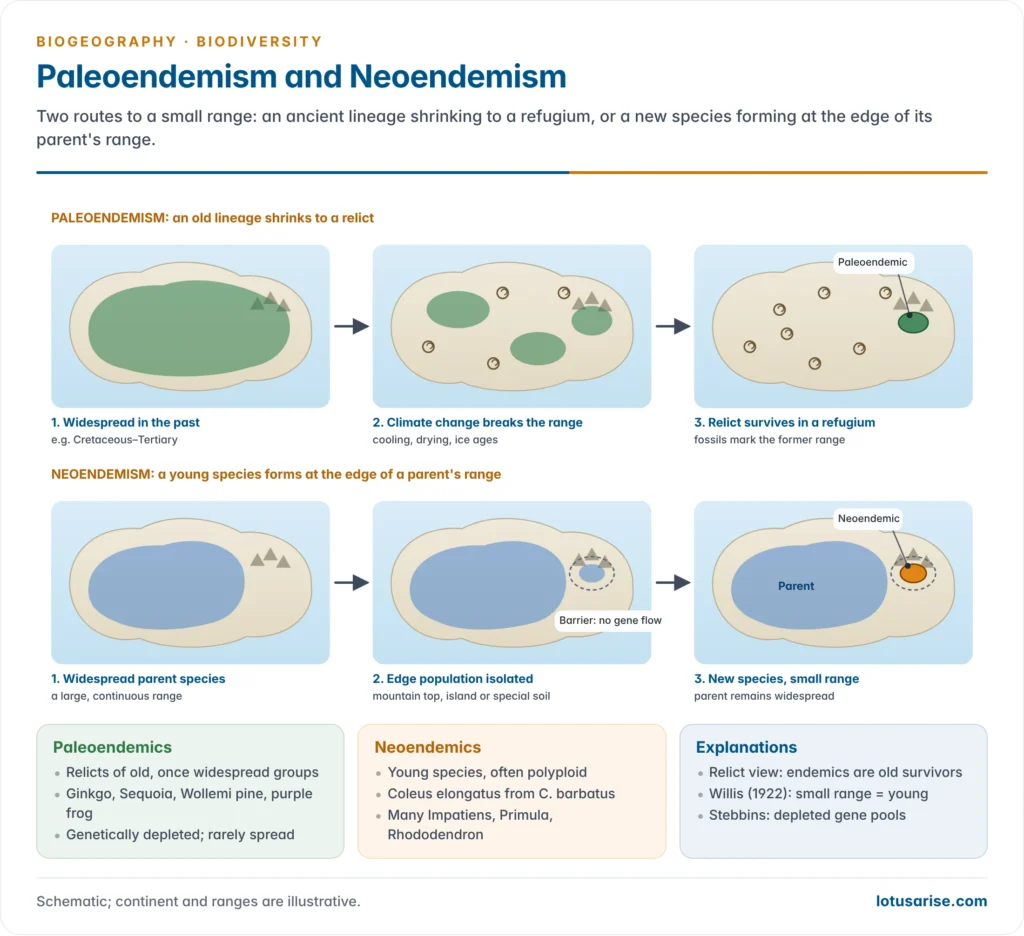
- Endemism is classified into paleoendemism and neoendemism, according to the evolutionary history behind the restricted range.
| Feature | Paleoendemic (“ancient endemic”) | Neoendemic (“new endemic”) |
|---|---|---|
| Origin | Survivor of a once widespread lineage that has died out elsewhere | Newly evolved species, close to a parent taxon, or arising by hybridisation |
| Evidence | Fossils show a former wide range (Ginkgo, Sequoia, Metasequoia, Lyonothamnus) | Common in plants, especially through polyploidy (multiplication of chromosome sets) |
| Distribution | Small “island” patches, remnants of a much larger range | Local, often at the edge of a related species’ wider range |
| Other names | Relicts or “epibiotics”; isolated taxa with many fossil relatives (living fossils) | Grouped by chromosome number into schizo-, patro- and apoendemics |
| Examples | Sequoia sempervirens (coastal California), Sequoiadendron giganteum (Sierra Nevada), the Wollemi pine (Australia), the purple frog (Western Ghats) | Coleus elongatus of Sri Lanka’s Ritigala hills; many Primula, Impatiens and Rhododendron species |
Cytological types of endemics
- Claude Favarger and Jeanne Contandriopoulos (1961) classified endemic plants by comparing their chromosome number (ploidy) with that of their closest widespread relatives:
- Paleoendemics: systematically isolated taxa with no close living relatives.
- Schizoendemics: endemic and related taxa have the same ploidy level. They arose by gradual divergence of a widespread ancestor split into isolated populations.
- Patroendemics: the endemic is the diploid parent of more widespread polyploid relatives, so it is the older group.
- Apoendemics: the endemic is a polyploid derived from a widespread diploid, so it is the younger group.
- Molecular dating has largely replaced this chromosome-based scheme, but the paleo/neo distinction remains in use.
Characteristics of endemic species
- Small ecological amplitude: a narrow tolerance of environmental conditions prevents spread into new areas.
- Limited ability to migrate: many endemics have used up the genetic variability that would let them colonise different conditions, a condition called genetic saturation.
- True (paleo)endemics rarely migrate; neoendemics still can, because they are younger and less genetically fixed.
- Poor dispersal: the seeds or spores of many endemics cannot survive the journey to new areas, or are blocked by barriers such as oceans, mountains and deserts.
Theories explaining endemism
- Two broad schools have competed to explain endemic ranges: endemics as old relicts, or as young species not yet spread.
1. The relict view
- Endemic remnants (“epibiotics”) are the last survivors of a once-thriving flora or fauna now in decline, that is, today’s paleoendemics.
- Example: Sequoia sempervirens of coastal California and Oregon and Sequoiadendron giganteum of the Sierra Nevada are confined to their present habitats, yet fossils show they were far more widespread in the Cretaceous and Tertiary.
- Climatic change, such as Tertiary cooling and the Pleistocene ice ages, shrank their ranges into refugia.
2. Willis’ age-and-area hypothesis
- John Christopher Willis, in Age and Area (1922), argued that most endemics are young species that have not yet had time to spread.
- The area a taxon occupies is proportional to its age: a small range marks a young species, a wide range an old one. Supporters cited genera such as Primula, Impatiens and Rhododendron.
- Example, Coleus of Sri Lanka: two species grow on the summit of the dry Ritigala hills.
- C. elongatus is a strict local endemic; C. barbatus is widespread across tropical Asia and Africa.
- On Willis’ view, the endemic C. elongatus is the younger species, descended from the widespread C. barbatus.
- Criticism: range size also depends on dispersal ability, habitat breadth, competition and barriers. A young species can spread fast, and an old one can shrink to a relict, so area alone is not a reliable measure of age.
3. Stebbins’ genetic and gene pool–niche interaction theories
- G. Ledyard Stebbins (1942) gave a genetic explanation: many endemics have exhausted their genetic variation, a condition called biotype depletion, so they cannot expand even where habitat is available.
- Stebbins (1980) later proposed the gene pool–niche interaction theory. Endemic ranges reflect adaptation to a particular combination of local conditions, among which soil texture and chemistry are very important.
- The population’s own gene pool is equally decisive:
- the total genetic variability present;
- the share of that variability that can be released (expressed) at any one time;
- the variation available in exactly those traits that decide whether a new population can establish itself.
Factors responsible for endemism
- Natural crossing between related plants and mutation produce endemic forms; their effect becomes far stronger once isolation sets in.
- Three factors together describe the distribution of endemics: geographical area, the ecological role of the species and isolation.
| Factor | Explanation | Example |
|---|---|---|
| Isolation | Islands and isolated sites cut gene flow; mountains, isolated by altitude, behave like islands | Andaman and Nicobar Islands; the “sky islands” of the Western Ghats; Hawaii |
| Climate | Sharp climatic contrasts over short distances create distinct micro-environments | Cold, arid Trans-Himalaya and Tibet versus the wet southern slopes of the Himalaya |
| Edaphic (soil) conditions | Soil texture and chemistry shape narrow ranges | Serpentine-soil endemics of California and New Caledonia; plants of the Western Ghats laterite plateaus |
| Genetic depletion | Loss of genetic variability blocks range expansion (Stebbins, 1942) | Relict conifers with little surviving genetic diversity |
| Age of landmass | Old, stable lands accumulate endemics; young or glaciated lands have had little time | Northern lands under Pleistocene ice have few endemics |
Endemic plants and their vulnerability
- Types of endemic plants:
- by origin: paleoendemics (relicts) and neoendemics (young species);
- by range: narrow (point) endemics of a single hill or island, regional endemics and continental endemics;
- by habitat: edaphic endemics tied to a special soil (serpentine, laterite, limestone), and island or mountain-top endemics.
- Degree of vulnerability follows Deborah Rabinowitz’s “seven forms of rarity” (1981), which combine three traits: geographic range (wide or narrow), habitat specificity (broad or narrow) and local population size (large or small).
- The most vulnerable endemics have a narrow range, narrow habitat and small populations: a single fire, landslide, mine or road can wipe them out.
- Paleoendemics are generally more vulnerable than neoendemics: they are genetically depleted, poor at dispersal and adapted to past conditions.
- Island and mountain-top endemics have nowhere to move as the climate warms.
- Edaphic endemics are lost to mining and quarrying of their special substrate.
- Under the IUCN Red List, a small extent of occurrence (under 100 km² for Critically Endangered) combined with decline or fragmentation qualifies a species as threatened. Many narrow endemics meet this criterion.
- Indian examples:
- The pitcher plant Nepenthes khasiana of Meghalaya is a regional endemic threatened by collection and habitat loss.
- Neelakurinji (Strobilanthes kunthiana), which flowers once in twelve years, is confined to the shola grasslands of the Western Ghats.
- Many Ceropegia and Impatiens species are narrow endemics of single Western Ghats hills.
Global distribution pattern of endemism
- Endemics occur on almost all major islands and mountain chains between about 48°N and 48°S, with few exceptions, such as parts of Italy and the Alps.
- Endemism is higher on older landmasses than on younger ones. Northern lands buried under Pleistocene ice carry fewer endemics today than unglaciated regions of similar size, because the ice repeatedly reset their communities.
- Islands are the richest centres: per unit area, endemism on islands is about 9.5 times that of the mainland for plants and 8 times for vertebrates. New Caledonia ranks highest of all (Gerold Kier, Holger Kreft and colleagues, 2009).
- Other centres are tropical mountains (the Andes, the Eastern Arc of Tanzania) and Mediterranean-climate regions (the Cape, south-west Australia, California). These are largely the same places as the hotspots.
Endemism in India
- Debabarta Chatterjee (1939), in the first survey of the endemic flora of India and Burma, recorded more than 50 endemic genera of dicotyledons and a large endemic element at species level.
- India has about 4,381 endemic vascular plant taxa, roughly a quarter of its vascular flora (Botanical Survey of India, 2015).
- The Himalaya and the southern Peninsula, above all the Western Ghats, hold the highest concentrations of endemic plants. The North-East and the Andaman and Nicobar Islands follow.
- The Western Ghats are especially rich in endemic amphibians, including the purple frog, a Gondwanan relict.
- The Indo-Gangetic Plain, a young alluvial tract built by constant deposition, has very few endemics.
Endemic Animals and Plants of the World
Endemic animals
- These examples show endemism across mammals, birds, reptiles, amphibians and insects, on every inhabited continent, from remote islands to isolated mountains.
| Species | Location | Key fact |
|---|---|---|
| Giant panda | Mountains of central China (Sichuan, Shaanxi, Gansu) | About 1,860 in the wild (2014 census); downgraded from Endangered to Vulnerable in 2016 |
| Norway lemming | Fennoscandia (Norway, Sweden, Finland, Kola) | The only vertebrate endemic to Fennoscandia |
| Scottish wildcat | Scottish Highlands | Britain’s last wild cats, isolated since Britain was cut off from the continent about 8,000 years ago; threatened by hybridisation with domestic cats |
| American alligator | South-eastern USA | Once endangered; now a conservation success story |
| Pygmy three-toed sloth | Isla Escudo de Veraguas, Panama | The smallest sloth, isolated on its island for about 9,000 years |
| Poison dart frogs | Humid forests of Central and South America | Over 100 species; the golden poison frog carries enough toxin to kill a human |
| Glacier (blue) bear | South-eastern Alaska | Blue-grey colour form of the American black bear |
| Chiribiquete emerald | Serranía de Chiribiquete, Colombia | A hummingbird confined to the scrub of these tabletop mountains |
| Sclater’s monkey | Southern Nigeria | Small, scattered populations in swamp and floodplain forest |
| Patagonian mara | Argentina | A large, hare-like rodent; Near Threatened by hunting and habitat loss |
| Southern adder | Western Cape, South Africa | Confined to coastal fynbos; Vulnerable to habitat loss and the pet trade |
| Sri Lankan birdwing | Sri Lanka | The island’s largest butterfly and its national butterfly |
| Brookesia micra | Nosy Hara islet, Madagascar | About 29 mm long; one of the smallest chameleons, overtaken by B. nana (described 2021) |
| Wilson’s bird-of-paradise | Waigeo and Batanta islands, Indonesia | Brilliant plumage and curled tail feathers |
| Platypus | Eastern Australia and Tasmania | An egg-laying mammal (monotreme); males carry venomous spurs |
| Kiwi | New Zealand | Flightless bird (genus Apteryx); national icon |
| Matschie’s (Huon) tree-kangaroo | Huon Peninsula, Papua New Guinea | Endangered tree-kangaroo of montane cloud forests |
| Lion-tailed macaque | Western Ghats, India | Endangered primate of wet evergreen forest |
| Nilgiri tahr | Western Ghats, India | Mountain goat of the high grasslands; Tamil Nadu’s state animal |
| Narcondam hornbill | Narcondam Island, Andamans | One of the smallest ranges of any hornbill |
Endemic and characteristic plants
- The tables organise endemic and characteristic regional flora continent by continent. They show how climate, isolation and substrate shape plant endemism.
North and South America
| Plant | Region | Key feature |
|---|---|---|
| California poppy (Eschscholzia californica) | California and neighbouring states | State flower of California; orange blooms of grassland and coast |
| Saguaro (Carnegiea gigantea) | Sonoran Desert (Arizona, California, north-west Mexico) | Up to about 12 m tall; lives over 150 years |
| Puya raimondii (“Queen of the Andes”) | High Andes of Peru and Bolivia | Largest bromeliad; flowers once, after many decades |
| Brazil nut (Bertholletia excelsa) | Amazon rainforest | Valuable seeds; depends on large bees and agoutis |
Africa
| Plant | Region | Key feature |
|---|---|---|
| Welwitschia mirabilis | Namib Desert (Namibia, Angola) | Only two strap-like leaves, growing for over 1,000 years |
| King protea (Protea cynaroides) | South Africa | Large flower heads; emblem of the Cape Floristic Region |
| Quiver tree (Aloidendron dichotomum) | Namibia, South Africa | Tree aloe; branches once hollowed for arrow quivers |
| Raphia regalis | Cameroon, Gabon, Congo, Angola | Longest leaves of any plant, up to about 25 m |
| Silver tree (Leucadendron argenteum) | Cape Peninsula, South Africa | Silvery leaves; Mediterranean-type climate |
| Madagascar baobabs (Adansonia, six endemic species) | Madagascar | Bottle-shaped trunks of dry forests; the African baobab (A. digitata) is the mainland species |
| Madagascar periwinkle (Catharanthus roseus) | Madagascar | Source of anti-cancer alkaloids |
| Kalanchoe beharensis | Madagascar | Large velvety leaves of arid scrub |
| Crown of thorns (Euphorbia milii) | Madagascar | Spiny stems, red bracts; a common ornamental |
| Aloe vera | Arabian Peninsula | Medicinal gel-bearing succulent |
| Euphorbia candelabrum | Ethiopia, East Africa | Candelabra-shaped tree succulent of rocky slopes |
| Marula (Sclerocarya birrea) | Southern and East Africa | Edible fruit, timber and medicine |
| Bird of paradise flower (Strelitzia reginae) | South Africa | Bird-head-shaped flower; widely grown |
| Drakensberg lily (Crinum bulbispermum) | South Africa | Trumpet flowers of cool upland grassland |
Australia and New Zealand
| Plant | Region | Key feature |
|---|---|---|
| Wollemi pine (Wollemia nobilis) | Wollemi National Park, New South Wales | “Living fossil” found in 1994; fewer than 100 wild adults |
| Coast banksia (Banksia integrifolia) | Eastern Australian coast | Flower spikes; key nectar source |
| Macadamia (M. integrifolia) | Eastern Australia | Valuable edible nut |
| Kangaroo paw (Anigozanthos) | South-west Australia | Claw-shaped red, yellow and green flowers |
| Waratah (Telopea speciosissima) | New South Wales | Red flower heads; state emblem |
| Tea tree (Melaleuca alternifolia) | New South Wales, Queensland | Antiseptic tea-tree oil |
| Eucalyptus | Throughout Australia | Over 700 species, nearly all endemic |
| Silky oak (Grevillea robusta) | Eastern Australia | Golden flowers; fern-like leaves |
| Kauri (Agathis australis) | North Island, New Zealand | One of the world’s most massive trees, about 50 m tall |
| Rimu (Dacrydium cupressinum) | New Zealand | Conifer of temperate rainforest |
| Totara (Podocarpus totara) | New Zealand | Durable timber conifer |
| Kowhai (Sophora microphylla) | New Zealand | Yellow spring flowers |
| Harakeke (Phormium tenax) | New Zealand | Sword-like leaves used in Māori weaving |
| Pohutukawa (Metrosideros excelsa) | North Island, New Zealand | Red coastal flowers at Christmas |
Asia
| Plant | Region | Key feature |
|---|---|---|
| Japanese maple (Acer palmatum) | Japan, Korea, China | Lobed leaves with autumn colour |
| Cherry blossom (Prunus serrulata) | Japan, Korea, China | Culturally significant spring flower |
| Ginkgo biloba | China | “Living fossil” with fan-shaped leaves |
| Chinese peony (Paeonia lactiflora) | China | Fragrant flowers used in medicine |
| Moso bamboo (Phyllostachys edulis) | China | Fast-growing timber bamboo |
| Chinese wisteria (Wisteria sinensis) | China | Cascading purple flowers |
| Japanese camellia (Camellia japonica) | Japan | Ornamental of traditional gardens |
| Japanese knotweed (Reynoutria japonica) | Japan | Now a major invasive species abroad |
| Himalayan blue poppy (Meconopsis betonicifolia) | Eastern Himalaya, south-east Tibet | Blue flowers of high altitude |
| Noble rhubarb (Rheum nobile) | Himalaya (Sikkim, Nepal, Bhutan) | “Glasshouse” bracts shelter the flowers from cold and ultraviolet light |
| Pitcher plant (Nepenthes khasiana) | Khasi and Jaintia Hills, Meghalaya | India’s only native pitcher plant |
| Neelakurinji (Strobilanthes kunthiana) | Western Ghats shola grasslands | Mass flowering every twelve years |
| Assam tea (Camellia sinensis var. assamica) | Assam and the North-East | Strong-flavoured tea |
| Indian lotus (Nelumbo nucifera) | South and East Asia | Sacred aquatic plant; India’s national flower |
| Rafflesia arnoldii | Sumatra and Borneo | World’s largest single flower; parasitic |
| Arabian jasmine (Jasminum sambac) | South and Southeast Asia | National flower of the Philippines; used in perfume |
| Tamarisk (Tamarix ramosissima) | Central Asia | Thrives on saline soils |
| Saffron crocus (Crocus sativus) | Grown in Iran, Kashmir, Afghanistan | Sterile cultivated plant; its stigmas are the costliest spice |
| Desert rose (Adenium obesum) | Arabian Peninsula, East Africa | Swollen succulent base |
| Juniper (Juniperus excelsa) | Turkey, Iran, Middle East | Valued wood and berries |
| Pomegranate (Punica granatum) | Iran to northern India | Native fruit tree of the region |
Europe
| Plant | Region | Key feature |
|---|---|---|
| Edelweiss (Leontopodium nivale subsp. alpinum) | Alps | Woolly white flowers; alpine symbol |
| Alpine aster (Aster alpinus) | Alps, Carpathians | Purple flowers of rocky meadows |
| Swiss stone pine (Pinus cembra) | Alps, Carpathians | High-altitude conifer with edible seeds |
| Welsh poppy (Papaver cambricum) | Wales, south-west England, western Europe | Yellow flowers of damp woodland |
| European yew (Taxus baccata) | Britain and central Europe | Long-lived evergreen |
| Cretan date palm (Phoenix theophrasti) | Crete and south-west Turkey | Europe’s only native palm besides the dwarf fan palm |
| Spanish bluebell (Hyacinthoides hispanica) | Iberian Peninsula | Bell-shaped flowers of woodland |
| Cyprus cedar (Cedrus brevifolia) | Troodos Mountains, Cyprus | Narrow endemic conifer |
| Dwarf cornel (Cornus suecica) | Scandinavia and northern Britain | Creeping shrub of acid heath and taiga |
| Lapland rosebay (Rhododendron lapponicum) | Lapland | Pink flowers of acid tundra |
| Dwarf iris (Iris pumila) | Pannonian Plain to the Russian steppes | Iris of dry, sandy grassland |
| Roman chamomile (Chamaemelum nobile) | Western Europe and the Mediterranean | Herbal remedy |
| Gum rockrose (Cistus ladanifer) | Spain, Portugal, southern France | Aromatic resin of dry scrub |
| Mediterranean heath (Erica multiflora) | Western Mediterranean | Pink heathland shrub |