

- Biodiversity is the combined variety of life at every level of biological organisation, from the genes inside cells through species to whole ecosystems and biomes. It is not just a count of species but the fabric of life that evolution has woven over about 3.5 billion years.
- Sustainable development is development that meets present needs without eroding the natural base on which future generations depend. Biodiversity is that base: it supplies food, fibre, medicine, clean water and a stable climate.
- The two ideas are therefore one problem seen from two sides. Millions of years of evolution built today’s diversity, yet at present rates of loss much of it could vanish within a couple of centuries.
- This is why biodiversity has moved from a concern of naturalists to a central issue of international law, economics and development planning.
Biodiversity: Concept, Levels and Distribution

Meaning and origin of the term
- Raymond F. Dasmann (1968) and Thomas Lovejoy (1980) used “biological diversity”. Walter G. Rosen contracted it to “BioDiversity” for the 1986 US National Forum on the subject.
- Edward O. Wilson popularised the word through the forum’s proceedings, published as BioDiversity (1988).
- The Convention on Biological Diversity (Article 2) defines it as “the variability among living organisms from all sources, including terrestrial, marine and other aquatic ecosystems and the ecological complexes of which they are part”. This includes diversity within species, between species and of ecosystems.
- Diversity exists at every level of organisation: macromolecules, cells, individuals, populations, species, communities, ecosystems, biomes and the biosphere.
- In practice it is studied at three levels: genetic, species and ecosystem diversity.
Levels of biodiversity
| Level | Meaning | Indian example | Significance |
|---|---|---|---|
| Genetic diversity | Variation in genes within and between populations of one species across its range | An estimated 50,000 rice varieties and over 1,000 mango varieties | Raw material of adaptation, evolution and crop breeding; its loss narrows future options |
| Species diversity | The number of species (richness) and their relative abundance (evenness) in an area | The Western Ghats hold far more amphibian species than the Eastern Ghats | The most commonly measured level; sustains food webs and community stability |
| Ecosystem diversity | The variety of habitats, communities and ecological processes in a region | Deserts, rainforests, mangroves, coral reefs, wetlands and alpine meadows give India far more than a country such as Norway | The matrix in which genetic and species diversity exist; each ecosystem gives distinct services |
- Diversity is also measured across space. Robert H. Whittaker (1960, 1972) distinguished three scales:
- Alpha (α) diversity: species richness within one community or habitat;
- Beta (β) diversity: the turnover of species between habitats along a gradient, for example from the coast to the crest of the Western Ghats;
- Gamma (γ) diversity: total richness of a whole landscape or region.
- Indices such as Shannon’s and Simpson’s combine richness and evenness into one number, so communities with the same species count can still be compared.
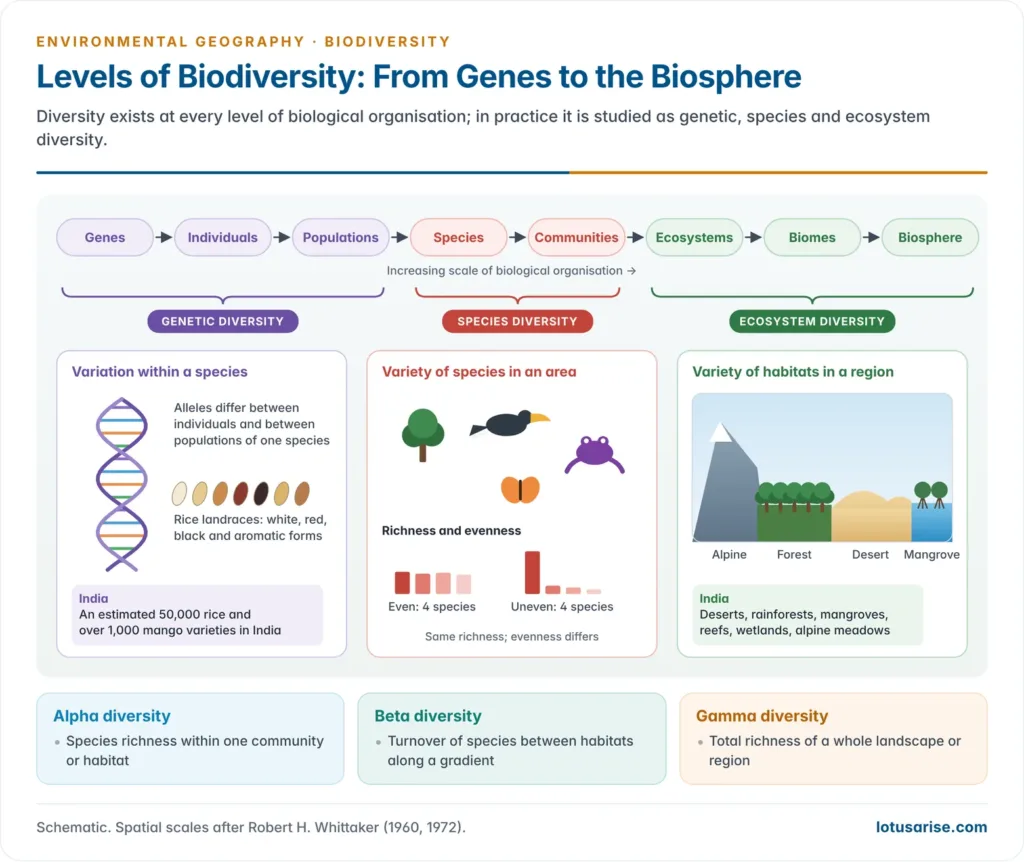
How biodiversity is distributed
- Biodiversity is very unevenly spread. The best-known pattern is the latitudinal gradient in species richness: richness rises from the poles towards the equator.
- The tropics hold an estimated well over half of all terrestrial species. Explanations stress higher energy and productivity, long climatic stability (no Pleistocene ice sheets), more evolutionary time and complex, many-layered habitats with more niches.
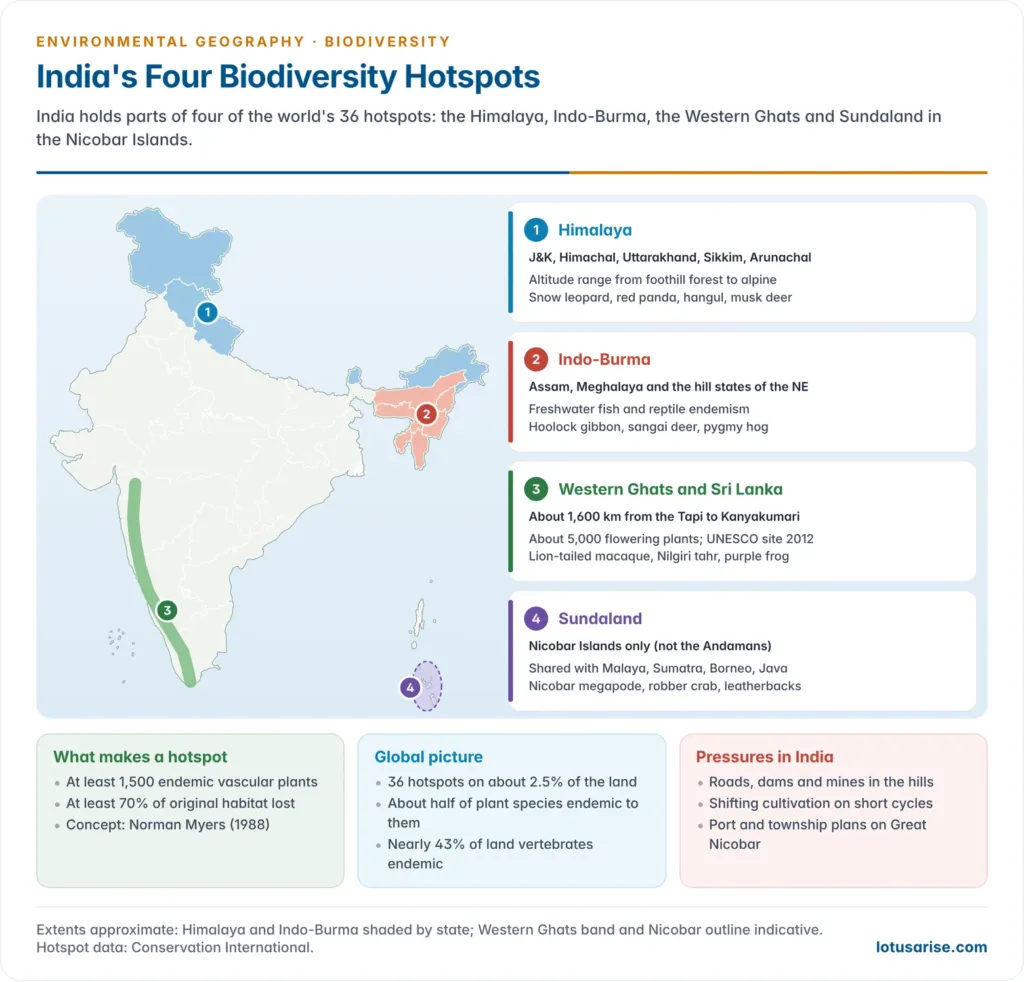
- Biodiversity hotspots are threatened centres of endemism. Norman Myers (1988) identified 10 tropical forest “hotspots”, raised to 18 in 1990. Conservation International adopted and expanded the idea from 1989.
- Two criteria: at least 1,500 endemic vascular plant species (over 0.5% of the world’s total), and loss of at least 70% of the original habitat.
- 36 hotspots are recognised today. They cover only about 2.5% of the land surface but hold about half of the world’s plant species as endemics and nearly 43% of bird, mammal, reptile and amphibian species as endemics.
- Their concentration of irreplaceable species makes them one of the most cost-effective targets for conservation spending.
- Megadiverse countries. About 17 countries, mostly tropical, hold around 70% of the world’s known species. India is one, and a founding member of the Like-Minded Megadiverse Countries group (Cancún, 2002).
India’s biodiversity
- India has about 2.4% of the world’s land but 7–8% of its recorded species. It is one of the 17 megadiverse countries and holds parts of 4 of the 36 hotspots.
| Category | India’s position | Notable feature |
|---|---|---|
| Fauna | 1,05,953 species recorded (Zoological Survey of India, 2026) | About 680–710 new species added every year |
| Flora | About 8% of the world’s recorded plant species; a high share of flowering plants endemic | Himalaya, north-east, Western Ghats and the islands richest |
| Crop diversity | A Vavilov centre of crop origin | An estimated 50,000 rice and over 1,000 mango varieties |
| Marine | EEZ of about 2.02 million km² | Gulf of Mannar, Gulf of Kachchh, Andaman and Nicobar, Lakshadweep reefs |
| Forests | 25.17% of area under forest and tree cover (ISFR 2023) | Forest cover alone 21.76%; carbon stock 7,285.5 million tonnes |
| Wetlands | 103 Ramsar sites (October 2026), the largest network in Asia | Chilika, Sundarbans, Loktak, Wular; the newest are Sukhna Lake (Chandigarh) and Sauj Jheel (Uttar Pradesh) |
| Protected areas | Over 1,000 protected areas, about 5.3% of the geographical area | More than 100 national parks and about 570 wildlife sanctuaries; 18 biosphere reserves |
Why India is so diverse
- Latitude and size: the mainland spans about 8°N to 37°N, from equatorial to warm-temperate conditions, across a subcontinent of 3.29 million km².
- Physiography: a vertical range of over 8,500 m, from sea-level deltas to the Himalayan crest. This compresses tropical to alpine zones into short distances.
- Climate: the monsoon creates a rainfall gradient from over 11,000 mm at Mawsynram to below 150 mm in the Thar, giving evergreen, deciduous, thorn and alpine formations.
- Biogeographic crossroads: India sits where three realms meet: Indo-Malayan, Palaearctic and Afrotropical. Elements of all three meet here, and India is divided into 10 biogeographic zones.
- Isolation: the Western Ghats, the islands and high mountain valleys have produced high endemism, for example in amphibians and reptiles.
- Long human history: millennia of farming, pastoralism and plant domestication have created a large agro-biodiversity of cultivated races and landraces.
India’s four hotspots
| Hotspot | Indian part | Key features and species |
|---|---|---|
| Himalaya | J&K, Himachal Pradesh, Uttarakhand, Sikkim, Arunachal Pradesh | Extreme altitude range; snow leopard, red panda, Himalayan tahr, musk deer, hangul |
| Indo-Burma | Assam, Meghalaya, Nagaland, Manipur, Mizoram, Tripura (into Myanmar, Thailand, Indo-China) | Freshwater and reptile endemism; hoolock gibbon (India’s only ape), sangai deer, pygmy hog |
| Western Ghats and Sri Lanka | About 1,600 km of escarpment from the Tapi to Kanyakumari; UNESCO World Heritage Site (2012) | Over 5,000 flowering plants, many endemic; lion-tailed macaque, Nilgiri tahr, purple frog |
| Sundaland | Nicobar Islands only (not the Andamans) | Nicobar megapode, Nicobar treeshrew, giant robber crab; leatherback nesting beaches on Great Nicobar |
India as a centre of crop origin
- Nikolai I. Vavilov (1926) placed the Hindustan (Indian) centre among the world’s centres of origin and diversity of cultivated plants.
- Crops domesticated or highly diversified here include rice, sugarcane, pigeon pea, mung bean, brinjal, cucumber, mango, citrus, black pepper and tree cotton.
- Crop wild relatives in these landscapes carry genes for disease resistance, drought and salinity tolerance and yield. Their survival in the wild is therefore a matter of global food security.
- In the 1970s, resistance to the grassy stunt virus that was ravaging Asian rice came from a single sample of the wild rice Oryza nivara collected in India. The gene was bred into the high-yielding varieties grown across the continent.
- India has identified 22 agro-biodiversity hotspots across its agro-climatic regions, from the cold deserts to the Kuttanad wetlands.
Value of Biodiversity and Its Loss
Values of biodiversity
- Biodiversity has value of many kinds. Economists group these as total economic value: use values (direct and indirect), option value and non-use values (existence and bequest).
| Value | Description | Examples |
|---|---|---|
| Direct use: consumptive | Goods consumed locally, without passing through markets | Food, fuelwood, fodder, bushmeat, fish, medicinal plants used by households |
| Direct use: productive | Goods harvested and sold commercially | Timber, pharmaceuticals (quinine, morphine, aspirin), fibres, ecotourism revenue |
| Indirect use (ecosystem services) | Benefits from ecosystem functioning rather than harvest | Pollination, worth US$235–577 billion of global crop output a year (IPBES, 2016); climate and flood regulation, water purification, soil formation, pest control |
| Option value | Value of keeping resources for uses not yet known | Undiscovered medicines, new crop genes, compounds for climate-resilient farming |
| Existence (intrinsic) value | Every species’ right to exist, regardless of human use | Basis of the CBD preamble and of ecocentric ethics |
| Bequest (ethical) value | Duty to hand biodiversity on to future generations | Intergenerational equity; stewardship of the Earth’s biological heritage |
- Cultural and spiritual values cut across all categories: sacred groves, totemic species and festivals tied to particular plants and animals.
- Nature underpins the economy. The World Economic Forum (2020) estimated that about US$44 trillion, more than half of world GDP, is moderately or highly dependent on nature.
- The Dasgupta Review (2021), led by Partha Dasgupta, treats biodiversity as a capital asset. It argues that global natural capital per head fell by nearly 40% between 1992 and 2014 while produced capital doubled.
- These flows from nature to people are the ecosystem services that the Millennium Ecosystem Assessment (2005) classed as provisioning, regulating, cultural and supporting.
Why biodiversity matters for stability
- Ecologists long held that species-rich communities are more stable: their productivity varies less from year to year, they resist or recover from natural and human disturbance, and they resist invasions by alien species.
- Long-term grassland experiments by David Tilman at Cedar Creek, Minnesota, from the 1980s supported this: plots with more species showed less year-to-year variation in total biomass and higher productivity.
- The rivet-popper hypothesis of Paul R. Ehrlich and Anne H. Ehrlich (1981) compares species to the rivets of an aeroplane. Losing a few may not be noticed, but beyond a point the structure fails.
- The insurance hypothesis: many species doing similar jobs provide functional redundancy. If one fails in a drought or disease, another takes over.
- Rich biodiversity is therefore not only a matter of ecosystem health. It is imperative for human survival and well-being.
The scale of biodiversity loss
- Extinction is now running tens to hundreds of times faster than the background rate of the geological past. Many scientists describe a sixth mass extinction, the first caused by a single species.
- IPBES Global Assessment (2019):
- about 1 million of an estimated 8 million animal and plant species are threatened with extinction, many within decades;
- 75% of the land surface and 66% of the ocean have been significantly altered by human action;
- over 85% of wetlands present in 1700 had been lost by 2000.
- IUCN Red List (2025): of roughly 172,000 species assessed, about 48,600 (28%) are threatened. These include 41% of amphibians, 44% of reef-building corals, 38% of sharks and rays and 71% of cycads.
- Amphibians are the most threatened vertebrate class, hit by habitat loss, climate change and the chytrid fungus.
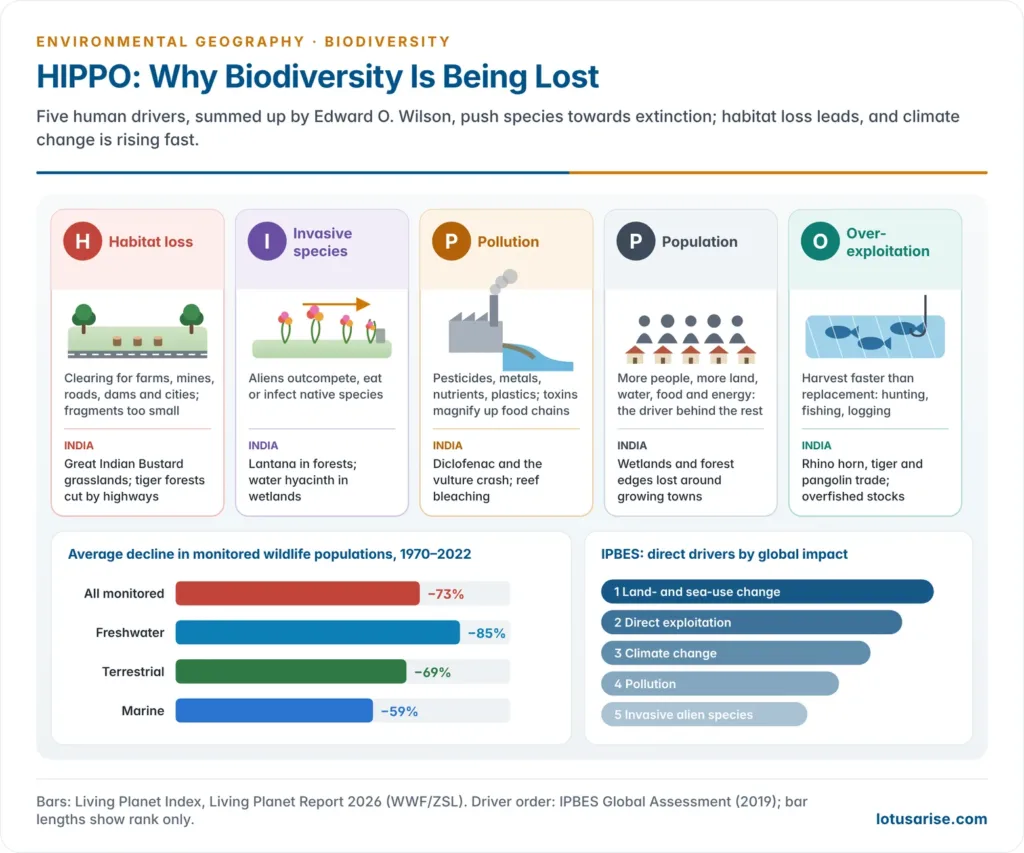
- Living Planet Report 2026: monitored vertebrate populations fell by an average of 73% between 1970 and 2022.
- Declines were steepest in freshwater (85%) and in Latin America and the Caribbean (95%). Terrestrial populations fell 69% and marine 59%.
- Forests: the world lost about 10.9 million ha a year to deforestation in 2015–2025, down from 17.6 million ha a year in the 1990s (FAO Forest Resources Assessment, 2025). Tropical rainforests, which once covered about 14% of the land, now cover about 6%.
Causes of loss: the HIPPO framework
- Edward O. Wilson summed up the human drivers in the acronym HIPPO. An older textbook set, Jared Diamond’s “evil quartet” (1989), lists habitat loss, over-exploitation, alien species invasions and co-extinctions.
- IPBES (2019) ranks five direct drivers, in order of global impact: land- and sea-use change, direct exploitation, climate change, pollution and invasive alien species.
- Behind these lie indirect drivers: population, consumption patterns, trade, technology, governance and values.
| Driver | Mechanism | Indian example |
|---|---|---|
| H: Habitat loss and fragmentation | Clearing for farms, cities, dams, mines and roads; fragments are too small for wide-ranging and migratory species; the single most important driver | Grasslands of the Great Indian Bustard lost to farms and power lines; central Indian tiger forests cut by highways and mines |
| I: Invasive alien species | Introduced species outcompete, prey on or infect natives | Lantana camara across Indian forests; water hyacinth in wetlands; Nile perch in Lake Victoria wiped out about 200 cichlid species |
| P: Pollution | Pesticides, heavy metals, nutrients, plastics and heat degrade habitats and biomagnify up food chains | Diclofenac crashed India’s vulture populations; effluents threaten the Gangetic dolphin; reef bleaching in Lakshadweep and the Gulf of Mannar |
| P: Human population growth | More people raise demand for land, water, energy and food; the driver behind the others | Forest edges and wetlands converted around growing towns |
| O: Over-exploitation | Hunting, fishing and harvesting faster than replacement; when “need turns to greed” | Rhino poaching for horn; tiger and pangolin trade; more than a third of assessed marine fish stocks are overfished worldwide |
- Climate change is now a fast-rising driver. The biogeography of climate change shows species ranges shifting upslope and polewards, coral reefs bleaching, and flowering and migration falling out of step.
- Co-extinction: when a species dies out, others obligately tied to it disappear too.
- A host fish takes its unique parasites with it, and a plant may take its specialist pollinator.
- The loss of particular fig species would doom their fig wasps and hit the many fruit-eating birds and mammals that rely on figs through lean seasons.
- Over-exploitation has a long record. Steller’s sea cow (1768) and the passenger pigeon (1914) were hunted to extinction, and the Indian cheetah was lost by the early 1950s.
- Habitat fragmentation creates edge effects, cuts landscape connectivity and isolates small populations, which then lose genetic diversity through inbreeding and drift.
Consequences of biodiversity loss
- Lower productivity: fewer plant species generally means less primary production, which undermines every food web above it.
- Lower resistance and resilience to drought, pests, disease and other perturbations.
- More variable ecosystem processes: productivity, water use and pest cycles become erratic and unpredictable.
- Loss of genetic options: the permanent closure of future agricultural, medical and adaptive choices.
- Ecosystem collapse: losing keystone species or whole functional groups can push a system past a tipping point from which it does not recover.
- Human costs: shrinking fisheries, pollinator decline, lost livelihoods for forest and fishing communities, and a higher risk of zoonotic disease as people press into wild habitats.
Sustainable Development
Evolution of the concept
| Year | Milestone | Contribution |
|---|---|---|
| 1972 | UN Conference on the Human Environment, Stockholm | First global environmental summit; created UNEP; linked environment and development |
| 1972 | The Limits to Growth (Club of Rome; Donella Meadows and others) | Warned that exponential growth would overshoot finite resources |
| 1980 | World Conservation Strategy (IUCN, UNEP, WWF) | First major use of “sustainable development”; conservation as a means of development |
| 1987 | Brundtland Commission (WCED), Our Common Future | The standard definition |
| 1992 | Rio Earth Summit | Rio Declaration (27 principles), Agenda 21; the CBD and UNFCCC opened for signature |
| 2002 | Johannesburg World Summit on Sustainable Development | Implementation; the 2010 biodiversity target endorsed |
| 2012 | Rio+20, The Future We Want | Green economy; launched the process for the SDGs |
| 2015 | 2030 Agenda for Sustainable Development | 17 SDGs and 169 targets, in force from 1 January 2016 |
Meaning and the Brundtland definition
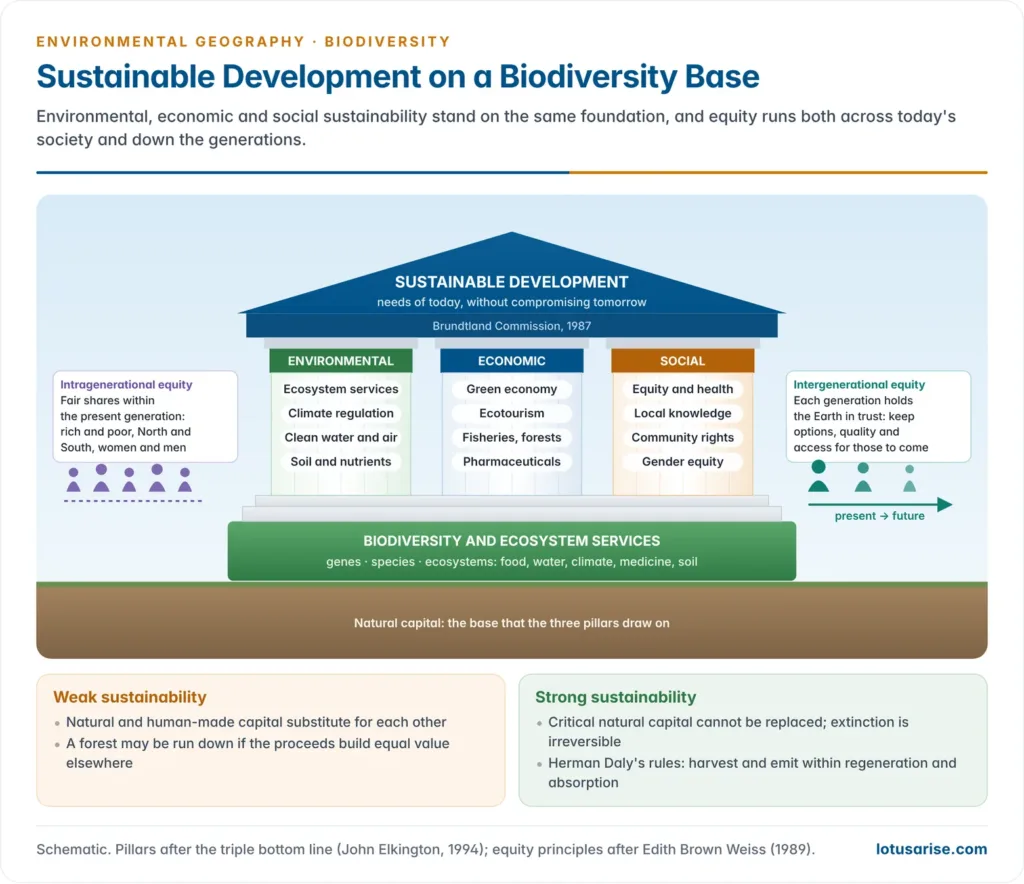
- The World Commission on Environment and Development, chaired by Gro Harlem Brundtland, defined sustainable development (1987) as “development that meets the needs of the present without compromising the ability of future generations to meet their own needs”.
- It contains two key concepts:
- “Needs”, above all the essential needs of the world’s poor, to which overriding priority should be given;
- “Limitations” imposed by the state of technology and social organisation on the environment’s ability to meet present and future needs.
- Two practical points follow:
- natural resources matter as much for future generations as for present survival;
- every development activity or programme must weigh its future consequences.
- Put simply, the rate of resource use must stay within the Earth’s capacity to regenerate those resources and absorb wastes.
- Mahatma Gandhi’s principle of “enoughness” says the same: “the earth provides enough to satisfy every man’s need, but not every man’s greed”.
- The human cost of growth. Material well-being rose sharply over the past two centuries, but at a heavy cost to the environment. Over-exploitation and degradation now threaten human welfare itself.
- The main causes of unsustainability are a growing human population and the over-exploitation of resources, driven by rising consumption.
- Steps towards sustainability: energy- and resource-saving methods; technology that minimises waste and toxins; biodegradable, renewable and recyclable products; and environmental education and awareness.
- The idea now guides planning for sustainable development at regional and city scale, through carrying-capacity studies, land-use zoning and environmental impact assessment.
Weak and strong sustainability
- Weak sustainability assumes that natural and human-made capital can substitute for each other. Running down a forest is acceptable if the proceeds build equal value in schools or factories.
- Strong sustainability holds that critical natural capital cannot be replaced. Biodiversity, the ozone layer and a stable climate must be kept intact.
- Herman Daly (1990) set out operational rules:
- harvest renewable resources no faster than they regenerate;
- emit wastes no faster than the environment can absorb them;
- deplete non-renewables no faster than renewable substitutes are developed.
- Herman Daly (1990) set out operational rules:
- Biodiversity is the clearest case for strong sustainability. Extinction is irreversible, and no technology can recreate a lost gene pool or an evolutionary lineage.
Critiques and measures of sustainability
- Critiques of the concept:
- Vague and elastic: the term is used by conservationists and industrialists alike, and “sustainable growth” can read as an oxymoron on a finite planet.
- Growth-centred: ecological economists, from Herman Daly’s steady-state economy to today’s degrowth writers, argue that endless material growth cannot be decoupled enough from resource use.
- Northern bias: critics from the South point out that the rich countries built their wealth on centuries of high consumption and emissions, yet ask poor countries to conserve forests and wildlife at their own cost.
- Ramachandra Guha and Joan Martínez-Alier (1997) contrasted this with the “environmentalism of the poor“, in which forest, fishing and farming communities defend nature because their livelihoods depend on it.
- Weak in practice: most national plans still treat nature as an externality, so biodiversity loss rarely shows up in the accounts that drive decisions.
- Measuring sustainability:
- GDP ignores depletion. A country that clears its forests and sells the timber records growth, not the loss of an asset.
- Alternatives include green GDP, the Genuine Progress Indicator, the Inclusive Wealth Index (UNEP, from 2012) and the ecological footprint compared with biocapacity.
- The UN’s System of Environmental-Economic Accounting (SEEA) gives a statistical standard. Its Ecosystem Accounting framework was adopted by the UN Statistical Commission in 2021, and India’s statistics ministry publishes environmental accounts under it.
- Planetary boundaries. Johan Rockström and colleagues (2009) proposed nine Earth-system limits for a “safe operating space”. The 2023 update found six already crossed, with biosphere integrity among the most severely transgressed.
- The Indian ethos offers an older measure of restraint. The Isha Upanishad‘s “tena tyaktena bhunjitha” (enjoy through renunciation) and Gandhi’s “enoughness” both judge development by sufficiency rather than accumulation.
Intergenerational and intragenerational equity
- Equity is the ethical core of sustainable development. It has two dimensions.
- Intergenerational equity is fairness between generations. Each generation holds the Earth in trust for those that follow.
- Edith Brown Weiss (1989) framed it as three principles:
- conservation of options: keep the diversity of the resource base;
- conservation of quality: pass on the planet in no worse condition;
- conservation of access: fair access to the legacy of past generations.
- Examples: the loss of species and gene pools, groundwater mined faster than it recharges, and the cumulative carbon debt that today’s young people will inherit.
- Edith Brown Weiss (1989) framed it as three principles:
- Intragenerational equity is fairness within the present generation: between rich and poor, North and South, men and women, and city and forest dweller.
- Examples:
- the “common but differentiated responsibilities” of Rio Principle 7;
- access and benefit sharing, so that communities whose knowledge leads to a drug or cosmetic share its profits;
- the Forest Rights Act 2006, which recognises the rights of forest dwellers;
- the risk that strict protected areas displace poor forest communities.
- Examples:
- The two pull together. Brundtland called poverty both a cause and an effect of environmental degradation.
- A society that cannot meet the needs of its poor today will draw down natural capital that future generations need.
- Indian law has absorbed both principles:
- the Supreme Court called sustainable development part of the law of the land in Vellore Citizens’ Welfare Forum v. Union of India (1996);
- it recognised intergenerational equity in State of Himachal Pradesh v. Ganesh Wood Products (1995);
- Article 21 (right to life, read to include a healthy environment), and the directive and duty in Articles 48A and 51A(g) give the constitutional base.
The three dimensions (pillars)
- Sustainable development rests on three mutually reinforcing pillars. John Elkington (1994) called this the triple bottom line of people, planet and profit.
- It is drawn either as intersecting circles (sustainability where all three overlap) or as a nested hierarchy, with the economy inside society and society inside the biosphere.
| Pillar | Core idea | Key principles | Biodiversity link |
|---|---|---|---|
| Environmental | Keep the environment’s life-support functions over time | Wise use; minimise impacts; protect and renew natural resources; Rio Principle 1: a healthy and productive life in harmony with nature | Biodiversity provides the ecosystem services (pollination, water purification, climate regulation) that economies depend on |
| Economic | Sustain well-being and income without depleting the capital base | Efficient resource mix; employment and income; move to an inclusive green economy | Ecotourism, sustainable fisheries, pharmaceuticals and agro-biodiversity show that conservation and growth can coexist |
| Social | Assure welfare (health, security, education) and distribute it fairly across classes and genders | Participation; cooperation between institutions; leave no one behind; gender equity in access to resources | Indigenous and local communities are custodians of biodiversity (sacred groves, seed systems) and among its main beneficiaries |
- Some frameworks add institutional (governance) and cultural dimensions to the concept of sustainable growth and development: sustainability fails without accountable institutions and the cultural values that sustain restraint.
The Sustainable Development Goals (Agenda 2030)
- In September 2015, all 193 UN member states adopted Transforming our World: the 2030 Agenda for Sustainable Development. Its 17 goals and 169 targets came into force on 1 January 2016.
- The goals are universal and indivisible: they integrate the three dimensions and pledge to leave no one behind. Progress is tracked through a global indicator framework of over 230 indicators.
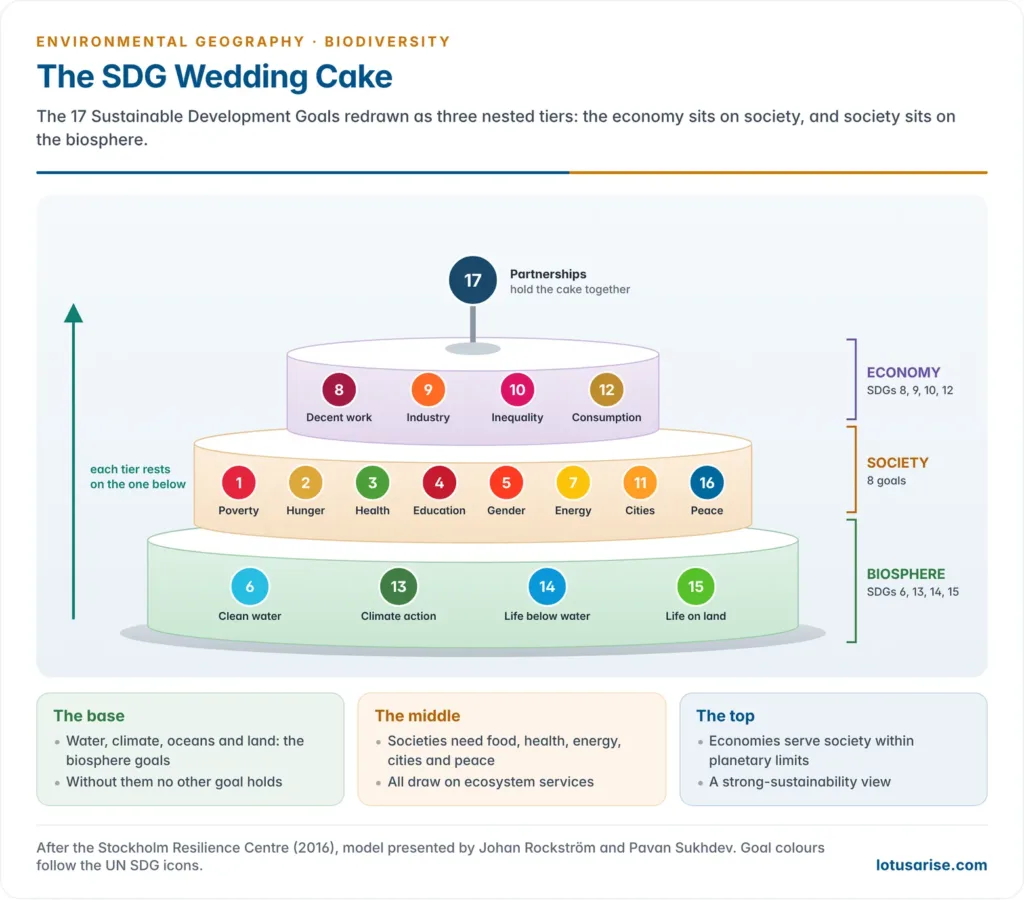
- The SDG “wedding cake”. The Stockholm Resilience Centre (2016), in a model presented by Johan Rockström and Pavan Sukhdev, redrew the SDGs as three nested tiers:
- Biosphere (base): SDG 6 clean water, 13 climate action, 14 life below water and 15 life on land;
- Society (middle): SDGs 1, 2, 3, 4, 5, 7, 11 and 16;
- Economy (top): SDGs 8, 9, 10 and 12, with SDG 17 partnerships as the cake-stand that holds it together.
- The message: economies and societies are embedded in the biosphere. Without the four biosphere goals the others cannot be achieved, which is the strong-sustainability view.
- Goals 14 and 15 are the explicit biodiversity goals. Goal 15 aims to halt biodiversity loss, restore degraded land, combat desertification and end poaching and invasive species. Goal 14 conserves the oceans.
- Yet biodiversity supports nearly every goal: food security (SDG 2), medicines and disease regulation (SDG 3), water (SDG 6), livelihoods (SDG 1) and climate (SDG 13).
- The SDG framework links three things:
- Leave no one behind and give everyone a life of dignity: sustainable livelihoods for those facing extreme poverty, discrimination or environmental deprivation.
- Environmental goals must not be pursued at the expense of human rights and social equity.
- Affordable, green technologies should reduce poverty and protect the environment at the same time.
- Prosper within the Earth’s life-support capacity: growth that no longer degrades the environment, an inclusive green economy, and sustainable consumption.
- Sustainable consumption is less about consuming less and more about consuming better.
- Build capital for resilience: invest in natural, social and economic capital so that societies absorb shocks.
- Natural resources, managed sustainably, become drivers of peace and well-being.
- Leave no one behind and give everyone a life of dignity: sustainable livelihoods for those facing extreme poverty, discrimination or environmental deprivation.
- Progress is off track. The UN Sustainable Development Goals Report 2026 found that only 36% of the 139 targets with trend data are on track or making moderate progress.
- About 49% are moving too slowly, and 15% have slipped below their 2015 baselines.
- India tracks progress through NITI Aayog’s SDG India Index. Its composite score rose from 66 (2020–21) to 71 (2023–24), though Goal 15 and Goal 13 remain uneven across states.
Biodiversity and Sustainable Development: Linkages and Governance
How biodiversity sustains development
- Biodiversity and sustainable development are not parallel concepts: biodiversity is the biological foundation on which all three pillars stand.
| Linkage | Mechanism | Example |
|---|---|---|
| Ecosystem services → economic value | Pollination, water purification, carbon storage and natural pest control underpin whole sectors | Pollinator-dependent crops (fruits, vegetables, oilseeds); mangroves and reefs sustain coastal fisheries and tourism |
| Genetic diversity → food security | Crop wild relatives supply genes for disease resistance, drought tolerance and yield under climate change | Wild and traditional rices of eastern India used in breeding; Himalayan wild relatives of cereals and fruits |
| Healthy ecosystems → climate regulation | Diverse forests, peatlands, mangroves and seagrasses store carbon, moderate rainfall and buffer floods and storms | The Sundarbans mangroves shield millions of people from cyclones; India’s forest carbon stock is 7,285.5 million tonnes (ISFR 2023) |
| Biodiversity loss → health risk | Encroachment brings people into contact with new pathogens; loss of predators and competitors can amplify disease hosts | Nipah outbreaks in Kerala and Kyasanur Forest Disease in the Western Ghats both follow human–forest contact |
| Conservation → poverty reduction | Ecotourism, sustainable harvest, fisheries and bio-trade earn income while conserving | Tiger-reserve tourism in Ranthambore, Corbett and Kanha; honey collection in the Sundarbans; van dhan forest-produce centres |
| Indigenous knowledge → sustainable management | Traditional ecological knowledge offers tested rules of restraint; community tenure protects habitat | The Bishnois of Rajasthan; the Dongria Kondh’s defence of the Niyamgiri hills; van panchayats of Uttarakhand |
- Women are often the main managers of seeds, fuel, fodder and medicinal plants, which makes gender and biodiversity inseparable in practice.
- The biodiversity–climate–development nexus. UNEP calls climate change, biodiversity loss and pollution the triple planetary crisis; unsustainable development drives all three.
- The IPBES Nexus Assessment (December 2024) found that tackling biodiversity, water, food, health and climate separately produces trade-offs. Integrated responses give larger co-benefits.
- Parties increasingly seek operational links among the three Rio Conventions: the CBD, UNFCCC and UNCCD.
- Nature-positive development, in which growth leaves nature better off than before, is the only path that meets both the SDGs and the Kunming-Montreal targets.
- India’s challenge is to meet the development needs of over 1.4 billion people while conserving 7–8% of the world’s recorded species on 2.4% of its land.
- Every measure of environmental degradation, from the ecological footprint to land degradation, signals the same tension.
Development and biodiversity: trade-offs in India
- India’s growth needs land, water and minerals, and much of that lies under its richest ecosystems. Recent projects show the trade-off sharply:
- Great Nicobar: a transhipment port, airport and township on Great Nicobar, in the Sundaland hotspot, would clear tropical forest and affect leatherback turtle nesting beaches, coral reefs and the lands of the Shompen.
- Ken–Betwa river link: its reservoir submerges part of the Panna Tiger Reserve, offset by a landscape management plan that adds new protected areas.
- Coal in central India: mining in the Hasdeo Arand forests of Chhattisgarh, one of the largest unbroken forest blocks in central India and elephant habitat, has met long local opposition.
- Hydropower in Arunachal Pradesh: large dams in the Dibang and Siang valleys raise questions of forest loss, river ecology and indigenous rights in the Eastern Himalaya.
- Ways to reconcile the two:
- mitigation hierarchy: avoid damage first, then minimise and restore, and use offsets only as a last resort;
- cumulative and strategic impact assessment for whole river basins and landscapes, not single projects;
- free, prior and informed consent of affected communities, as the Forest Rights Act and the Supreme Court’s Niyamgiri judgement (2013) require of gram sabhas;
- green infrastructure: animal underpasses on highways such as NH 44 through the Pench landscape, and eco-sensitive zones around protected areas.
The international framework
| Convention or framework | Year | Key contribution |
|---|---|---|
| Ramsar Convention on Wetlands | 1971 | First treaty on a single ecosystem type; List of Wetlands of International Importance |
| Stockholm Conference | 1972 | Created UNEP; groundwork for global environmental governance |
| CITES | 1973 | Regulates international trade in wild species (Appendix I no commercial trade, II regulated, III listed by a range state); India a party since 1976 |
| Convention on Migratory Species (Bonn) | 1979 | Conservation of migratory animals across their range; COP13 held at Gandhinagar (2020) |
| Convention on Biological Diversity | 1992 | First comprehensive biodiversity treaty; three objectives |
| Cartagena Protocol on Biosafety | 2000 | Safe transboundary movement of living modified organisms |
| Nagoya Protocol | 2010 | Access and benefit sharing for genetic resources |
| Aichi Biodiversity Targets | 2010 | Strategic Plan 2011–2020: 20 targets under 5 goals; none fully met |
| Kunming-Montreal Global Biodiversity Framework | 2022 | 4 goals for 2050, 23 targets for 2030; 30×30 |
| High Seas Treaty (BBNJ Agreement) | 2023 | Marine biodiversity beyond national jurisdiction; in force since 17 January 2026; India has signed it |
The Convention on Biological Diversity (CBD)
Origin and status
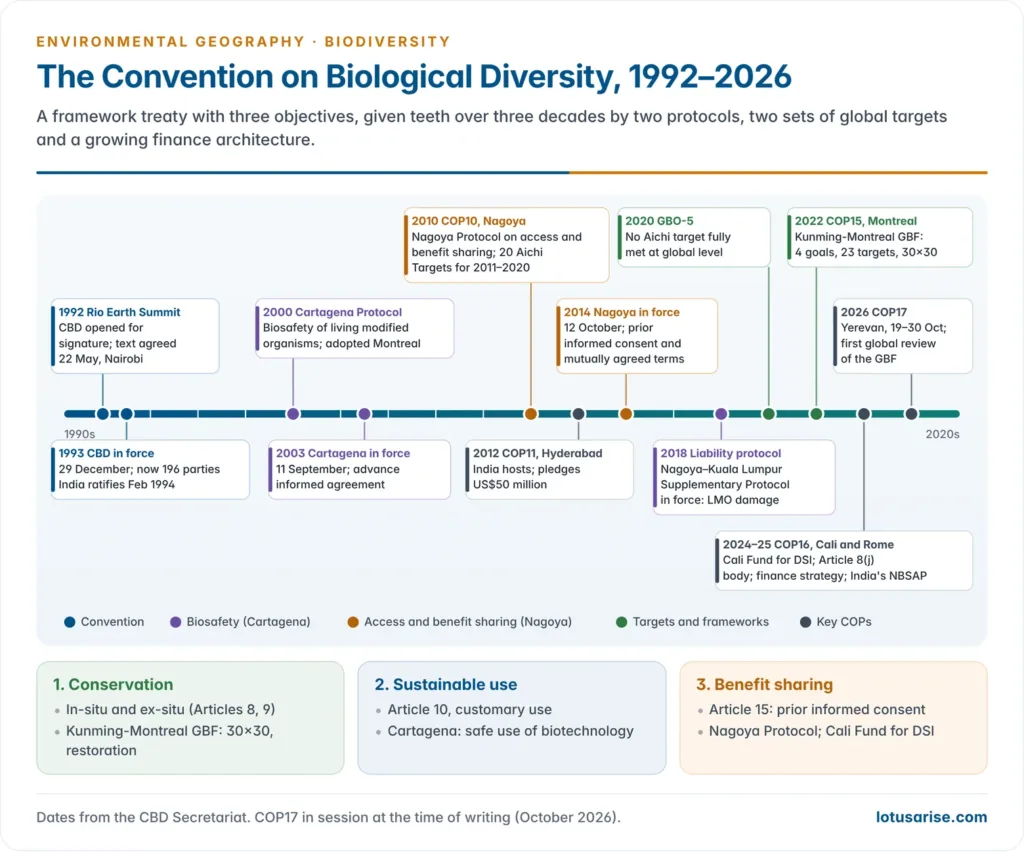
- The CBD’s text was agreed in Nairobi on 22 May 1992, and it was opened for signature at the Rio Earth Summit on 5 June 1992. It entered into force on 29 December 1993.
- It has 196 parties, almost universal membership. The United States signed but has not ratified it.
- India ratified it on 18 February 1994. Its domestic law is the Biological Diversity Act 2002.
- The Secretariat is in Montreal. 22 May, the day the text was adopted, is the International Day for Biological Diversity.
Objectives (Article 1)
- Conservation of biological diversity;
- Sustainable use of its components;
- Fair and equitable sharing of the benefits arising from the use of genetic resources.
- Together these make the CBD the first treaty to treat biodiversity as a development issue as well as a conservation one.
Characteristics
- A framework convention: it sets broad goals and principles and leaves targets and methods to national action and later protocols and decisions.
- Comprehensive: it covers all levels of biodiversity (genes, species, ecosystems) and all ecosystems. Earlier treaties covered single species, trade or habitats.
- Sovereign rights: states have sovereign rights over their biological resources (Articles 3 and 15). This ended the old idea of genetic resources as the “common heritage of mankind”, while making conservation “a common concern of humankind” (preamble).
- The ecosystem approach: adopted at COP5 (Nairobi, 2000) with 12 principles, it is the CBD’s primary framework for ecosystem management.
- A link to development: it recognises that economic and social development and poverty eradication are the first priorities of developing countries. It provides for technology transfer (Article 16) and new and additional finance (Article 20).
- Recognition of communities: Article 8(j) requires respect for the knowledge, innovations and practices of indigenous and local communities and equitable sharing of benefits from their use.
- The precautionary approach: the preamble states that lack of full scientific certainty should not postpone measures where there is a threat of significant loss.
- National implementation: each party prepares a National Biodiversity Strategy and Action Plan (Article 6) and submits periodic national reports (Article 26).
- Weaknesses: soft obligations (“as far as possible and as appropriate”), no compliance mechanism with teeth, chronic under-funding, and weak integration with trade and agriculture policy.
| Article | Provision |
|---|---|
| 6 | National strategies and action plans; mainstreaming into sectors |
| 7 | Identification and monitoring |
| 8 | In-situ conservation: protected areas, restoration, invasive species, 8(j) traditional knowledge |
| 9 | Ex-situ conservation, preferably in the country of origin |
| 10 | Sustainable use, including customary use |
| 11 | Incentive measures |
| 14 | Impact assessment |
| 15 | Access to genetic resources: prior informed consent, mutually agreed terms |
| 16, 19 | Technology transfer and biotechnology (basis of the Cartagena Protocol) |
| 20, 21 | Financial resources; financial mechanism (operated by the Global Environment Facility) |
Institutions
- Conference of the Parties (COP): the supreme body, now meeting every two years.
- SBSTTA (Subsidiary Body on Scientific, Technical and Technological Advice) and the Subsidiary Body on Implementation (set up in 2014).
- A new permanent subsidiary body on Article 8(j) for indigenous peoples and local communities, agreed at COP16 (2024).
- The Clearing-House Mechanism, the Biosafety Clearing-House and the ABS Clearing-House share information.
- The Global Environment Facility is the interim financial mechanism. It also hosts the Global Biodiversity Framework Fund, launched in 2023.
The protocols
| Protocol | Adopted | In force | Parties | Purpose |
|---|---|---|---|---|
| Cartagena Protocol on Biosafety | 29 January 2000, Montreal | 11 September 2003 | About 173 | Safe transfer, handling and use of LMOs; advance informed agreement before the first import of LMOs for release; the Biosafety Clearing-House |
| Nagoya–Kuala Lumpur Supplementary Protocol | 2010 | 5 March 2018 | – | Liability and redress for damage from LMOs |
| Nagoya Protocol on ABS | 29 October 2010, Nagoya | 12 October 2014 | 142 (2025) | Prior informed consent and mutually agreed terms for access to genetic resources and associated knowledge; compliance checkpoints; benefit sharing |
- India is party to all three protocols. It hosted COP11 at Hyderabad (2012) and the Cartagena MOP6 alongside it, pledging US$50 million to strengthen biodiversity institutions.
From Aichi to Kunming-Montreal
- COP10 at Nagoya (2010) adopted the Strategic Plan for Biodiversity 2011–2020 with 20 Aichi Biodiversity Targets.
- The Global Biodiversity Outlook 5 (2020) found that none was fully achieved at global level, and only six were partially achieved. This failure shaped the next framework.
- COP15, held in two parts, at Kunming, China (October 2021) and Montreal (7–19 December 2022), adopted the Kunming-Montreal Global Biodiversity Framework (GBF). It is often called the “Paris Agreement for nature”.
- Vision: “living in harmony with nature” by 2050.
- Mission (2030): to halt and reverse biodiversity loss, putting nature on a path to recovery.
- 4 long-term goals for 2050:
- A: ecosystem integrity, halting human-induced extinction and cutting the extinction rate tenfold;
- B: sustainable use and nature’s contributions to people;
- C: fair sharing of benefits, including from digital sequence information (DSI);
- D: adequate means of implementation, especially finance.
- 23 action targets for 2030, in three groups.
| Group | Key targets |
|---|---|
| Reducing threats (Targets 1–8) | T2: at least 30% of degraded ecosystems under effective restoration; T3 (“30×30”): at least 30% of land, inland waters and coastal and marine areas conserved through protected areas and OECMs, recognising indigenous and traditional territories; T6: cut the introduction of invasive species by at least 50%; T7: halve excess nutrients and the overall risk from pesticides, and work to eliminate plastic pollution |
| Meeting people’s needs (Targets 9–13) | Sustainable use and management of wild species, farming, fisheries and forests; access and benefit sharing |
| Tools and solutions (Targets 14–23) | T15: large companies to disclose their biodiversity risks, dependencies and impacts; T16: halve global food waste; T18: reduce harmful subsidies by at least US$500 billion a year by 2030; T19: mobilise US$200 billion a year from all sources, including international finance of US$20 billion a year by 2025 and US$30 billion by 2030; T22, T23: rights of indigenous peoples, gender equality |
- COP16 at Cali, Colombia (21 October–1 November 2024), called the “People’s COP“, added:
- the Cali Fund, a multilateral mechanism through which companies using DSI share benefits, with an indicative 1% of profits or 0.1% of revenue; at least half is meant for indigenous peoples and local communities;
- a permanent subsidiary body on Article 8(j) and recognition of people of African descent;
- decisions on biodiversity and health (One Health), synthetic biology, invasive species and marine areas.
- The meeting was suspended on 2 November 2024 for lack of quorum before finance decisions were made.
- The resumed COP16 in Rome (25–27 February 2025), at FAO headquarters:
- adopted a resource mobilisation strategy to reach US$200 billion a year by 2030;
- agreed a roadmap to a permanent financial mechanism, with decisions due by COP19 (2030);
- finalised the GBF monitoring framework;
- the Cali Fund was formally launched on its margins.
- COP17 is meeting at Yerevan, Armenia (19–30 October 2026). It holds the first global review of collective progress on the GBF, based on national reports and updated NBSAPs.
- Criticisms of the GBF:
- targets remain not legally binding;
- 30×30 risks “fortress conservation” that displaces communities unless rights are secured;
- the finance gap is still large;
- countries have been slow to submit updated plans.
India’s legal and policy response
| Act or plan | Year | Key provisions |
|---|---|---|
| Wild Life (Protection) Act | 1972 (amended 2022) | Bans hunting of scheduled species; protected-area network; 2022 amendment cut the schedules to four and brought CITES into domestic law |
| Forest (Conservation) Act | 1980 (amended 2023) | No diversion of forest land without central approval; renamed the Van (Sanrakshan Evam Samvardhan) Adhiniyam in 2023 |
| Biological Diversity Act | 2002 (assent 5 February 2003) | Implements the CBD: regulates access to biological resources and associated knowledge; three-tier structure |
| Biological Diversity Rules | 2004 | Operational rules for the Act |
| Forest Rights Act | 2006 | Recognises forest dwellers’ rights, including community forest resources; joins social justice to conservation |
| National Biodiversity Action Plan | 2008 (addendum 2014) | 12 national biodiversity targets aligned with Aichi |
| Biological Diversity (Amendment) Act | 2023 (in force 1 April 2024) | Eases compliance for AYUSH and research; decriminalises offences |
| Updated NBSAP | 2024 | 23 national targets mirroring the Kunming-Montreal GBF |
The Biological Diversity Act 2002
- Three-tier structure:
- the National Biodiversity Authority (NBA), Chennai (2003), approves access by foreign entities and any intellectual property rights over Indian biological resources;
- State Biodiversity Boards regulate access by Indian entities for commercial use;
- Biodiversity Management Committees (BMCs) at every local body document local resources and knowledge in People’s Biodiversity Registers (PBRs).
- Access and benefit sharing: users pay a share of benefits into national, state and local biodiversity funds, which reach the communities that conserve the resource.
- Biodiversity Heritage Sites: states may notify areas of special biodiversity value. The first was the Nallur Tamarind Grove, Karnataka (2007).
- Landmark use: the NBA’s decision (2011) to prosecute the developers of Bt brinjal for using local brinjal varieties without approval was India’s first move against biopiracy under the Act.
The Biological Diversity (Amendment) Act 2023
- Passed in 2023 (assent 3 August 2023) and in force from 1 April 2024.
- Decriminalisation: imprisonment for most offences is replaced by penalties of ₹1 lakh to ₹50 lakh, plus up to ₹1 crore for continuing contravention.
- Exemptions: registered AYUSH practitioners, vaids and hakims, local communities and growers are exempt from prior intimation to State Biodiversity Boards.
- Cultivated medicinal plants are exempt when certified by the BMC.
- Foreign-controlled companies: only companies controlled by foreigners (under the Companies Act 2013) are now treated as foreign.
- Intellectual property: NBA approval is needed before the grant of an IPR, not before the application, and covers associated traditional knowledge.
- Benefit-sharing regulations (2025): the NBA’s new regulations set benefit sharing at 0.2–0.6% of annual ex-factory sales above a ₹5 crore turnover. Cultivated medicinal plants are exempt.
- Critique:
- easing access for the AYUSH industry may weaken benefit sharing with the communities who hold the knowledge;
- decriminalisation may dilute deterrence;
- local BMCs had little say in the amendment.
The updated NBSAP (2024)
- India released its updated National Biodiversity Strategy and Action Plan at COP16, Cali (30 October 2024). It has 23 national targets aligned with the GBF and follows a “whole of government, whole of society” approach.
- Three themes: reducing threats (8 targets), meeting people’s needs through sustainable use and benefit sharing (5 targets), and tools and solutions for implementation (10 targets).
- It aims to bring 30% of land, waters and coasts under effective conservation through PAs and OECMs, and to restore at least 30% of prioritised degraded ecosystems by 2030.
- The estimated cost is about ₹81,664 crore a year (2024–25 to 2029–30), spread across 23 ministries and departments.
- Target 16 ties lifestyle change to Mission LiFE (Lifestyle for Environment, 2022), echoing Gandhi’s “enoughness”.
- The plan rests on principles of environmental policy in India such as precaution, polluter pays and public trust, and on instruments ranging from regulation to the Green Credit Programme (2023).
Methods of conserving biodiversity for sustainable development
Preservation and conservation
| Basis | Preservation | Conservation |
|---|---|---|
| Meaning | Keeping rare and endangered species in strictly protected areas so their numbers recover; no resource use | Proper use, protection and management of resources so they stay available for judicious use while keeping ecological balance |
| Orientation | Strictly protective; excludes people | Combines protection with wise, sustainable use |
| Practice | Core zones of biosphere reserves; national parks | Sanctuaries, buffer zones, community and conservation reserves, sustainable harvest |
| Framework | Strict prohibitions under the Wild Life (Protection) Act | World Conservation Strategy 1980; CBD 1992; Kunming-Montreal GBF 2022 |
- Conservation can be defined as the setting and observance of economically, socially and politically acceptable norms for a society’s use of natural resources.
- Its aims are to prevent the loss of genetic diversity, save species from extinction and protect ecosystems from damage.
- For sustainable development, conservation is the more useful idea: it keeps nature and people together.
In-situ conservation
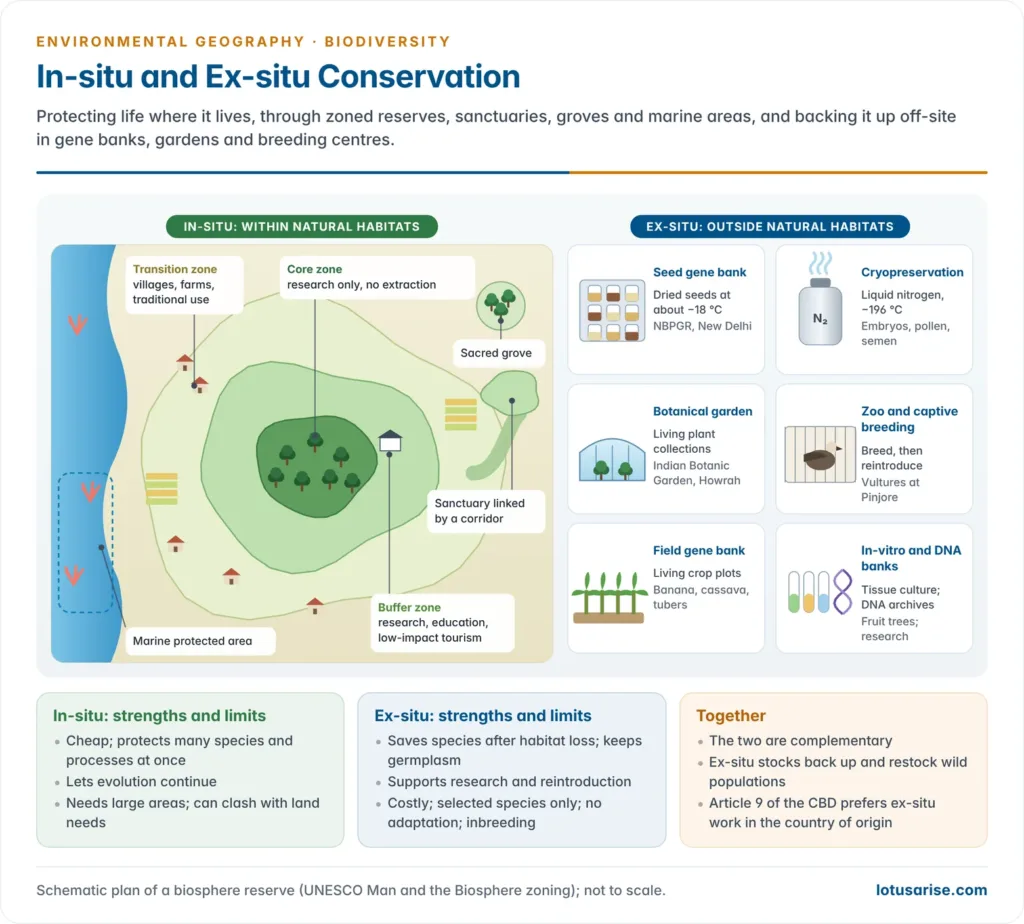
- In-situ conservation protects species in their natural habitats, conserving the whole ecosystem: genes, populations, species, communities and ecological processes. It is the oldest and most fundamental approach, and is cheap, keeps evolution running and protects many species at once.
- Its limits are that it needs large areas and can conflict with people’s land needs.
- National parks: under the Wild Life (Protection) Act 1972, destruction, exploitation or removal of wildlife is prohibited, and grazing is not allowed.
- Examples: Corbett (Uttarakhand), Kaziranga (Assam), Kanha (Madhya Pradesh), Bandipur (Karnataka), the Sundarbans (West Bengal), and Keibul Lamjao (Manipur), the world’s only floating national park.
- Wildlife sanctuaries: protect wildlife like parks, but some rights (grazing, collection of forest produce, private ownership) may continue where they do not harm wildlife.
- Biosphere reserves: under UNESCO’s Man and the Biosphere Programme (1971), people are part of the system. India has notified 18, and 13 are in UNESCO’s World Network; the latest is the Cold Desert reserve of Himachal Pradesh (2025).
| Zone | Permitted activities | Function |
|---|---|---|
| Core | Research and monitoring only | Undisturbed ecosystem; genetic reservoir |
| Buffer | Non-destructive research, education, low-impact tourism | Absorbs edge effects between core and settlements |
| Transition | Settlements, sustainable farming, traditional use, ecotourism | Shows conservation and sustainable development side by side |
- Marine protected areas: intertidal and sub-tidal areas reserved for biodiversity. Examples are the Gulf of Kachchh and Gulf of Mannar marine national parks; the condition of coral reefs depends on them.
- Conservation and community reserves:
- Conservation reserves (added to the Act in 2003) are declared on government land next to PAs, often as buffers and corridors.
- Community reserves are declared on community or private land where people volunteer to conserve wildlife, without affecting their rights.
- Sacred groves, of which India has an estimated over 100,000, are ancient community-protected refugia, from the devrais of Maharashtra to the law kyntang of Meghalaya.
- OECMs (other effective area-based conservation measures) count well-managed areas outside formal PAs, such as community forests, wetlands and defence lands, towards 30×30.
Ex-situ conservation
- Ex-situ conservation keeps species outside their natural habitats. It is a back-up for species whose habitats are destroyed or whose numbers are too low to survive in the wild.
| Method | Technique | Best used for | Indian institution |
|---|---|---|---|
| Seed gene banks | Dried seeds stored at low temperature (about −18 °C for long-term storage) | Crops, wild relatives, orthodox seeds | National Bureau of Plant Genetic Resources (NBPGR), New Delhi; high-altitude seed vault at Chang La, Ladakh |
| Field gene banks | Living plants grown in plots | Vegetatively propagated or non-seeding crops: banana, cassava, tubers | Horticultural and crop research stations |
| In-vitro banks | Tissue culture on nutrient gel in aseptic conditions | Fruit trees, woody and horticultural species | NBPGR tissue-culture units |
| Cryopreservation | Storage in liquid nitrogen at −196 °C, which halts metabolism | Embryos, meristems, pollen, recalcitrant seeds, semen | NBPGR |
| Animal and fish gene banks | Frozen semen, embryos and cell lines of livestock breeds and fish | Native cattle, buffalo, goat and fish germplasm | National Bureau of Animal Genetic Resources, Karnal; National Bureau of Fish Genetic Resources, Lucknow |
| DNA banks | DNA samples in networked databases | Research, taxonomy, biotechnology | National and global DNA bank networks |
| Zoos and captive breeding | Managed breeding, veterinary care, reintroduction | Critically low species where habitat can be secured | Under the Central Zoo Authority: vulture breeding at Pinjore; gharial at Kukrail (Lucknow) |
| Botanical gardens and arboreta | Living plant collections | Rare and threatened plants; education | Acharya Jagadish Chandra Bose Indian Botanic Garden, Howrah; Lloyd Botanical Garden, Darjeeling |
- Limits: ex-situ populations stop evolving with their environment, are costly, cover only selected species and risk inbreeding. In-situ and ex-situ methods are therefore complementary.
- Civil-society bodies add to official efforts. The Biodiversity Conservation Council of India (BiCCI), a public charitable trust, works to document indigenous flora and fauna, protect traditional knowledge of farming, medicine and livestock, and conserve native livestock breeds.
Conservation as a tool of sustainable development
- Sustainable use: harvest within regeneration limits, under community management. Examples are joint forest management, van panchayats and the sustainable collection of non-timber forest produce.
- Access and benefit sharing: the Kani tribe of Kerala shared licence fees for Jeevani, an anti-fatigue drug developed from arogyapacha (Trichopus zeylanicus). This is a classic model of rewarding traditional knowledge.
- Agro-biodiversity conservation: on-farm conservation of landraces, community seed banks, millets promotion (the International Year of Millets, 2023) and the Protection of Plant Varieties and Farmers’ Rights Act 2001.
- Payments and markets: payment for ecosystem services, eco-sensitive zones around PAs, certified ecotourism, and biodiversity-positive business disclosure under GBF Target 15.
- Ecosystem restoration: the UN Decade on Ecosystem Restoration (2021–30), mangrove planting under MISHTI, and wetland revival under Amrit Dharohar.
- Landscape and corridor planning: linking fragments through wildlife corridors, and recovering species such as the tiger, Asiatic lion and one-horned rhino through landscape-level management.
- Mainstreaming: building biodiversity into agriculture, fisheries, infrastructure and urban planning through environmental impact assessment, natural-capital accounting and green budgeting.
- Awareness and values: education, citizen science and the shift in perception and attitude captured by the PAVE framework.
- Species and forest programmes: Project Tiger (1973), Project Elephant (1992), the vulture action plan and the Green India Mission tie wildlife conservation to forest conservation and local livelihoods.
- People’s movements such as Chipko, Appiko and the Silent Valley campaign showed that environmental conservation in India grows out of livelihood struggles as much as out of science.
Challenges and the way forward
- Challenges:
- development pressure from mining, highways, hydropower and urban growth in hotspots such as the Western Ghats, the north-east and Great Nicobar;
- human–wildlife conflict around protected areas and corridors;
- invasive species such as Lantana and Prosopis juliflora;
- weak functioning of many BMCs and PBRs;
- underfunding;
- data gaps for insects, fungi and marine life;
- the uneven sharing of conservation’s costs and benefits.
- The way forward:
- secure community rights within 30×30, so that conservation is with people, not against them;
- reform harmful subsidies, for example on fertiliser and fuel;
- scale up restoration and corridors;
- use natural-capital accounting in national accounts;
- make benefit sharing work at the village level;
- link the CBD, climate and land agendas through nature-based solutions.
- The guiding thought is simple: biodiversity is not a constraint on development but its foundation. Development that destroys it borrows from future generations without their consent.
Previous Year Questions
2026“Sustainable development requires Intergenerational and Intragenerational equity.” Comment with examples.2022How do physiography and climate of India explain the biological diversity of the country?2017Give an account on sustainable development and its components.2015Discuss the methods of conserving biodiversity for sustainable development.2006Write short note: Sustainable development.1994Short note: Biodiversity.


thank u so much…
I hope you have kept this content by keeping UPSC PYQs in mind
Absolutely. The entire breakdown—from the HIPCO framework for biodiversity loss to the In-situ vs. Ex-situ classifications and the Kunming-Montreal GBF targets—has been structured specifically around high-yield themes frequently targeted in UPSC Mains. It is designed to be highly scannable for quick, exam-oriented revision.