- The environment is never static. Temperature, moisture, light, food and enemies change over seasons and over geological time, and an organism must either adjust to the new conditions or face extinction.
- Every major environmental change in Earth history has therefore been matched by the development of new adaptive features in plants and animals.
- An ecological adaptation is any heritable structural, physiological or behavioural feature that raises an organism’s fitness: its ability to survive and reproduce in a particular environment.
- Adaptations touch every part of life: body form and anatomy, food and feeding, way of living, reproduction, defence, and protection against extreme weather.
- Adaptation is a process as well as a product. As a process it is the working of natural selection on inherited variation over generations; as a product it is the trait that results.
- For the geographer, adaptation explains why particular species live where they do, why the world’s biomes look so different from one another, and how one ecosystem can differ so sharply from the next.
Adaptation as an Ecological Process

How adaptations arise
- Charles Darwin and Alfred Russel Wallace set out the mechanism in their joint papers of 1858, and Darwin developed it fully in On the Origin of Species (1859). Natural selection needs three conditions:
- Variation: individuals of a species differ in form and function;
- Inheritance: some of these differences pass from parents to offspring;
- Differential survival and reproduction: in a given environment, some variants leave more offspring than others.
- Over generations the favourable variants spread, and the population becomes better fitted to its environment.
- Adaptation can be fast when the pressure is strong:
- Industrial melanism: dark forms of the peppered moth (Biston betularia) spread on soot-blackened trees in industrial Britain. Bernard Kettlewell’s field experiments in the 1950s showed that birds took more of the pale moths there. Pale forms returned once clean-air laws cut the soot.
- Darwin’s finches: after the 1977 drought on the Galápagos island of Daphne Major, Peter and Rosemary Grant found that finches with deeper beaks, able to crack the hard seeds that remained, survived better, and their offspring inherited the deeper beaks.
- Adaptedness is the state of being fitted to the present environment; adaptation is the process that produces it.
- Exaptation: Stephen Jay Gould and Elisabeth Vrba (1982) used this term for a trait that evolved for one function and was later co-opted for another. Feathers, for example, probably arose for insulation long before they served flight.
- Adaptations have limits:
- Trade-offs: a feature that helps in one setting costs in another. Thick fur protects in winter but overheats in summer.
- Constraints: selection can only work on the variation available and on an inherited body plan.
- Lag: a population adapted to past conditions may be maladapted when the environment changes faster than it can evolve, which is the risk that rapid climate change now poses.
Why adaptation matters in environmental geography
- Adaptations set each species’ range of tolerance, and so explain the factors that govern the distribution of plants and animals: cacti in deserts, mangroves on tidal coasts, yaks on high plateaus.
- Similar climates select similar life forms on different continents, which is why biomes can be recognised worldwide even where their species differ.
- Adaptation also decides how species respond to human-made change: generalists adjust to farms and cities, while narrowly adapted specialists decline first.
- People adapt too, biologically and above all culturally. Human ecological adaptation by environment type, and the cultural adaptation of humans through history, build on the same principles.
Kinds of adaptation
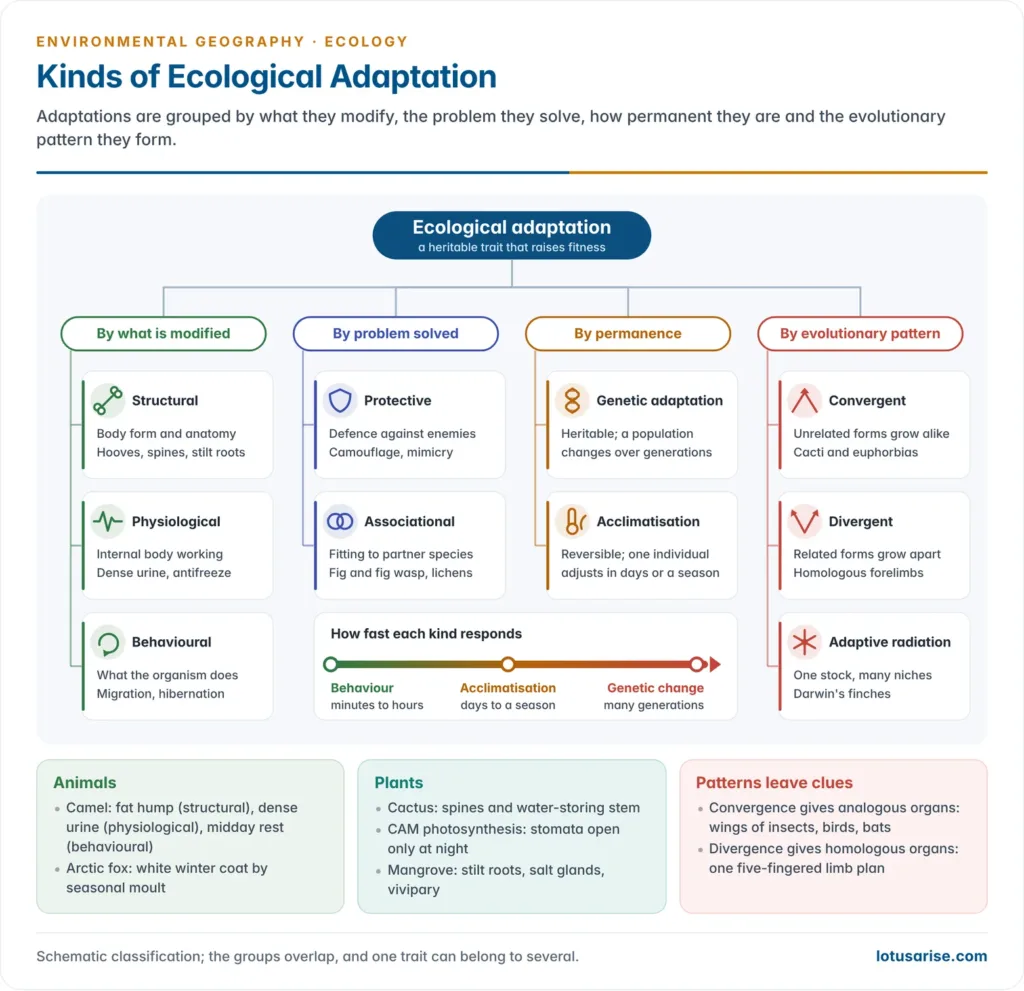
- Adaptations can be grouped by what is modified (form, function or behaviour), by the problem they solve (defence, living with other species), by how permanent they are, and by the evolutionary pattern they form.
| Kind | What changes | Examples |
|---|---|---|
| Structural (morphological) | External form and internal anatomy | Hooves of the blackbuck, spines of cacti, webbed feet of ducks |
| Physiological | Internal working of cells, organs and body systems | Concentrated urine of desert rodents, antifreeze proteins of polar fish, CAM photosynthesis |
| Behavioural | What the organism does | Migration, hibernation, nocturnal activity, burrowing, huddling |
| Protective | Defence against predators and hazards | Camouflage, mimicry, warning colours, armour, venom |
| Associational (co-adaptation) | Mutual fitting of interacting species | Fig and fig wasp, root nodules of legumes, lichens |
Structural (morphological) adaptations
- These are changes in body form and anatomy shaped by the physical environment.
- Animals: streamlined bodies of fast swimmers, long limbs of runners, thick fur in the cold, large ears in hot deserts.
- Plants: spines in place of leaves, succulent stems, air-filled tissues in water plants, stilt roots in mangroves.
- They are the most visible adaptations, and the basis of the locomotory classes of animals described below.
Physiological adaptations
- These modify the internal functioning of the body to meet environmental demands, often with no visible change in form.
- Examples: warm-bloodedness, efficient kidneys that save water, haemoglobin that binds oxygen in thin air, enzymes that work near 0°C or under crushing pressure, salt-excreting glands, and the C4 and CAM pathways of photosynthesis in hot, dry places.
Behavioural adaptations
- These are actions and habits that improve survival: migration, hibernation and aestivation, nocturnal activity in deserts, burrowing, huddling, food storage, nest-building and social defence.
- Behaviour is usually the fastest line of response: an animal can move into shade or a burrow long before its body form can change.
- Most organisms combine all three kinds. The camel’s hump of fat (structural), concentrated urine (physiological) and habit of resting through the midday heat (behavioural) work together.
Protective and associational adaptations
- Protective adaptations defend against predators and hazards, through colour, shape, armour, chemicals or behaviour.
- Associational adaptations fit species to one another, in mutualism, commensalism and parasitism. Such pairs often evolve together.
Genetic adaptation and acclimatisation
- Not every adjustment is inherited. Two time scales need to be kept apart:
- Genetic (evolutionary) adaptation: a heritable change in the gene pool of a population, built over many generations by natural selection.
- Acclimatisation: a reversible adjustment within one individual’s lifetime in response to a changed environment. Ecologists use acclimation for the same response to a single factor under controlled, laboratory conditions.
- The capacity to acclimatise (phenotypic plasticity) is itself inherited and varies between species.
| Basis | Genetic adaptation | Acclimatisation |
|---|---|---|
| Unit | Population or species | Individual |
| Time scale | Generations | Days to weeks or a season |
| Inherited? | Yes, coded in genes | No; reversible |
| Mechanism | Natural selection on variation | Physiological and behavioural adjustment |
| Example | Bar-headed goose haemoglobin that binds oxygen strongly | Lowlanders producing more red blood cells after weeks at high altitude |
| Example | Thick fur and short ears of the Arctic fox | Seasonal moult from a brown summer coat to a white winter coat |
- Plants acclimatise too. Many temperate plants harden in autumn, raising their sugar content and frost tolerance before winter.
- Among people, highland Tibetans carry inherited variants (notably of the EPAS1 gene) that keep haemoglobin from rising too high at altitude, while visiting lowlanders only acclimatise.
Evolutionary patterns of adaptation
- Convergent evolution: unrelated organisms in similar environments evolve similar forms.
- Cacti of the American deserts and cactus-like euphorbias of Africa and India: leafless, spiny, succulent stems from unrelated families.
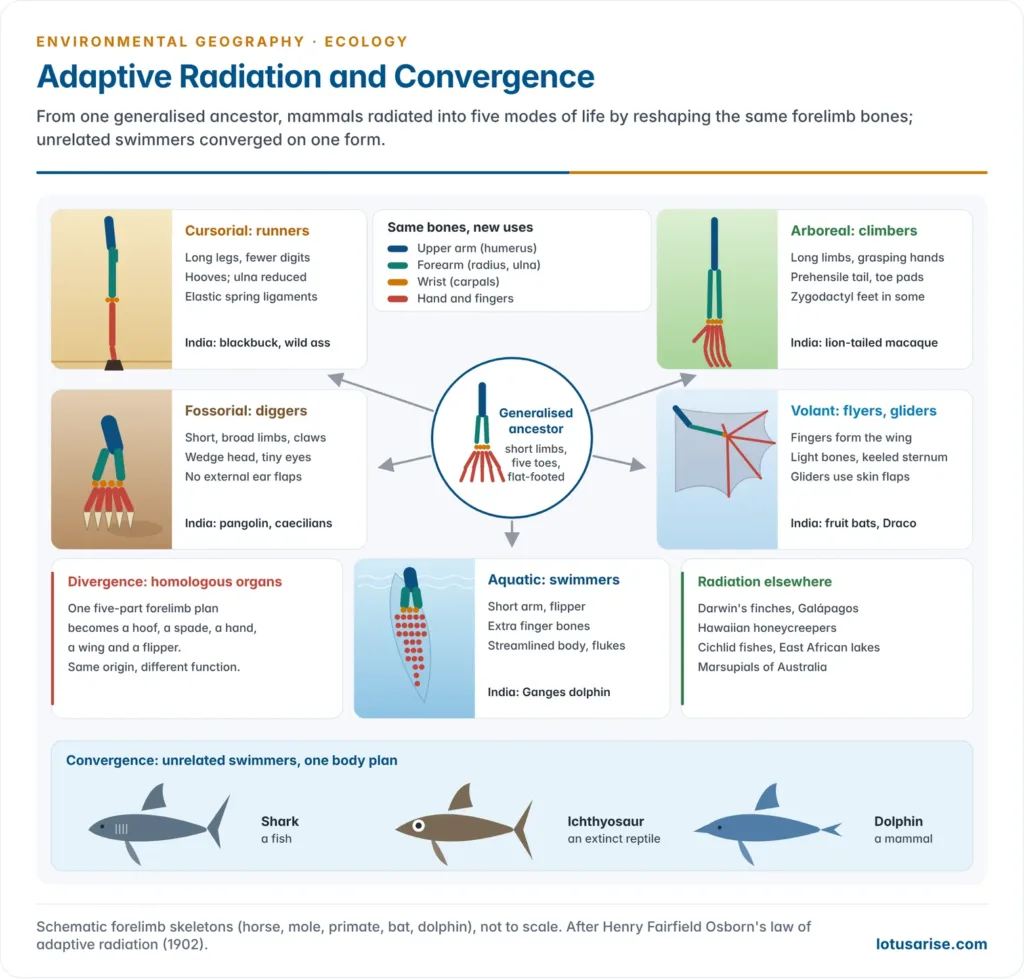
- The shark (a fish), the extinct ichthyosaur (a reptile) and the dolphin (a mammal): all fusiform, with a dorsal fin and a powerful tail.
- The wings of insects, birds and bats are analogous organs: alike in function, different in origin.
- Divergent evolution: related organisms, starting from a common ancestor, become different as they adapt to different environments.
- Their shared structures are homologous organs: the same five-fingered limb forms a whale’s flipper, a bat’s wing, a horse’s leg and a human arm.
- Adaptive radiation: rapid divergence of one ancestral stock into many species, each fitted to a different niche, usually when new land or empty niches become available.
- Darwin’s finches of the Galápagos, the Hawaiian honeycreepers, the cichlid fishes of the East African lakes and the marsupials of Australia are the classic cases.
- Henry Fairfield Osborn (1902) formalised the law of adaptive radiation for mammals: from a short-limbed, five-toed, plantigrade ancestor, lineages radiated into cursorial, fossorial, arboreal, aerial (volant) and aquatic modes of life.
- Parallel evolution: related lineages, separated geographically, independently develop similar adaptations because they started from a similar body plan and met similar conditions.
- Co-evolution: two interacting species adapt to each other reciprocally, as Paul Ehrlich and Peter Raven (1964) showed for butterflies and their food plants.
Animal Adaptations
Locomotory adaptations: Osborn’s habitat types
- The habitat an animal moves through (open ground, soil, trees, air or water) sets the dominant selective pressure on its limbs and body.
Cursorial adaptations: runners of open plains
- Pressure: on open plains with no cover, animals depend on speed, both to cover long distances for food and water and to escape predators. Cursorial comes from the Latin cursor, a runner.
- Structural modifications:
- Streamlined body that cuts drag.
- Change in foot posture from plantigrade (whole sole on the ground: bears) to digitigrade (on the toes: dogs, cats) to unguligrade (on the hoof tips: horses, antelopes). Each step lengthens the stride.
- Lengthening of the lower (distal) limb segments, so each stride covers more ground.
- Reduction of digits, from five to one in the horse: fewer, longer, stronger supports.
- Reduction or fusion of the ulna and fibula, giving a lighter yet stronger limb.
- Limb movement confined to one fore-and-aft plane, so muscle power goes into forward motion.
- Spring ligaments that store and return elastic energy at each stride.
- Tail used for balance in sharp turns at speed.
- In some lineages, bipedal running and keen senses.
- Indian examples:
- Blackbuck (Antilope cervicapra): open grasslands of Rajasthan, Gujarat, Maharashtra and the Deccan; slender limbs, unguligrade feet and bursts of up to about 80 km/h.
- Indian wild ass (Equus hemionus khur): the flat, bare Little Rann of Kachchh.
- Cheetah, the fastest land mammal, has been back in India since its reintroduction to Kuno National Park (Madhya Pradesh) in 2022.
Fossorial adaptations: diggers and burrowers
- Pressure: life underground means darkness, confined space, stable temperatures and the hard work of moving through soil. Fossorial comes from the Latin fossor, a digger.
- Three grades of specialisation:
- Grade I: dig for food, live above ground. Only the digging apparatus (strong forelimbs and claws) is specialised. Examples: armadillos, anteaters, pangolins.
- Grade II: dig for shelter, feed above ground. Mainly the limbs are modified. Examples: rabbits, porcupines, bandicoot rats of Indian farmland.
- Grade III: live permanently underground (true fossorial). Maximum specialisation. Examples: moles, the swamp eels (Synbranchus, Monopterus) and caecilians.
- Structural modifications: worm-like or cylindrical body; wedge-shaped head for pushing through soil; short or no neck; reduced tail; limbs turned into digging paddles or lost; smooth, tough skin; reduced or lost eyes; no external ears (pinnae); well-developed touch organs; specialised digging snouts, claws or teeth; and, in many, winter sleep.
- Indian examples:
- Indian pangolin (Manis crassicaudata): powerful claws for tearing open termite mounds, protective scales and a long sticky tongue; Endangered, and heavily poached for its scales.
- Caecilians (order Gymnophiona), such as Ichthyophis and the Western Ghats endemic Uraeotyphlus: limbless, burrowing amphibians with skin-covered, almost useless eyes.
Arboreal (scansorial) adaptations: climbers
- Pressure: vertical surfaces demand grip and balance in three dimensions, and a fall can be fatal.
- Three categories:
- Wall and rock climbers that rely on friction and flexibility: geckos and lizards.
- Terrestrio-arboreal forms, mainly ground-living but able to climb: leopards, squirrels.
- True arboreal forms, spending almost their entire life in trees: monkeys, gibbons, sloths, chameleons.
- Structural modifications: small, light, compact body; girdles modified for climbing leverage; long upper limb segments for reach; syndactyly (fused digits) and zygodactyly (two toes forward, two back, as in parrots and chameleons) for grip; a prehensile tail acting as a fifth limb; and adhesive toe pads.
- Gecko toe pads carry millions of microscopic hairs (setae) that cling to surfaces through van der Waals forces.
- Indian examples:
- Lion-tailed macaque (Macaca silenus): Endangered, endemic to the rainforests of the Western Ghats, and rarely descends to the ground.
- Malabar giant squirrel (Ratufa indica), the state animal of Maharashtra: leaps several metres between canopy trees.
- Hoolock gibbons, India’s only apes, in the forests of the North-East: swing arm over arm (brachiation) on very long arms.
- Tokay gecko of North-East India: the textbook adhesive toe pad.
Volant adaptations: flyers and gliders
- Pressure: flight must overcome gravity continuously. It is the most energy-demanding mode of movement and requires lightness, power and precise control.
- Active (true) flight: birds, bats and the extinct pterosaurs: self-powered, sustained flight on wings made from modified forelimbs.
- Passive flight (gliding): flying squirrels, flying lizards, flying frogs and flying snakes glide on skin membranes (patagia), webbed feet or flattened bodies, but cannot gain height under their own power.
- Western Ghats gliders include the flying lizard (Draco dussumieri) and the Malabar gliding frog (Rhacophorus malabaricus).
- Structural modifications for active flight: wings; streamlined body; reduced body weight; hollow bones, braced inside and linked to air sacs in birds; a keeled breastbone to anchor the flight muscles; high metabolic rate; and highly developed sense organs.
- Physiological adaptations for flight reshape almost every body system:
| System | Adaptation | Purpose |
|---|---|---|
| Skeleton | Light, hollow long bones with internal struts | Low weight with high strength |
| Muscles | Breast (flight) muscles massive; back muscles reduced | Power where the downstroke needs it |
| Digestion | High food intake, rapid digestion | Fuels a very high metabolic rate |
| Respiration | Air-sac system; air flows one way through the lungs | Oxygen extracted during both inhalation and exhalation |
| Circulation | Large heart relative to body size; rapid blood flow | Fast oxygen delivery to the muscles |
| Temperature | Warm-blooded (endothermic) | Flight in all seasons and at altitude |
| Excretion | Uric acid; little water lost | Lower weight; water saved |
| Brain and senses | Large brain, keen eyes, sensitive inner ear | Three-dimensional navigation and balance |
| Reproduction | Gonads shrink outside the breeding season | Weight saved |
- Indian examples:
- Bar-headed goose (Anser indicus): crosses the Himalaya between Central Asian breeding lakes and Indian wetlands. Satellite tracking has recorded flights up to 7,290 m, though most crossings stay below about 6,000 m and follow the valleys. Its haemoglobin binds oxygen unusually strongly.
- Great hornbill: its massive casque is light, with a honeycomb-like internal structure, which illustrates the principle of weight saving.
- Amur falcon: breeds in south-eastern Siberia and northern China and winters in southern Africa. It gathers in very large numbers in Nagaland (around Doyang reservoir) each October–November, then makes a non-stop crossing of the Arabian Sea.
Protective adaptations
- Cryptic colouration (camouflage): colour and pattern that blend with the background.
- Tiger stripes in tall grass, the rosettes of the snow leopard on rock, leaf and stick insects, and sand-coloured desert animals.
- Countershading, dark above and pale below, cancels the shadow that would reveal a body’s shape.
- Seasonal colour change: the stoat, mountain hare and ptarmigan turn white in winter.
- Mimicry:
- Batesian mimicry (Henry Walter Bates, 1862): a harmless species copies a harmful one. The female common mormon butterfly mimics the distasteful common rose.
- Müllerian mimicry (Fritz Müller, 1878): several distasteful species share one warning pattern, so predators learn it faster, as in the tiger and crow butterflies.
- Aggressive mimicry: a predator imitates something harmless or attractive, like the lure of the anglerfish.
- Warning colouration (aposematism): bright colours advertise poison or venom: poison dart frogs, coral snakes, many wasps.
- Armour and spines: pangolin scales, tortoise shells, porcupine quills, the spiny skins of desert lizards.
- Chemical defence: the spray of the skunk, the boiling chemical jet of the bombardier beetle, and venom in snakes, scorpions and spiders.
- Defensive behaviour: autotomy (a lizard shedding its tail), playing dead, rolling into a ball (pangolins), group vigilance and alarm calls.
Adaptations in species associations
- Species that live together adapt to one another. Their population interactions, from mutualism to parasitism, are themselves products of adaptation.
- Mutualism: both partners benefit, often so closely that neither survives alone.
- Each fig species is pollinated by its own fig wasp, which breeds only inside its figs.
- Rhizobium bacteria fix nitrogen in the root nodules of legumes, and mycorrhizal fungi extend plant roots.
- Lichens join a fungus and an alga; clownfish shelter among the stinging tentacles of sea anemones.
- Commensalism: one benefits and the other is unaffected. Cattle egrets feed on insects disturbed by grazing cattle.
- Parasitism: parasites carry hooks and suckers, reduced sense and digestive organs (tapeworms absorb food through the body wall) and very high fecundity.
- Co-evolution produces matched traits such as long-tubed flowers and long-billed sunbirds, and the arms race of toxic plants and resistant insects.
Desert animals
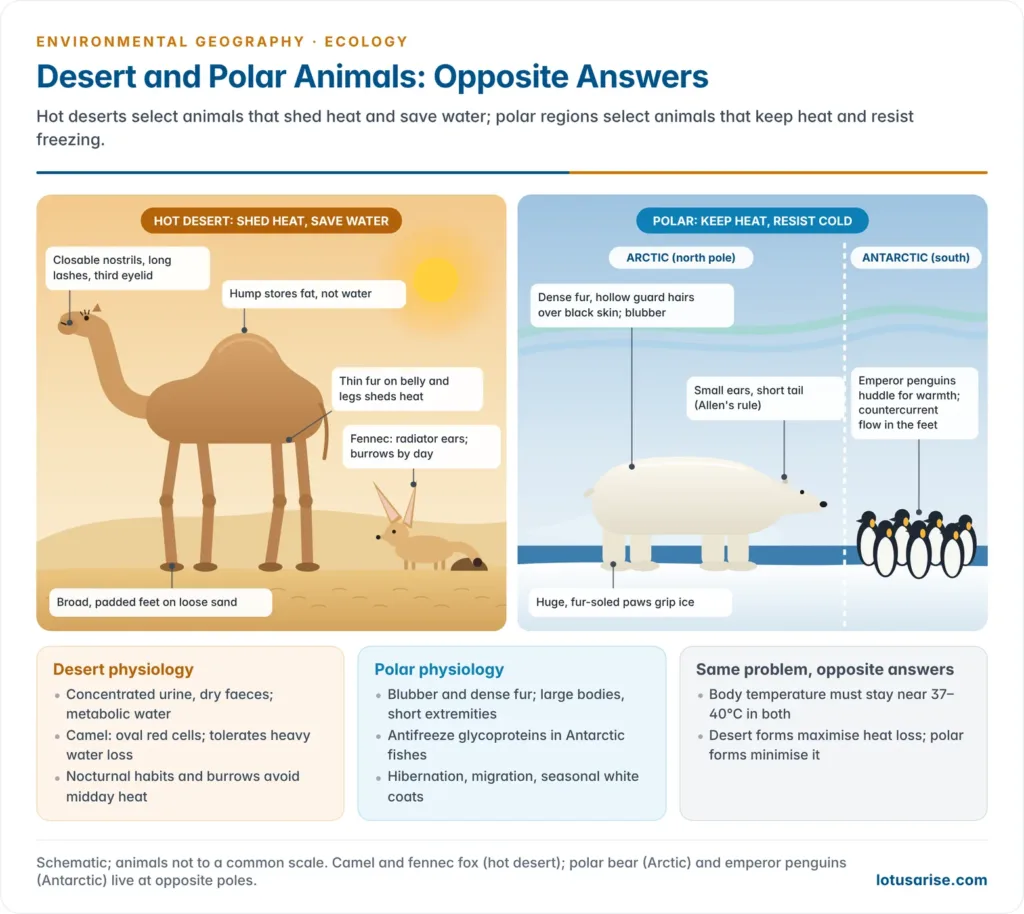
- Deserts receive less than about 250 mm of rain a year, with high evaporation, intense sunshine and wide daily and seasonal temperature ranges.
- Sand surfaces can become far hotter than the air above them; the main challenges are scarcity of water, extremes of heat, and dust and sand storms.
Conserving body water
- Concentrated urine and dry faeces: long kidney tubules reabsorb almost all water.
- Metabolic water: the kangaroo rat of North American deserts can live without drinking, on water released by oxidising the food it eats.
- Nocturnal and crepuscular habits: activity in the cool hours cuts water lost in breathing and cooling.
- Burrowing: a burrow a short distance down is cooler and more humid than the surface.
Shedding and avoiding heat
- Radiator ears: the fennec fox of the Sahara and the jackrabbits of North America have very large, blood-rich ears that lose heat to cooler air.
- Uneven fur: camels, desert sheep and goats keep thick fur on the back against solar heat but thin fur on the belly and legs to lose heat.
- Long legs raise the body above the hottest layer of air next to the sand.
- Pale, reflective colouring cuts the heat absorbed.
Sand, wind and movement
- Closable nostrils, hair-fringed ears, long eyelashes and a third, transparent eyelid (nictitating membrane) keep out blowing sand.
- Broad, padded feet or fringed toes spread weight on loose sand.
- Speed and stamina let animals cover great distances between scattered food and water.
Colour, spines, venom and behaviour
- Cryptic sandy colours hide most desert animals, while poisonous ones (some lizards, rattlesnakes, scorpions) carry warning colours.
- Spinescence: horned lizards and Australia’s thorny devil bristle with spines that deter predators; the thorny devil’s skin grooves also draw water to its mouth.
- On the fog-bathed Namib, fog-basking beetles stand head-down into the wind so that fog condenses on their backs and runs to their mouths.
- Venom serves both defence and predation: the Gila monster and the Mexican beaded lizard of the south-western United States and Mexico, rattlesnakes, scorpions and tarantulas.
- Clever defences: the chuckwalla wedges itself into a rock crevice and inflates its body so it cannot be pulled out; the kangaroo rat kicks sand into the face of an attacking rattlesnake.
- Indian examples, the Thar:
- Dromedary camel: the hump stores fat, not water, an energy reserve for lean spells. Its oval red blood cells keep flowing in thickened blood and swell greatly without bursting on rehydration, and it tolerates the loss of a quarter or more of its body weight as water. It also has slit-like closable nostrils, padded feet and a third eyelid.
- Desert fox (Vulpes vulpes pusilla): large ears, sandy coat, nocturnal habits.
- Spiny-tailed lizard (Saara hardwickii): burrowing, herbivorous, gets much of its water from plants.
- Desert monitor, Indian gerbil and chinkara, which can go long periods without drinking.
- Great Indian bustard of Desert National Park, Jaisalmer: grey-brown, cryptic plumage on open grassland and scrub.
Cold and polar animals
- Polar and cold regions pose the opposite problem: conserving heat, finding food in a short season and coping with ice and snow.
- Insulation:
- Blubber of seals and whales; dense double-layered fur and underfur; the polar bear’s long, hollow guard hairs over black skin.
- Feathers fluffed to trap air in birds.
- Body shape: large body size and short ears, legs and tails cut the surface through which heat escapes (Bergmann’s and Allen’s rules, below).
- Countercurrent heat exchange: warm arterial blood heading into legs, flippers and feet warms the cold venous blood returning, so little heat is lost at the extremities. This is how Arctic foxes and wolves in the north, and penguins in the Antarctic, stand on ice.
- Antifreeze and freeze tolerance:
- Antarctic notothenioid fishes produce antifreeze glycoproteins that stop ice crystals growing in their blood, first described by Arthur DeVries in the late 1960s.
- The wood frog of North America survives with much of its body water frozen, packing its cells with glucose as a cryoprotectant.
- Behaviour: huddling by thousands of emperor penguins through the Antarctic winter; hibernation; migration to milder latitudes; snow burrows for ptarmigans and lemmings.
- Seasonal white coats in the Arctic fox, Arctic hare and ptarmigan for camouflage on snow.
- Indian examples: the Himalayan brown bear and Himalayan marmot hibernate through winter; the Changthangi goat of Ladakh grows the fine pashmina undercoat.
High-altitude animals
- Pressures: hypoxia (thin air: at about 5,500 m the air holds roughly half the oxygen of sea-level air), intense cold, strong ultraviolet radiation, strong winds and a short growing season. The fragility of these mountain ecosystems makes their specialists vulnerable.
- Adaptations:
- Haemoglobin with high oxygen affinity: bar-headed goose, yak, llama and deer mice of the high Rockies and Andes.
- Large lungs and hearts, more capillaries in the muscles, and efficient breathing.
- Dense wool or fur, and fat layers for the cold.
- Hibernation or food storage to bridge the winter: the pika gathers haypiles of grass.
- Indian Himalayan examples:
- Yak: a dense undercoat, a thick fringe of long hair, large lungs and heart, and few sweat glands.
- Snow leopard: thick fur, small rounded ears, wide furry paws that act as snowshoes, an enlarged nasal cavity that warms cold air, and a long, thick tail used for balance and wrapped over the face as a muffler.
- Tibetan antelope (chiru): the fine shahtoosh underwool, for which it was hunted almost to extinction.
- Bar-headed goose and Himalayan griffon: high-altitude flight.
Aquatic animals
- Aquatic animals live in seas, rivers, lakes, ponds and marshes. They fall into two groups by evolutionary history.
Primary aquatic animals
- Primary aquatic animals have never left water; their ancestors were aquatic too. Fishes are the classic group.
- Adaptations of fishes:
- Body shape: fusiform (spindle-shaped), laterally compressed or torpedo-shaped, all cutting drag.
- Fins: paired (pectoral, pelvic) and unpaired (dorsal, anal, caudal) for thrust, steering, balance and braking.
- Muscles in segmented blocks (myomeres) for undulating swimming.
- Gills: thin, richly supplied membranes that extract dissolved oxygen.
- Swim bladder: a gas-filled float that holds the fish at a depth without effort.
- Lateral line: pressure-sensing organs along the flanks that detect currents, movement and obstacles in murky water.
- Scales coated with mucus that cut friction and resist infection.
- Indian example: the mahseer (Tor species) of fast Himalayan and Western Ghats rivers, with a powerful body, large scales and strong fins for torrential water.
Secondary aquatic animals
- Secondary aquatic animals descend from land ancestors and have returned to water: turtles, crocodiles, whales, dolphins, seals, sea lions and, partly, the hippopotamus.
- They keep signs of their land ancestry: lungs, warm blood in the mammals, and egg-laying on land in turtles and crocodiles.
- Adaptations: a streamlined body that converges on the fish form; a short or absent neck; waterproof skin; limbs turned into flippers, or the hind limbs lost in whales; fins and tail flukes that are not homologous with fish fins; dense bones for ballast in the hippopotamus; and echolocation in toothed whales and dolphins.
- Indian examples:
- Ganges river dolphin (Platanista gangetica), India’s national aquatic animal: practically blind, with tiny eyes lacking a lens, it hunts in silt-laden water by echolocation, often swimming on its side.
- Gharial (Gavialis gangeticus): Critically Endangered; its long, narrow snout snaps sideways at fish. The Chambal is its stronghold, with smaller groups in the Girwa, Son and Mahanadi. Its weak legs make it clumsy on land.
- Olive ridley turtle: spends its life at sea but returns to the Odisha coast at Gahirmatha, Rushikulya and the Devi river mouth to nest en masse (arribada), a reminder of its land ancestry.
Cave animals
- Caves are natural hollows below the ground or within mountains, mostly dissolved in limestone by underground water.
- Their interior is marked by total darkness, near-constant temperature, high humidity, still air and scarce food, which comes in from outside as bat guano, flood debris and roots.
- Zones of a cave:
- Entrance zone: light and outside conditions; the richest mix of species.
- Twilight zone: dim light; conditions still fluctuate.
- Variable-temperature zone: dark, but seasonal changes in temperature are still felt.
- Deep (dark) zone: permanent darkness, constant temperature and humidity; home of the most specialised cave dwellers.
- Ecological classes of cave animals:
- Trogloxenes use caves but must leave to feed: bats, cave swiftlets.
- Troglophiles can complete their life cycle in caves or outside: some crickets and spiders.
- Troglobionts (troglobites) are obligate cave dwellers; their aquatic counterparts are stygobionts.
- Adaptive features of troglobionts: darkness is the overriding pressure.
- Loss of pigment: colourless, pale or translucent bodies.
- Reduction or loss of eyes: vestigial eyes in recent colonists, none in long-established ones.
- Slender bodies and long, thin appendages.
- Highly developed touch, smell and vibration senses: long antennae, sensitive whiskers, an enlarged lateral line in fish.
- Slow metabolism, long life and few, large eggs, which suit a food-poor habitat.
- Thin exoskeleton in cave arthropods.
- Regressive evolution: where a structure gives no advantage, its upkeep is a cost, so selection no longer maintains it. The Mexican tetra (Astyanax mexicanus) shows it within one species: its cave populations are blind and pale, while its river populations have working eyes.
- Indian examples:
- The limestone caves of Meghalaya are among the longest known in Asia. In 2023 a cave fish from Krem Um Ladaw and Krem Chympe in the Jaintia Hills was described as Neolissochilus pnar. Its adults exceed 40 cm, it has no pigment, and its eyes are invisible externally in adults; it is the largest subterranean fish known.
- Wroughton’s free-tailed bat (Otomops wroughtoni), a trogloxene, roosts in the Barapede caves of Karnataka and in Meghalaya’s caves, with a record from Cambodia; it depends on caves for roosting.
Deep-sea animals
- The deep sea lies below about 200 m; the hadal zone is below about 6,000 m. It is the most stable environment on Earth, but extreme:
- Darkness: no sunlight below about 1,000 m;
- Cold: a few degrees above 0°C at depth;
- Pressure: rising by about 1 atmosphere every 10 m, so about 1,000 atmospheres at 10,000 m;
- Scarce food: no photosynthesis, so food sinks from above as marine snow.
- Adaptations:
- Bioluminescence: light made by the animals themselves for luring prey (the anglerfish’s lure), finding mates and counter-illumination camouflage. Deep-sea surveys by remotely operated vehicles found about three-quarters of the animals in the water column can produce light.
- Pressure: no gas-filled spaces that would be crushed, so no swim bladder; flexible cell membranes; enzymes that work under pressure; and small molecules such as TMAO (trimethylamine N-oxide) that stabilise proteins.
- Scarce food: huge mouths and expandable stomachs (the gulper eel swallows prey as large as itself), slow metabolism, and keen smell.
- Vision: some lose their eyes; others have huge tubular eyes tuned to faint bioluminescent flashes.
- Soft, watery or gelatinous bodies with little calcified skeleton, which saves energy.
- Hydrothermal vent communities are fed by chemosynthetic bacteria instead of sunlight, in water around vents that can exceed 350–400°C.
- India and the deep sea:
- The Deep Ocean Mission (approved 2021, ₹4,077 crore) is building the crewed submersible Matsya 6000 for dives to 6,000 m under its Samudrayaan project. In August 2025, two Indian aquanauts dived to about 5,000 m aboard a French submersible in preparation.
- In 2024 Indian oceanographers captured their first images of an active hydrothermal vent on an Indian Ocean ridge.
Coping with seasons and climatic variation
- Where temperature and rainfall swing through the year, animals avoid, resist or ride out the unfavourable season.
- Hibernation: a deep winter sleep with sharply lowered body temperature, heart rate and metabolism, as in marmots, many bats and hedgehogs. Bears enter a lighter winter dormancy.
- Aestivation: dormancy through the hot, dry season. African lungfish seal themselves in mucus cocoons in dried mud; desert snails and tortoises do the same in other ways.
- Diapause: a hormonally timed pause in the development of insects, often as eggs or pupae.
- Daily torpor: a nightly drop in body temperature in hummingbirds and some bats, which saves energy.
- Migration: seasonal movement to better conditions: the Amur falcon, the bar-headed goose, the vast herds of wildebeest in East Africa, and the olive ridley’s return to its nesting beaches. Such migration links distant habitats.
- Food caching, fat storage, moulting and seasonal coat change help animals bridge the lean season in place.
- Breeding timed to the season of plenty: many birds of the Indian subcontinent nest with the monsoon.
Comparative summary of animal adaptations
| Habitat type | Main pressure | Key structural change | Key physiological or behavioural change | Indian example |
|---|---|---|---|---|
| Cursorial | Speed on open plains | Long limbs, fewer digits, hooves | Spring ligaments; fast muscles | Blackbuck, wild ass |
| Fossorial | Digging through soil | Digging limbs, wedge head, lost eyes and ears | Keen touch | Pangolin, caecilians |
| Arboreal | Grip and balance | Prehensile tail, zygodactyly, toe pads | Three-dimensional spatial sense | Lion-tailed macaque, gecko |
| Volant | Gravity, cost of flight | Wings, hollow bones, keeled sternum | Endothermy, air sacs, high metabolism | Bar-headed goose |
| Desert | Water loss, heat | Radiator ears, padded feet, spines | Concentrated urine, metabolic water, nocturnality | Camel, desert fox |
| Cold and polar | Heat loss | Large body, short appendages, blubber, thick fur | Countercurrent exchange, antifreeze, hibernation | Snow leopard, marmot |
| High altitude | Hypoxia, cold | Large lungs and heart, dense wool | High-affinity haemoglobin | Yak, bar-headed goose |
| Aquatic (primary) | Water resistance, dissolved oxygen | Fusiform body, fins, lateral line | Gills, swim bladder | Mahseer |
| Aquatic (secondary) | Return to water | Flippers, streamlined body | Lungs retained, echolocation | River dolphin, gharial |
| Cave | Darkness, scarce food | Lost eyes and pigment, slender body | Keen touch and smell, slow metabolism | Meghalaya cave fish |
| Deep sea | Darkness, pressure, scarce food | Light organs, gelatinous body, huge mouth | Pressure-tolerant enzymes, slow metabolism | Vent and abyssal fauna |
Plant Adaptations
- Plants cannot move away from stress, so their adaptations are mainly structural and physiological, and they are shaped above all by water, salt, light and temperature. The resulting groups form the ecological classification of plants.
Adaptations along the moisture gradient
Hydrophytes: plants of water
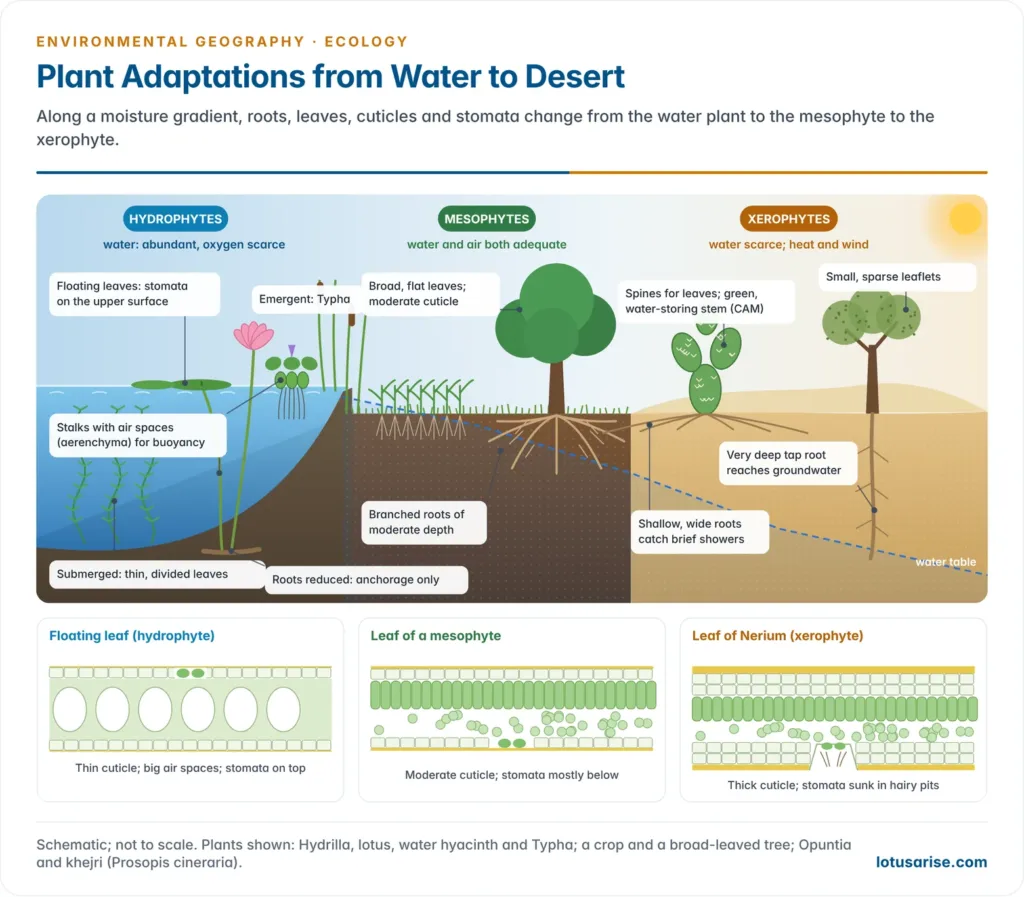
- Hydrophytes grow in water or in waterlogged soil, where water is plentiful but oxygen is scarce and support comes from buoyancy.
- Types:
- Submerged: wholly under water; Hydrilla, Vallisneria.
- Free-floating: water hyacinth (Eichhornia), with swollen, spongy leaf stalks; Pistia.
- Rooted with floating leaves: lotus and water lilies.
- Emergent (amphibious): rooted in shallow water with shoots in the air; Typha (cattail), reeds.
- Adaptations:
- Roots reduced, absent or used mainly for anchorage, since water and nutrients are absorbed over the whole surface.
- Aerenchyma: large air spaces in stems and leaves store oxygen and give buoyancy.
- Little or no supporting tissue, so stems are soft and flexible.
- Thin or no cuticle; submerged leaves are thin, narrow or finely divided.
- Stomata absent in submerged leaves and only on the upper surface of floating leaves.
- Heterophylly: different submerged and aerial leaves on the same plant.
- Vegetative reproduction by runners and fragments, which makes water hyacinth such an aggressive weed.
Mesophytes: plants of moderate moisture
- Mesophytes grow where water and air are both adequate: most crops, grasses and the trees of temperate and humid tropical forests.
- Adaptations: well-developed, branched root systems; broad, flat leaves with a moderate cuticle; stomata mostly on the lower leaf surface; and normal supporting tissue.
Xerophytes: plants of dry habitats
- Xerophytes live where water is scarce or hard to obtain: hot and cold deserts, sand dunes, bare rock and saline ground.
- Three strategies:
- Drought escapers (ephemerals): complete their life cycle in a few weeks after rain, surviving the dry season as seeds. The Thar blooms with them after the monsoon.
- Drought evaders (succulents): store water in fleshy stems or leaves: Opuntia, the cactus-like Euphorbia, Aloe and Agave. Most use CAM photosynthesis, opening their stomata only at night.
- Drought endurers (non-succulent perennials): survive with deep or wide roots and water-saving leaves: khejri (Prosopis cineraria), Acacia, ak (Calotropis), and the leafless kair (Capparis decidua).
- Root adaptations: very long tap roots reach deep groundwater, while shallow, wide-spreading roots catch brief showers.
- Stem adaptations: phylloclades, green flattened stems that take over photosynthesis (Opuntia); water storage tissue; thick bark.
- Leaf adaptations:
- Leaves small, reduced to spines or shed in the dry season.
- Thick, waxy cuticle and hairs that reflect light and trap still air.
- Sunken stomata in pits lined with hairs (Nerium, oleander).
- Rolled or folded leaves that enclose the stomata (marram grass on dunes).
- Phyllodes: flattened leaf stalks in place of leaves (Australian acacias).
- Physiological adaptations: high osmotic pressure in the cells, CAM and C4 photosynthesis that save water, and dormancy in the driest months.
| Feature | Hydrophyte | Mesophyte | Xerophyte |
|---|---|---|---|
| Roots | Reduced or absent; anchorage | Well branched, moderate depth | Very deep tap roots or wide shallow mats |
| Stem | Soft, spongy, with air spaces | Normal, woody or herbaceous | Woody, or succulent and water-storing |
| Leaves | Thin, divided or floating | Broad, flat | Small, spiny, waxy or absent |
| Cuticle | Thin or absent | Moderate | Thick and waxy |
| Stomata | None (submerged) or upper surface (floating) | Mostly lower surface | Few, sunken, often closed by day |
| Supporting tissue | Little | Normal | Abundant |
| Examples | Hydrilla, lotus, water hyacinth, Typha | Wheat, mango, sal | Opuntia, khejri, Calotropis, Nerium |
Halophytes and mangroves
- Halophytes tolerate salt: they grow on saline soils and tidal coasts, where salt water causes physiological drought even though water surrounds them.
- Ways of handling salt:
- Exclusion: roots filter out most salt as water enters (Rhizophora).
- Secretion: salt glands on the leaves excrete salt crystals (Avicennia).
- Accumulation with succulence: fleshy tissues dilute the salt (Salicornia, Suaeda of salt marshes and the Rann of Kachchh).
- Mangroves add adaptations to soft, oxygen-poor, tidal mud:
- Stilt (prop) roots of Rhizophora brace the tree in soft mud.
- Pneumatophores, vertical breathing roots that rise above the mud, of Avicennia and Sonneratia, with knee roots in Bruguiera.
- Vivipary: seeds germinate on the parent tree, and the long seedling (propagule) drops into the mud or floats away.
- Thick, leathery leaves that save fresh water.
- India: mangrove cover is about 4,992 sq km (India State of Forest Report 2023), with West Bengal (the Sundarbans, named after the sundari tree Heritiera fomes) holding over two-fifths, followed by Gujarat and the Andaman and Nicobar Islands. Bhitarkanika in Odisha is another major block.
Epiphytes, climbers, parasites and insectivorous plants
- These plants are adapted to light, space and nutrients rather than to water alone.
- Epiphytes grow on other plants for access to light, without taking food from them: orchids, ferns, mosses and the tank bromeliads of tropical America.
- Aerial roots with a spongy velamen layer soak up rain and humid air (Vanda orchids).
- Some store water in thick leaves or pseudobulbs, and tank bromeliads catch it in leaf rosettes.
- The humid forests of North-East India and the Western Ghats are rich in epiphytic orchids.
- Climbers and lianas root in the ground but climb to the canopy with tendrils, twining stems, hooks or adhesive roots, saving the cost of a self-supporting trunk.
- Parasitic plants draw food from a host through haustoria:
- Total parasites such as Cuscuta (dodder) have no chlorophyll.
- Partial parasites such as the mistletoes (Loranthus, Dendrophthoe) photosynthesise but take water and minerals from the host.
- Root parasites include Rafflesia of Sumatra and Borneo and Sapria himalayana of Arunachal Pradesh.
- Insectivorous plants grow on nitrogen-poor, waterlogged or acid soils and trap insects for nitrogen:
- Pitchers: the pitcher plant Nepenthes khasiana, endemic to Meghalaya.
- Sticky tentacles: sundews (Drosera).
- Underwater bladders: bladderworts (Utricularia).
Adaptations to light, temperature and the seasons
- Light:
- Heliophytes (sun plants) have small, thick leaves and high photosynthetic capacity.
- Sciophytes (shade plants) of the forest floor have broad, thin leaves rich in chlorophyll.
- In dense rainforest, drip-tip leaves shed water quickly.
- Photoperiodism: the response of plants to day length, discovered by Wightman Garner and Harry Allard (1920). It times flowering to the season:
- Short-day plants: rice, soybean, chrysanthemum;
- Long-day plants: wheat, spinach, radish;
- Day-neutral plants: tomato, cucumber.
- Vernalisation: some plants, such as winter wheat and rye, flower only after a spell of cold, which keeps them from flowering before winter.
- Deciduousness: tropophytes change with the seasons. The trees of India’s tropical deciduous forests, teak and sal among them, shed leaves in the dry season to cut water loss, as temperate trees do in the winter cold.
- Dormancy of seeds, buds and underground organs (bulbs, rhizomes, tubers) carries plants through cold or drought.
- Photosynthetic pathways:
- C3 plants, such as wheat and rice, suit cool, moist conditions.
- C4 plants, such as maize, sugarcane, sorghum and most tropical grasses, concentrate carbon dioxide and so photosynthesise efficiently in heat and strong light with less water loss.
- CAM plants, such as cacti, pineapple and Agave, open their stomata at night.
- Cold and alpine plants:
- Cushion and rosette forms hug the ground, out of the wind.
- Dense hairs, dark pigments that absorb heat, and antifreeze sugars.
- Short life cycles fit the brief summer.
- The Sikkim rhubarb (Rheum nobile) builds a tower of translucent bracts that acts as a glasshouse over its flowers, and the Brahma kamal (Saussurea obvallata) shelters its flower heads within papery bracts.
- Fire:
- Thick bark: the chir pine of the Himalaya.
- Resprouting from underground lignotubers: eucalypts.
- Serotinous cones that release seed only after fire: lodgepole pine.
Ecogeographic Rules
- Ecogeographic rules describe regular geographic trends in the form of animals within a widely distributed group, linked to climate. They are the clearest evidence that climate shapes body form across space.
The classic rules
| Rule | Proponent | Statement | Example |
|---|---|---|---|
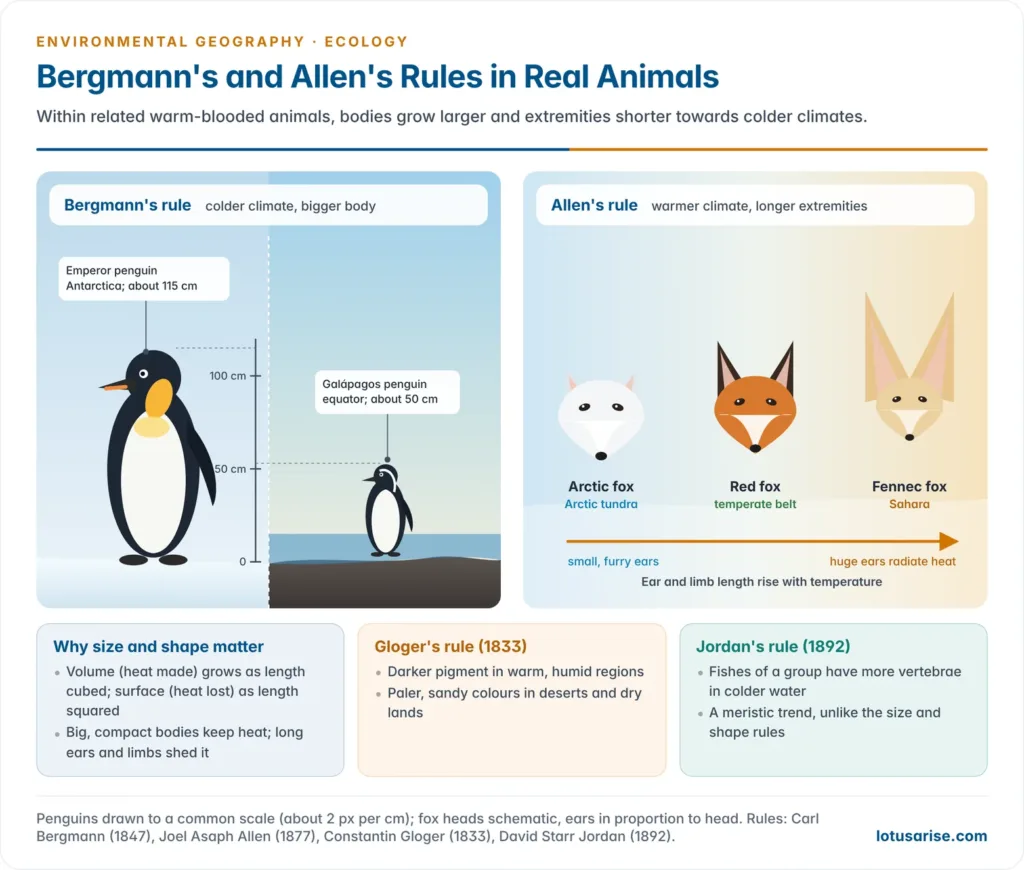
| Bergmann’s rule | Carl Bergmann (1847) | Within a widespread group of warm-blooded animals, body size is larger in colder climates (higher latitudes and altitudes) | Amur tiger much heavier than Sumatran tiger; emperor penguin (Antarctic) far larger than Galápagos penguin (equator) |
| Allen’s rule | Joel Asaph Allen (1877) | Appendages (ears, limbs, tails, bills) are shorter in colder climates and longer in warmer ones | Arctic fox (small ears), red fox, fennec fox (huge ears); Arctic hare versus desert jackrabbit |
| Gloger’s rule | Constantin Wilhelm Lambert Gloger (1833) | Animals are more heavily pigmented in warm, humid regions and paler in dry regions | Dark races of birds and mammals in humid forests; pale sandy races in deserts |
| Jordan’s rule | David Starr Jordan (1892) | Fishes of a group have more vertebrae in colder waters | Northern populations of a species with more vertebrae than southern ones |
| Island rule | J. Bristol Foster (1964) | On islands, large mammals tend to become dwarfs and small mammals giants | Extinct dwarf elephants of Mediterranean islands; giant island rodents |
- Bergmann’s rule rests on geometry. As an animal grows, its volume (heat production) rises faster than its surface (heat loss): volume grows as the cube of length, surface only as the square.
- A larger body therefore has less surface per unit of volume and keeps heat better in the cold, while small bodies shed heat more easily in the heat.
- Allen’s rule follows the same logic: short extremities lose less heat in the cold, while long ears and limbs act as radiators in hot climates.
- Gloger’s rule: dark melanin pigments resist feather- and hair-degrading bacteria in humid climates, absorb heat, and match the darker vegetation. Pale colours suit the bright, open background of deserts.
- Human populations show parallel trends: the stocky build and short limbs of Arctic peoples, the tall, long-limbed build of East African herders, and darker skin under strong tropical sunlight.
- The island rule reflects limited food and space for large species and fewer predators and competitors for small ones on islands.
Evaluation and the warming world
- The rules are tendencies, not laws. Many species follow them; many do not.
- Cold-blooded animals often show the reverse of Bergmann’s rule, because a large body warms up too slowly in a short, cool summer.
- Body size also tracks food supply, season length, predation and moisture, not only temperature.
- Whether heat loss is the real cause of Bergmann’s trend is still debated. Larger animals also resist starvation better through long winters.
- Climate change is now testing the rules in real time:
- Among 70,716 migratory birds of 52 North American species collected in Chicago between 1978 and 2016, body size fell in all 52 species while wing length rose, consistent with Bergmann’s rule under warming (Brian Weeks and colleagues, 2020).
- A 2021 review led by Sara Ryding found many warm-blooded animals “shape-shifting” with larger bills, ears, tails or legs, as Allen’s rule predicts. The bills of several Australian parrots have grown by about 4–10% since 1871.
- Where body form cannot change fast enough, species move instead, and the resulting poleward and upslope range shifts are the other face of adaptation under climate change.
- Specialists suffer most: endemics of narrow habitats (high mountain, cave, island) cannot easily move or change, and are the first to be lost.
Previous Year Questions
2026How does the annual variations in temperature and precipitation influence plants growth, development and distribution? How do animals cope up with variations in climate?2022Plants and animals that exist in a particular ecosystem are those that have been successful in adjusting to their habitat and environmental conditions. Elucidate with examples.