

- Human adaptation is only partly biological. Body form and physiology adjust slowly to heat, cold and altitude, as the ecogeographic rules of Bergmann and Allen describe, but these explain only a small part of humanity’s spread across every biome.
- The far more powerful force is cultural adaptation: the capacity to change behaviour, technology, social organisation and worldview in response to environmental and social conditions, and to pass these changes on by learning instead of by genes.
- Fire, clothing, shelter, tools, food storage, irrigation and machines let one species occupy deserts, tundra and high plateaus that its tropical body never evolved for.
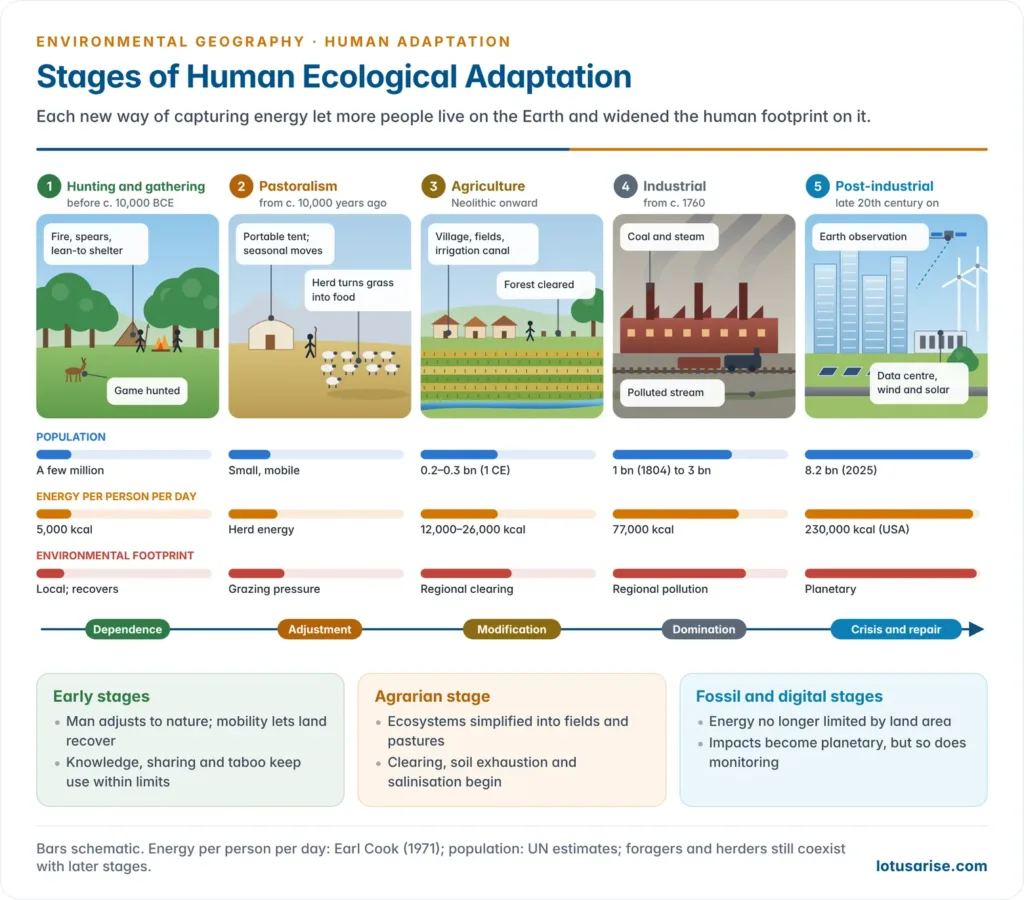
- Through history, humans have moved through distinct stages of ecological adaptation: hunting and gathering, pastoralism, agriculture, industry and the post-industrial information age. Each stage raised population, energy use and environmental footprint and shifted the balance between man and environment.
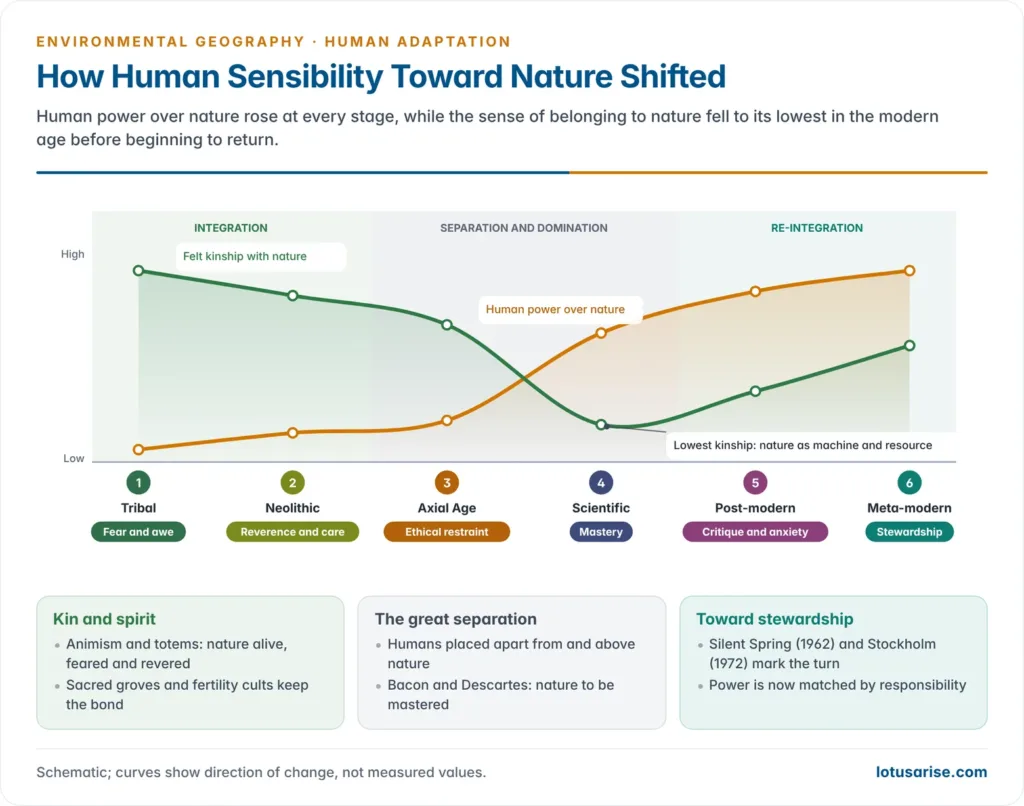
- Each stage also carried a distinct human sensibility toward nature: from awe and kinship, through reverence and ethical restraint, to mastery and exploitation, and now toward critique and stewardship.
- The journey from tribal sensibility to meta-modern consciousness is not linear. It is a dynamic process shaped by ecological, technological and ideological change, and understanding it helps shape strategies that are resilient, inclusive and ecologically sustainable.
Culture as Adaptation

Biological and cultural adaptation
| Basis | Biological adaptation | Cultural adaptation |
|---|---|---|
| Carrier | Genes and physiology | Learning, language, institutions |
| Speed | Generations to millennia | Within a lifetime; spreads rapidly |
| Examples | Barrel chests of Andean and Tibetan highlanders; tall, slim builds in hot dry lands | Igloos, irrigation, terraces, air conditioning |
| Reversibility | Slow and fixed | Flexible; can be borrowed and abandoned |
| Effect on environment | Little | Can transform whole ecosystems |
- Biological adjustment works at two speeds: short-term acclimatisation, such as extra red blood cells after weeks at altitude, and slow genetic change over many generations.
- Real communities blend the two. Every human ecological adaptation to desert, tundra or mountain pairs body with culture: Inuit cold tolerance with fur clothing and snow houses, Sherpa efficiency at low oxygen with terraced fields, yak herds and trans-Himalayan trade.
- Culture works as humanity’s “extra-somatic” means of adaptation: it sits between people and nature and filters every environmental pressure.
- For the same reason, culture is also the means by which humans change the environment, so every gain in adaptive power is also a gain in power to disturb.
The cultural-ecology lens
- Julian Steward, in Theory of Culture Change (1955), founded cultural ecology in the history of the man–environment relationship.
- The culture core (subsistence technology, work organisation and settlement pattern) is shaped most directly by the environment.
- Similar environments can produce similar cores in unrelated societies: multilinear evolution, not one universal ladder.
- Leslie White (1943) tied cultural evolution to energy: culture advances as the energy harnessed per person rises, or as the efficiency of tools improves (C = E × T).
- Each stage of adaptation below is, in this sense, a new way of capturing energy: muscle and fire, herds, crops, fossil fuels, electricity and information.
- Madhav Gadgil and Ramachandra Guha (This Fissured Land, 1992) recast Indian ecological history as four modes of resource use: gathering, nomadic pastoralism, settled cultivation and industry.
- Each mode has its own technology, economy, social organisation and ideology of resource use: from prudence and taboo among gatherers to the short-term, profit-led extraction of the industrial mode.
- In Ecology and Equity (1995) they divided Indians into ecosystem people (living off local resources), omnivores (drawing on resources from everywhere) and ecological refugees (displaced by resource loss).
Stages of Human Ecological Adaptation
- The stages are dominant modes, not a strict sequence. Foragers, herders, farmers and digital workers coexist today, often within one country.
- With each stage, three quantities grow together: population, energy used per person and the share of the biosphere under human control.
Hunting and gathering
- For more than 95% of human history, people lived by foraging: hunting, fishing and collecting wild plants, in small, mobile, kin-based bands.
- Adaptations: fire, stone and later composite tools, clothing and shelter, food sharing, seasonal movement and an encyclopaedic knowledge of plants, animals, seasons and terrain.
- Populations stayed small, usually well under one person per km², held below carrying capacity by mobility, birth spacing and sharing.
- Ecological role: foragers formed one more trophic level in food webs instead of simplifying them; frequent movement let used patches recover.
- Not always in perfect balance:
- Late Pleistocene extinctions of mammoths, giant marsupials and ground sloths follow human arrival in Australia and the Americas closely, the overkill hypothesis of Paul S. Martin (1967), though climate change also played a part.
- Fire was used to manage landscapes: Australian “fire-stick farming” opened forests for game.
- Marshall Sahlins called foragers the “original affluent society” (1966): wants were few and met with modest work, so leisure was ample.
- Indian and global examples: the Jarawa and Onge of the Andaman Islands, the Chenchu of the Nallamala hills, the San of the Kalahari and Aboriginal Australians.
- Their traditional ecological knowledge (TEK) is now valued in biodiversity conservation. Indigenous peoples manage or hold rights over about a quarter of the world’s land.
Pastoralism
- Domestication of animals, sheep and goats first in south-west Asia, about 10,000–11,000 years ago, then cattle, camels, yaks and horses, gave rise to pastoralism: life built around herds that turn grass, which people cannot digest, into milk, meat, wool and transport.
- Specialised mobile pastoralism took hold on the dry and cold margins of farming lands: steppes, savannas, deserts and high mountains.
- Adaptations:
- nomadism (whole groups follow pasture) and transhumance (seasonal vertical or horizontal moves between fixed pastures);
- herd diversity as insurance; portable tents; exchange with farmers.
- Man–environment balance: man now manages one part of nature, the herd, but remains dependent on rainfall and grass.
- Mobility keeps rangelands healthy. Overstocking, loss of commons and forced settlement lead to overgrazing and desertification.
- Examples: the Gaddi and Bakarwal of the western Himalaya, the Changpa of Ladakh, the Raika of Rajasthan, the Maasai, Bedouin and Mongol herders. The UN declared 2026 the International Year of Rangelands and Pastoralists.
Agriculture: the Neolithic Revolution
- About 10,000–12,000 years ago, the Neolithic Revolution marked a decisive shift from foraging to cultivating plants and keeping animals, one of the most consequential transitions in human history.
- It followed the end of the Pleistocene ice age, when the warmer, more stable Holocene climate favoured crop growing.
- Independent centres of domestication:
- the Fertile Crescent (wheat, barley, sheep, goats, cattle);
- China: millet on the Yellow River, rice on the Yangtze;
- Mesoamerica (maize, beans, squash) and the Andes (potato);
- New Guinea and parts of Africa.
- In South Asia, Mehrgarh at the foot of the Bolan Pass shows farming by about 7000 BCE, and Old World cotton was first domesticated in the Indus region.
- Forms of farming:
- Shifting cultivation (slash and burn): sustainable on long fallows, but degrading when fallows shorten, as with jhum in north-east India.
- Settled rainfed farming, then irrigated river-valley farming that supported the first cities of Mesopotamia, Egypt, the Indus and China.
- Karl Wittfogel (1957) argued that managing large irrigation works produced centralised “hydraulic” states.
- Man–environment balance: man now modifies ecosystems deliberately, replacing diverse vegetation with a few crops: the first large ecosystem simplification.
- Ecological costs:
- deforestation for fields and fuel;
- soil exhaustion and erosion under continuous cropping;
- salinisation of irrigated land, which helped undermine southern Mesopotamian farming;
- spread of diseases from livestock and crowding.
- William Ruddiman (2003) argues that early forest clearance and rice paddies raised carbon dioxide and methane thousands of years before the industrial age.
- Population rose from a few million foragers to about 0.2–0.3 billion by the start of the Common Era, because farming fed far more people per hectare.
- The agrarian stage peaked with pre-industrial intensification: terraces, tanks and canals, manuring and crop rotation. The Green Revolution of the 1960s later fused farming with industrial inputs.
The industrial stage
- The Industrial Revolution (c. 1760–1840), beginning in Britain, shifted the energy base from muscle, wood, wind and water to coal, the steam engine and later oil, gas and electricity.
- Fossil fuels are stored ancient sunlight, so for the first time society’s energy budget was not limited by the area of land it could farm or forest.
- Adaptations: mass production, railways and steamships, chemical fertilisers, medicine and sanitation, and large-scale urbanisation.
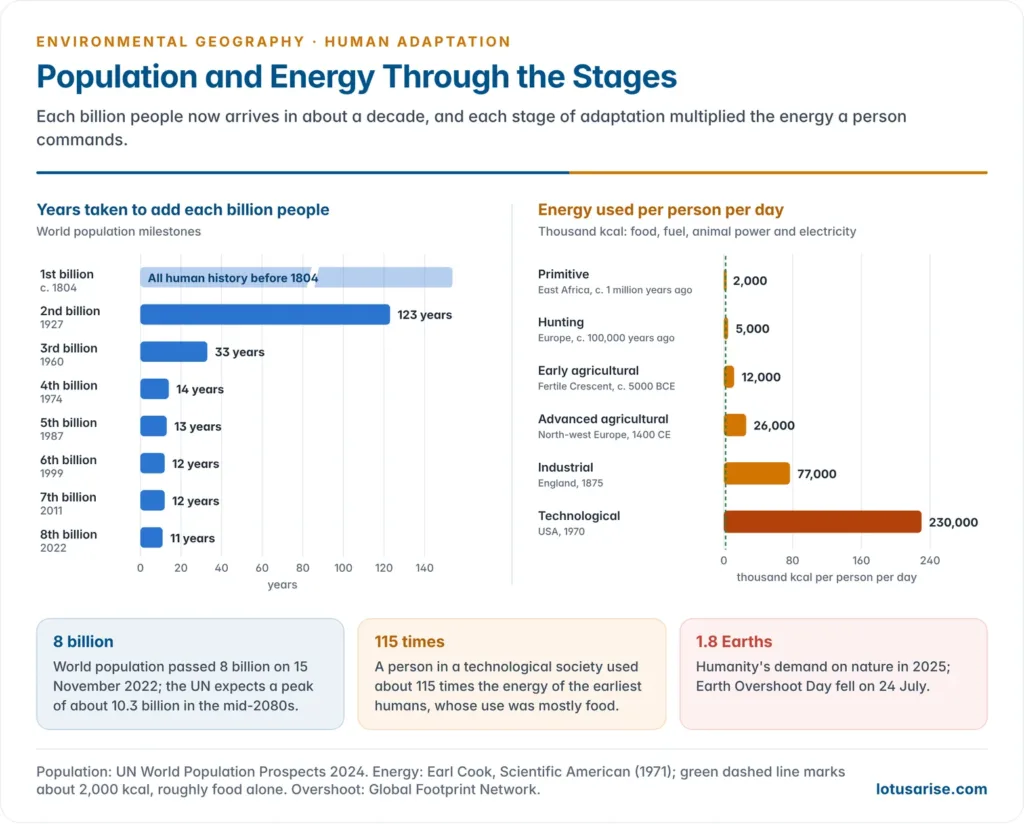
- World population reached 1 billion around 1804 and 3 billion by 1960.
- Man–environment balance: man becomes a dominant geological agent, extracting minerals, damming rivers, clearing forests on a continental scale and loading the air and water with wastes.
- George Perkins Marsh, in Man and Nature (1864), was among the first to document how human action had degraded the Mediterranean world.
- Environmental consequences:
- industrial air and water pollution;
- atmospheric carbon dioxide rising from about 280 ppm before industrialisation to 423.9 ppm in 2024, with a record annual rise of 3.5 ppm;
- roughly three-quarters of the land surface significantly altered by human action and about one million species threatened with extinction.
- Industrial growth reached into the colonies. The British forest policy in India served timber demand for railways and shipbuilding. The Indian Forest Acts of 1865 and 1878 created reserved forests and curtailed the customary rights of communities that had long managed them.
The post-industrial and information age
- From the later 20th century, rich economies shifted toward services, knowledge and information: the post-industrial society of Daniel Bell (1973).
- Adaptations: computers and the internet, satellites and remote sensing, biotechnology, renewable energy and global supply chains.
- World population passed 8 billion in November 2022. The UN expects it to peak at about 10.3 billion in the mid-2080s.
- Two faces of the balance:
- Pressure persists: consumption spreads globally, footprints shift to the countries that manufacture goods, and data centres alone used about 415 TWh of electricity in 2024 (about 1.5% of world use), a figure expected to more than double by 2030.
- Efficiency gains often raise total use, the rebound effect or Jevons paradox (William Stanley Jevons, 1865).
- Capacity to repair grows: satellites monitor forests, glaciers and air quality in near real time; solar and wind power, electric transport and circular-economy practices decouple some growth from emissions.
- Indian example: India reached 50% non-fossil installed power capacity in June 2025, five years ahead of its 2030 target. Its NDC for 2031–2035, approved in March 2026, aims to cut the emissions intensity of GDP by 47% from 2005 levels and raise non-fossil capacity to 60% by 2035, on the path to net zero by 2070.
Comparing the stages
| Stage | Began (approx.) | Energy per person per day (kcal) | Population | Balance with environment |
|---|---|---|---|---|
| Hunting and gathering | Origin of humans | 5,000 | A few million (c. 10,000 BCE) | Man as part of nature; minimal footprint |
| Pastoralism | c. 10,000 years ago | Food plus animal products | Small, mobile groups | Man manages herds; grazing pressure |
| Agriculture | c. 10,000 years ago | 12,000 (early) to 26,000 (advanced) | 0.2–0.3 billion (1 CE) | Man modifies ecosystems; local degradation |
| Industrial | c. 1760 | 77,000 | 1 billion (c. 1804) to 3 billion (1960) | Man dominates; regional pollution |
| Post-industrial | Late 20th century | Up to 230,000 (USA, 1970) | 8.2 billion (2025) | Planetary pressure; also planetary monitoring |
- The energy figures follow Earl Cook’s classic estimates (1971), which count food, fuel, animal power and electricity together.
The changing balance between man and environment
- Across these stages, the relationship moves through five phases:
- Dependence and harmony: foragers adjust to nature and are controlled by it.
- Adjustment and modification: herders and farmers reshape parts of nature but stay within regional limits.
- Domination and exploitation: industrial society treats nature as a store of raw materials and a sink for wastes.
- Crisis: degradation, pollution, biodiversity loss and climate change expose the limits of domination.
- Reconciliation: conservation, sustainable development and restoration seek a new balance.
- The swing in geographic thought follows the same path.
- Early stages fit the view that nature controls man (environmental determinism).
- The agrarian and industrial stages fit possibilism: nature offers options, people choose.
- The present stage fits Griffith Taylor’s stop-and-go determinism: man can change nature, but only within limits that it is wise to respect.
- The scale has become planetary. In 2000, Paul Crutzen and Eugene Stoermer proposed the Anthropocene, an epoch defined by human impact.
- The International Union of Geological Sciences rejected it as a formal epoch in March 2024, but it remains widely used as a concept.
- Overshoot: in 2025 humanity used resources as if it had about 1.8 Earths, and Earth Overshoot Day fell on 24 July.
- Population, affluence and technology combine to drive this demand, and population growth itself is only one of the three.
- Clarence Glacken (Traces on the Rhodian Shore, 1967) traced three old Western ideas through this history: a designed earth made for man, environmental influence on man, and man as a geographic agent. The third has become dominant.
Evolution of Human Sensibility: Six Cultural Stages
- Alongside the material stages runs a change in consciousness: how humans see themselves in relation to nature, society and each other.
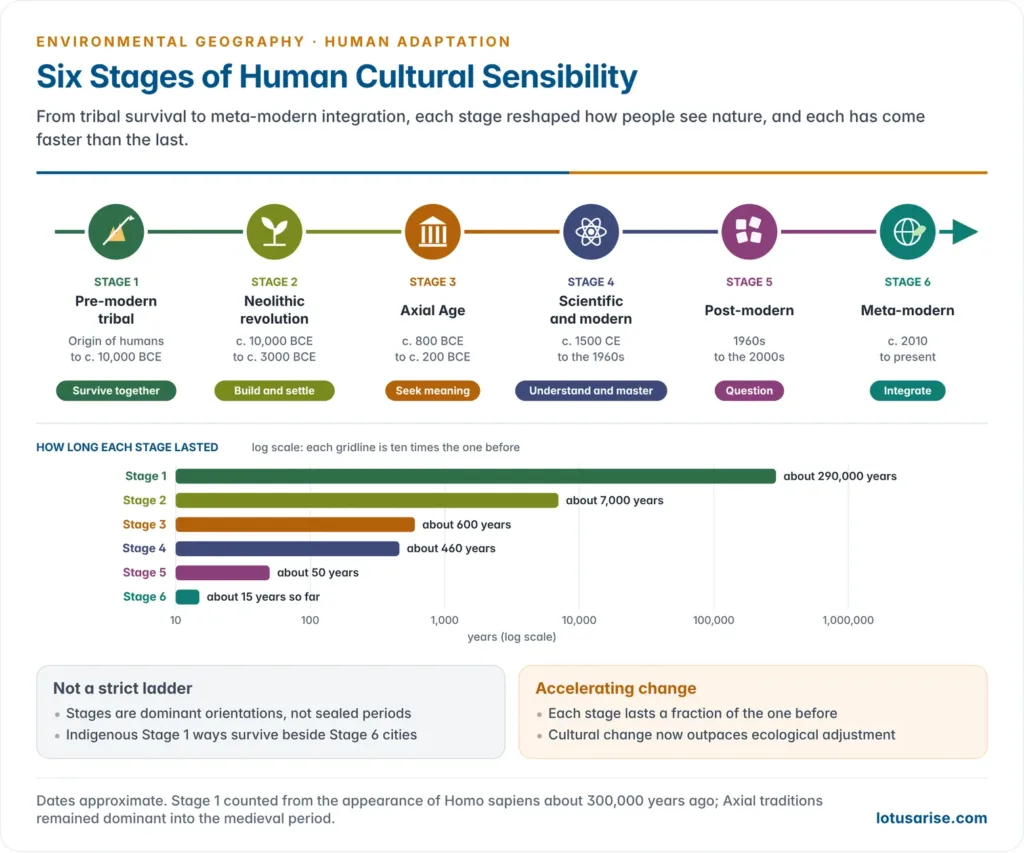
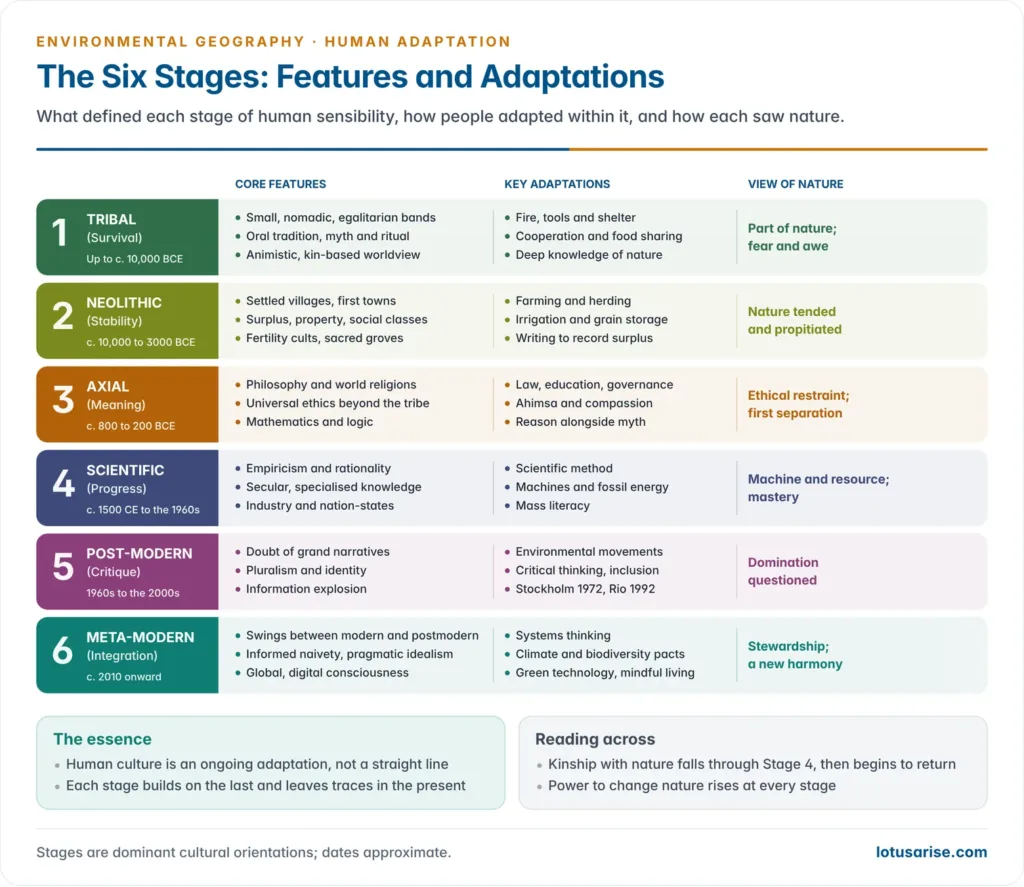
- It can be read as six cultural stages: five classical ones, with meta-modernism added as the emerging sixth. Each marks a shift in consciousness, organisation and environmental interaction.
- These stages are not strictly linear or mutually exclusive. Many societies hold elements of several at once: indigenous communities keeping Stage 1 practices live alongside Stage 6 digital metropolises.
- The stages are dominant cultural orientations, not rigid historical periods.
Stage 1: Pre-modern indigenous tribal sensibility
- The earliest stage: hunter-gatherers in small, egalitarian bands, humanity’s longest and most stable ecological relationship, built on integration with nature, not domination.
- Social organisation:
- Elders led, but power was spread fairly evenly.
- Kinship and community bonds held groups together: survival depended on collective cooperation and sharing.
- Communication and memory:
- Complex spoken language let bands coordinate, teach and plan.
- Mnemonic devices (songs, chants, genealogies, landmarks) stored knowledge across generations.
- Cultural transmission:
- Culture passed orally, through songs, stories, myths and rituals rooted in a spiritual connection with nature.
- Animism and totemism gave animals, rivers and mountains spirit and kinship.
- Environmental worldview:
- Nature was a living community to be respected, not a resource to be exploited. People saw themselves as part of it: a holistic worldview.
- Its powers inspired both fear and awe.
- Ecological footprint: minimal. Nomadic or semi-nomadic movement let ecosystems recover.
- Example: the Andaman Islanders, the San of the Kalahari and Aboriginal Australians still carry this sensibility in their knowledge systems.
Stage 2: The Neolithic agrarian sensibility
- With farming came settled, sedentary life, which brought:
- permanent villages and the first towns;
- division of labour;
- organised religion, ritual centres and temples;
- early writing, to record surplus and administer it.
- Social stratification:
- Surplus allowed wealth to be stored and inherited, and classes formed: priests, warriors, farmers and craftspeople.
- Gender roles hardened as property and inheritance systems developed.
- Ecological impact: clearing, soil exhaustion, salinisation and monoculture began, despite great social progress.
- Spiritual–ecological ties survived:
- Fertility goddesses, sacred groves and seasonal festivals kept reverence for natural cycles alive, a continuity from the tribal stage.
- Sensibility shifted from awe to reverence and stewardship: nature as a mother to be propitiated and tended.
- Indian example: the Harappan civilisation adapted to a semi-arid, flood-prone river environment.
- Dholavira’s rock-cut reservoirs stored scarce water; covered drains, baked-brick houses and grid planning met the needs of dense towns.
- Standardised weights served trade.
Stage 3: The Axial Age and pre-modern formal sensibility
- The Axial Age, a term coined by the philosopher Karl Jaspers (1949), spans roughly 800–200 BCE. In this period great philosophical and religious traditions arose almost at once in Greece, India, China, Persia and the Levant.
- Philosophical rationalism:
- Thinkers worked independently on ethics, metaphysics and social order: Socrates, Plato and Aristotle in Greece, Confucius and Laozi in China, Gautama Buddha and Mahavira in India, and the Hebrew prophets.
- Formal ethics and cosmology:
- Institutional religions gave societies shared frameworks of meaning: moral codes, systems of justification and universal ethics that reached beyond local tribal loyalties.
- Mathematics and logic emerged as distinct disciplines, with early economic thought: the start of the systematic approach that later produced modern science.
- The human–nature conception split in two directions:
- Some traditions, notably Greek philosophy and later Western theology, placed humans apart from and above nature, a precursor of modern anthropocentrism.
- Lynn White Jr. (1967) traced the roots of the ecological crisis to this attitude in medieval Christianity.
- Indian traditions moved toward ethical restraint. The Upanishads saw self and cosmos as one (Atman–Brahman). Buddhism taught compassion for all beings, and Jainism carried ahimsa (non-violence) to all forms of life.
- Intellectual foundations: still rooted in agrarian life, this stage was humanity’s first systematic attempt to understand the human condition through reason rather than myth alone, laying the base of the modern scientific worldview.
- Indian echo: the reverence of Jain and Buddhist ethics lives on in practices such as the Bishnoi protection of khejri trees and blackbuck. In 1730, at Khejarli in Rajasthan, Amrita Devi and 363 Bishnois gave their lives to stop the felling of trees.
Stage 4: Scientific Revolution and the modern Enlightenment sensibility
- From about 500 years ago, the Scientific Revolution (16th–17th centuries) and the Enlightenment (17th–18th centuries) transformed human understanding of nature. This was the most consequential shift in humanity’s ecological relationship: from integration to domination.
- Rationality and empiricism:
- Francis Bacon, René Descartes, Isaac Newton and John Locke made systematic observation and experiment the foundation of knowledge, and celebrated individualism.
- Descartes (1637) hoped science would make humans “masters and possessors of nature”.
- Secularisation of knowledge:
- Theological authority over natural phenomena gave way.
- Knowledge split into disciplines (physics, chemistry, biology, geology), each seeking mastery over its domain.
- Mechanistic nature: nature became a machine to be studied, controlled and exploited. The Cartesian res extensa (extended matter) had no inherent value.
- Industrial capitalism: the Industrial Revolution turned this sensibility into mass production, urbanisation and markets, at an unprecedented scale of extraction and waste.
- Anthropocentric sensibility:
- Human reason and material progress were placed above ecological harmony.
- Nature was framed as raw material, and economic growth became the main social measure.
- Indian example: colonial forestry applied this logic. Forests were surveyed as timber stock for railways and the navy, and forest law turned communities that had managed landscapes for centuries into trespassers. The colonial worldview treated nature and indigenous peoples alike as resources.
Stage 5: Post-modern sensibility
- From the 1960s, a powerful critique of modernity challenged the universal claims of Enlightenment reason and the social and environmental costs of industrial capitalism.
- This stage is marked by fragmentation, pluralism and deconstruction, and by the birth of the modern environmental movement.
- Social movements:
- Civil rights, anti-war, feminist and ecological movements of the 1960s–70s questioned the hierarchies and certainties of modernity.
- From them came the Stockholm Conference (1972) and the Rio Earth Summit (1992).
- Postmodern philosophy:
- Jean-François Lyotard (1979) defined the postmodern as “incredulity toward metanarratives”: grand stories of progress, science or revolution.
- Michel Foucault and Jacques Derrida showed knowledge to be bound up with power and language.
- Environmental consciousness:
- Rachel Carson’s Silent Spring (1962) exposed the dangers of pesticides such as DDT.
- The Limits to Growth (1972), commissioned by the Club of Rome, modelled overshoot and collapse.
- The Brundtland Commission defined sustainable development (1987).
- Political ecology and the Marxian critique tied degradation to power and inequality.
- Information revolution: the internet, mass media and 24-hour news multiplied identities and narratives. Information became abundant but unreliable, and environmental narratives competed with economic ones.
- Strengths and limits:
- Postmodernism’s great achievement was to deconstruct the anthropocentric certainties of modernity.
- Its limit was that it could critique without constructing: it offered no shared worldview able to tackle planetary problems such as climate change.
- Indian example: the Chipko movement (1973), in the Garhwal Himalaya, embodied this stage.
- It was women-led and community-based, rooted in local ecological knowledge, and challenged state “scientific” forestry.
- It set local knowledge against universal expertise, women’s voices against patriarchal institutions, and ecological values against commercial calculation.
Stage 6: Meta-modern cultural consciousness
- Meta-modernism responds to the excesses of postmodernism: its nihilism, fragmentation and failure to inspire collective action.
- The term was popularised by Timotheus Vermeulen and Robin van den Akker (2010).
- It is not a return to modernist certainty but an oscillation between modern and postmodern attitudes, holding both in productive tension.
- Integration of perspectives: it joins postmodern pluralism to the sincerity, structure and aspiration of earlier paradigms, moving “between and beyond” both instead of choosing one.
- A coherent worldview:
- It seeks an emotionally resonant outlook able to address climate change, inequality and digital transformation.
- Its spirit is “informed naivety” or “pragmatic idealism”: knowing the limits of idealism, yet choosing to act with hope.
- Meta-cultural consciousness embraces complexity and contradiction, balancing reason and emotion, the individual and the collective, and hope and scepticism, without forcing false certainty.
- Climate action: in environmental geography, this sensibility shows in agreements and movements that hold opposites together:
- the Paris Agreement (2015), which joins national choice with a global goal;
- the Kunming-Montreal Global Biodiversity Framework (2022), with its 30×30 target;
- youth climate activism, which moves between despair and fierce hope.
- At COP30 in Belém (2025), the Global Mutirão decision called for efforts to at least triple adaptation finance by 2035. The Tropical Forest Forever Facility was launched with pledges of over US$6.7 billion.
- Information technology keeps shaping this sensibility. It blurs boundaries between cultures and ideologies and powers global environmental movements, but it also spreads climate disinformation and carries its own energy footprint.
- Indian example: India’s climate governance holds several frameworks at once.
- It combines technological optimism (solar and wind targets, the National Action Plan on Climate Change of 2008) with international cooperation and the defence of equity and national development needs.
- It draws on cultural ethics through Mission LiFE (Lifestyle for Environment, launched October 2022), which asks for mindful consumption rather than only new technology.
Comparing the six stages
| Stage | Era (approx.) | Relationship with nature | Social organisation | Key cultural output | Footprint |
|---|---|---|---|---|---|
| 1 Tribal | Origin of humans to 10,000 BCE | Integration: part of nature | Egalitarian bands; kinship | Oral tradition, myth, ritual | Minimal; nomadic recovery |
| 2 Neolithic | 10,000–3,000 BCE | Management: begins shaping nature | Settlements; stratification | Agriculture, writing, temples | Moderate; clearing, soil exhaustion |
| 3 Axial Age | 800–200 BCE | Contemplation: conceptual separation and ethical restraint | City-states, empires, religions | Philosophy, mathematics, ethics | Moderate; agricultural intensification |
| 4 Scientific | 1500 to 1960s CE | Domination: nature as object and resource | Industrial capitalism; nation-states | Science, technology, industry | Extreme; fossil fuels, CO₂ surge, extinctions |
| 5 Post-modern | 1960s–2000s | Critique: questions domination but offers no replacement | Pluralist, networked | Environmental movements, NGOs | Awareness rises; systemic change limited |
| 6 Meta-modern | c. 2010 onward | Integration of complexity: seeks a new harmony | Global–local digital networks | Climate agreements, green technology, youth activism | Ambiguous: regenerative potential vs digital footprint |
Environmental Implications
Cultural stages and environmental worldviews
- Each cultural stage left a distinct ecological footprint and a distinct set of ideas about humans and nature. Many of these ideas still shape policy today.
| Cultural stage | Environmental worldview | Echo in geographic thought | Policy relevance today |
|---|---|---|---|
| 1 Tribal | Holistic, biocentric: humans part of nature | Traditional ecological knowledge; cultural ecology | Sacred groves; Van Panchayats; community forest rights |
| 2 Neolithic | Stewardship: managing nature for sustained yield | Human ecology (Harlan Barrows, 1923); man–land relations | Tank irrigation; watershed management |
| 3 Axial Age | Ethical: life has intrinsic worth (ahimsa) | Environmental ethics; deep ecology | Wildlife protection; Project Tiger; biodiversity law |
| 4 Scientific | Anthropocentric: nature as raw material | Determinism and possibilism debates; resource geography | Pollution control laws; Stockholm 1972; CPCB |
| 5 Post-modern | Ecocentric critique of anthropocentrism | Political ecology; deep vs shallow ecology | Chipko; UNFCCC; CBD |
| 6 Meta-modern | Integral: complexity-aware, holds contradictions | Perception studies; ecosystem approach; planetary boundaries | SDGs; NDCs; Kunming-Montreal GBF; UN Decade on Ecosystem Restoration |
- Harlan Barrows (1923) defined geography as human ecology, the study of how people adjust to their natural environment: the agrarian stage’s man–land focus in academic form.
- The arc of the stages also explains why sacred groves, Van Panchayats and community forest rights under the Forest Rights Act (2006) are now treated as modern conservation tools, not relics.
From sensibility to action
- Sensibility decides behaviour. How people perceive, value and feel about nature shapes whether they conserve or exploit it.
- The PAVE framework (perception, attitude, value and emotion) treats these four layers as the levers of environmental management.
- The Bishnoi, sacred-grove keepers and Chipko women show strong values and emotions turning into conservation without any law.
- Ethics frames the choice of path. Shallow ecology reforms the industrial path, curbing pollution and depletion for human benefit.
- The deep ecology of Arne Næss (1973) asks for a change of sensibility itself, granting all life intrinsic value: in effect, a return to Stage 1 kinship with Stage 6 knowledge.
- Concluding synthesis:
- The trajectory runs from biocentric integration (Stage 1), through anthropocentric domination (Stage 4), toward a new ecological integration (Stage 6).
- Adaptive power has grown at every stage; ecological wisdom has not always kept pace.
- The task of the present stage is to join the reach of science and technology to the restraint and kinship of older sensibilities, so that adaptation once more stays within the limits of the biosphere.





 History Optional PYQ Master Pack: Topic-wise Model Answers (1985–2025) by LotusArise IAS