

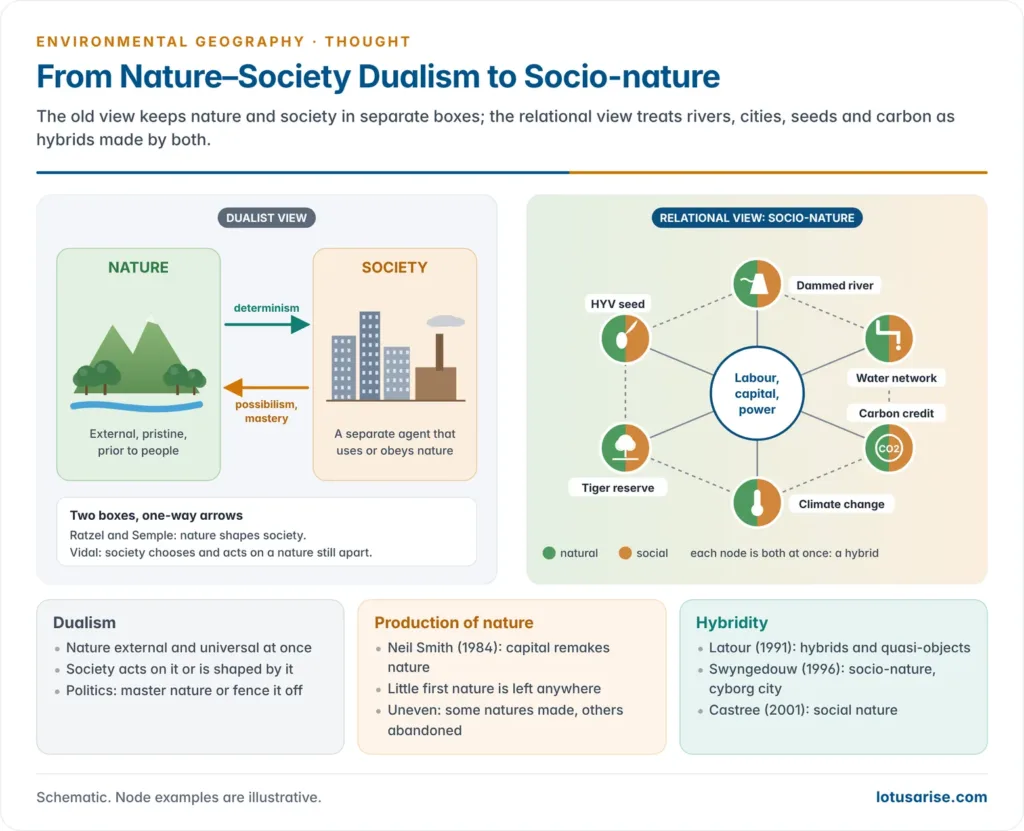
- For most of its history, geographical thought rested on a nature–society dualism: nature as an independent, pristine realm existing prior to and outside human activity, and society as an external agent that either obeys it or acts upon it.
- Radical and Marxist geographers broke with this binary in the 1980s. Their claim was that, under capitalism, nature cannot be understood apart from society at all: it is continuously produced, reshaped and commodified by social and economic processes.
- The most influential statement is Neil Smith’s “production of nature” thesis in Uneven Development: Nature, Capital and the Production of Space (1984): the nature we know is socially produced, and has not been “natural” in the pristine sense for a very long time.
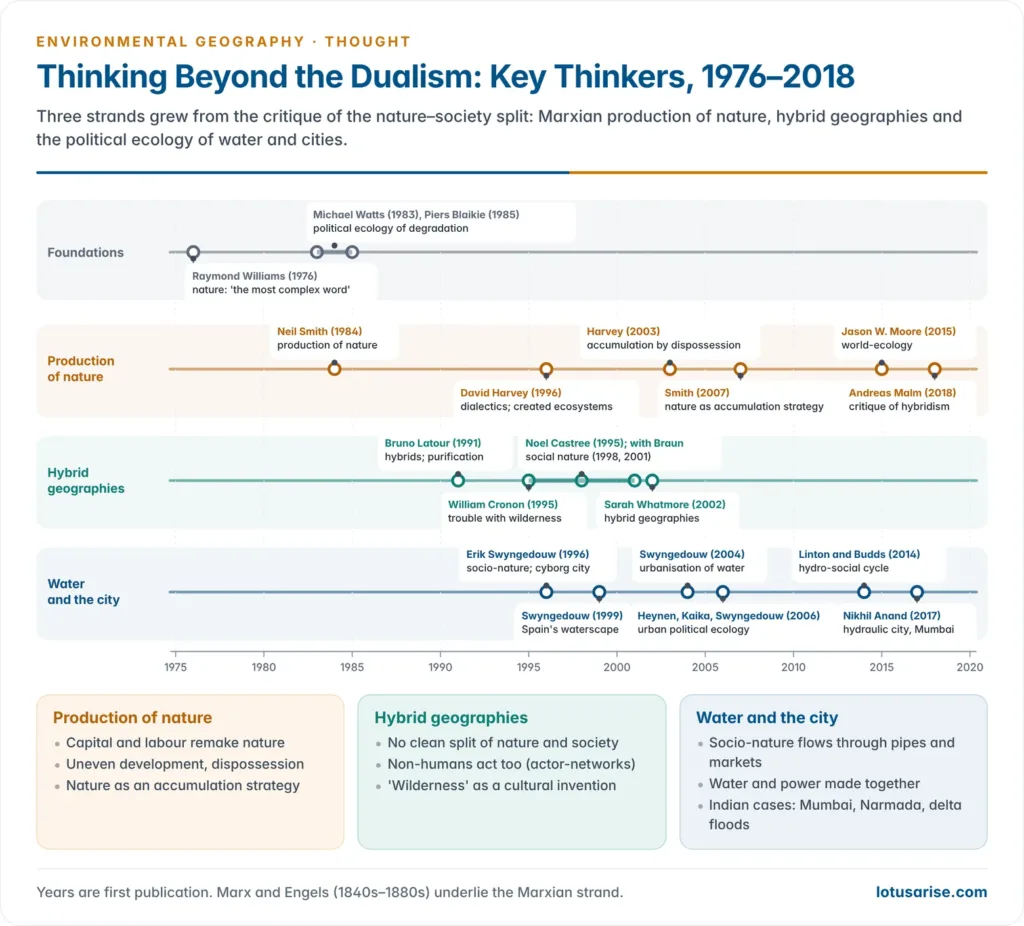
- From the 1990s the critique widened into a family of relational or hybrid views: David Harvey’s dialectics of nature (1996), Bruno Latour’s hybrids (1991), and the socio-nature of Erik Swyngedouw and Noel Castree. All of them treat nature and society as made together, not as two separate things that interact.
The Nature–Society Dualism

What “nature” is taken to mean
- Raymond Williams called nature “perhaps the most complex word in the language” (Keywords, 1976). Three meanings run together in ordinary use:
- External nature: the non-human world “out there”: forests, rivers, wildlife, wilderness.
- Universal nature: the whole material world, humans included, governed by natural laws.
- Intrinsic nature: the essential quality of a thing, as in “human nature”.
- Smith’s “ideology of nature” is the habit of holding the first two meanings at once:
- Nature is treated as external, a realm apart from society that society can use, conquer or protect;
- and at the same time as universal, a standard that makes existing social arrangements (competition, inequality, gender roles) look “natural” and therefore beyond question.
- The result is that nature becomes a political alibi: what is socially made is presented as given.
Why the dualism needed rejecting
- Environmental determinism (Friedrich Ratzel, Ellen Churchill Semple, Ellsworth Huntington) treated the environment as the independent variable shaping human society, assuming nature to be a fixed, external given. The determinism–possibilism debate never questioned that split.
- Possibilism (Paul Vidal de la Blache, Lucien Febvre) retained the dualism and merely inverted agency: humans now choose and act upon a nature still conceived as separate.
- Spatial science and systems thinking of the 1960s modelled “human” and “physical” subsystems with flows between them, which kept the two boxes apart; the wider dichotomy and dualism of physical versus human geography mirrors the same divide.
- Mainstream environmentalism inherited the split in a protective form: nature is a fragile “out there” to be fenced off from people.
- The radical objection: the whole framework misses how capitalism materially transforms the biophysical world: soil, water, atmosphere, genetic material, even climate.
- Nature is not only interpreted differently by different societies; it is physically remade by them, and the remade nature then conditions social life in turn.
- This argument grew out of the radical approach in geography and its Marxian roots, which Marx’s view of the environment set out through labour and metabolism.
| Basis | Dualist view | Relational (produced or hybrid) view |
|---|---|---|
| Nature | External, prior to society, pristine | Made and remade with society; no pure “outside” |
| Society | An agent acting on nature, or shaped by it | Itself material and ecological; built out of nature |
| Causation | One-way: nature → society or society → nature | Two-way and historical: each makes the other |
| Unit of study | “Man” and “environment” as separate boxes | Socio-natural processes: dams, cities, crops, carbon |
| Politics | Protect nature from people, or master it | Ask who produces which nature, for whom |
Neil Smith and the Production of Nature
Neil Smith and Uneven Development (1984)
- Neil Smith (1954–2012), a Scottish-born geographer trained under David Harvey at Johns Hopkins, built Uneven Development from his doctoral work. Later editions (2008) carried an afterword answering two decades of debate.
- The book’s logic runs in sequence:
- The ideology of nature: how the external–universal split conceals social relations;
- The production of nature: how labour and, above all, capital remake the material world;
- The production of space: how capital builds landscapes of investment;
- Uneven development: why capital produces some places and natures while abandoning others.
- Production, for Smith, is not a metaphor. Rewriting Marx’s scattered remarks into one sequence, he traces three steps:
- Production in general: every society works on nature to meet its needs; in changing the form of matter, labour also changes the labourer, so human nature is itself partly produced.
- Production for exchange: once a permanent surplus appears, so do exchange, classes and the state. Control over nature rises, but as social control that subordinates part of society.
- Capitalist production: exchange value now governs the relation with nature. Capital “stalks the earth” in search of profit, and the price tag decides the fate of nature.
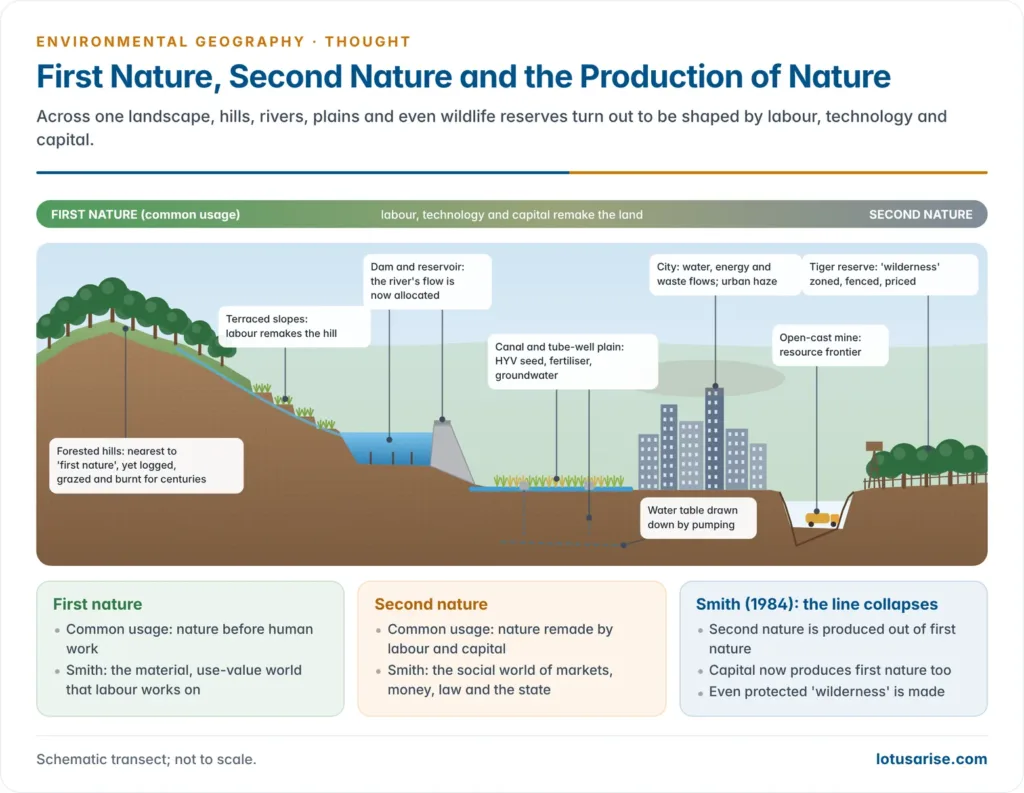
First nature and second nature
- The terms are old. Marcus Tullius Cicero described humans creating, through farming, irrigation and damming rivers, a kind of second nature within the world of nature. Georg Wilhelm Friedrich Hegel later used “second nature” for the social world of institutions and customs that humans build for themselves.
- In common usage the pair separates untouched from transformed nature:
| Concept | Common meaning | Smith’s sharper usage |
|---|---|---|
| First nature | Pristine nature existing independent of human intervention | The material, use-value world worked on by human labour |
| Second nature | Nature reshaped by labour, technology and capital | The social relations of exchange: markets, money, law, the state |
| Relation | First nature is gradually converted into second | Second nature is produced out of first, and capital now produces first nature too |
- Smith’s argument is that capitalism collapses the distinction:
- “Second nature is produced out of first nature“: markets, cities and states are built from transformed matter.
- In turn, first nature itself is now produced within second nature: the seed is bred, patented and priced; the river is dammed and allocated; the forest is planted, protected or cleared according to markets and policy.
- Hence very little first nature survives anywhere. Even apparently pristine wilderness is already second nature, mediated by social and economic processes.
- Agricultural landscapes appear natural, but they are products of human labour, technology and markets: irrigation systems, high-yielding seeds and fertiliser regimes.
- Wilderness areas such as national parks and biosphere reserves are not untouched nature either. They are socially produced spaces: zoned, regulated, mapped and designed for conservation, tourism and revenue.
Production is not control
- Production of nature is not mastery of nature. Smith rejects the language of “domination” and “control”: capitalism remakes nature on a vast scale but anarchically, without plan, and with consequences nobody chose.
- Friedrich Engels had warned that nature takes “revenge” for each victory claimed over it: deforestation that brings floods, irrigation that brings salt.
- Pollution, ozone depletion and climate change are produced natures that are nobody’s commodity but everybody’s condition.
- Scarcity is produced, not given. Where social crises are still blamed on “natural” scarcity, Smith reads them as produced scarcity: water shortages that reflect allocation and pricing rather than rainfall alone; famines that reflect entitlement rather than harvests alone.
- Capital creates barriers to its own future. Crises now arise from contradictions inside the social production of nature itself, a theme the second contradiction of capitalism developed further.
Uneven development: the see-saw of capital
- Two tendencies pull against each other:
- Equalisation: capital tends to level conditions across space, spreading the same technologies, commodities and landscapes everywhere.
- Differentiation: profit depends on differences in wages, resources and rents, so capital concentrates in some places and leaves others.
- The see-saw: capital moves into a region while profits are high, produces its nature and space (mines, plantations, dams, suburbs), then withdraws, devaluing what it built, and returns later when the region is cheap again.
- Uneven environments follow uneven development: the “nature” of a mining belt, a green-revolution plain and a gentrified waterfront are produced by the same logic at different moments.
- Indian echo: the mineral belt of the Chotanagpur plateau was opened for coal and iron in the colonial era, re-opened by public-sector expansion after 1947, and again by private and captive mining after liberalisation, each round leaving its own produced landscape.
Nature as an accumulation strategy
- In “Nature as Accumulation Strategy” (Socialist Register 2007), Smith argued that capital no longer merely plunders an available nature: it now integrates nature vertically into capital.
- Formal subsumption: capital takes nature as it finds it and extracts from it (mining, logging, early plantations).
- Real subsumption: capital re-engineers the biological and ecological processes themselves: hybrid and genetically modified seeds, industrial livestock, plantation forestry, engineered wetlands.
- Ecological credits and environmental derivatives (carbon offsets, wetland and biodiversity banking) become new financial assets built on produced nature.
- Later political ecology and world-ecology writing, notably Jason W. Moore, names two paths along which capital extends into nature:
- Commodity widening: the spatial extension of commodity frontiers into new places, from developed to developing and least-developed countries, with the dispossession that accompanies it.
- Example: eco-tourism and conservation zones that sell “wilderness” for elite consumption, often while displacing local and indigenous communities.
- Commodity deepening: the intensification of commodification at existing sites, converting new elements of nature (water, genetic material, atmospheric carbon) into tradable commodities.
- Example: carbon credits, which turn the atmosphere’s capacity to absorb carbon into a tradable asset.
- Commodity widening: the spatial extension of commodity frontiers into new places, from developed to developing and least-developed countries, with the dispossession that accompanies it.
- Through these paths, nature is restructured not only physically but ideologically and economically, reorganised to serve accumulation.
Hybridity and Socio-nature
David Harvey: Justice, Nature and the Geography of Difference (1996)
- David Harvey extended the critique through a dialectical view: “things” such as a forest or a city are moments in processes and relations, not fixed objects.
- His best-known line is that “there is in a sense nothing unnatural about New York City“: the city is a created ecosystem, as much a product of natural processes as of social ones.
- Every ecological project is simultaneously a political-economic project, and every political-economic project is ecological. Choosing a river regime, a forest policy or a city form is choosing whose interests the produced environment will serve.
- This grounds environmental justice: produced environments distribute benefits (water, clean air, green space) and harms (pollution, flood risk, displacement) unequally by class, caste, race and place.
- Accumulation by dispossession (The New Imperialism, 2003): capital’s expansion into common-pool natural resources (land, water, forests, minerals) continues the logic of primitive accumulation, enclosing commons and dispossessing traditional and indigenous users.
Bruno Latour: We Have Never Been Modern (1991)
- Bruno Latour (French original 1991; English translation 1993) argued that the “modern constitution” rests on a double move:
- Purification: officially, nature (the realm of science and things) and society (the realm of politics and people) are kept strictly apart.
- Translation (mediation): in practice, moderns produce ever more hybrids, “quasi-objects” that are part natural and part social: the ozone hole, global warming, HIV, frozen embryos.
- Because hybrids are denied by purification, they proliferate unchecked.
- “We have never been modern”: the clean split never existed. Latour proposed a non-modern stance and a “parliament of things” in which hybrids, and the scientists and publics who speak for them, are represented together.
- Through actor-network theory, Latour and his followers treat non-humans (microbes, rivers, machines) as actants that shape outcomes alongside people.
- Sarah Whatmore’s Hybrid Geographies (2002) carried this into geography: nature and society are co-constituted networks, and pure “wilderness” is itself a cultural-historical invention.
Erik Swyngedouw: socio-nature and the urbanisation of water
- Erik Swyngedouw developed the idea of hybrid “socio-nature” in “The city as a hybrid: on nature, society and cyborg urbanization” (1996). The city is a cyborg: a fusion of social and natural flows (water, food, energy, waste) through pipes, wires and markets.
- His study of Spain’s hydraulic modernisation (1999; book form Liquid Power, 2015) showed how dams and canals produced a national “waterscape” along with the state, engineers and landed elites.
- Social Power and the Urbanization of Water: Flows of Power (2004) studied Guayaquil, Ecuador, where about 600,000 people lacked easy access to potable water:
- Water flows upward to power: well-off districts were piped, poor peripheries bought water from tanker vendors at many times the price.
- Scarcity was produced by the social organisation of the flow, not by the river.
- These ideas founded urban political ecology (Nik Heynen, Maria Kaika and Swyngedouw, In the Nature of Cities, 2006), which reads urbanisation as a socio-environmental metabolism.
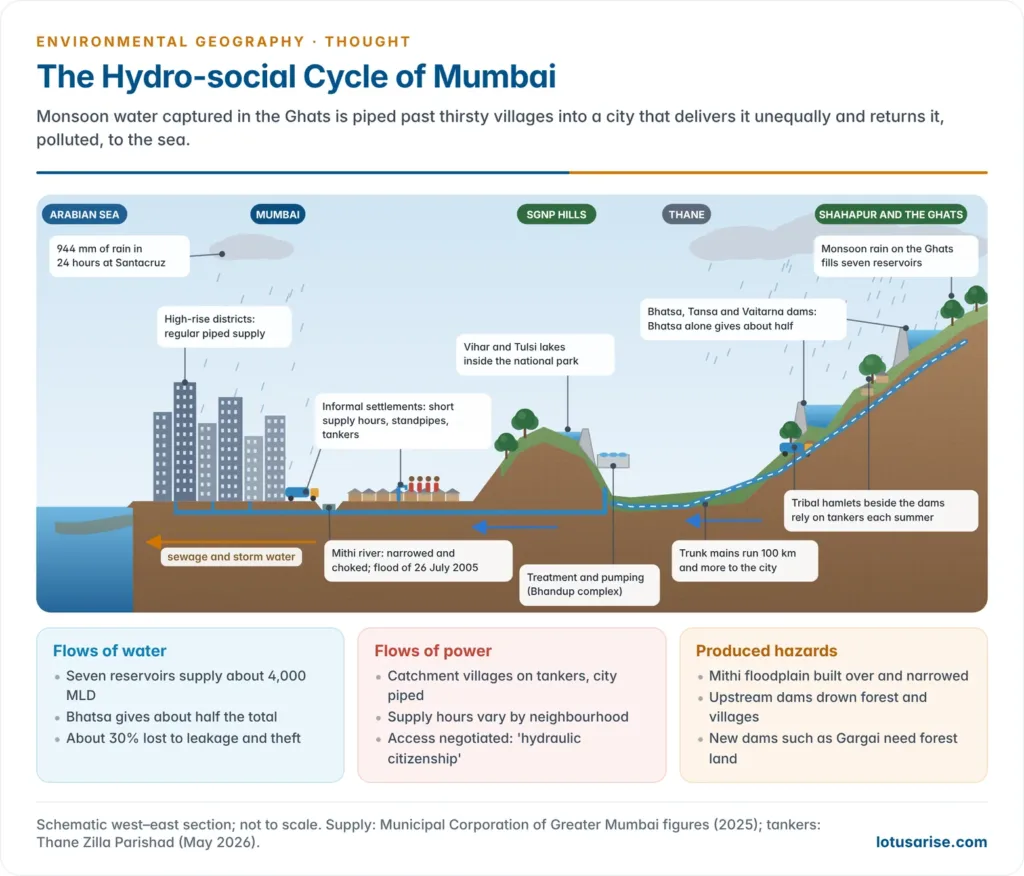
- The hydro-social cycle (Jamie Linton and Jessica Budds, 2014) is the process by which water and society make and remake each other over space and time. It deliberately adds power, law and infrastructure to the physical hydrological cycle.
Noel Castree: social nature
- Noel Castree sharpened the theory and tested its limits:
- “The nature of produced nature” (1995) defended Smith’s thesis against the charge of productivism while insisting on the materiality of nature: produced nature still has properties of its own.
- With Bruce Braun, he edited Remaking Reality (1998) and Social Nature (2001), which fixed the term “social nature” for a position between naive realism (nature simply exists) and radical constructionism (nature is only discourse).
- Later work examined the commodification and neoliberalisation of nature: privatisation, marketisation, deregulation and the rise of ecosystem-service markets.
- Castree separates two claims that are often confused:
- Knowledge of nature is socially constructed: what counts as “forest”, “wasteland” or “natural flow” depends on who classifies it.
- Nature itself is socially produced: rivers, soils and species are physically remade.
Allied strands
- William Cronon’s “The Trouble with Wilderness” (1995): the American ideal of untouched wilderness was a nineteenth-century social construction that erased the prior presence and land management of indigenous peoples. The Indian version of this critique belongs to deep and shallow ecology and its Third World critics.
- Political ecology (Piers Blaikie, 1985; Michael Watts, 1983): environmental degradation such as soil erosion is rarely purely “natural”; it follows from unequal land tenure, debt and market pressure, not only from biophysical processes.
- World-ecology (Jason W. Moore, Capitalism in the Web of Life, 2015): capitalism is not a society acting on nature but a way of organising nature; “Nature plus Society” is false arithmetic.
| Thinker (key work) | Core idea | What it adds |
|---|---|---|
| Neil Smith (1984; 2007) | Production of nature; uneven development | Capital as the engine that remakes nature unevenly |
| David Harvey (1996; 2003) | Dialectics; created ecosystems; dispossession | Environmental justice; enclosure of commons |
| Bruno Latour (1991) | Purification vs hybrids; parliament of things | Non-human agency; the end of the clean split |
| Erik Swyngedouw (1996; 2004) | Socio-nature; urbanisation of water | Power flowing through pipes and cities |
| Noel Castree (1995; 2001) | Social nature; limits of commodification | Materiality kept in view; knowledge vs matter |
| Sarah Whatmore (2002) | Hybrid geographies | More-than-human relations |
Indian Illustrations
Rivers and dams as produced nature
- The Narmada: the Sardar Sarovar dam, raised to its full height of 138.68 m and dedicated in 2017, turned a monsoon river into a regulated canal system serving Gujarat’s farms, industries and cities.
- Amita Baviskar’s In the Belly of the River (1995) showed how the same project produced submergence, displacement and loss of forest commons for the Bhilala adivasis of the valley: one river, two produced natures.
- The Ganga: the Tehri dam, barrages and canal diversions leave long stretches with heavily altered flows, while cities return sewage. The Ganga is no longer a “natural” river in any simple sense.
- In March 2017 the Uttarakhand High Court declared the Ganga and Yamuna legal persons; the Supreme Court stayed the order in July 2017. The case shows how a river’s “nature” is also legally and politically constructed.
- The Mahanadi delta: Rohan D’Souza’s Drowned and Dammed (2006) traced how colonial embankments and flood-control works in Orissa produced the very floods they were meant to stop, by cutting the delta off from its silt-spreading inundation.
- Basin-scale second nature: inter-basin transfers, hydropower cascades and large dams remake river regimes, sediment budgets and fisheries; river interlinking would extend this to a national scale.
Cities: the hydro-social cycle of Mumbai
- Mumbai drinks from the Western Ghats. Seven reservoirs (Upper, Middle and Lower Vaitarna or Modak Sagar, Tansa, Bhatsa, Vihar and Tulsi) supply roughly 4,000 million litres a day, and Bhatsa alone gives about half.
- Most of the large dams lie in Shahapur taluka (Thane) and the adjoining Nashik and Palghar hills, about 100 km or more from the city. Vihar and Tulsi lie inside the Sanjay Gandhi National Park.
- Water flows to power:
- Within the catchment, 33 villages and well over a hundred hamlets (padas) of Shahapur depended on tankers in the summer of 2026, while pipelines carry their water past them to Thane and Mumbai.
- Within the city, high-rise districts receive regular piped supply, while informal settlements rely on short supply hours, shared standpipes and tankers. Nikhil Anand’s Hydraulic City (2017) calls the negotiation for water “hydraulic citizenship“.
- Losses to leakage and theft are officially put at about 30% of the water reaching the city’s reservoirs.
- Produced floods: the Mithi river rises from Vihar lake. Its narrowing by reclamation, the airport and buildings, and choked drains helped turn 944 mm of rain in 24 hours at Santacruz on 26 July 2005 into a catastrophic flood.
- New frontiers: proposed dams such as Gargai would need forest land for future supply, renewing the cycle of capture upstream and consumption downstream.
- Other cities show the same logic: Delhi’s Yamuna floodplain, built over and embanked, carried a record flood in July 2023; Bengaluru’s lost tanks and Chennai’s built-over wetlands make floods and droughts as much social as meteorological. These belong to the wider problems of urbanisation.
Agrarian and forest landscapes
- The green-revolution plain of Punjab and Haryana looks like a natural agrarian landscape but is engineered second nature: tube-well irrigated, green revolution seeds, fertiliser-dependent rice–wheat systems. Its groundwater is extracted far faster than it recharges, and its soils carry the costs.
- Tiger reserves and eco-tourism: protected landscapes are zoned into core and buffer, fenced and priced for tourism. They produce a “wilderness” while generating displacement and rights conflicts with forest dwellers, in tension with the Forest Rights Act, 2006. Their wildlife conservation record is real, but so is the social making of the “wild”.
- The Sundarbans: embankments built over two centuries turned tidal islands into rice land, and the tiger, the forest and the islanders’ livelihoods are now produced together by embankment, conservation and market.
- Mining frontiers: iron-ore mining in the Western Ghats (Goa and Bellary) and the contested limits of the Aravallis show extraction converting forest and hill into commodified resource landscapes, with attendant deforestation and biodiversity loss.
Markets in nature: contemporary policy
- India’s Carbon Credit Trading Scheme (2023): notified in June 2023 under the amended Energy Conservation Act. Emission-intensity targets were set for aluminium, cement, chlor-alkali and pulp and paper in October 2025, and for refineries, petrochemicals, textiles and secondary aluminium in January 2026. Atmospheric absorption becomes a tradable certificate, a direct case of commodity deepening and a pillar of India’s carbon neutrality path.
- The Green Credit Programme (2023) issues tradable credits for tree planting, water conservation and similar actions, turning ecological work into units of account.
- The Kunming–Montreal Global Biodiversity Framework (2022) asks countries to mobilise finance through, among other things, payment for ecosystem services, green bonds and biodiversity offsets and credits. This frames biodiversity partly in market terms, echoing Smith’s thesis at a planetary scale.
- Article 6 of the Paris Agreement, whose crediting mechanism was made operational at COP29 (Baku, 2024), builds the international market architecture in which “produced” emission reductions are bought and sold.
- Environmental clearance: critics argue that environmental impact assessment often legitimises the production of new resource landscapes (mines, dams, highways) rather than questioning the political economy of extraction.
Critical Evaluation
Strengths of the thesis
- It historicises nature: environments are read as products of particular social relations, not timeless backdrops, which explains why the same river or forest means different things to different groups.
- It links environment and inequality: degradation, scarcity and hazard are traced to who produces nature and who bears its costs, the basis of environmental justice and political ecology.
- It anticipated the Anthropocene debate: human remaking of the Earth system is now a scientific commonplace, even though geologists rejected a formal Anthropocene epoch in March 2024. The thesis adds that “humanity” does not act as one; specific economies and classes do.
Criticisms and debates
- Risk of economic reductionism: folding all nature–society relations into capitalist logic can underplay non-capitalist, cultural and subsistence relations with nature that persist: sacred groves, community forestry, Joint Forest Management, pastoral commons.
- Biophysical autonomy is not erased: climate systems, tectonics, monsoon variability and pandemics retain causal force and feedbacks that capital cannot fully control or predict, which exposes the limits of “produced” nature.
- Productivism and anthropocentrism: speaking of “producing” nature can sound Promethean, as if only human labour mattered. Ecocentric thinkers object that nature has value beyond its use to people.
- Neglect of non-human agency: hybrid and actor-network writers argue that Smith left nature passive, a raw material for labour, and missed how rivers, microbes or monsoons act back.
- Hybridity has its own critics:
- Andreas Malm (The Progress of This Storm, 2018) argues that if everything is “hybrid”, one cannot say what is social and what is natural in climate change. He defends a “property dualism”: nature and society are distinct yet inseparable.
- Theorists of the metabolic rift prefer to keep society and nature distinct but dialectically related, rather than collapsing them.
- Concept stretch: if every landscape is produced, the term risks losing analytical bite unless the degree, mode and agents of production are specified case by case.
Significance for environmental geography
- The core shift: nature is not a given backdrop but a historically, politically and economically produced category and material reality.
- The political question changes: from “how do we save nature from people?” to “which nature is being produced, by whom, for whom, and at whose cost?“
- For sustainable development, preserving nature as an external entity is not enough: policy must also address the political economy of resource use, consumption and commodification that drives degradation in the first place.
- The thesis gives depth to the study of degradation, conservation and policy, moving from describing symptoms to explaining structural causes, and it links environmental geography to the wider critical revolution in the discipline.
Previous Year Questions
- No direct PYQ has been asked on this sub-topic yet.





 History Optional Mains Master Kit 2027 Complete Self-Study System — Notes, Mapping & Premium Articles by LotusArise IAS