

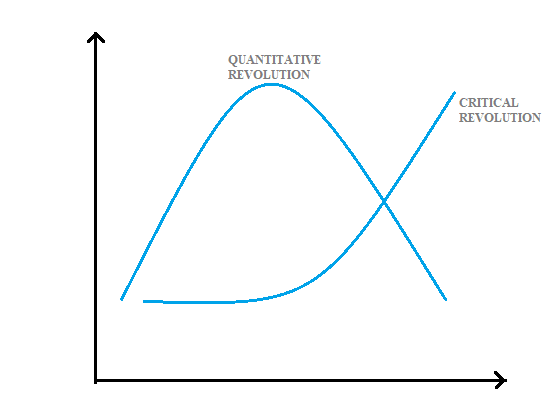
- The Critical Revolution in geography emerged during the 1970s as a reaction to the limitations of the Quantitative Revolution and the dominance of positivist approaches.
- This intellectual movement sought to re-establish the human element and social relevance at the core of geographical inquiry, moving away from the perceived reduction of human beings to mere mechanical entities or statistical data.
- Critical Revolution can be seen as a critique on positivism introduced by the Quantitative revolution. Critical Revolution can be seen as one of the major turning points in the history of geography. Major turning points that came before were, in chronological order, environmental determinism, regional geography, and the quantitative revolution.
Background and Causes of Critical Revolution

- The Quantitative Revolution (QR) in the 1950s and 1960s aimed to make geography a more scientific and rigorous discipline by employing statistical methods and mathematical models. However, this approach faced growing criticism for its:
- Mechanistic View of Humanity: QR often reduced human decision-making to rational economic models, neglecting the complexities of human behaviour, values, emotions, and individual experiences.
- Lack of Social Relevance: Quantitative models, while providing spatial analysis, were often criticized for failing to address pressing societal problems like poverty, inequality, social injustice, and environmental degradation. Theories generated by QR sometimes lacked practical utility in solving real-world issues.
- Value-Neutral Stance: Positivism advocated for a value-free science, which critical geographers argued was impossible and, in fact, served to maintain existing power structures and inequalities.
- The 1960s and 70s were also decades of global upheaval: civil rights movements, student protests, anti-colonial struggles, and the Vietnam War.
- These socio-political contexts influenced geographers to think more critically about their discipline’s role in society.
- The Critical Revolution, therefore, emerged as a demand for a more realistic, humane, and socially conscious geography.
Critical Revolution
- The demerits of the Quantitative Revolution led to the rise of the Critical Revolution.
- When Quantitative Revolution was declining, Critical Revolution gained more worth
- Critical Revolution was a backlash against Quantitative Revolution in the 1950s & 1960s as the related scholars wanted a change in the methodology
- Critical Revolution is a realistic approach in Geography. It evolved from the criticism against the Quantitative Revolution which was a part of the Critical revolution
- During the 1970s, a new wave emerged in Geography that is known as Critical Revolution.
- The term was used by Tuan in 1976.
- This was also supported by Peet.
- It is related to societal problems, that is why Critical Revolution is not only a methodological revolution but also a revolution in the contents of Geography.
- Critical Revolution has established human aspects as the principal concern of geography as Quantitative Revolution reduced man to a mechanical being.
- Critical Revolution deals with aspects of human geography, hence it is directed to establish geography as a useful subject that cannot be ignored by planning and development agencies.
- Critical Revolution has brought about 6 major concepts in geography –
- 📌 Behavioural concept
- 📌 Humanistic concept
- 📌 Time-space concept
- 📌 Human ecology concept
- 📌 Welfare concept
- 📌 Radical concept
Origins of Critical Geographies
- Background and Emergence
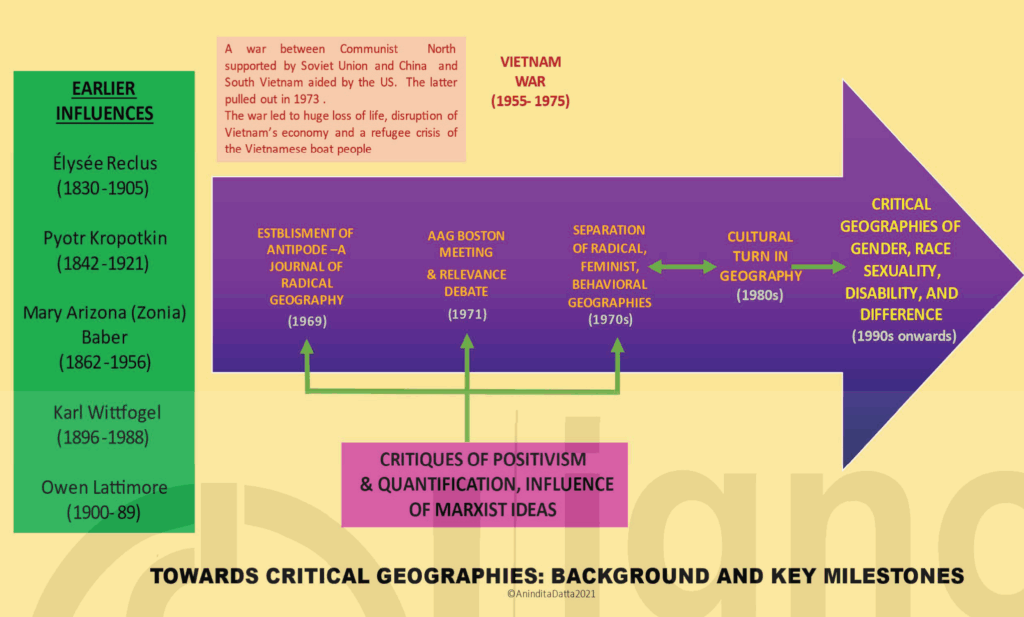
- The roots of critical geographies can be traced to growing dissatisfaction with the dominance of quantitative methods in geography during the mid-20th century.
- Critiques were raised against the paradigms of Areal Differentiation and Spatial Organization, which were seen as insufficient in addressing real-world issues like poverty, hunger, inequality, civil rights, and social injustice, particularly in the context of the United States.
- Birth of the Antipode Journal (1969)
- In 1969, the journal Antipode was launched as a landmark in the development of radical and critical geography.
- The journal was explicitly radical, tackling pressing social issues such as race, poverty, civil rights, and also adopting an anti-war stance.
- Influenced heavily by Marxist ideology, Antipode became a prominent platform for Marxist, feminist, and socialist geographers.
- Student Activism and Social Movements
- Students played a leading role in the origins of critical geography, raising powerful questions about inequality, racism, and U.S. involvement in the Vietnam War.
- It was these students who initiated Antipode, emphasizing grassroots activism and a need for more inclusive and relevant geographical inquiry.
- The journal continues to challenge capitalism and promote social and political engagement within geography.
- 1971 AAG Meeting in Boston – A Turning Point
- A critical milestone occurred during the 1971 meeting of the Association of American Geographers (AAG) in Boston.
- Here, geographers passed a strong resolution against the Vietnam War, marking the discipline’s political awakening.
- This event initiated the “relevance debate”, asserting the necessity for geographers to engage with contemporary social and political issues.
- Evolution into Three Radical Streams
- During the 1970s, radical geography evolved into three major streams, each challenging the limits of quantitative geography:
- ✅ Behavioral Geography:
- Focused on how humans make spatial decisions, influenced by knowledge, perception, and bounded rationality.
- Believed that such decisions could be predicted, contrasting with the abstract models of spatial science.
- ✅ Marxist or Radical Geography:
- Inspired by Karl Marx, it concentrated on issues of inequality, class conflict, and uneven development.
- Examined how capitalism shaped urban forms, spatial structures, and economic injustice.
- ✅ Feminist Geography:
- Pointed out the absence of women and gender perspectives in mainstream geography.
- Aimed at visibilizing women and their experiences, emphasizing patriarchy, gender roles, and intersectionality.
- ✅ Behavioral Geography:
- During the 1970s, radical geography evolved into three major streams, each challenging the limits of quantitative geography:
- Foundation of Critical Geographies
- These radical critiques laid the foundation for what is now called Critical Geography.
- This school of thought remains deeply committed to social justice, equality, equity, and activist scholarship.
- It examines who produces geographical knowledge, whose voices are heard, and how power relations shape spatial realities.
- Influence of the Cultural Turn
- The cultural turn in the social sciences brought new emphasis on:
- 🌍 Diversity and difference
- 🗣️ Multiplicity of voices and truths
- 🧠 Contextual and qualitative approaches to geographical research
- This turn helped further define critical geography as an approach and sub-discipline focusing on meaning, experience, and power structures in geographical space.
- The cultural turn in the social sciences brought new emphasis on:
Core Themes and Principles of the Critical Revolution
- The Critical Revolution in geography emerged as a reaction to the limitations of positivist and quantitative approaches that dominated the discipline during the mid-20th century. It focused on questioning the underlying assumptions, power structures, and ideological biases within geographical research and practice.
- The following are the major themes and principles that define this critical turn:
- 📌 Rejection of Positivism and Value-Neutrality
- Critical geographers challenged positivism, which emphasized objective, quantitative analysis and value-neutral inquiry.
- They argued that science is not value-free; research is influenced by the positionality, worldview, and socio-political context of the researcher.
- This principle marks a shift from studying “what is” to also asking “why it is” and “for whom it is.”
- 📌 Emphasis on Power, Inequality, and Ideology
- A central tenet of the critical revolution is the focus on power relations that shape spatial structures and geographic outcomes.
- It seeks to uncover who benefits and who loses from spatial arrangements like urban planning, resource allocation, and development strategies.
- Ideology is seen not just as a background context but as a force that actively shapes spatial processes.
- 📌 Advocacy for Social Justice and Emancipation
- Geography is seen as a tool for social critique and progressive change, not just spatial description.
- Social justice, equity, and liberation from oppression (especially of marginalized groups) became central goals.
- The approach often aligns with activist scholarship, where geographers engage with real-world struggles (e.g., displacement, environmental racism).
- 📌 Focus on Lived Experience and Subjectivity
- Unlike the earlier quantitative traditions, critical geography emphasizes human subjectivity and lived experience.
- It values qualitative methodologies like ethnography, participatory research, and discourse analysis.
- The aim is to understand the world from below, incorporating voices of the marginalized, oppressed, and everyday actors.
- 📌 Spatiality and the Production of Space
- Influenced by thinkers like Henri Lefebvre, critical geography views space as produced through social relations.
- Space is not a passive backdrop but an active medium through which power, economy, and culture are negotiated.
- This theme laid the foundation for debates around urban restructuring, gentrification, and spatial justice.
- 📌 Interdisciplinarity and Theoretical Pluralism
- The critical revolution broke the isolation of geography and drew upon diverse disciplines such as philosophy, sociology, political science, feminism, and post-colonial theory.
- It embraces theoretical pluralism, using Marxism, feminism, post-structuralism, and other critical lenses to understand spatial phenomena.
- 📌 Reflexivity in Geographical Research
- Critical geography emphasizes the importance of reflexivity—researchers must be aware of their own biases, positionalities, and ethical implications.
- It calls for transparent, accountable, and situated knowledge rather than detached and universal claims.
- 📌 Critique of Neoliberalism and Global Capitalism
- A dominant concern of critical geographers is to expose the spatial implications of neoliberal economic policies, such as privatization, deregulation, and austerity.
- The geographies of inequality, exclusion, and accumulation under global capitalism are central to this critique.
- 📌 Embracing Multiple Identities and Intersectionality
- Critical geography recognizes the importance of race, class, gender, sexuality, and ethnicity in shaping spatial experiences.
- It employs intersectional analysis to examine how different forms of oppression overlap and are reinforced in space.
- 📌 Transformative Praxis
- Critical geography is not just about theorizing but also about intervening and transforming society.
- It promotes participatory planning, community-based research, and policy advocacy as tools for spatial justice.
- 📌 Rejection of Positivism and Value-Neutrality
Key Thinkers and Contributions
- 📌 David Harvey – Marxist Geography and Spatial Justice
- A leading figure in the critical turn, Harvey’s works revolutionized the understanding of urban space, capitalism, and inequality.
- Key Work: Social Justice and the City (1973) marked a break from traditional spatial science and emphasized the role of capitalism in shaping urban spaces.
- He introduced the concept of spatial fix, showing how capitalism relocates production to solve crises.
- His later works like The Limits to Capital (1982) and Spaces of Hope (2000) offer critiques of neoliberalism and argue for radical urban planning.
- Harvey emphasized that space is not neutral, but socially constructed and contested.
- 📌 Edward Soja – Spatiality and Socio-Spatial Dialectic
- Soja emphasized the importance of space and spatial thinking in understanding social processes.
- Key Work: Postmodern Geographies (1989) and Thirdspace (1996).
- He argued that space is socially produced and should be studied as actively as time and society.
- Introduced the concept of Thirdspace – a combination of physical (Firstspace) and imagined spaces (Secondspace) – a hybrid and dynamic space of lived experience.
- 📌 Doreen Massey – Space, Place, and Power Relations
- A feminist geographer who reshaped the understanding of place and identity in human geography.
- Key Works: Space, Place and Gender (1994); For Space (2005).
- Argued that places are not static containers, but dynamic processes shaped by power relations, gender, and globalization.
- Introduced the idea of a global sense of place, which connects localities to wider global processes.
- Massey critiqued deterministic models and emphasized multiplicity and interconnectivity of spatial identities.
- 📌 Nigel Thrift – Non-Representational Theory and Embodied Geography
- Thrift developed ideas around non-representational theory, focusing on practice, performance, and affect in everyday life.
- He argued that not all geographies can be represented by maps or models, and we must also attend to emotions, gestures, habits, and rhythms.
- Emphasized the role of time, speed, and movement in shaping space.
- 📌 Gill Valentine – Feminist and Emotional Geographies
- A key contributor to feminist geography, Valentine brought gender and emotional dimensions to the forefront.
- Focused on how public and private spaces are shaped by gender norms.
- Explored themes like fear, safety, sexuality, and exclusion in urban spaces.
- Her works emphasized that geography must consider everyday experiences and embodied identities.
- 📌 Don Mitchell – The Right to the City and Labor Geographies
- Mitchell’s work connects labor, public space, and capitalism through a Marxist lens.
- Key Works: The Right to the City and Cultural Geography: A Critical Introduction.
- He argued that public spaces are increasingly privatized, restricting access for the working class and homeless.
- Advocated for the right to access, produce, and participate in urban space.
- 📌 J.K. Gibson-Graham – Post-Capitalist Geographies
- A feminist duo (Julie Graham and Katherine Gibson) who challenged the hegemony of capitalism in geographical thinking.
- Key Work: The End of Capitalism (As We Knew It).
- Proposed diverse economic imaginaries such as cooperative economies, subsistence, and gift economies.
- Emphasized that alternatives to capitalism already exist and must be made visible.
- 📌 Trevor Barnes and Eric Sheppard – Critical Economic Geography
- They critiqued neoclassical economic geography for being overly abstract and ignoring inequality.
- Advocated for relational approaches, connecting economic processes with power, institutions, and place-based contexts.
- Supported the idea that economic space is socially constructed and must be studied through contextualized models.
- 📌 Ash Amin – Plurality and Networked Urbanism
- Explored the idea of cities as fluid, interconnected, and relational networks.
- Challenged the fixed spatial binaries of traditional urban geography.
- Emphasized the importance of flows, hybrid spaces, and global-local interactions in city formation.
- 📌 Yi-Fu Tuan & Humanistic Geography
- Focused on human experience, perception, and place attachment.
- Introduced topophilia (love of place) as an essential part of geography.
Types of Critical Geography
- Marxist Geography
- Emerged in the 1970s as a critique of capitalism and its role in producing spatial inequality.
- Analyzed how capitalist systems produce uneven development, gentrification, and spatial injustice.
- Key themes: class conflict, capital accumulation, urbanization, labor geography, and spatial fix.
- 📌 Key Thinkers: David Harvey (Social Justice and the City), Manuel Castells, Neil Smith.
- Feminist Geography
- Arising from feminist movements of the 1970s and 1980s, it critiques patriarchal structures in geography.
- Emphasizes how space and place are gendered, and how women experience geography differently.
- Questions male-dominated knowledge systems and introduces the concept of embodied geographies.
- Focus on private vs. public space, gendered mobility, and intersectionality (gender, race, class).
- 📌 Key Thinkers: Doreen Massey, Gill Valentine, Linda McDowell.
- Postmodern and Poststructuralist Geography
- Emerged in response to grand narratives and universal models.
- Emphasizes difference, fragmentation, and plurality of spatial experiences.
- Argues that reality is socially constructed and shaped by discourse, language, and power.
- Undermines binary oppositions (e.g., center vs. periphery, developed vs. underdeveloped).
- 📌 Key Thinkers: Edward Soja (Thirdspace), Derek Gregory, John Urry.
- Postcolonial Geography
- Focuses on the legacies of colonialism and the spatial reproduction of inequality.
- Challenges Eurocentrism in geographical knowledge and methods.
- Explores how colonial histories, identities, and borders shape the present-day world.
- Advocates decolonization of knowledge and geographic narratives.
- 📌 Key Thinkers: Ananya Roy, James Sidaway, Gyan Prakash (interdisciplinary relevance).
- Critical Race Geography
- Examines the spatial dimensions of racial inequality, segregation, and discrimination.
- Explores how racism is embedded in landscapes, city planning, housing policies, and institutional systems.
- Engages with themes of racialized space, ghettos, immigrant geographies, and diasporic spaces.
- 📌 Key Thinkers: Ruth Wilson Gilmore, Bobby M. Wilson, Laura Pulido.
- Queer Geography
- Questions heteronormative assumptions in spatial analysis.
- Focuses on the geographies of sexual minorities, LGBTQ+ spaces, and the politics of identity.
- Studies the spatial expressions of sexuality, such as gay neighborhoods, pride marches, or safe spaces.
- Advocates for inclusive urban planning and representation.
- 📌 Key Thinkers: Gill Valentine, Kath Browne, Jon Binnie.
- Emotional and Affectual Geography
- Highlights the emotions, feelings, and affective experiences tied to places and environments.
- Argues that emotional responses shape sense of place, belonging, attachment, and fear.
- Challenges the idea that geography must be cold, rational, and objective.
- Explores phenomena like trauma, grief, joy, and nostalgia in relation to spatiality.
- Radical Geography
- An umbrella term used in the 1960s and 70s, often synonymous with Marxist geography but broader.
- Seeks to use geographical knowledge for social transformation and activism.
- Radical geographers do not just study injustice; they aim to change unjust systems.
- Strongly aligned with anti-capitalist, anti-racist, and anti-imperialist ideologies.
- 📌 Associated Journals: Antipode (Radical Journal of Geography).
- Critical Urban Geography
- Focuses on urban issues like gentrification, housing inequality, urban segregation, and public space access.
- Studies neoliberal urbanism, privatization of space, and exclusionary zoning policies.
- Integrates insights from Marxist, feminist, and postcolonial theories to understand urban change.
- 📌 Key Thinkers: Don Mitchell, Neil Smith, Loretta Lees.
- Critical Environmental Geography
- Critiques traditional approaches to nature and the environment as separate from society.
- Explores environmental justice, political ecology, and power dynamics in environmental decision-making.
- Advocates for the inclusion of indigenous knowledge systems, grassroots environmental movements, and sustainable practices.
- 📌 Key Thinkers: Paul Robbins, Piers Blaikie, Dianne Rocheleau.
| Type of Critical Geography | Focus Area | Key Thinkers |
|---|---|---|
| Marxist Geography | Capitalism, class, spatial inequality | David Harvey, Neil Smith |
| Feminist Geography | Gender, space, intersectionality | Doreen Massey, Gill Valentine |
| Postmodern/Poststructuralist | Discourse, plurality, fragmented realities | Edward Soja, Derek Gregory |
| Postcolonial Geography | Colonial legacies, decolonization | James Sidaway, Ananya Roy |
| Critical Race Geography | Racialized space, discrimination | Laura Pulido, Ruth Wilson Gilmore |
| Queer Geography | Sexuality, LGBTQ+ spaces | Kath Browne, Gill Valentine |
| Emotional Geography | Emotions, affect, sense of place | Mona Domosh, Nigel Thrift (in part) |
| Radical Geography | Activism, justice, transformation | Don Mitchell, Editors of Antipode |
| Critical Urban Geography | Neoliberal cities, exclusion, gentrification | Loretta Lees, Neil Smith, Don Mitchell |
| Critical Environmental Geography | Political ecology, grassroots, justice | Paul Robbins, Piers Blaikie |
Criticism of the Critical Revolution in Geography
- Overemphasis on Ideology
- The Critical Revolution, especially under Marxist Geography, overemphasized class conflict, capitalism, and power structures.
- David Harvey, one of its leading proponents, was criticized for making geography overly ideological and class-centric.
- Critics argue that this approach reduced multifaceted spatial issues to economic determinism, neglecting other variables like culture, environment, or individual agency.
- Neglect of Scientific Rigor and Empiricism
- Positivist scholars like Brian Berry and Burton argued that the rejection of scientific methodologies and statistical tools weakened geography’s objective and empirical base.
- Ron Johnston also raised concerns about the decline of empiricism in geographical research.
- Critics claimed that normative goals overtook positive analysis, making it hard to test or falsify the claims made by critical geographers.
- Subjectivity and Relativism
- The influence of postmodernism brought with it excessive relativism and skepticism of universal truths.
- Edward Soja and Doreen Massey, though influential in critical geography, were critiqued for embracing spatial subjectivities that lacked consistent methodological grounding.
- Critics argued this led to fragmented worldviews and weakened geography’s ability to build coherent models or general theories.
- Fragmentation of the Discipline
- The proliferation of sub-fields (feminist, queer, Marxist, postcolonial geographies) led to disciplinary disunity.
- Ron Johnston and Peter Haggett expressed concern that geography was losing its core identity due to over-fragmentation.
- This pluralism, while intellectually rich, made geography harder to define and teach as a unified discipline.
- Over-politicization of Geography
- Critical geography’s activist tone was criticized for blurring the line between academic research and political advocacy.
- Richard Peet, known for radical and Marxist geography, was accused of treating geography as a tool for political propaganda.
- Critics from the quantitative school, like William Bunge, cautioned that unmoderated political agendas may compromise scientific objectivity.
- Marginalization of Physical Geography
- Critical geography’s strong focus on human-environment inequality and social justice ignored the biophysical environment.
- Michael Watts, while engaging in political ecology, was critiqued for downplaying the independent role of physical geography.
- This led to an artificial divide between human and physical geography, which critics like Peter Haggett sought to bridge.
- Methodological Challenges
- Critical geographers often lacked concrete tools or methods to operationalize their theories.
- David Harvey, in later works, acknowledged that without robust empirical support, critical theory could become rhetorical rather than practical.
- Fotheringham and Brunsdon (2000) highlighted the need for quantitative and spatial methods even within critical frameworks.
- Resistance to Generalization
- Postmodern scholars like Derek Gregory discouraged grand theories, favoring localized, specific narratives.
- This created challenges in formulating universal spatial laws or predictive models, weakening geography’s explanatory power.
- Critics argue that regional planning, urban policy, and applied geography require some level of generalization.
- Disregard for Quantitative Methods
- Brian Berry and Burton led the quantitative revolution to bring scientific objectivity to geography.
- They criticized critical geography for rejecting data-driven decision-making.
- Peter Haggett maintained that quantitative and theoretical geography are essential for robust analysis, especially in applied fields like transport or urban studies.
Critical Geographies: Radical Geography and Critical Geography
- Shared Foundations
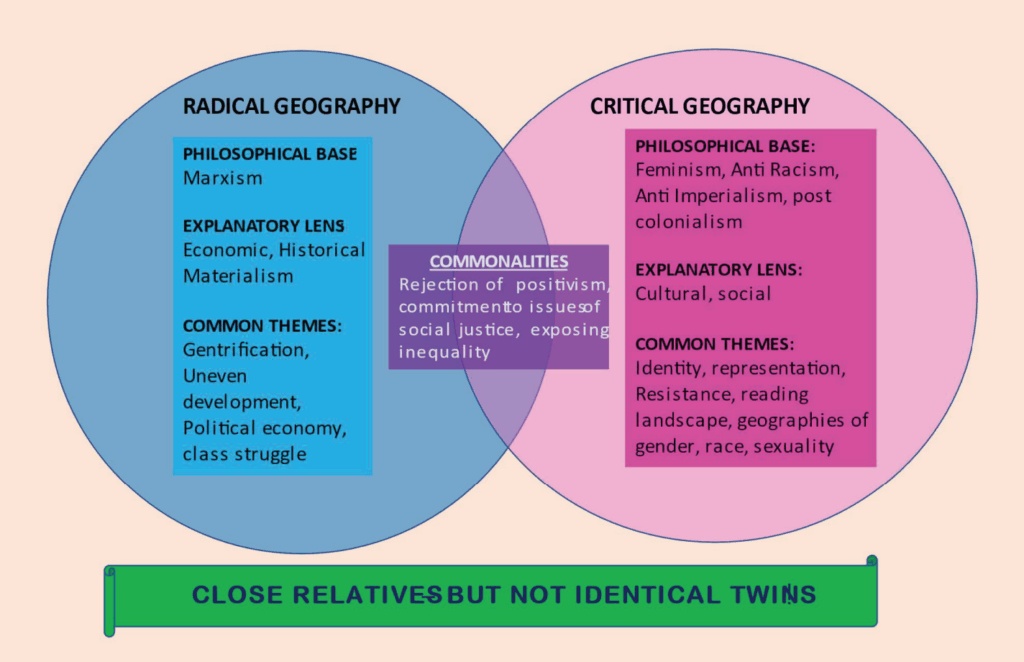
- Radical and critical geographies share a common concern with social injustice, inequality, and activism.
- Critical geographies of the 1990s are considered an evolution of the radical geographies of the 1970s.
- Philosophical Differences
- Radical geography is rooted in Marxist philosophy, focusing on economic structures, capitalism, and class-based inequality.
- Critical geography, on the other hand, is shaped by the cultural turn and post-structuralist philosophies.
- Emphasis on identity, representation, subjective experiences, and marginalization.
- Greater focus on cultural and social dimensions rather than purely economic ones.
- Key Thematic Distinctions
- Radical geography emphasizes:
- 💰 Economic determinism
- 🏭 Structural influences in shaping society
- Critical geography emphasizes:
- 🧠 Human agency and individual subjectivities
- 🎭 Multiplicity of perspectives, experiences, and narratives
- ❌ Rejection of grand theories or metatheories that claim universal applicability
- Radical geography emphasizes:
- Epistemological and Methodological Commitments
- Critical geographers challenge positivism, both in method and philosophy.
- They seek to uncover the unequal distribution of social power and expose systems of domination.
- They emphasize reflexivity in knowledge creation:
- 🧍♀️ Who creates the knowledge?
- 🌍 What is the social and cultural context of the researcher?
- 🤔 What are their positions and perspectives?
- Critical geographers challenge positivism, both in method and philosophy.
- Diverse Theoretical Influences
- Critical geography draws from a broad array of theoretical frameworks, including:
- 📣 Anti-imperialism
- 🚺 Feminism
- ✊ Anti-racism
- 🛠️ Post-colonial theory
- There is a strong belief in praxis—the application of theory in everyday life and practice.
- Critical geography draws from a broad array of theoretical frameworks, including:
- Connection to Social Activism
- Many critical geographers are directly engaged in social change movements.
- They aim to bridge theory and practice, aligning scholarly work with real-world transformation.
- Role of Representation in Power Dynamics
- Representation is viewed as both a tool of domination and a means of resistance.
- 🖼️ Examples include the critical interpretation of cartoons, memes, and media portrayals.
- Questions are raised such as:
- Who creates these representations?
- What power structures are they resisting or reinforcing?
- How are different communities or identities portrayed?
- Representation is viewed as both a tool of domination and a means of resistance.
- Reconceptualizing Space
- For critical geographers, space is not a passive backdrop.
- It is an active tool in shaping experiences, politics, and inequalities.
- Spatial structures and representations are used to produce oppression or to resist it.
- For critical geographers, space is not a passive backdrop.
- Use of the Term ‘Geographies’ (Plural)
- The preference for ‘Geographies’ (plural) over ‘Geography’ (singular) reflects:
- ❌ Rejection of a single universal theory
- ✅ Acceptance of a multiplicity of voices, identities, and interpretations
- 📚 Recognition of diverse worldviews and context-specific truths
- The preference for ‘Geographies’ (plural) over ‘Geography’ (singular) reflects:



thanku very much
sir thank u so much for these notes… and sir this is my humble request pls never remove these notes from this site.. as usually people doing these things for monetary gains…
these notes are blessing for student like me who could not afford coaching.. these are so comprehensive and are in easy language,…i m very happy by studying from these notes
ok
The best site ever I visit on Geography. Keep on going. May Allah bless you.
Thanks
everything seems vague wihtout real life examples or anything to relate to.. request too add some good examles.
Updated!