

- Behavioral geography is an approach to human geography that attempts to understand human activity in space, place, and environment by studying it at the disaggregate level of analysis—at the level of the individual person. Behavioral geographers analyze data on the behavior of individual people, recognizing that individuals vary from each other.
Behavioural Approach

- By the mid-1960s use of statistical techniques in research for precision has been largely accepted by geographers. The duality of systematic versus regional geography was resolved as both were now accepted as important components of the discipline through interdependent and equally useful.
- It was increasingly realized by the geographers that the models propounded and tested with the help of quantitative techniques, provided poor descriptions of geographic reality as well as the man-environment relationship.
- Consequently, progress towards the development of the geographical theory was glaringly slow and its predictive powers were weak. Theories such as Central Place Theory, based on statistical and mathematical techniques, were found inadequate to explain the spatial organization of society.
- The economic rationality of decision-making was also criticized as it does not explain the behaviour of man. It was a psychological twist in human geography which emphasized the role of subjective and decision-making processes that mediate the association between environment and spatial behaviour of man.
- It can be said that the dissatisfaction with the models and theories developed by the positivists, using the statistical techniques which were based on the ‘economic rationality’ of man led to the development of behavioural approach in geography.
- The axiom of ‘economic person’ who always tries to maximize his profit was challenged by Wolpert, in his paper entitled ‘The Decision Process in Spatial Context’, Wolpert (1964) compared the actual and potential labour productivity of Swedish farmers and came to a conclusion that optimal farming practices were not attainable. He concluded that the farmers were not optimizers but, satisfies.
- Thus human behaviour was seen to be a product of decision-making and it was a human tendency to have incomplete information, to make imperfect choices, and even then be satisfied with sub-optimal options.
Historical Perspective of Behavioural Concept in Geography
- The very emergence of behavioural concept had taken place in 1951 when Kirk had used the term “Behavioural Environment” to explain some complicated socio-economic problems, but this work could not receive attention in the midst of the tornado of Quantitative Revolution
- Similar work was done by Boulding in 1956 who presented a book titled “Progress in Geography” in which he expressed arguments in favour of behavioural explanation of some complicated geographical problems but he also failed to get due recognition
- By the end of the 1960s, there was a realization that scientific models and theories are unable to provide a realistic explanation of several socio-economic problems and in that situation, behavioural explanations were sought and it was this approach that provided satisfactory conclusions.
- Gradually, Quantitative Revolution started declining and Behavioural Geographers started criticizing some components of the Quantitative Revolution like considering man as economic and rational, isotropic surface, etc.
- It is rightly observed that the emergence of behavioural geography was due to disillusionment with the axioms on which the models of geography were based as these axioms were far removed from reality (they were idealistic)
- Minshull, in his book “Making of Geography“, stated that “by giving some models and preparing some theoretical statements you cannot explain geography“.
- In other words, behavioural revolution in counter-revolution of Quantitative Revolution – “where Quantitative Revolution failed to give a scientific explanation, behavioural concept solved the problem”
- Behavioural Revolution refined some loopholes of Quantitative Revolution, therefore it is also called as refinement/extension of Quantitative Revolution.
- Behaviouralism is antithetical to Quantitative Revolution in 2 regards –
- In Quantitative Revolution, the man was considered economically rational and it neglected normative questions of a man like value system, culture, moral, his choices, sentiments whereas in Behavioural Revolution, perceptions of man are taken into consideration.
- Behaviouralism believed in per capita or per individual study whereas Quantitative Revolution was based on gross generalization. In behaviouralism, model building and theorization was not neglected. It wanted to construct a law by induction, and collection of primary data by field surveys.
- Thus, it is not against positivism but it differs on the point that it is against overgeneralization and considering man as a point on the surface
What is Behavioural geography (Behaviouralism)?
- The essence of behavioural approach in geography lies in the fact that the way people behave is mediated by their understanding of the environment in which they live or by the environment itself with which they are confronted.
- The behavioural approach has taken the view that a deeper understanding of man environment interaction can be achieved by looking at the various psychological processes through which man comes to know the environment in which he lives and by examining the way in which these processes influence the nature of resultant behaviour (i.e. perceptions of man, Downs concept, Mental Maps, etc) at the psychological level.
- The behaviouralistic approach is largely inductive aiming to build general statements out of observations of ongoing processes i.e. generalisation achieved through specific cases.
- The core idea: Human behaviour is not just shaped by the environment, but also by the individual’s understanding and perception of it.
Models of Man-Environment interaction
- The followers of behavioural geography do not recognize the man as a rational person or an ‘economic man’ who always try to optimize profits.
- Man always does not take into consideration the profit aspect while performing an economic function. Most of his decisions are based on behavioural environment rather than on the objective or real environment. The decisions are influenced by Perceptions of man.
- It emphasizes that environmental cognition (how people mentally process their surroundings) and human behaviour are closely interconnected.
- Psychological processes are crucial in shaping how individuals interpret their environment and make spatial decisions.
Conventional Models of Man-Environment interaction
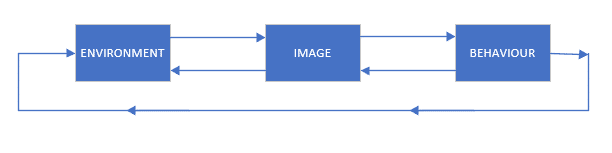
- Boulding in 1956 presented a model for Man-Environment interaction
- The fundamental arguments of behavioural geography are
- People have environmental images (based on perception)
- Those images can be identified accurately by researchers, and
- There is a strong relationship between environmental images and actual behaviour
Robert Kates and Perception of Environmental Hazards
- Robert Kates (1962) provided pioneering work in perception of environmental hazards, particularly floodplain management.
- His model was built on four assumptions:
- Humans are rational decision-makers.
- They make choices consciously.
- Choices are based on available knowledge.
- Information is evaluated based on pre-determined criteria.
- This showed that perception of risk and uncertainty directly influences decisions, especially in managing environmental challenges.
Kirk’s Behavioural Model (1952–1963)
- J. Kirk proposed that people from different socio-economic and cultural backgrounds interpret the same geographical environment differently.
- Individual reactions to spatial information vary based on caste, class, culture, and economic needs.
- 🧑🌾 Example: In the Indo-Gangetic Plain, different communities (Jats, Gujjars, Ahirs, Sainis, etc.) living in the same village perceive and utilize land differently based on their needs (e.g., growing sugarcane, fodder, vegetables).
Concept of Mental Maps
- One of the most influential concepts in behavioural geography.
- Introduced by Peter Gould (1966) in his seminal paper.
- 📌 Mental maps are not actual maps, but cognitive images of space formed by personal interpretation, memory, and experience.
- These maps help understand:
- How individuals perceive space.
- How they form preferences and make location decisions.
- Further developed by:
- Downs (1970) – Environmental cognition and image formation.
- Downs & Stea (1973) – Expanded framework on environmental use.
- Gould & White (1974) and Saarinen (1979) – Explored spatial preferences and decision processes.
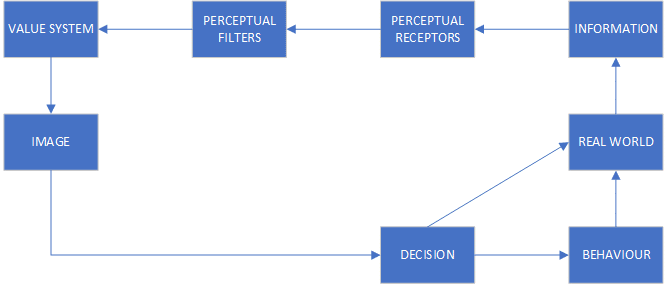
Downs’ Conceptual Framework (1970)
- Proposes that:
- Real-world information is filtered through personality, culture, beliefs, and cognition.
- The outcome is a mental image used to make spatial decisions.
- Differentiates between:
- Objective environment: Actual, physical surroundings.
- Behavioural environment: The subjective interpretation of those surroundings by individuals.
- Individuals act based on how they perceive the environment, not just how it objectively exists.
Pred’s Behavioural Matrix (1969)
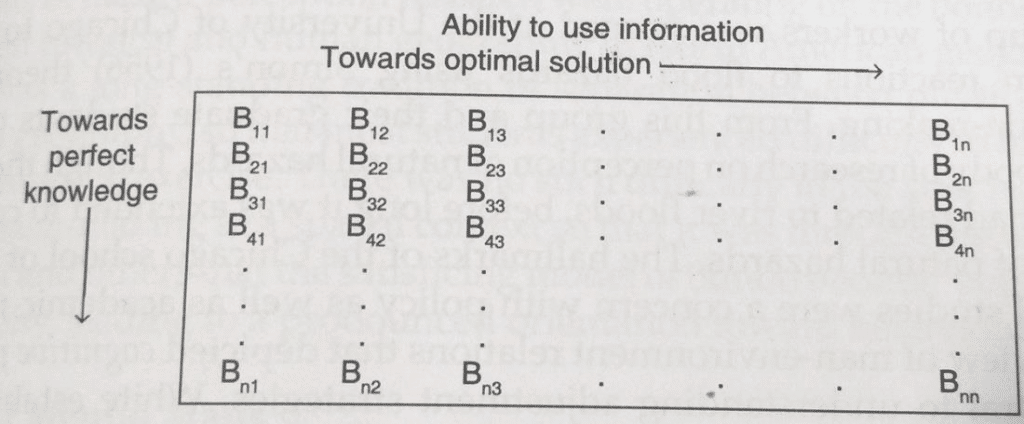
- Offered a structured model to analyze locational decisions.
- Emphasized variations in:
- Quality and quantity of available information.
- Ability of individuals to use that information.
- People are placed on a matrix depending on their:
- Aspirations, experience, and social group norms.
- Recognized that even the same individual can make different decisions over time due to changing spatial conditions.
Porteous(1977) suggested 3 environments –
- Physical Environment (Physical objects),
- Personal Environment (perceived images of phenomenal or real environment), and
- Contextual Environment (culture, religion, beliefs, and expectations that influence behaviour)
Sonnenfield
- American geographer Sonnenfield has also presented a model to explain the importance of behavioural environment in Human Geography
- He viewed that behavioural environment is in the centre of understanding of the universe and once the universe is understood, the development plans can be prepared for the betterment of society
- His model is as follows –
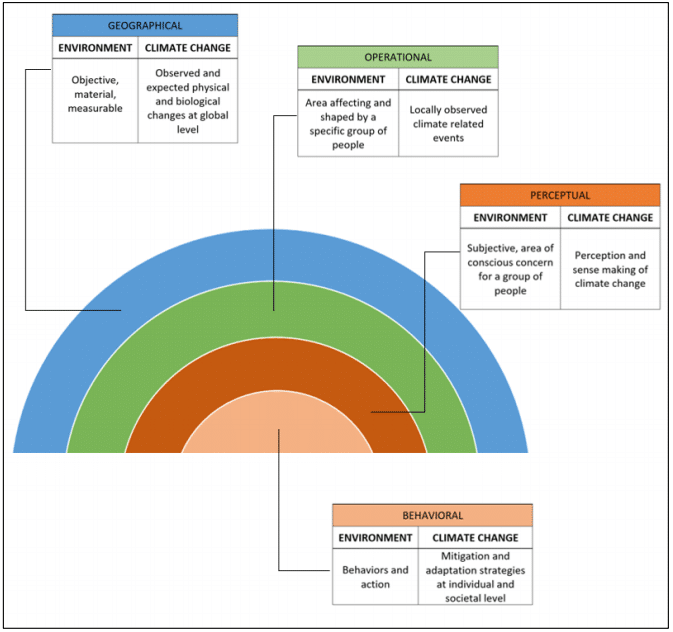
- It consists of nested set of Environments according to which the perception of any observer will be reflected in Behaviour
- By presenting this model, Sonnenfield has also viewed that developed societies have a greater geographical environment in comparison to developing societies. Consequently, they are capable to make greater use of resources
- Developing societies have not been able to develop a greater operational environment due to a lack of information. Consequently, They depend on traditional operational behaviour
Objectives of Behavioural Geography
- The objectives of behavioural approach were:
- To develop models for a human phenomenon which would provide an alternative to
the spatial location theories developed under the influence of positivism. - To define the cognitive (subjective) environment that determines the decision-making
process of humans; - To come up with psychological and social theories of human decision-making and
behaviour in a spatial framework; - To change the emphasis from aggregate populations to the disaggregate scale of
individuals and small group - To search for methods other than those popular during the quantitative revolution that
could uncover the latent structure in data and decision-making; - To emphasize on procession rather than structural explanations of human activity and
physical environment; - To generate primary data about human behaviour and not to rely heavily on the
published data; and - To adopt an interdisciplinary approach for theory-building and problem-solving.
- To develop models for a human phenomenon which would provide an alternative to
- The fundamental arguments of the behavioural geography to achieve these objectives are that:
- (i) People have environmental images;
- (ii) Those images can be identified accurately by researchers; and
- (iii) There is a strong relationship between environmental image and actual behaviour or the decision-making process of man.
Advantages of Behavioural Concept
- Revolution has brought phenomenal changes in the understanding of socio-economic problems in Geography
- Olosor (Sweden) has rightly observed that the behavioural approach has the key of social geography
- Although every field of human geography is within the investigation realm of behavioural approach, but there are two important fields which have received greater advantages from this method –
- Study of movement in Geography (contributors – Wolpert, BJL Berry, Hagerstrand)
- Study of Locational Decision (contributors – Smith, Gould, Hotteling, Hagerstrand, Felter)
1. The study of movement can be broadly divided into –
- (a) Consumer Movement / Marketing Behaviour
- (b) Migration, and
- (c) Intra-moves (Knox)
- All these spatial activities can properly be explained with the help of behavioural approach
- Marketing pattern is no more simply depending on space proximity and Nearest market is not necessarily the preferred market
- Marketing depends on behavioural perceptions. Hence, there has been a need to redirect transport system
- Migration pattern has also the impact of behavioural pattern
- All over the developing countries, there is a rural-urban migration because the urban centres provide more job opportunities while in developed countries they have urban-rural migration because urban areas are environmentally degraded and is preferable to settle in nearby rural areas for healthier environment
- Knox in his work “An introduction to the study of Urban Social Geography” developed the concept of intra-moves
- Intra-moves means residential movements within urban areas.
2. All kinds of functional locations are influenced by Behavioural environment, so behavioural explanation is needed
- Hotteling cites an example that in the USA, Miami beach has tremendous growth of ice-cream industry
- According to Hoover, a minimum production cost centre is the most favourable centre for industrial growth
- According to Weaver, a minimum transport cost centre is most favourable for industrial growth, But in the case of Miami, none of these 2 views are applicable because here both the production and transport cost is maximum as milk is brought from California (2000 Km away) and sugar from the northern parts of USA
- It is the behavioural environment of tourists due to which the industry has emerged here. So, it is only the behavioural approach which can explain the location of industries
- It is in opposition to Quantitative Revolution’s optimum location where cost should be minimum and profit should be maximum
- Smith’s industrial location theory is known as maximum profit point theory
- Industry will emerge at a point where profit is maximum
- Purchasing capacity depends upon income and behaviour
- This is in contradiction to theories of Quantitative Revolution
- Gould worked in an agricultural location
- He viewed that farmers often change the crop on the basis of changes in demand and changes in meteorological conditions
- Hagerstrand has given a model on the diffusion of innovation and their impact on agricultural efficiency
- He has viewed that all farmers of a region would not adopt new seeds and techniques, only a few progressive farmers would take the risk and once the high yield would be established, there would be a sweeping use of seed on new environment
- These are some studies and some examples to substantiate the fact that behavioural revolution has brought about a major change in the explanation of human geography in general and complicated socio-economic problems in particular
- Quantitative Revolution cannot be applied everywhere and perceptions of man help us better to understand human geography.
Salient Features of Behavioural Geography
- Dual Character of Space: Objective vs. Behavioural Environment
- Behavioural geographers emphasize that the way people perceive their environment often differs significantly from the actual, physical environment.
- Therefore, space or environment has two essential aspects:
- Objective Environment: The real world, which can be measured and sensed through direct observation (e.g., topography, temperature, rainfall).
- Behavioural Environment: The environment as perceived by individuals—a mental, psychological interpretation that exists in the mind.
- Despite being partial or selective, the behavioural environment is what truly guides human decision-making.
- 📌 Key Insight: People act based on how they perceive reality, not necessarily on how reality objectively exists.
- 🧠 This concept is famously illustrated by Koffka (1935–36) through a Swiss tale, showing how perception, not reality, influences action.
- Focus on the Individual Over Groups
- Unlike other approaches that prioritize societies, institutions, or cultures, behavioural geography places the individual at the center of analysis.
- Every person is seen as:
- A goal-directed agent.
- Interacting with and altering the environment—even if subtly or unintentionally.
- Human-environment interactions are thus individual-centric, making it crucial to understand personal motivations, perceptions, and behaviours.
- This helps to explain variability in spatial behaviour, even among people living in the same setting.
- Interactive Human-Environment Relationship
- Behavioural geography rejects the one-way deterministic model (i.e., nature controls man).
- Instead, it promotes a mutual interaction model:
- Man shapes the environment through his choices and actions.
- The environment, in turn, influences man’s perceptions, options, and behaviours.
- 📚 As noted by Gould (1980): The relationship is dynamic—man and environment continually influence each other.
- Multidisciplinary Outlook
- Behavioural geography is not a self-contained field—it actively draws from multiple disciplines:
- Psychology (e.g., perception, cognition)
- Philosophy (e.g., individualism, interpretation)
- History (e.g., cultural experience over time)
- Sociology and Anthropology (e.g., social norms, community behaviours)
- Ethnology (e.g., cultural patterns)
- Urban Planning (e.g., spatial behaviour in cities)
- This interdisciplinary approach enriches the field but also highlights its lack of unique, inbuilt theories—a major reason for its slower development compared to other paradigms.
- Behavioural geography is not a self-contained field—it actively draws from multiple disciplines:
- Broad Scope and Scientific Relevance
- Behavioural geography makes a valuable contribution by bridging the gap between the natural and social sciences.
- Its emphasis on real-world perception, decision-making, and cognition allows it to address a wide range of human geographical issues—from hazard perception to resource use and urban movement.
- Even within human geography, its scope remains broad, covering:
- Risk and hazard studies
- Mental mapping
- Perception of space
- Personal decision-making frameworks
Limitations /Disadvantages
- Harvey has a famous book to his credit known as “Explanation in Geography” published in 1969, according to which behaviouralism is a complex phenomenon and has been oversimplified in geographical explanation. Behaviouralism plays a greater role in sociological and historical events rather than events of geography
- H.J.Eysenck (psychologist) has also viewed that this type of approach will bring psychology of politics in social sciences as bringing subjectivity in Geography will make it more complicated
- Herbert Simon has also been of different view. According to him, behavioural environment is a hypothetical perception. It needs satisfying knowledge which is never possible
- Skinner (psychologist) in his book “Beyond dignity and freedom” viewed that behavioural approach may become the basis of reactionary political doctrines in social sciences
- Several geographers have also been afraid of the distortion and deviation of behavioural environment due to ill-conceived and biased information. So, Information is the principal issue
- Perceptions can be Hypothetical which can reduce objectivity in Geography
- The information can be irrelevant from Geographical perspective
- If the flow of information is proper, then the behavioural information may be an instrument of geographical explanations
- But any situation leading to distortion of information will be suicidal for this new anthropocentric approach in geography and will lead to deviation from Man-Environment Focus.
Criticisms of Behavioural Geography
- Urban-Centric and Western Bias
- Behavioural geography has historically focused on urban spaces and developed countries, leaving rural settings and the Global South relatively underexplored.
- This restricts the universal applicability of its theories and models.
- Lack of Theoretical Coherence and Conceptual Clarity
- A major shortcoming is its failure to synthesize empirical findings into coherent theoretical frameworks.
- Terminology and concepts in behavioural geography are often:
- Loosely defined
- Poorly integrated
- Inconsistent across studies
- This lack of a systematically organized theoretical base hinders its development into a robust sub-discipline.
- Over-Reliance on Laboratory Experiments and Animal Studies
- Much of behavioural geography’s data originates from laboratory experiments on animals, which are indirectly applied to human behaviour.
- This approach has led to what Koestler (1975) called the “rato-morphic fallacy”—reducing complex human experiences to basic animal responses.
- As a result, theories often appear elegant in design but disconnected from real-world man-environment interactions.
- Excessive Focus on Ego-Centric Environmental Interpretation
- Behavioural geography overemphasizes individual perception (ego-centred analysis), often neglecting societal, cultural, and institutional contexts.
- Assumptions like the existence of clearly measurable environmental images and direct image-behaviour linkage remain empirically unverified.
- Mental maps and cognitive models, while insightful, lack universal methodological validation.
- Weak Practical Relevance and Policy Disconnect
- Despite its scientific aspirations, behavioural geography suffers from a gap between theory and practice.
- Behavioural geographers largely remain observers, not active participants in policy or planning.
- This lack of engagement with real-world problems limits its utility in public planning, urban policy, and welfare schemes.
- Even when policy recommendations are made, they are often based on small student samples and lack applicability on a broader scale.
- Inability to Produce Predictive Models or Laws
- Unlike other subfields of geography, behaviouralism has failed to formulate universally accepted models or spatial laws related to human behaviour.
- The few models it did produce (e.g., Kates’ decision-making scheme, Pred’s behavioural matrix) had limited credibility and applicability.
- This failure diluted its influence and raised questions about its scientific rigour.
- Methodological Limitations and Lack of Subjectivity
- Behavioural geography leans heavily on positivist methods, overlooking subjective and qualitative aspects of spatial experience.
- It fails to engage with emotional, symbolic, and value-based human interactions with space.
- This weakness made it difficult to bring the behavioural approach into the mainstream of geographical thought.
- Decline and Transition to Post-Behaviouralism
- Due to its shortcomings, behavioural geography declined post-1970s, giving way to post-behaviouralism.
- Post-behaviouralism:
- Merged with humanistic and welfare geography
- Embraced subjective, qualitative, and value-sensitive methods
- Focused on the individual’s lived experience and spatial well-being
- It marked a shift away from cold quantification toward empathetic, grounded geographies.
Conclusions
- Despite several constraints and methodological limitations, behavioural geography is now widely accepted within the positivist orientation. It seeks to account for spatial patterns by establishing generalizations about people-environment interrelationship, which may then be used to stimulate change through environmental planning activities that modify the stimuli which affect the spatial behaviour of us and others.
- The research methods of behavioural geography vary substantially but the general orientation – inductive generalization leading to planning for environmental change remains. Eventually, it is hoped, a ‘powerful new theory’ will emerge.
- Golledge argued that substantial advances in understanding spatial behaviour have already been made by studying ‘individual preferences, opinions, attitudes, cognitions, cognitive maps, perception, and so on – what he terms processes variables.





Worth reading it 😘😘
lots of love sir/maidam……thanku very much…GOD BLESS U
How to represent Nature of geography in answer?
Thank you sir,
Very helpful 👍☺️
Thank you for explaining this difficult subject so well. If we look at it, people rarely study such topics because in most of the books and by teachers, such topics are explained in a very difficult manner. But the way you have explained it, no amount of praise is enough for it.🙏🙏🙏