- Regional and systematic geography, the two approaches, differ in their unit of study and also in their methodologies, one strand of geography’s wider dualism.
- Regional geography seeks to understand the unique and leans towards the idiographic and inductive.
- Systematic geography seeks general laws and leans towards the nomothetic and deductive.
- The question was the discipline’s central quarrel from Richard Hartshorne’s The Nature of Geography (1939) to the quantitative revolution of the 1960s.
Two Methodologies

Regional Geography: The Idiographic Tradition
- Regional geography grew out of geography as areal differentiation, the interpretation of the variable character of places.
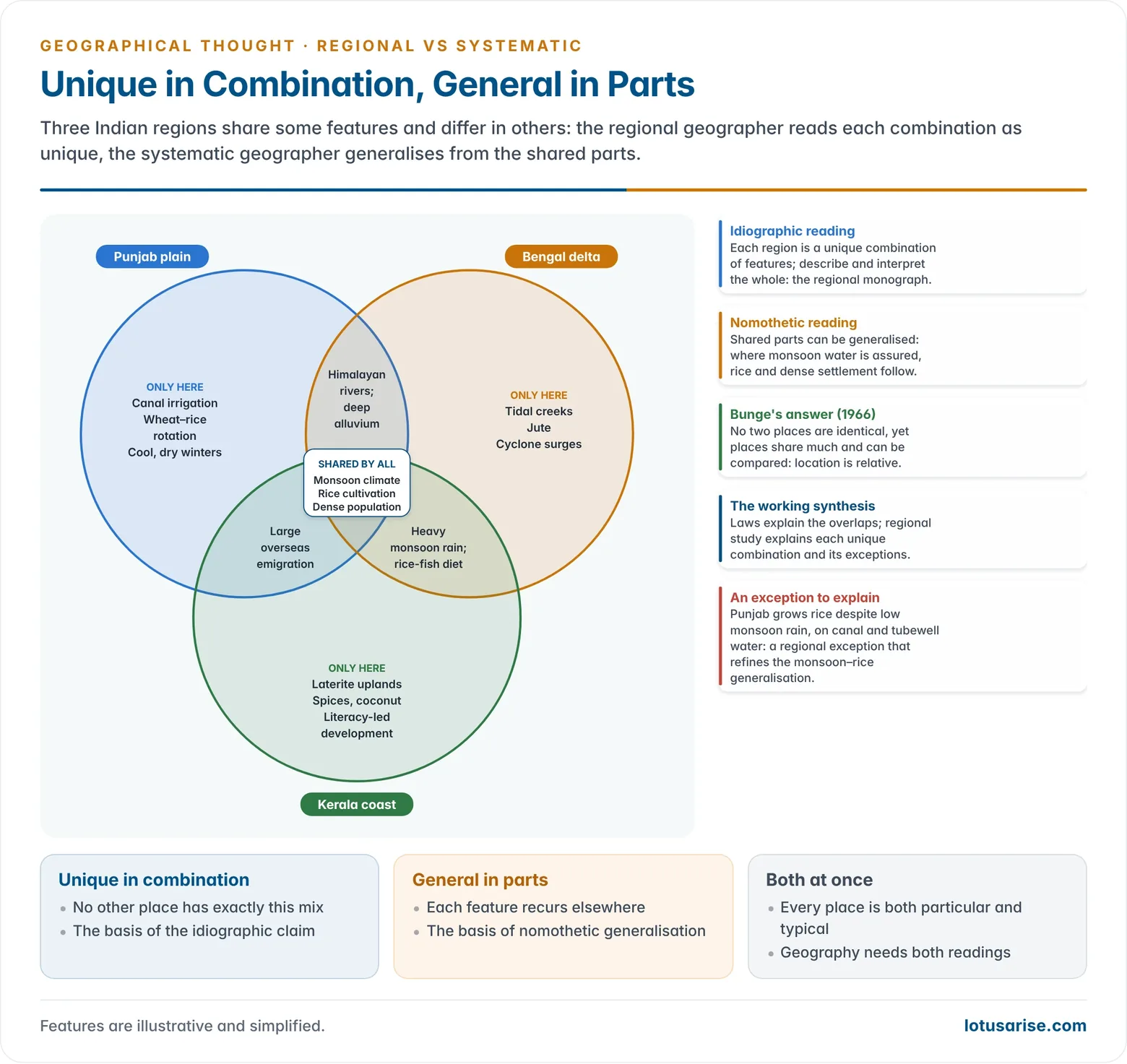
- Phenomena occur in association, bound by causal links, so each region is unique in its assemblage of phenomena.
- Paradox of the region: sameness in one or more attributes defines a region internally, while differences from its neighbours define its uniqueness.
- Basis of regional division: uniqueness, homogeneity and identifiable bounds, drawn according to the purpose of the study.
- Scope: physical, economic, cultural and political characteristics are synthesised into one region’s picture; the past matters only as it explains the present.
- What it seeks instead of laws: Hartshorne (1959) set geography four tasks: to describe, classify in generic concepts, interpret by analysis and synthesis, and arrange the findings in an orderly system.
- Principle: regional geography studies “all about one”: every relevant phenomenon in one region, examined exhaustively from relief and climate to economy and culture.
Systematic Geography: The Nomothetic Tradition
- Systematic geography is organised around phenomena of general significance, each studied as it varies from place to place. Like the systematic sciences, it aims at description and generalisation, seeking laws that hold across many areas.
- Its principle is “one about all”: one phenomenon over the whole earth or a defined stretch of it.
- Laws of spatial pattern: Fred K. Schaefer (1953) argued that it is “the spatial arrangements of the phenomena, and not the phenomena themselves” about which geographers should make law-like statements.
- Its laws are pattern laws governing spatial distributions, as distinct from the process laws of the other social sciences.
- From systematic to spatial analysis: after 1950 systematic geography grew into spatial analysis of interaction and organisation, which largely ignores individual regions as wholes.
- Method: it frames hypotheses, tests them against empirical data and builds models, whose universal statements add objectivity to geography.
- Analytical, with generic concepts: it takes one class of phenomena at a time and classifies it by generic concepts that apply wherever the type recurs, such as Wladimir Köppen’s climatic types, William Morris Davis’s cycle of erosion or Walter Christaller’s central place hierarchy. From these come general statements such as the gravity model of interaction or Waldo Tobler’s first law.
| Basis | Regional geography | Systematic geography |
|---|---|---|
| Focus | All phenomena in one region | One phenomenon across regions |
| Philosophy | Idiographic: the unique and particular | Nomothetic: the general and universal |
| Dominant logic | Inductive: from cases to generalisation | Deductive: from theory to cases |
| Concept of space | Areal differentiation, chorology | Spatial organisation, spatial interaction |
| Output | Regional monograph, synthesis | Laws, models, theories |
| Leading figures | Ritter, Vidal de la Blache, Hettner, Hartshorne | Humboldt, Schaefer, Bunge, Haggett, Harvey |
| Main criticism | Descriptive, no general laws | Abstract, loses the character of places |
How the Balance Shifted
- Roots: Bernhard Varenius’s general and special geography (1650) prefigured the pair; Alexander von Humboldt developed systematic physical geography and Carl Ritter regional study. Ferdinand von Richthofen called general geography analytical and regional geography descriptive and synthetic.
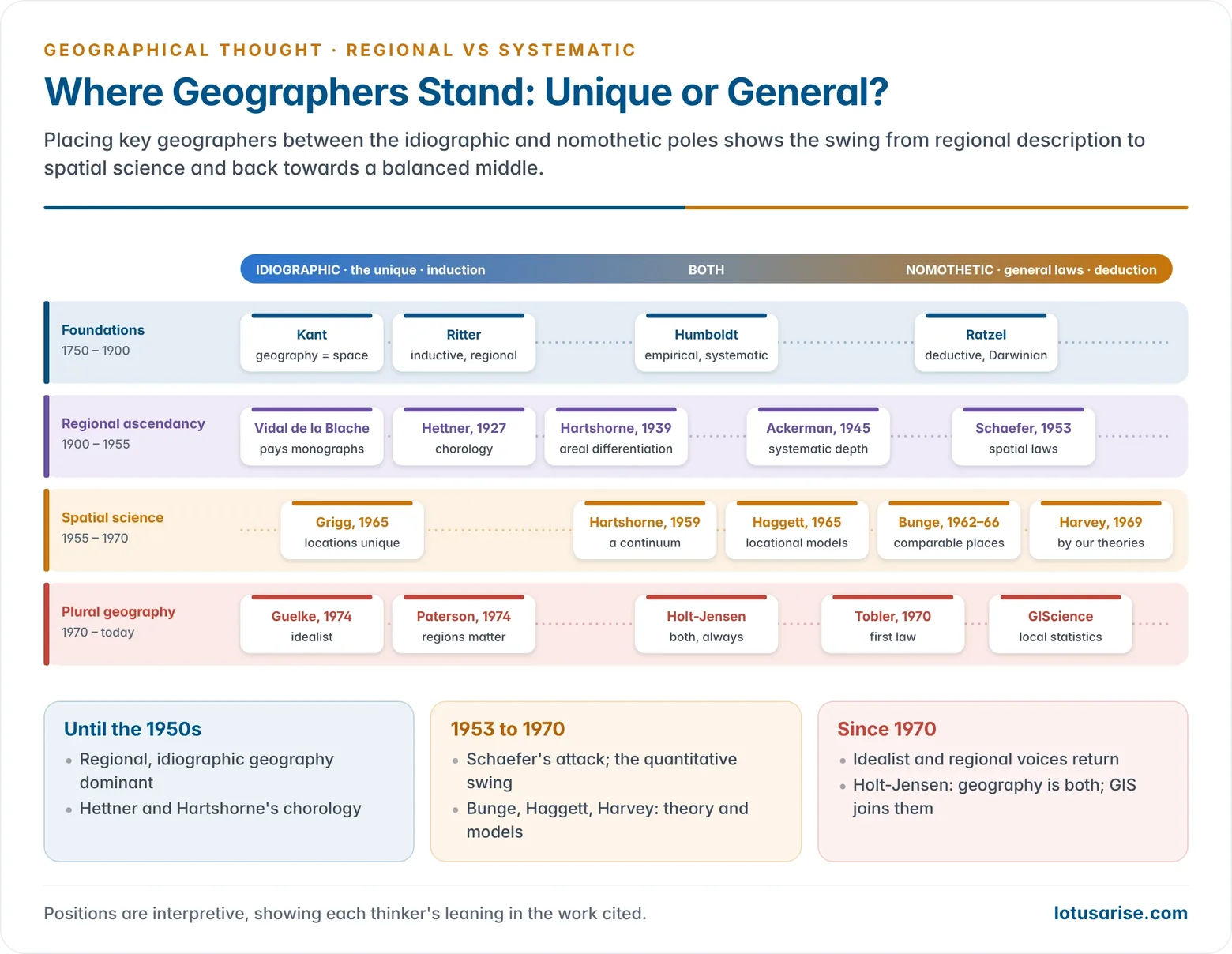
- Regional ascendancy (1900–1950): Paul Vidal de la Blache’s pays, Alfred Hettner’s chorology and Hartshorne made regional study the discipline’s core.
- Sources of dissatisfaction:
- Edward A. Ackerman (1945), after wartime intelligence work, found regional work thin in systematic depth, and George H. T. Kimble (1951) called the region outdated.
- T. W. Freeman (1961) gave three reasons: macro-scale natural regions were naive; regional texts dragged through unrelated facts; and the success of the pays bred the false belief that the whole earth divides into unique regions.
- Industrialisation weakened the self-contained, agricultural regions that the French model assumed.
- Defence: J. H. Paterson (1974) answered that industrial change altered only the scale of explanation.
The Methodological Dichotomy
Idiographic vs Nomothetic
- Wilhelm Windelband (1894), a Neo-Kantian, separated the idiographic sciences, which describe the unique and particular, from the nomothetic sciences, which seek general laws.
- Idiographic position (Immanuel Kant, Hettner, Hartshorne): geography describes particular regions and their causal relationships; generalisation is of little use, because regions are individual cases.
- Nomothetic position: geography should create its own laws as well as apply those of other sciences, giving it the objective character of the natural sciences.
- Nuance: Hartshorne held that both elements are present in every science, though general concepts in geography must serve the understanding of specific regions.
- In 1959 he found “no dichotomy or dualism” between systematic and regional geography, only a continuum, and held that geography, though less able than many fields to develop laws, must develop them as far as possible.
Inductive vs Deductive
- Induction moves from particular cases to general statements.
- David Harvey’s Explanation in Geography (1969) called it the Baconian route: sense data are ordered by definition, measurement and classification into empirical generalisations. Its weakness is the extended generalisation: a thousand white swans do not prove that all swans are white.
- Ritter, Vidal de la Blache in his pays studies and Humboldt worked inductively.
- Deduction moves from general premises to particular cases.
- Harvey’s second route starts from an a priori model of reality, frames a theory, deduces hypotheses and tests them against data: the hypothetico-deductive method of positivism.
- Friedrich Ratzel proceeded largely deductively; Davis’s cycle of erosion and Halford Mackinder’s heartland were early hypothetico-deductive models.
- Karl Popper’s falsificationism added that laws can never be finally verified, only falsified, so theories are provisional.
- In practice both are used: induction generates conjectures and deduction tests them.
Problems of Law-Making in Geography
- Uniqueness blocks laws only if causal relations themselves change unpredictably from place to place, and not when places differ in a trivial property such as exact location.
- Open systems: geography is a field science. Atmospheres, river basins, cities and regions are too large and open for laboratory experiment, human motives are among their causes, and field data control extraneous variables only statistically.
- Borrowed theory: geography often derives its theory from cognate sciences, as central place theory comes from economics, and combining several disciplines’ frameworks is difficult.
- The observer effect: people change their behaviour when observed, and published findings can change the behaviour they describe.
Exceptionalism
- Exceptionalism is the claim that geography, like history, is methodologically distinct from the other sciences because it studies the unique.
- Kant is regarded as its father; Humboldt, Ritter, Hettner and Hartshorne all repeated his pairing of history (the science of time) and geography (the science of space).
- Fred K. Schaefer’s “Exceptionalism in Geography” (1953) attacked this position: all sciences deal with unique events and still explain them by laws, so geography should adopt the methods of positivist science. Geography’s claim to be the integrating science was, he said, arrogant.
- Hartshorne replied in 1955, 1958 and 1959. In the full debate, as Ron Johnston put it, Hartshorne described geography as geographers had made it, while Schaefer prescribed what it should be.
- Outcome: by the late 1950s geography had moved from regional to systematic, from areal to spatial study and from absolute to relative location.
Uniqueness of Location: The Grigg–Bunge Exchange
- David Grigg (1965), writing on the logic of regional systems, still held that all locations are unique, so location cannot be a differentiating characteristic.
- William Bunge (1966) replied that locations are relative and comparable: words such as near, far and adjacent show that locations can be generalised, and no two things are identical yet they share much in common.
- Grigg conceded that locations are essentially relative, which removed the last logical barrier to a law-seeking geography.
Views of Notable Geographers
| Geographer | Year | Leaning | Main view |
|---|---|---|---|
| Alfred Hettner | 1927 | Idiographic, chorological | Geography studies areas as they differ; both methods needed |
| Richard Hartshorne | 1939, 1959 | Idiographic | Areal differentiation; laws a means, not the end |
| George H. T. Kimble | 1951 | Anti-regional | The region is an 18th-century concept; links, not breaks, matter |
| Edward A. Ackerman | 1945, 1963 | Systematic | Regional work lacked systematic depth and isolated geography |
| Fred K. Schaefer | 1953 | Nomothetic | Laws of spatial arrangement; against exceptionalism |
| William Bunge | 1962, 1966 | Nomothetic | Theoretical Geography; locations are comparable |
| Peter Haggett | 1965 | Nomothetic | Locational models of movement, networks and hierarchies |
| David Harvey | 1969 | Nomothetic | “By our theories you shall know us” |
| Leonard Guelke | 1974, 1977 | Idealist | Human geography need not build its own laws; understand the actor’s thought |
| J. H. Paterson | 1974 | Regional | Not all places are the same place; hypotheses must be tested in regions |
- Edward L. Ullman recast geography as the study of spatial interaction, and Haggett’s Locational Analysis in Human Geography (1965) turned regional questions into testable models.
Contemporary Relevance
- Both approaches survive. Tobler’s “first law of geography” (1970), that near things are more related than distant things, is a working nomothetic principle in GIScience, while local statistics such as geographically weighted regression measure how a general relationship varies from place to place.
- The new regional geography of the 1980s returned to the region as a social construct shaped by wider economic and political processes.
- Indian example: the Aspirational Districts Programme (2018) ranks 112 districts on common indicators (a nomothetic tool) but plans for each in its own setting (an idiographic task).
- The prevailing view follows Arne Holt-Jensen: geography must be both idiographic and nomothetic, with induction and deduction serving the same inquiry.