- The Hartshorne–Schaefer debate (1953–1959) was the main methodological controversy in mid-20th-century American geography. At issue was whether geography is an idiographic study of unique regions or a nomothetic, law-seeking science of spatial arrangements.
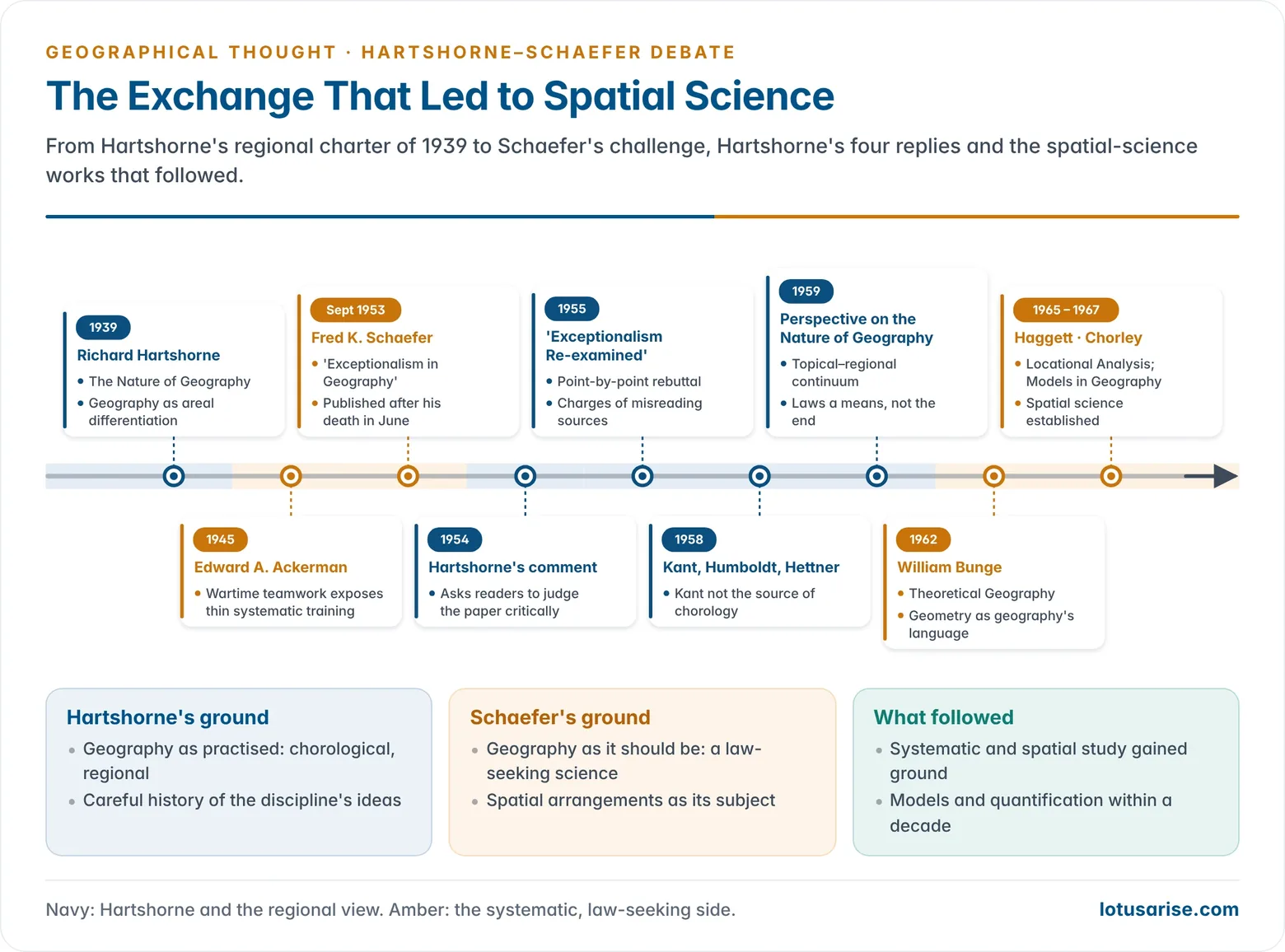
- It set Richard Hartshorne’s chorological view in The Nature of Geography (1939) against Fred K. Schaefer’s paper “Exceptionalism in Geography: A Methodological Examination” (1953).
- The debate marked the move of geography from areal to spatial analysis. It prepared the ground for the quantitative revolution.
Background

The Regional Orthodoxy
- Hartshorne’s The Nature of Geography (1939) drew on Kant, Humboldt and especially Alfred Hettner. It defined geography as the study of areal differentiation.
- Geography and history were set apart as integrating sciences. History synthesises sections of time; geography synthesises sections of space.
- Every area is a unique combination of phenomena, so geography’s highest form is regional geography, and laws have little place in it.
- Through the 1940s, this regional paradigm dominated American geography. The systematic branches served mainly as suppliers of facts for regional synthesis.
Growing Dissatisfaction
- Second World War teamwork: geographers who worked with economists and other specialists in US intelligence found their systematic training thin.
- Edward A. Ackerman (1945) urged a firmer grounding in topical specialisms.
- Weak regional writing: much of it was naive at the macro scale and catalogued unrelated facts without explaining their links.
- Isolation: the chorological view gave geography a goal separate from other sciences and cut it off from the social sciences.
- Post-war setting: demand for planning and prediction grew. Physics and economics enjoyed high prestige, and logical positivism was spreading in American universities.
The Two Positions
Schaefer’s Attack (1953)
- Fred Kurt Schaefer (1904–1953) was a Berlin-trained economist and refugee from Nazi Germany. He was a founding member of the geography department at the University of Iowa.
- He wrote the paper with help from Gustav Bergmann, a logical-positivist philosopher at Iowa.
- Schaefer died in June 1953, before the paper appeared in the Annals of the Association of American Geographers (vol. 43) that September.
- Exceptionalism: Schaefer gave this name to the claim that geography and history are methodologically exceptional because they study unique places and periods.
- He traced the claim to Kant, and through Hettner to Hartshorne.
- Against Hettner’s history analogy, he argued that historians also explain unique periods by applying laws from the social sciences. Unique periods, like unique places, can still be explained by laws.
- His main arguments:
- Uniqueness is universal: physics and economics also deal with unique events, yet they explain them through laws. Uniqueness gives geography no special status.
- Science means explanation by laws: to explain something is to show it as an instance of a law. A merely descriptive geography is not a science.
- Geography’s subject: geography should seek laws about the spatial arrangement of phenomena, not about the phenomena themselves.
- Morphological (pattern) laws: geography produces laws about spatial form. The other social sciences produce process laws, which geography should borrow to explain its patterns.
- Method: observation leads to a hypothesis linking two spatial patterns. The hypothesis is tested on many cases, mainly through map correlation.
- Integration claim rejected: calling geography the integrator of all sciences was, he wrote, arrogant, and it had yielded few new insights.
- Geography as a social science: he placed human geography among the social sciences and urged closer ties with them.
- Problems admitted: the last part of the paper conceded that experiment and quantification are difficult in geography. It proposed map comparison of patterns as a practical substitute.
Hartshorne’s Replies (1954–1959)
- 1954: a short comment in the Annals asked readers to treat Schaefer’s paper critically.
- 1955: “‘Exceptionalism in Geography’ Re-examined” (Annals) answered Schaefer point by point.
- It accused him of misreading and mistranslating Kant, Humboldt and Hettner, and of offering opinion dressed up as historical analysis.
- It argued that Schaefer, by having geography borrow process laws from other sciences, had himself made an exceptionalist claim.
- 1958: “The Concept of Geography as a Science of Space, from Kant and Humboldt to Hettner” (Annals) denied that Kant was the source of the chorological view.
- It argued that Humboldt and Hettner reached that view independently.
- 1959: Perspective on the Nature of Geography gave his fullest restatement.
- Definition: geography seeks to describe and interpret “the variable character from place to place of the earth as the world of man”.
- No dichotomy: studies range along a continuum from topical studies, which analyse simple elements over the world, to regional studies, which analyse complex integrations in small areas. Every real study uses both.
- Laws as means: law-making is one important method of science, but treating it as the end “confuses the means with the end”.
- Limits to laws in geography:
- Laws need many comparable cases, while geography studies complex, unique integrations.
- Controlled experiments that vary a few factors are not possible.
- Interpretation needs expertise in many systematic sciences.
- Laws imply a determinism unsuited to human choice.
- Time: geography describes existing interrelationships. The past is studied only to explain the present, a position that kept historical geography as “past geographies”.
- He separated expository description, of the present character of areas, from explanatory description of how they came to be. The second was kept subordinate to the first.
- Physical–human divide: separating the two was a legacy of environmental determinism that narrowed integration.
Points of Difference and Common Ground
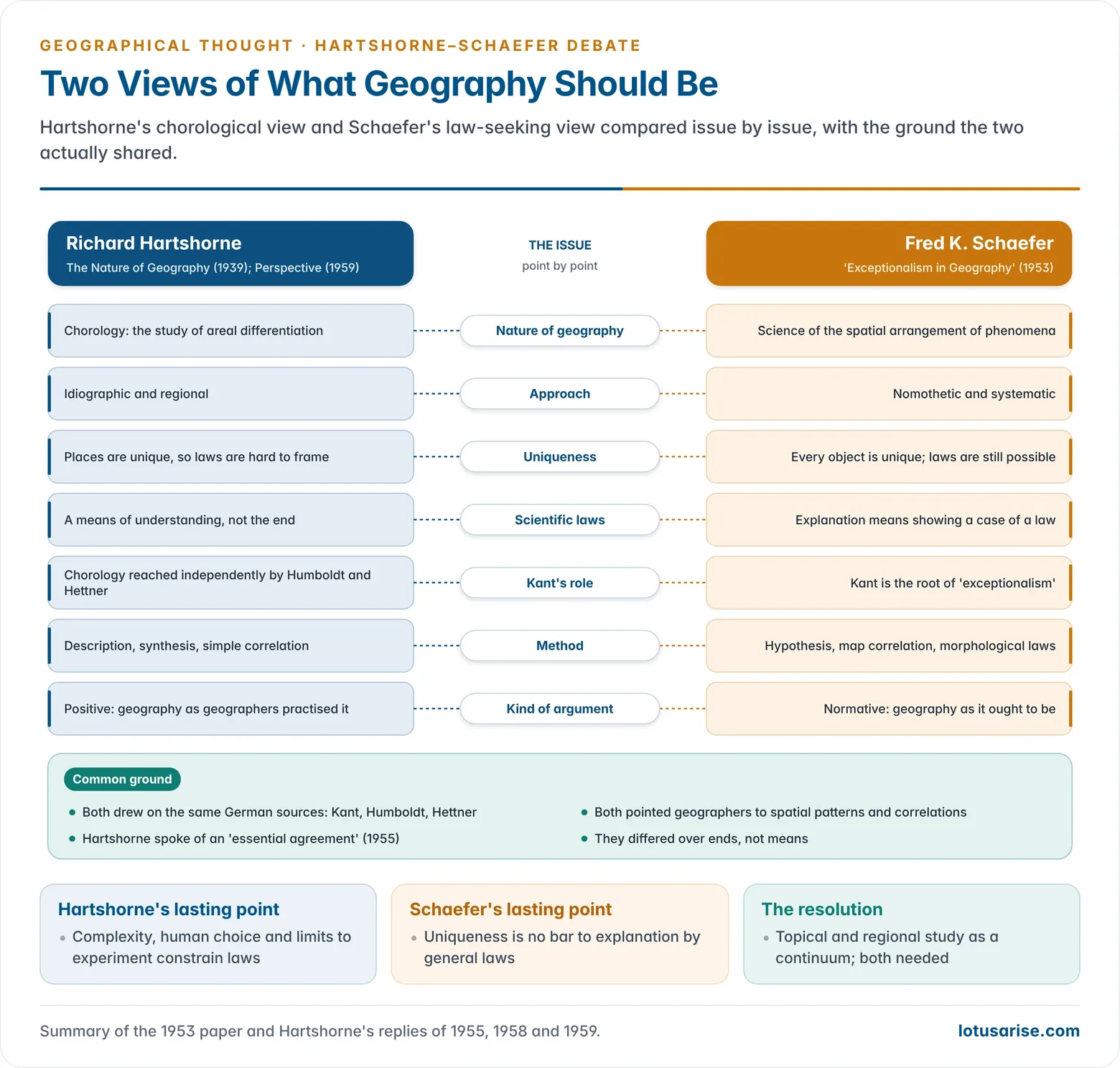
| Issue | Richard Hartshorne | Fred K. Schaefer |
|---|---|---|
| Nature of geography | Chorological; areal differentiation | Science of spatial arrangements |
| Approach | Idiographic, regional | Nomothetic, systematic |
| Uniqueness | Places unique; laws hard to frame | All objects unique; laws still possible |
| Laws | A means, not the end | The goal of science |
| Kant’s role | Not the source of chorology | Root of exceptionalism |
| Place among sciences | Integrating science, like history | A social science like others |
| Method | Description, synthesis, simple correlation | Hypothesis, testing, morphological laws |
| Kind of view | Positive: geography as practised | Normative: geography as it should be |
- Positive versus normative: Hartshorne described what geography had been, as geographers had practised it. Schaefer prescribed what geography should become.
- More apparent than real: the two shared more than either admitted.
- Both drew on the same German sources and pointed geographers towards spatial patterns.
- Hartshorne himself spoke of an “essential agreement” in 1955, and accepted that geography should use generic concepts and laws wherever possible.
- Hartshorne’s “simple correlations” are hard to tell apart from Schaefer’s morphological laws, since both reduce to spatial patterns.
- They differed over ends, not means. Schaefer saw spatial laws as geography’s purpose. Hartshorne saw them as tools for understanding particular regions in their “fullness of colour and life”.
- Where Schaefer had the stronger case: by extending uniqueness to everything, he removed the main logical barrier to a law-seeking geography.
- Where Hartshorne had the stronger case: his scholarship on the history of the discipline was far more careful. His warnings about complexity, human choice and the limits of experiment were later echoed by behavioural and humanistic critics.
- Uneven debate: Schaefer died before the paper appeared and could not answer Hartshorne’s replies.
- Personal tension sharpened the tone. Schaefer believed Hartshorne had reported his left-wing views to the authorities, and Hartshorne charged Schaefer with defective scholarship.
Outcome and Significance
- Shift in American geography: within about a decade, most geographers had accepted at least part of Schaefer’s programme. Attention moved in several directions:
- from regional to systematic study;
- from areal integration to spatial interaction;
- from absolute to relative location;
- from description to analysis.
- Spatial science: geography came to be seen as a “discipline in distance” (James Wreford Watson, 1955) and a study of spatial interaction (Edward L. Ullman).
- William Bunge’s Theoretical Geography (1962) carried Schaefer’s case furthest. Geometry, he argued, is the language of geography.
- Peter Haggett’s Locational Analysis in Human Geography (1965) and Chorley and Haggett’s Models in Geography (1967) built the model-based paradigm.
- Centres of change: Iowa (Harold McCarty), Wisconsin and, above all, Washington at Seattle (William Garrison).
- Much of this work arose alongside Schaefer’s paper rather than from it. The paper was cited far more in later histories than in the 1950s.
- Philosophical turn: the debate brought positivism into geography’s self-understanding and opened the series of paradigm shifts that followed.
- Dualism softened: it sharpened the idiographic–nomothetic contrast. It also pushed Hartshorne to his continuum view, an early step towards resolving the systematic–regional dualism.
- Return of difference: from the 1980s, critics argued that spatial science had treated local specificity as “noise” or “deviation”.
- The study of particular places returned in a new, theory-informed form, as in new regional geography.
- Indian echo: Indian geography long followed the regional tradition, as in R. L. Singh’s edited India: A Regional Geography (1971). Quantitative and model-based methods spread in Indian departments from the late 1960s, and both strands continue side by side.
Previous Year Questions
- No direct PYQ has been asked on this sub-topic yet.