

- A region is a part of the earth’s surface that stands apart from its surroundings in terms of chosen criteria. Regional geography studies such parts as integrated wholes.
- Regional synthesis is the method that brings together the physical, economic, social and political elements of an area. It shows how they combine to give the area its distinct character.
- It is the working method of areal differentiation. Areal differentiation asks how places differ; regional synthesis shows how to study a place so that the differences become intelligible.
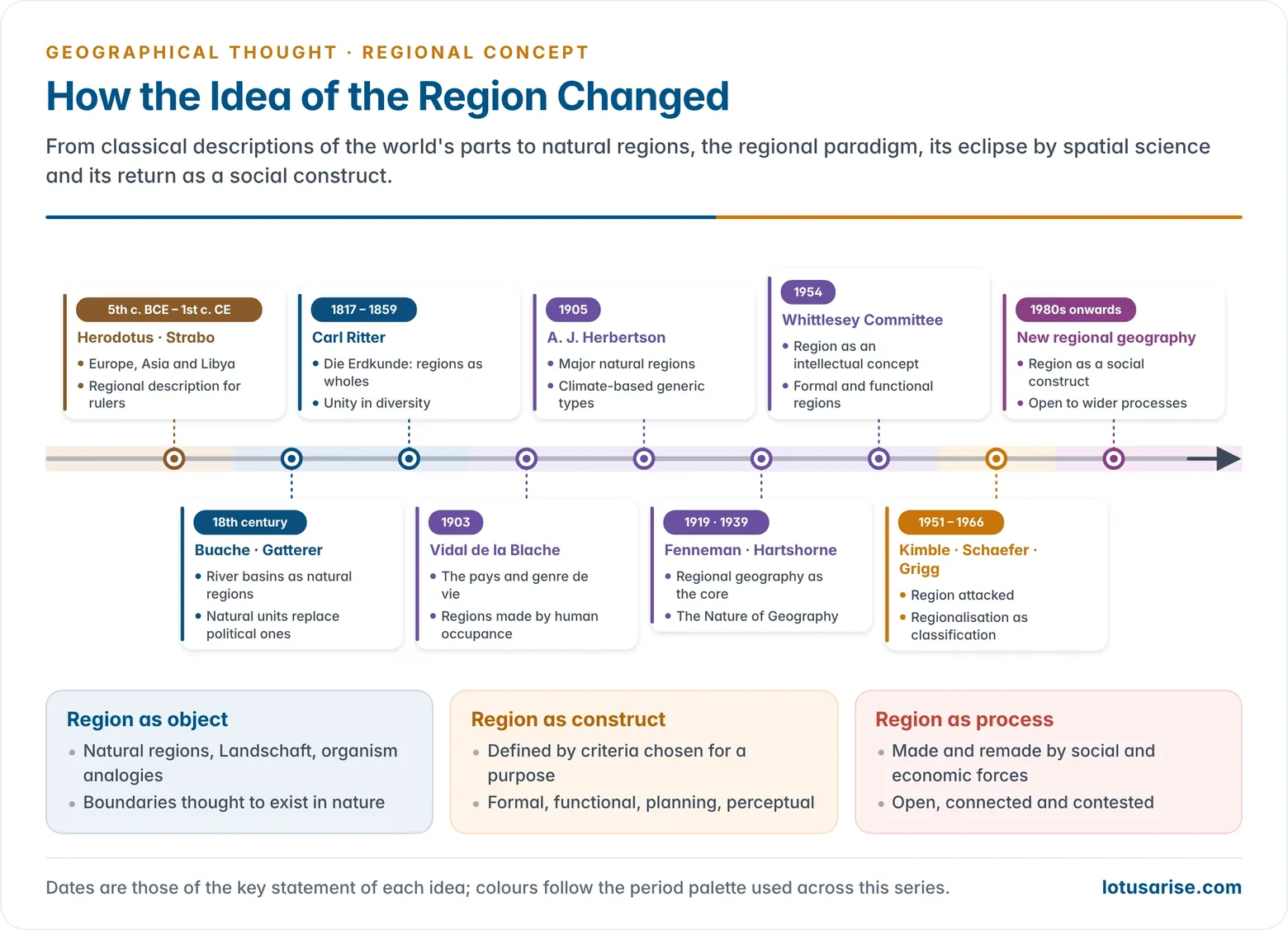
- The regional idea is among the oldest in geography. It dominated the discipline until the 1950s, was eclipsed by spatial science, and returned from the 1980s in a new, theory-informed form.
The Regional Concept in History

Meaning of Region
- Etymology: “region” comes from the Latin regio, from regere, “to rule or direct”. It first meant an area under one administration.
- No single definition: a survey of American regionalism in the late 1930s by Howard Odum and Harry Moore gathered about 40 definitions. Each major geographer framed the region in his own way.
| Geographer | How the region was seen |
|---|---|
| Paul Vidal de la Blache | A domain where diverse beings have adapted to a common existence (the pays) |
| A. J. Herbertson | A complex of land, water, air, plant, animal and man forming a characteristic portion of the earth |
| N. M. Fenneman | An area of similar surface features, contrasted with its neighbours |
| R. S. Platt | An area of general homogeneity in land character and occupance |
| Whittlesey Committee (1954) | Any area homogeneous in chosen criteria; an intellectual concept, not an object |
- The modern view: a region is not given by nature. It is an intellectual construct, created by selecting the features relevant to a problem and ignoring the rest.
- Its homogeneity holds only for the criteria chosen. A rice region can be heterogeneous in language, and a linguistic region can be heterogeneous in relief.
From Classical Description to Natural Regions
- Classical period:
- Herodotus (5th century BCE) described the known world in three parts: Europe, Asia and Libya (Africa).
- Strabo (Geographica, 17 books) wrote a human-centred description of the regions of the Roman world, meant for statesmen and commanders.
- Ptolemy separated chorography, the description of small regions, from the mapping of the whole earth.
- Regional knowledge served administration, trade and war.
- Renaissance and colonial era: voyages and empires produced regional accounts, atlases and “universal geographies” of newly known lands. These recorded their resources, peoples and routes.
- Geographical societies, such as the Royal Geographical Society (1830), tied regional description to trade and empire.
- The search for natural regions:
- Philippe Buache (1700–1773) divided the earth into river basins separated by supposedly continuous mountain chains.
- Johann Christoph Gatterer (1727–1799) urged that such natural regions replace political units as the frame of geographical description.
- The mountain-network theory proved false, but Carl Ritter kept the natural region as the basic unit of regional geography.
- Richthofen and Hettner made the study of areas the centre of the discipline. Hettner judged that no single principle can divide the world; regional division has to combine several grounds, weighted differently in different places.
Landschaft, Pays and Cultural Landscape
- German Landschaft carried two meanings: the visual scene and a tract of land with a uniform aspect. Mixing the two let some geographers treat regions as concrete objects.
- Albrecht Penck limited the Landschaft to what is visible, which included human works but not people themselves.
- Otto Schlüter made people a major landscape element and separated the natural from the cultural landscape (Kulturlandschaft).
- Siegfried Passarge excluded people and animals altogether and built regions mainly on vegetation and landforms.
- French pays: these were small regions shaped by centuries of close interplay between a community and its milieu, the areal expression of a genre de vie in the French school.
- For Vidal, human occupance could create homogeneity even where nature was not uniform.
- Carl Ortwin Sauer’s “The Morphology of Landscape” (1925) put it this way: “culture is the agent, the natural area is the medium, the cultural landscape the result.”
- In American usage, “landscape” came to be used much like “region”.
- Region as organism: Ritter, Vidal, Sauer, Vernor Finch and Glenn Trewartha all likened regions to organisms.
- Hartshorne rejected the analogy: a region can be divided into parts, has no common growth and “is acted upon; of itself it never reacts”.
Natural Regions and Their Critique
- Andrew John Herbertson’s “The Major Natural Regions” (1905) divided the world into generic regions, based mainly on climate, with relief and vegetation.
- Monsoon lands, Mediterranean lands and tundra recur on several continents as specimens of one type.
- The scheme became a staple of school geography.
- Its users assumed each natural region produced a definite way of life. This gave regional geography a deterministic tilt.
- J. F. Unstead (1916, 1933) built regions synthetically from the bottom up. The smallest unit was the stow, stows grouped into tracts (close to the pays), and tracts into minor and major regions.
- Herbertson’s scheme, by contrast, worked analytically, dividing the world downwards.
- The critique of “natural” regions:
- Climate, relief, soils and location vary largely independently of one another, so no division fits all of them.
- Choosing which factor is decisive is a subjective judgement. The regions are therefore constructs of the geographer, not divisions found in nature.
Rise, Eclipse and Return of Regional Geography
- High point:
- Richard Hartshorne’s The Nature of Geography (1939) made regional study the highest form of geography.
- The Whittlesey Committee of the Association of American Geographers (“The Regional Concept and the Regional Method”, 1954) codified regional method.
- George Chabot called regional geography “the centre around which everything converges”.
- Attack:
- George H. T. Kimble (“The Inadequacy of the Regional Concept”, 1951) called the region an 18th-century idea. He warned that regional geographers might be trying to “put boundaries that do not exist around areas that do not matter”.
- Fred K. Schaefer (1953) branded the regional approach exceptionalist, which opened the Hartshorne–Schaefer debate.
- Industrialisation weakened the local, rural self-sufficiency on which the Vidalian method rested (E. A. Wrigley, 1965).
- Regionalisation as classification:
- David Grigg’s “The Logic of Regional Systems” (1965) treated regionalisation as a form of scientific classification.
- William Bunge’s reply (1966), that locations are comparable, not unique, is often taken as the end of the idiographic position.
- Regional science: Walter Isard’s Regional Science Association (1954) built theory about regional economies. Regional geography kept its descriptive, educational role.
- Regional science is problem-oriented, forward-looking and precise. Regional geography aims at balanced coverage and appeals to wonder and concern about other places and peoples.
- Defence and return:
- J. H. Paterson (1974) answered that “all places are manifestly not the same place”.
- The region came back from the 1980s as a social construct shaped by wider processes, the new regional geography.
Region: Attributes, Types and Principles
Attributes of a Region
- Areal extent: every region covers an area with some homogeneity of physical or cultural traits, for example the Thar Desert, Bundelkhand or the Sahara.
- Location: regions have absolute and relative location, often fixed in their names, such as South Asia, South-East Asia and the Middle East.
- Boundaries: boundaries may be sharp, like administrative lines, or transitional, like the Himalayan foothills or the margins of a language area.
- “Nature abhors lines”, yet regions need them. Transition zones only move the problem, since they too must be bounded.
- Homogeneity or function: unity may come from sameness (formal regions) or from linkages to a centre (functional regions).
- Hierarchy: regions nest inside larger regions.
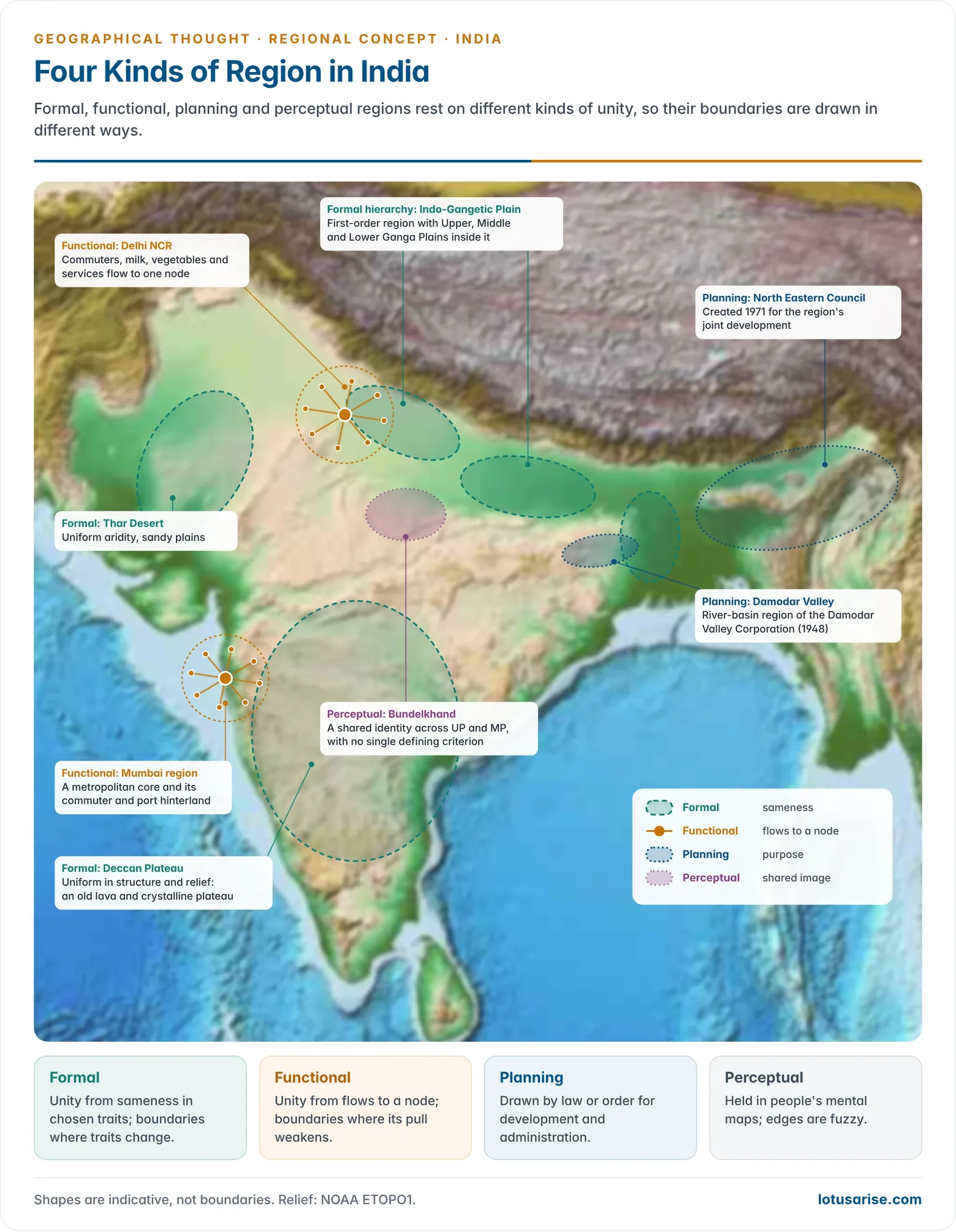
- The Indo-Gangetic Plain is a first-order region. It contains the Upper, Middle and Lower Ganga Plains as second-order regions.
- Change: regions are dynamic. Functional regions such as NCR expand, and cultural and political regions are redrawn.
Types of Region
- Formal (uniform) regions: homogeneous throughout in the chosen criteria.
- Physical: landform regions, such as the Deccan Plateau and the Brahmaputra Valley; climatic regions, such as the monsoon lands.
- Cultural: linguistic, religious and ethnic regions, the cultural regions of the world and of India.
- Political: the nation-state is the most sharply bounded formal region. Its borders change with wars and treaties; the fall of the Berlin Wall (1989) ended the division of Germany.
- Economic and resource: regions of economic activities such as agricultural belts; the Jharia coalfield; the iron-ore belt of Odisha and Jharkhand; industrial regions such as the Hugli belt.
- Compage: Derwent Whittlesey’s term (1956) for a uniform region in which all features, physical, biotic and social, are tied to human occupance.
- Functional (nodal) regions: areas tied to one or more nodes by flows of people, goods, services and information.
- They are defined by measuring movement, such as commuting, newspaper circulation or market service areas.
- Their boundaries mark where one centre’s pull gives way to another’s.
- Examples: Delhi NCR’s milk-, vegetable- and commuter-shed; the Mumbai Metropolitan Region; Jean Gottmann’s Megalopolis (1961), the urban chain from southern New Hampshire to northern Virginia.
- Robert E. Dickinson’s City Region and Regionalism (1947) and Allen K. Philbrick (1957) built on Christaller’s central places to make the functional region central.
- Planning regions: areas delimited for development and administration. They usually combine formal and functional logic.
- Indian examples: the Damodar Valley Corporation (1948), a river-basin region; the NCR Planning Board (1985); the North Eastern Council (1971); the Planning Commission’s 15 agro-climatic regions (1989).
- Perceptual (vernacular) regions: regions that exist in people’s mental maps, with fuzzy edges and strong identity.
- “Purvanchal”, “the North-East” and “Bundelkhand” are perceived as wholes, though no single criterion defines them. They are studied through the mental maps of behavioural geography.
- Generic and specific regions: a Geographical Association committee (1937) made this distinction.
- Generic regions are types that recur wherever the defining traits recur; “Mediterranean” lands, for example, occur on several continents.
- Specific regions are unique places, such as the Ganga Plain or the Alps, studied in their actual location.
| Type | Basis of unity | Boundary | Indian example |
|---|---|---|---|
| Formal | Sameness in chosen traits | Where traits change | Deccan Plateau; Hindi belt |
| Functional | Flows to a node | Where pull weakens | Delhi NCR; Mumbai region |
| Planning | Administrative purpose | Drawn by law or order | Damodar Valley; NCR Planning Board |
| Perceptual | Shared images | Fuzzy | Bundelkhand; “the North-East” |
Principles of Regionalisation
- Regionalisation is classification. Grouping places upward by similarity is synthetic and inductive; dividing a whole downward is analytical and deductive.
- Bunge (1962) wrote that geographers had “independently rediscovered the entire logic of classification systems”.
- Grigg’s principles (1965) set out how regions should be drawn:
- Regions are drawn for a specific purpose; one scheme rarely serves two purposes equally well.
- Criteria should be properties of the thing classified. Farming regions should rest on farming systems, not on the soils and climate thought to cause them.
- The division must be exhaustive and mutually exclusive: every part belongs to one region only.
- Each level uses one principle, and the most important criterion comes at the highest level.
- Schemes are not absolute. They must be revised as knowledge grows; inherited schemes such as Herbertson’s need constant review.
Regional Synthesis
Meaning
- Synthesis means a complex whole made of many parts unified. Regional synthesis is the integrated analysis of all relevant phenomena in a region, physio-cultural, socio-economic and geopolitical, to give a true picture of the region.
- It grew within the areal-differentiation tradition. Hartshorne called geography an integrating science, and regional synthesis is the method that does the integrating.
- Example: no single variable defines a backward area. Income per head, literacy, mortality, health facilities and infrastructure must be combined into one picture.
- Likewise, language, ethnicity, customs, ritual and religion together define a cultural region.
- The method needs topical specialists. Systematic studies supply the materials, and regional synthesis assembles them. This is why the two approaches are complementary rather than opposed.
Fenneman’s Circumference of Geography (1919)
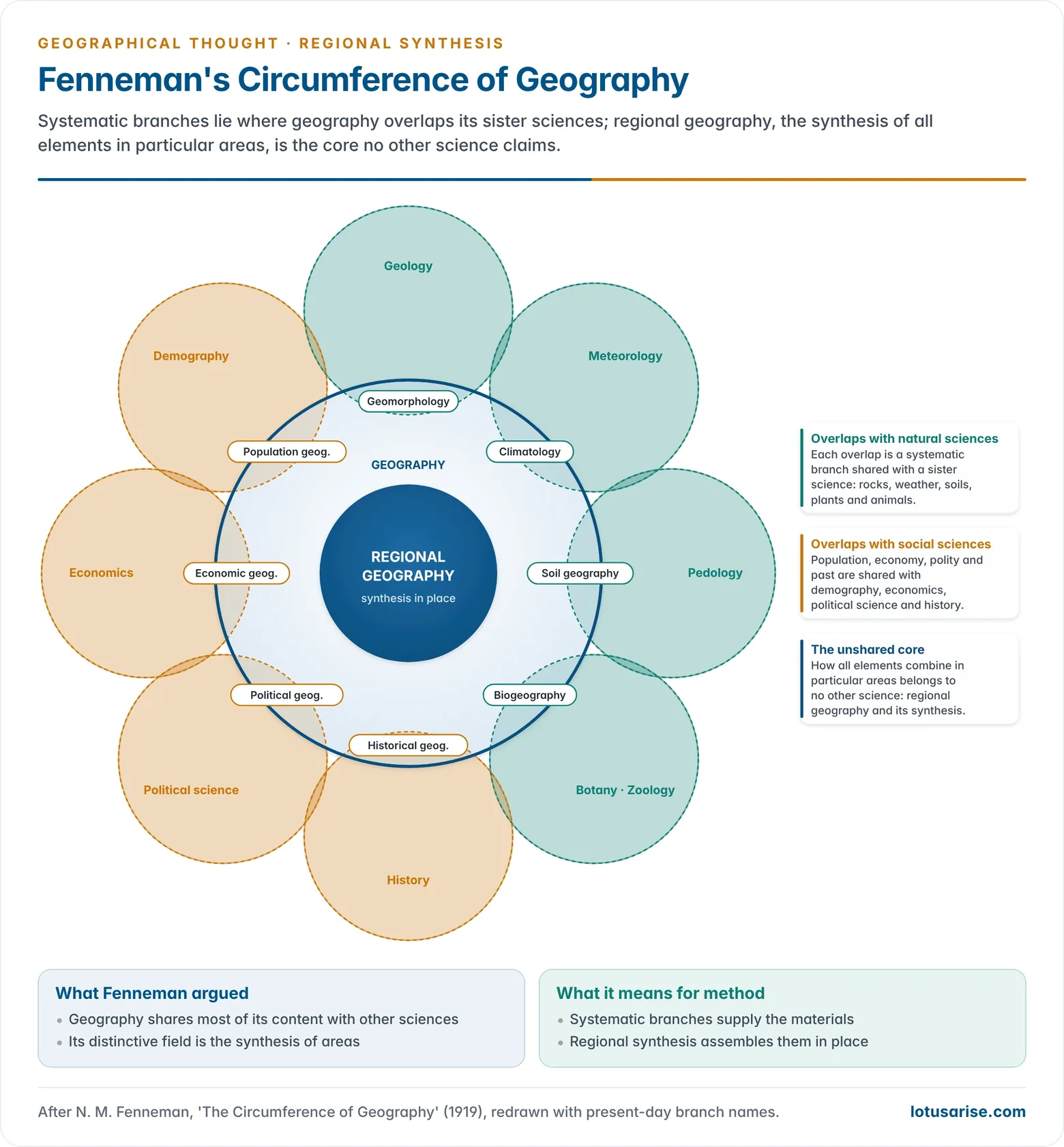
- Nevin M. Fenneman’s presidential address to the Association of American Geographers, “The Circumference of Geography” (1919), drew geography as a circle overlapped by the sister sciences.
- Each overlap is a systematic branch that geography shares with another science: geomorphology with geology, climatology with meteorology, biogeography with botany and zoology, economic geography with economics, and so on.
- The central core, belonging to no other science, is regional geography: the study of how all these elements combine in particular areas.
- The lesson: geography’s distinctive task is not any single class of phenomena but their integration in place. Regional synthesis is that task.
- The region is where the atmosphere, lithosphere, hydrosphere and biosphere meet human activity. Synthesis reads them together; each sister science reads only one.
- Even systematic schemes depend on such synthesis. Wladimir Köppen drew his climatic boundaries partly from vegetation limits, and soil classes are tied to moisture and aridity.
Berry’s Geographical Matrix (1964)
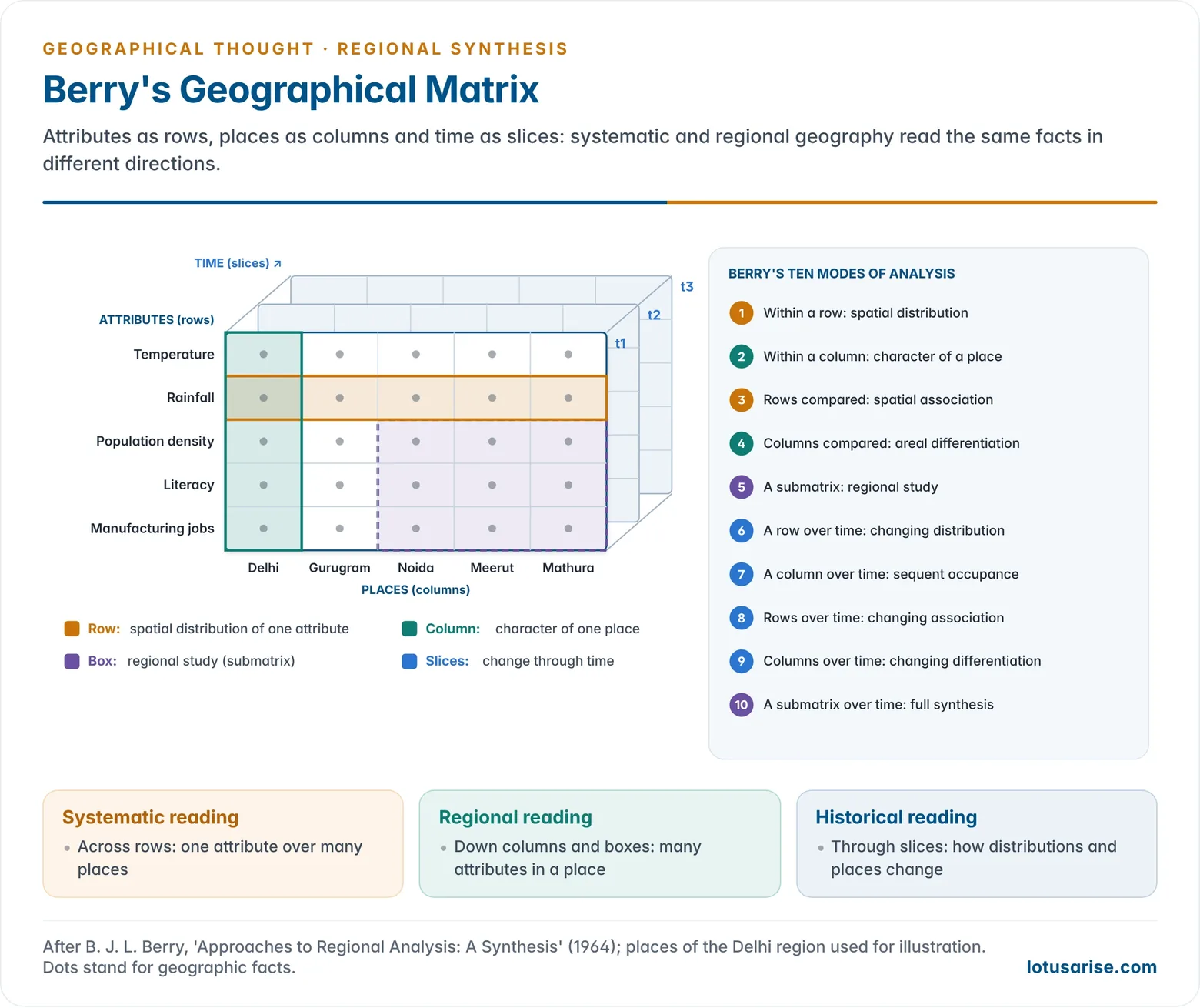
- Brian J. L. Berry’s “Approaches to Regional Analysis: A Synthesis” (1964) arranged geographical data as a matrix:
- rows are attributes, such as temperature, rainfall, density or literacy;
- columns are places, such as Delhi, Gurugram, Meerut or Mathura;
- each cell is a geographic fact: one attribute at one place;
- time adds a third dimension, as a stack of matrix slices.
- Ten modes of analysis:
- Arrangement within a row, the spatial distribution of one attribute.
- Arrangement within a column, the character of one place.
- Comparison of rows, or spatial association between attributes.
- Comparison of columns, or areal differentiation between places.
- Study of a submatrix (box), the regional study of selected places and attributes.
- A row through time: changing spatial distribution.
- A column through time: sequent occupance, the changing character of a place.
- Rows compared through time: changing spatial association.
- Columns compared through time: changing areal differentiation.
- A submatrix through time, which may combine all the above.
- Significance: the matrix shows that systematic (row-wise) and regional (column-wise) geography read the same data in different directions. Regional synthesis is the submatrix approach, with time added.
The Method in Practice
- Two kinds of unity: synthesis looks for vertical relations within a region, between rock, soil, climate, crops and people. It also looks for horizontal relations between regions: flows, trade and influence.
- The old regional monograph stressed the first; functional and new regional approaches stress the second.
- The classical outline: the German regional monograph, as Hettner shaped it, ran in a cause-and-effect sequence.
- It moved from location, geology, relief and climate to resources, population, settlement, economy, transport and political divisions.
- Through Hartshorne it became the standard outline in the English-speaking world. Critics called it a catalogue that tied every human feature back to physical “causes”.
- Five ways of studying regions: H. Fochler-Hauke (1959) distinguished:
- landscape morphology, the form and structure of the visible landscape;
- landscape ecology, the functional interplay within a region and with its centres;
- landscape chronology, the development of a region over time;
- regionalisation, the delimitation of regions;
- landscape classification, the grouping of regions into types.
- Steps of regional synthesis:
- Define the purpose, for example agricultural planning, backwardness or cultural identity.
- Select criteria suited to that purpose.
- Collect and map data from census, surveys, remote sensing and field work.
- Integrate the layers through composite indices, factor or cluster analysis, or overlay in GIS.
- Delimit regions and their boundaries, and arrange them in a hierarchy.
- Interpret the interrelations that give each region its character, and compare it with others.
- Example: the Indo-Gangetic Plain. Alluvial soils, gentle slope, monsoon rainfall, perennial Himalayan rivers, canal irrigation, rice–wheat farming, dense rural settlement and a long cultural history combine into one regional personality.
- Synthesis also shows the internal gradients from the Upper to the Lower Plain: rising rainfall, a shift from wheat towards rice and jute, and higher densities.
- Indian regional studies:
- O. H. K. Spate’s India and Pakistan: A General and Regional Geography (1954; later editions with A. T. A. Learmonth) is the classic regional synthesis of the subcontinent.
- R. L. Singh’s edited India: A Regional Geography (1971) divided India into a hierarchy of regions for systematic description.
- Planning schemes, such as the 15 agro-climatic regions, carry the method into policy.
Importance Today
- Climate change: warming and rainfall change are regionally uneven. The IPCC’s Sixth Assessment Report (2021) assesses projections for reference regions.
- Adaptation plans in India are drawn at the state and district level.
- Regional disparity: composite regionalisation identifies lagging areas for targeted programmes, such as NITI Aayog’s Aspirational Districts Programme (2018).
- Planning and governance: river basins, metropolitan regions, agro-climatic zones and disaster-risk zones all need multi-factor synthesis.
- Federal governance: India’s states were largely reorganised on linguistic regions under the States Reorganisation Act, 1956. Later states, from Jharkhand, Chhattisgarh and Uttarakhand (2000) to Telangana (2014), show that regional identity and regional disparity still shape political maps.
- Change over time: through sequent occupance (Derwent Whittlesey, 1929), regional synthesis traces how successive cultures reshape one area.
- Technology: GIS, remote sensing and big data make multi-layer synthesis faster and more precise than the old map overlays.
- Integration of knowledge: at a time of narrow specialisation, regional synthesis keeps physical and human geography together.
Limitations
- Subjectivity: the choice and weighting of criteria are subjective.
- Fixed boundaries: boundaries freeze what is in fact gradual and changing.
- Description over explanation: traditional synthesis tended to describe without explaining. It also treated regions as closed, neglecting external links and global processes.
- Scale of the task: the range of knowledge needed for a full synthesis is beyond any one scholar, so teamwork and area-studies collaboration are needed.
- Response: these limits led to the reformulation of the region as an open, socially produced unit in the new regional geography.
Previous Year Questions
2015“Regional synthesis is the crux of geographical studies.” Elaborate.1994Examine critically the concepts of ‘determinism’ and ‘possibilism’. Bring out the significance of regional concept.


Their is no need to read any book after reading this content…thank you lotusarise and team…
Thanks a lot, Keep reading
Sir please upload more content and diagram so that we need very less book content because reading book is time consuming and difficult to understand
A MATERIAL PROVIDED WAS MUCH BETTER THAN ANYTHING I HAVE EVER SEEN, VERY GOOD BEST SIMPLE CONTENT EXPLANATION.
Thanks, Kiran. Keep reading
you are doing a great job . Thankyou
So kind of you, Sahil
You are doing a great job pls create your own app
Thanks
Just awesome stuff
Great appreciation to lotusarise team
Being a geography optional student ,highly recommends this one
Thanks, Piyush for your kind words.
All the material provided by this site is way better than any renowned coaching institute’s notes.
I’m very obliged to the man behind who is behind this initiative.
Thanks, Sanjeev for your kind words.
1st of all a huge salute to the team. m totaly surprised the way u guys r providig notes, topic wise. i must say sir you should launch ur own book on optional notes, after compiling these notes….m eagerly waiting when will the remaining lectures be uploaded….please upload…..thanks fr ur all team.
Thanks a lot..
Thank you so much. Really indebted to your efforts. Lord bless
Thanks, that’s so kind of you
This is so holistically covered. Great effort
Thanks
a complete guide for optional better than the notes of coaching institutions
Thanks
great job it helped me a lot. keep going!!!!!
hello sir which book shoul i refer for regional synthesis topic
https://lotusarise.com/geography-optional-books-for-upsc/
A1
Seriously amazing content !!
I got my strenuous optional content here! Thnx for sharing
This page is true gem, hatsoff guys🙏👍
Hey, lotus arises, we are extremely privileged to use your website, just waiting for the coming son topics, brother. Let us know how can we contribute you whatever we can.
Thanking you
https://www.instamojo.com/@lotusarise/
Hai lotusarise,
I was recently bought your geography optional previous years compilation, it is really helpful. I must appreciate your efforts, I have been following your articles quite a while, those are really helpful. I joined your telegram group, there are beautiful papers in it, quite worth to study them. keep doing your amazing work.:)
Thank you for making my journey easy.
Keep Reading
respected sir, please guide us, will your notes will be enough, or do we have to combine books into our plan.
Please read reference books once, then you can rely on these notes.
I was lost in a ocean of geography optional but now i see hope….thanku lotus arise
What a good content☺
Thank u so much team Lotus arise… You have made my optional preparation journey easier… Very rich and effective notes on every topics… Great job guys… No need to read any book further… This much is more than sufficient
These notes are for revision, Please read your std. books.
Thank you for providing this precise content …..
awesome content being a student of geography optional i found it really helpful.
Appreciate the initiative. All the best !
Enhanced my knowledge base. Thankful !
very helpful and to the point content ….thank you so much…
really good content !!
Thank you ،
Greetings !!! Please tell me one thing, will these notes be enough, and do we have to read the book in addition?
Please read reference books once, then you can rely on these notes
Thank you so much I was facing a lot of difficulty in human geography. Now it’s like salad bowl for me every point and chapter is here in simple words
The best content I have ever seen about this topic. After reading this, there is no need to read something else. Thanku so much team.
Most Welcome
I’ll support this institute by purchasing its content, althouh i know these free notes are enough. thank you so much Lotus IAS
Thanks
good content….thanks for your efforts
Thanks a lot sir!, your notes gives a broader picture as to what to read and what not.