- Regional geography and systematic geography are not only two ways of organising content. They rest on two methodologies: one seeks to understand the unique, and the other seeks general laws.
- Regional geography leans towards the idiographic and inductive; systematic geography leans towards the nomothetic and deductive.
- On the surface the systematic and regional approaches differ only in their unit of study. Beneath that lies a contrast of method and philosophy, one strand of geography’s wider dualism.
- The methodological question became the central quarrel of the discipline between Richard Hartshorne’s The Nature of Geography (1939) and the quantitative revolution of the 1960s.
Two Methodologies

Regional Geography: The Idiographic Tradition
- Regional geography grew out of geography as areal differentiation: the description and interpretation of the variable character of places on the earth surface as the world of man.
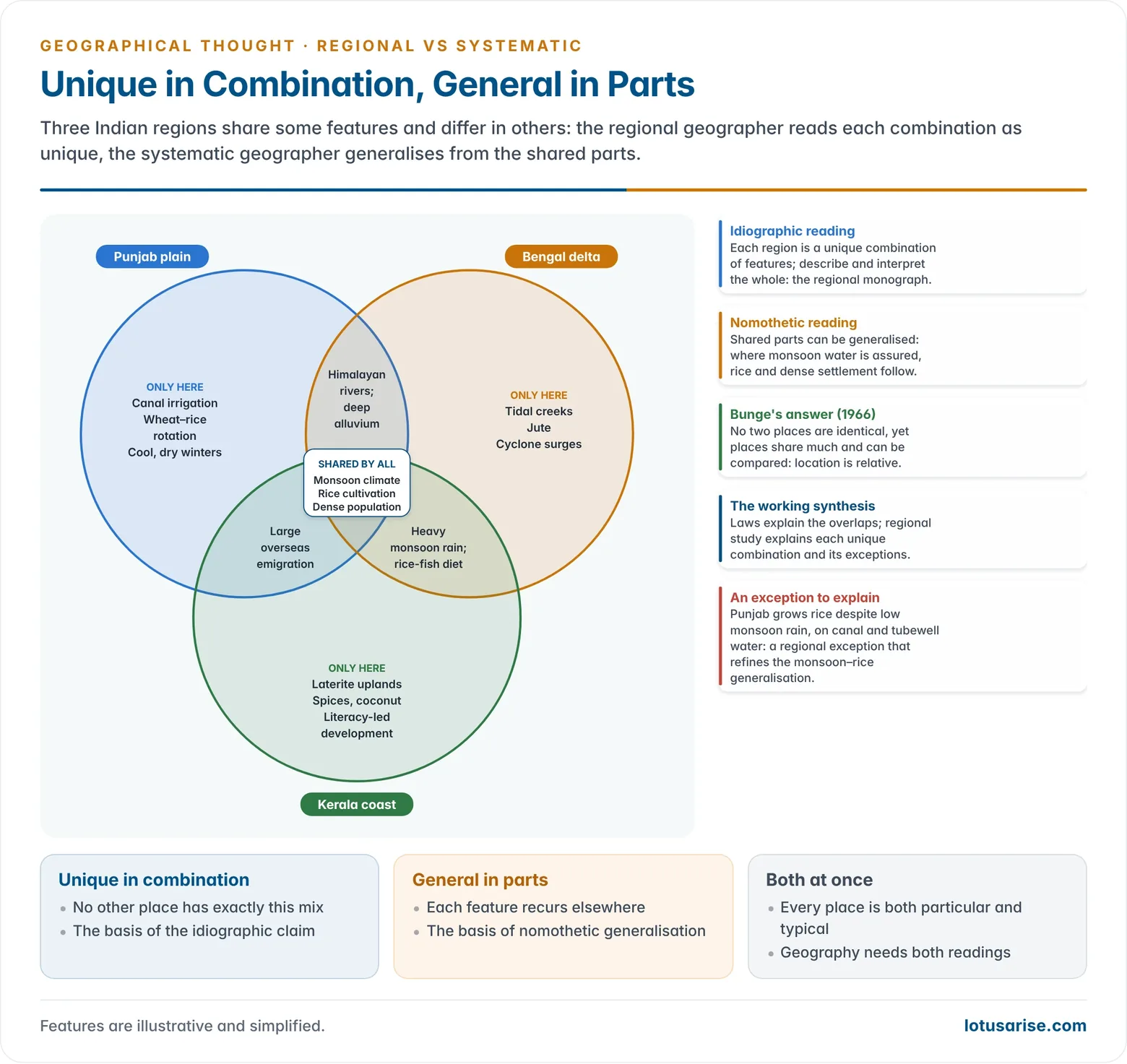
- Phenomena occur in association on the earth surface and are bound by complex causal links. Each region is therefore unique in its assemblage of phenomena, though homogeneous within its own limits.
- Paradox of the region: sameness in one or more attributes defines a region internally, while differences from its neighbours define its uniqueness.
- Basis of regional division: uniqueness, homogeneity and identifiable bounds. Regionalisation is dynamic: the earth can be divided in many ways according to the purpose of the study.
- Scope: it covers the physical environment and also demographic, occupational, socio-economic, cultural and political characteristics, analysed and then synthesised into the picture of one region. Past features are explained only so far as they illuminate the present.
- It also asks whether a region’s structure is static or changing over time.
- Why it cannot make laws:
- Geography is a field science. It cannot isolate dependent and independent variables or hold others constant, as a laboratory can.
- Regions are large, open, multi-variable systems, and human motives are part of their causes.
- What it seeks instead: Hartshorne (1959) set four aims:
- to describe phenomena as accurately and objectively as possible;
- to classify them in generic concepts as far as reality permits;
- to interpret them by analysis and synthesis, using general principles where available;
- to arrange the findings in an orderly system.
- Principle: regional geography studies “all about one”: every relevant phenomenon in one region, in depth.
- Once a region is demarcated for the purpose in hand, it is examined exhaustively, from relief and climate to economy and culture.
Systematic Geography: The Nomothetic Tradition
- Systematic geography is organised around phenomena of general significance, each studied in terms of how it varies from place to place.
- Like the systematic sciences, it aims at both description and generalisation, and seeks laws that hold across many areas.
- Its principle is “one about all”: one phenomenon over the whole earth or a defined stretch of it.
- Laws of spatial pattern: Fred K. Schaefer (1953) argued that it is “the spatial arrangements of the phenomena, and not the phenomena themselves” about which geographers should make law-like statements.
- Geography thus becomes the science of the laws governing spatial distributions. Its laws are pattern laws, as distinct from the process laws of the other social sciences.
- From systematic to spatial analysis: after 1950 systematic geography grew into spatial analysis, stressing spatial interaction and organisation. Areal differentiation was kept only in a subordinate role.
- It largely ignores individual regions as wholes, attending instead to the broad spatial organisation of the phenomenon studied.
- Method: it frames hypotheses, tests them against empirical data and builds models. Universal statements add objectivity and credibility and free geography from purely subjective description.
| Basis | Regional geography | Systematic geography |
|---|---|---|
| Focus | All phenomena in one region | One phenomenon across regions |
| Philosophy | Idiographic: the unique and particular | Nomothetic: the general and universal |
| Dominant logic | Inductive: from cases to generalisation | Deductive: from theory to cases |
| Concept of space | Areal differentiation, chorology | Spatial organisation, spatial interaction |
| Output | Regional monograph, synthesis | Laws, models, theories |
| Key figures | Ritter, Vidal de la Blache, Hettner, Hartshorne | Humboldt, Schaefer, Bunge, Haggett, Harvey |
| Main criticism | Descriptive, no general laws | Abstract, loses the character of places |
How the Balance Shifted
- Roots: Bernhard Varenius’s general and special geography (1650) prefigured the pair. Humboldt developed systematic physical geography and Ritter regional study. Ferdinand von Richthofen called general geography analytical and regional geography descriptive and synthetic.
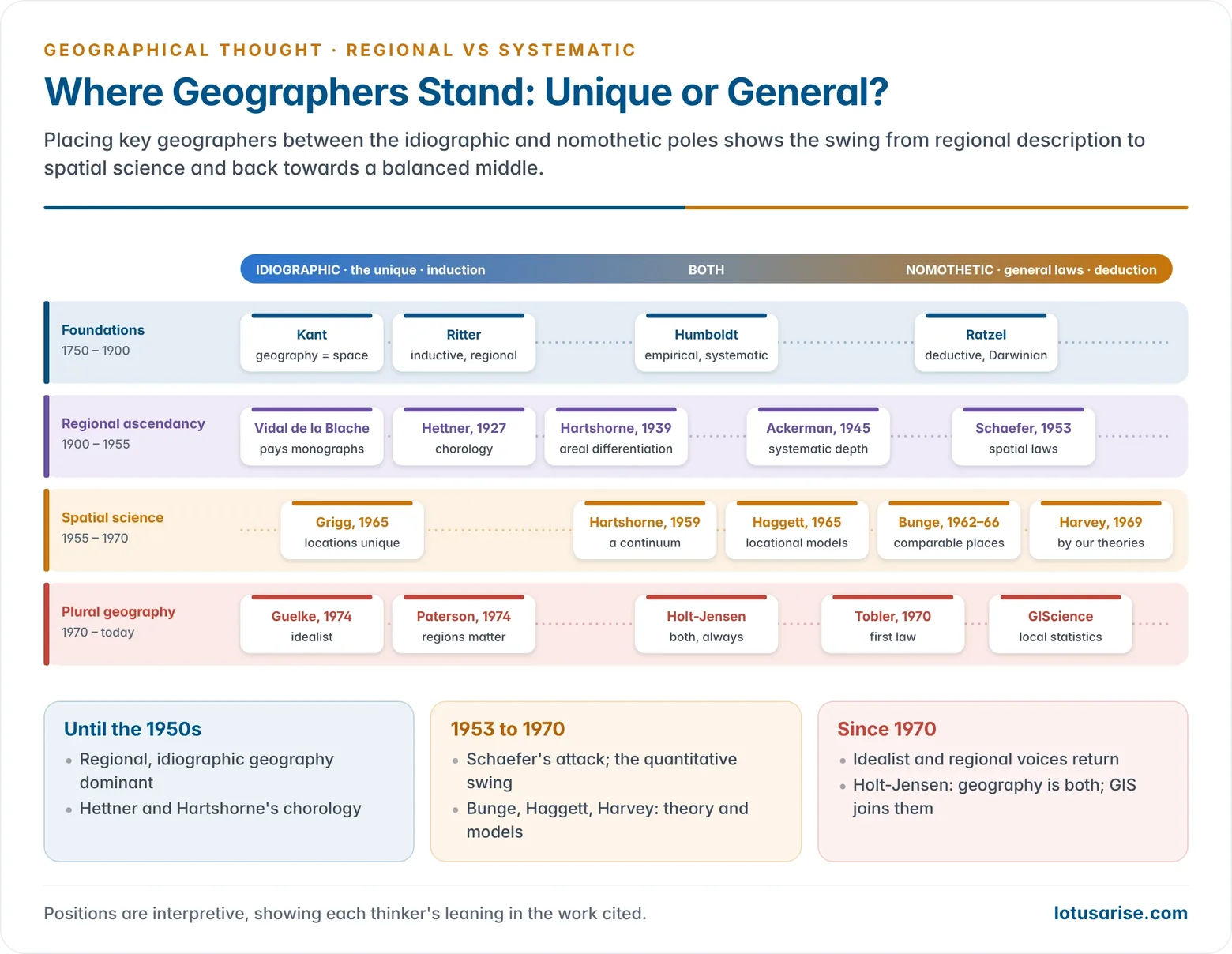
- Regional ascendancy (1900–1950): Vidal de la Blache’s pays monographs, Hettner’s chorology and Hartshorne’s The Nature of Geography made regional study the core of the discipline until the early 1950s.
- Sources of dissatisfaction:
- Edward A. Ackerman (1945), drawing on wartime intelligence work, found geographers thin in systematic knowledge and urged deeper topical training.
- George H. T. Kimble (1951) called the region an outdated concept, since links in the landscape now mattered more than breaks.
- T. W. Freeman (1961) gave three reasons: macro-scale studies built on natural regions were naive; regional texts dragged through unrelated facts and tried to include too much; and the success of the pays in the Paris basin bred the false belief that the whole earth divides into unique regions, so theory was neglected.
- Industrialisation and market economies weakened the self-contained, agricultural regions that the French model assumed.
- Defence: J. H. Paterson (1974) answered that all places are not the same place, and that industrial change altered the scale of explanation, not the need for it. Regional study also gained from post-war area studies, which spared the geographer from mastering every subject.
- Regional science, founded by the economist Walter Isard (Regional Science Association, 1954), took up the theoretical analysis of regional economies. Regional geography kept the balanced, educational description of places.
The Methodological Dichotomy
Idiographic vs Nomothetic
- Wilhelm Windelband (1894) separated the idiographic sciences, which describe the unique and particular, from the nomothetic sciences, which seek general laws. The distinction came from the Neo-Kantian split between the cultural-historical and natural sciences.
- Idiographic position: geography describes particular regions, their characteristics and causal relationships. Generalisation is of little use, because regions are individual cases.
- Immanuel Kant, Alfred Hettner and Hartshorne are usually placed here. Hettner called history the science of time and geography the science of space, both dealing with unique integrations of heterogeneous phenomena.
- Nomothetic position: geography should not merely apply laws from other sciences but create its own, giving the subject a scientific and objective character like the natural sciences.
- Nuance: Hartshorne himself denied a clean split, saying both elements are present in every science. He insisted only that general concepts in geography must serve the understanding of specific regions.
- In 1959 he concluded that there is “no dichotomy or dualism” between systematic and regional geography, but a gradual range along a continuum, from topical studies of elementary complexes to regional studies of the most complex integrations.
- He held that geography is less able than many fields to develop laws, because of its complexity and its concern with individual cases, but must still develop them as far as possible.
Inductive vs Deductive
- Induction moves from particular cases to general statements.
- David Harvey’s Explanation in Geography (1969) called it the Baconian route: sense data are ordered by definition, measurement and classification into empirical generalisations.
- Its weakness is the extended generalisation. A thousand white swans do not prove that all swans are white, as the black swans of Australia showed.
- Carl Ritter worked inductively from detailed regional facts towards simple generalisations, and Paul Vidal de la Blache used inductive, historical study of the pays. Alexander von Humboldt’s empirical method was also inductive.
- Deduction moves from general premises to particular cases.
- Harvey’s second route starts from an a priori model of reality, frames a theory, deduces hypotheses and tests them against data: the hypothetico-deductive method of positivism.
- In Carl Hempel’s covering-law form, an event is explained by deducing it from general laws plus initial conditions. Explanation and prediction become symmetrical.
- Friedrich Ratzel proceeded largely deductively. William Morris Davis’s cycle of erosion and Halford Mackinder’s heartland were early hypothetico-deductive models.
- Karl Popper’s falsificationism added that laws can never be finally verified, only falsified. Theories are therefore provisional.
- In practice both are used. Induction generates conjectures and deduction tests them, and inductive steps appear inside deductive frameworks.
Problems of Law-Making in Geography
- Uniqueness: uniqueness blocks laws only if causal relations themselves change unpredictably from place to place. Uniqueness in some trivial property, such as exact location, does not.
- Open systems: atmospheres, river basins and cities are too large and open for laboratory experiment. Field data control extraneous variables only statistically, and only for variables that were recorded.
- Borrowed theory: geography often derives its theory from cognate sciences, as central place theory comes from economics. Combining several disciplines’ frameworks is difficult.
- The observer effect: in human geography, people may change their behaviour when observed, and published findings may change the behaviour they describe.
Exceptionalism
- Exceptionalism is the claim that geography, like history, is methodologically distinct from the other sciences because it studies the unique.
- Kant is regarded as its father. Humboldt, Ritter, Hettner and finally Hartshorne all repeated his pairing of history (time) and geography (space).
- Fred K. Schaefer’s “Exceptionalism in Geography: A Methodological Examination” (1953), published after his death, attacked this position:
- All sciences deal with unique events and still explain them by laws, so uniqueness is no excuse.
- The claim that geography is the integrating science of the findings of other sciences was arrogant, and its results lacked new insight.
- Geography should adopt the philosophy and methods of positivist science.
- Hartshorne replied in 1955 and 1958, and in Perspective on the Nature of Geography (1959). The full debate turned out to be about ends, not means (Derek Gregory, 1978).
- Ron Johnston put it this way: Hartshorne described geography as geographers had made it, while Schaefer prescribed what it should be.
- Outcome: by the late 1950s geography had moved from regional to systematic, from areal to spatial study, from absolute to relative location, and from areal integration to spatial interaction.
Uniqueness of Location: The Grigg–Bunge Exchange
- David Grigg (1965), writing on the logic of regional systems, still held that all locations are unique, so location cannot be a differentiating characteristic.
- William Bunge (1966) replied that locations are relative and comparable: words such as near, far and adjacent show that locations can be generalised. No two things are identical, but that does not stop them sharing much in common.
- Grigg conceded that locations are essentially relative. James Bird later called this the “one and only revolution” in geography, because it removed the last logical barrier to a law-seeking discipline.
Views of Notable Geographers
| Geographer | Year | Leaning | Key view |
|---|---|---|---|
| Alfred Hettner | 1927 | Idiographic, chorological | Geography studies areas as they differ; both methods needed |
| Richard Hartshorne | 1939, 1959 | Idiographic | Areal differentiation; laws a means, not the end |
| George H. T. Kimble | 1951 | Anti-regional | The region is an 18th-century concept; links, not breaks, matter |
| Edward A. Ackerman | 1945, 1963 | Systematic | Regional work lacked systematic depth and isolated geography |
| Fred K. Schaefer | 1953 | Nomothetic | Laws of spatial arrangement; against exceptionalism |
| William Bunge | 1962, 1966 | Nomothetic | Theoretical Geography; locations are comparable |
| Peter Haggett | 1965 | Nomothetic | Locational models of movement, networks and hierarchies |
| David Harvey | 1969 | Nomothetic | “By our theories you shall know us” |
| Leonard Guelke | 1974, 1977 | Idealist | Human geography need not build its own laws; understand the actor’s thought |
| J. H. Paterson | 1974 | Regional | Not all places are the same place; hypotheses must be tested in regions |
- Edward L. Ullman recast geography as the study of spatial interaction, and Haggett’s Locational Analysis in Human Geography (1965) turned regional questions into testable models of location.
- Harvey’s dictum expressed the nomothetic faith of the 1960s that a discipline is judged by its theory.
- Guelke, from an idealist position, argued that human actions are best explained by rethinking the thoughts behind them, not by laws.
Contemporary Relevance
- Both approaches survive. Spatial analysis revived generalisation and law-like statements, while a strong current still values the uniqueness of places.
- Waldo Tobler’s “first law of geography” (1970), that near things are more related than distant things, remains a working nomothetic principle in GIScience.
- Local statistics such as geographically weighted regression measure how a general relationship varies from place to place. This joins the nomothetic and the idiographic in one method.
- The new regional geography of the 1980s returned to the region, now as a social construct shaped by wider economic and political processes, not as a self-contained unique unit.
- Critique of both:
- Pure regional description cannot generalise and risks becoming an inventory.
- Pure nomothetic geography abstracts away the context and meaning that humanistic and critical geographers restored after 1970.
- Indian example: India’s Aspirational Districts Programme (2018) ranks 112 districts on common systematic indicators, a nomothetic tool, but plans for each district in its own setting, an idiographic task.
- The prevailing view follows Arne Holt-Jensen: geography, like any discipline, must be both idiographic and nomothetic, with induction and deduction serving the same inquiry.