- The Marxian view on the environment reads the human–nature relationship through historical materialism: how a society produces its means of life decides how it uses, transforms and degrades nature.
- Its central claim is that environmental crisis is not a problem of human nature, population or technology as such, but of a particular mode of production: capitalism, organised around profit and endless accumulation.
- A common belief holds that Karl Marx (1818–1883) ignored nature in the pursuit of industrial growth. His philosophy, dialectical materialism, in fact treats history, society and nature as interconnected parts of one material reality.
- Marx broke with the long tradition of seeing humans as separate from and above the rest of nature. He held that an active, proper relationship with nature is necessary for both survival and human fulfilment.
- He also held that this relationship has gone wrong in the capitalist epoch.
- In geography the view entered through the radical approach of the 1970s. It now runs through eco-socialism, political ecology and the production-of-nature thesis, and forms one strand in the sequence of human–environment paradigms.
Marx and Engels on Nature

Two common accusations, and the record
| Accusation | The record |
|---|---|
| Marx had an overly positive view of industrialisation and saw nature as an unlimited resource to exploit | Marx was among the first to analyse the destructive effect of capitalist industrialisation on nature as well as on society |
| Marxism bears responsibility for some of the worst ecological disasters, notably in the Soviet Union | Those disasters came from regimes that used Marx’s name but contradicted his ideas on workers’ democracy, the state and nature |
- Concern for the environment is not new to Marxists. Friedrich Engels (1820–1895), co-author with Marx of the Communist Manifesto (1848), described the poisoned rivers and slums of Manchester in The Condition of the Working Class in England (1845).
- Both men followed the natural sciences closely: chemistry, geology, physiology and the evolutionary theory of Charles Darwin.
- Many who blame Marx for neglecting nature have studied not his work but that of his self-declared followers in social democracy or Stalinism.
Dialectical materialism: humanity inside nature
- Marx built his philosophy from two sources:
- the non-mechanistic materialism of Epicurus (341–270 BCE), the subject of his doctoral thesis (1841);
- the dialectics of Georg Wilhelm Friedrich Hegel (1770–1831), stripped of its idealism.
- Core positions that matter for the environment:
- Everything changes: the world is mortal and in motion, not static or God-given.
- Humanity is in nature: human life is a product of the Earth, not of a creator standing outside it.
- One history: Marx did not split history into a social and a natural part. The same dialectical movement runs through both, so the history of nature and the history of society condition each other.
- Totality is the method: Marx took the world and its history as a whole as the starting point, never an isolated “environmental” fragment.
- In the Economic and Philosophic Manuscripts (1844) he predicted that natural science and the science of man would merge: “there will be one science”.
Labour, nature and wealth
- In Capital, Volume I (1867), Marx defined labour as “a process in which both man and Nature participate“, in which humans start, regulate and control the material re-actions between themselves and nature.
- Humans act on nature as one of nature’s own forces, and in changing external nature they change their own nature.
- In the Critique of the Gotha Programme (written 1875), Marx attacked the draft’s opening phrase that labour is “the source of all wealth”:
- “Labour is not the source of all wealth. Nature is just as much the source of use values (and it is surely of such that material wealth consists!) as labour, which itself is only the manifestation of a force of nature, human labour power.”
- The labour-only formula came from the Lassallean current in the German workers’ movement, not from Marx, who made nature co-equal with labour as a source of use values.
Metabolism: the human–nature interchange
- Marx took the term metabolism (Stoffwechsel) from physiology and from the agricultural chemist Justus von Liebig. It means a chain of linked material exchanges through which an organism and its environment act on each other, both being changed in the process.
- For Marx, labour is the social metabolism between humanity and nature, a universal and perpetual condition of human life. Its form, and so its ecological result, differs between feudalism, capitalism and socialism.
- The 1844 Manuscripts give the idea its most quoted form:
- “Nature is man’s inorganic body – nature, that is, insofar as it is not itself human body. Man lives on nature – means that nature is his body, with which he must remain in continuous interchange if he is not to die. That man’s physical and spiritual life is linked to nature means simply that nature is linked to itself, for man is a part of nature.”
Alienation from nature: a double process
- Marx saw the alienation of workers in capitalist production and humanity’s alienation from nature as one and the same process.
- Estranged labour tears from the worker his “inorganic body”: land becomes private property, and the producer is cut off from the soil. In Marx’s time this was most visible in the industrialisation of agriculture and the enclosure of common land.
- The working class stands on the front line of capitalism’s environmental effects:
- energy and extractive industries (oil, coal, nuclear, mining) threaten workers and nature together;
- workers are often the first to recognise environmental dangers, because they meet them at the workplace;
- the struggle for a safe working environment is part of the environmental struggle. The Bhopal gas disaster (December 1984) and silicosis among India’s stone-quarry workers show occupational and environmental harm falling on the same people.
Engels: nature’s revenge and the organism–environment dialectic
- In The Part Played by Labour in the Transition from Ape to Man (written 1876), Engels warned: “Let us not, however, flatter ourselves overmuch on account of our human victories over nature. For each such victory nature takes its revenge on us.”
- Each victory first brings the expected result, but then unforeseen effects that often cancel it. Those who cleared forests in Mesopotamia, Greece and Asia Minor for farmland prepared those lands’ later desolation; Alpine Italians who felled the southern pine slopes ruined their dairy economy and loosed torrents on the plains.
- His conclusion is the classic Marxian statement of humanity’s place in nature:
- “we by no means rule over nature like a conqueror over a foreign people, like someone standing outside nature – but that we, with flesh, blood and brain, belong to nature, and exist in its midst, and that all our mastery of it consists in the fact that we have the advantage over all other creatures of being able to learn its laws and apply them correctly.”
- Marx drew the same lesson from Carl Fraas (Climate and the Plant World over Time, 1847). His letter to Engels of 25 March 1868 sums up Fraas: cultivation that “is not consciously controlled … leaves deserts behind it, Persia, Mesopotamia, etc., Greece”.
- Organism and environment are dialectically interconnected. The environment is not a passive stage: it helps make the organism what it is, and an “environment” means something only in relation to the organism living in it.
- The German Ideology (written 1845–46) makes the point with a river: “The ‘essence’ of the freshwater fish is the water of a river. But the latter ceases to be the ‘essence’ of the fish and is no longer a suitable medium of existence as soon as the river is made to serve industry, as soon as it is polluted by dyes and other waste products and navigated by steamboats.”
The Metabolic Rift
Liebig, soil exhaustion and the town–country divide
- Marx wrote during Britain’s second agricultural revolution (about 1815–1880), when soil exhaustion alarmed farmers in Europe and North America.
- Britain imported bones and Peruvian guano on a vast scale; the United States passed the Guano Islands Act (1856) to annex guano islands.
- Justus von Liebig (1803–1873) showed how crops draw mineral nutrients (nitrogen, phosphorus, potassium) from the soil. In the 1862 edition of his Agricultural Chemistry he condemned British high farming as a “robbery system”.
- Food and fibre carried nutrients from the countryside to the towns, but the nutrients in human and animal waste never returned; they ended in rivers as pollution.
- Marx made this a social theory: the antagonistic separation of town and country breaks the nutrient cycle at both ends, causing soil depletion in the countryside and pollution in the cities.
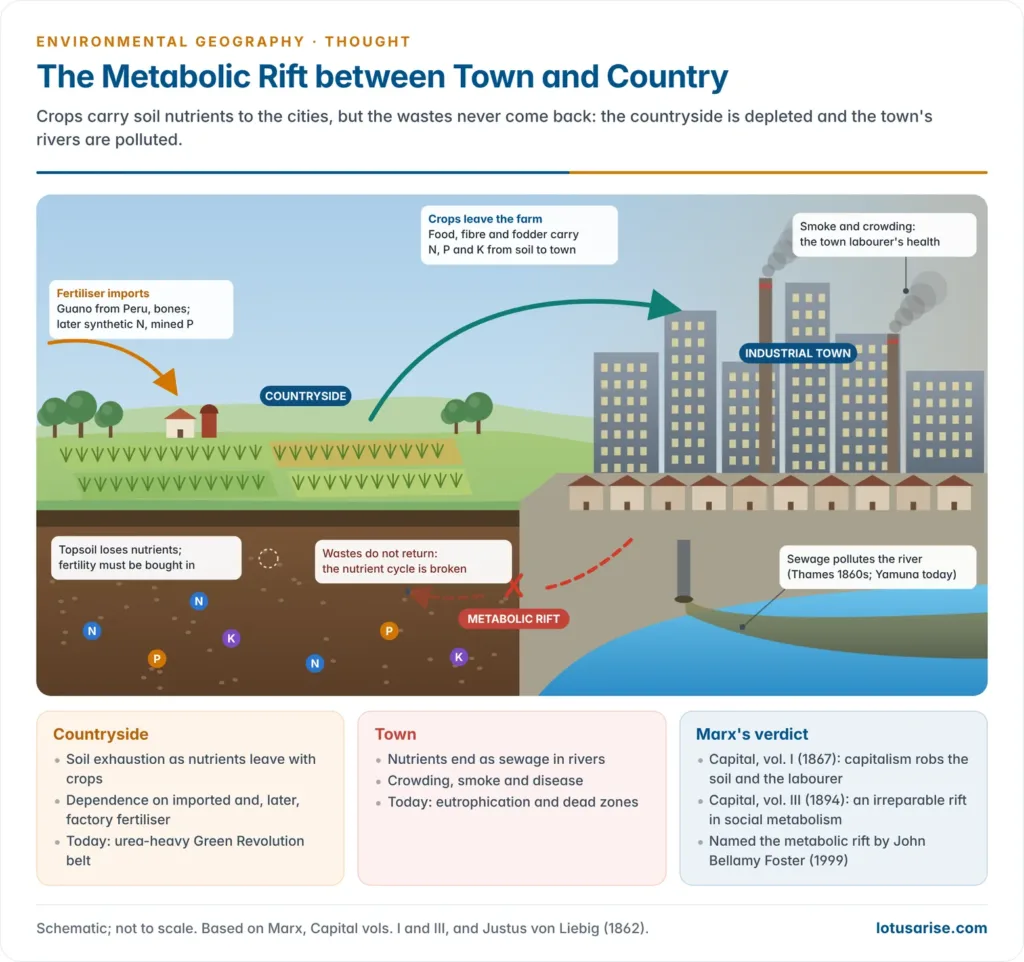
Marx’s texts on the rift
- Capital, Volume I (1867), on modern industry and agriculture:
- “Capitalist production, by collecting the population in great centres … disturbs the circulation of matter between man and the soil, i.e., prevents the return to the soil of its elements consumed by man in the form of food and clothing; it therefore violates the conditions necessary to lasting fertility of the soil.”
- “All progress in capitalistic agriculture is a progress in the art, not only of robbing the labourer, but of robbing the soil; all progress in increasing the fertility of the soil for a given time, is a progress towards ruining the lasting sources of that fertility.”
- The more a country builds on modern industry, as the United States did, “the more rapid is this process of destruction”.
- “Capitalist production, therefore, develops technology … only by sapping the original sources of all wealth — the soil and the labourer.”
- Capital, Volume III (edited by Engels and published in 1894, after Marx’s death), on ground rent:
- Large landed property “reduces the agricultural population to a constantly falling minimum, and confronts it with a constantly growing industrial population crowded together in large cities. It thereby creates conditions which cause an irreparable break in the coherence of social interchange prescribed by the natural laws of life.”
- A later English translation renders this as an “irreparable rift” in social metabolism, which gave the concept its name. The squandered vitality of the soil, Marx added, is “carried by commerce far beyond the borders” of a country.
- In the same volume he noted that London could do no better with the excrement of four and a half million people than contaminate the Thames with it at heavy expense.
- Marx also saw the way out: by wrecking the old metabolism, capitalism “imperiously calls for its restoration as a system, as a regulating law of social production”.
Foster’s recovery of the concept
- The sociologist John Bellamy Foster named and systematised the idea as the metabolic rift:
- “Marx’s Theory of Metabolic Rift” (American Journal of Sociology, 1999);
- Marx’s Ecology: Materialism and Nature (2000), which traced Marx’s materialism from Epicurus to Darwin;
- The Ecological Rift (2010, with Brett Clark and Richard York), which extended it to climate, oceans and biodiversity.
- Earlier Marxists had used the idea: Karl Kautsky described the fertiliser treadmill in The Agrarian Question (1899), and Nikolai Bukharin treated society as a system in material exchange with nature in Historical Materialism (1921).
The rift today
- Nutrient rift: synthetic nitrogen (the Haber–Bosch process, industrial from 1913) and mined phosphate replaced guano, but shifted the rift instead of closing it.
- Global nitrogen and phosphorus flows now exceed their planetary boundaries, feeding eutrophication and coastal dead zones; phosphate rock is concentrated in a few countries, above all Morocco.
- The 2025 planetary-boundary assessment found seven of nine boundaries crossed, ocean acidification being the latest.
- Carbon rift: fossil fuels move carbon stored over millions of years into the air far faster than the biogeochemical cycles can return it.
- India:
- The Green Revolution belt of Punjab and Haryana runs a fertiliser treadmill: urea-heavy use far from the recommended 4:2:1 NPK ratio, falling soil organic carbon, micronutrient deficiency, groundwater drawn beyond recharge, and stubble burning.
- At the urban end, installed sewage-treatment capacity covers well under half of the sewage Indian cities generate (CPCB, 2021), so nutrients that belong on farms pollute the Yamuna, the Ganga and urban lakes.
Tipping points: quantity into quality
- The Earth’s climate and ecosystems are dynamic, complex systems in which every change feeds back on all the others. Holism and feedback are central to dialectical thinking too.
- The dialectical law of the transformation of quantity into quality holds that slow accumulation produces sudden qualitative leaps.
- Climate science now warns of tipping points: thresholds beyond which an ice sheet, a monsoon or the Amazon passes irreversibly into a new state.
- Fred Pearce’s With Speed and Violence (2007) shows stresses building in the climate system without outward sign until abrupt change bursts forth. Marxists read rapid climate change and revolutionary social change as expressions of the same dialectical pattern.
Capitalism and Ecological Crisis
Nature as a free gift: use value without exchange value
- Critics say Marx treated nature as free and unlimited. His point was the reverse: under capitalism nature has no value, because value counts only the labour time in a commodity.
- Unexploited nature still holds use value: air, forests, fish, soil fertility, a stable climate.
- Capital takes these as a “free gift”, so it under-prices and over-uses them, and their loss never reaches the balance sheet.
- Michael Löwy (1997) judged Marx too uncritical of industrial civilisation. Marx did call capitalism historically progressive, but only in comparison with feudalism, and so only for a time. He understood it as a system for producing profit out of surplus labour, and warned of its consequences for nature.
- In Capital, Volume III, Marx denied that anyone owns the Earth: “Even a whole society, a nation, or even all simultaneously existing societies taken together, are not the owners of the globe. They are only its possessors, its usufructuaries, and, like boni patres familias, they must hand it down to succeeding generations in an improved condition.”
- This is an early statement of the intergenerational equity later written into sustainable development.
The growth imperative and the treadmill of production
- Capital must expand or die: competition forces each firm to reinvest surplus value, so the system needs endless growth on a finite planet.
- Allan Schnaiberg’s “treadmill of production” (1980) shows firms, the state and even labour unions coming to depend on ever-rising throughput of energy and materials. The same logic drives the “use and throw” economy and planned obsolescence.
- Efficiency alone does not save nature. The Jevons paradox, from William Stanley Jevons’s The Coal Question (1865), shows that more efficient use of a resource tends to raise its total use by making it cheaper.
- Ecological imperialism: raw materials, food and cheap labour flow from the global South to the North, while pollution and waste such as e-waste and plastic scrap flow back.
The second contradiction of capitalism
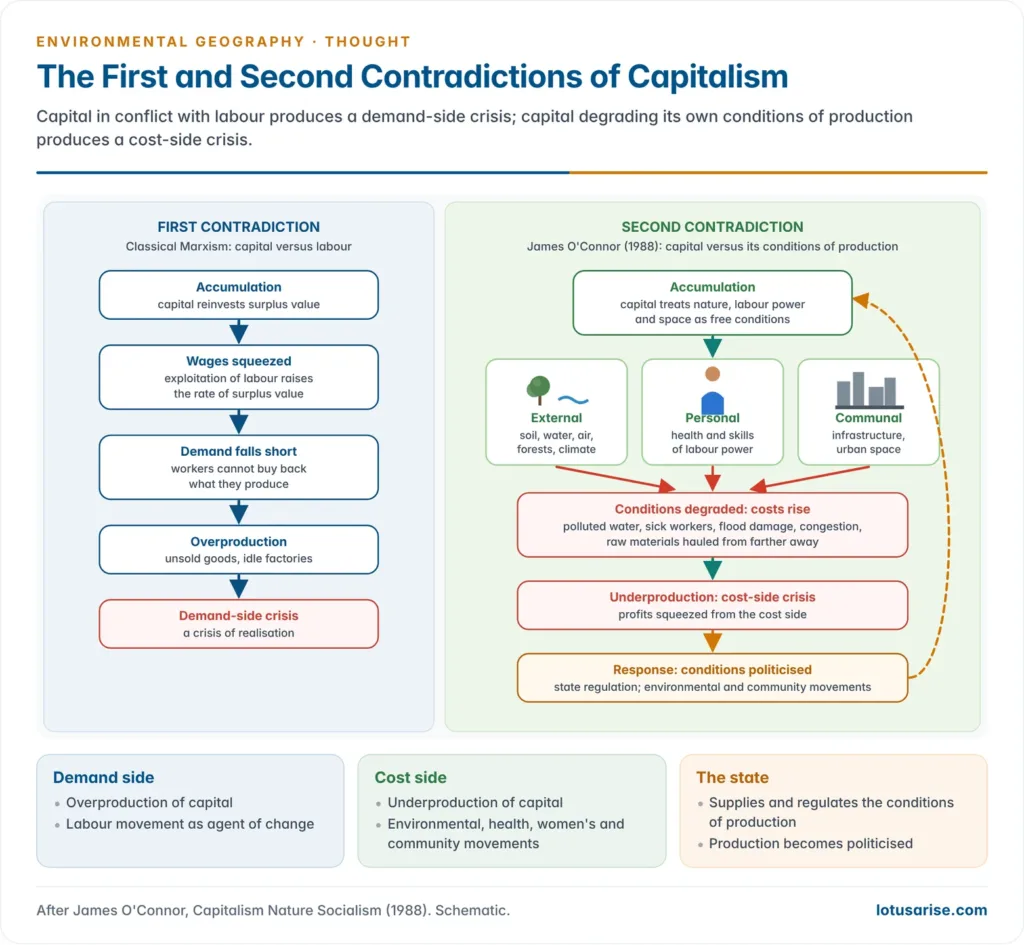
- The economist James O’Connor set out the “second contradiction of capitalism” in “Capitalism, Nature, Socialism: A Theoretical Introduction” (1988), the opening essay of his journal Capitalism Nature Socialism.
- The first contradiction, classical Marxism’s, lies between the forces and relations of production. Capital squeezes wages, workers cannot buy what they produce, and overproduction brings a demand-side crisis.
- The second contradiction lies between capitalist production and the conditions of production, which capital uses but does not produce as commodities:
- external (natural) conditions: soil, water, air, forests, a stable climate;
- personal conditions: the health and skills of labour power;
- general, communal conditions: infrastructure, communication and urban space.
- By degrading these conditions capital raises its own costs (cleaning water, treating sick workers, rebuilding after floods, hauling raw materials from farther away), which brings underproduction, a cost-side crisis.
- The state steps in to supply and regulate the conditions, which politicises production. Environmental, public-health, women’s and community movements become barriers to capital and a second path to socialism beside the labour movement.
| Basis | First contradiction | Second contradiction |
|---|---|---|
| Between | Forces and relations of production | Capitalist production and its conditions of production |
| Source | Exploitation of labour | Degradation of nature, labour power and communal space |
| Crisis type | Overproduction; demand side | Underproduction; cost side |
| Agents of change | Labour movement | New social movements, with labour |
| Key thinker | Marx | James O’Connor (1988) |
The Marxian critique of Malthusian environmentalism
- Thomas Robert Malthus (1798) blamed misery on population outrunning food. Marx and Engels rejected any eternal natural law of population.
- Engels (1844) called it a “vile, infamous theory, this hideous blasphemy against nature and mankind”.
- Marx held that “every special historic mode of production has its own special laws of population”. Under capitalism, accumulation itself creates a relative surplus population, the industrial reserve army, which looks like overpopulation but is made by capital. The Marxian theory of population builds on this.
- The geographer David Harvey, in “Population, Resources, and the Ideology of Science” (1974), took the critique into environmental debate: resources are not fixed natural stocks but are defined by technology, social relations and demand, and talk of “overpopulation” can serve as an ideology that blames the poor.
- The same critique answers the neo-Malthusian environmentalism of Paul Ehrlich’s The Population Bomb (1968), Garrett Hardin’s “Tragedy of the Commons” (1968) and the Limits to Growth report (1972).
- Marxists accept real ecological limits but place the driver in consumption and accumulation by the rich, not in the numbers of the poor.
- Hardin’s tragedy is, on this reading, one of unregulated open access, not of common property as such.
Marxism versus individual green thought
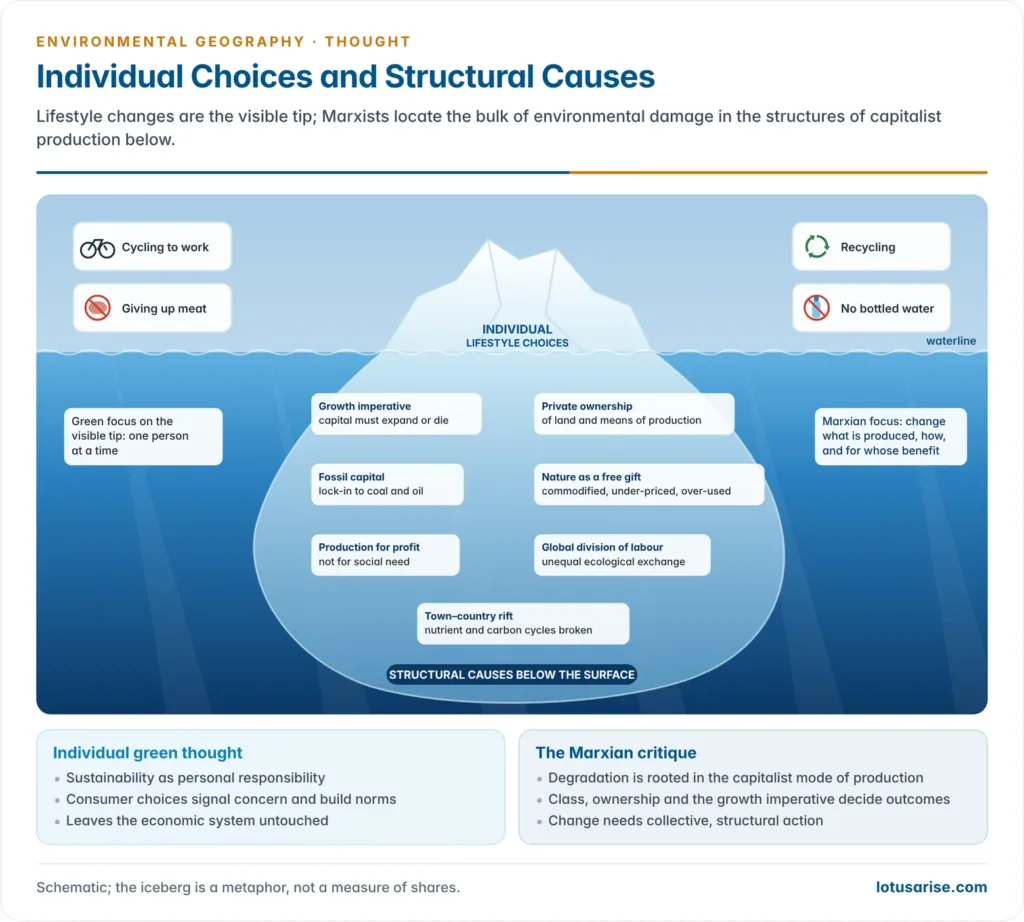
- Much green thought has long neglected class and the economic system. People who care about degradation and global warming often frame sustainability as individual responsibility: cycling to work, giving up meat, recycling, refusing bottled water.
- The Marxian critique: lifestyle change that builds a sustainable world one person at a time ignores the structural causes embedded in the capitalist mode of production.
- Marxism addresses the economic system: who owns the means of production, what is produced, and for whose benefit.
- Individual choices still matter, but mainly as signals and politics, not as a substitute for changing production.
Ecological Marxism After Marx
- Marxism is a developing body of thought, not a closed creed. It has learned from new situations and new science, and several socialists have shaped modern ecology.
Early socialist ecology and Vernadsky
- Serhii Podolynsky (1880) tried to link the labour theory of value with energy flows in farming, a forerunner of ecological economics.
- Engels, writing to Marx in December 1882, granted that labour can fix solar energy through farming, but added that the worker is “a still greater squanderer of past solar heat“: coal, ores and forests.
- Vladimir Vernadsky (1863–1945), the Russian–Ukrainian geochemist, built the modern science of the biosphere in The Biosphere (1926).
- The word was coined by the geologist Eduard Suess (1875); Vernadsky made living matter a geological force that drives the chemistry of the Earth’s surface.
- His later idea of the noosphere, a stage when human thought and labour become the main force reshaping the planet, anticipates the Anthropocene.
- At the founding of the Radium Institute (1922) he warned that humanity would soon hold atomic energy and must learn to use it wisely.
- A liberal rather than a Bolshevik, he worked within early Soviet science, which was still ecological (pioneering zapovedniki, or strict nature reserves) before it turned productivist and, with Lysenkoism, anti-scientific.
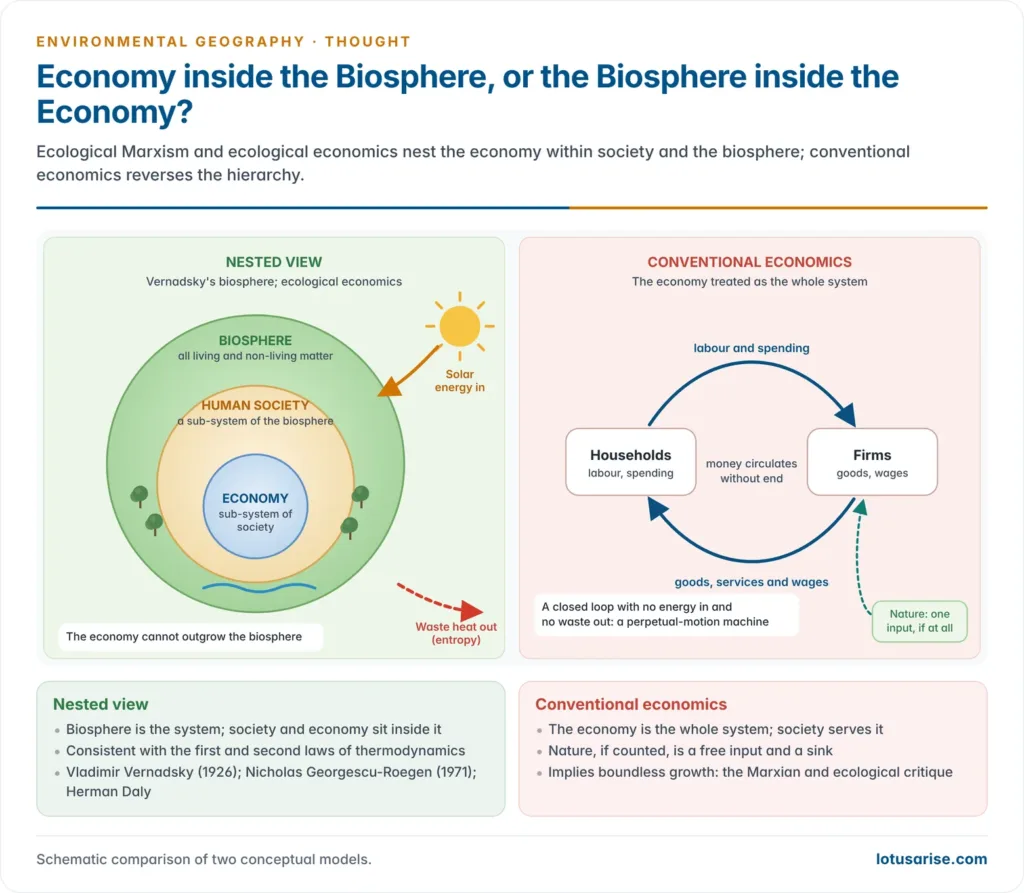
- Vernadsky’s biosphere implies a nested hierarchy: the economy within society, society within the biosphere. Ecological economists such as Nicholas Georgescu-Roegen (The Entropy Law and the Economic Process, 1971) and Herman Daly later drew the same picture.
- Conventional economics inverts it, treating the economy as the whole system and nature as one input. Its circular flow runs like a perpetual-motion machine, which the laws of thermodynamics rule out.
- The Soviet record is the strongest charge against Marxism: the Aral Sea drained for cotton irrigation, and the Chernobyl disaster (1986).
- Ecological Marxists answer that centralised, growth-at-all-costs planning without democracy reproduced the productivism Marx criticised.
First-stage and second-stage eco-socialism
- First-stage eco-socialists (1970s–1980s) grafted green ideas onto Marxism while conceding that Marx was weak on ecology: André Gorz (Ecology as Politics, 1975), Ted Benton (“Marxism and Natural Limits”, 1989), who charged Marx with underplaying natural limits, and James O’Connor (1988).
- Second-stage eco-socialists went back to Marx’s texts and found ecology built into his critique of political economy: Paul Burkett (Marx and Nature: A Red and Green Perspective, 1999) and John Bellamy Foster (2000).
- Eco-socialism as a programme: the geographer David Pepper‘s Eco-socialism: From Deep Ecology to Social Justice; Joel Kovel and Michael Löwy‘s An Ecosocialist Manifesto (2001); and the Belém Ecosocialist Declaration (2009 World Social Forum).
- Shared aims: social ownership of key resources, democratic planning of production for need, renewable energy, conservation and an end to the growth imperative.
Kohei Saito and degrowth communism
- The Japanese philosopher Kohei Saito (born 1987) used Marx’s unpublished natural-science notebooks to argue that Marx’s ecology deepened in his last years.
- Karl Marx’s Ecosocialism: Capital, Nature, and the Unfinished Critique of Political Economy (2017) won the Deutscher Memorial Prize (2018), making him its youngest winner. His Japanese bestseller Capital in the Anthropocene (2020) sold over half a million copies.
- Marx in the Anthropocene: Towards the Idea of Degrowth Communism (2023) argues that the late Marx abandoned productivism for a steady, commons-based economy; Slow Down: The Degrowth Manifesto (English, 2024) popularised it.
- Five pillars of degrowth communism:
- production for use value, not accumulation;
- shorter working hours;
- abolition of the uniform, deskilling division of labour;
- democratisation of production;
- priority for essential work such as care.
- Critics, including eco-modernist Marxists such as Matthew Huber, dispute this reading of the late Marx and defend growth in clean energy. Others ask whether degrowth suits countries such as India, where basic needs still require more energy and materials; Saito’s answer is degrowth in the rich North and convergence for the South.
World-ecology, fossil capital and the production of nature
- Jason W. Moore (Capitalism in the Web of Life, 2015) rejects the society–nature split: capitalism is a way of organising nature that lives on “cheap natures” (food, energy, raw materials, labour), so the epoch is better called the Capitalocene. He traces the rift to the “long” 16th century.
- Andreas Malm (Fossil Capital, 2016) shows British industry moving from water power to coal-fired steam because coal let capital control labour and location, not because it was cheaper, placing the roots of global warming in class relations.
- The geographer Neil Smith (Uneven Development, 1984) argued that capitalism actively produces a second nature through labour and capital. His production of nature thesis carries the Marxian view into hybridity and socio-nature.
Political ecology: the Marxian roots
- Political ecology grew from Marxian political economy applied to land, resources and degradation in the Third World.
- The anthropologist Eric Wolf revived the term in “Ownership and Political Ecology” (1972).
- Michael Watts (Silent Violence, 1983) traced famine in northern Nigeria to colonial and market relations, not simply to Sahel drought.
- Piers Blaikie (The Political Economy of Soil Erosion in Developing Countries, 1985) and Blaikie with Harold Brookfield (Land Degradation and Society, 1987) showed that peasants who degrade land are often pushed by debt, markets and dispossession.
- It keeps the Marxian questions, who gains, who loses, who decides, while adding culture, gender and discourse, and is the latest major approach in the man–environment relationship.
Key thinkers in Marxian ecological thought
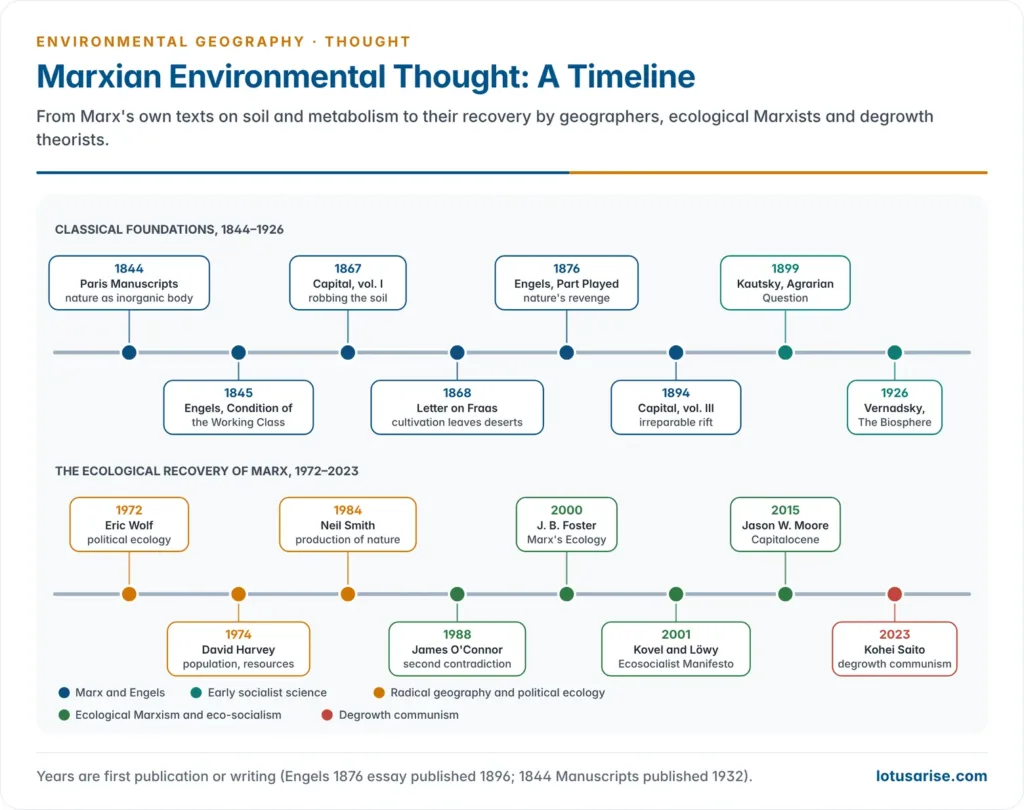
| Thinker | Period or work | Contribution |
|---|---|---|
| Karl Marx | 1818–1883; Capital I (1867), III (1894) | Labour as metabolism with nature; soil robbery; town–country rift |
| Friedrich Engels | 1820–1895; Part Played by Labour (1876) | Nature’s “revenge”; humans belong to nature and must learn its laws |
| Karl Kautsky | The Agrarian Question (1899) | Fertiliser treadmill; town exploits country |
| Vladimir Vernadsky | The Biosphere (1926) | Biosphere science; living matter as geological force; noosphere |
| David Harvey | 1974 | Resources are social; critique of Malthusian scarcity |
| Neil Smith | 1984 | Production of nature |
| James O’Connor | 1988 | Second contradiction of capitalism |
| Paul Burkett; John Bellamy Foster | 1999; 1999–2000 | Recovery of Marx’s ecology; metabolic rift |
| Joel Kovel; Michael Löwy | 2001 | Ecosocialist Manifesto |
| Jason W. Moore; Andreas Malm | 2015; 2016 | World-ecology and Capitalocene; fossil capital |
| Kohei Saito | 2017; 2023 | Late Marx’s ecology; degrowth communism |
Applications and Evaluation
The Marxian view in the Indian context
- Madhav Gadgil and Ramachandra Guha (This Fissured Land, 1992; Ecology and Equity, 1995) read India’s ecological history through modes of resource use and class:
- omnivores: urban, industrial and rural elites who draw resources from everywhere;
- ecosystem people: forest dwellers, pastoralists, fishers and small farmers who live off local nature;
- ecological refugees: people displaced by dams, mines and degradation into urban slums.
- Guha’s The Unquiet Woods (1989) read the Chipko movement (from 1973) as a peasant struggle over forest rights and livelihoods. With Joan Martinez-Alier he named this the “environmentalism of the poor”.
- Struggles over the conditions of production, in O’Connor’s sense:
- Niyamgiri, Odisha: the Supreme Court (April 2013) let the gram sabhas of the Dongria Kondh decide on Vedanta’s bauxite mine; every village consulted rejected it, and the ministry refused clearance in 2014. The pattern recurs across the environmental impacts of large dams and mining.
- Thoothukudi, Tamil Nadu: the Sterlite copper smelter was closed in May 2018 after pollution protests ended in police firing; the Supreme Court refused its reopening in 2024.
- Plachimada, Kerala: a Coca-Cola bottling plant shut in 2004 after villagers protested groundwater depletion and contamination.
- Coal belts such as Jharia and Singrauli show the costs of cheap energy falling on local communities.
- Indian movements also draw on Gandhian and ecofeminist traditions (Vandana Shiva and the gender and biodiversity debate), not class analysis alone.
What is required to end the contradiction
- Regulating the remote effects of production, Engels wrote, “requires something more than mere knowledge. It requires a complete revolution in our hitherto existing mode of production, and simultaneously a revolution in our whole contemporary social order.”
- Ending the exploitation of nature for profit means removing the profit motive from the command of production.
- The private right to own land and the means of production must give way to common ownership and production for social need. Only then, on this view, will the simultaneous exploitation of nature and humanity end.
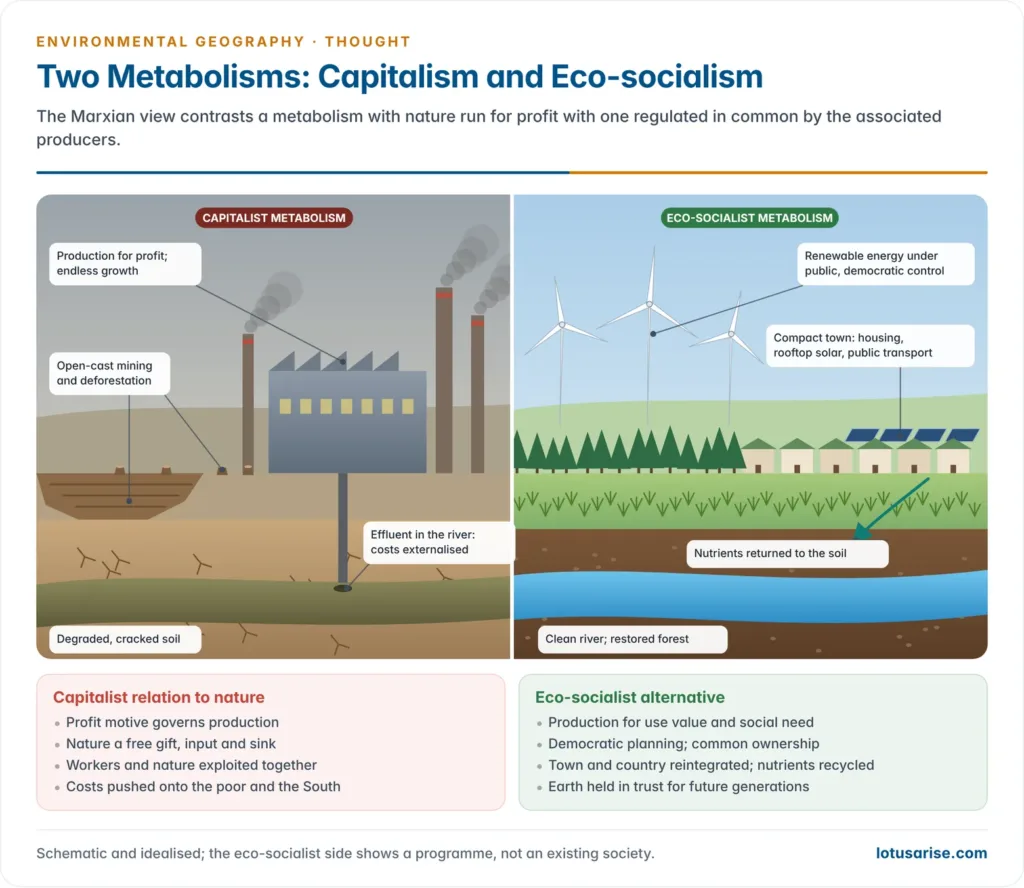
- In Capital, Volume III, Marx described the goal: the associated producers “rationally regulating their interchange with Nature, bringing it under their common control”, with the least expenditure of energy and in conditions worthy of human nature.
| Basis | Capitalist relation to nature | Eco-socialist alternative |
|---|---|---|
| Goal of production | Profit and accumulation | Use value and social need |
| View of nature | Free gift; input; sink | Condition of life; held in trust for future generations |
| Growth | Endless, compulsory | Planned, bounded; degrowth in the rich North |
| Ownership | Private ownership of land and means of production | Social, common and democratic control |
| Town and country | Separated; nutrient rift | Reintegrated; nutrients recycled |
| Environmental cost | Externalised onto the poor and the South | Internalised and shared |
Critical evaluation
- Strengths:
- it explains degradation through structures (ownership, accumulation, global trade), not just individual behaviour or population;
- it joins social justice and ecology: the poor, workers and the global South bear most environmental costs;
- the metabolic rift and the second contradiction remain working tools for nutrient cycles, climate and urban pollution.
- Criticisms:
- Prometheanism: Marx praised the growth of productive forces, and Benton and others doubt that ecology was central to his thought;
- the historical record of Soviet and Eastern Bloc pollution;
- anthropocentrism: nature is valued for human use, whereas deep ecology asks for intrinsic value;
- class reductionism: gender, caste, indigeneity and culture can be underplayed;
- degrowth sits uneasily with the development needs of poorer countries;
- market tools work in part: pollution taxes, emissions trading and Environmental Kuznets Curve evidence show some decoupling within capitalism, though not at the speed the climate needs.
- Current view: Marx’s ecology is now widely taken seriously. The live debate is less about whether Marx thought ecologically than about what follows: eco-modernist socialism, degrowth communism, or a mixed path of planning, public ownership of energy and the commons, and market regulation.
Previous Year Questions
- No direct PYQ has been asked on this sub-topic yet.