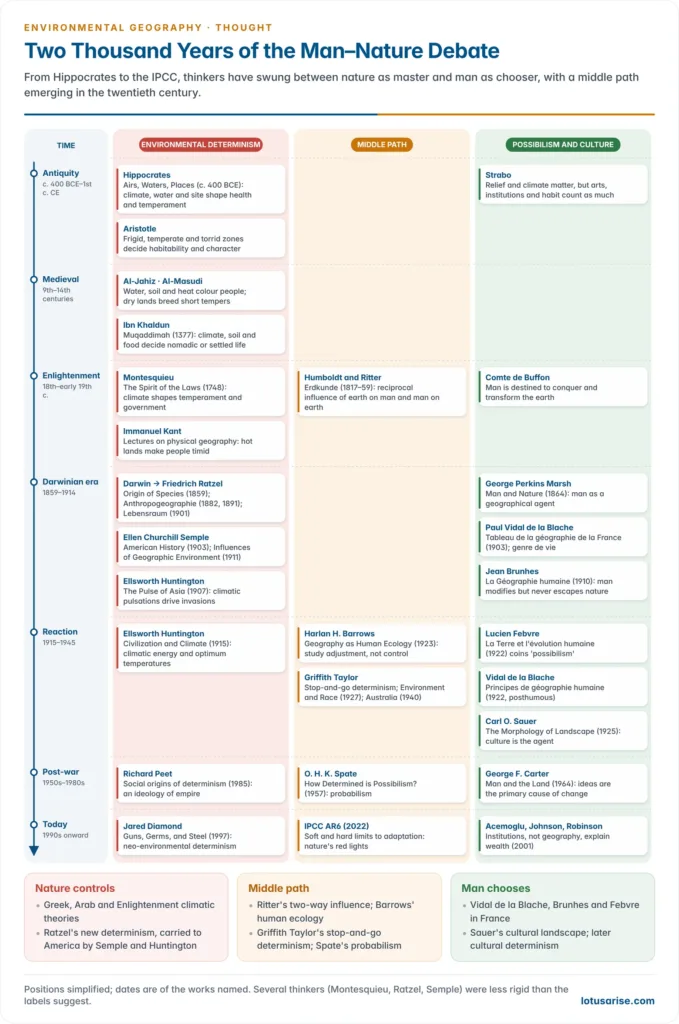
- The history of geographical thought is, in large part, a long argument about where human beings stand within their natural environment.
- Two opposed philosophies sit at the centre of it: environmental determinism and possibilism.
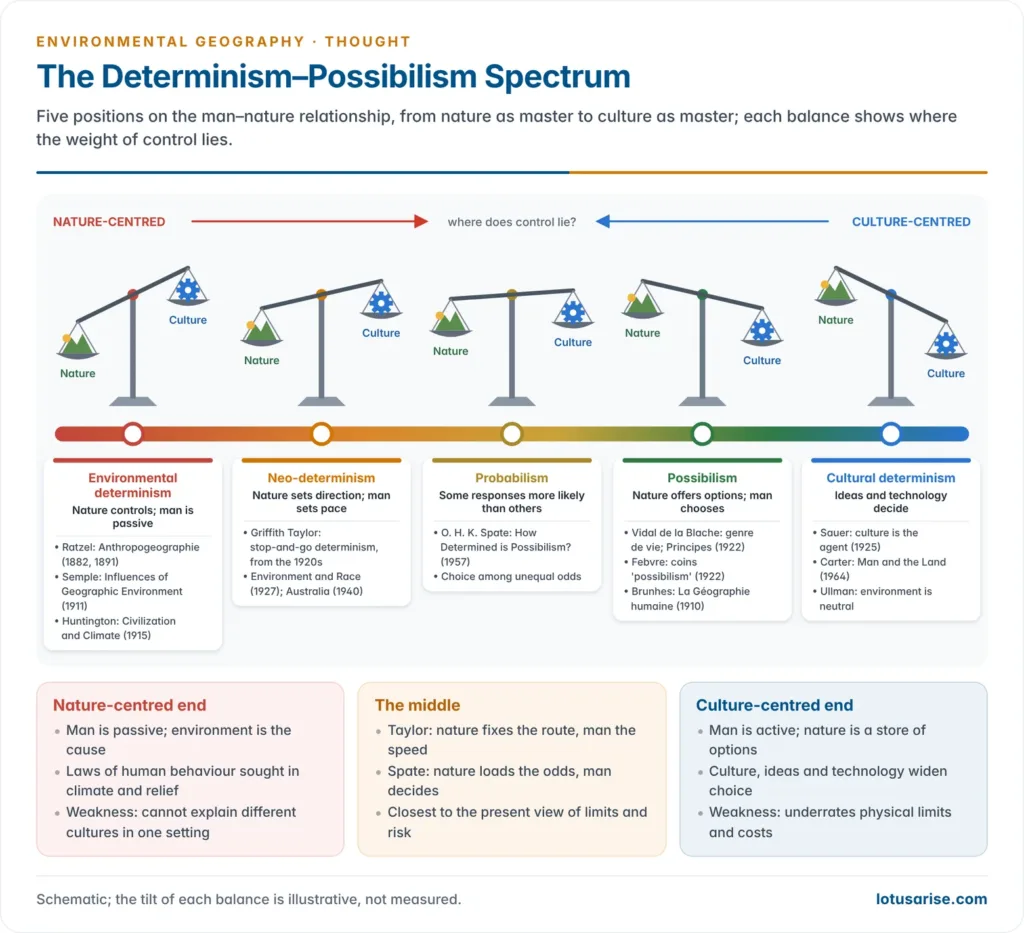
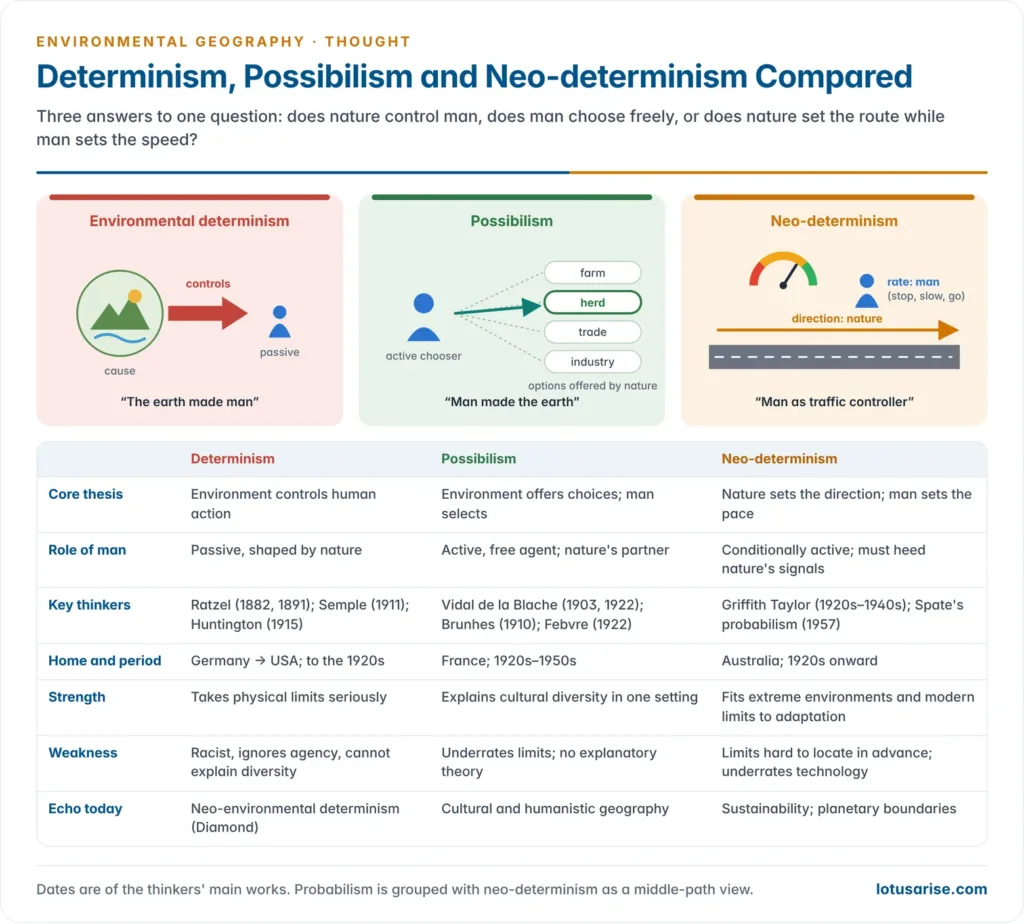
- Between them lie neo-determinism (stop-and-go determinism) and probabilism, which together complete the classical framework of man–nature relationships in geography.
- The whole debate turns on one question: is the human being a passive agent shaped by nature, or an active force that adapts to, chooses within and transforms the environment?
- The positions are best read as points on a spectrum, from “nature controls” at one end to “man controls” at the other. Each arose as a reaction to the excesses of the one before it, and each survives in a modified form in present-day debates on climate change, hazards and development.
Background: How the Debate Took Shape

Classical, medieval and early-modern roots
- From antiquity until the early twentieth century, some form of determinism was the dominant way of explaining the man–environment relationship. The broad idea stayed remarkably constant across centuries: man is a product of nature, and the physical environment moulds human culture.
- Greek and Roman scholars first tried to explain the physical features and character of peoples through natural conditions, as part of the wider contribution of Greek scholars to geography.
- The Hippocratic treatise Airs, Waters, Places (about 400 BCE) linked the health, physique and temperament of peoples to climate, water and site.
- Aristotle divided the earth into frigid, temperate and torrid zones and held that these zones decided the habitability of the earth and the character of its peoples.
- Strabo described how relief, slope and climate shaped ways of life, but he also stressed that arts, institutions and habit count for as much as nature, a qualification later possibilists valued.
- Arab scholars of the medieval period, notably Al-Masudi, Al-Jahiz and Ibn Khaldun, carried the climatic tradition forward in their geographical writings, dividing the world into climatic belts and reading human character from them.
- In the eighteenth century the French thinker Charles de Secondat, Baron de Montesquieu, in The Spirit of the Laws (1748), argued that climate shapes temperament, customs and even forms of government.
- Immanuel Kant, who lectured on physical geography at Königsberg for four decades, accepted a strongly climatic view of human character.
- Alexander von Humboldt and Carl Ritter, the founders of modern geography, were more nuanced, and their contributions show it:
- Humboldt was impressed by the influence of the environment on man but was equally interested in how people respond to their surroundings. He saw nature and organic life as one connected whole.
- Ritter treated geography as anthropocentric (the earth as the home of man) and accepted environmental influence on human character. Crucially, he also stressed the reciprocal influence of earth on man and of man on earth, an early glimpse of ecological thinking.
The nineteenth-century turn
- Scientific developments of the later nineteenth century gave determinism a new, apparently scientific basis:
- Charles Darwin’s On the Origin of Species (1859) made adaptation to environment the engine of change in living things.
- Herbert Spencer’s social evolutionism and the phrase “survival of the fittest” carried that logic into the study of societies (Social Darwinism).
- Newtonian cause-and-effect reasoning encouraged geographers to look for natural “laws” of human behaviour.
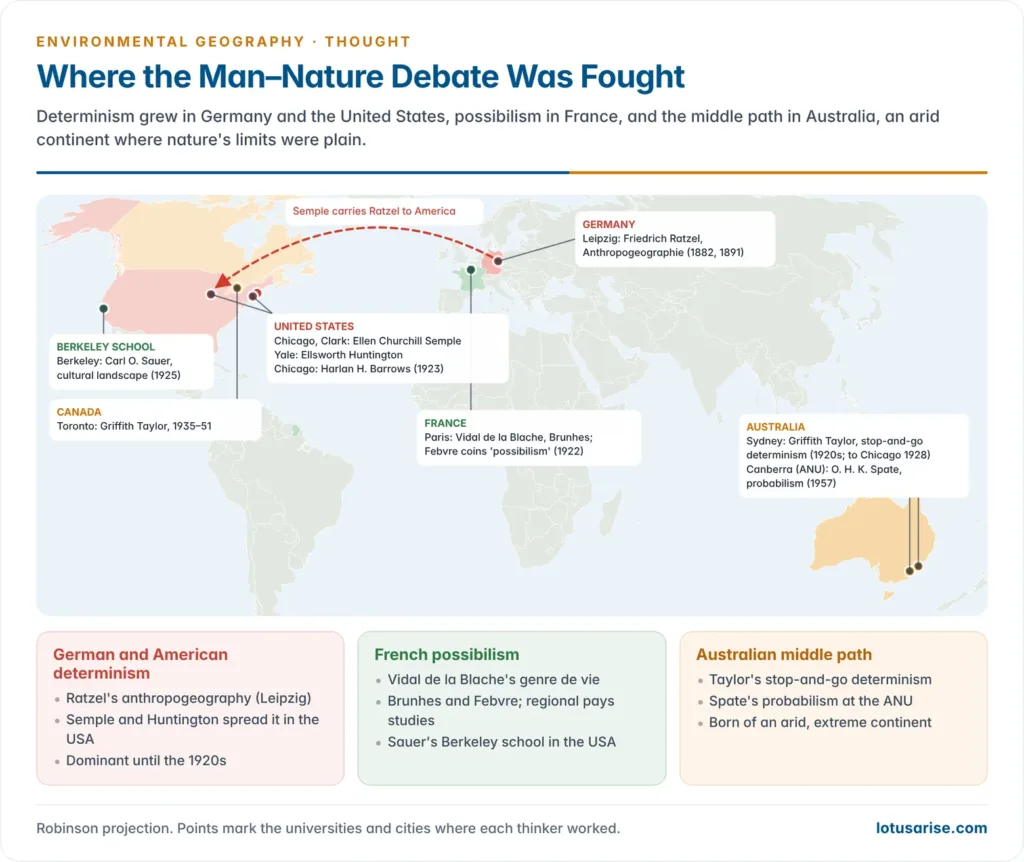
- The result was a “new determinism”, launched in Germany by Friedrich Ratzel and carried to the United States by Ellen Churchill Semple and Ellsworth Huntington. This is the classical form of environmentalism in geography.
- The same scientific climate produced a reaction in France. The French School of Geographical Thought under Paul Vidal de la Blache, with Lucien Gallois, Jean Brunhes, Albert Demangeon, Emmanuel de Martonne and Raoul Blanchard, placed human beings, rather than the earth or climate, at the centre of geographical enquiry. This became possibilism.
- From the 1920s Griffith Taylor offered a middle path (neo-determinism), and in 1957 O. H. K. Spate proposed probabilism to end the “wrangle” between the two camps.
Environmental Determinism
Meaning and core assumptions
- Environmental determinism is the philosophy that the physical environment controls the course of human action. It is also called environmentalism or geographical determinism.
- The history, culture, way of life and stage of development of a social group or nation are held to be exclusively, or largely, governed by physical factors: climate, relief, soil, location and natural resources.
- Humans are passive agents. Physical forces act on them constantly and decide their attitudes, decisions and ways of life.
- The approach thus “naturalises” humans: every social, cultural, political and economic trait is read as a response to natural forces.
- Core assumptions:
- Nature is the cause, culture the effect: the relationship runs one way, from environment to people.
- Similar environments produce similar ways of life, and different environments produce different ones.
- Climate is the master factor, acting on body, temperament and energy.
- The relationship can be stated as laws, on the model of the natural sciences.
Determinism before modern geography
- Aristotle explained the contrast between peoples by climate:
- The cold climate of Europe produced brave, spirited peoples who could keep their freedom but lacked the skill to rule others.
- The warm climate of Asia produced intelligent and skilful but spiritless peoples, easily subjected.
- The Greeks, in an intermediate climate, combined both qualities. The argument conveniently placed the author’s own people at the top.
- Al-Masudi wrote that people in well-watered Sham (Syria) were cheerful and good-humoured, while people of dry lands were short-tempered; nomads living in the open air were marked by strength, resolution and wisdom.
- Montesquieu held that people of cold climates are stronger, braver, franker and less suspicious than those of hot climates, whose heat breeds indolence.
- He nonetheless added that wise legislators should oppose the vices of a climate rather than give in to them, a softening that later writers saw as an early hint of possibilism.
- Kant held that the inhabitants of hot lands were exceptionally lazy and timid, and that timidity breeds superstition and servitude.
- Henry Thomas Buckle, in his History of Civilization in England (1857–61), tied the progress of civilisations to climate, soil, food and the “general aspect of nature”.
Early determinism in explaining race
- Al-Jahiz (9th century, Basra) argued that the colour of people and livestock is shaped by the water, soil and heat of their surroundings.
- He pointed to the black basalt country of northern Najd in Arabia, whose inhabitants and animals were dark, as evidence.
- Ibn Khaldun (1332–1406), in the Muqaddimah (1377), is regarded as one of the first systematic environmental determinists.
- He attributed dark skin to the hot climate of sub-Saharan Africa, not to descent, and so rejected the biblical explanations of his day.
- He also held that soil, climate and food decide whether a people is nomadic or settled, and shape its customs.
Key thinkers of modern determinism
Friedrich Ratzel (1844–1904)
- Friedrich Ratzel, the German geographer regarded as the founder of modern human geography, trained as a zoologist and brought an evolutionary, naturalist outlook into the study of man.
- He stressed the influence of the physical environment on man, treating man as a product of evolution adapting to his surroundings.
- Anthropogeographie (two volumes, 1882 and 1891) is the foundational text of human geography.
- Volume I (1882) applied geography to history and gave the most weight to environmental influence on peoples.
- Volume II (1891) dealt with the geographical distribution of mankind, migration and the diffusion of culture, and gave more room to human movement and contact.
- Ratzel was therefore less rigid than many of his followers: the deterministic reading of his work owes much to its translation into English through Semple.
- “Similar locations lead to a similar mode of life” is the principle usually attributed to him.
- His standard example was the British Isles and Japan: insular locations that gave natural protection against invasion, a maritime outlook and rapid national progress.
- His determinism gave special weight to location (Lage) and space (Raum) in relation to topography.
- The organic theory of the state: in Politische Geographie (1897) Ratzel treated the state as an organism rooted in the soil, growing and declining like a living being.
- He used the Darwinian ideas of selection and struggle, and in a 1901 essay developed the concept of Lebensraum (living space): a vigorous state must expand to secure the space it needs.
- Misuse of the idea: Ratzel’s organic state and Lebensraum were taken up by Rudolf Kjellén, who coined the word geopolitics, and then by Karl Haushofer’s German Geopolitik school of the 1920s–30s. The concept was used to justify Nazi territorial expansion, one of the most dangerous misappropriations of a geographical idea, and part of the wider story of colonialism, neo-colonialism and Lebensraum.
- Ratzel’s place in the German School of Geographical Thought rests on making human geography a systematic science, whatever the later verdict on his determinism.
Ellen Churchill Semple (1863–1932)
- Ellen Churchill Semple, an American geographer, studied under Ratzel at Leipzig (as a woman she could attend his lectures but not matriculate). She became the most influential determinist of the early twentieth century and the chief carrier of Ratzel’s ideas into the English-speaking world.
- She taught at the University of Chicago and later Clark University, and was the first woman president of the Association of American Geographers (1921).
- Through her students she shaped many leaders of the profession between the two World Wars, part of the wider American School of Geographical Thought.
- Major works:
- American History and Its Geographic Conditions (1903): the course of American history read through its rivers, mountains, coasts and climate.
- Influences of Geographic Environment (1911), subtitled On the Basis of Ratzel’s System of Anthropo-Geography: her most famous book, which established environmentalism in America.
- The Geography of the Mediterranean Region: Its Relation to Ancient History (1931).
- Her creed opens Influences of Geographic Environment:
- “Man is a product of the earth’s surface. This means not merely that he is a child of the earth, dust of her dust; but that the earth has mothered him, fed him, set him tasks, directed his thoughts, confronted him with difficulties that have strengthened his body and sharpened his wits, given him his problems of navigation or irrigation, and at the same time whispered hints for their solution.”
- Why she counts as an ardent determinist:
- Environment shapes body and mind: the mountaineer gets “leg muscles of iron”, the coast-dweller a strong chest and arms for the oar; the river-valley farmer is tied to a “dull round” of duties, while the steppe and desert nomad develops a vast simplicity of outlook that leads to monotheism and, in time, to imperial conquest.
- Climate decides temperament: northern Europeans are energetic, provident, serious and cautious; southerners of the Mediterranean are easy-going, improvident, gay and emotional.
- Physical barriers and highways decide the paths of migration and conquest; mountain peoples are isolated and conservative, islanders and coast-dwellers enterprising.
- Method: she compared peoples of different races living in similar environments, and attributed their similarities to environment rather than race.
- Her own caution: in the preface she wrote that she spoke of “geographic factors and influences”, shunned the word “geographic determinant” and spoke “with extreme caution of geographic control”.
- Her practice was far bolder than her preface: sweeping generalisations, selective examples and racial and cultural stereotypes run through the book. This is why later critics placed her at the hard end of the spectrum.
Ellsworth Huntington (1876–1947): climatic determinism
- Ellsworth Huntington, trained at Harvard and long based at Yale University, turned environmentalism into climatic determinism: of all environmental factors, climate was the fundamental factor in the rise and fall of civilisations.
- Major works: The Pulse of Asia (1907), Civilization and Climate (1915; revised 1924), Principles of Human Geography (with Sumner W. Cushing, 1920, many later editions) and Mainsprings of Civilization (1945).
- The pulsatory hypothesis (1907): pulsations of climate, alternating moist and dry phases in Central Asia, pushed nomadic peoples out of their homelands. Periods of drying set off invasions and tribal warfare that shaped the history of Eurasia.
- Climatic energy (1915): from records of factory workers and students, he argued that human efficiency peaks under particular conditions:
- a physical optimum at a mean outdoor temperature of about 60–65 °F (about 15–18 °C);
- a mental optimum at about 38 °F (about 3 °C);
- moderate humidity and frequent changes of weather (storminess), which stimulate energy.
- Mapping this “climatic energy” against his own ranking of civilisation, he found the best of both in north-western Europe and the north-eastern United States.
- Tropics and development: the hot, humid, unvarying tropics were said to make people lethargic and inefficient, while the ease of growing food removed the spur to effort.
- Ancient civilisations of the Nile, Mesopotamia, the Indus and China were explained by a once more stimulating climate in those valleys.
- Later writers extended this reasoning into the claim that a country’s development could be predicted from its distance from the equator.
- Assessment: his work rested on ranked lists of “civilisation” drawn up by himself and like-minded scholars. He led the board of the American Eugenics Society (1934–38). The theory is now regarded as Eurocentric and racist, and scientifically discredited in its strong form, though his interest in climate change and human history anticipated later research.
Decline and critique of determinism
- Environmental determinism dominated the early 1900s but began to decline in the 1920s, as its claims were repeatedly found to be wrong, and after the Second World War it was attacked outright.
- Geographers in the United States, Britain, Canada and elsewhere objected to its one-sided approach: it exaggerated nature’s active role and allowed man only passive adaptation.
Academic critiques
- Carl O. Sauer (from 1924) argued that environmentalism produced premature generalisations about culture that were not based on direct observation.
- In The Morphology of Landscape (1925) he turned the question around: “Culture is the agent, the natural area is the medium, the cultural landscape the result.”
- For Sauer, natural law does not govern social groups: what people do in an area reflects the active agency of culture. His critique helped end determinism’s hold and redirected geography towards the study of cultural landscapes.
- Harlan H. Barrows (1923), in Geography as Human Ecology, proposed studying human adjustment to environment rather than environmental control, because this was “more likely to result in the recognition and proper valuation of all the factors involved, and especially to minimize the danger of assigning to the environmental factors a determinative influence which they do not exert.”
- Richard Hartshorne (The Nature of Geography, 1939) rejected environmentalism because it separates nature from man as cause and effect, which breaks the fundamental unity of geography as an integrating, areal science; he turned instead to areal differentiation.
- O. H. K. Spate attacked the dogmatism of the determinists: environment, taken by itself, means nothing without man; it acts through society, and cultural tradition has an autonomous influence of its own.
- Richard Peet (1985) showed the social origins of determinism: it flourished in the age of empire because it offered a “natural” justification for colonialism, racial hierarchy and capitalist expansion.
- The critics did not put a comprehensive theory in its place. Between the 1930s and 1950s geography drifted towards a regional perspective; determinism was criticised rather than replaced.
- A balanced view accepts that the weight of physical factors varies by setting: small in a temperate, well-equipped city, inescapable in the Sahara, the tundra or the high Himalaya.
The empirical failure: Indian examples
- Determinism fails above all because it cannot explain cultural diversity within the same physical environment. Two societies in areas of similar climate and landforms may be entirely different.
- Indian counter-examples:
- The Bakarwals and the Kashmiris of Jammu and Kashmir live in a similar environment but have very different modes of life and cultural ethos: one transhumant pastoralist, the other settled horticulturist and artisan.
- The Nepalis and the Khasis of Meghalaya, the Assamese and the Bengalis of the Brahmaputra valley, and the Tharus and the Sikhs of the Tarai of Uttar Pradesh all share environments yet differ sharply in culture, economy and settlement.
- The same environment also supports different societies over time: the Indo-Gangetic plain has carried forest-dwelling hunters, Vedic pastoralists, Mughal-era peasants and Green Revolution farmers. The environment changed little; technology and society changed a great deal.
Ideological misuse
- Colonial and racial ideology: “tropical” peoples were described as indolent and unfit for self-rule, which made empire look like nature’s verdict rather than a political choice.
- Geopolitics: the organic state and Lebensraum fed the expansionist Geopolitik of inter-war Germany.
- Eugenics and immigration restriction in the United States drew on the same climatic and racial rankings.
- These associations, more than any single empirical error, made determinism a discredited word in post-war geography.
Cultural (social) determinism
- One response kept the deterministic logic but reversed the causal arrow: cultural or social determinism makes human culture and technology, not nature, the decisive cause.
- Its maxim: our thoughts determine our acts, and our acts determine the nature of the world around us.
- Since interests, desires, prejudices and group values differ across space, the cultural landscape and levels of development differ too. How an environment is modified depends on perception, ideas and decisions.
- Edward L. Ullman treated the environment as essentially neutral: its role depends on the stage of technology, the type of culture and other traits of a changing society.
- George F. Carter (Man and the Land, 1964) held that ideas are the primary cause of change: they decide how people use the physical world, and human will is the decisive factor.
- Limitation: social determinism ignores the influence of the natural environment on cultural differences. It is as rigid as environmental determinism, merely at the opposite pole, and cannot be accepted in its crude form.
Determinism never fully left geography
- Determinism was redefined, refined and redirected rather than dislodged.
- The spatial science of the Quantitative Revolution built deterministic models of location, distance and interaction, often compressed into mathematical formulae (gravity models, central-place hierarchies).
- The study of natural hazards, climate change and limits to growth keeps returning geography to environmental constraint.
Possibilism: The Humanisation of Nature
Meaning
- Possibilism holds that the physical environment offers a range of opportunities and possibilities, from among which man is free to choose.
- Humans are active agents, not passive subjects; nature is a partner or a store of options, not a master.
- The number of possibilities grows with knowledge and technology. As a cultural group advances, it can widen the set of options its environment offers, and with the help of his mind man can change the influence of nature upon him.
- Possibilism is often described as the “humanisation of nature”: landscapes that look natural are in truth the work of man.
Rise of possibilism
- Possibilism emerged in the early twentieth century, mainly in France, as a reaction against German environmentalism.
- Determinism came to look conservative and unsuited to an advanced society that had already transformed extreme environments, for instance by canals carrying water into deserts.
- Roots:
- Plato and other idealist philosophers stressed mind over matter.
- Montesquieu, despite his climatic views, insisted that human laws and free will can counter climate.
- Georges-Louis Leclerc, Comte de Buffon saw man as destined to conquer and transform the earth.
- These ideas, never framed as a doctrine, form what is sometimes called the crypto-possibilist tradition.
- George Perkins Marsh, in Man and Nature (1864), documented how human action had reshaped forests, rivers and soils around the Mediterranean, the first great study of man as a geographical agent. The German geographer Alfred Kirchhoff also focused on man himself rather than on environmental control.
- The modern possibilist doctrine was launched by Paul Vidal de la Blache, and the term “possibilism” was coined by the historian Lucien Febvre in 1922. Vidal himself never used the word.
Key thinkers of possibilism
Paul Vidal de la Blache (1845–1918)
- Paul Vidal de la Blache, founder of the French school of human geography, gave possibilism its core statement: nature sets limits and offers possibilities for human settlement, but how people respond to or adjust to these conditions depends on their traditional way of life.
- Man is a partner, not a slave, of the environment.
- Vidal rejected material determinism and was critical of the Darwinian–Ratzelian heritage.
- He also rejected Émile Durkheim’s attempt to absorb human geography into sociology as “social morphology”, insisting that geography studies the relation between groups and their milieu.
- Society and nature are not adversaries: man is part of nature and its most active collaborator.
- Key concepts:
- Genre de vie (way of life): the whole set of activities, practices, techniques and values through which a human group adapts to its milieu. The same physical setting can carry different genres de vie in different groups.
- Milieu: the natural surroundings of a group’s habitat, always read together with its culture.
- Pays: small, distinctive regions of France, each the product of a long interplay between a people and its land, the basis of French regional geography.
- Works: the Tableau de la géographie de la France (1903), a classic regional portrait; and Principes de géographie humaine, published posthumously in 1922, edited by Emmanuel de Martonne (English translation, Principles of Human Geography, 1926).
- In the Principes he wrote that nature gives man materials with their own inherent needs and limitations, which lead to limited uses.
- In 1913 he argued that geography seeks to understand the role of man in modifying the earth’s surface, famously describing it as the science of places, not of men.
Lucien Febvre (1878–1956)
- Lucien Febvre, the historian who later co-founded the Annales journal with Marc Bloch (1929), gave possibilism its name and its most quoted formula.
- In La Terre et l’évolution humaine (1922), translated as A Geographical Introduction to History (1925), he wrote: “There are no necessities, but everywhere possibilities; and man, as master of the possibilities, is the judge of their use.”
- Humans cannot escape the environment, but they can transform it through initiative and motivation; they are the most powerful agents modifying the earth’s surface.
- A common illustration of the possibilist argument: once man had learnt to work iron, the metal could become a hammer, a ship, a car or an aircraft, depending on his technical level. Before the aircraft existed there was no necessity for it, but the possibility was always there. Nature supplies the range of means; it does not dictate the outcome.
- A homogeneous region need not produce a homogeneous society, because the people of an area choose among possibilities differently, and in different measure, over time.
Jean Brunhes (1869–1930)
- Jean Brunhes, Vidal’s student, carried possibilism further in La Géographie humaine (1910), with a sharp focus on the actual exploitation of the earth by man.
- Human power is real but bounded: human activity can vary within the limits of its environment and can modify it, but never escape it; it always remains conditioned by it. Nature, in this view, is not compulsory but consenting.
- Essential facts of human geography, his famous classification:
- Unproductive occupation of the soil: houses, roads, settlements.
- Conquest of the plant and animal world: cultivated fields, domesticated animals.
- Destructive economy (économie destructive): mining, deforestation and over-hunting, which use up what nature provides. Brunhes thus flagged human damage to the environment early.
Others in the possibilist tradition
- Albert Demangeon, Emmanuel de Martonne, Raoul Blanchard and Max Sorre extended Vidalian regional and human geography; Sorre linked human geography to its biological foundations.
- Carl O. Sauer and the Berkeley School brought a similar spirit to the United States: the geographer’s task is to trace how a natural landscape becomes a cultural landscape under a succession of human groups.
- Crop history illustrates the point: wheat, domesticated in south-west Asia, reached its greatest output not in its hearth but in Europe, North America, Australia and the plains of north India, where human selection, trade and technology carried it.
Evidence: the humanised landscape
- Many landscapes that look natural are creations of human choice and effort. Indian examples:
- Apple and almond orchards of Kashmir, Himachal Pradesh and the Kumaon division of Uttarakhand are planted landscapes.
- Rice, including basmati, grown in the low-rainfall south-west of Punjab and Haryana is the direct result of canal and tube-well irrigation.
- Wheat in West Bengal, Odisha and around Dimapur in Nagaland became possible with high-yielding, adapted varieties.
- The Indira Gandhi Canal turned parts of the Thar into farmland, and Ladakh’s ice stupas (artificial glaciers first built in 2013–14) store winter meltwater for spring sowing.
- Indigenous systems such as the zabo of Nagaland and the bamboo drip irrigation of Meghalaya show the same ingenuity on a village scale.
- World examples: the polders of the Netherlands, drip irrigation in Israel, land reclamation in Singapore, and the wheat, barley, olive and vine landscape of the Mediterranean, whose crops were selected and spread by people.
- The conclusion possibilists drew: man and environment are interdependent, and it is hard to say which is more influential, or when.
Criticisms of possibilism
- Physical limits remain: however many options a setting offers, people cannot go against the limits set by the environment, above all in extreme environments such as hot and cold deserts, high mountains and the tundra.
- No explanatory or predictive power: Griffith Taylor objected that possibilists describe what has happened but cannot explain what will happen; possibilism offers no framework for geography as a science.
- Neglect of the physical environment: possibilism encourages an over-humanistic approach and weakens the study of physical geography within human geography.
- Cost of choices ignored: possibilists treat options as if they were free, but every choice has an ecological price. The waterlogging and salinity in parts of the Indira Gandhi Canal command and the steep fall of groundwater in Punjab are the price of choices made against the grain of the environment.
- Europe-centred: possibilism grew out of north-western Europe, a mild environment with many viable options, and generalised from it.
- Self-correction: French geographers themselves recognised that in deserts and tundra the range of possibilities shrinks so far that practice comes close to determinism.
Neo-determinism and Probabilism: The Middle Path
Griffith Taylor and neo-determinism
- Neo-determinism, also called scientific determinism or stop-and-go determinism, is a revised and refined determinism that sits nearer to real-world experience than either extreme. It is a middle path between determinism and possibilism.
- Neither absolute necessity (determinism) nor absolute freedom (possibilism) describes the human relationship with the environment.
- Thomas Griffith Taylor (1880–1963), born in England and raised in Australia, was a geologist, a member of Robert Falcon Scott’s Terra Nova Antarctic expedition (1910–13), founder of Australia’s first university geography department at Sydney (1920), and later professor at Chicago (1928–35) and Toronto (1935–51).
- Major works: Environment and Race (1927), Environment and Nation (1936) and Australia: A Study of Warm Environments and Their Effect on British Settlement (1940).
- His core argument:
- Possibilists had built their ideas in temperate north-western Europe, which offers many viable forms of human occupancy. Such environments are rare.
- Over most of the world, as in Australia, the environment is far more extreme and its control over human activity is enormous.
- The Australian controversy (1920s): Taylor argued that the limits of agricultural settlement in Australia were set by physical factors, above all the distribution of rainfall, and that the arid interior could never carry dense settlement.
- Against the popular slogan “Australia Unlimited” and hopes of 100 million people, he estimated that the country would hold only about 19–20 million by the year 2000.
- Western Australia’s education authorities banned his textbook for describing much of the state as “arid” and “desert”. He left for Chicago in 1928.
- His view has since been largely vindicated: Australia had about 19 million people in 2000, and its population remains concentrated on the humid south-eastern and south-western fringes.
Stop-and-go determinism: the traffic-controller analogy
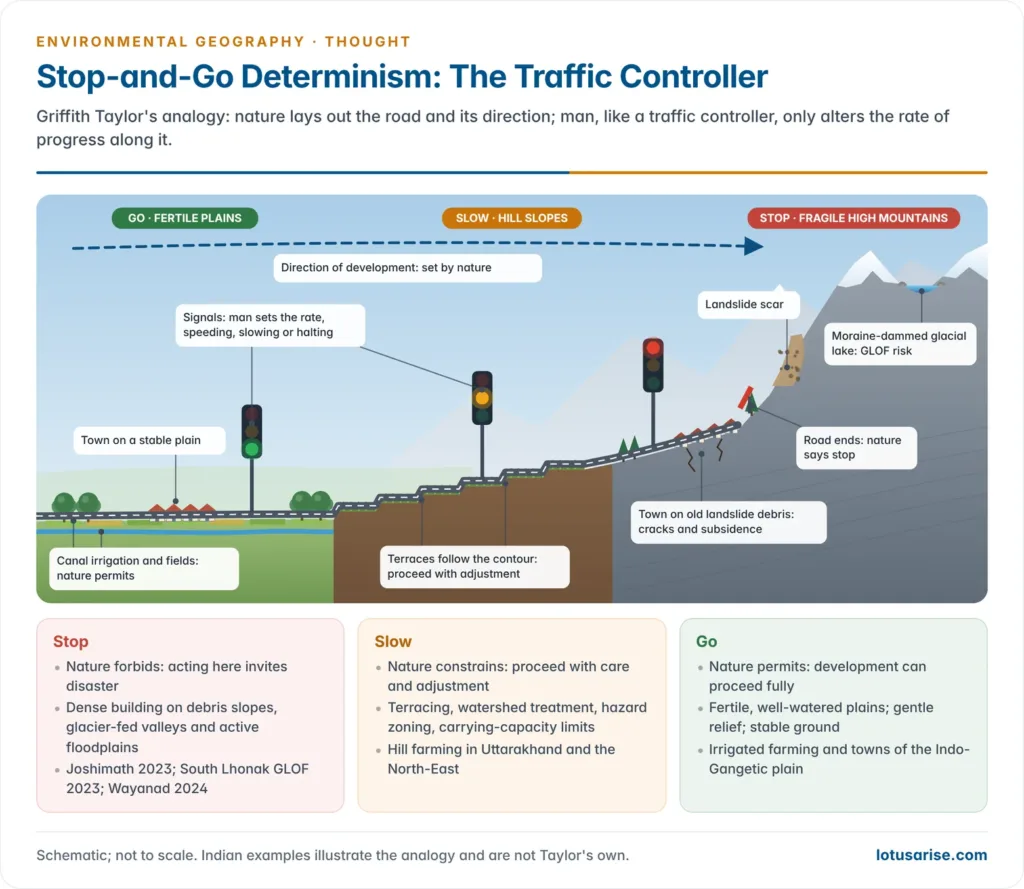
- Taylor coined the term “stop-and-go determinism”: in the short term, people may attempt whatever they wish with their environment, but in the long term nature’s plan ensures that the environment wins and forces a compromise from its human occupants.
- He summed up his position in a famous passage: “Man can accelerate, slow or stop the progress of a country’s development. But he should not, if he is wise, depart from the directions as indicated by the natural environment. He is like the traffic controller in a large city, who alters the rate but not the direction of progress.”
- Reading the analogy:
- Nature lays out the roads: the broad direction of development (where crops, cities and routes can thrive) is set by climate, relief, soil and water.
- Man controls the signals: he decides the pace of development and can speed it, slow it or halt it.
- Stop: nature prohibits certain actions; attempting them leads to disaster.
- Slow: nature imposes constraints; people can proceed, but with caution and adjustment.
- Go: nature permits development in this direction, and human activity can proceed fully.
- In short, man conquers nature by obeying it. People must respond to nature’s “red lights” and move ahead when nature permits; possibilities can be created within limits that do not damage the environment, and there is no free run without accidents.
The philosophical basis
- Taylor admits choice: within the broad limits set by the environment, man can choose, including the choice between what is wise and what is foolish.
- But wisdom and folly are human concepts; the natural environment knows nothing of them. In nature there is only the possible and the impossible.
- Possibilists themselves conceded that the opportunities offered by environments are not equal.
- Some settings demand little adjustment, others make people struggle continuously. The ratio between human effort and return can be read as the price nature demands for a choice.
- In no environment are the possibilities limitless, and for every choice a price must be paid.
- Neo-determinism refines rather than rejects possibilism. Nothing in it contradicts Febvre’s formula that there are no necessities but everywhere possibilities: man chooses, but only from the range that nature presents to him.
- In brief: the short term is possibilistic; the long term is deterministic. Neo-determinism holds both truths at once.
Probabilism: O. H. K. Spate
- Oskar Hermann Khristian Spate (1911–2000), a London-born geographer who taught at Rangoon, the London School of Economics and the Australian National University, wrote the classic regional geography India and Pakistan (1954).
- In “How Determined is Possibilism?” (Geographical Studies, 1957) he proposed probabilism to end the “interminable wrangle” between determinists and possibilists.
- The idea: the environment neither dictates nor merely permits; it makes some human responses more probable than others.
- Possibilities are not equally likely: an arid plain will most probably carry pastoralism or irrigated farming, a humid delta wet rice, a cold upland livestock and hardy crops.
- Human choice decides which probable outcome is realised, and technology and culture shift the odds over time.
- Significance: probabilism moved the debate from all-or-nothing claims to degrees of likelihood, opening the way for the statistical and behavioural studies of decision-making that followed.
Relevance of stop-and-go determinism today
- Climate change is the clearest “red light”: the IPCC’s Sixth Assessment Report (2021–23) distinguishes soft limits to adaptation, which better technology or policy can push back, from hard limits, beyond which no adaptation is possible. Some natural ecosystems, such as warm-water coral reefs, some coastal wetlands and some polar and mountain ecosystems, are at or near hard limits. This is Taylor’s argument in modern language.
- Planetary boundaries: the 2023 update found six of the nine Earth-system boundaries crossed, a global version of nature setting the limits within which development must run.
- Himalayan hazards show what happens when signals are ignored, the core of the degradation of mountain environments:
- Kedarnath (June 2013): pilgrim settlements built on glacial debris and river terraces were swept away.
- Joshimath (January 2023): a town built on old landslide debris, loaded with construction and tunnelling, began to subside.
- South Lhonak GLOF, Sikkim (October 2023): a glacial lake outburst destroyed the Teesta-III dam at Chungthang.
- Floodplains and slopes: encroachment on lakes and drainage channels made the Chennai floods of 2015 worse, and the Wayanad landslides of July 2024 struck settlements on steep, rain-soaked slopes, killing more than 200 people.
- Agriculture against the grain: the water-intensive paddy–wheat system of Punjab has pushed groundwater extraction far above recharge, the kind of “fast” development nature eventually halts.
- Green-light development follows nature’s direction: watershed management, terracing of hill slopes, flood-plain zoning, hazard and carrying-capacity mapping, climate-resilient crops and ecosystem-based adaptation. This idea of “development within limits” sits at the heart of sustainable development.
- Criticisms of neo-determinism:
- It is hard to say in advance where the red lights are; “nature’s plan” is often clear only after a disaster.
- It underestimates technology, which keeps shifting the limits (Israeli desert farming, Dutch polders).
- It is still nature-centred and pays little attention to power, poverty and inequality, the concerns later raised by radical and political-ecology approaches.
Comparison and the Current View
The philosophies at a glance
| Basis | Environmental determinism | Possibilism | Neo-determinism | Probabilism |
|---|---|---|---|---|
| Core thesis | Environment controls human action | Environment offers choices; man selects | Nature sets direction; man sets pace | Environment makes some choices more likely |
| View of humans | Passive agent | Active, free agent | Conditionally active agent | Chooser among unequal options |
| Role of environment | Cause | Store of options; mild constraint | Framework of limits and direction | Set of probabilities |
| Key thinkers | Ratzel, Semple, Huntington | Vidal, Febvre, Brunhes, Sauer | Griffith Taylor | O. H. K. Spate |
| Metaphor | “Earth made man” | “Man made the earth” | Man as traffic controller | Nature as weighted dice |
| Home | Germany → USA | France → wider world | Australia | Britain and Australia |
| Main period | Late 19th century to the 1920s | 1920s to 1950s | 1920s onward | 1950s onward |
| Main critique | Racist, ignores human agency | Underrates physical limits; no theory | Limits hard to define in advance | Probabilities hard to measure |
| Today | Neo-environmental determinism debates | Cultural and humanistic geography | Sustainability, limits to adaptation | Risk and decision analysis |
- One-line summaries:
- Determinism: the earth made man; physical factors control history, culture and development.
- Possibilism: man made the earth; nature offers a menu, and culture, technology and will make the choice.
- Neo-determinism: man obeys nature in order to conquer it; the direction is nature’s, the rate and method are man’s.
- Probabilism: nature loads the dice; man throws them.
- Cultural determinism: ideas decide the world; technology and culture are the decisive variables.
Later approaches to the man–environment relationship
- After the 1950s the debate was absorbed into wider approaches to the man–environment relationship:
- Human and cultural ecology (Barrows, Julian Steward) studied adjustment and adaptation rather than control, for example the ecological adaptations of desert, mountain and forest peoples.
- Systems and ecosystem approaches treated people and environment as one interacting system.
- Behavioural and humanistic geography stressed that people act on the environment as perceived, not the environment as it objectively is.
- Marxist and radical geography read nature through relations of production, leading to the Marxian view of the environment and to Neil Smith’s thesis of the social production of nature, which dissolves the nature–society dualism on which the whole debate rested.
- The determinism–possibilism pair therefore remains the starting point of the paradigm sequence in environmental geography.
Neo-environmental determinism and the rejuvenation of environmentalism
- Environment-based explanation has returned since the 1990s, in more careful forms:
- Jared Diamond, in Guns, Germs, and Steel (1997), explained Eurasia’s head start by its east–west axis, which let crops and animals spread across similar latitudes, and by its wealth of domesticable plants and animals, explicitly rejecting racial explanations.
- John Luke Gallup, Jeffrey Sachs and Andrew Mellinger (1999) linked poverty to tropical disease burdens, poor soils and distance from the sea.
- Studies of climate and conflict, such as Solomon Hsiang, Marshall Burke and Edward Miguel (2013), found that unusual heat and rainfall raise the risk of violence.
- The critics:
- Andrew Sluyter (2003) called this neo-environmental determinism and argued that it does not break cleanly with its colonial predecessors.
- Daron Acemoglu, Simon Johnson and James Robinson (2001, and Why Nations Fail, 2012) argued that institutions, not geography, explain why some nations grew rich; former colonies that were richest in 1500 are often poorest today, a “reversal of fortune” geography alone cannot explain. Their work won the 2024 Nobel Prize in Economics.
- Mike Hulme (2011) warned against climate reductionism: treating climate as the master variable for future societies, ignoring adaptation, politics and choice.
- The current view is a qualified, interactive one:
- The environment is neither master nor neutral stage. It sets constraints and probabilities that technology can stretch but not abolish, and human action in turn reshapes the environment, sometimes past its thresholds.
- The Anthropocene reverses the old question: humans have become a geological force, so the issue is now as much man’s control of nature as nature’s control of man.
- Environmental ethics, from shallow resource management to deep ecology, asks how far that control should go.
- The “rejuvenation of environmentalism” is therefore real but transformed: it speaks the language of limits, risk and resilience, not of racial or civilisational ranking.
Glossary
| Term | Meaning |
|---|---|
| Environmental determinism | The physical environment controls the course of human action; dominant until about the 1920s |
| Possibilism | The environment sets limits and offers possibilities; culture and human choice decide which are used |
| Stop-and-go determinism | Griffith Taylor’s middle path: man alters the rate, not the direction, of development set by nature |
| Probabilism | O. H. K. Spate’s (1957) view that the environment makes some responses more probable than others |
| Cultural determinism | Culture, ideas and technology, not nature, decide the human use of the earth |
| Anthropogeographie | Ratzel’s two-volume work (1882, 1891), the founding text of human geography |
| Lebensraum | Ratzel’s “living space” (1901): the state as an organism that must expand; later misused by Nazi Germany |
| Genre de vie | Vidal de la Blache’s “way of life”: the techniques and practices by which a group adapts to its milieu |
| Erdkunde | Carl Ritter’s multi-volume “Earth Science” (1817–59), the great anthropocentric world geography |
| Climatic determinism | Huntington’s view that climate, through human energy, decides the rise and fall of civilisations |
| Neo-environmental determinism | Sluyter’s (2003) label for modern geography-based explanations of development, such as Diamond’s |