- Colonialism, neo-colonialism and Lebensraum are three ideas about how powerful states control territory, people and resources beyond their own borders.
- Colonialism was direct political rule. Neo-colonialism is indirect economic and political control after independence. Lebensraum was a geographical doctrine of territorial expansion that was used to justify Nazi conquest.
- Together they explain much of today’s uneven economic geography: the global core–periphery structure, export-dependent economies, artificial boundaries, and the long shadow cast over political geography and geopolitics.
Colonialism

Meaning
- Colonialism is the practice or policy by which one people or power exercises control over another people or area, often by establishing colonies, and generally for economic dominance.
- It is the establishment and maintenance of rule, over an extended period, by a sovereign power over a subordinate and alien people who are separated from the ruling power.
- Colonialism and imperialism: imperialism is the wider idea and practice of building an empire and dominating others, whether by formal rule or informal influence. Colonialism is its territorial form, often with settlement or direct administration.
- Types of colonies:
- Settler colonies: large numbers of colonists settled permanently and often displaced the native population (the USA, Canada, Australia, New Zealand, Argentina, South Africa, Algeria, Kenya’s highlands).
- Exploitation colonies: a small ruling group extracted raw materials, taxes and labour for the metropole (India, most of Africa, Southeast Asia).
- Plantation colonies: estates worked by enslaved or indentured labour (the Caribbean, Brazil’s north-east, Sri Lanka, Malaysia, Fiji, Mauritius).
Mechanism and Motives
- During colonisation, colonisers imposed their religion, language, economic system and cultural practices.
- Motives: economic gain (raw materials, markets, investment outlets, land), the spread of Christianity (the “civilising mission”), strategic power (naval bases, routes) and national prestige.
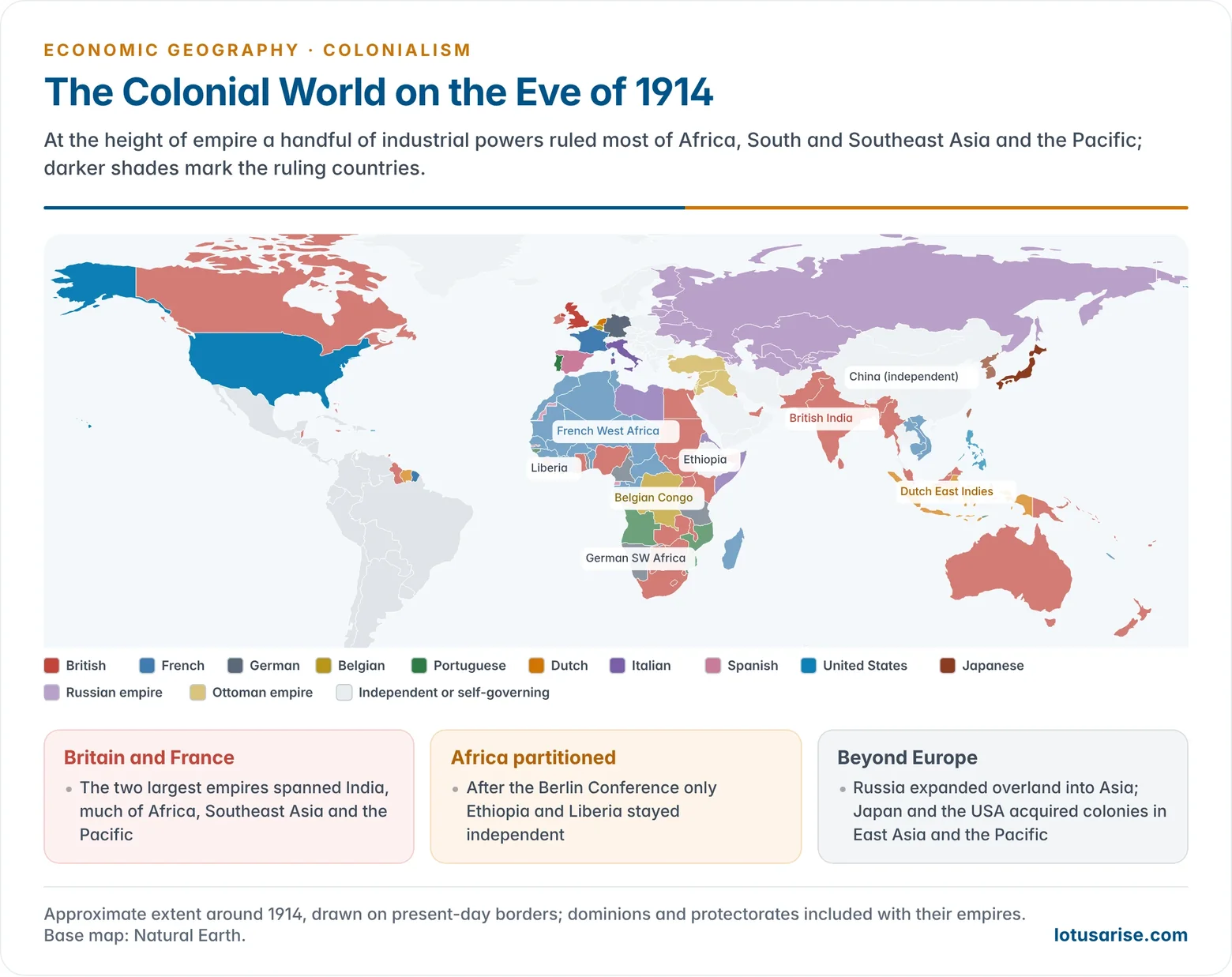
- Not only European: colonialism is most associated with Spain, Portugal, Britain, France, the Netherlands, Belgium, Germany and Italy. But Russia (Siberia and Central Asia), Japan (Taiwan, Korea, Manchuria) and the USA (the Philippines, Puerto Rico, Hawaii) also built colonial empires.
Phases of Colonialism
| Phase | Period | Main powers | Character |
|---|---|---|---|
| Mercantile colonialism | c. 1500–1800 | Spain, Portugal, the Netherlands, Britain, France | Bullion, spices, sugar, the slave trade; chartered companies such as the English East India Company (1600) and the Dutch VOC (1602) |
| Industrial imperialism | c. 1800–1914 | Britain, France, Germany, Belgium, Italy, the USA, Japan | Raw materials and markets for industry; the Scramble for Africa after the Berlin Conference (1884–85); by 1914 almost all of Africa was under European rule |
| Late colonialism | 1914–1945 | Britain and France (League of Nations mandates), Japan, Italy | Mandates in West Asia and Africa; Japanese and Italian expansion |
| Decolonisation | 1945–1975 | Former colonies | Independence of India (1947), Indonesia (1949), Ghana (1957), Algeria (1962) and the Portuguese colonies (1974–75) |
Economic Geography of Colonialism
- The most serious outcome of the colonial era was the economic exploitation of colonies by the occupying powers.
- The global economic geography built in this period favoured the industrial countries. It played havoc with the economic structures of the colonies, leaving them dependent and underdeveloped.
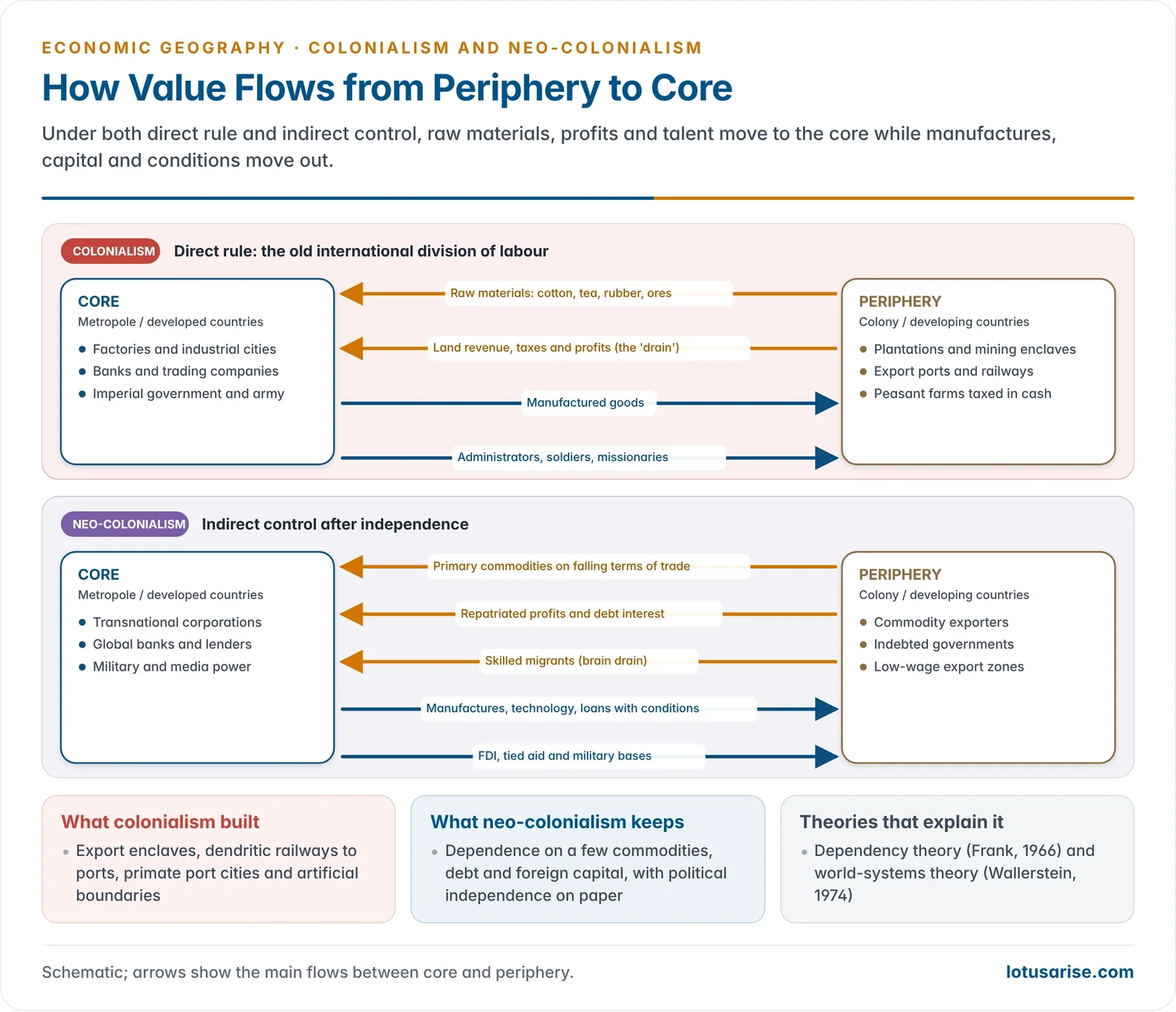
- Core–periphery division of labour: colonies supplied primary products (cotton, jute, tea, rubber, sugar, minerals) and bought manufactures. This is the old international division of labour.
- Export enclaves: plantations (tea in Assam, rubber in Malaya, sugar in the Caribbean) and mining enclaves (Katanga copper, Witwatersrand gold, Bolivian tin) were linked to the outside world but not to their own hinterlands.
- Transport and urban geography:
- Railways and roads ran from the interior to the ports in a dendritic pattern built for export, not for internal integration.
- Colonial port cities became primate cities: Mumbai, Kolkata, Chennai, Lagos, Dakar, Singapore.
- India:
- Deindustrialisation of handloom textiles came under the competition of machine-made British cloth.
- Agriculture was commercialised (indigo, cotton, jute, opium), and the land-revenue system impoverished peasants.
- Recurring famines followed, as in Bengal in 1943.
- Dadabhai Naoroji called the outflow of wealth the “drain of wealth” (Poverty and Un-British Rule in India, 1901). The economist Utsa Patnaik has estimated the drain from 1765 to 1938 at about US$45 trillion in present values, a contested but widely cited figure.
- Political geography: colonial powers drew artificial boundaries, often straight lines across Africa, which split ethnic groups and lumped rivals together. These boundaries remain a source of conflict (the Horn of Africa, the Great Lakes, Sudan).
Decolonisation
- After 1945, two forces drove rapid decolonisation:
- the rise of anti-colonial and nationalist movements in the colonies;
- the economic and political crisis of the imperial system itself, as war-weakened Britain and France could no longer afford their empires.
- The UN General Assembly’s Declaration on the Granting of Independence to Colonial Countries and Peoples (Resolution 1514, 1960) made self-determination a global norm.
- UN membership rose from 51 founding members (1945) to 193 today, most of them former colonies.
From Colonialism to Neo-colonialism
- The move from colonialism to neo-colonialism marks a shift in the methods of domination in the global economy.
- Colonialism meant formal political control of territory by direct foreign rule. Neo-colonialism is indirect, subtle and less visible control.
- Even after formal independence, many former colonies remained economically dependent on their former rulers and on other developed nations.
- The structures of global trade, investment and finance built in the colonial era were largely preserved, so economic exploitation continued.
- Neo-colonialism thus extends the colonial legacy into the post-colonial world through economic, political, cultural and military means, shaping the uneven geographies of development.
Neo-colonialism
Origin of the Concept
- The term néo-colonialisme was first used by French Marxists in the late 1950s and came into wide use in the 1960s.
- Kwame Nkrumah, the first president of Ghana, gave it its classic statement in Neo-Colonialism: The Last Stage of Imperialism (1965).
- He argued that a neo-colonial state is independent in name, while its economic system and political policy are directed from outside.
- It has been described as “the survival of the colonial system in spite of formal recognition of political independence“. Emerging countries became victims of indirect and subtle domination by political, economic, social, military and technical forces.
- Not entirely new: V. I. Lenin (Imperialism, the Highest Stage of Capitalism, 1917) had observed that finance capital is a force so decisive that it can subordinate even states that appear to be fully independent.
Meaning
- Neo-colonialism refers to economic and political control exercised by powerful developed states over the economies and societies of the underdeveloped world. These states have included the USA, the former USSR (now Russia), Japan and the members of the European Union.
- The dominated states appear politically independent, with no formal or direct rule, but their economic and political systems are effectively controlled from outside.
- It is the economic and political dependency that remains in former colonies after independence.
- The trade relationships of the colonial era were largely retained, and the inequalities of socio-economic development continue to burden the new states.
Mechanisms of Neo-colonial Control
| Channel | How control works | Examples |
|---|---|---|
| Trade | Dependence on a few primary commodities whose prices fluctuate and whose terms of trade tend to decline (the Prebisch–Singer thesis, 1950) | About two-thirds of developing countries (95 of 143) were commodity-dependent in 2021–23 |
| Debt and finance | Loans tied to conditions: structural adjustment programmes, cuts in public spending, privatisation | The Latin American and African debt crises of the 1980s |
| Investment and TNCs | Transnational corporations control extraction, plantations and value chains; profits flow to the core | Oil in the Niger delta, mining in the Congo, fruit plantations in Central America |
| Aid | Tied aid and aid conditional on political alignment | Cold War aid blocs |
| Monetary | Currency arrangements linked to a former ruler | The CFA franc zone of West and Central Africa, pegged to the French franc and later the euro |
| Military | Foreign military bases, arms dependence and interventions | Bases across Africa, West Asia and the Indian Ocean |
| Cultural and digital | Media, language, consumer culture and control of data and platforms | “Digital colonialism” debates over data flows and platform power |
| Land and resources | Large foreign land acquisitions and resource-for-infrastructure deals | Land deals in Africa after 2008; debate over Chinese-financed ports such as Hambantota (Sri Lanka, leased for 99 years in 2017) |
Disadvantages
- Economic exploitation: neo-colonialism perpetuates the economic imbalance between rich and poor countries and deepens the economic dependence of developing countries on developed states.
- Distorted development: export enclaves, weak manufacturing, capital flight and the resource curse.
- Military tensions: foreign military bases and proxy conflicts raise instability in many regions.
- Loss of policy autonomy: debt conditions and investor pressure limit what elected governments can do.
Theories Linked to Neo-colonialism
- Dependency theory: Andre Gunder Frank (1966) wrote of “the development of underdevelopment“. The periphery is underdeveloped because of its links to the core, not despite them.
- World-systems theory: Immanuel Wallerstein (1974) divided the capitalist world economy into a core, semi-periphery and periphery, held together by unequal exchange.
- Both theories became central to radical geography and to its explanation of the problems of world economic development as a product of history and power, not of nature.
- Critique: the term can be used too loosely. Some former colonies, such as South Korea, Taiwan, Singapore and Malaysia, industrialised rapidly by using trade and foreign investment. Local governance, institutions and policy choices matter as much as external control.
Lebensraum
Ratzel’s Concept
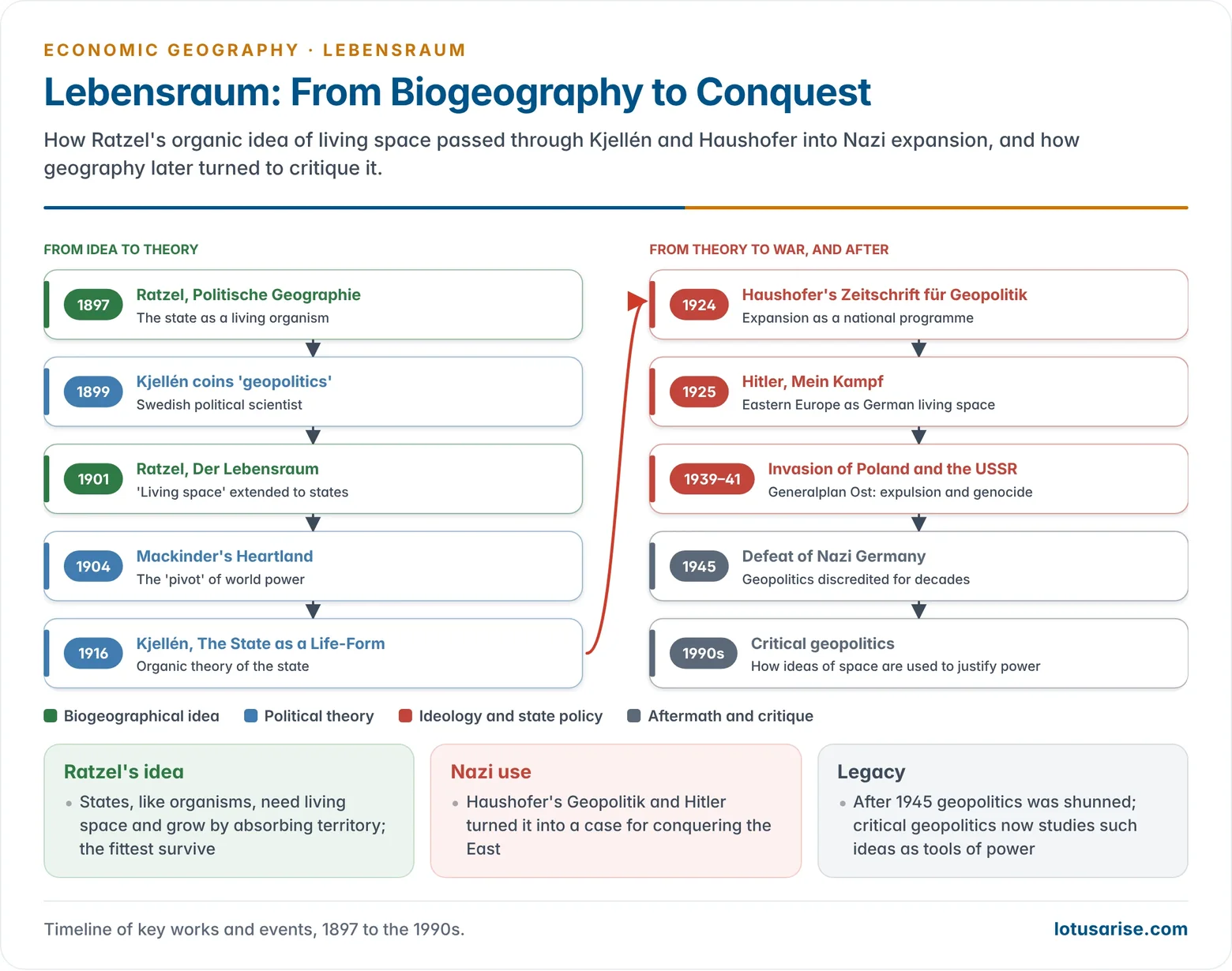
- Lebensraum means “living space“. The word was already in use, notably by Oscar Peschel. The German geographer Friedrich Ratzel (1844–1904) gave it its fullest formulation in his essay Der Lebensraum (1901), building on his Politische Geographie (1897).
- In biogeography it meant the geographical area within which living organisms develop.
- Ratzel applied it to states through the organic theory of the state.
- A state is like a living organism. Its territorial expansion resembles a growing organism’s search for space in order to survive.
- Conflict between nations is a contest for territory, in which expansion is essential and the fittest survive. This is the influence of Darwinism and Social Darwinism.
- His “laws of the spatial growth of states” held that states grow by absorbing smaller units and that boundaries are the state’s peripheral organ, shifting with its strength.
From Ratzel to Geopolitik
- The Swedish political scientist Rudolf Kjellén coined the term geopolitics (Geopolitik, 1899) and developed the state-as-organism idea.
- In the 1920s and 1930s the German Geopolitik school, led by Karl Haushofer and his journal Zeitschrift für Geopolitik (founded 1924), turned Lebensraum into a programme of territorial expansion.
- Adolf Hitler took up the idea in Mein Kampf (1925). New territory had to be acquired for settlement, enlarging the “mother country” and its material resources and national power.
- Eastern Europe was to be conquered to create a vast German empire, with more space for a larger population and new land for food and raw materials.
- This led to the invasion of Poland (1939) and the USSR (1941), and to the genocidal Generalplan Ost.
Critique and Legacy
- Lebensraum reflected an early attempt to interpret human territorial behaviour biologically. It was environmentally determinist and Social Darwinist.
- Its use to justify aggression, racial ideology and genocide discredited geopolitics in the academic world for decades after 1945.
- Critical geopolitics in the 1990s revived the subject, but as the study of how geographical ideas are used to justify power, with Lebensraum as its chief cautionary example.
- Echoes of “living space” thinking appear whenever states justify territorial expansion by resource needs, population pressure or historical destiny. Rival claims over resource frontiers such as the Arctic and the South China Sea are debated in this light.
- Lebensraum grew out of the German school of geographical thought. Haushofer also drew on Halford Mackinder’s Heartland theory (1904), seeing control of Eurasia’s interior as the key to world power.
Comparison
| Aspect | Colonialism | Neo-colonialism | Lebensraum |
|---|---|---|---|
| Nature | Direct political rule over territory | Indirect economic and political control | Doctrine of territorial expansion |
| Period | c. 1500–1975 | 1950s to the present | Ratzel’s essay 1901; state policy 1933–1945 |
| Main agents | European empires, Russia, Japan, the USA | Developed states, TNCs, financial institutions | German state under the Nazis; the Geopolitik school |
| Means | Conquest, settlement, administration | Trade, debt, investment, aid, military bases | War, annexation, settlement, expulsion |
| Justification | Economic gain, “civilising mission” | Market forces, development assistance | Organic state, population pressure, racial ideology |
| Geographical legacy | Core–periphery division of labour, export enclaves, artificial boundaries | Commodity dependence, uneven development | Discrediting of geopolitics; redrawn borders of Central and Eastern Europe |
Previous Year Questions
- No direct PYQ has been asked on this sub-topic yet.