- The New International Division of Labour (NIDL) is the spatial reorganisation of global production that began in the late 1960s and 1970s.
- Labour-intensive manufacturing shifted from the industrialised North to selected developing countries.
- Control, design and research and development stayed in the North.
- The concept was set out by Folker Fröbel, Jürgen Heinrichs and Otto Kreye in The New International Division of Labour (German edition 1977, English 1980). They studied West German textile and electronics firms moving production to Asia and North Africa.
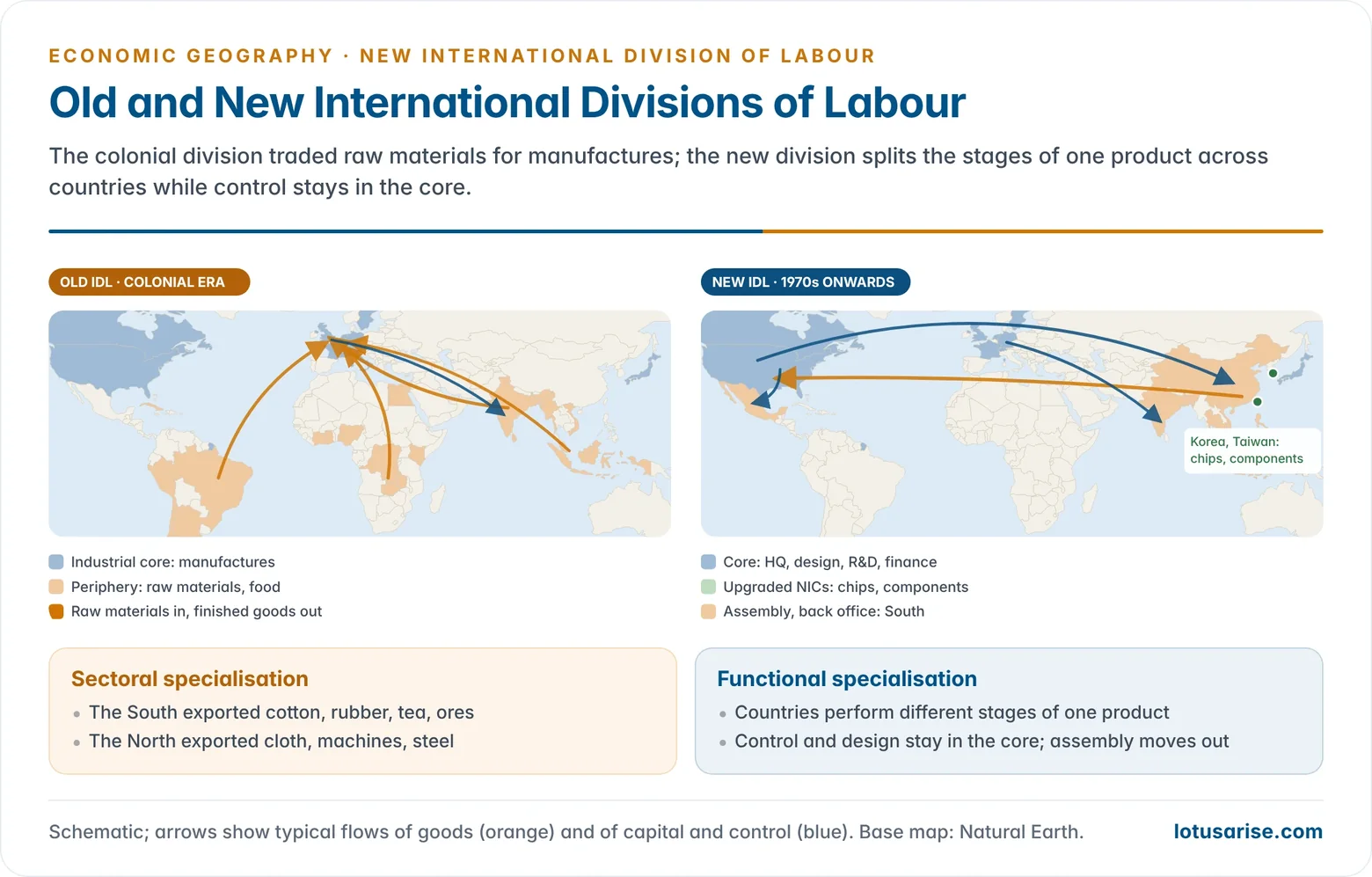
- The NIDL marked a shift from sectoral specialisation to functional specialisation.
- Under sectoral specialisation, countries made different goods: the North made manufactures and the South supplied raw materials.
- Under functional specialisation, countries perform different stages of the same product.
The Historical Context: the Old International Division of Labour

- The division of labour of the 19th and early 20th centuries was rooted in colonialism and imperialism. It was asymmetrical and hierarchical.
- The industrialised North (Britain, Germany, the USA) dominated manufacturing, processing and value addition.
- The Global South (Africa, Asia, Latin America) was confined to exporting raw materials: cotton, sugar, rubber, tea, oil, timber and minerals.
- Colonies exported raw materials and imported finished goods from the metropole.
- Example: Indian raw cotton went to Lancashire, and Manchester cloth came back to Indian markets. Wealth accumulated in the North while underdevelopment persisted in the South.
- The result was a core–periphery world economy:
- technology, industrial jobs and capital-intensive production were concentrated in the North;
- extractive and labour-intensive roles were imposed on the South.
- The dependency school (Andre Gunder Frank, Samir Amin) and Immanuel Wallerstein’s world-systems theory analysed this structure.
- This old international division of labour (OIDL) is the background against which the NIDL appeared after decolonisation.
Emergence of the NIDL
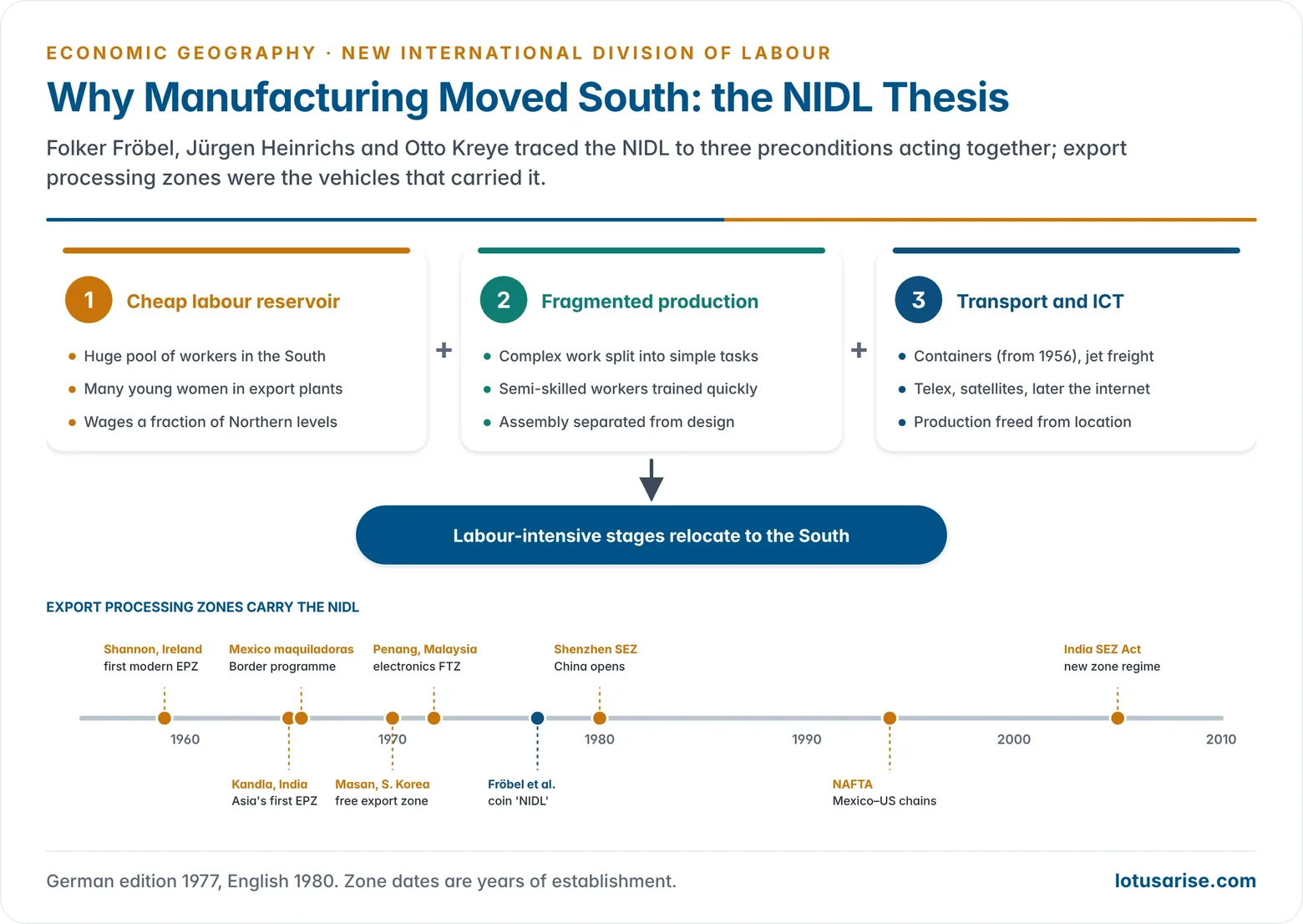
The Three Preconditions (Fröbel, Heinrichs and Kreye)
- A worldwide reservoir of cheap labour in developing countries. Workers, many of them young women, were available at a fraction of Northern wages.
- Fragmentation of the production process, so that complex manufacture could be split into simple tasks. Semi-skilled or unskilled workers could learn these quickly.
- Transport and communication technologies that made production largely independent of location: container shipping, jet freight, telex and later the internet.
Driving Forces
- Multinational and transnational corporations (MNCs/TNCs):
- Faced with rising wages, strong unions and falling profits in the North in the 1970s, firms relocated production to lower-cost countries.
- China, India, Bangladesh, Mexico and Vietnam became key hubs for textiles, electronics and consumer goods.
- Technological change in transport and communication:
- Containerisation, air logistics and telecommunications cut the friction of distance.
- Each production stage could be placed where it was cheapest, which made global supply chains more intricate and dispersed.
- State policy in host countries:
- Export processing zones (EPZs) offered tax holidays, duty-free imports, cheap land and relaxed labour rules.
- The first was Shannon (Ireland, 1959). Kandla (India, 1965) was Asia’s first. Others followed: Mexico’s maquiladoras (Border Industrialisation Programme, 1965), Masan (South Korea, 1970), the Penang free-trade zone (1972) and Shenzhen SEZ (1980).
- Neoliberal policy and institutions:
- From the 1980s, free trade, privatisation and deregulation spread.
- The IMF, the World Bank (through structural adjustment) and later the WTO (1995) encouraged developing economies to open markets.
- This favoured relocation to countries with low wages, weak labour protection and lenient environmental rules.
Characteristics and Examples
Key Characteristics
- Global spatial division of labour: production is no longer confined within national economies. It is distributed globally on cost and efficiency.
- Functional specialisation:
- routine assembly and data entry go to low-wage economies;
- design, branding, finance and research and development remain in the North.
- Rise of newly industrialising countries (NICs):
- first the Four Tigers;
- then China, Malaysia, Thailand, Mexico and Brazil;
- later Vietnam, Bangladesh and the Philippines (back-office services);
- and India (software and IT-enabled services).
- TNCs orchestrate global value chains (GVCs): they outsource or offshore stages to many countries in a global assembly line, coordinated just in time.
- Gendered labour: export factories relied heavily on low-paid young women, seen as a “nimble-fingered” and compliant workforce. This raised concerns about labour rights, wage gaps and exploitation.
| Feature | Old IDL (colonial era) | New IDL (1970s onwards) |
|---|---|---|
| Specialisation | Sectoral: manufactures vs raw materials | Functional: stages of the same product |
| Role of the South | Raw materials, food, market for manufactures | Assembly, components, low-end services |
| Key actor | Colonial state, trading companies | Transnational corporations |
| Technology | Railways, steamships | Containers, air freight, ICT |
| Institutions | Imperial preference | EPZs, IMF/World Bank, WTO |
| Typical flow | Cotton from India → cloth from Lancashire | Chips from Taiwan → phones assembled in China/India → world markets |
Examples of the NIDL in Action
- China: the “world’s factory“. It assembles electronics, garments and machinery for global brands, and is now upgrading into design, EVs and batteries.
- India: a leader in IT services and business process outsourcing, with growing roles in pharmaceuticals, auto parts and, since 2020, phone assembly under PLI.
- Vietnam and Bangladesh: major textile and apparel hubs built on low labour costs and export orientation. Vietnam is also an electronics hub (Samsung).
- India’s zones: from Kandla (1965) and SEEPZ Mumbai (1973) to the SEZ Act, 2005. These zones carried India into the NIDL, first in gems and jewellery, garments and electronics, then in software exports from Bengaluru, Hyderabad and Pune.
- Services offshoring: the NIDL extended to services in the 1990s. Call centres, software and finance and accounting work moved to India and the Philippines once fibre-optic links made distance irrelevant.
- Mexico and Central America: close to the US under NAFTA (1994) and its successor USMCA (2020). They specialise in auto parts, electronics and food processing.
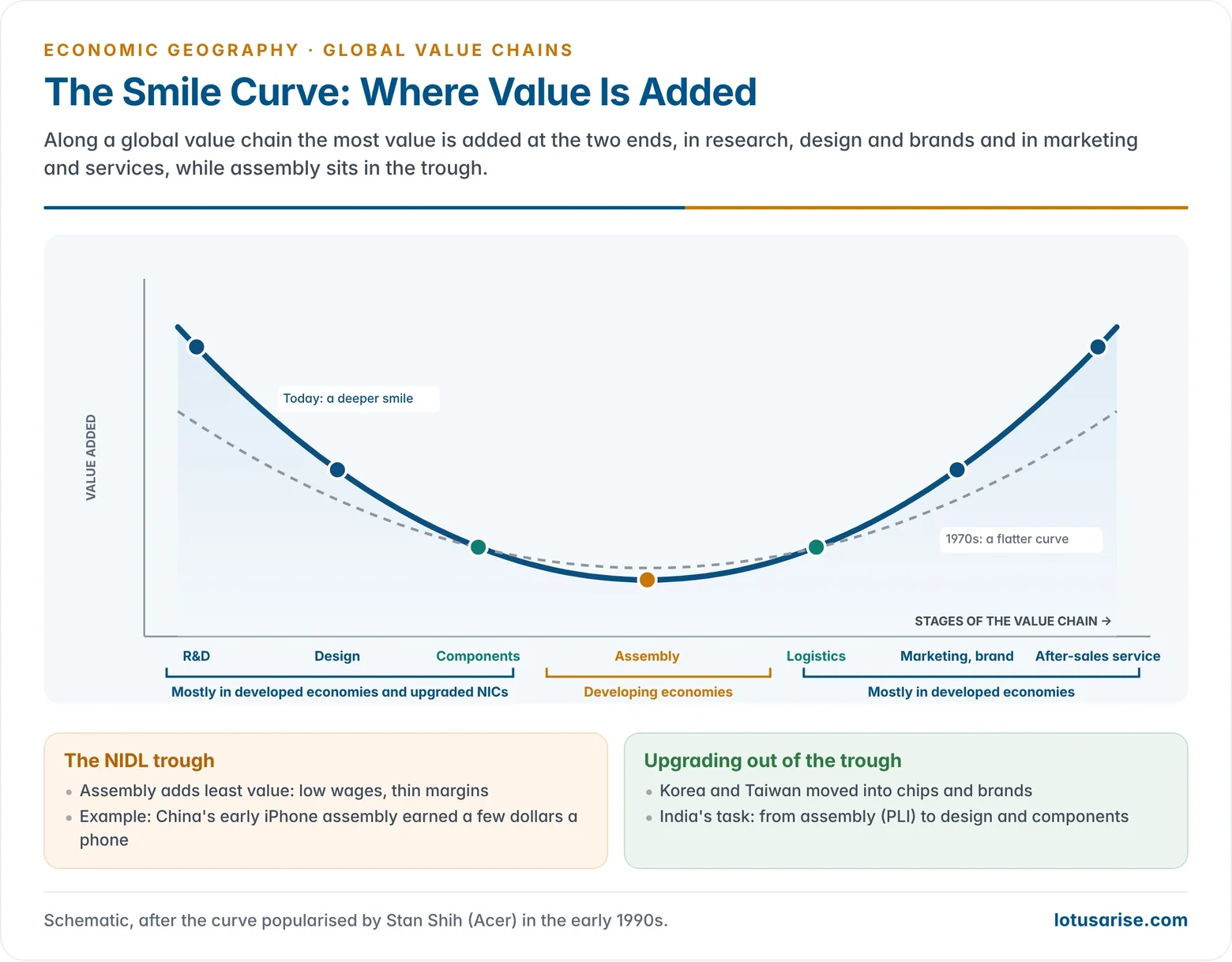
- The smile curve: in a typical value chain, the highest value is added at the two ends: research, design and branding at one end, marketing and after-sales service at the other.
- Assembly, in the middle, earns the least. The NIDL placed the developing world in this trough.
- The idea was popularised by Stan Shih of Acer in the early 1990s.
Impacts, Critiques and Present Relevance
Impacts and Debates
- Integration versus dependency:
- Supporters argue that the NIDL integrated developing countries into the world economy. It brought jobs, exports, foreign exchange and technology, and the East Asian economies used it as a ladder.
- Critics argue it perpetuates dependency. Many countries still rely on primary exports, show limited diversification, and depend on TNCs for capital, technology and markets.
- Continuity or transformation?
- Some scholars see the NIDL as a continuation of historical exploitation and uneven development.
- Others see a genuine functional shift, from sectoral to functional specialisation.
- Economic vulnerability: export-led industrialisation is exposed to swings in global demand, automation and trade policy.
- The 2008 financial crisis, the COVID-19 supply shocks (2020–22) and the tariff wars of 2018–25 exposed fragile, over-stretched supply chains.
- Academic critique of the theory:
- It over-stressed cheap labour and ignored host domestic markets, skills and productivity.
- It under-played the state: the East Asian developmental states directed industrialisation, rather than simply receiving it.
- It treated the South as a passive object. Most FDI still flowed between developed countries.
- It was soon overtaken by global commodity chain and global production network analysis (Gary Gereffi, 1994; Peter Dicken; Jeffrey Henderson and colleagues, 2002). That work explains governance, upgrading and the roles of different places more finely.
Critiques of the NIDL
- Continued dependence on developed economies for technology, capital, design and marketing. This is a neo-colonial structure.
- Limited industrial upgrading: most participants are stuck in low-value stages such as assembly or data entry. They rarely move into research, innovation or brand ownership.
- Exploitative labour practices:
- Sweatshops, precarious work, wage suppression and weak rights, which especially affect women.
- The Rana Plaza collapse (Dhaka, 2013), which killed more than 1,100 garment workers, is the starkest example.
- Countries are drawn into a “race to the bottom” on wages and standards.
- Environmental degradation:
- Relocation to countries with lax rules brings pollution and resource depletion. This is the pollution-haven hypothesis.
- The environmental costs fall on host countries while profits accrue to TNCs.
- Vulnerability to global shocks: financial crises, pandemics and supply-chain disruption hit export enclaves first.
- Uneven development and spatial inequality:
- Benefits concentrate in urban-industrial clusters and coastal zones, leaving rural interiors marginalised.
- Within cities, it widens class divides and informal labour.
The NIDL Today
- The NIDL has evolved into a world of global value chains: close to half of world trade passes through them (World Bank, World Development Report 2020). The latest phase is reshaped by automation, reshoring, “China plus one” and geopolitics, as traced in the global shift in manufacturing.
- Lessons: China, the Four Tigers and India show that participation can be a ladder, but only with deliberate upgrading. Many others remain trapped in low-wage stages. For the NIDL to support sustainable and equitable development, countries need to:
- diversify and upgrade within global value chains;
- enforce labour and environmental standards;
- invest in education, technology and innovation;
- strengthen regional integration and domestic demand to reduce vulnerability.
- The NIDL is best read critically: not only as a spatial shift of production, but as a structural transformation with consequences for development planning, industrial policy and global economic governance.
Previous Year Questions
2019“A large-scale global shift in manufacturing is the outcome of deindustrialization in the developed world matched by industrialization in the developing world.” Analyse this statement.1996Write short note: Globalization of trade and industry.