- The man–environment relationship is the two-way bond between human societies and the physical, biological and social surroundings in which they live: how the environment shapes people, and how people perceive, use and transform it.
- Its study stands at the heart of Geography as a discipline. Other sciences take the parts in isolation, while geography integrates the abiotic (land, air, water, energy), biotic (flora, fauna, micro-organisms) and cultural (mentifacts, sociofacts, artefacts) components of the Earth’s surface in one frame.
- The central question has stayed the same for two thousand years: are human beings active agents who shape their world, or passive subjects shaped by it?
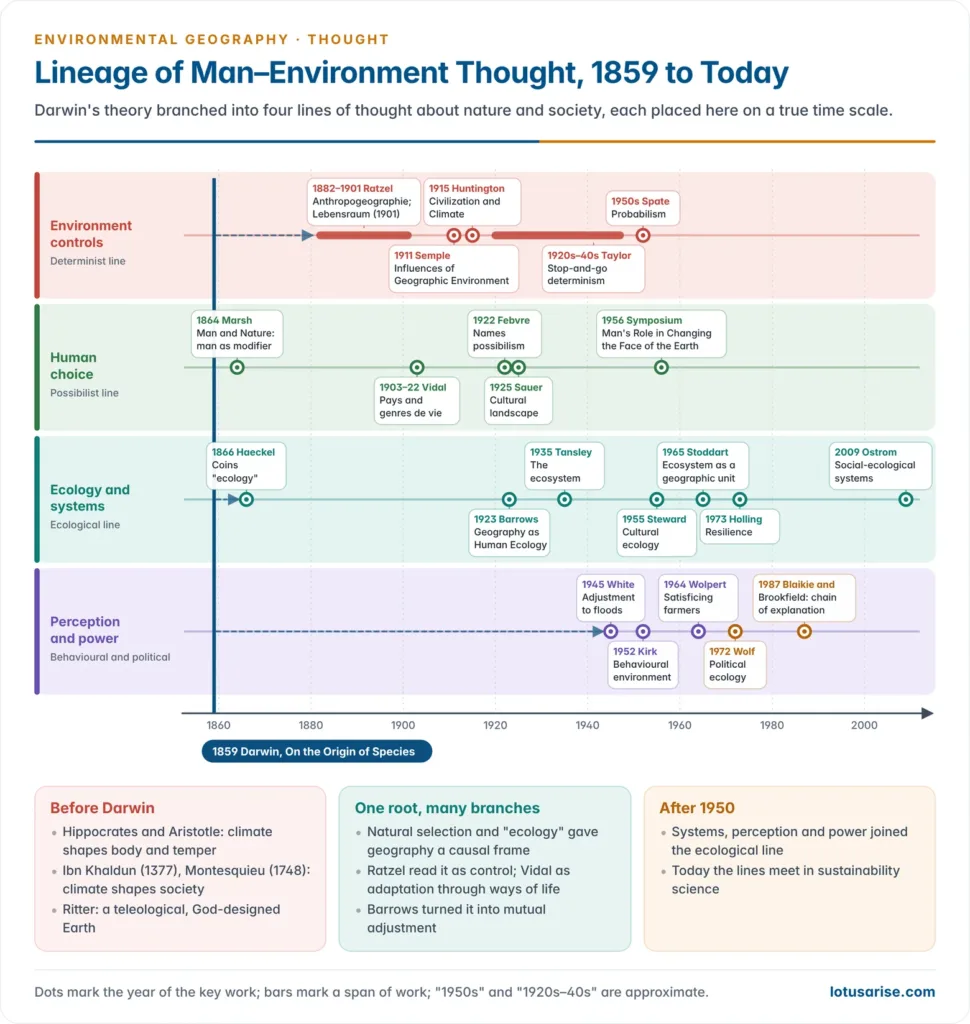
- The answers form a long sequence of ideas: classical climatic theories → Darwin’s influence → Ratzel and Semple → Vidal’s possibilism → Barrows’ human ecology → Steward’s cultural ecology → the systems and ecosystem approach → the behavioural and perception approach → political ecology. Today they meet in sustainability science.
Foundations: Geography as the Science of Relationships

Why geography is placed at the human–nature interface
- Geography studies the spatial attributes of all phenomena in a time–space continuum.
- It is an integrating science that bridges the social and natural sciences.
- It studies the biosphere, the air–land–water interface, in totality.
- It identifies, maps and explains environmental regions.
- A geographer works with landforms, climate, soils and vegetation together, a combination few other disciplines offer. Environmental geography is the branch that turns this integration on the bond between society and nature.
- Same setting, different cultures: the Khasis and the Nepali settlers of Meghalaya live under almost identical physical conditions yet keep very different farming, housing and social practices.
- This is a direct challenge to any simple environmental control of culture and a clear case of cultural agency.
Three enduring ideas about nature and society
- The historian of geography Clarence Glacken (1967) traced Western thought on the subject to three recurring ideas, which still organise the debate:
- A designed earth (teleology): the Earth was made as a fit home for humanity, so nature exists for human use.
- Environmental influence: climate, relief and soil mould human bodies, character and institutions.
- Man as a geographic agent: humans modify and transform nature, often unintentionally.
- The third idea gained its classic statement in George Perkins Marsh’s Man and Nature (1864), which documented deforestation, soil loss and the drying of land around the Mediterranean as human-made damage.
- It returned on a global scale with the Princeton symposium Man’s Role in Changing the Face of the Earth (1956), in which Carl Sauer took a leading part.
Classical, medieval and early modern ideas
- The search for links between physical conditions and human traits began with Greek, Roman, Indian, Chinese and Arab scholars.
- Greek and Roman writers:
- Hippocrates, in Airs, Waters, Places, linked bodily constitution and temperament to climate, water and site.
- Aristotle explained the contrast between the “spirited” peoples of cold Europe and the “intelligent but spiritless” peoples of hot Asia by climate, with the Greeks in a balanced middle.
- Strabo credited the bravery of northern Europeans to their cold climate. Ideas like these run through Greek geography.
- Arab geographers:
- Al-Masudi, Ibn Hawqal and Al-Idrisi divided the known world into seven climes (iqlim) and attached human characteristics to each.
- Ibn Khaldun’s Muqaddimah (1377) related skin colour, temperament and the rise and fall of dynasties to climate and to the contrast between nomadic and settled life. Their framework was broadly deterministic, a strand of Arab geographical thought.
- Early modern thinkers:
- Montesquieu’s The Spirit of the Laws (1748), an Enlightenment work and not a medieval one, gave climatic determinism a political form: cold climates bred vigour and liberty, hot climates languor and despotism.
- Immanuel Kant, in his lectures on physical geography in the late eighteenth century, repeated similar judgements about the inhabitants of the torrid zone. They are an early and now discredited expression of environmental influence on character.
- Alexander von Humboldt and Carl Ritter systematised these observations in the early nineteenth century.
- Humboldt studied nature as an interconnected whole, linking vegetation, climate and altitude.
- Ritter saw the Earth as a divinely planned home for humanity, a teleological view in which each continent had a God-given role. Both laid the groundwork for modern human geography.
From Darwin to the Classical Paradigms
Darwin’s contribution and its impact on geography
- The scientific study of the relationship took a decisive turn with Charles Darwin’s On the Origin of Species (1859).
- Evolution by natural selection gave geography an empirical, causal framework for studying how organisms, and by analogy human groups, adapt to different environments.
- It displaced the older teleological view that all nature exists for human use with a naturalistic one.
- Darwin’s three core propositions, as geography read them:
- Variation: organisms vary and the variations are heritable; different environments favour different traits.
- Over-production: organisms produce more offspring than can survive, so they compete for limited resources.
- Natural selection: the variants best fitted to their environment survive and reproduce; the others are eliminated.
- Two offshoots carried Darwin into human geography:
- Ernst Haeckel coined “ecology” (Oekologie, 1866) for the study of organisms in relation to their surroundings.
- Herbert Spencer’s phrase “survival of the fittest” (1864) became the slogan of Social Darwinism, which applied natural selection to nations and races.
The Ratzel–Semple connection
- Friedrich Ratzel (1844–1904), trained in zoology, applied evolutionary thinking to society in Anthropogeographie (volume 1, 1882; volume 2, 1891).
- He argued that the physical environment shapes the culture, history and mode of life of peoples, and is regarded as the founder of modern human geography.
- His second volume gave more weight to migration and cultural diffusion and was less deterministic than the first.
- Politische Geographie (1897) treated the state as a living organism** that grows by absorbing territory, the basis of Ratzel’s organic state theory.
- Lebensraum (1901): Ratzel’s essay argued that nations, like organisms, need living space to grow.
- The German Geopolitik school of the 1920s–30s appropriated the idea, and the Nazi regime used it to justify territorial expansion. It is a cautionary case of geographical theory turned to ideological ends.
- Modern geographers reject these uses while recognising Ratzel’s descriptive contribution.
- Ellen Churchill Semple (1863–1932), his American disciple, became the most forceful advocate of the school in** Influences of Geographic Environment (1911).
- She opened with the claim that “man is a product of the earth’s surface“: the Earth has mothered, fed and set tasks for him.
- In her account, mountains bred hardy, freedom-loving peoples, plains bred settled and organised societies, and coasts and islands bred traders and explorers.
Determinism, possibilism and the middle paths
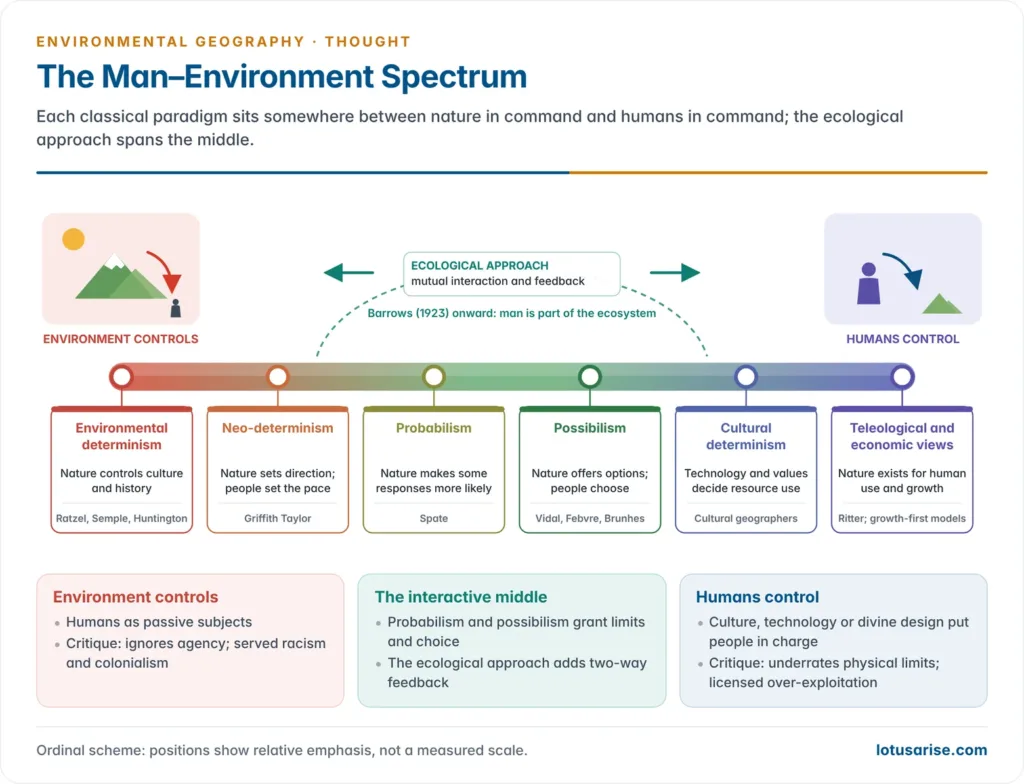
- Environmental determinism holds that human activities, history, culture and development are principally controlled by the physical environment: climate, terrain, soils and resources. Humans are passive subjects.
- Ratzel added Social Darwinism to the classical tradition, and Semple popularised it.
- Ellsworth Huntington’s Civilization and Climate (1915) tied the rise of civilisations to “climatic energy”, claiming that stimulating, variable temperate climates produced the most advanced peoples. It is now rejected as Eurocentric and scientifically unsound.
- Its flaws: it ignores human agency, technology and innovation; it cannot explain why similar environments carry very different cultures; it confuses correlation with causation; and it was used to justify colonialism, racism and Lebensraum.
- Its legacy: it gave early systematic explanations of cultural variation, highlighted genuine physical constraints, and stimulated fieldwork. A soft form survives in works such as Jared Diamond’s Guns, Germs, and Steel (1997), itself criticised as geographic reductionism.
- Possibilism holds that the environment sets the stage but does not write the script: nature offers a range of possibilities, and people choose among them through culture, technology and history.
- Its geographic form came from the French school of Paul Vidal de la Blache (1845–1918), who rejected Ratzel’s material determinism.
- He built it on pays, small regions shaped by long human–nature interaction, and genres de vie, ways of life formed by a community’s adaptive history in its locality.
- Jean Brunhes spread it through La Géographie Humaine (1910).
- Lucien Febvre named it in** La Terre et l’évolution humaine (1922): “There are no necessities, but everywhere possibilities; and man, as master of these possibilities, is the judge of their use.”
- Its flaws: it can underestimate physical limits in extreme environments, and it says little about which possibilities exist or why one is chosen over another.
- Indian illustrations of possibilism:
- The Thar Desert supports camel pastoralism, canal irrigation under the Indira Gandhi Canal, and large solar parks, depending on technology and choice.
- The Western Ghats carry tea and coffee plantations, shifting cultivation and hill stations in the same physical space.
- In the Kashmir region, Gujjar and Bakarwal transhumant herders share the landscape with settled Kashmiri cultivators, each with its own genre de vie.
- Neo-determinism, or “stop-and-go determinism“, of Thomas Griffith Taylor holds that humans can speed up, slow down or stop the pace of development, but not change the direction set by nature, like a traffic controller at a junction.
- Probabilism, proposed by Oskar H. K. Spate in the 1950s, holds that the environment does not determine responses but makes some more probable than others: a statistical, not categorical, view.
- Land-use intensity on the Sutlej–Ganga plain tends to fall with distance from market centres, with exceptions.
- Population density generally declines away from metropolitan centres unless history or economics reverse it.
- Crop yields typically decline beyond walking distance of a village, unless irrigation or roads override the pattern.
- Critique: knowledge of the environment is never complete, resource data vary in reliability across regions, and perceptions of “resources” differ between people and cultures, so a universal probability model is hard to build.
- Cultural (social) determinism argues that values, knowledge and technology, not the physical environment, decide how nature is used. The environment is treated as essentially neutral.
- A mountain pass has different value for people on foot, on horseback, in a lorry and in an aircraft.
- Coal had no economic value before steam technology.
- Amazonia is “resource-poor” for temperate commercial farming but rich for its indigenous peoples’ subsistence.
- Critique: like possibilism, it gives too little weight to physical constraint in polar, desert and high-altitude environments.
- The teleological and economic-determinist views share a different premise: humans are masters of nature.
- The teleological view, rooted in the Judaeo-Christian idea of dominion and in Ritter, treats creation as made for human use.
- Economic determinism treats growth and industrial expansion as paramount and environmental quality as secondary. It drove the resource exploitation behind the ecological crises of the industrial world.
| Paradigm | Core thesis | Key thinkers | View of humans | Main critique |
|---|---|---|---|---|
| Environmental determinism | Environment controls culture and history | Ratzel, Semple, Huntington | Passive subjects | Ignores agency; served racism and colonialism |
| Teleological | Nature designed for human use | Judaeo-Christian tradition; Ritter | Masters of nature | Licensed reckless exploitation |
| Possibilism | Environment offers options; people choose | Vidal, Febvre, Brunhes | Active agents | Vague on limits and on choice |
| Neo-determinism | Nature sets direction; people set pace | Griffith Taylor | Traffic controllers | Hard to define the “direction” |
| Probabilism | Some responses more probable than others | Spate | Semi-constrained agents | Hard to operationalise |
| Cultural determinism | Technology and values decide resource use | Post-war cultural geographers | Culturally conditioned agents | Undervalues physical limits |
| Ecological | Mutual, two-way interaction with feedback | Barrows; modern ecology | Part of the ecosystem | Widely accepted; basis of sustainability |
Approaches to Man–Environment Study
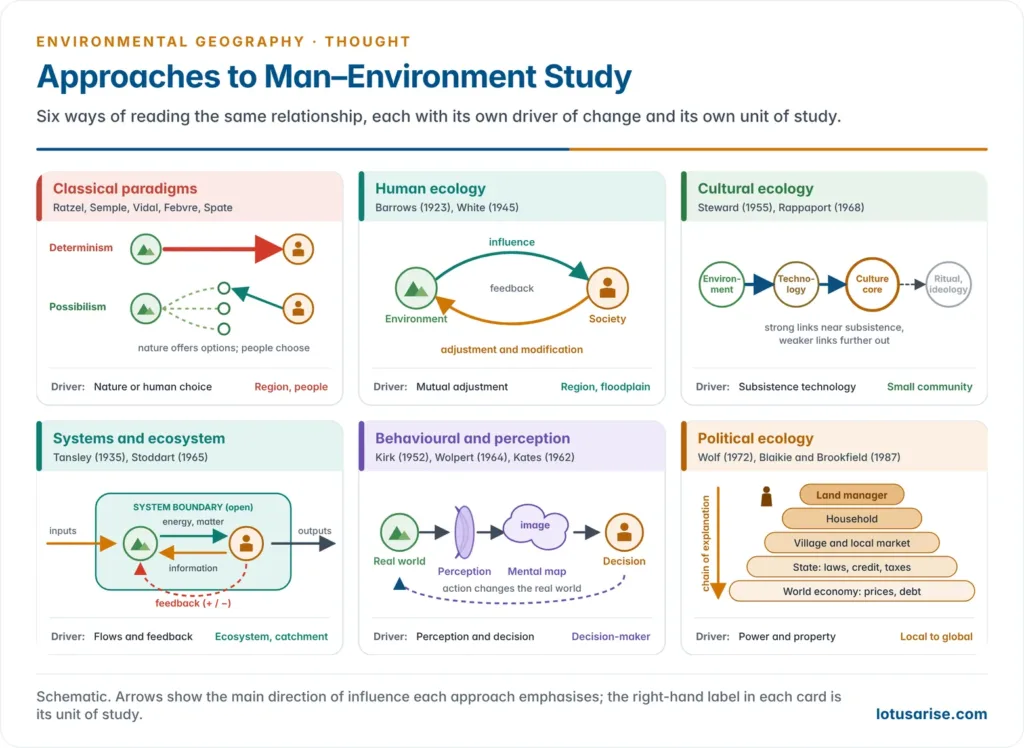
- Beyond the grand paradigms, geographers have used specific methodological approaches to study the relationship. They are not mutually exclusive: modern environmental geography usually combines several.
- They differ in what they treat as the driver (nature, culture, the mind or power) and in their unit of study (region, community, ecosystem, decision-maker or political economy).
The ecological approach and human ecology
- Harlan H. Barrows, in his presidential address to the Association of American Geographers, published as “Geography as Human Ecology” (1923), defined geography as the study of the mutual relations between people and their natural environment.
- He urged the study of man’s adjustment to environment rather than environmental influence on man, because “adjustment” puts the initiative with people.
- The address helped displace determinism from American geography.
- His student Gilbert F. White carried the idea into hazard research with** Human Adjustment to Floods (1945), showing that flood losses rose despite embankments because people kept occupying floodplains.
- Human ecology in the social sciences grew in parallel.
- The Chicago school of sociology of Robert E. Park and Ernest W. Burgess (1921, 1925) borrowed competition, invasion, succession and dominance from plant ecology to explain city growth. The concentric-zone model was its product.
- Amos Hawley’s Human Ecology (1950) treated the community as a population’s collective adaptation to its environment.
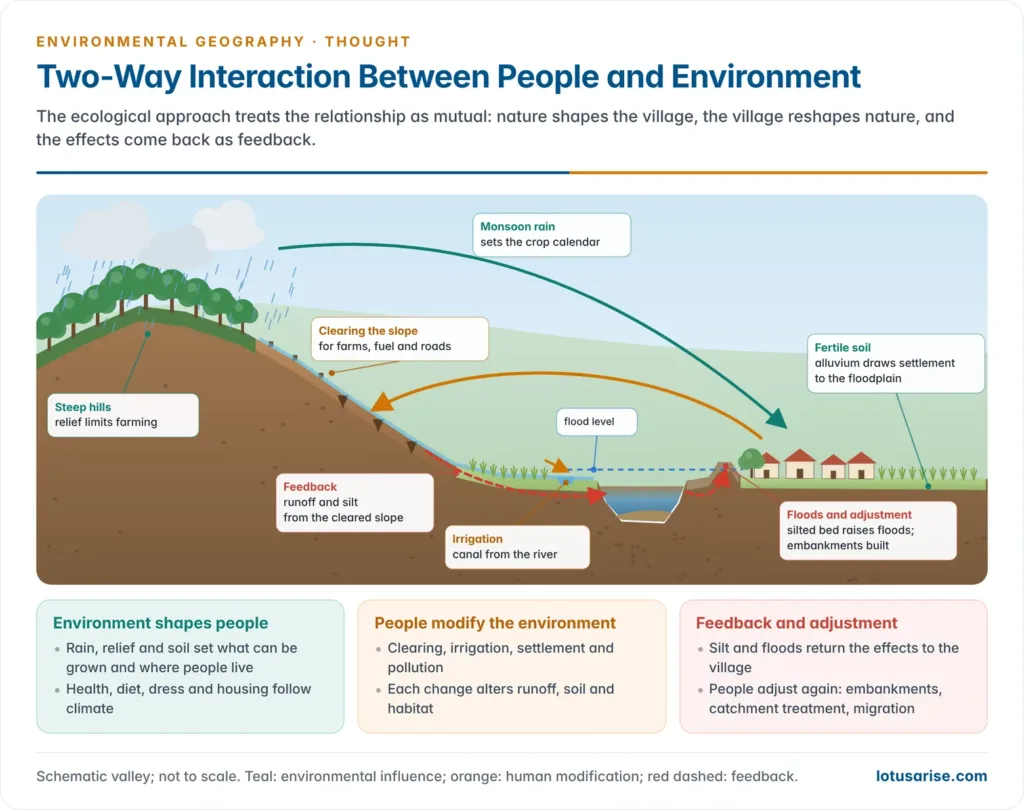
- The ecological view is two-directional and symbiotic:
- The environment affects people: health, settlement pattern, economic activity, diet and dress.
- People modify the environment: clearing, irrigation, urbanisation and pollution.
- The two directions form feedback loops. Clearing a catchment, for example, raises floods and siltation downstream, which in turn forces new adjustments such as embankments, migration or catchment treatment. This is the ecological basis of sustainability science.
- The same reasoning underlies the influence of man on ecology and the ecosystem approach to environmental management.
Human ecology through ecological concepts
- Human ecology studies the mutual relationship of people with both their natural and their social environment. The concepts of general ecology carry over to human groups, with culture added as the main means of adaptation.
| Ecological concept | Human-ecological meaning | Example |
|---|---|---|
| Adaptation | Biological and, above all, cultural fitting to conditions | Igloos, stilt houses, terraced fields |
| Adjustment | Deliberate choices that reduce stress or risk | Flood-proof plinths, crop insurance |
| Carrying capacity | Population a territory supports at a given technology | Shortened jhum cycles under population pressure |
| Niche | A group’s functional role and resource base | Pastoral, farming and trading castes in one village economy |
| Competition, invasion, succession | Groups replacing one another in space | Slum clearance and gentrification in city cores |
| Homeostasis and feedback | Self-regulation of a human–nature system | Ritual and customary limits on harvests |
| Energy flow | Food, fuel and fodder moving through society | Village biomass economy of crops, cattle and dung |
- Natural and social environments act together. A tribal community’s welfare depends as much on forest rights, markets and laws as on rainfall and soil. This is why human ecological adaptations are both biological and cultural.
Cultural ecology: Julian Steward
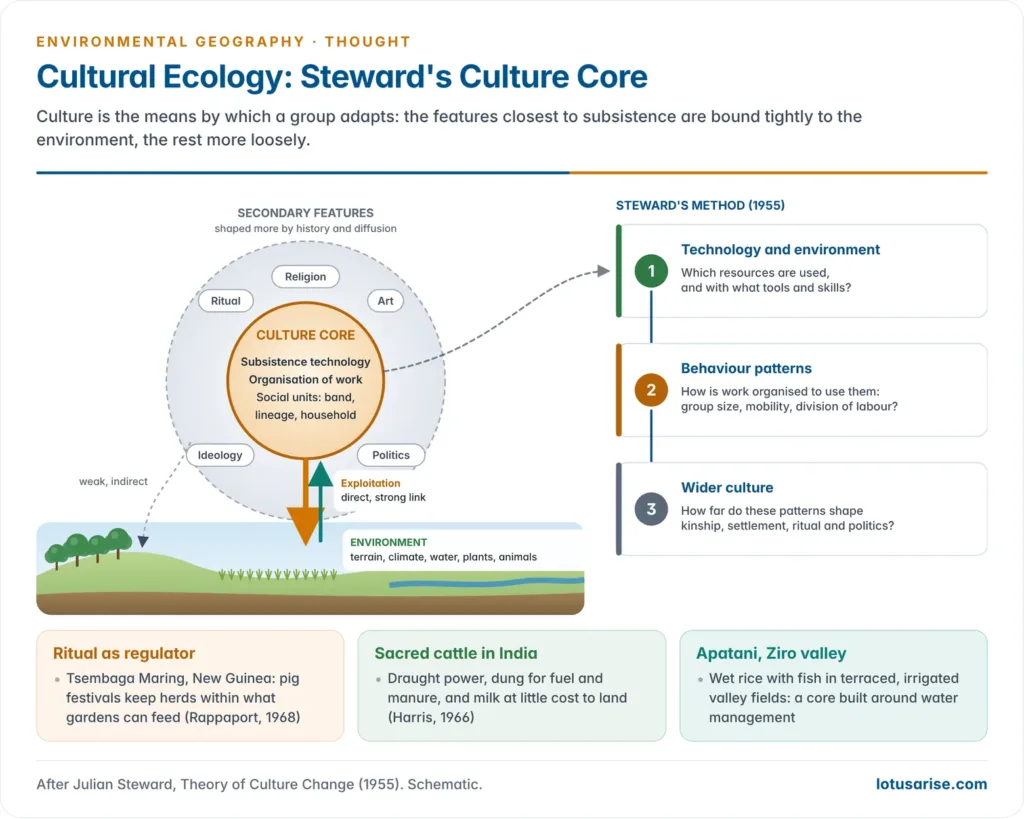
- Julian Steward (1902–1972), an American anthropologist, coined cultural ecology and set out its method in** Theory of Culture Change (1955).
- He rejected both determinism and the view that culture floats free of nature. Culture is the means by which human groups adapt to their environment.
- The culture core is the cluster of features most closely tied to subsistence: the technology of production, the organisation of work, and the social units that do it.
- Features further from subsistence, such as art, ritual and ideology, are secondary and shaped more by history and diffusion.
- Steward’s three-step method:
- Analyse the relation between the technology of production and the environment.
- Study the behaviour patterns involved in exploiting the area with that technology.
- Assess how far those patterns shape other aspects of culture.
- Multilinear evolution: similar environments and technologies tend to produce parallel social forms in different regions, without one universal path. Examples include the patrilineal bands of hunters and the irrigation states of arid river valleys.
- Later work in the same line:
- Roy Rappaport’s Pigs for the Ancestors (1968) showed how ritual pig festivals of the Tsembaga Maring of New Guinea regulated pig numbers and land use like a homeostatic device.
- Marvin Harris (1966) argued that India’s sacred cattle are ecologically rational: they supply draught power, dung for fuel and manure, and milk, at little cost to land.
- In geography, Karl Butzer and others used the approach for agrarian and prehistoric landscapes.
- Indian illustrations:
- Apatani wet-rice cultivation with fish in the Ziro valley of Arunachal Pradesh.
- The Bishnoi protection of khejri trees and blackbuck in the Thar.
- The pastoral round of the Todas in the Nilgiris.
- Critique:
- Its functionalism tends to assume that customs exist because they are adaptive.
- It focuses on small, closed communities, with little attention to markets, the state and power. Political ecology later took up exactly this gap.
The systems and ecosystem approach
- Arthur George Tansley (1935) coined the ecosystem: organisms and their physical environment form one interacting system of energy flows and nutrient cycles.
- Ludwig von Bertalanffy’s general systems theory (1950s; book 1968) offered a language of elements, links, inputs, outputs, open systems, equilibrium and feedback for any complex whole.
- Geographers took it up in the 1960s:
- Richard Chorley (1962) applied open-system thinking to landforms.
- David Stoddart (1965) argued that the ecosystem is the ideal geographic unit because it is monistic (it joins people, plants, animals and environment), structured, functioning through energy and matter flows, and a type of general system that can be modelled.
- These ideas fed into system analysis in human geography.
- The man–environment system:
- Society and nature are linked subsystems exchanging energy, materials and information.
- Negative feedback stabilises the system, for example fallow restoring soil fertility.
- Positive feedback amplifies change, for example deforestation, erosion and further clearing.
- Current forms of the approach:
- C. S. Holling’s resilience (1973): the capacity of a system to absorb shocks and still keep its function.
- Elinor Ostrom’s social-ecological systems framework (2009): shows how resource users, governance and resource systems interact.
- Coupled human and natural systems research since 2007.
- Strengths: it is holistic, quantifiable and suited to modelling, remote sensing and GIS, and it bridges physical and human geography.
- Weaknesses: human systems have purpose, values and conflict that ecological analogies miss. Equilibrium may be the exception rather than the rule. And treating society as a “component” hides inequality.
The behavioural and perception approach
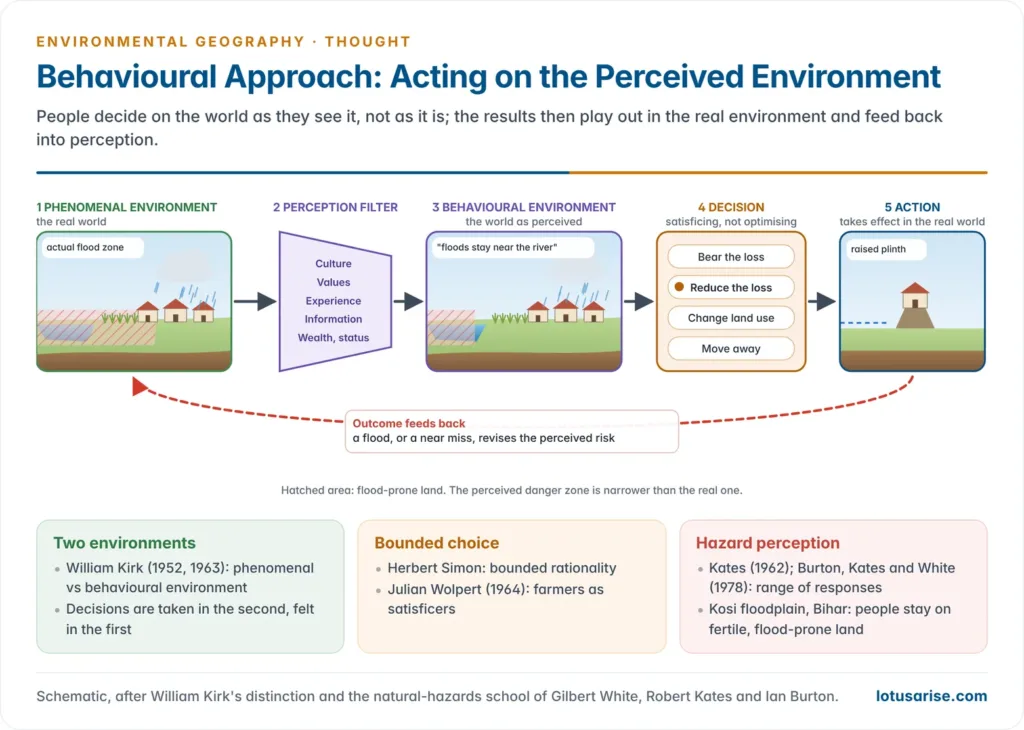
- From the 1950s geographers argued that people act not on the real environment but on the environment as they perceive it.
- William Kirk (1952, 1963) distinguished the phenomenal environment (the objective world of facts) from the behavioural environment (the world as perceived through culture, values and experience). Decisions are taken in the second but take effect in the first.
- David Lowenthal (1961) stressed geography as experience and imagination.
- Herbert Simon’s bounded rationality (1950s) entered geography through Julian Wolpert (1964), who found that Swedish farmers were satisficers, not profit-maximisers.
- Natural hazards research became the approach’s most practical field.
- Robert Kates (1962) showed how floodplain dwellers misjudge flood risk.
- Ian Burton, Robert Kates and Gilbert White, The Environment as Hazard (1978), compared the range of human responses: bearing or sharing the loss, reducing it by modifying the event or the vulnerability, and changing land use or moving away.
- Indian illustration: families on the Kosi floodplain of north Bihar stay on, or return to, flood-prone land after disasters such as the 2008 Kusaha embankment breach, weighing fertile silt and livelihoods against risk. Such perceptions decide how far hazard management succeeds on the ground.
- The approach underlies behavioural geography, mental maps and the PAVE framework of perception, attitude, value and emotion in environmental management.
- Critique: perceptions are hard to measure, and individual choice is often constrained by class, caste, gender and the state, which the approach tends to underplay.
Political ecology
- Political ecology explains environmental change through power, property and political economy, asking who gains and who loses from the use of nature.
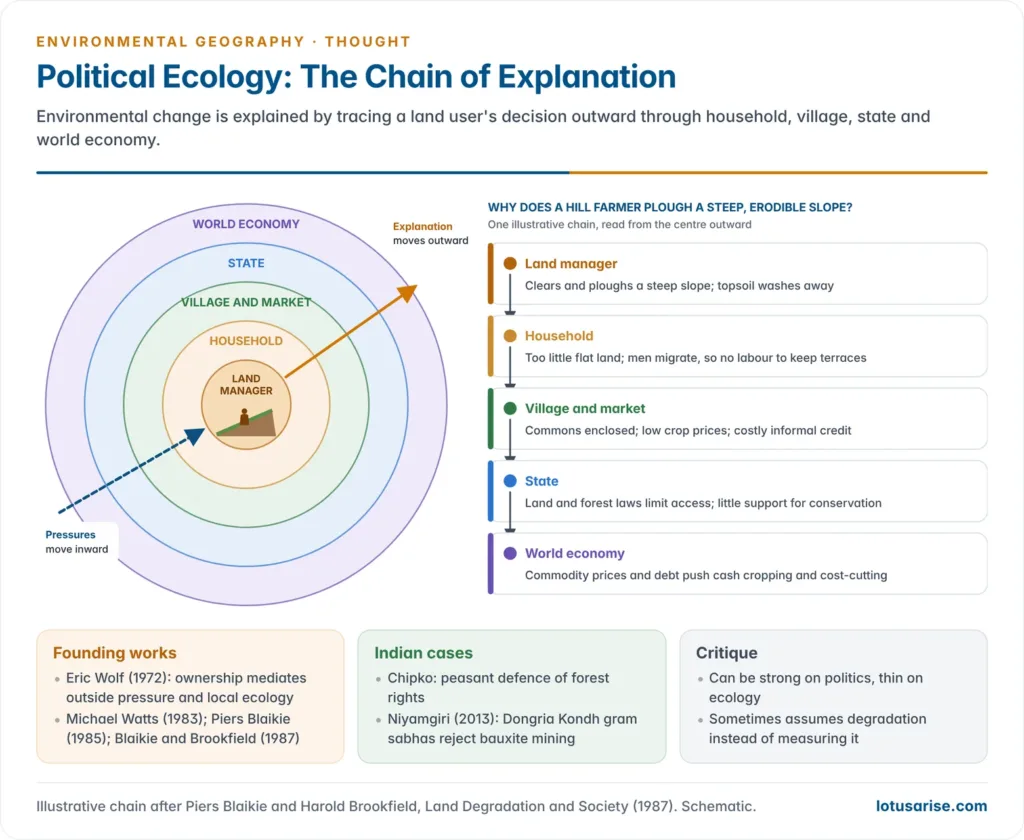
- The term appeared in the 1930s. Eric Wolf’s “Ownership and Political Ecology” (1972) revived it, showing how local rules of ownership and inheritance mediate between outside pressures and the local ecosystem.
- Founding works:
- Michael Watts’s Silent Violence (1983) traced famine in northern Nigeria to colonial and market change, not drought alone.
- Piers Blaikie’s The Political Economy of Soil Erosion in Developing Countries (1985) made a similar case for erosion.
- Piers Blaikie and Harold Brookfield’s Land Degradation and Society (1987) set out the chain of explanation. It begins with the land manager and moves outward through the household, the village and its markets, the state, and the world economy.
- Its main theses, as later political ecologists summarise them:
- Degradation and marginalisation: the poor degrade land because they are pushed onto marginal land.
- Conservation and control: parks and conservation can dispossess local users.
- Environmental conflict and exclusion: struggles over access shape who may use nature.
- Environmental identity: movements form around resources.
- Political objects and actors: even dams, rivers and species carry political meaning.
- Indian illustrations:
- The Chipko movement (from 1973) is read by Ramachandra Guha (1989) as a peasant defence of customary forest rights against commercial forestry.
- Madhav Gadgil and Ramachandra Guha’s This Fissured Land (1992) wrote India’s ecological history as a story of changing modes of resource use.
- The Niyamgiri case ended with the Dongria Kondh gram sabhas rejecting bauxite mining in 2013, after the Supreme Court gave them the decision.
- Joan Martinez-Alier called such struggles the “environmentalism of the poor”.
- Links with radical thought: political ecology draws on the Marxian view of the environment and the radical approach. It shares ground with the thesis that nature is socially produced.
- Critique: it can be stronger on politics than on ecology (“politics without ecology”), and it sometimes assumes rather than tests degradation.
Comparing the modern approaches
| Approach | Key figures | Driver of change | Unit of study | Weakness |
|---|---|---|---|---|
| Human ecology | Barrows (1923), White (1945) | Human adjustment | Region, floodplain | Little on power |
| Cultural ecology | Steward (1955), Rappaport (1968) | Subsistence technology | Small community | Functionalist, closed |
| Systems and ecosystem | Tansley, Chorley, Stoddart | Flows and feedback | Ecosystem, catchment | Mechanistic; hides conflict |
| Behavioural and perception | Kirk, Wolpert, Kates | Perception and decision | Decision-maker | Hard to measure; ignores structure |
| Political ecology | Wolf, Watts, Blaikie and Brookfield | Power and political economy | Land manager to world economy | Thin on ecology |
Other contemporary lenses
- Environmental ethics asks whether nature has value beyond human use; the contrast between deep and shallow ecology of Arne Næss (1973) is its best-known form.
- Population and limits: the Malthusian tradition and the *Limits to Growth* model (1972) placed resource limits at the centre of the relationship. It remains a reference point for later sustainability debates.
- The Anthropocene names an age in which humanity is a geological force. The International Union of Geological Sciences declined to adopt it as a formal epoch in March 2024, but it remains a widely used concept.
- Evolutionary stages of the relationship, from hunting-gathering to the information age, show the balance shifting from adaptation to domination, and with it a changing human sensibility towards nature.
Contemporary Synthesis: Sustainable Development
- The return of environmentalism. After the quantitative revolution sidelined the man–environment theme in the 1950s and 1960s, it returned to the centre of geography.
- Rachel Carson’s Silent Spring (1962), the Stockholm Conference (1972) and the oil shocks put environmental limits back on the agenda.
- Geography rebuilt environmentalism on ecology, systems and political economy instead of on determinism.
- The Brundtland Commission (1987) defined sustainable development as “development that meets the needs of the present without compromising the ability of future generations to meet their own needs”.
- It turns the ecological approach into a policy goal, balancing environment, economy and society.
- The Sustainable Development Goals (2015) carry it forward; biodiversity and sustainable development are now linked in global targets.
- India’s practice reflects the same synthesis:
- The National Action Plan on Climate Change (2008) and its missions.
- Mission LiFE (Lifestyle for Environment), launched in October 2022, which targets individual consumption choices.
- The updated NDC (2022) and the net zero by 2070 goal.
- India reached 50% non-fossil installed power capacity by mid-2025, five years ahead of its 2030 target.
- The present consensus:
- The relationship is mutual, scale-dependent and mediated by culture, technology, perception and power.
- No single approach is sufficient. Human ecology and systems analysis describe the interactions; behavioural study explains decisions; political ecology explains who decides.